The final color impression of a product is not only defined by the pigmentation of the substrate or paint, but
also by the surface properties. A high gloss sample with same pigmentation is visually judged darker by the eye
when compared to a matte or structured sample. To explain this phenomenon a closer look onto the
interaction between light and substrate is needed.
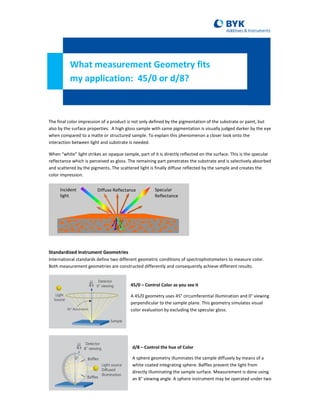
When “white” light strikes an opaque sample, part of it is directly reflected on the surface. This is the specular
reflectance which is perceived as gloss. The remaining part penetrates the substrate and is selectively absorbed
and scattered by the pigments. The scattered light is finally diffuse reflected by the sample and creates the
color impression.
Standardized Instrument Geometries
International standards define two different geometric conditions of spectrophotometers to measure color.
Both measurement geometries are constructed differently and consequently achieve different results.
45/0 – Control Color as you see it
A 45/0 geometry uses 45° circumferential illumination and 0° viewing
perpendicular to the sample plane. This geometry simulates visual
color evaluation by excluding the specular gloss.
d/8 – Control the hue of Color
A sphere geometry illuminates the sample diffusely by means of a
white coated integrating sphere. Baffles prevent the light from
directly illuminating the sample surface. Measurement is done using
an 8° viewing angle. A sphere instrument may be operated under two
Incident
light
Specular
Reflectance
Diffuse Reflectance
What measurement Geometry fits
my application: 45/0 or d/8?
different measurement conditions: specular included (spin) or specular excluded (spex).
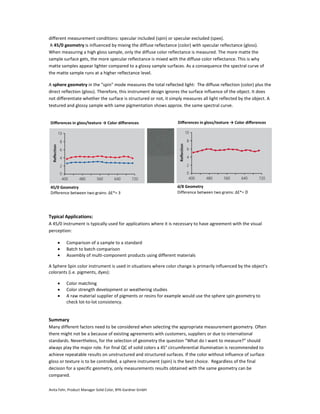
A 45/0 geometry is influenced by mixing the diffuse reflectance (color) with specular reflectance (gloss).
When measuring a high gloss sample, only the diffuse color reflectance is measured. The more matte the
sample surface gets, the more specular reflectance is mixed with the diffuse color reflectance. This is why
matte samples appear lighter compared to a glossy sample surfaces. As a consequence the spectral curve of
the matte sample runs at a higher reflectance level.
A sphere geometry in the "spin" mode measures the total reflected light: The diffuse reflection (color) plus the
direct reflection (gloss). Therefore, this instrument design ignores the surface influence of the object. It does
not differentiate whether the surface is structured or not, it simply measures all light reflected by the object. A
textured and glossy sample with same pigmentation shows approx. the same spectral curve.
Typical Applications:
A 45/0 instrument is typically used for applications where it is necessary to have agreement with the visual
perception:
• Comparison of a sample to a standard
• Batch to batch comparison
• Assembly of multi-component products using different materials
A Sphere Spin color instrument is used in situations where color change is primarily influenced by the object’s
colorants (i.e. pigments, dyes):
• Color matching
• Color strength development or weathering studies
• A raw material supplier of pigments or resins for example would use the sphere spin geometry to
check lot-to-lot consistency.
Summary
Many different factors need to be considered when selecting the appropriate measurement geometry. Often
there might not be a because of existing agreements with customers, suppliers or due to international
standards. Nevertheless, for the selection of geometry the question “What do I want to measure?” should
always play the major role. For final QC of solid colors a 45° circumferential illumination is recommended to
achieve repeatable results on unstructured and structured surfaces. If the color without influence of surface
gloss or texture is to be controlled, a sphere instrument (spin) is the best choice. Regardless of the final
decision for a specific geometry, only measurements results obtained with the same geometry can be
compared.
45/0 Geometry
Difference between two grains: ΔE*= 3
d/8 Geometry
Difference between two grains: ΔE*= 0
Differences in gloss/texture → Color differences Differences in gloss/texture → Color differences
Anita Fehr, Product Manager Solid Color, BYK-Gardner GmbH

What measurement geometry_fits_my_applications

  • 1.
    The final colorimpression of a product is not only defined by the pigmentation of the substrate or paint, but also by the surface properties. A high gloss sample with same pigmentation is visually judged darker by the eye when compared to a matte or structured sample. To explain this phenomenon a closer look onto the interaction between light and substrate is needed. When “white” light strikes an opaque sample, part of it is directly reflected on the surface. This is the specular reflectance which is perceived as gloss. The remaining part penetrates the substrate and is selectively absorbed and scattered by the pigments. The scattered light is finally diffuse reflected by the sample and creates the color impression. Standardized Instrument Geometries International standards define two different geometric conditions of spectrophotometers to measure color. Both measurement geometries are constructed differently and consequently achieve different results. 45/0 – Control Color as you see it A 45/0 geometry uses 45° circumferential illumination and 0° viewing perpendicular to the sample plane. This geometry simulates visual color evaluation by excluding the specular gloss. d/8 – Control the hue of Color A sphere geometry illuminates the sample diffusely by means of a white coated integrating sphere. Baffles prevent the light from directly illuminating the sample surface. Measurement is done using an 8° viewing angle. A sphere instrument may be operated under two Incident light Specular Reflectance Diffuse Reflectance What measurement Geometry fits my application: 45/0 or d/8?
  • 2.
    different measurement conditions:specular included (spin) or specular excluded (spex). A 45/0 geometry is influenced by mixing the diffuse reflectance (color) with specular reflectance (gloss). When measuring a high gloss sample, only the diffuse color reflectance is measured. The more matte the sample surface gets, the more specular reflectance is mixed with the diffuse color reflectance. This is why matte samples appear lighter compared to a glossy sample surfaces. As a consequence the spectral curve of the matte sample runs at a higher reflectance level. A sphere geometry in the "spin" mode measures the total reflected light: The diffuse reflection (color) plus the direct reflection (gloss). Therefore, this instrument design ignores the surface influence of the object. It does not differentiate whether the surface is structured or not, it simply measures all light reflected by the object. A textured and glossy sample with same pigmentation shows approx. the same spectral curve. Typical Applications: A 45/0 instrument is typically used for applications where it is necessary to have agreement with the visual perception: • Comparison of a sample to a standard • Batch to batch comparison • Assembly of multi-component products using different materials A Sphere Spin color instrument is used in situations where color change is primarily influenced by the object’s colorants (i.e. pigments, dyes): • Color matching • Color strength development or weathering studies • A raw material supplier of pigments or resins for example would use the sphere spin geometry to check lot-to-lot consistency. Summary Many different factors need to be considered when selecting the appropriate measurement geometry. Often there might not be a because of existing agreements with customers, suppliers or due to international standards. Nevertheless, for the selection of geometry the question “What do I want to measure?” should always play the major role. For final QC of solid colors a 45° circumferential illumination is recommended to achieve repeatable results on unstructured and structured surfaces. If the color without influence of surface gloss or texture is to be controlled, a sphere instrument (spin) is the best choice. Regardless of the final decision for a specific geometry, only measurements results obtained with the same geometry can be compared. 45/0 Geometry Difference between two grains: ΔE*= 3 d/8 Geometry Difference between two grains: ΔE*= 0 Differences in gloss/texture → Color differences Differences in gloss/texture → Color differences Anita Fehr, Product Manager Solid Color, BYK-Gardner GmbH