Discussion
What is the Ultimate Taste?
         Gloria Origgi
     CNRS – InstitutNicod
http://gloriaoriggi.blogspot.com
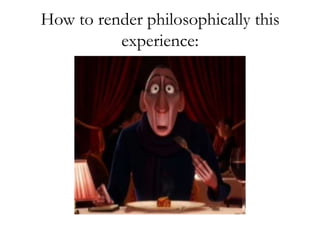
How to render philosophically this
          experience:
Taste as Authority vs. Taste as
            Commonsense


Taste seems to be a instable concept that lies in
a impossible realm between a Culture and
Nature.
Oxford English Dictionary
• OED:
  – Taste: Mental perception of
    quality, judgment, discriminative faculty.
  – Taste: The fact or condition of liking or preferring
    something; inclination, social disposition.
  – Taste: The sense of what is appropriate, harmonious
    or beautiful; discernment and appreciation of the
    beautiful in nature and art; the faculty of perceiving
    and enjoying what is excellent in art, literature and
    the like.
The concept of taste seems to
    encompass all these philosophical
             oppositions:

• Cultural Relativism vs. Universalism
• Cultural (learned) vs. Perceptual
• Normative (ex.OED “the appreciation of the
  beautiful”) vs. Descriptive
• Natural vs. Artificial
• Objective vs. Subjective
Cultural Relativism vs. Universalism


Taste is culturally determined and yet it is a
  universal experience of recognizing some
  features or qualities in things (ex. universality of
  some disgust experiences, preference for
  sugar, etc.)
Cultural (learned) vs. Perceptual

• We do not learn to experience colors, but we learn to taste wine
• Taste has been mainly studied in sociology as a capacity of
  discrimination that deeply depends on our social and cultural
  condition (Pierre Bourdieu: La Distinction). Bourdieu speaks of
  an effect of “naturalization of the social world” as it becomes
  deeply entrenched in our perceptual experience.
• Yet the perceptual dimension of taste is unavoidable: it is
  immediate, encapsulated, bottom-up, cannot be corrected “top-
  down” on the spot (although we can educate our taste in time)
Normative vs. Descriptive


• Taste has a normative dimension: there is an
  implicit scale on which we measure the
  “rightness” of our experience
• Yet, our experience has a content, it points to
  some real features of the world…
Natural vs. Artificial

• Our taste faculty challenges the opposition between
  natural taste and artificial taste.
• In food and wine, we taste the product of
  craftsmanship. Craftsmanship is based on a special
  relation between the natural world and the artificial
  world of production.
• We can reproduce artificially a “natural taste” and
  what is natural, that is, “picked up in the woods”
  can taste awfully artificial (have you ever tried wild
  strawberries?)
Taste as a form of “Perceptual
                Wisdom”
What is Wisdom?

  – It is based on the “Authority of the Past”
  – It is a culturally constructed capacity of judging
    “right”
  – It is based on what we consider
    “commonsensical”, “intuitively right”, reasonable.
What is Common sense?
• Common sense refers historically to an average
  experiential/practical knowledge dependant on a
  universal humankoiné
• It is an historically and socially constructed
  immediacy with an experience (cf. Clifford Geertz:
  “Commonsense as a Cultural System”)
• Commonsense beliefs cannot be used either to
  distinguish between what we know through our
  eyes and ears and what we know through culture.
  Both kinds of beliefs can be commonsensical.
The “right taste” experience possesses
the natural authority of craftsmanship


Craftsmanship: The intelligence that comes from
afar possessed an authority which gave it
validity, even when it was not subject to
verification.
                  (W. Benjamin, Illuminations)
Paul Valéry
The authority of craftsmanship is that of the perfect things in
  nature, flawless pearls, full-bodied, matured wines, truly developed
  creatures and calls them: the precious product of a long chain of
  causes similar to one another. The accumulation of such causes has
  its temporal limit only at perfection.
  “The patient process of Nature” was once imitated by men.
  Miniatures, ivory carvings, elaborated to the point of greatest
  perfection, stones that are perfect in polish and engraving, lacquer
  work of paintings in which a series of thin, transparent layers are
  placed on top of the other – all these products of
  sustained, sacrificing effort are vanishing, and the time is past in
  which time did not matter. Modern man no longer works at what
  cannot be abbreviated”
What is the “Ultimate Taste” or the
      “Right Taste” Experience”?
• It is experiencing the Authority of Nature, that is, the
  “patient accumulation of causes similar to one another”
• It is an experience that reconnects us with a way of telling a
  story about ourselves, about the way in which our
  commonsense, our capacity of immediate feeling has been
  constructed in our life, our childhood, through our authorities.
• It is an act of deference to a past word of authorities we
  accept because they constitute ourselves.
• Clifford Geerts says that common sense is “the world in its
  authority.” I would reformulate its motto in conclusion by
  saying that it is not only the world, rather, the words of our
  mothers and fathers, their ways of crafting our natural
  world, intheir eternal authority.
Blaise Pascal:


No one dies so poor that he does not
 leave something behind…

What is the ultimate taste

  • 1.
    Discussion What is theUltimate Taste? Gloria Origgi CNRS – InstitutNicod http://gloriaoriggi.blogspot.com
  • 2.
    How to renderphilosophically this experience:
  • 3.
    Taste as Authorityvs. Taste as Commonsense Taste seems to be a instable concept that lies in a impossible realm between a Culture and Nature.
  • 4.
    Oxford English Dictionary •OED: – Taste: Mental perception of quality, judgment, discriminative faculty. – Taste: The fact or condition of liking or preferring something; inclination, social disposition. – Taste: The sense of what is appropriate, harmonious or beautiful; discernment and appreciation of the beautiful in nature and art; the faculty of perceiving and enjoying what is excellent in art, literature and the like.
  • 5.
    The concept oftaste seems to encompass all these philosophical oppositions: • Cultural Relativism vs. Universalism • Cultural (learned) vs. Perceptual • Normative (ex.OED “the appreciation of the beautiful”) vs. Descriptive • Natural vs. Artificial • Objective vs. Subjective
  • 6.
    Cultural Relativism vs.Universalism Taste is culturally determined and yet it is a universal experience of recognizing some features or qualities in things (ex. universality of some disgust experiences, preference for sugar, etc.)
  • 7.
    Cultural (learned) vs.Perceptual • We do not learn to experience colors, but we learn to taste wine • Taste has been mainly studied in sociology as a capacity of discrimination that deeply depends on our social and cultural condition (Pierre Bourdieu: La Distinction). Bourdieu speaks of an effect of “naturalization of the social world” as it becomes deeply entrenched in our perceptual experience. • Yet the perceptual dimension of taste is unavoidable: it is immediate, encapsulated, bottom-up, cannot be corrected “top- down” on the spot (although we can educate our taste in time)
  • 8.
    Normative vs. Descriptive •Taste has a normative dimension: there is an implicit scale on which we measure the “rightness” of our experience • Yet, our experience has a content, it points to some real features of the world…
  • 9.
    Natural vs. Artificial •Our taste faculty challenges the opposition between natural taste and artificial taste. • In food and wine, we taste the product of craftsmanship. Craftsmanship is based on a special relation between the natural world and the artificial world of production. • We can reproduce artificially a “natural taste” and what is natural, that is, “picked up in the woods” can taste awfully artificial (have you ever tried wild strawberries?)
  • 10.
    Taste as aform of “Perceptual Wisdom” What is Wisdom? – It is based on the “Authority of the Past” – It is a culturally constructed capacity of judging “right” – It is based on what we consider “commonsensical”, “intuitively right”, reasonable.
  • 11.
    What is Commonsense? • Common sense refers historically to an average experiential/practical knowledge dependant on a universal humankoiné • It is an historically and socially constructed immediacy with an experience (cf. Clifford Geertz: “Commonsense as a Cultural System”) • Commonsense beliefs cannot be used either to distinguish between what we know through our eyes and ears and what we know through culture. Both kinds of beliefs can be commonsensical.
  • 12.
    The “right taste”experience possesses the natural authority of craftsmanship Craftsmanship: The intelligence that comes from afar possessed an authority which gave it validity, even when it was not subject to verification. (W. Benjamin, Illuminations)
  • 13.
    Paul Valéry The authorityof craftsmanship is that of the perfect things in nature, flawless pearls, full-bodied, matured wines, truly developed creatures and calls them: the precious product of a long chain of causes similar to one another. The accumulation of such causes has its temporal limit only at perfection. “The patient process of Nature” was once imitated by men. Miniatures, ivory carvings, elaborated to the point of greatest perfection, stones that are perfect in polish and engraving, lacquer work of paintings in which a series of thin, transparent layers are placed on top of the other – all these products of sustained, sacrificing effort are vanishing, and the time is past in which time did not matter. Modern man no longer works at what cannot be abbreviated”
  • 14.
    What is the“Ultimate Taste” or the “Right Taste” Experience”? • It is experiencing the Authority of Nature, that is, the “patient accumulation of causes similar to one another” • It is an experience that reconnects us with a way of telling a story about ourselves, about the way in which our commonsense, our capacity of immediate feeling has been constructed in our life, our childhood, through our authorities. • It is an act of deference to a past word of authorities we accept because they constitute ourselves. • Clifford Geerts says that common sense is “the world in its authority.” I would reformulate its motto in conclusion by saying that it is not only the world, rather, the words of our mothers and fathers, their ways of crafting our natural world, intheir eternal authority.
  • 15.
    Blaise Pascal: No onedies so poor that he does not leave something behind…

Editor's Notes

  • #3 Anton Ego
  • #6 Which makes the concept philosophically intriguing