HELLO I AM
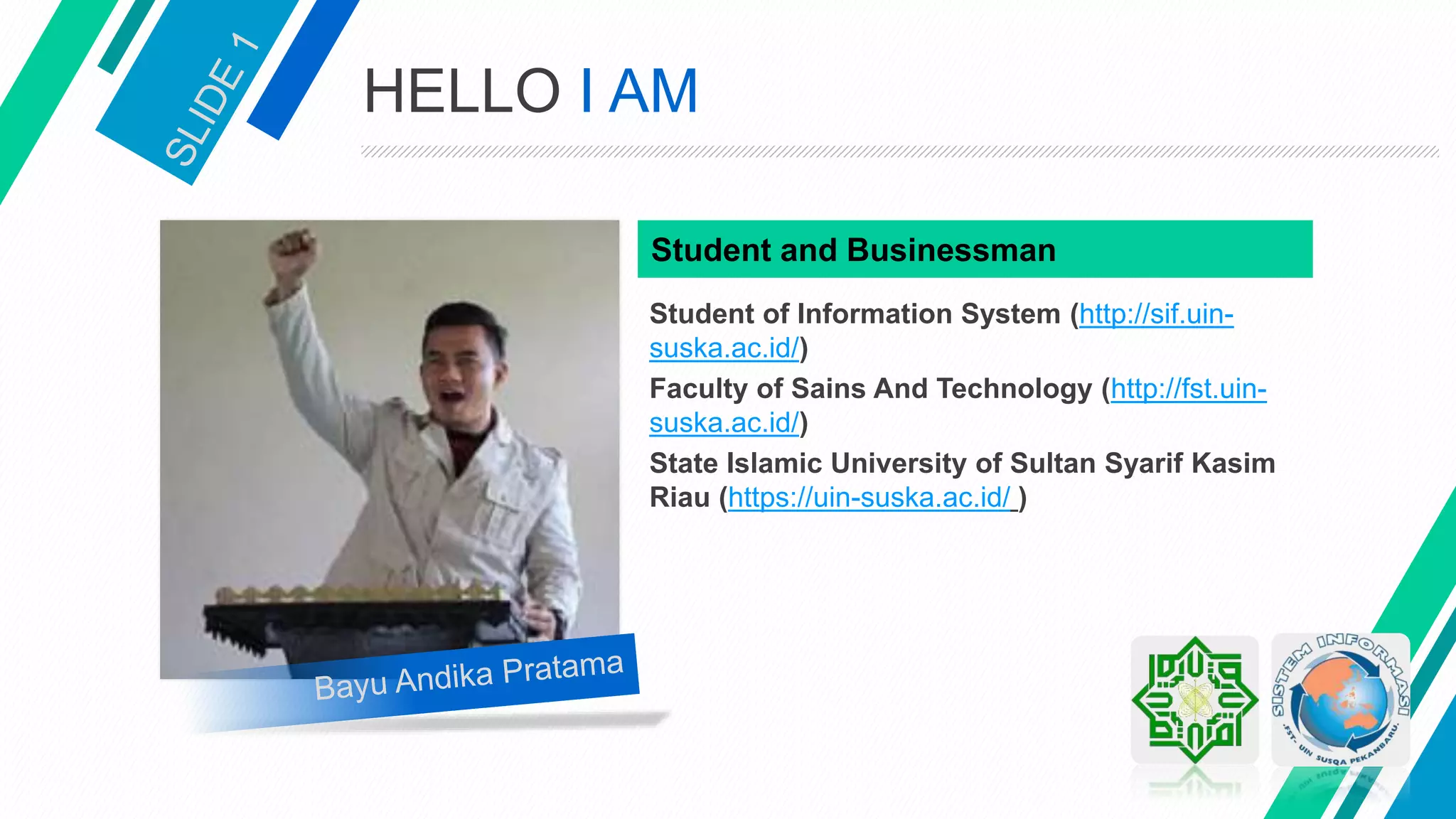
Student and Businessman
Student of Information System (http://sif.uin-
suska.ac.id/)
Faculty of Sains And Technology (http://fst.uin-
suska.ac.id/)
State Islamic University of Sultan Syarif Kasim
Riau (https://uin-suska.ac.id/ )
WHAT
IS
TESTING?
Testing Implementation System
WHAT IS TESTING?
In this section, we will review the common objectives of testing. We'll explain
how testing helps us to find defects, provide confidence and information, and
prevent defects. We will also introduce additional fundamental principles of
testing.
1. The driving
test - an
analogy for
software testing
We have spent some time describing why we need to test, but we have
not discussed what testing is. What do we mean by the word testing?
The format of the driving test and the conduct of the examiner are
worth considering:
1. The test is planned and prepared for.
2. The test has known goals - assessing whether the driver is
sufficiently safe to be allowed to drive by themselves without an
instructor, without endangering themselves or others.
3. The test is therefore carried out to show that the driver satisfies the
requirements for driving and to demonstrate that they are fit to
drive.
4. As well as observing the driver actually driving, the examiner will
ask questions or the driver will take a written exam to check their
understanding of the rules of the road, road signs, and what to do
in various traffic situations.
WHAT IS TESTING?
2. Defining
software
testing
Let's break the definition down into parts;
the definition has some key phrases to remember.
The definition starts with a description of testing as
a process and then lists some objectives of the test
process. First, let's look at testing as a process:
1. Process
2. All Life Cycle Activities
3. Both Static and Dynamic
4. Planning
5. Preparation
6. Evaluation
7. Software products and related work products
WHAT IS TESTING?
3. Software
test and
driving test
compared
We can see that the software test is very like a driving
test in many ways, although of course it is not a perfect
analogy! The driving examiner becomes the software
tester. The driver being examined becomes the system or
software under test, and you'll see as we go through this
book that the same approach broadly holds.
1. Planning and Preparation
2. Static and Dynamic
3. Evaluation
4. Determine that they satisfy specified requirements
5. Demonstrate that they are fit for purpse
6. Detect defects
WHAT IS TESTING?
4. When can
we meet our
test
objectives?
We can use both dynamic testing and static testing as a
means for achieving similar test objectives. Both
provide information to improve both the system to be
tested, and the development and testing processes. We
mentioned above that testing can have different goals and
objectives, which often include:
1. Finding defects
2. Gaining confidence in and providing information about the
level of quality
3. Preventing defects
WHAT IS TESTING?
5. Focusing on
defects can
help us plan
our tests
Reviewing defects and failures in order to
improve processes allows us to improve our testing and
our requirements, design and development processes.
One phenomenon that many testers have observed is
that defects tend to cluster. This can happen because an
area of the code is particularly complex and tricky, or
because changing software and other products tends to
cause knock-on defects. Testers will often use this
information when making their risk assessment for
planning the tests, and will focus on known 'hot spots'.
WHAT IS TESTING?
6. The defect
clusters
change over
time
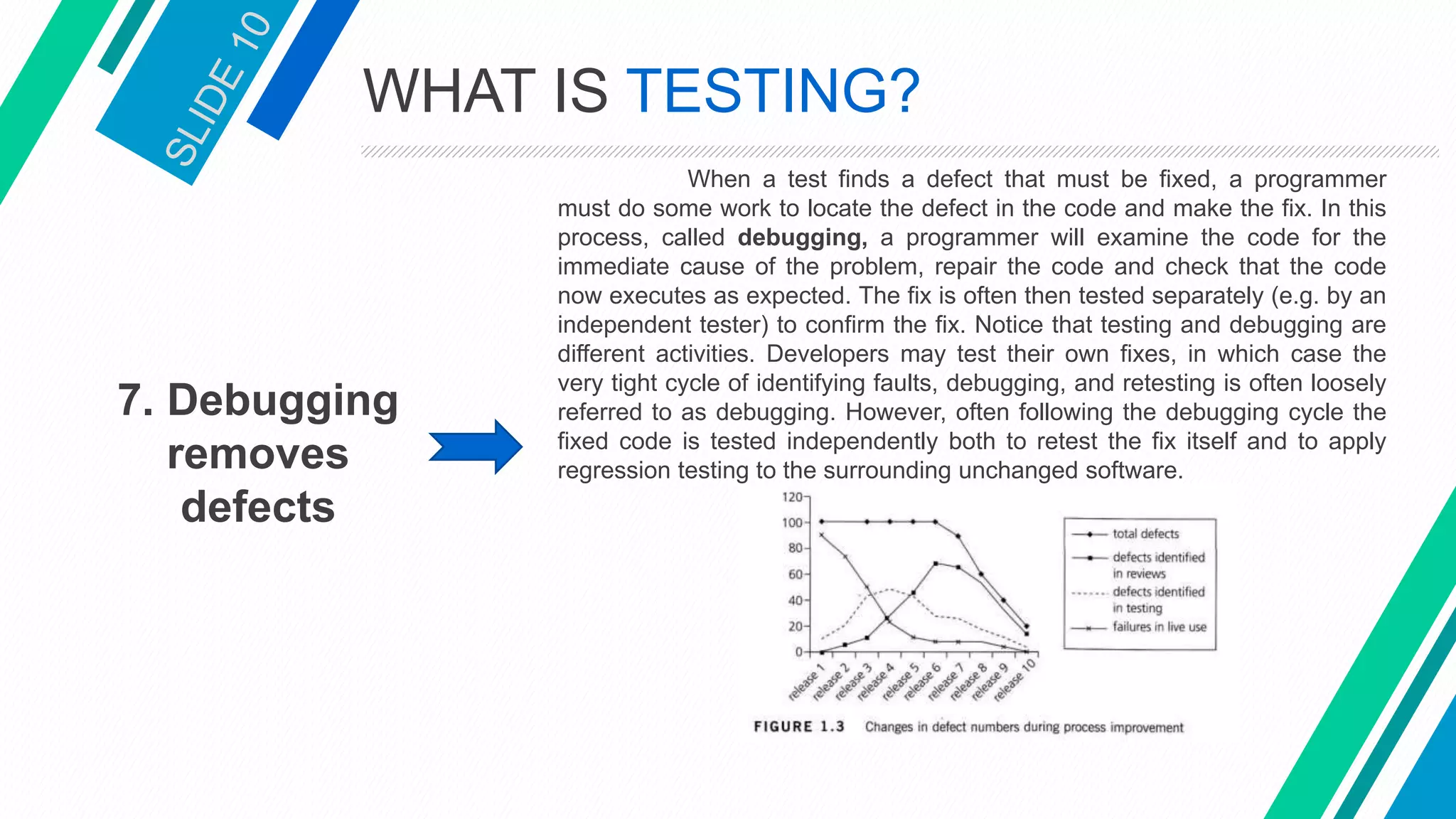
Over time, as we improve our whole software
development life cycle and the early static testing, we
may well find that dynamic test levels find fewer defects.
A typical test improvement initiative will initially find more
defects as the testing improves and then, as the defect
prevention kicks in, we see the defect numbers dropping,
as shown in Figure 1.3. The first part of the improvement
enables us to reduce failures in operation; later the
improvements are making us more efficient and Effective
in producing the software With fewer defects in it.
WHAT IS TESTING?
7. Debugging
removes
defects
When a test finds a defect that must be fixed, a programmer
must do some work to locate the defect in the code and make the fix. In this
process, called debugging, a programmer will examine the code for the
immediate cause of the problem, repair the code and check that the code
now executes as expected. The fix is often then tested separately (e.g. by an
independent tester) to confirm the fix. Notice that testing and debugging are
different activities. Developers may test their own fixes, in which case the
very tight cycle of identifying faults, debugging, and retesting is often loosely
referred to as debugging. However, often following the debugging cycle the
fixed code is tested independently both to retest the fix itself and to apply
regression testing to the surrounding unchanged software.
WHAT IS TESTING?
8. Is the
software
defect free?
This principle arises from the theory of the
process of scientific experimentation And has been
Adopted By testers; you’ll see the idea in many Testing
books. While You Are Not Expected to read The Scientific
Theory [Popper] The Analogy Used in science is useful;
however many White swans we see, we cannot say ‘All
Swans are white'. However, As soon as we see one black
swan we can say ‘Not All swans are white’. In the same
way, However Many tests we execute without Finding a
bug, we have not shown 'There Are no bugs’. As soon as
we find a bug, We Have Shown 'This Code is not bug-
free'.
WHAT IS TESTING?
9. If we don’t
find defects
does that
mean the
users will
accept the
software?
There is another important principle we must
consider; the customers for software - the people and
organizations who buy and use it to aid in their day-today
tasks - are not interested in defects or numbers of
defects, except when they are directly affected by the
instability of the software. The people using software are
more interested in the software supporting them in
completing tasks efficiently and effectively. The software
must meet their needs. It is for this reason that the
requirements and design defects we discussed earlier are
so important, and why reviews and inspections (see
chapter 3) are such a fundamental part of the entire test
activity.
WHAT IS TESTING?
Thank you! 
Reference: Graham et al Foundationf of Software Testing

What is testing

  • 1.
    HELLO I AM Studentand Businessman Student of Information System (http://sif.uin- suska.ac.id/) Faculty of Sains And Technology (http://fst.uin- suska.ac.id/) State Islamic University of Sultan Syarif Kasim Riau (https://uin-suska.ac.id/ )
  • 2.
  • 3.
    WHAT IS TESTING? Inthis section, we will review the common objectives of testing. We'll explain how testing helps us to find defects, provide confidence and information, and prevent defects. We will also introduce additional fundamental principles of testing.
  • 4.
    1. The driving test- an analogy for software testing We have spent some time describing why we need to test, but we have not discussed what testing is. What do we mean by the word testing? The format of the driving test and the conduct of the examiner are worth considering: 1. The test is planned and prepared for. 2. The test has known goals - assessing whether the driver is sufficiently safe to be allowed to drive by themselves without an instructor, without endangering themselves or others. 3. The test is therefore carried out to show that the driver satisfies the requirements for driving and to demonstrate that they are fit to drive. 4. As well as observing the driver actually driving, the examiner will ask questions or the driver will take a written exam to check their understanding of the rules of the road, road signs, and what to do in various traffic situations. WHAT IS TESTING?
  • 5.
    2. Defining software testing Let's breakthe definition down into parts; the definition has some key phrases to remember. The definition starts with a description of testing as a process and then lists some objectives of the test process. First, let's look at testing as a process: 1. Process 2. All Life Cycle Activities 3. Both Static and Dynamic 4. Planning 5. Preparation 6. Evaluation 7. Software products and related work products WHAT IS TESTING?
  • 6.
    3. Software test and drivingtest compared We can see that the software test is very like a driving test in many ways, although of course it is not a perfect analogy! The driving examiner becomes the software tester. The driver being examined becomes the system or software under test, and you'll see as we go through this book that the same approach broadly holds. 1. Planning and Preparation 2. Static and Dynamic 3. Evaluation 4. Determine that they satisfy specified requirements 5. Demonstrate that they are fit for purpse 6. Detect defects WHAT IS TESTING?
  • 7.
    4. When can wemeet our test objectives? We can use both dynamic testing and static testing as a means for achieving similar test objectives. Both provide information to improve both the system to be tested, and the development and testing processes. We mentioned above that testing can have different goals and objectives, which often include: 1. Finding defects 2. Gaining confidence in and providing information about the level of quality 3. Preventing defects WHAT IS TESTING?
  • 8.
    5. Focusing on defectscan help us plan our tests Reviewing defects and failures in order to improve processes allows us to improve our testing and our requirements, design and development processes. One phenomenon that many testers have observed is that defects tend to cluster. This can happen because an area of the code is particularly complex and tricky, or because changing software and other products tends to cause knock-on defects. Testers will often use this information when making their risk assessment for planning the tests, and will focus on known 'hot spots'. WHAT IS TESTING?
  • 9.
    6. The defect clusters changeover time Over time, as we improve our whole software development life cycle and the early static testing, we may well find that dynamic test levels find fewer defects. A typical test improvement initiative will initially find more defects as the testing improves and then, as the defect prevention kicks in, we see the defect numbers dropping, as shown in Figure 1.3. The first part of the improvement enables us to reduce failures in operation; later the improvements are making us more efficient and Effective in producing the software With fewer defects in it. WHAT IS TESTING?
  • 10.
    7. Debugging removes defects When atest finds a defect that must be fixed, a programmer must do some work to locate the defect in the code and make the fix. In this process, called debugging, a programmer will examine the code for the immediate cause of the problem, repair the code and check that the code now executes as expected. The fix is often then tested separately (e.g. by an independent tester) to confirm the fix. Notice that testing and debugging are different activities. Developers may test their own fixes, in which case the very tight cycle of identifying faults, debugging, and retesting is often loosely referred to as debugging. However, often following the debugging cycle the fixed code is tested independently both to retest the fix itself and to apply regression testing to the surrounding unchanged software. WHAT IS TESTING?
  • 11.
    8. Is the software defectfree? This principle arises from the theory of the process of scientific experimentation And has been Adopted By testers; you’ll see the idea in many Testing books. While You Are Not Expected to read The Scientific Theory [Popper] The Analogy Used in science is useful; however many White swans we see, we cannot say ‘All Swans are white'. However, As soon as we see one black swan we can say ‘Not All swans are white’. In the same way, However Many tests we execute without Finding a bug, we have not shown 'There Are no bugs’. As soon as we find a bug, We Have Shown 'This Code is not bug- free'. WHAT IS TESTING?
  • 12.
    9. If wedon’t find defects does that mean the users will accept the software? There is another important principle we must consider; the customers for software - the people and organizations who buy and use it to aid in their day-today tasks - are not interested in defects or numbers of defects, except when they are directly affected by the instability of the software. The people using software are more interested in the software supporting them in completing tasks efficiently and effectively. The software must meet their needs. It is for this reason that the requirements and design defects we discussed earlier are so important, and why reviews and inspections (see chapter 3) are such a fundamental part of the entire test activity. WHAT IS TESTING?
  • 13.
    Thank you!  Reference:Graham et al Foundationf of Software Testing