Chapter 1
FUNDAMENTAL OF TESTING
Reference By Graham et al (2006)
PROGRAM STUDI S1 SISTEM INFORMASI
FAKULTAS SAINS DAN TEKNOLOGI
UNIVERSITAS ISLAM NEGERI SULTAN SYARIF KASIM
RIAU
EVA NORMALA
What is testing ?
For the moment, let's adopt a simple everyday-life usage: 'when we are
testing something we are checking whether it is OK'. We'll need to refine that
when we define software testing later on. Let's start by considering why testing is
needed. Testing is necessary because we all make mis-takes. Some of those
mistakes are unimportant, but some of them are expensive or dangerous. We
need to check everything and anything we produce because things can always go
wrong - humans make mistakes all the time - it is what we do best!
Sumber : Graham et al (2006)
What is testing necessary ?
1. Describe, with examples, the way in which a defect in software can cause
harm to a person, to the environment or to a company. (K2)
2. Distinguish between the root cause of a defect and its effects. (K2)
3. Give reasons why testing is necessary by giving examples. (K2)
4. Describe why testing is part of quality assurance and give examples of how
testing contributes to higher quality. (K2)
5. Recall the terms 'mistake', 'defect', 'fault', 'failure' and the correspon ding
terms 'error' and 'bug'. (Kl)
6. Explain the fundamental principles in testing. (K2)
Sumber : Graham et al (2006)
Software System Context
These days, almost everyone is aware of software systems. We encounter them in
our homes, at work, while shopping, and because of mass-communication systems.
More and more, they are part of our lives. We use software in day-today business
applications such as banking and in consumer products such as cars and washing
machines. However, most people have had an experience with software that did not
work as expected: an error on a bill, a delay when waiting for a credit card to process
and a website that did not load correctly are common examples of problems that may
happen because of software problems. Not all software systems carry the same level
of risk and not all problems have the same impact when they occur.
Sumber : Graham et al (2006)
Cause of Software Defect
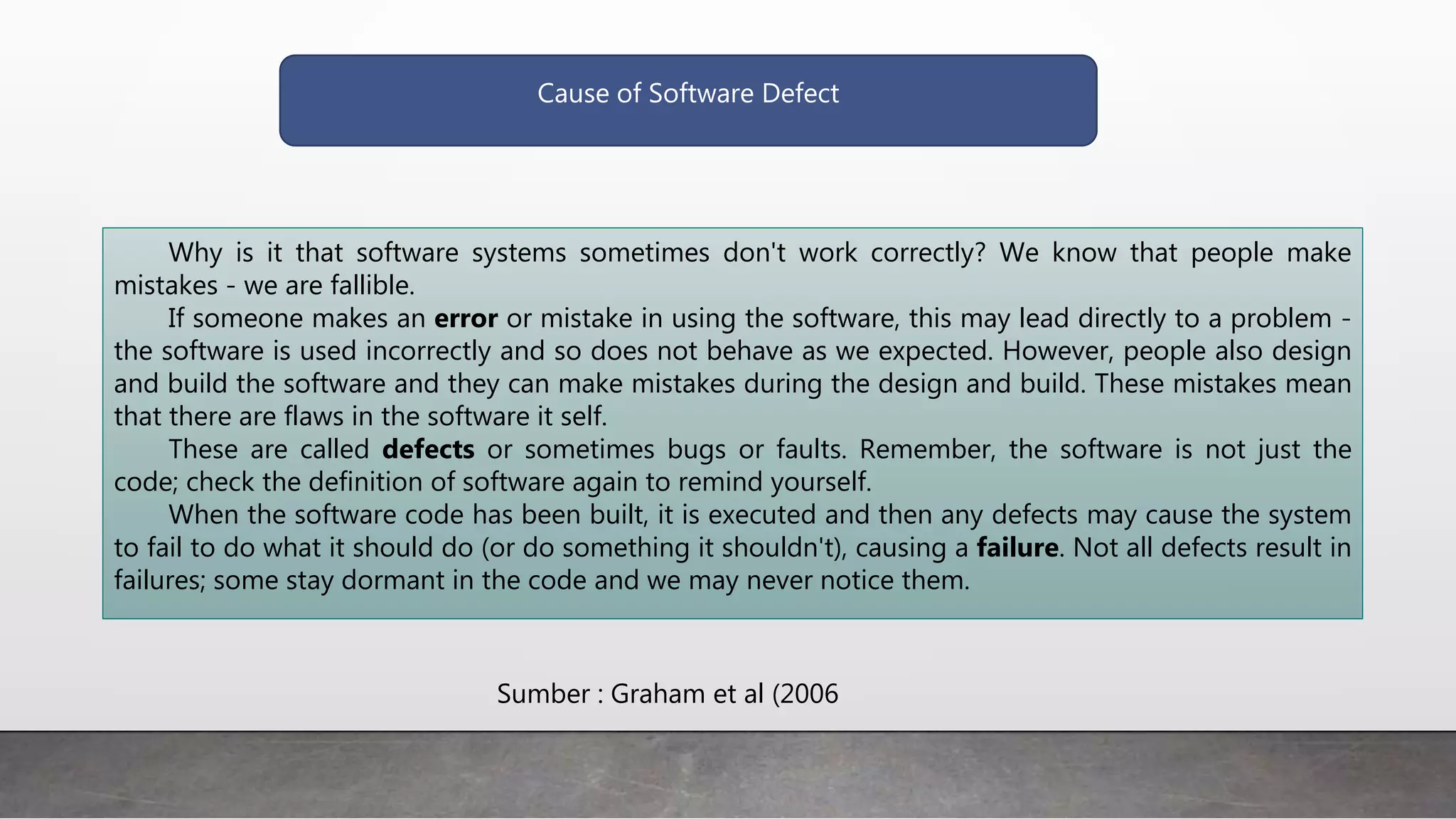
Why is it that software systems sometimes don't work correctly? We know that people make
mistakes - we are fallible.
If someone makes an error or mistake in using the software, this may lead directly to a problem -
the software is used incorrectly and so does not behave as we expected. However, people also design
and build the software and they can make mistakes during the design and build. These mistakes mean
that there are flaws in the software it self.
These are called defects or sometimes bugs or faults. Remember, the software is not just the
code; check the definition of software again to remind yourself.
When the software code has been built, it is executed and then any defects may cause the system
to fail to do what it should do (or do something it shouldn't), causing a failure. Not all defects result in
failures; some stay dormant in the code and we may never notice them.
Sumber : Graham et al (2006
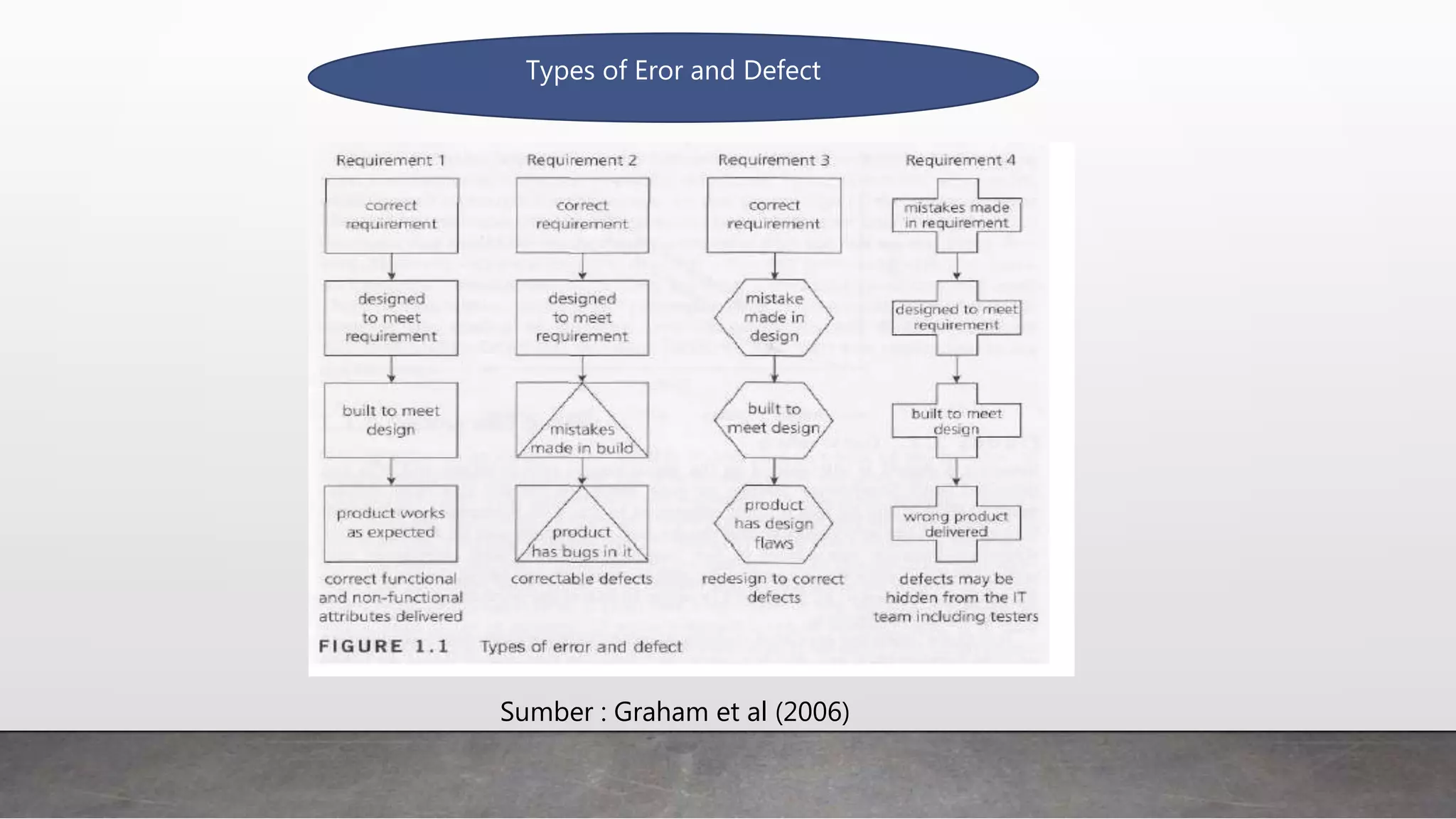
Types of Eror and Defect
Sumber : Graham et al (2006)
Role of testing in software development, maintenance and operations
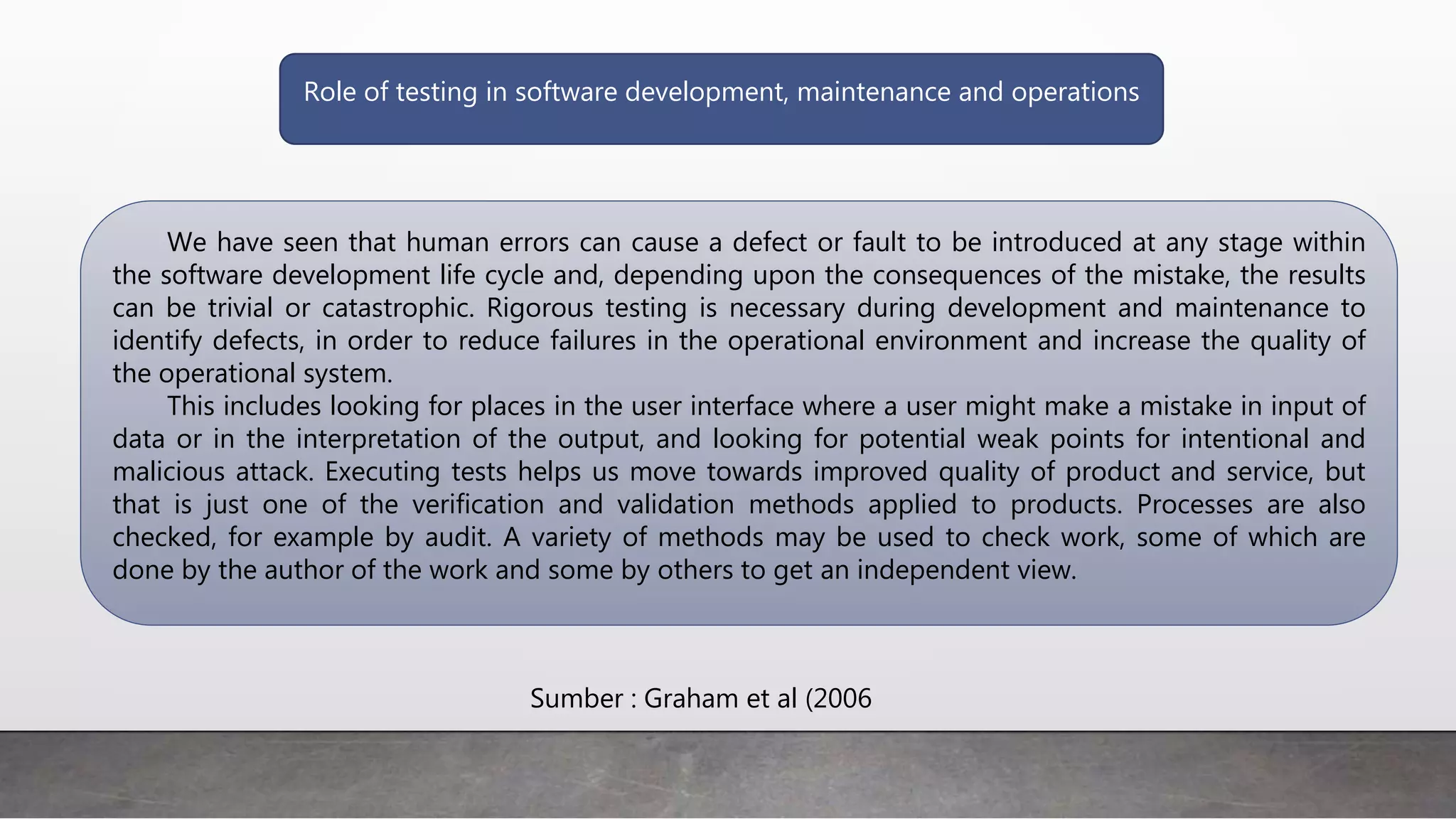
We have seen that human errors can cause a defect or fault to be introduced at any stage within
the software development life cycle and, depending upon the consequences of the mistake, the results
can be trivial or catastrophic. Rigorous testing is necessary during development and maintenance to
identify defects, in order to reduce failures in the operational environment and increase the quality of
the operational system.
This includes looking for places in the user interface where a user might make a mistake in input of
data or in the interpretation of the output, and looking for potential weak points for intentional and
malicious attack. Executing tests helps us move towards improved quality of product and service, but
that is just one of the verification and validation methods applied to products. Processes are also
checked, for example by audit. A variety of methods may be used to check work, some of which are
done by the author of the work and some by others to get an independent view.
Sumber : Graham et al (2006
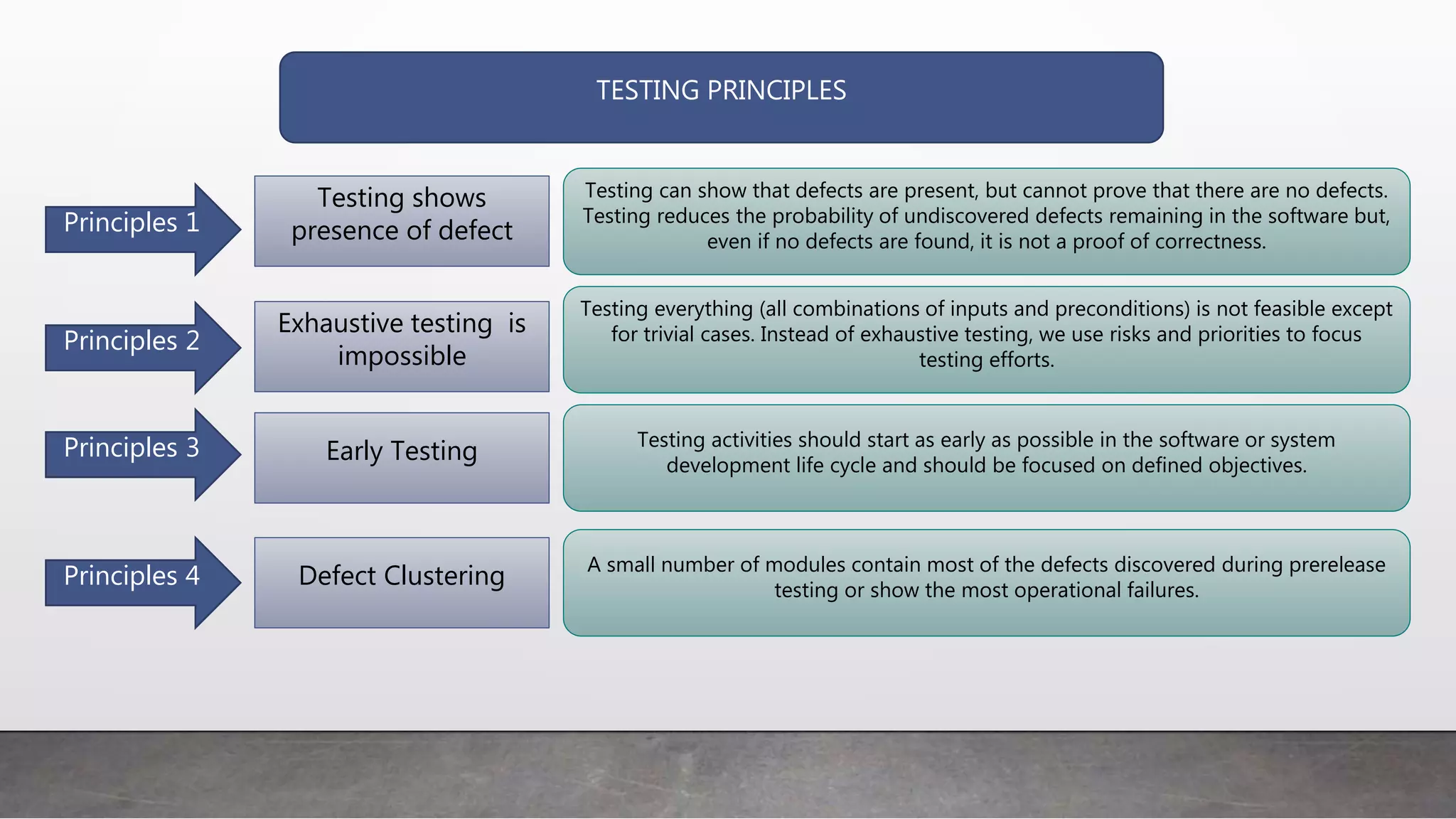
TESTING PRINCIPLES
Principles 1
Principles 2
Principles 3
Principles 4
Testing shows
presence of defect
Exhaustive testing is
impossible
Early Testing
Defect Clustering
Testing can show that defects are present, but cannot prove that there are no defects.
Testing reduces the probability of undiscovered defects remaining in the software but,
even if no defects are found, it is not a proof of correctness.
Testing everything (all combinations of inputs and preconditions) is not feasible except
for trivial cases. Instead of exhaustive testing, we use risks and priorities to focus
testing efforts.
Testing activities should start as early as possible in the software or system
development life cycle and should be focused on defined objectives.
A small number of modules contain most of the defects discovered during prerelease
testing or show the most operational failures.
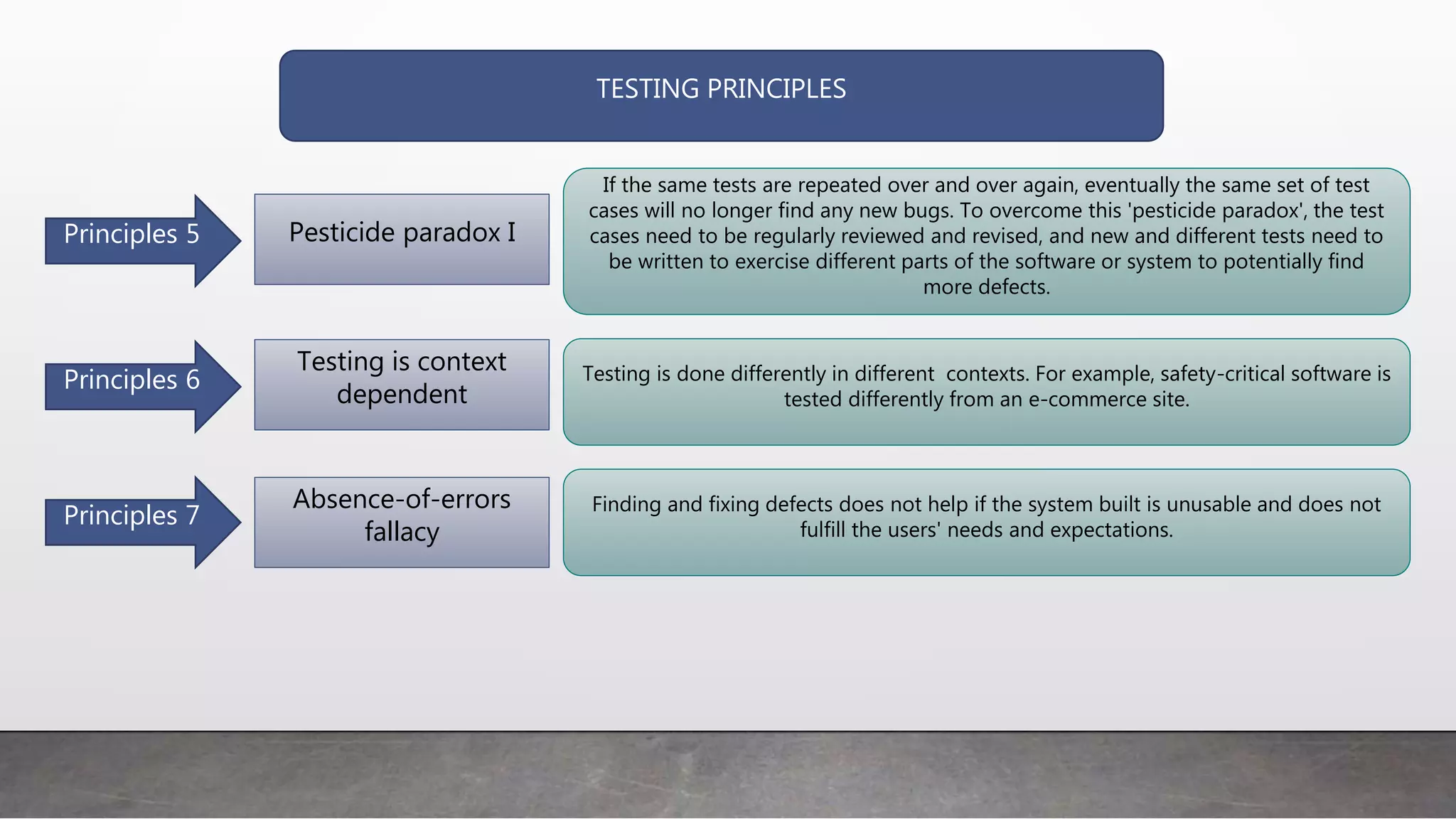
TESTING PRINCIPLES
Principles 5
Principles 6
Principles 7
Pesticide paradox I
Testing is context
dependent
Absence-of-errors
fallacy
If the same tests are repeated over and over again, eventually the same set of test
cases will no longer find any new bugs. To overcome this 'pesticide paradox', the test
cases need to be regularly reviewed and revised, and new and different tests need to
be written to exercise different parts of the software or system to potentially find
more defects.
Testing is done differently in different contexts. For example, safety-critical software is
tested differently from an e-commerce site.
Finding and fixing defects does not help if the system built is unusable and does not
fulfill the users' needs and expectations.
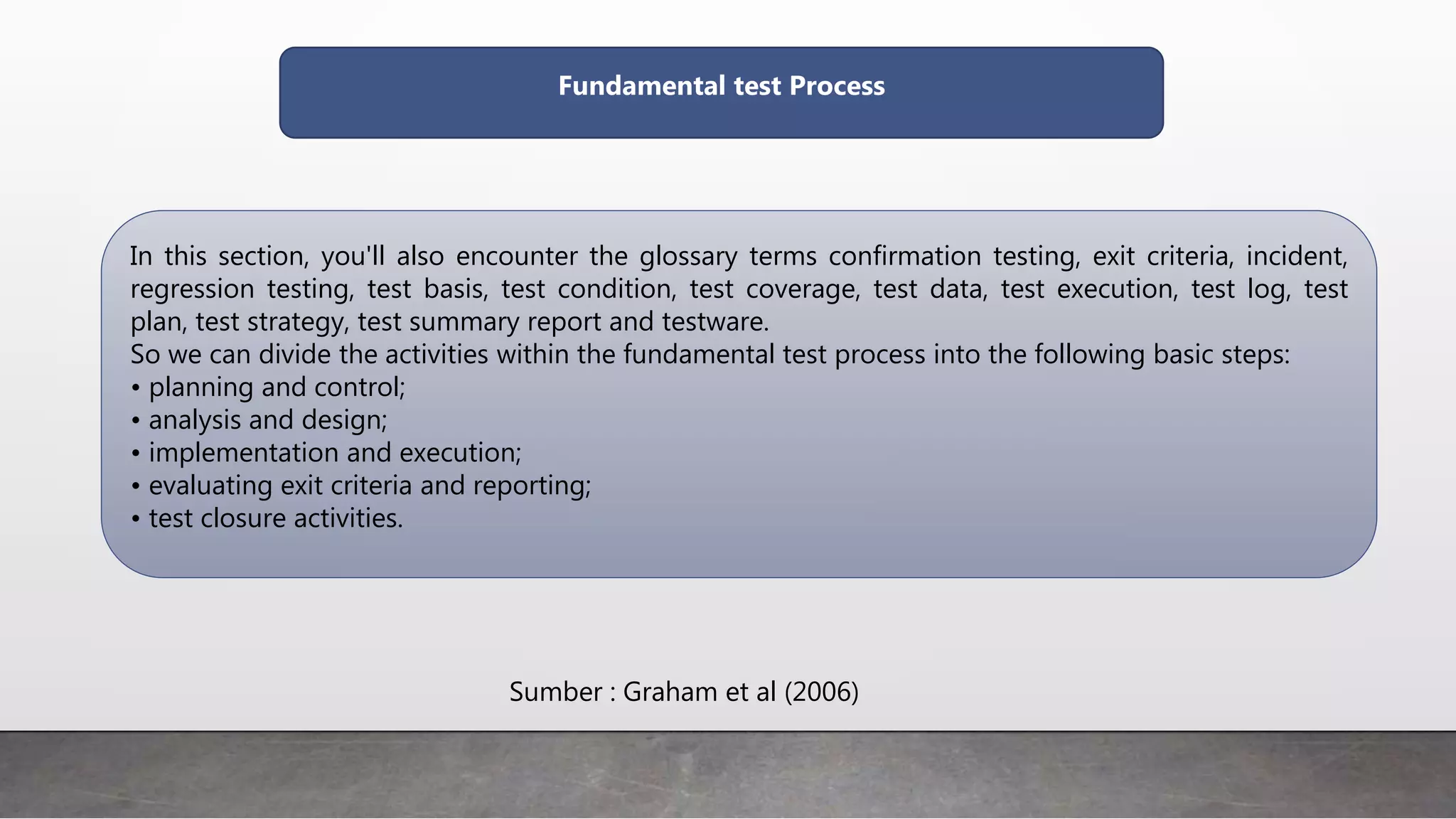
Fundamental test Process
In this section, you'll also encounter the glossary terms confirmation testing, exit criteria, incident,
regression testing, test basis, test condition, test coverage, test data, test execution, test log, test
plan, test strategy, test summary report and testware.
So we can divide the activities within the fundamental test process into the following basic steps:
• planning and control;
• analysis and design;
• implementation and execution;
• evaluating exit criteria and reporting;
• test closure activities.
Sumber : Graham et al (2006)
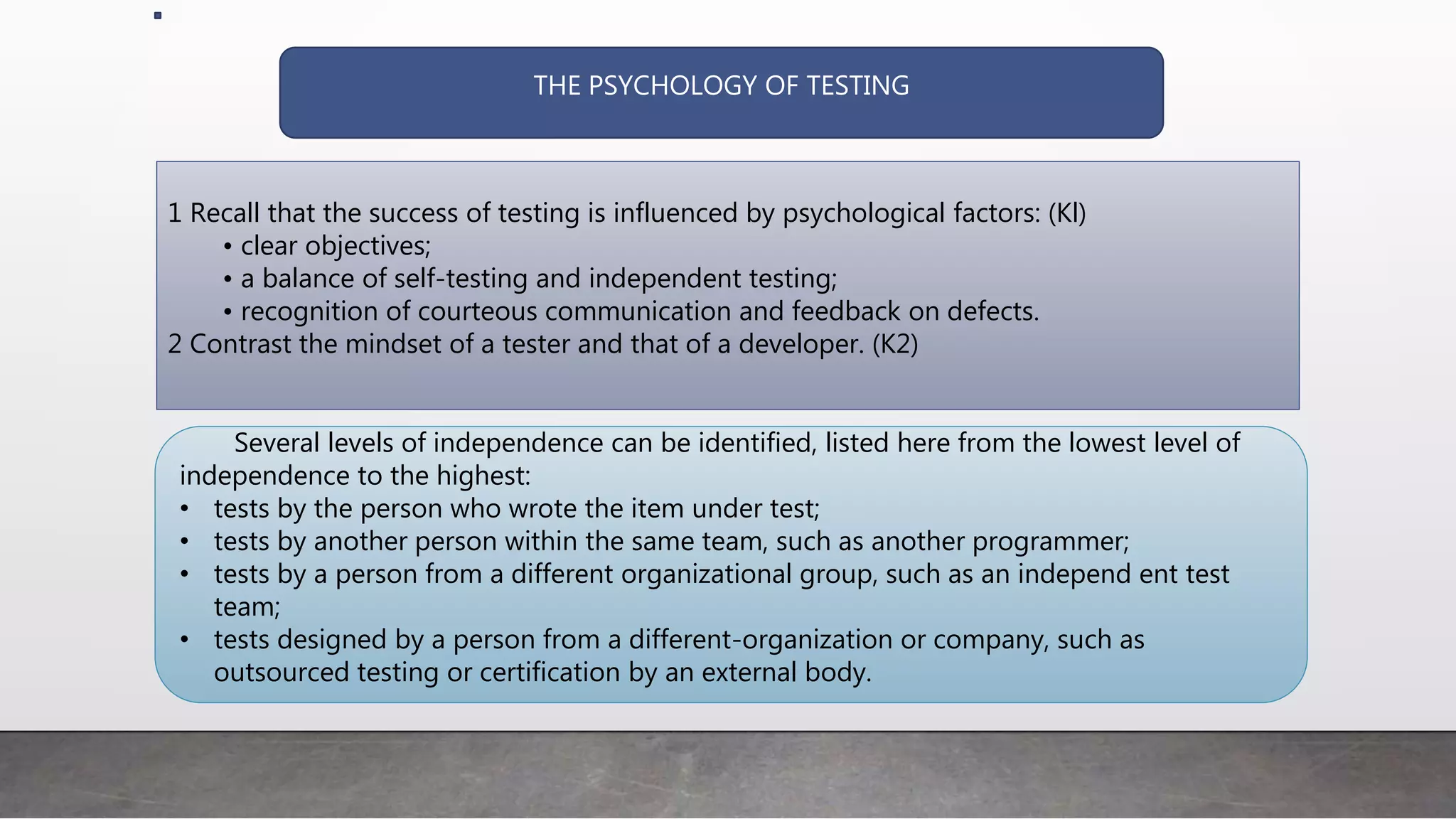
THE PSYCHOLOGY OF TESTING
1 Recall that the success of testing is influenced by psychological factors: (Kl)
• clear objectives;
• a balance of self-testing and independent testing;
• recognition of courteous communication and feedback on defects.
2 Contrast the mindset of a tester and that of a developer. (K2)
Several levels of independence can be identified, listed here from the lowest level of
independence to the highest:
• tests by the person who wrote the item under test;
• tests by another person within the same team, such as another programmer;
• tests by a person from a different organizational group, such as an independ ent test
team;
• tests designed by a person from a different-organization or company, such as
outsourced testing or certification by an external body.

Chapter 1 Fundamental of testing (By Eva Normala)

  • 1.
    Chapter 1 FUNDAMENTAL OFTESTING Reference By Graham et al (2006) PROGRAM STUDI S1 SISTEM INFORMASI FAKULTAS SAINS DAN TEKNOLOGI UNIVERSITAS ISLAM NEGERI SULTAN SYARIF KASIM RIAU EVA NORMALA
  • 2.
    What is testing? For the moment, let's adopt a simple everyday-life usage: 'when we are testing something we are checking whether it is OK'. We'll need to refine that when we define software testing later on. Let's start by considering why testing is needed. Testing is necessary because we all make mis-takes. Some of those mistakes are unimportant, but some of them are expensive or dangerous. We need to check everything and anything we produce because things can always go wrong - humans make mistakes all the time - it is what we do best! Sumber : Graham et al (2006)
  • 3.
    What is testingnecessary ? 1. Describe, with examples, the way in which a defect in software can cause harm to a person, to the environment or to a company. (K2) 2. Distinguish between the root cause of a defect and its effects. (K2) 3. Give reasons why testing is necessary by giving examples. (K2) 4. Describe why testing is part of quality assurance and give examples of how testing contributes to higher quality. (K2) 5. Recall the terms 'mistake', 'defect', 'fault', 'failure' and the correspon ding terms 'error' and 'bug'. (Kl) 6. Explain the fundamental principles in testing. (K2) Sumber : Graham et al (2006)
  • 4.
    Software System Context Thesedays, almost everyone is aware of software systems. We encounter them in our homes, at work, while shopping, and because of mass-communication systems. More and more, they are part of our lives. We use software in day-today business applications such as banking and in consumer products such as cars and washing machines. However, most people have had an experience with software that did not work as expected: an error on a bill, a delay when waiting for a credit card to process and a website that did not load correctly are common examples of problems that may happen because of software problems. Not all software systems carry the same level of risk and not all problems have the same impact when they occur. Sumber : Graham et al (2006)
  • 5.
    Cause of SoftwareDefect Why is it that software systems sometimes don't work correctly? We know that people make mistakes - we are fallible. If someone makes an error or mistake in using the software, this may lead directly to a problem - the software is used incorrectly and so does not behave as we expected. However, people also design and build the software and they can make mistakes during the design and build. These mistakes mean that there are flaws in the software it self. These are called defects or sometimes bugs or faults. Remember, the software is not just the code; check the definition of software again to remind yourself. When the software code has been built, it is executed and then any defects may cause the system to fail to do what it should do (or do something it shouldn't), causing a failure. Not all defects result in failures; some stay dormant in the code and we may never notice them. Sumber : Graham et al (2006
  • 6.
    Types of Erorand Defect Sumber : Graham et al (2006)
  • 7.
    Role of testingin software development, maintenance and operations We have seen that human errors can cause a defect or fault to be introduced at any stage within the software development life cycle and, depending upon the consequences of the mistake, the results can be trivial or catastrophic. Rigorous testing is necessary during development and maintenance to identify defects, in order to reduce failures in the operational environment and increase the quality of the operational system. This includes looking for places in the user interface where a user might make a mistake in input of data or in the interpretation of the output, and looking for potential weak points for intentional and malicious attack. Executing tests helps us move towards improved quality of product and service, but that is just one of the verification and validation methods applied to products. Processes are also checked, for example by audit. A variety of methods may be used to check work, some of which are done by the author of the work and some by others to get an independent view. Sumber : Graham et al (2006
  • 8.
    TESTING PRINCIPLES Principles 1 Principles2 Principles 3 Principles 4 Testing shows presence of defect Exhaustive testing is impossible Early Testing Defect Clustering Testing can show that defects are present, but cannot prove that there are no defects. Testing reduces the probability of undiscovered defects remaining in the software but, even if no defects are found, it is not a proof of correctness. Testing everything (all combinations of inputs and preconditions) is not feasible except for trivial cases. Instead of exhaustive testing, we use risks and priorities to focus testing efforts. Testing activities should start as early as possible in the software or system development life cycle and should be focused on defined objectives. A small number of modules contain most of the defects discovered during prerelease testing or show the most operational failures.
  • 9.
    TESTING PRINCIPLES Principles 5 Principles6 Principles 7 Pesticide paradox I Testing is context dependent Absence-of-errors fallacy If the same tests are repeated over and over again, eventually the same set of test cases will no longer find any new bugs. To overcome this 'pesticide paradox', the test cases need to be regularly reviewed and revised, and new and different tests need to be written to exercise different parts of the software or system to potentially find more defects. Testing is done differently in different contexts. For example, safety-critical software is tested differently from an e-commerce site. Finding and fixing defects does not help if the system built is unusable and does not fulfill the users' needs and expectations.
  • 10.
    Fundamental test Process Inthis section, you'll also encounter the glossary terms confirmation testing, exit criteria, incident, regression testing, test basis, test condition, test coverage, test data, test execution, test log, test plan, test strategy, test summary report and testware. So we can divide the activities within the fundamental test process into the following basic steps: • planning and control; • analysis and design; • implementation and execution; • evaluating exit criteria and reporting; • test closure activities. Sumber : Graham et al (2006)
  • 11.
    THE PSYCHOLOGY OFTESTING 1 Recall that the success of testing is influenced by psychological factors: (Kl) • clear objectives; • a balance of self-testing and independent testing; • recognition of courteous communication and feedback on defects. 2 Contrast the mindset of a tester and that of a developer. (K2) Several levels of independence can be identified, listed here from the lowest level of independence to the highest: • tests by the person who wrote the item under test; • tests by another person within the same team, such as another programmer; • tests by a person from a different organizational group, such as an independ ent test team; • tests designed by a person from a different-organization or company, such as outsourced testing or certification by an external body.