Headache School
           2013
Norton Headache and Concussion Center
Why Headache School?
• Headache is one of the most common reasons
  for patients to seek medical attention
• Of patients seeking medical attention for
  headache, the majority will be diagnosed with
  migraine
• Migraine affects approximately 12% of the
  population
Why Headache School?
• Formal educational programs have been
  shown to produce better outcomes for
  patients with headache
• Opportunity for patients to interact with
  physicians and other patients in an informal
  setting
What Can You Do?
•   Come to classes
•   Bring a friend, spouse, etc.
•   Come with questions
•   Share your story
    – Interact with those around you
    – Migraine is a lot more common than you think
    – You are NOT the only one
Upcoming Classes
• Medication Maze
  – April 11
• How Diet Affects Headaches
  – May 16
• Women and Headaches
  – June 13
What Is Migraine?
A Common Problem
• 45 million Americans with headache disorders
• 30 million Americans with migraine, the most
  common disabling form of headache
• 12% of the US population has migraine
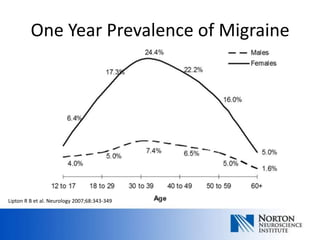
• 18% of women, 6% of men are affected by
  migraine
One Year Prevalence of Migraine


Lipton R B et al. Neurology 2007;68:343-349
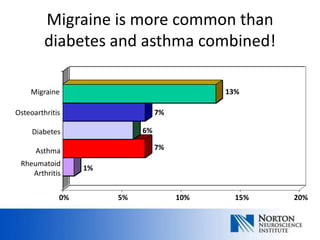
Migraine is more common than
         diabetes and asthma combined!

    Migraine                                13%

Osteoarthritis                   7%

     Diabetes               6%

      Asthma                     7%

 Rheumatoid
                  1%
    Arthritis


             0%        5%             10%     15%   20%
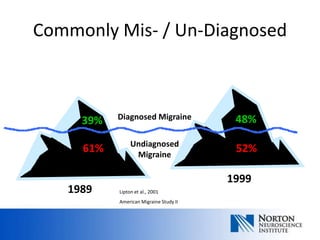
Commonly Mis- / Un-Diagnosed


           Diagnosed Migraine            48%
     39%
                Undiagnosed
     61%         Migraine
                                         52%

                                        1999
   1989    Lipton et al., 2001
           American Migraine Study II
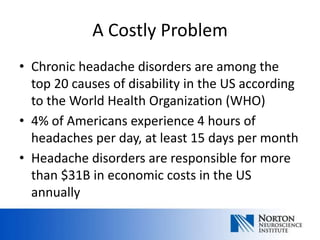
A Costly Problem
• Chronic headache disorders are among the
  top 20 causes of disability in the US according
  to the World Health Organization (WHO)
• 4% of Americans experience 4 hours of
  headaches per day, at least 15 days per month
• Headache disorders are responsible for more
  than $31B in economic costs in the US
  annually
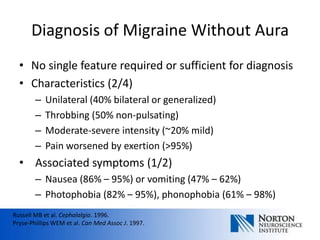
Diagnosis of Migraine Without Aura
  • No single feature required or sufficient for diagnosis
  • Characteristics (2/4)
        –   Unilateral (40% bilateral or generalized)
        –   Throbbing (50% non-pulsating)
        –   Moderate-severe intensity (~20% mild)
        –   Pain worsened by exertion (>95%)
  • Associated symptoms (1/2)
        – Nausea (86% – 95%) or vomiting (47% – 62%)
        – Photophobia (82% – 95%), phonophobia (61% – 98%)
Russell MB et al. Cephalalgia. 1996.
Pryse-Phillips WEM et al. Can Med Assoc J. 1997.
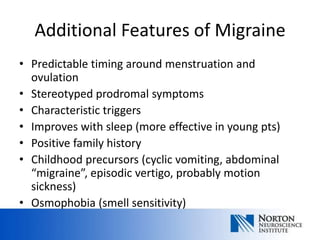
Additional Features of Migraine
• Predictable timing around menstruation and
  ovulation
• Stereotyped prodromal symptoms
• Characteristic triggers
• Improves with sleep (more effective in young pts)
• Positive family history
• Childhood precursors (cyclic vomiting, abdominal
  “migraine”, episodic vertigo, probably motion
  sickness)
• Osmophobia (smell sensitivity)
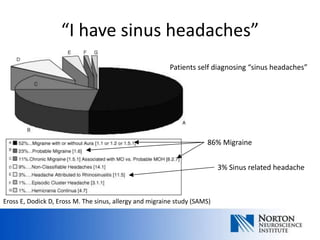
“I have sinus headaches”
                                                         Patients self diagnosing “sinus headaches”


                                                                      86% Migraine


                                                                           3% Sinus related headache


Eross E, Dodick D, Eross M. The sinus, allergy and migraine study (SAMS)
What Causes Migraine?
• The Vascular Theory

• Blood vessels constricting (aura)
        Followed by
• Blood vessels dilating
The Vascular Theory
• Does not explain prodrome
• Not supported by blood flow studies
• There are effective nonvascular drugs, such as
  NSAIDs
• Most patients do not have aura

• THIS IS NOT CORRECT
The Neurovascular Theory
• Referred pain from dura mater and blood
  vessels
• Peripheral Neural Processing
• Central Neural Processing
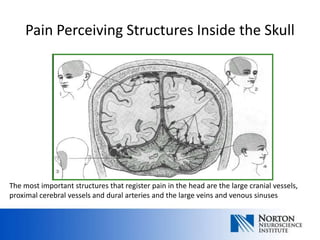
Pain Perceiving Structures Inside the Skull


The most important structures that register pain in the head are the large cranial vessels,
proximal cerebral vessels and dural arteries and the large veins and venous sinuses
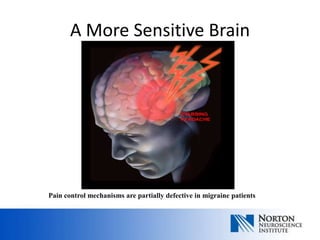
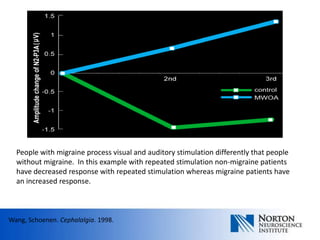
A More Sensitive Brain


Pain control mechanisms are partially defective in migraine patients
People with migraine process visual and auditory stimulation differently that people
  without migraine. In this example with repeated stimulation non-migraine patients
  have decreased response with repeated stimulation whereas migraine patients have
  an increased response.


Wang, Schoenen. Cephalalgia. 1998.
Migraine Triggers
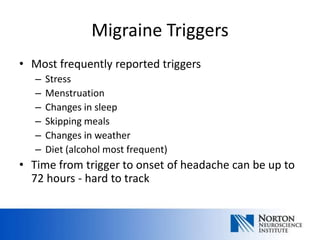
• Most frequently reported triggers
   –   Stress
   –   Menstruation
   –   Changes in sleep
   –   Skipping meals
   –   Changes in weather
   –   Diet (alcohol most frequent)
• Time from trigger to onset of headache can be up to
  72 hours - hard to track
Migraine Triggers


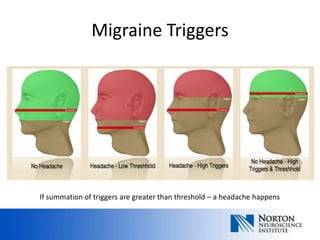
If summation of triggers are greater than threshold – a headache happens
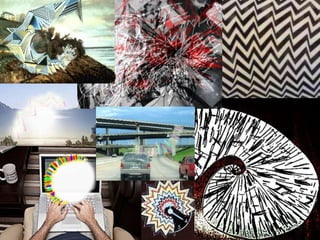
Migraine Aura
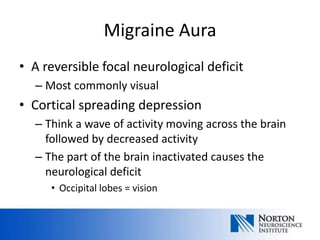
Migraine Aura
• A reversible focal neurological deficit
  – Most commonly visual
• Cortical spreading depression
  – Think a wave of activity moving across the brain
    followed by decreased activity
  – The part of the brain inactivated causes the
    neurological deficit
     • Occipital lobes = vision
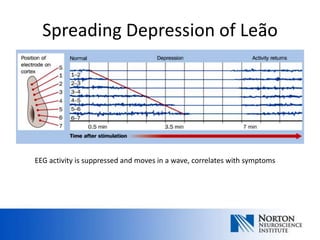
Spreading Depression of Leão


EEG activity is suppressed and moves in a wave, correlates with symptoms
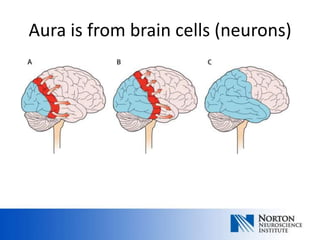
Aura is from brain cells (neurons)
The Pain
Neuropeptides
• Cranial levels of both substance P and
  calcitonin gene-related peptide (CGRP) are
  increased by stimulation of the trigeminal
  ganglion in humans
• In migraine CGRP is elevated in external
  jugular vein blood, whereas substance P is not
• CGRP infusions can trigger headache and
  migraine
A Growing Snowball
• Trigeminal nerve and its blood supply
  (neurovascular)
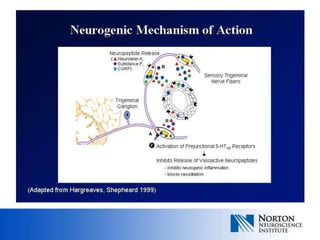
   – Release of neuropeptides
      •   CGRP
      •   Substance P
      •   5-HT (serotonin) --> “triptans”
      •   Nitric oxide
   – Vasodilatation (CGRP) leads to further activation, and the
     process spreads
   – Brainstem, thalamus, cortex become activated leading to
     “central sensitization”
      • Amplified pain signaling in the central nervous system
   – Allodynia: pain due to a non-noxious stimulant
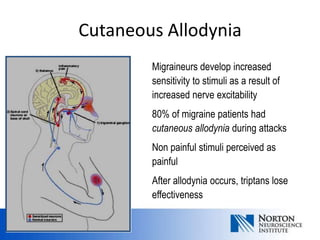
Cutaneous Allodynia
        Migraineurs develop increased
        sensitivity to stimuli as a result of
        increased nerve excitability
        80% of migraine patients had
        cutaneous allodynia during attacks
        Non painful stimuli perceived as
        painful
        After allodynia occurs, triptans lose
        effectiveness
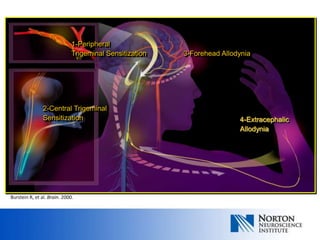
1-Peripheral
                              Trigeminal Sensitization   3-Forehead Allodynia


                2-Central Trigeminal
                Sensitization                                            4-Extracephalic
                                                                         Allodynia


Burstein R, et al. Brain. 2000.
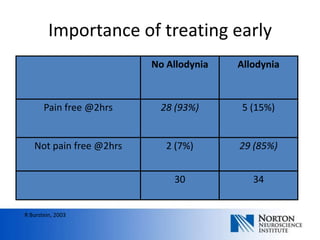
Importance of treating early
                         No Allodynia   Allodynia


       Pain free @2hrs    28 (93%)      5 (15%)


   Not pain free @2hrs      2 (7%)      29 (85%)


                             30            34


R Burstein, 2003
Allodynia is a risk factor for
developing chronic migraine
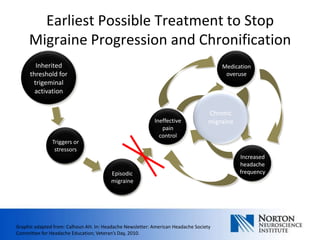
Earliest Possible Treatment to Stop
     Migraine Progression and Chronification
       Inherited                                                                       Medication
     threshold for                                                                      overuse
      trigeminal
       activation


                                                                                   Chronic
                                                           Ineffective             migraine
                                                              pain
                                                             control
               Triggers or
                stressors
                                                                                              Increased
                                                                                              headache
                                         Episodic                                             frequency
                                         migraine


Graphic adapted from: Calhoun AH. In: Headache Newsletter: American Headache Society
Committee for Headache Education; Veteran’s Day, 2010.
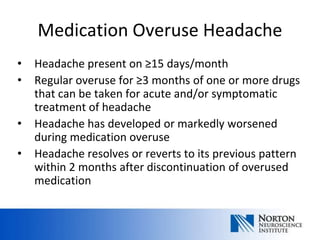
Medication Overuse Headache
•   Headache present on ≥15 days/month
•   Regular overuse for ≥3 months of one or more drugs
    that can be taken for acute and/or symptomatic
    treatment of headache
•   Headache has developed or markedly worsened
    during medication overuse
•   Headache resolves or reverts to its previous pattern
    within 2 months after discontinuation of overused
    medication
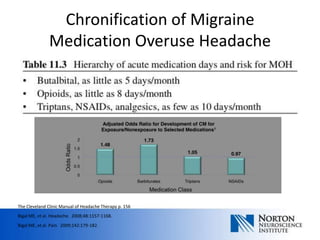
Chronification of Migraine
               Medication Overuse Headache


The Cleveland Clinic Manual of Headache Therapy p. 156
Bigal ME, et al. Headache. 2008;48:1157-1168.
Bigal ME, et al. Pain. 2009;142:179-182.
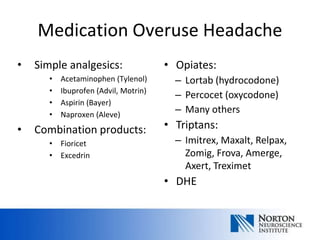
Medication Overuse Headache
•   Simple analgesics:                 • Opiates:
       •   Acetaminophen (Tylenol)       – Lortab (hydrocodone)
       •   Ibuprofen (Advil, Motrin)
                                         – Percocet (oxycodone)
       •   Aspirin (Bayer)
       •   Naproxen (Aleve)
                                         – Many others
•   Combination products:              • Triptans:
       • Fioricet                        – Imitrex, Maxalt, Relpax,
       • Excedrin                          Zomig, Frova, Amerge,
                                           Axert, Treximet
                                       • DHE
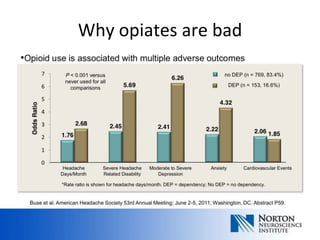
Why opiates are bad
Other Associated Symptoms
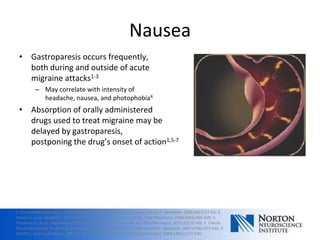
Nausea
 • Gastroparesis occurs frequently,
   both during and outside of acute
   migraine attacks1-3
          – May correlate with intensity of
            headache, nausea, and photophobia4
 • Absorption of orally administered
   drugs used to treat migraine may be
   delayed by gastroparesis,
   postponing the drug’s onset of action1,5-7


1. Krymchantowski AV, et al. Cephalalgia. 2006;26(7):871-874; 2. Aurora SK, et al. Headache. 2006;46(1):57-63; 3.
Aurora S, et al. Headache. 2007;47(10):1443-1446; 4. Boyle R, et al. Br J Clin Pharmacol. 1990;30(3):405-409; 5.
Thomsen LL, et al. Cephalalgia. 1996;16(4):270-275; 6. Volans GN. Br J Clin Pharmacol. 1975;2(1):57-63; 7. Tokola
RA and Neuvonen PJ. Br J Clin Pharmacol. 1984;18(6):867-871; 8. Tfelt-Hansen P. Headache. 2007;47(6):929-930; 9.
Dahlöf C. Curr Opin Neurol. 2002;15:317-322; 10. Lychkova AE. Bull Exp Biol Med. 2004;138(2):127-130.
Other Associated Symptoms
•   Blurry vision (29%)
•   Neck pain (31%)
•   Nasal congestion (28%)
•   Sweating (30%)
•   Dizziness (16%)
Why is it important to understand
   the science of migraine?
• Treatment
  – Prevention of triggers
  – Preventative medications
  – Rescue medications
Triggers
• We now understand that patients with
  migraine have an “excitable” brain
  – Need to be careful with:
     •   Sleep
     •   Diet
     •   Medication overuse
     •   Stress management
Preventative Medications
• Antiseizure drugs
   – Topamax
   – Depakote
• Antidepressants
   – Amitriptyline (Elavil)
   – Effexor
• Blood pressure medications
   – Propranolol (Inderal)
   – Verapamil
Rescue Medications
• Triptans
• NSAIDs
• DHE
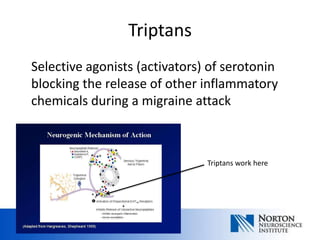
Triptans
Selective agonists (activators) of serotonin
blocking the release of other inflammatory
chemicals during a migraine attack


                               Triptans work here
Triptans
• Prevent release of neuropeptides
• Once enough activation has occurred the
  process of central sensitization begins
  – Manifested by allodynia
  – Remember 15% vs. 93% chance of success
NSAIDs
• Ketorolac infusion has been shown to reverse
  central sensitization
• IV ketorolac is not practical in the outpatient
  setting
• Further discussed next month
DHE
• Can also reverse central sensitization
• More side effects
• A little less convenient to give in the home
  setting

• Will be discussed further next month
Summary
• Hyperexcitable brain: more susceptible to
  triggers
• Aura: spreading excitation and depression
• Throbbing head pain: trigeminal inflammation
• Allodynia: common, important and due to
  central sensitization
Future Classes
• Medication Maze
  – April 11
• How Diet Affects Headaches
  – May 16
• Women and Headaches
  – June 13
Questions?

             Thanks

NortonHealthcare.com/HeadacheandConcussion

What is migraine march 2013

  • 1.
    Headache School 2013 Norton Headache and Concussion Center
  • 2.
    Why Headache School? •Headache is one of the most common reasons for patients to seek medical attention • Of patients seeking medical attention for headache, the majority will be diagnosed with migraine • Migraine affects approximately 12% of the population
  • 3.
    Why Headache School? •Formal educational programs have been shown to produce better outcomes for patients with headache • Opportunity for patients to interact with physicians and other patients in an informal setting
  • 4.
    What Can YouDo? • Come to classes • Bring a friend, spouse, etc. • Come with questions • Share your story – Interact with those around you – Migraine is a lot more common than you think – You are NOT the only one
  • 5.
    Upcoming Classes • MedicationMaze – April 11 • How Diet Affects Headaches – May 16 • Women and Headaches – June 13
  • 6.
  • 7.
    A Common Problem •45 million Americans with headache disorders • 30 million Americans with migraine, the most common disabling form of headache • 12% of the US population has migraine • 18% of women, 6% of men are affected by migraine
  • 8.
    One Year Prevalenceof Migraine Lipton R B et al. Neurology 2007;68:343-349
  • 9.
    Migraine is morecommon than diabetes and asthma combined! Migraine 13% Osteoarthritis 7% Diabetes 6% Asthma 7% Rheumatoid 1% Arthritis 0% 5% 10% 15% 20%
  • 10.
    Commonly Mis- /Un-Diagnosed Diagnosed Migraine 48% 39% Undiagnosed 61% Migraine 52% 1999 1989 Lipton et al., 2001 American Migraine Study II
  • 11.
    A Costly Problem •Chronic headache disorders are among the top 20 causes of disability in the US according to the World Health Organization (WHO) • 4% of Americans experience 4 hours of headaches per day, at least 15 days per month • Headache disorders are responsible for more than $31B in economic costs in the US annually
  • 12.
    Diagnosis of MigraineWithout Aura • No single feature required or sufficient for diagnosis • Characteristics (2/4) – Unilateral (40% bilateral or generalized) – Throbbing (50% non-pulsating) – Moderate-severe intensity (~20% mild) – Pain worsened by exertion (>95%) • Associated symptoms (1/2) – Nausea (86% – 95%) or vomiting (47% – 62%) – Photophobia (82% – 95%), phonophobia (61% – 98%) Russell MB et al. Cephalalgia. 1996. Pryse-Phillips WEM et al. Can Med Assoc J. 1997.
  • 13.
    Additional Features ofMigraine • Predictable timing around menstruation and ovulation • Stereotyped prodromal symptoms • Characteristic triggers • Improves with sleep (more effective in young pts) • Positive family history • Childhood precursors (cyclic vomiting, abdominal “migraine”, episodic vertigo, probably motion sickness) • Osmophobia (smell sensitivity)
  • 14.
    “I have sinusheadaches” Patients self diagnosing “sinus headaches” 86% Migraine 3% Sinus related headache Eross E, Dodick D, Eross M. The sinus, allergy and migraine study (SAMS)
  • 15.
    What Causes Migraine? •The Vascular Theory • Blood vessels constricting (aura) Followed by • Blood vessels dilating
  • 16.
    The Vascular Theory •Does not explain prodrome • Not supported by blood flow studies • There are effective nonvascular drugs, such as NSAIDs • Most patients do not have aura • THIS IS NOT CORRECT
  • 17.
    The Neurovascular Theory •Referred pain from dura mater and blood vessels • Peripheral Neural Processing • Central Neural Processing
  • 18.
    Pain Perceiving StructuresInside the Skull The most important structures that register pain in the head are the large cranial vessels, proximal cerebral vessels and dural arteries and the large veins and venous sinuses
  • 19.
    A More SensitiveBrain Pain control mechanisms are partially defective in migraine patients
  • 20.
    People with migraineprocess visual and auditory stimulation differently that people without migraine. In this example with repeated stimulation non-migraine patients have decreased response with repeated stimulation whereas migraine patients have an increased response. Wang, Schoenen. Cephalalgia. 1998.
  • 21.
    Migraine Triggers • Mostfrequently reported triggers – Stress – Menstruation – Changes in sleep – Skipping meals – Changes in weather – Diet (alcohol most frequent) • Time from trigger to onset of headache can be up to 72 hours - hard to track
  • 22.
    Migraine Triggers If summationof triggers are greater than threshold – a headache happens
  • 23.
  • 25.
    Migraine Aura • Areversible focal neurological deficit – Most commonly visual • Cortical spreading depression – Think a wave of activity moving across the brain followed by decreased activity – The part of the brain inactivated causes the neurological deficit • Occipital lobes = vision
  • 26.
    Spreading Depression ofLeão EEG activity is suppressed and moves in a wave, correlates with symptoms
  • 27.
    Aura is frombrain cells (neurons)
  • 28.
  • 30.
    Neuropeptides • Cranial levelsof both substance P and calcitonin gene-related peptide (CGRP) are increased by stimulation of the trigeminal ganglion in humans • In migraine CGRP is elevated in external jugular vein blood, whereas substance P is not • CGRP infusions can trigger headache and migraine
  • 31.
    A Growing Snowball •Trigeminal nerve and its blood supply (neurovascular) – Release of neuropeptides • CGRP • Substance P • 5-HT (serotonin) --> “triptans” • Nitric oxide – Vasodilatation (CGRP) leads to further activation, and the process spreads – Brainstem, thalamus, cortex become activated leading to “central sensitization” • Amplified pain signaling in the central nervous system – Allodynia: pain due to a non-noxious stimulant
  • 32.
    Cutaneous Allodynia Migraineurs develop increased sensitivity to stimuli as a result of increased nerve excitability 80% of migraine patients had cutaneous allodynia during attacks Non painful stimuli perceived as painful After allodynia occurs, triptans lose effectiveness
  • 33.
    1-Peripheral Trigeminal Sensitization 3-Forehead Allodynia 2-Central Trigeminal Sensitization 4-Extracephalic Allodynia Burstein R, et al. Brain. 2000.
  • 34.
    Importance of treatingearly No Allodynia Allodynia Pain free @2hrs 28 (93%) 5 (15%) Not pain free @2hrs 2 (7%) 29 (85%) 30 34 R Burstein, 2003
  • 35.
    Allodynia is arisk factor for developing chronic migraine
  • 36.
    Earliest Possible Treatmentto Stop Migraine Progression and Chronification Inherited Medication threshold for overuse trigeminal activation Chronic Ineffective migraine pain control Triggers or stressors Increased headache Episodic frequency migraine Graphic adapted from: Calhoun AH. In: Headache Newsletter: American Headache Society Committee for Headache Education; Veteran’s Day, 2010.
  • 37.
    Medication Overuse Headache • Headache present on ≥15 days/month • Regular overuse for ≥3 months of one or more drugs that can be taken for acute and/or symptomatic treatment of headache • Headache has developed or markedly worsened during medication overuse • Headache resolves or reverts to its previous pattern within 2 months after discontinuation of overused medication
  • 38.
    Chronification of Migraine Medication Overuse Headache The Cleveland Clinic Manual of Headache Therapy p. 156 Bigal ME, et al. Headache. 2008;48:1157-1168. Bigal ME, et al. Pain. 2009;142:179-182.
  • 39.
    Medication Overuse Headache • Simple analgesics: • Opiates: • Acetaminophen (Tylenol) – Lortab (hydrocodone) • Ibuprofen (Advil, Motrin) – Percocet (oxycodone) • Aspirin (Bayer) • Naproxen (Aleve) – Many others • Combination products: • Triptans: • Fioricet – Imitrex, Maxalt, Relpax, • Excedrin Zomig, Frova, Amerge, Axert, Treximet • DHE
  • 40.
  • 41.
  • 42.
    Nausea • Gastroparesisoccurs frequently, both during and outside of acute migraine attacks1-3 – May correlate with intensity of headache, nausea, and photophobia4 • Absorption of orally administered drugs used to treat migraine may be delayed by gastroparesis, postponing the drug’s onset of action1,5-7 1. Krymchantowski AV, et al. Cephalalgia. 2006;26(7):871-874; 2. Aurora SK, et al. Headache. 2006;46(1):57-63; 3. Aurora S, et al. Headache. 2007;47(10):1443-1446; 4. Boyle R, et al. Br J Clin Pharmacol. 1990;30(3):405-409; 5. Thomsen LL, et al. Cephalalgia. 1996;16(4):270-275; 6. Volans GN. Br J Clin Pharmacol. 1975;2(1):57-63; 7. Tokola RA and Neuvonen PJ. Br J Clin Pharmacol. 1984;18(6):867-871; 8. Tfelt-Hansen P. Headache. 2007;47(6):929-930; 9. Dahlöf C. Curr Opin Neurol. 2002;15:317-322; 10. Lychkova AE. Bull Exp Biol Med. 2004;138(2):127-130.
  • 43.
    Other Associated Symptoms • Blurry vision (29%) • Neck pain (31%) • Nasal congestion (28%) • Sweating (30%) • Dizziness (16%)
  • 44.
    Why is itimportant to understand the science of migraine? • Treatment – Prevention of triggers – Preventative medications – Rescue medications
  • 45.
    Triggers • We nowunderstand that patients with migraine have an “excitable” brain – Need to be careful with: • Sleep • Diet • Medication overuse • Stress management
  • 46.
    Preventative Medications • Antiseizuredrugs – Topamax – Depakote • Antidepressants – Amitriptyline (Elavil) – Effexor • Blood pressure medications – Propranolol (Inderal) – Verapamil
  • 47.
  • 48.
    Triptans Selective agonists (activators)of serotonin blocking the release of other inflammatory chemicals during a migraine attack Triptans work here
  • 49.
    Triptans • Prevent releaseof neuropeptides • Once enough activation has occurred the process of central sensitization begins – Manifested by allodynia – Remember 15% vs. 93% chance of success
  • 50.
    NSAIDs • Ketorolac infusionhas been shown to reverse central sensitization • IV ketorolac is not practical in the outpatient setting • Further discussed next month
  • 51.
    DHE • Can alsoreverse central sensitization • More side effects • A little less convenient to give in the home setting • Will be discussed further next month
  • 52.
    Summary • Hyperexcitable brain:more susceptible to triggers • Aura: spreading excitation and depression • Throbbing head pain: trigeminal inflammation • Allodynia: common, important and due to central sensitization
  • 53.
    Future Classes • MedicationMaze – April 11 • How Diet Affects Headaches – May 16 • Women and Headaches – June 13
  • 54.
    Questions? Thanks NortonHealthcare.com/HeadacheandConcussion