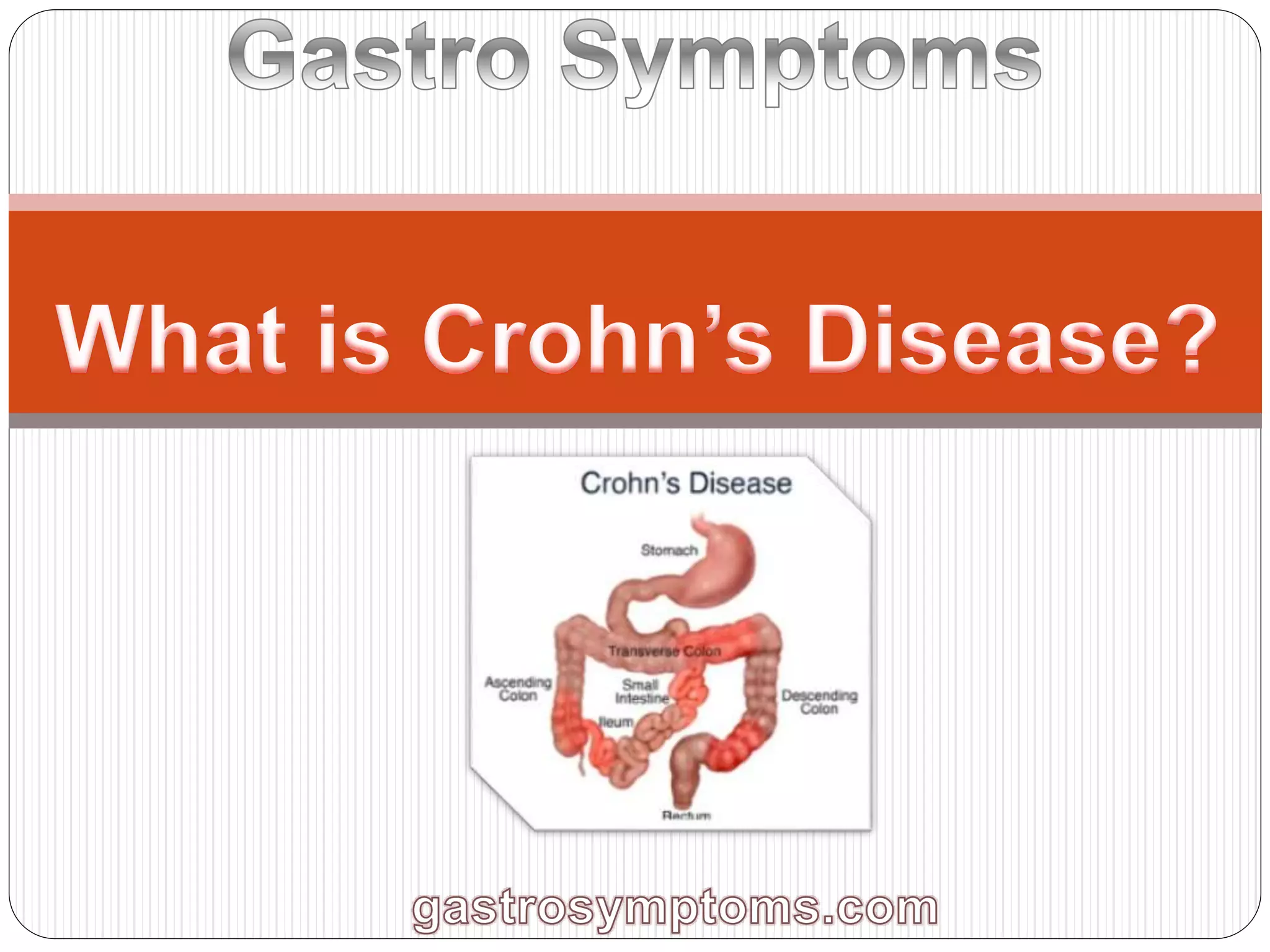
WHAT IS CROHN’S DISEASE?
Gastrosymptoms.com
Gastrosymptoms.com
Crohn’s disease refers to an inflammation of the digestive tract. The
disease is chronic. It affects the digestive tract (gastro-intestinal
tract) anywhere from the mouth to the anus. An estimated 25% of
patients who develop Crohn’s disease develop it in childhood.
Patients should see a physician if they develop common symptoms
of the disease such as diarrhea, fever and fatigue, blood in stool,
mouth sores, reduced appetite and weight loss, and inflammation in
the anus or nearby areas. These symptoms can cause slight
discomfort or even severe pain. Children and adolescents are at a
higher risk of developing the disease. Further research is needed to
determine whether there are ethnic or gender differences in
developing the disease.
Gastrosymptoms.com
Radiology techniques such as conventional enteroclysis,
ultrasonography, computed tomography, and magnetic
resonance imaging can be used to evaluate Crohn’s
Disease (CD). Some methods are preferable to others
because they allow the evaluation of the small bowel that is
often affected over 80% of the time.
Treatment of Crohn’s disease may be challenging as the
causes of the disease are not well understood. Perhaps the
disease occurs as a culmination of genetic, environmental,
and immunologic factors.
Gastrosymptoms.com
It is possible that some hosts are genetically
susceptible, although it is unclear how or why they are
more susceptible. Overall, it is possible that the
development of the disease depends on the
interactions between diet, the intestinal wall, and the
permeability of the intestinal wall. Some research
studies suggest that both extremes of weight (low
body mass index or high body mass index) may be
associated with the disease and that patients at either
extreme are more likely to develop Crohn’s disease.
These results indicate a U-shaped relationship with
Crohn’s Disease, with risk being highest in those with
low Body Mass Index (BMI) and very high BMI.
Treatments for Crohn’s Disease include
glucocorticosteroids, immunosuppressive agents, and
biologic agents. These are primarily directed against the
inflammatory process of the disease. Their role is to
reduce inflammation, slow down disease progression, and
maintain remission.
Additionally, personal dietary intervention has been used
to treat Crohn’s Disease although the degree of success
has been variable. Thus far, very few diets have improved
disease outcomes in a clinical setting and perhaps
molecular nutrition interventions could be more useful.
Exclusion diets that eliminate all food types and
introduce new foods one at a time may be used to
assess clinical response to diet modification. However
these have not been rigorously studied, in part
because exclusion diets tend to be complex and time-
consuming and in part because patients are less likely
to comply with these restrictive diets. Preliminary
studies indicate that the exclusion of red meat and
other forms of animal protein appear may be
beneficial and that an increased diet rich in fiber may
not be helpful.
In summary, it is important for researchers to continue
investigating the precise dietary components that help
mitigate or treat the disease. It is also important for
researchers to develop methods to better understand how
the disease develops.
Call Your GI Doctor
If you have any of the above mentioned symptoms be sure to call your
GI doctor. These conditions can often be treated effectively with timely
recognition, management and appropriate therapy.
Visit this Link to Find a
Gastroenterologist in your Area
http://gastrosymptoms.com/find-a-
gastroenterologist-in-your-area/

What is Crohns's Disease

  • 1.
    WHAT IS CROHN’SDISEASE? Gastrosymptoms.com
  • 2.
    Gastrosymptoms.com Crohn’s disease refersto an inflammation of the digestive tract. The disease is chronic. It affects the digestive tract (gastro-intestinal tract) anywhere from the mouth to the anus. An estimated 25% of patients who develop Crohn’s disease develop it in childhood. Patients should see a physician if they develop common symptoms of the disease such as diarrhea, fever and fatigue, blood in stool, mouth sores, reduced appetite and weight loss, and inflammation in the anus or nearby areas. These symptoms can cause slight discomfort or even severe pain. Children and adolescents are at a higher risk of developing the disease. Further research is needed to determine whether there are ethnic or gender differences in developing the disease.
  • 3.
    Gastrosymptoms.com Radiology techniques suchas conventional enteroclysis, ultrasonography, computed tomography, and magnetic resonance imaging can be used to evaluate Crohn’s Disease (CD). Some methods are preferable to others because they allow the evaluation of the small bowel that is often affected over 80% of the time. Treatment of Crohn’s disease may be challenging as the causes of the disease are not well understood. Perhaps the disease occurs as a culmination of genetic, environmental, and immunologic factors.
  • 4.
    Gastrosymptoms.com It is possiblethat some hosts are genetically susceptible, although it is unclear how or why they are more susceptible. Overall, it is possible that the development of the disease depends on the interactions between diet, the intestinal wall, and the permeability of the intestinal wall. Some research studies suggest that both extremes of weight (low body mass index or high body mass index) may be associated with the disease and that patients at either extreme are more likely to develop Crohn’s disease. These results indicate a U-shaped relationship with Crohn’s Disease, with risk being highest in those with low Body Mass Index (BMI) and very high BMI.
  • 5.
    Treatments for Crohn’sDisease include glucocorticosteroids, immunosuppressive agents, and biologic agents. These are primarily directed against the inflammatory process of the disease. Their role is to reduce inflammation, slow down disease progression, and maintain remission. Additionally, personal dietary intervention has been used to treat Crohn’s Disease although the degree of success has been variable. Thus far, very few diets have improved disease outcomes in a clinical setting and perhaps molecular nutrition interventions could be more useful.
  • 6.
    Exclusion diets thateliminate all food types and introduce new foods one at a time may be used to assess clinical response to diet modification. However these have not been rigorously studied, in part because exclusion diets tend to be complex and time- consuming and in part because patients are less likely to comply with these restrictive diets. Preliminary studies indicate that the exclusion of red meat and other forms of animal protein appear may be beneficial and that an increased diet rich in fiber may not be helpful.
  • 7.
    In summary, itis important for researchers to continue investigating the precise dietary components that help mitigate or treat the disease. It is also important for researchers to develop methods to better understand how the disease develops.
  • 8.
    Call Your GIDoctor If you have any of the above mentioned symptoms be sure to call your GI doctor. These conditions can often be treated effectively with timely recognition, management and appropriate therapy. Visit this Link to Find a Gastroenterologist in your Area http://gastrosymptoms.com/find-a- gastroenterologist-in-your-area/