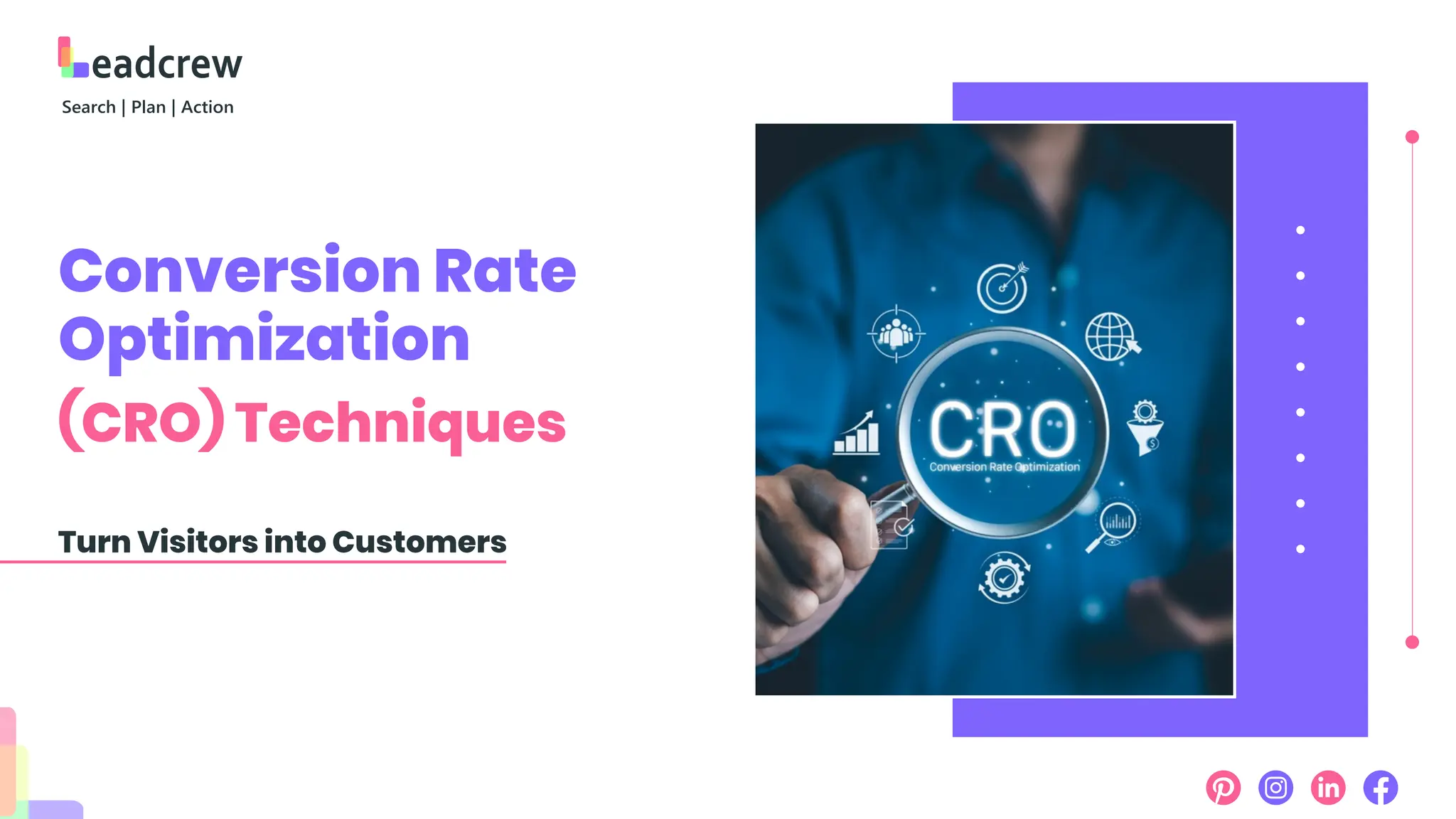
Conversion Rate
Optimization
Turn Visitors into Customers
(CRO) Techniques
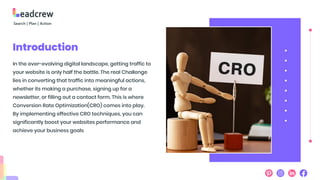
Introduction
In the ever-evolving digital landscape, getting traffic to
your website is only half the battle. The real Challenge
lies in converting that traffic into meaningful actions,
whether its making a purchase, signing up for a
newsletter, or filling out a contact form. This is where
Conversion Rate Optimization(CRO) comes into play.
By implementing effective CRO techniques, you can
significantly boost your websites performance and
achieve your business goals
Understanding CRO
What is CRO?
Conversion Rate Optimization, or CRO, is the process of enhancing your website to increase the percentage of visitors
who take a desired action. This could be anything form purchasing a product to signing up for a newsletter.
Essentially, CRO is about making your website more effective in turning visitors into customers
Why is CRO Important?
CRO is crucial because it directly impact your bottom line. A higher conversion rate means more customers & revenue
without needing to increase your website traffic. Plus, a well-optimized site improves user experience, which can lead
to higher customer satisfaction and loyalty
Analyzing User Behavior
Using Analytics Tools
To optimize your website, you first need to understand how user are interacting with it. Tools like Google analytics
provide valuable insights into user behavior, showing you which pages are performing well and which ones need
improvement
Heatmaps and Session Recordings
Heatmaps and session recording offer a visual representation of where users are clicking, scrolling, and spending the
most time. This data helps identify problem areas and opportunities for enhancement, allowing you to make data
driven decisions
Optimizing Landing Pages
Crafting Compelling Headlines
Your landing page is often the first impression visitors have of your site. A compelling headline can grab attention
and encourage users to stay and explore. Focus on creating clear, benefit-driven headlines that address the needs
and desires of your target audience
Utilizing Engaging Visuals
High-quality visuals can significantly boost user engagement. Use images, videos, and infographics that are relevant to
your content and help convey your message more effectively
Improving Website Speed
Importance of Load Times
Website speed is a critical factor in user experience and conversion rates. Slow load times can frustrate users and
lead to higher bounce rate. In fact, a delay of just one second can reduce conversion by 7%
Techniques to Enhance Speed
To improve your website speed, consider the following techniques
Optimize images: compress images to reduce their file size without sacrificing quality
Use a Content Delivery Network(CDN): A CDN can distribute your content globally, reducing load
times for international users
Minimize HTTP requests: Reduce the number of elements on your page to decrease load times
Call-to-Action (CTA) Buttons
Designing Effective CTAs
Your CTA buttons play a crucial role in guiding users towards conversion. Design button that stand out with contrast-
ing colors and clear, actionable text like "Buy Now" or "Sign Up"
Placement and Wording of CTAs
Place CTAs in prominent locations where users are most likely to see them, such as above that fold and at the end of
content. Use persuasive language that communicates vale and urgency
Mobile Optimization
Ensuring Mobile-Friendliness
With the majority of web traffic now coming from mobile devices, ensuring your website is mobile-friendly is essential.
A mobile-optimized site provides a seamless user experience, leading to higher conversions
Responsive Design Techniques
Implement responsive design techniques to ensure your website adjusts smoothly to different screen sizes. This includes
flexible grids, fluid images, and CSS media quires
Utilizing Social Proof
Types of Social Proof
Social proof, such as customer reviews, testimonials, and case studies, can significantly influence potential custom-
ers. Seeing that others have had a positive experience with your product or service builds trust and encourages con-
versions
Integrating Social Proof into Your Website
Incorporate social proof throughout your website, particularly on landing pages and near CTAs. Highlight customer
reviews, showcase case studies, and display trust badges to reinforce credibility
Simplifying Forms
Reducing Forms Fields
Long, complicated forms can deter users from completing them. Simplify your forms by only asking for essential infor-
mation. The fewer fields users have to fill out, the more likely they are to convert
Making Forms User-Friendly
Ensure your forms are user-friendly by using clear labels, providing inline validation, and offering autofill options. This
makes the process smoother and reduce friction
Personalization Strategies
Dynamic Content Personalization
Personalization involves tailoring your website content to individual users based on their behavior, preferences, and
demographics. Dynamic content personalization can include personalized product recommendations, custom offers,
and tailored messages
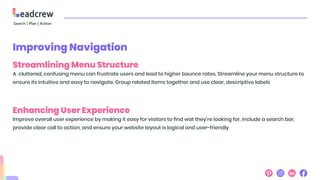
Improving Navigation
Streamlining Menu Structure
A cluttered, confusing menu can frustrate users and lead to higher bounce rates, Streamline your menu structure to
ensure its intuitive and easy to navigate. Group related items together and use clear, descriptive labels
Enhancing User Experience
Improve overall user experience by making it easy for visitors to find wat they're looking for. include a search bar,
provide clear call to action, and ensure your website layout is logical and user-friendly
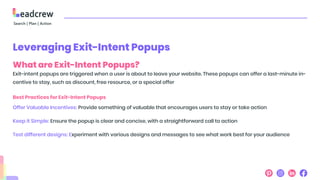
Leveraging Exit-Intent Popups
What are Exit-Intent Popups?
Exit-intent popups are triggered when a user is about to leave your website. These popups can offer a last-minute in-
centive to stay, such as discount, free resource, or a special offer
Best Practices for Exit-Intent Popups
Offer Valuable Incentives: Provide something of valuable that encourages users to stay or take action
Keep it Simple: Ensure the popup is clear and concise, with a straightforward call to action
Test different designs: Experiment with various designs and messages to see what work best for your audience
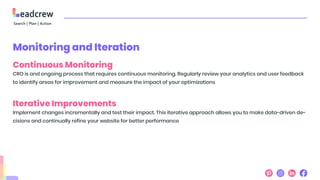
Monitoring and Iteration
Continuous Monitoring
CRO is and ongoing process that requires continuous monitoring. Regularly review your analytics and user feedback
to identify areas for improvement and measure the impact of your optimizations
Iterative Improvements
Implement changes incrementally and test their impact. This iterative approach allows you to make data-driven de-
cisions and continually refine your website for better performance
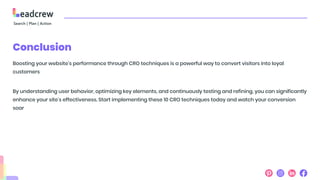
Conclusion
Boosting your website's performance through CRO techniques is a powerful way to convert visitors into loyal
customers
By understanding user behavior, optimizing key elements, and continuously testing and refining, you can significantly
enhance your site's effectiveness. Start implementing these 10 CRO techniques today and watch your conversion
soar
FAQs
What is the most important CRO technique?
While all CRO techniques are important, understanding user behavior through analytics and testing is foundational.
without knowing how users interact with your site, it's challenging to make effective optimizations
How often should I conduct A/B tests?
A/B tests should be conducted continuously. Regular testing helps you stay updated on what works best for our audi-
ence and allows for ongoing optimization
Can CRO improve my SEO ranking?
Yes, CRO can indirectly improve SEO, A better user experience leads to longer site visits and lower bounce rates, which
are positive signals to search engines
FAQs
How do I know if my CRO efforts are working?
Monitor key metrics like conversion rates, bounce rates, and user engagement. An increase in these metrics indicates
that your CRO efforts are effective
Is it necessary to hire a professional for CRO?
while you can start with basic CRO techniques on your own, hiring a professional can provide advanced insights and
strategies, leading to more significant improvements
THANK YOU
www.leadcrew.co info@leadcrew.co

What is Conversion Rate Optimization (CRO) Techniques - Leadcrew

  • 1.
    Conversion Rate Optimization Turn Visitorsinto Customers (CRO) Techniques
  • 2.
    Introduction In the ever-evolvingdigital landscape, getting traffic to your website is only half the battle. The real Challenge lies in converting that traffic into meaningful actions, whether its making a purchase, signing up for a newsletter, or filling out a contact form. This is where Conversion Rate Optimization(CRO) comes into play. By implementing effective CRO techniques, you can significantly boost your websites performance and achieve your business goals
  • 3.
    Understanding CRO What isCRO? Conversion Rate Optimization, or CRO, is the process of enhancing your website to increase the percentage of visitors who take a desired action. This could be anything form purchasing a product to signing up for a newsletter. Essentially, CRO is about making your website more effective in turning visitors into customers Why is CRO Important? CRO is crucial because it directly impact your bottom line. A higher conversion rate means more customers & revenue without needing to increase your website traffic. Plus, a well-optimized site improves user experience, which can lead to higher customer satisfaction and loyalty
  • 4.
    Analyzing User Behavior UsingAnalytics Tools To optimize your website, you first need to understand how user are interacting with it. Tools like Google analytics provide valuable insights into user behavior, showing you which pages are performing well and which ones need improvement Heatmaps and Session Recordings Heatmaps and session recording offer a visual representation of where users are clicking, scrolling, and spending the most time. This data helps identify problem areas and opportunities for enhancement, allowing you to make data driven decisions
  • 5.
    Optimizing Landing Pages CraftingCompelling Headlines Your landing page is often the first impression visitors have of your site. A compelling headline can grab attention and encourage users to stay and explore. Focus on creating clear, benefit-driven headlines that address the needs and desires of your target audience Utilizing Engaging Visuals High-quality visuals can significantly boost user engagement. Use images, videos, and infographics that are relevant to your content and help convey your message more effectively
  • 6.
    Improving Website Speed Importanceof Load Times Website speed is a critical factor in user experience and conversion rates. Slow load times can frustrate users and lead to higher bounce rate. In fact, a delay of just one second can reduce conversion by 7% Techniques to Enhance Speed To improve your website speed, consider the following techniques Optimize images: compress images to reduce their file size without sacrificing quality Use a Content Delivery Network(CDN): A CDN can distribute your content globally, reducing load times for international users Minimize HTTP requests: Reduce the number of elements on your page to decrease load times
  • 7.
    Call-to-Action (CTA) Buttons DesigningEffective CTAs Your CTA buttons play a crucial role in guiding users towards conversion. Design button that stand out with contrast- ing colors and clear, actionable text like "Buy Now" or "Sign Up" Placement and Wording of CTAs Place CTAs in prominent locations where users are most likely to see them, such as above that fold and at the end of content. Use persuasive language that communicates vale and urgency
  • 8.
    Mobile Optimization Ensuring Mobile-Friendliness Withthe majority of web traffic now coming from mobile devices, ensuring your website is mobile-friendly is essential. A mobile-optimized site provides a seamless user experience, leading to higher conversions Responsive Design Techniques Implement responsive design techniques to ensure your website adjusts smoothly to different screen sizes. This includes flexible grids, fluid images, and CSS media quires
  • 9.
    Utilizing Social Proof Typesof Social Proof Social proof, such as customer reviews, testimonials, and case studies, can significantly influence potential custom- ers. Seeing that others have had a positive experience with your product or service builds trust and encourages con- versions Integrating Social Proof into Your Website Incorporate social proof throughout your website, particularly on landing pages and near CTAs. Highlight customer reviews, showcase case studies, and display trust badges to reinforce credibility
  • 10.
    Simplifying Forms Reducing FormsFields Long, complicated forms can deter users from completing them. Simplify your forms by only asking for essential infor- mation. The fewer fields users have to fill out, the more likely they are to convert Making Forms User-Friendly Ensure your forms are user-friendly by using clear labels, providing inline validation, and offering autofill options. This makes the process smoother and reduce friction
  • 11.
    Personalization Strategies Dynamic ContentPersonalization Personalization involves tailoring your website content to individual users based on their behavior, preferences, and demographics. Dynamic content personalization can include personalized product recommendations, custom offers, and tailored messages
  • 12.
    Improving Navigation Streamlining MenuStructure A cluttered, confusing menu can frustrate users and lead to higher bounce rates, Streamline your menu structure to ensure its intuitive and easy to navigate. Group related items together and use clear, descriptive labels Enhancing User Experience Improve overall user experience by making it easy for visitors to find wat they're looking for. include a search bar, provide clear call to action, and ensure your website layout is logical and user-friendly
  • 13.
    Leveraging Exit-Intent Popups Whatare Exit-Intent Popups? Exit-intent popups are triggered when a user is about to leave your website. These popups can offer a last-minute in- centive to stay, such as discount, free resource, or a special offer Best Practices for Exit-Intent Popups Offer Valuable Incentives: Provide something of valuable that encourages users to stay or take action Keep it Simple: Ensure the popup is clear and concise, with a straightforward call to action Test different designs: Experiment with various designs and messages to see what work best for your audience
  • 14.
    Monitoring and Iteration ContinuousMonitoring CRO is and ongoing process that requires continuous monitoring. Regularly review your analytics and user feedback to identify areas for improvement and measure the impact of your optimizations Iterative Improvements Implement changes incrementally and test their impact. This iterative approach allows you to make data-driven de- cisions and continually refine your website for better performance
  • 15.
    Conclusion Boosting your website'sperformance through CRO techniques is a powerful way to convert visitors into loyal customers By understanding user behavior, optimizing key elements, and continuously testing and refining, you can significantly enhance your site's effectiveness. Start implementing these 10 CRO techniques today and watch your conversion soar
  • 16.
    FAQs What is themost important CRO technique? While all CRO techniques are important, understanding user behavior through analytics and testing is foundational. without knowing how users interact with your site, it's challenging to make effective optimizations How often should I conduct A/B tests? A/B tests should be conducted continuously. Regular testing helps you stay updated on what works best for our audi- ence and allows for ongoing optimization Can CRO improve my SEO ranking? Yes, CRO can indirectly improve SEO, A better user experience leads to longer site visits and lower bounce rates, which are positive signals to search engines
  • 17.
    FAQs How do Iknow if my CRO efforts are working? Monitor key metrics like conversion rates, bounce rates, and user engagement. An increase in these metrics indicates that your CRO efforts are effective Is it necessary to hire a professional for CRO? while you can start with basic CRO techniques on your own, hiring a professional can provide advanced insights and strategies, leading to more significant improvements
  • 18.