
What’s
Chelation Therapy?
American Heart
   Association Website:
Chelation therapy is administering a man-
made amino acid called EDTA into the veins.
(EDTA is an abbreviation for ethylenediamine
tetraacetic acid. It’s marketed under several
names, including Edetate, Disodium, Endrate,
and Sodium Versenate.)
American Heart Association Website:

EDTA is most often used in cases of heavy
metal poisoning (lead or mercury). That’s
because it can latch onto or bind these
metals, creating a compound that can be
excreted in the urine.
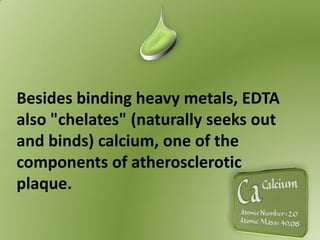
Besides binding heavy metals, EDTA
also "chelates" (naturally seeks out
and binds) calcium, one of the
components of atherosclerotic
plaque.
In the early 1960s, this led to peculation
that EDTA could remove calcium deposits
from buildups in arteries. The idea was that
once the calcium was removed by regular
treatments of EDTA, the remaining
elements in the plaque would break up and
the plaque would clear away. The narrowed
arteries would be restored to their former
state.
Based upon this thinking,
chelation therapy has been
 proposed to treat existing
   atherosclerosis and to
  prevent it from forming.
After carefully reviewing all the
available scientific literature on this
subject, the American Heart
Association has concluded that the
benefits claimed for this form of
therapy aren’t scientifically proven.
That’s why we don’t recommend this
type of treatment.
Lou Principe
Informational Speaker

   251-367-7953
Lou@LouPrincipe.com

What Is Chelation Therapy

  • 1.
  • 2.
    American Heart Association Website: Chelation therapy is administering a man- made amino acid called EDTA into the veins. (EDTA is an abbreviation for ethylenediamine tetraacetic acid. It’s marketed under several names, including Edetate, Disodium, Endrate, and Sodium Versenate.)
  • 3.
    American Heart AssociationWebsite: EDTA is most often used in cases of heavy metal poisoning (lead or mercury). That’s because it can latch onto or bind these metals, creating a compound that can be excreted in the urine.
  • 4.
    Besides binding heavymetals, EDTA also "chelates" (naturally seeks out and binds) calcium, one of the components of atherosclerotic plaque.
  • 5.
    In the early1960s, this led to peculation that EDTA could remove calcium deposits from buildups in arteries. The idea was that once the calcium was removed by regular treatments of EDTA, the remaining elements in the plaque would break up and the plaque would clear away. The narrowed arteries would be restored to their former state.
  • 6.
    Based upon thisthinking, chelation therapy has been proposed to treat existing atherosclerosis and to prevent it from forming.
  • 7.
    After carefully reviewingall the available scientific literature on this subject, the American Heart Association has concluded that the benefits claimed for this form of therapy aren’t scientifically proven. That’s why we don’t recommend this type of treatment.
  • 8.
    Lou Principe Informational Speaker 251-367-7953 Lou@LouPrincipe.com