Trisha Gee, Java Driver Developer
#JFokus
What do you mean,
Backwards Compatibility?
@trisha_gee
Trisha Gee, Java Driver Developer
#JFokus
Stuff I Should Have Already
Known
@trisha_gee
customer = {
_id: "joe",
name: "Joe Bookreader",
address: {
street: "123 Fake St",
city: "Faketon",
state: "MA",
zip: 12345
}
books: [ 27464, 747854, ...]
}
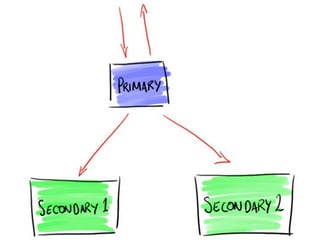
Replica Set
MongoDB
MongoDB
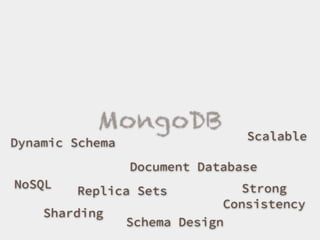
NoSQL
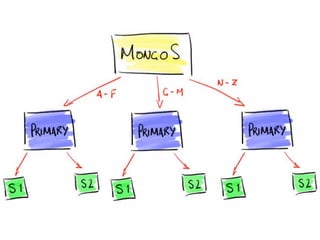
Sharding
Replica Sets
Document Database
Scalable
Dynamic Schema
Strong
Consistency
Schema Design
MongoDB
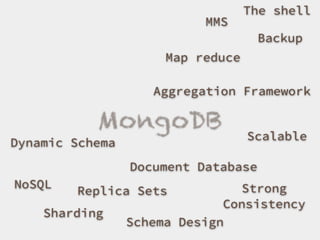
NoSQL
Sharding
Replica Sets
Document Database
Scalable
Dynamic Schema
Strong
Consistency
Schema Design
The shell
Map reduce
MMS
Backup
Aggregation Framework
MongoDB
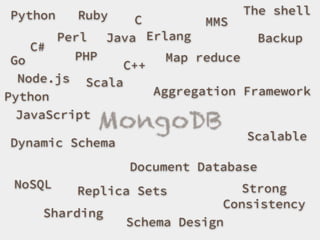
NoSQL
Python
Perl
PHP
Ruby
Node.js
C#
Java
Sharding
Replica Sets
Document Database
Scalable
Dynamic Schema
Strong
Consistency
Schema Design
The shell
Map reduce
MMS
Backup
Aggregation Framework
Scala
C
C++Go
Erlang
Python
JavaScript
The Java Driver
Te>
xt
Te>
xt
What do you want
to do?
_
Te>
xt
Te>
xt
What do you want
to do?
_
Common Problems
Our Solutions
...not unique to us
which is the point
really.
“Let me help you
with that”
We’re using different
words
Or the same words to
mean different things
Ubiquitous Language
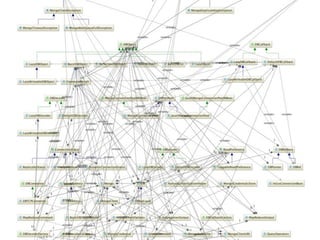
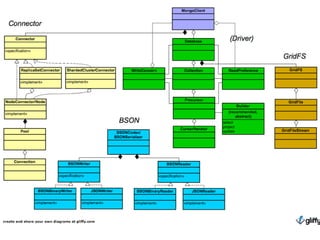
UML
Documentation
Your API is your UI
Naming is Hard
This takes ages...
DO THIS FIRST
The code is hard to
debug and modify
Re-write the whole
driver
Re-write the whole
driver
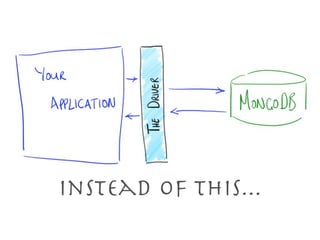
Anti Corruption
Layer
Instead of this...
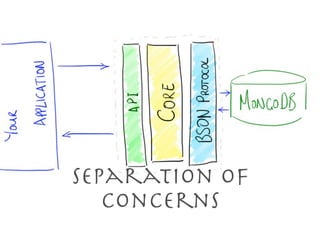
Separation of
Concerns
Pluggable APIs
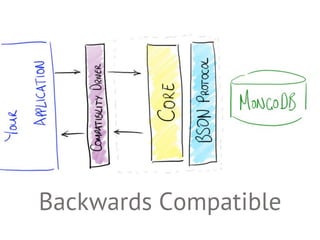
Backwards Compatible
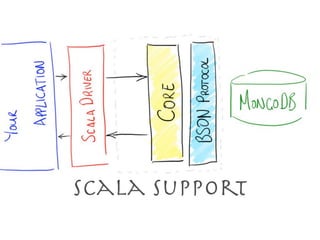
Scala Support
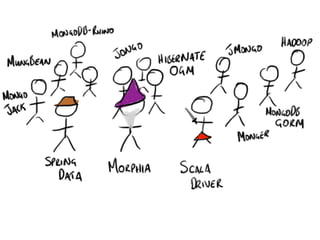
Support other
libraries
Easier to maintain
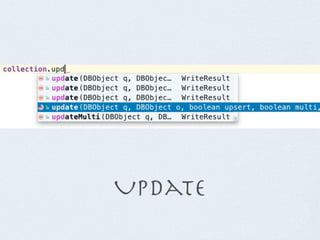
Confusing API
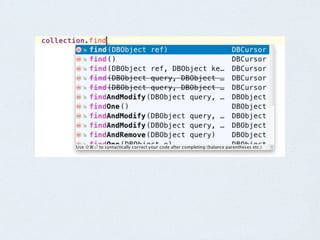
Method Overloading
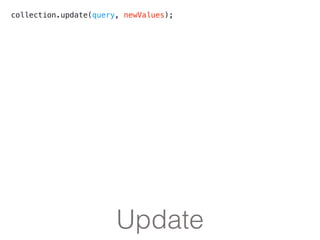
Update
Update
Update
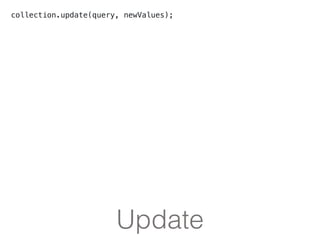
collection.update(query, newValues);
Update
Update
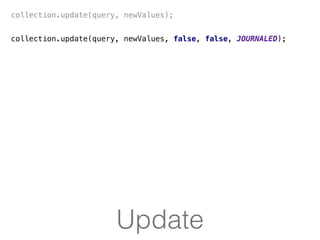
collection.update(query, newValues);
collection.update(query, newValues, false, false, JOURNALED);
DSL-ish
Update
Update
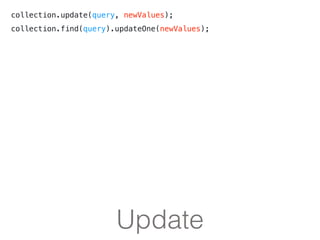
collection.update(query, newValues);
Update
collection.update(query, newValues);
collection.find(query).updateOne(newValues);
Update
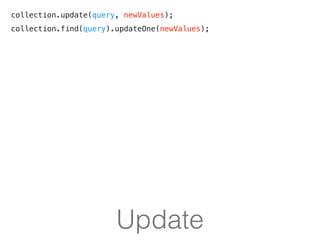
collection.update(query, newValues);
collection.find(query).updateOne(newValues);
Update
Update
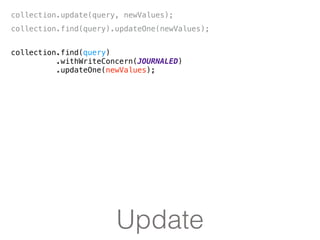
collection.update(query, newValues);
collection.find(query).updateOne(newValues);
collection.find(query)
.withWriteConcern(JOURNALED)
.updateOne(newValues);
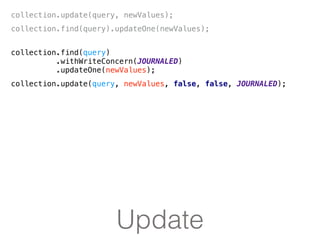
Update
collection.update(query, newValues);
collection.find(query).updateOne(newValues);
collection.find(query)
.withWriteConcern(JOURNALED)
.updateOne(newValues);
collection.update(query, newValues, false, false, JOURNALED);
Self Documenting
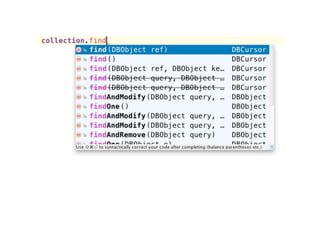
IDE-friendly
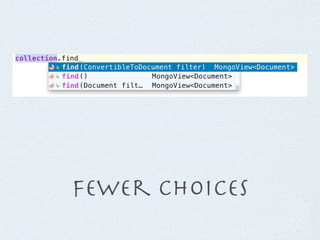
Fewer choices
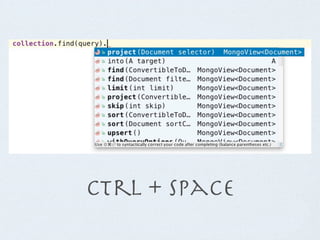
Ctrl + space
Testing is Hard and
Boring
...and we can’t agree
on style
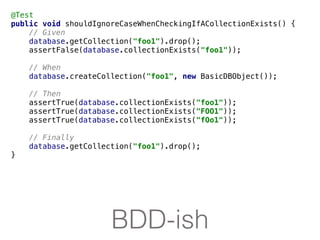
BDD-ish
@Test
public void shouldIgnoreCaseWhenCheckingIfACollectionExists() {
// Given
database.getCollection("foo1").drop();
assertFalse(database.collectionExists("foo1"));
// When
database.createCollection("foo1", new BasicDBObject());
// Then
assertTrue(database.collectionExists("foo1"));
assertTrue(database.collectionExists("FOO1"));
assertTrue(database.collectionExists("fOo1"));
// Finally
database.getCollection("foo1").drop();
}
vs
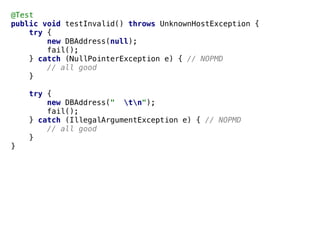
@Test
public void testInvalid() throws UnknownHostException {
try {
new DBAddress(null);
fail();
} catch (NullPointerException e) { // NOPMD
// all good
}
try {
new DBAddress(" tn");
fail();
} catch (IllegalArgumentException e) { // NOPMD
// all good
}
}
...and the tests are
confusing
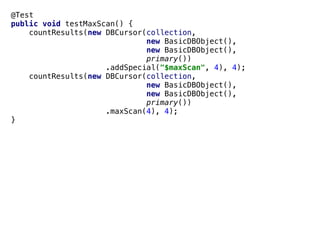
@Test
public void testMaxScan() {
countResults(new DBCursor(collection,
new BasicDBObject(),
primary())
.addSpecial("$maxScan", 4), 4);
countResults(new DBCursor(collection,
new BasicDBObject(),
primary())
.maxScan(4), 4);
}
Spock!
def 'should throw duplicate key when response has a duplicate key
error code'() {
given:
def commandResult = new CommandResult(new ServerAddress(),
['ok' : 1,
'err' : 'E11000',
'code': 11000] as Document,
1);
when:
ProtocolHelper.getWriteResult(commandResult)
then:
def e = thrown(MongoDuplicateKeyException)
e.getErrorCode() == 11000
}
Really? Groovy?
Our tests are our
documentation
BDD-ish thinking
Test styles
converging
Data Driven Testing
def '#wc should return write concern document #commandDocument'()
{
expect:
wc.asDocument() == commandDocument;
where:
wc | commandDocument
WriteConcern.ACKNOWLEDGED | ['w' : 1]
WriteConcern.JOURNALED | ['w' : 1, 'j': true]
WriteConcern.FSYNCED | ['w' : 1, 'fsync': true]
new WriteConcern('majority') | ['w': 'majority']
new WriteConcern(2, 100) | ['w' : 2, 'wtimeout': 100]
}
Data Driven Testing
def '#wc should return write concern document #commandDocument'()
{
expect:
wc.asDocument() == commandDocument;
where:
wc | commandDocument
WriteConcern.ACKNOWLEDGED | ['w' : 1]
WriteConcern.JOURNALED | ['w' : 1, 'j': true]
WriteConcern.FSYNCED | ['w' : 1, 'fsync': true]
new WriteConcern('majority') | ['w': 'majority']
new WriteConcern(2, 100) | ['w' : 2, 'wtimeout': 100]
}
is.gd/ddTest
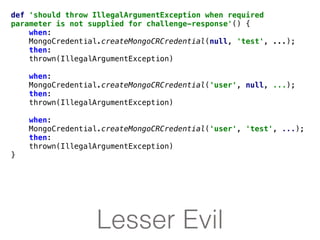
Lesser Evil
def 'should throw IllegalArgumentException when required
parameter is not supplied for challenge-response'() {
when:
MongoCredential.createMongoCRCredential(null, 'test', ...);
then:
thrown(IllegalArgumentException)
when:
MongoCredential.createMongoCRCredential('user', null, ...);
then:
thrown(IllegalArgumentException)
when:
MongoCredential.createMongoCRCredential('user', 'test', ...);
then:
thrown(IllegalArgumentException)
}
Java 8 is coming
Lambdas
New Collections API
Date & Time
...and other stuff
But we support 1.5
But we support 1.5
But we support 1.6
Do Your Homework
Single Method
Interfaces
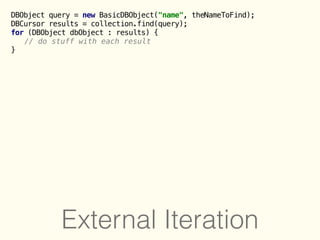
External Iteration
DBObject query = new BasicDBObject("name", theNameToFind);
DBCursor results = collection.find(query);
for (DBObject dbObject : results) {
// do stuff with each result
}
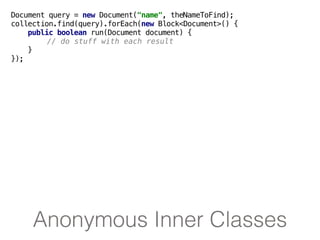
Anonymous Inner Classes
Document query = new Document("name", theNameToFind);
collection.find(query).forEach(new Block<Document>() {
public boolean run(Document document) {
// do stuff with each result
}
});
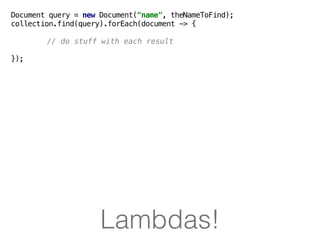
Lambdas!
Document query = new Document("name", theNameToFind);
collection.find(query).forEach(document -> {
// do stuff with each result
});
API supports
lambdas
(Mongo) Collection
API Java 8-ish
Separation of
Concerns
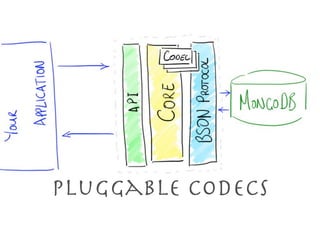
Pluggable Codecs
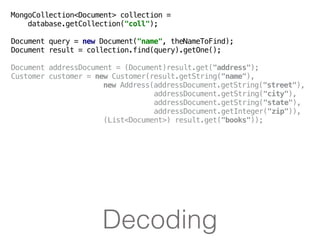
Decoding
MongoCollection<Document> collection =
database.getCollection("coll");
Document query = new Document("name", theNameToFind);
Document result = collection.find(query).getOne();
Document addressDocument = (Document)result.get("address");
Customer customer = new Customer(result.getString("name"),
new Address(addressDocument.getString("street"),
addressDocument.getString("city"),
addressDocument.getString("state"),
addressDocument.getInteger("zip")),
(List<Document>) result.get("books"));
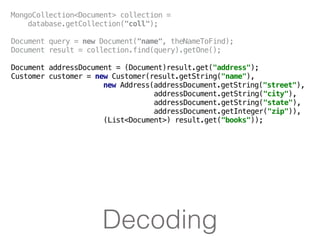
Decoding
MongoCollection<Document> collection =
database.getCollection("coll");
Document query = new Document("name", theNameToFind);
Document result = collection.find(query).getOne();
Document addressDocument = (Document)result.get("address");
Customer customer = new Customer(result.getString("name"),
new Address(addressDocument.getString("street"),
addressDocument.getString("city"),
addressDocument.getString("state"),
addressDocument.getInteger("zip")),
(List<Document>) result.get("books"));
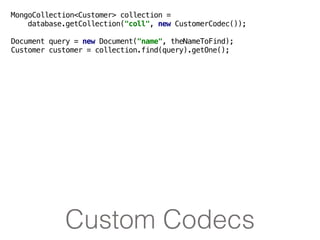
Custom Codecs
MongoCollection<Customer> collection =
database.getCollection("coll", new CustomerCodec());
Document query = new Document("name", theNameToFind);
Customer customer = collection.find(query).getOne();
Now With Generics!
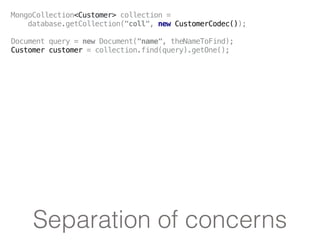
Separation of concerns
MongoCollection<Customer> collection =
database.getCollection("coll", new CustomerCodec());
Document query = new Document("name", theNameToFind);
Customer customer = collection.find(query).getOne();
Decoding code in
one place
Can support new
Date & Time
Caveat: Under
Construction
Unfinished Business
Codecs
New Public API
Clear testing
definitions
Continuous Delivery
The Driver!!!
Lessons Learnt
It’s been done
before:
Domain Driven
Design
Separation of
Concerns
The API is your UI
The tools exist
Don’t wait for Java 8
What’s in it for you?
Try This At Home
Try This At Work
Download & use the
new MongoDB driver
is.gd/java3mongodb
Come play
http://is.gd/java3mongodb
#JFokus
Questions
@trisha_gee
I want to run the
tests
Every time before I
check in
I want good quality
pull requests
I want it to be easy
for people to start
If it can be
automated, do it
Gradle
Painless Dependency
Management
Easy to introduce
static analysis
Wrapper = no extra
overhead
Easy to get started
as a contributor
Includes IDE Setup
Performance
Bottlenecks
More Servers =
More Delay
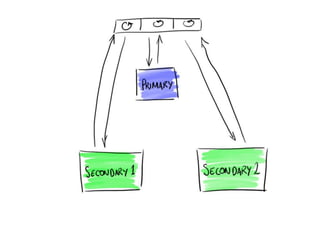
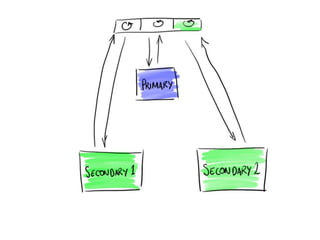
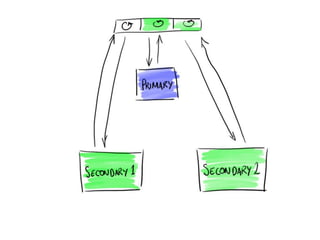
Event Driven
Async = Good
Events = Good
Scalable

What do you mean, Backwards Compatibility?