Sharon Armon Lotem Wh-Questions 1
Questions in English
• Yes/no questions are marked only by subject-auxiliary
inversion, i.e., an overt syntactic change in word order in
which the auxiliary is raised into C. Do-support operates
when there is no auxiliary is the declarative.
• [Spec, CP] is the target for overt Wh-movement both in
matrix and embedded clauses, with subject-auxiliary
inversion in matrix clauses, but not in embedded clause.
Do-support operates when there is no auxiliary is the
declarative.
a. What did the child see?
b. The teacher wondered what the child saw.
Sharon Armon Lotem Wh-Questions 2
TD Acquisition
Phase I
• Children use neither modals nor auxiliaries
• Yes/no questions are marked only with rising intonation
• Wh-word appears sentence initially in wh-questions
without inversion.
• A limited set, ‘what,’ ‘where’ and ‘why,’ ( ‘where NP go?,’
‘what NP doing?’)
• Children do not seem to understand wh-questions and
their responses are often inappropriate (Radford 1990)
Sharon Armon Lotem Wh-Questions 3
Phase II
• Auxiliary verbs are used in subject auxiliary
inversion for yes/no questions
• Auxiliary verbs are not used for wh-questions.
• Wh-questions involve productive use of an
extended set of wh-words, but no inversion.
Phase III
• Children make adult use of question formation,
which involves subject-auxiliary inversion.
Sharon Armon Lotem Wh-Questions 4
What determines the order in which
questions are acquired?
• Wh in-situ hypothesis (WISH) – universally wh in-situ
with no overt movement is allowed by UG. Subject
questions can be interpreted as in-situ, while objects
require movement.
• Vacuous movement hypothesis (VMH) – the wh-
parameter can be either + or – movement, but we should
not have both options within one language. In English all
questions involve movement, only it is invisible for
subjects
• Proper government hypothesis (PGH) - traces (of
movement) must be properly governed. Object traces
are theta-governed by the verb, while subject (and
adjunct) traces must be antecedent governed (cf.
complements are obligatory, everything else is optional).
Sharon Armon Lotem Wh-Questions 5
Predictions:
• WISH – subject questions first
• VMH – subject and object questions at the
same time
• PGH – object questions first
Sharon Armon Lotem Wh-Questions 6
Stromswold, K. 1995. The acquisition of
subject and object wh-questions. Language
Acquisition, 4, 5-48
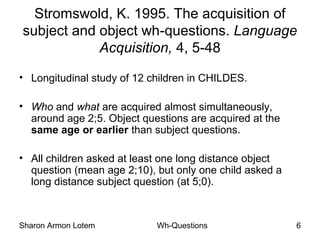
• Longitudinal study of 12 children in CHILDES.
• Who and what are acquired almost simultaneously,
around age 2;5. Object questions are acquired at the
same age or earlier than subject questions.
• All children asked at least one long distance object
question (mean age 2;10), but only one child asked a
long distance subject question (at 5;0).
Sharon Armon Lotem Wh-Questions 7
By the age of 2;6
• TD children use wh-movement properly
• TD children do not show problem with wh-
non-local dependency
• TD children have no problem with theta-
government
Sharon Armon Lotem Wh-Questions 8
Wh-movement in children with
grammatical SLI: A test of the
RDDR hypothesis
Van der Lely HKJ and Battell J (2003),
Language 79: 153-181
• SLI subjects fail to master the syntax of the two
types of movement operation involved in wh-
questions (preposing a wh-expression and
preposing an auxiliary).
• This is the result of difficulties they have in
processing non-local dependencies.
Sharon Armon Lotem Wh-Questions 9
Subjects
• 15 SLI subjects aged from 11;3 to 18;2
• 12 TD (typically developing) grammar-
matched children aged from 5;3 to 7;4
• 12 TD (typically developing) vocabulary-
matched children aged from 7;4 to 9;1
Sharon Armon Lotem Wh-Questions 10
Method
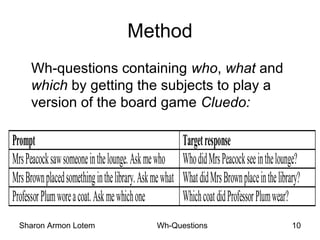
Wh-questions containing who, what and
which by getting the subjects to play a
version of the board game Cluedo:
Prompt Targetresponse
MrsPeacocksawsomeoneinthelounge.Askmewho WhodidMrsPeacockseeinthelounge?
MrsBrownplacedsomethinginthelibrary.Askmewhat WhatdidMrsBrownplaceinthelibrary?
ProfessorPlumworeacoat.Askmewhichone WhichcoatdidProfessorPlumwear?
Sharon Armon Lotem Wh-Questions 11
Findings
Types oferror producedby thesubjects
SLIsubjects Younger TD controls Older TD controls
No errors 0/15 (0%) 6/12 (50%) 12/12 (100%)
AUX errors only 3/15 (20%) 4/12(33%) 0/12 (0%)
WH errors only 0/15 (0%) 1/12 (8%) 0/12 (0%)
WH andAUX errors 12/15 (80%) 1/12 (8%) 0/12 (0%)
Sharon Armon Lotem Wh-Questions 12
Wh-errors
(a) Who Miss Scarlett saw somebody? (Response to ‘Miss
Scarlet saw someone in the lounge. Ask me who’ – the
target response being Who did Miss Scarlet see in the
lounge?)
(b) Which Reverend Green open a door? (Response to
‘Reverend Green opened a door. Ask me which one’ –
the target response being Which door did Rev. Green
open?).
(c) What did Colonel Mustard had something in his pocket?
(Response to ‘Something was in Colonel Mustard’s
pocket. Ask me what’ – the target response being What
was in Colonel Mustard’s pocket?).
Sharon Armon Lotem Wh-Questions 13
Summary of findings
• SLI subjects have far more problems with the
syntax of wh-questions than language-matched
TD controls.
• The pattern of errors made by the SLI subjects
differs from the pattern of errors made by the TD
subjects:
– Most SLI subjects have problems with both auxiliaries
and wh-expressions
– Most TD subjects have problems with neither, or only
with auxiliary inversion.
Sharon Armon Lotem Wh-Questions 14
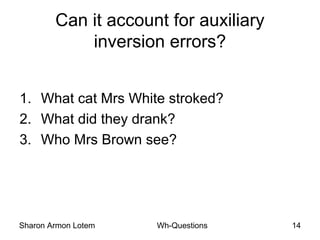
Can it account for auxiliary
inversion errors?
1. What cat Mrs White stroked?
2. What did they drank?
3. Who Mrs Brown see?
Sharon Armon Lotem Wh-Questions 15
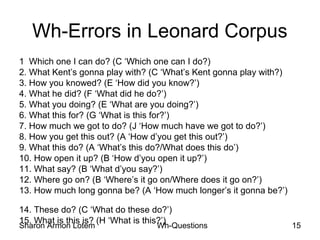
Wh-Errors in Leonard Corpus
1 Which one I can do? (C ‘Which one can I do?)
2. What Kent’s gonna play with? (C ‘What’s Kent gonna play with?)
3. How you knowed? (E ‘How did you know?’)
4. What he did? (F ‘What did he do?’)
5. What you doing? (E ‘What are you doing?’)
6. What this for? (G ‘What is this for?’)
7. How much we got to do? (J ‘How much have we got to do?’)
8. How you get this out? (A ‘How d’you get this out?’)
9. What this do? (A ‘What’s this do?/What does this do’)
10. How open it up? (B ‘How d’you open it up?’)
11. What say? (B ‘What d’you say?’)
12. Where go on? (B ‘Where’s it go on/Where does it go on?’)
13. How much long gonna be? (A ‘How much longer’s it gonna be?’)
14. These do? (C ‘What do these do?’)
15. What is this is? (H ‘What is this?’)
Sharon Armon Lotem Wh-Questions 16
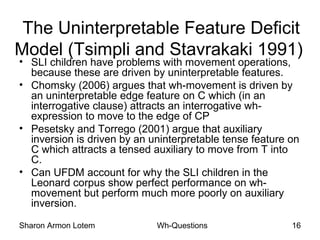
The Uninterpretable Feature Deficit
Model (Tsimpli and Stavrakaki 1991)
• SLI children have problems with movement operations,
because these are driven by uninterpretable features.
• Chomsky (2006) argues that wh-movement is driven by
an uninterpretable edge feature on C which (in an
interrogative clause) attracts an interrogative wh-
expression to move to the edge of CP
• Pesetsky and Torrego (2001) argue that auxiliary
inversion is driven by an uninterpretable tense feature on
C which attracts a tensed auxiliary to move from T into
C.
• Can UFDM account for why the SLI children in the
Leonard corpus show perfect performance on wh-
movement but perform much more poorly on auxiliary
inversion.
Sharon Armon Lotem Wh-Questions 17
Controlled naturalistic sample
(Michal Cohen 2008)
• A twenty centimeter square box is
presented which contains different objects:
• The investigator tells the child that there is
a surprise in the box. If the child wants to
open the box, she has to find out what is
in the box by asking questions.
• Once a relevant question regarding the
content of the box is asked, she received
one object from the box.
Sharon Armon Lotem Wh-Questions 18
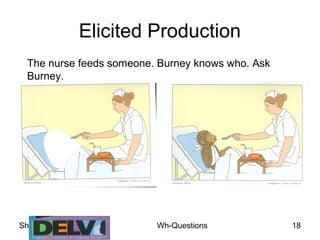
Elicited Production
The nurse feeds someone. Burney knows who. Ask
Burney.
Sharon Armon Lotem Wh-Questions 19
Picture selection task
Michal Cohen
Subject vs.
Object
Sharon Armon Lotem Wh-Questions 20
Other topics: From Singleton to
Exhaustive: the Acquisition of
Wh-
Roeper, T., Schulz, P., Pearson, B. Z. &
Reckling, I. (2006). From singleton to
exhaustive: The acquisition of wh-. Proceedings
of SULA 2005 Conference (Semantics of
Understudied Languages), Buffalo NY.
Sharon Armon Lotem Wh-Questions 21
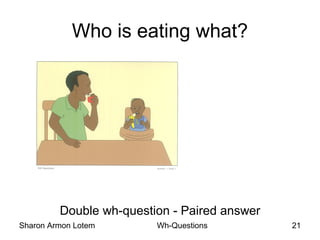
Who is eating what?
Double wh-question - Paired answer
Sharon Armon Lotem Wh-Questions 22
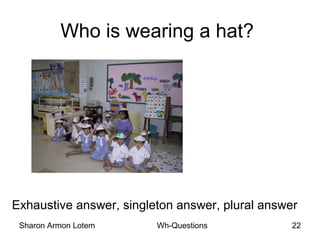
Who is wearing a hat?
Exhaustive answer, singleton answer, plural answer
Sharon Armon Lotem Wh-Questions 23
The [+variable] Feature
• Necessary in order to recognize
exhaustivity
• Specificity: relating to pre-established
elements in the discourse
+Specific = - variable = singleton,
-Specific = +variable = exhaustive/paired.
• Child’s initial default assumption:
Questions are specific in nature
Sharon Armon Lotem Wh-Questions 24
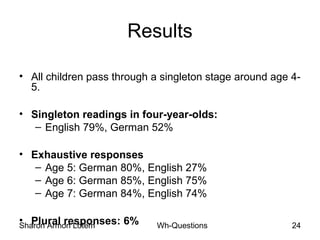
Results
• All children pass through a singleton stage around age 4-
5.
• Singleton readings in four-year-olds:
– English 79%, German 52%
• Exhaustive responses
– Age 5: German 80%, English 27%
– Age 6: German 85%, English 75%
– Age 7: German 84%, English 74%
• Plural responses: 6%

Wh questions by ami

  • 1.
    Sharon Armon LotemWh-Questions 1 Questions in English • Yes/no questions are marked only by subject-auxiliary inversion, i.e., an overt syntactic change in word order in which the auxiliary is raised into C. Do-support operates when there is no auxiliary is the declarative. • [Spec, CP] is the target for overt Wh-movement both in matrix and embedded clauses, with subject-auxiliary inversion in matrix clauses, but not in embedded clause. Do-support operates when there is no auxiliary is the declarative. a. What did the child see? b. The teacher wondered what the child saw.
  • 2.
    Sharon Armon LotemWh-Questions 2 TD Acquisition Phase I • Children use neither modals nor auxiliaries • Yes/no questions are marked only with rising intonation • Wh-word appears sentence initially in wh-questions without inversion. • A limited set, ‘what,’ ‘where’ and ‘why,’ ( ‘where NP go?,’ ‘what NP doing?’) • Children do not seem to understand wh-questions and their responses are often inappropriate (Radford 1990)
  • 3.
    Sharon Armon LotemWh-Questions 3 Phase II • Auxiliary verbs are used in subject auxiliary inversion for yes/no questions • Auxiliary verbs are not used for wh-questions. • Wh-questions involve productive use of an extended set of wh-words, but no inversion. Phase III • Children make adult use of question formation, which involves subject-auxiliary inversion.
  • 4.
    Sharon Armon LotemWh-Questions 4 What determines the order in which questions are acquired? • Wh in-situ hypothesis (WISH) – universally wh in-situ with no overt movement is allowed by UG. Subject questions can be interpreted as in-situ, while objects require movement. • Vacuous movement hypothesis (VMH) – the wh- parameter can be either + or – movement, but we should not have both options within one language. In English all questions involve movement, only it is invisible for subjects • Proper government hypothesis (PGH) - traces (of movement) must be properly governed. Object traces are theta-governed by the verb, while subject (and adjunct) traces must be antecedent governed (cf. complements are obligatory, everything else is optional).
  • 5.
    Sharon Armon LotemWh-Questions 5 Predictions: • WISH – subject questions first • VMH – subject and object questions at the same time • PGH – object questions first
  • 6.
    Sharon Armon LotemWh-Questions 6 Stromswold, K. 1995. The acquisition of subject and object wh-questions. Language Acquisition, 4, 5-48 • Longitudinal study of 12 children in CHILDES. • Who and what are acquired almost simultaneously, around age 2;5. Object questions are acquired at the same age or earlier than subject questions. • All children asked at least one long distance object question (mean age 2;10), but only one child asked a long distance subject question (at 5;0).
  • 7.
    Sharon Armon LotemWh-Questions 7 By the age of 2;6 • TD children use wh-movement properly • TD children do not show problem with wh- non-local dependency • TD children have no problem with theta- government
  • 8.
    Sharon Armon LotemWh-Questions 8 Wh-movement in children with grammatical SLI: A test of the RDDR hypothesis Van der Lely HKJ and Battell J (2003), Language 79: 153-181 • SLI subjects fail to master the syntax of the two types of movement operation involved in wh- questions (preposing a wh-expression and preposing an auxiliary). • This is the result of difficulties they have in processing non-local dependencies.
  • 9.
    Sharon Armon LotemWh-Questions 9 Subjects • 15 SLI subjects aged from 11;3 to 18;2 • 12 TD (typically developing) grammar- matched children aged from 5;3 to 7;4 • 12 TD (typically developing) vocabulary- matched children aged from 7;4 to 9;1
  • 10.
    Sharon Armon LotemWh-Questions 10 Method Wh-questions containing who, what and which by getting the subjects to play a version of the board game Cluedo: Prompt Targetresponse MrsPeacocksawsomeoneinthelounge.Askmewho WhodidMrsPeacockseeinthelounge? MrsBrownplacedsomethinginthelibrary.Askmewhat WhatdidMrsBrownplaceinthelibrary? ProfessorPlumworeacoat.Askmewhichone WhichcoatdidProfessorPlumwear?
  • 11.
    Sharon Armon LotemWh-Questions 11 Findings Types oferror producedby thesubjects SLIsubjects Younger TD controls Older TD controls No errors 0/15 (0%) 6/12 (50%) 12/12 (100%) AUX errors only 3/15 (20%) 4/12(33%) 0/12 (0%) WH errors only 0/15 (0%) 1/12 (8%) 0/12 (0%) WH andAUX errors 12/15 (80%) 1/12 (8%) 0/12 (0%)
  • 12.
    Sharon Armon LotemWh-Questions 12 Wh-errors (a) Who Miss Scarlett saw somebody? (Response to ‘Miss Scarlet saw someone in the lounge. Ask me who’ – the target response being Who did Miss Scarlet see in the lounge?) (b) Which Reverend Green open a door? (Response to ‘Reverend Green opened a door. Ask me which one’ – the target response being Which door did Rev. Green open?). (c) What did Colonel Mustard had something in his pocket? (Response to ‘Something was in Colonel Mustard’s pocket. Ask me what’ – the target response being What was in Colonel Mustard’s pocket?).
  • 13.
    Sharon Armon LotemWh-Questions 13 Summary of findings • SLI subjects have far more problems with the syntax of wh-questions than language-matched TD controls. • The pattern of errors made by the SLI subjects differs from the pattern of errors made by the TD subjects: – Most SLI subjects have problems with both auxiliaries and wh-expressions – Most TD subjects have problems with neither, or only with auxiliary inversion.
  • 14.
    Sharon Armon LotemWh-Questions 14 Can it account for auxiliary inversion errors? 1. What cat Mrs White stroked? 2. What did they drank? 3. Who Mrs Brown see?
  • 15.
    Sharon Armon LotemWh-Questions 15 Wh-Errors in Leonard Corpus 1 Which one I can do? (C ‘Which one can I do?) 2. What Kent’s gonna play with? (C ‘What’s Kent gonna play with?) 3. How you knowed? (E ‘How did you know?’) 4. What he did? (F ‘What did he do?’) 5. What you doing? (E ‘What are you doing?’) 6. What this for? (G ‘What is this for?’) 7. How much we got to do? (J ‘How much have we got to do?’) 8. How you get this out? (A ‘How d’you get this out?’) 9. What this do? (A ‘What’s this do?/What does this do’) 10. How open it up? (B ‘How d’you open it up?’) 11. What say? (B ‘What d’you say?’) 12. Where go on? (B ‘Where’s it go on/Where does it go on?’) 13. How much long gonna be? (A ‘How much longer’s it gonna be?’) 14. These do? (C ‘What do these do?’) 15. What is this is? (H ‘What is this?’)
  • 16.
    Sharon Armon LotemWh-Questions 16 The Uninterpretable Feature Deficit Model (Tsimpli and Stavrakaki 1991) • SLI children have problems with movement operations, because these are driven by uninterpretable features. • Chomsky (2006) argues that wh-movement is driven by an uninterpretable edge feature on C which (in an interrogative clause) attracts an interrogative wh- expression to move to the edge of CP • Pesetsky and Torrego (2001) argue that auxiliary inversion is driven by an uninterpretable tense feature on C which attracts a tensed auxiliary to move from T into C. • Can UFDM account for why the SLI children in the Leonard corpus show perfect performance on wh- movement but perform much more poorly on auxiliary inversion.
  • 17.
    Sharon Armon LotemWh-Questions 17 Controlled naturalistic sample (Michal Cohen 2008) • A twenty centimeter square box is presented which contains different objects: • The investigator tells the child that there is a surprise in the box. If the child wants to open the box, she has to find out what is in the box by asking questions. • Once a relevant question regarding the content of the box is asked, she received one object from the box.
  • 18.
    Sharon Armon LotemWh-Questions 18 Elicited Production The nurse feeds someone. Burney knows who. Ask Burney.
  • 19.
    Sharon Armon LotemWh-Questions 19 Picture selection task Michal Cohen Subject vs. Object
  • 20.
    Sharon Armon LotemWh-Questions 20 Other topics: From Singleton to Exhaustive: the Acquisition of Wh- Roeper, T., Schulz, P., Pearson, B. Z. & Reckling, I. (2006). From singleton to exhaustive: The acquisition of wh-. Proceedings of SULA 2005 Conference (Semantics of Understudied Languages), Buffalo NY.
  • 21.
    Sharon Armon LotemWh-Questions 21 Who is eating what? Double wh-question - Paired answer
  • 22.
    Sharon Armon LotemWh-Questions 22 Who is wearing a hat? Exhaustive answer, singleton answer, plural answer
  • 23.
    Sharon Armon LotemWh-Questions 23 The [+variable] Feature • Necessary in order to recognize exhaustivity • Specificity: relating to pre-established elements in the discourse +Specific = - variable = singleton, -Specific = +variable = exhaustive/paired. • Child’s initial default assumption: Questions are specific in nature
  • 24.
    Sharon Armon LotemWh-Questions 24 Results • All children pass through a singleton stage around age 4- 5. • Singleton readings in four-year-olds: – English 79%, German 52% • Exhaustive responses – Age 5: German 80%, English 27% – Age 6: German 85%, English 75% – Age 7: German 84%, English 74% • Plural responses: 6%

Editor's Notes

  • #23 Not “mention-some” questions: Where is a bathroom around here? There’s one down the hall.
  • #24 Specificty: John missed the train can be definite or specific.
  • #25 Formal Feature Hypothesis The language learner begins with the concept of [specific] which allows a singleton reading. Then, she acquires non-specifity, which requires a [+variable] feature. When the [+variable] feature is linked to wh-, then exhaustivity is automatic, in principle instantly blocking the plural reading.