WevQuery: Testing Hypotheses about Web
Interaction Patterns
Aitor Apaolaza
Markel Vigo
EICS 2017
June 28, 2017 - Lisbon, Portugal
WevQuery
EICS 2017
Motivation
● We don’t know what users do
● We can get the data, but we don’t have the expertise to handle it
● Data is big, confusing and difficult to handle
2
WevQuery
EICS 2017
3
WevQuery
EICS 2017
Lab settings
● Strengths
○ Provide a deep understanding
○ Allows for controlling variables
○ Good for internal validity
● Weaknesses
○ Resource demands: time for data analysis
○ Guinea Pig effect and response bias
○ Task driven
○ Risks to external validity
○ Recruitment problem
4
WevQuery
EICS 2017
Remote settings
● Strengths
○ Good for external validity (if naturalistic)
○ Ecologically valid
○ Users are easily recruited
○ Easy to implement
● Weaknesses
○ Resource demands: have the right infrastructure
○ Cannot control the confounding variables
5
WevQuery
EICS 2017
Remote log file analysis
● Common technique for HCI and IR
● Large data: millions of datapoints from thousands of users
● Current approaches have one or more drawbacks:
○ Not informative enough
○ Not straightforward for non-specialists
○ Not flexible
○ Not scalable
○ Lack of support for decision-making
● WevQuery addresses the above issues
6
WevQuery
EICS 2017
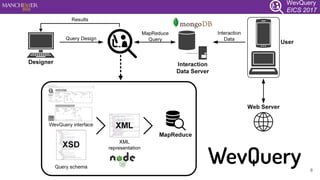
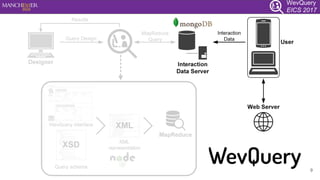
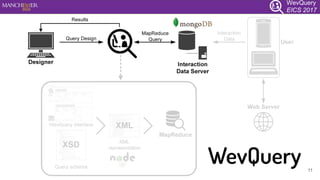
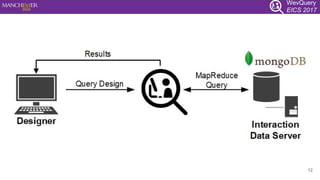
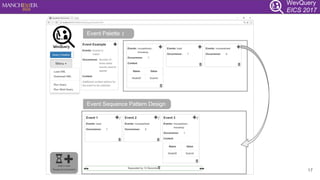
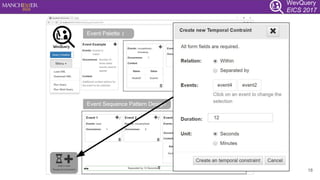
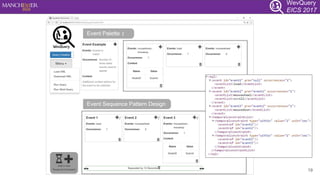
What’s WevQuery
● Web Event Query
● Bridge the gap between designers and data analysts
● Guided, flexible and visual query system
● Users without data analysis experience
● Highly scalable
7
WevQuery
EICS 2017
8
WevQuery
EICS 2017
9
WevQuery
EICS 2017
10
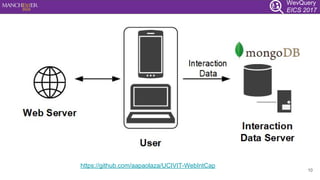
https://github.com/aapaolaza/UCIVIT-WebIntCap
WevQuery
EICS 2017
11
WevQuery
EICS 2017
12
WevQuery
EICS 2017
13
WevQuery
EICS 2017
14
WevQuery
EICS 2017
15
WevQuery
EICS 2017
16
WevQuery
EICS 2017
17
WevQuery
EICS 2017
18
WevQuery
EICS 2017
19
WevQuery
EICS 2017
Proof of concept
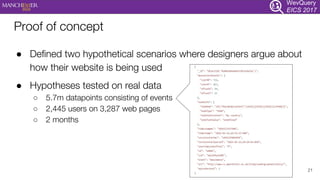
● Defined two hypothetical scenarios where designers argue about
how their website is being used
● Hypotheses tested on real data
○ 5.7m datapoints consisting of events
○ 2,445 users on 3,287 web pages
○ 2 months
20
WevQuery
EICS 2017
Proof of concept
● Defined two hypothetical scenarios where designers argue about
how their website is being used
● Hypotheses tested on real data
○ 5.7m datapoints consisting of events
○ 2,445 users on 3,287 web pages
○ 2 months
21
WevQuery
EICS 2017
22
Scenario 1
WevQuery
EICS 2017
23
Scenario 1
WevQuery
EICS 2017
Scenario 1
24
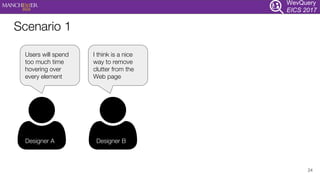
Users will spend
too much time
hovering over
every element
Designer A Designer B
I think is a nice
way to remove
clutter from the
Web page
WevQuery
EICS 2017
Scenario 1
25
Users will spend
too much time
hovering over
every element
Designer A Designer B
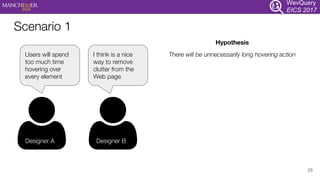
Hypothesis
There will be unnecessarily long hovering actionI think is a nice
way to remove
clutter from the
Web page
WevQuery
EICS 2017
I think is a nice
way to remove
clutter from the
Web page
Scenario 1
26
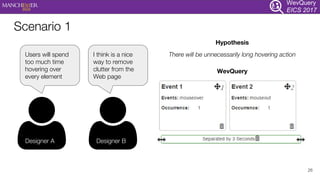
Hypothesis
There will be unnecessarily long hovering action
WevQuery
Users will spend
too much time
hovering over
every element
Designer A Designer B
WevQuery
EICS 2017
Scenario 1
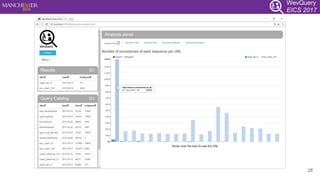
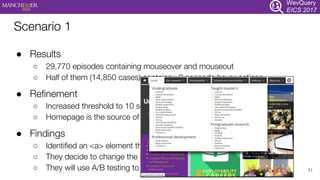
● Results
○ 29,770 episodes containing mouseover and mouseout
○ Half of them (14,850 cases) contains >3 seconds hover actions
● Refinement
○ Increased threshold to 10 seconds (down to 8,277 cases)
○ Homepage is the source of most
27
WevQuery
EICS 2017
28
WevQuery
EICS 2017
Scenario 1
● Results
○ 29,770 episodes containing mouseover and mouseout
○ Half of them (14,850 cases) contains >3 seconds hover actions
● Refinement
○ Increased threshold to 10 seconds (down to 8,277 cases)
○ Homepage is the source of most
29
WevQuery
EICS 2017
Scenario 1
● Results
○ 29,770 episodes containing mouseover and mouseout
○ Half of them (14,850 cases) contains >3 seconds hover actions
● Refinement
○ Increased threshold to 10 seconds (down to 8,277 cases)
○ Homepage is the source of most
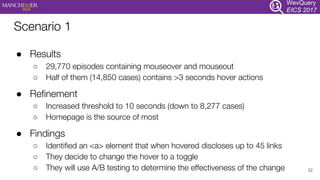
● Findings
○ Identified an <a> element that when hovered discloses up to 45 links
○ They decide to change the hover to a toggle
○ They will use A/B testing to determine the effectiveness of the change 30
WevQuery
EICS 2017
● Results
○ 29,770 episodes containing mouseover and mouseout
○ Half of them (14,850 cases) contains >3 seconds hover actions
● Refinement
○ Increased threshold to 10 seconds (down to 8,277 cases)
○ Homepage is the source of most
● Findings
○ Identified an <a> element that when hovered discloses up to 45 links
○ They decide to change the hover to a toggle
○ They will use A/B testing to determine the effectiveness of the change
Scenario 1
31
WevQuery
EICS 2017
Scenario 1
32
● Results
○ 29,770 episodes containing mouseover and mouseout
○ Half of them (14,850 cases) contains >3 seconds hover actions
● Refinement
○ Increased threshold to 10 seconds (down to 8,277 cases)
○ Homepage is the source of most
● Findings
○ Identified an <a> element that when hovered discloses up to 45 links
○ They decide to change the hover to a toggle
○ They will use A/B testing to determine the effectiveness of the change
WevQuery
EICS 2017
Scenario 2
33
WevQuery
EICS 2017
34
Scenario 2
WevQuery
EICS 2017
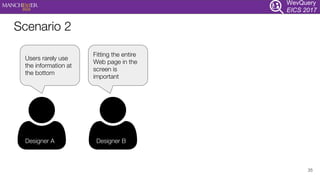
Users rarely use
the information at
the bottom
Fitting the entire
Web page in the
screen is
important
35
Designer A Designer B
Scenario 2
WevQuery
EICS 2017
36
Scenario 2
Designer A Designer B
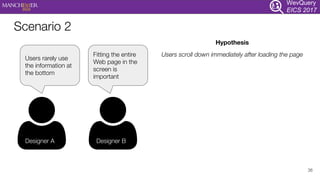
Hypothesis
Users scroll down immediately after loading the page
Users rarely use
the information at
the bottom
Fitting the entire
Web page in the
screen is
important
WevQuery
EICS 2017
37
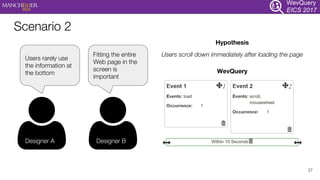
Hypothesis
Users scroll down immediately after loading the page
WevQuery
Scenario 2
Designer A Designer B
Users rarely use
the information at
the bottom
Fitting the entire
Web page in the
screen is
important
WevQuery
EICS 2017
Scenario 2
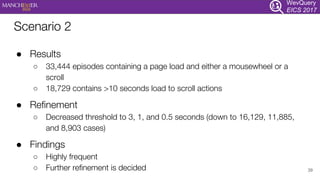
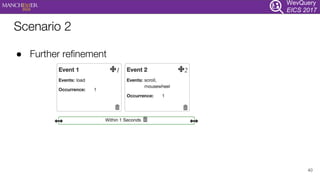
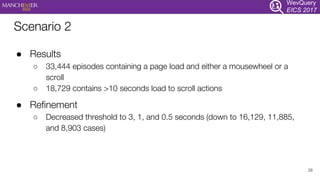
● Results
○ 33,444 episodes containing a page load and either a mousewheel or a
scroll
○ 18,729 contains >10 seconds load to scroll actions
● Refinement
○ Decreased threshold to 3, 1, and 0.5 seconds (down to 16,129, 11,885,
and 8,903 cases)
38
WevQuery
EICS 2017
Scenario 2
● Results
○ 33,444 episodes containing a page load and either a mousewheel or a
scroll
○ 18,729 contains >10 seconds load to scroll actions
● Refinement
○ Decreased threshold to 3, 1, and 0.5 seconds (down to 16,129, 11,885,
and 8,903 cases)
● Findings
○ Highly frequent
○ Further refinement is decided 39
WevQuery
EICS 2017
40
Scenario 2
● Further refinement
WevQuery
EICS 2017
41
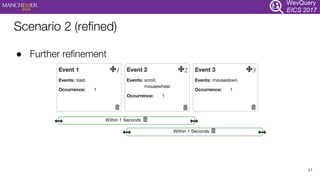
Scenario 2 (refined)
● Further refinement
WevQuery
EICS 2017
Scenario 2 (refined)
● Results
○ 371 occurrences
○ No clicks on elements at the bottom of the page
● Findings
○ Information at the bottom is not sought
○ Making pages fit the screen is beneficial
42
WevQuery
EICS 2017
Proof of concept
● Designers decide to take a compromise solution
● On the performance
○ Run on a laptop
○ Mouseover and mouseout accounts for 2.8m events (out of 5.7m)
○ Execution time depends on event frequency (~50 seconds to ~2 minutes)
43
WevQuery
EICS 2017
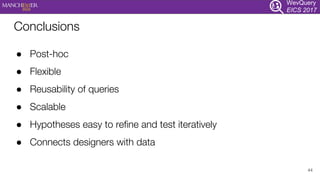
Conclusions
● Post-hoc
● Flexible
● Reusability of queries
● Scalable
● Hypotheses easy to refine and test iteratively
● Connects designers with data
44
WevQuery
EICS 2017
45
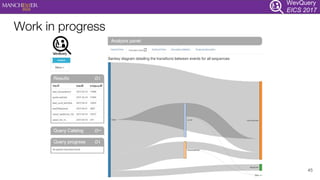
Work in progress
WevQuery
EICS 2017
Future work
● Sequence pattern mining
● Further support for non-experts
● User evaluation
46
https://github.com/aapaolaza/wevquery
aitor.apaolaza@manchester.ac.uk
Aitor Apaolaza and Markel Vigo
EICS 2017 June 28, 2017 - Lisbon, Portugal
Questions?
The MOVING project has received funding from the European
Union’s Horizon 2020 research and innovation programme under
grant agreement No 693092.

Wevquery: Testing Hypotheses about Web Interaction Patterns

  • 1.
    WevQuery: Testing Hypothesesabout Web Interaction Patterns Aitor Apaolaza Markel Vigo EICS 2017 June 28, 2017 - Lisbon, Portugal
  • 2.
    WevQuery EICS 2017 Motivation ● Wedon’t know what users do ● We can get the data, but we don’t have the expertise to handle it ● Data is big, confusing and difficult to handle 2
  • 3.
  • 4.
    WevQuery EICS 2017 Lab settings ●Strengths ○ Provide a deep understanding ○ Allows for controlling variables ○ Good for internal validity ● Weaknesses ○ Resource demands: time for data analysis ○ Guinea Pig effect and response bias ○ Task driven ○ Risks to external validity ○ Recruitment problem 4
  • 5.
    WevQuery EICS 2017 Remote settings ●Strengths ○ Good for external validity (if naturalistic) ○ Ecologically valid ○ Users are easily recruited ○ Easy to implement ● Weaknesses ○ Resource demands: have the right infrastructure ○ Cannot control the confounding variables 5
  • 6.
    WevQuery EICS 2017 Remote logfile analysis ● Common technique for HCI and IR ● Large data: millions of datapoints from thousands of users ● Current approaches have one or more drawbacks: ○ Not informative enough ○ Not straightforward for non-specialists ○ Not flexible ○ Not scalable ○ Lack of support for decision-making ● WevQuery addresses the above issues 6
  • 7.
    WevQuery EICS 2017 What’s WevQuery ●Web Event Query ● Bridge the gap between designers and data analysts ● Guided, flexible and visual query system ● Users without data analysis experience ● Highly scalable 7
  • 8.
  • 9.
  • 10.
  • 11.
  • 12.
  • 13.
  • 14.
  • 15.
  • 16.
  • 17.
  • 18.
  • 19.
  • 20.
    WevQuery EICS 2017 Proof ofconcept ● Defined two hypothetical scenarios where designers argue about how their website is being used ● Hypotheses tested on real data ○ 5.7m datapoints consisting of events ○ 2,445 users on 3,287 web pages ○ 2 months 20
  • 21.
    WevQuery EICS 2017 Proof ofconcept ● Defined two hypothetical scenarios where designers argue about how their website is being used ● Hypotheses tested on real data ○ 5.7m datapoints consisting of events ○ 2,445 users on 3,287 web pages ○ 2 months 21
  • 22.
  • 23.
  • 24.
    WevQuery EICS 2017 Scenario 1 24 Userswill spend too much time hovering over every element Designer A Designer B I think is a nice way to remove clutter from the Web page
  • 25.
    WevQuery EICS 2017 Scenario 1 25 Userswill spend too much time hovering over every element Designer A Designer B Hypothesis There will be unnecessarily long hovering actionI think is a nice way to remove clutter from the Web page
  • 26.
    WevQuery EICS 2017 I thinkis a nice way to remove clutter from the Web page Scenario 1 26 Hypothesis There will be unnecessarily long hovering action WevQuery Users will spend too much time hovering over every element Designer A Designer B
  • 27.
    WevQuery EICS 2017 Scenario 1 ●Results ○ 29,770 episodes containing mouseover and mouseout ○ Half of them (14,850 cases) contains >3 seconds hover actions ● Refinement ○ Increased threshold to 10 seconds (down to 8,277 cases) ○ Homepage is the source of most 27
  • 28.
  • 29.
    WevQuery EICS 2017 Scenario 1 ●Results ○ 29,770 episodes containing mouseover and mouseout ○ Half of them (14,850 cases) contains >3 seconds hover actions ● Refinement ○ Increased threshold to 10 seconds (down to 8,277 cases) ○ Homepage is the source of most 29
  • 30.
    WevQuery EICS 2017 Scenario 1 ●Results ○ 29,770 episodes containing mouseover and mouseout ○ Half of them (14,850 cases) contains >3 seconds hover actions ● Refinement ○ Increased threshold to 10 seconds (down to 8,277 cases) ○ Homepage is the source of most ● Findings ○ Identified an <a> element that when hovered discloses up to 45 links ○ They decide to change the hover to a toggle ○ They will use A/B testing to determine the effectiveness of the change 30
  • 31.
    WevQuery EICS 2017 ● Results ○29,770 episodes containing mouseover and mouseout ○ Half of them (14,850 cases) contains >3 seconds hover actions ● Refinement ○ Increased threshold to 10 seconds (down to 8,277 cases) ○ Homepage is the source of most ● Findings ○ Identified an <a> element that when hovered discloses up to 45 links ○ They decide to change the hover to a toggle ○ They will use A/B testing to determine the effectiveness of the change Scenario 1 31
  • 32.
    WevQuery EICS 2017 Scenario 1 32 ●Results ○ 29,770 episodes containing mouseover and mouseout ○ Half of them (14,850 cases) contains >3 seconds hover actions ● Refinement ○ Increased threshold to 10 seconds (down to 8,277 cases) ○ Homepage is the source of most ● Findings ○ Identified an <a> element that when hovered discloses up to 45 links ○ They decide to change the hover to a toggle ○ They will use A/B testing to determine the effectiveness of the change
  • 33.
  • 34.
  • 35.
    WevQuery EICS 2017 Users rarelyuse the information at the bottom Fitting the entire Web page in the screen is important 35 Designer A Designer B Scenario 2
  • 36.
    WevQuery EICS 2017 36 Scenario 2 DesignerA Designer B Hypothesis Users scroll down immediately after loading the page Users rarely use the information at the bottom Fitting the entire Web page in the screen is important
  • 37.
    WevQuery EICS 2017 37 Hypothesis Users scrolldown immediately after loading the page WevQuery Scenario 2 Designer A Designer B Users rarely use the information at the bottom Fitting the entire Web page in the screen is important
  • 38.
    WevQuery EICS 2017 Scenario 2 ●Results ○ 33,444 episodes containing a page load and either a mousewheel or a scroll ○ 18,729 contains >10 seconds load to scroll actions ● Refinement ○ Decreased threshold to 3, 1, and 0.5 seconds (down to 16,129, 11,885, and 8,903 cases) 38
  • 39.
    WevQuery EICS 2017 Scenario 2 ●Results ○ 33,444 episodes containing a page load and either a mousewheel or a scroll ○ 18,729 contains >10 seconds load to scroll actions ● Refinement ○ Decreased threshold to 3, 1, and 0.5 seconds (down to 16,129, 11,885, and 8,903 cases) ● Findings ○ Highly frequent ○ Further refinement is decided 39
  • 40.
  • 41.
    WevQuery EICS 2017 41 Scenario 2(refined) ● Further refinement
  • 42.
    WevQuery EICS 2017 Scenario 2(refined) ● Results ○ 371 occurrences ○ No clicks on elements at the bottom of the page ● Findings ○ Information at the bottom is not sought ○ Making pages fit the screen is beneficial 42
  • 43.
    WevQuery EICS 2017 Proof ofconcept ● Designers decide to take a compromise solution ● On the performance ○ Run on a laptop ○ Mouseover and mouseout accounts for 2.8m events (out of 5.7m) ○ Execution time depends on event frequency (~50 seconds to ~2 minutes) 43
  • 44.
    WevQuery EICS 2017 Conclusions ● Post-hoc ●Flexible ● Reusability of queries ● Scalable ● Hypotheses easy to refine and test iteratively ● Connects designers with data 44
  • 45.
  • 46.
    WevQuery EICS 2017 Future work ●Sequence pattern mining ● Further support for non-experts ● User evaluation 46
  • 47.
    https://github.com/aapaolaza/wevquery aitor.apaolaza@manchester.ac.uk Aitor Apaolaza andMarkel Vigo EICS 2017 June 28, 2017 - Lisbon, Portugal Questions? The MOVING project has received funding from the European Union’s Horizon 2020 research and innovation programme under grant agreement No 693092.