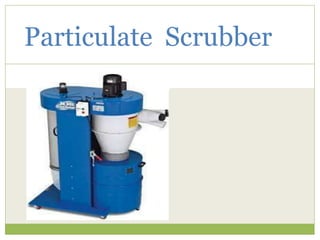
Particulate Scrubber
Many industries like chemical and Building Materials
industries may be required to reduce the amount of
particulate they release into the environment.
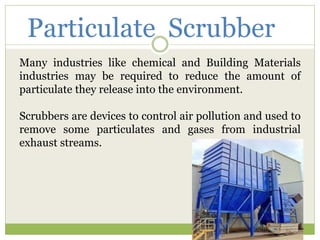
Scrubbers are devices to control air pollution and used to
remove some particulates and gases from industrial
exhaust streams.
Particulate Scrubber
The two main types of scrubbers are wet scrubbers and
dry scrubbers.
1. Wet Scrubbers
These can be used to control particulate matter less than
10 micrometers as well as inorganic gases such as SO2,
H2S, NH3, and various chlorides and fluorides. Wet
scrubbers may also be useful to control volatile organic
compounds i.e. VOCs.
Particulate Scrubber - Types
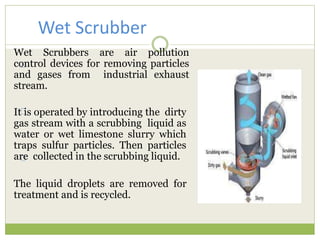
Wet Scrubbers are air pollution
control devices for removing particles
and gases from industrial exhaust
stream.
It is operated by introducing the dirty
gas stream with a scrubbing liquid as
water or wet limestone slurry which
traps sulfur particles. Then particles
are collected in the scrubbing liquid.
The liquid droplets are removed for
treatment and is recycled.
Wet Scrubber
2. Dry Scrubbers:
The system sprays a collection of dry reagents into an
exhaust stream. These chemicals can react differently
depending on which material they are specifically
targeting for removal. Some of these materials neutralize
harmful pollutants in the stream through
a chemical reaction, while others cause a material to
react and turn into a different substance.
Particulate Scrubber - Types
• What is the nature of the particulate/dust to be
removed?
• What is the particulate size distribution? What is the
initial pollutant loading/ concentration in the waste
stream? Is it flammable or combustible?
• What is the required removal efficiency?
• What is the temperature and flow rate of the waste
stream?
• Where will the scrubber be located, indoors or
outside?
The scrubber’s design will be impacted by a
wide range of variables such as:
1. Packed Tower Wet Scrubbers
2. Impingement Wet Scrubbers
3. Venturi Wet Scrubbers
Wet Scrubber - Types
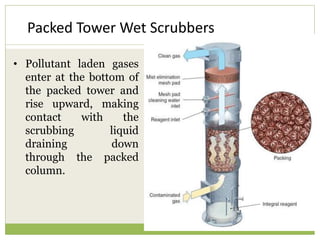
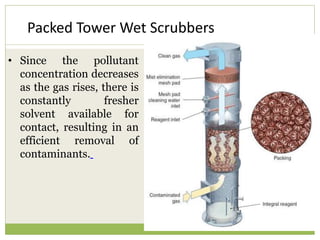
• Pollutant laden gases
enter at the bottom of
the packed tower and
rise upward, making
contact with the
scrubbing liquid
draining down
through the packed
column.
Packed Tower Wet Scrubbers
• Since the pollutant
concentration decreases
as the gas rises, there is
constantly fresher
solvent available for
contact, resulting in an
efficient removal of
contaminants.
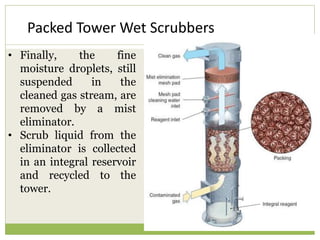
Packed Tower Wet Scrubbers
• Finally, the fine
moisture droplets, still
suspended in the
cleaned gas stream, are
removed by a mist
eliminator.
• Scrub liquid from the
eliminator is collected
in an integral reservoir
and recycled to the
tower.
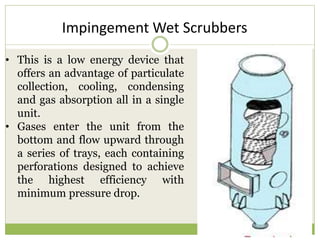
Packed Tower Wet Scrubbers
• This is a low energy device that
offers an advantage of particulate
collection, cooling, condensing
and gas absorption all in a single
unit.
• Gases enter the unit from the
bottom and flow upward through
a series of trays, each containing
perforations designed to achieve
the highest efficiency with
minimum pressure drop.
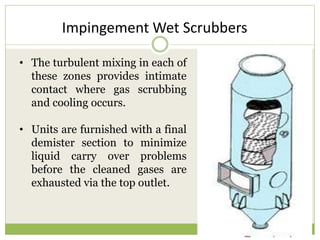
Impingement Wet Scrubbers
• Scrubbing liquid is introduced
above the top tray and cascades
downward to the lower trays.
• As the gases accelerate through
the perforations, a fluidized
zone of liquid and gas is
created.
Impingement Wet Scrubbers
• The turbulent mixing in each of
these zones provides intimate
contact where gas scrubbing
and cooling occurs.
• Units are furnished with a final
demister section to minimize
liquid carry over problems
before the cleaned gases are
exhausted via the top outlet.
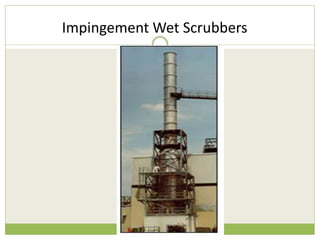
Impingement Wet Scrubbers
• The type and number of trays is selected to meet the
process requirements.
• The CGS Impingement Wet Scrubber is particularly useful
where particulate matter would foul a packed bed type
scrubber, and on applications where gas absorption and/or
sub-cooling is required.
Impingement Wet Scrubbers

wet scrubber, process, operation and applications

  • 1.
  • 2.
    Many industries likechemical and Building Materials industries may be required to reduce the amount of particulate they release into the environment. Scrubbers are devices to control air pollution and used to remove some particulates and gases from industrial exhaust streams. Particulate Scrubber
  • 3.
    The two maintypes of scrubbers are wet scrubbers and dry scrubbers. 1. Wet Scrubbers These can be used to control particulate matter less than 10 micrometers as well as inorganic gases such as SO2, H2S, NH3, and various chlorides and fluorides. Wet scrubbers may also be useful to control volatile organic compounds i.e. VOCs. Particulate Scrubber - Types
  • 4.
    Wet Scrubbers areair pollution control devices for removing particles and gases from industrial exhaust stream. It is operated by introducing the dirty gas stream with a scrubbing liquid as water or wet limestone slurry which traps sulfur particles. Then particles are collected in the scrubbing liquid. The liquid droplets are removed for treatment and is recycled. Wet Scrubber
  • 5.
    2. Dry Scrubbers: Thesystem sprays a collection of dry reagents into an exhaust stream. These chemicals can react differently depending on which material they are specifically targeting for removal. Some of these materials neutralize harmful pollutants in the stream through a chemical reaction, while others cause a material to react and turn into a different substance. Particulate Scrubber - Types
  • 6.
    • What isthe nature of the particulate/dust to be removed? • What is the particulate size distribution? What is the initial pollutant loading/ concentration in the waste stream? Is it flammable or combustible? • What is the required removal efficiency? • What is the temperature and flow rate of the waste stream? • Where will the scrubber be located, indoors or outside? The scrubber’s design will be impacted by a wide range of variables such as:
  • 7.
    1. Packed TowerWet Scrubbers 2. Impingement Wet Scrubbers 3. Venturi Wet Scrubbers Wet Scrubber - Types
  • 8.
    • Pollutant ladengases enter at the bottom of the packed tower and rise upward, making contact with the scrubbing liquid draining down through the packed column. Packed Tower Wet Scrubbers
  • 9.
    • Since thepollutant concentration decreases as the gas rises, there is constantly fresher solvent available for contact, resulting in an efficient removal of contaminants. Packed Tower Wet Scrubbers
  • 10.
    • Finally, thefine moisture droplets, still suspended in the cleaned gas stream, are removed by a mist eliminator. • Scrub liquid from the eliminator is collected in an integral reservoir and recycled to the tower. Packed Tower Wet Scrubbers
  • 12.
    • This isa low energy device that offers an advantage of particulate collection, cooling, condensing and gas absorption all in a single unit. • Gases enter the unit from the bottom and flow upward through a series of trays, each containing perforations designed to achieve the highest efficiency with minimum pressure drop. Impingement Wet Scrubbers
  • 13.
    • Scrubbing liquidis introduced above the top tray and cascades downward to the lower trays. • As the gases accelerate through the perforations, a fluidized zone of liquid and gas is created. Impingement Wet Scrubbers
  • 14.
    • The turbulentmixing in each of these zones provides intimate contact where gas scrubbing and cooling occurs. • Units are furnished with a final demister section to minimize liquid carry over problems before the cleaned gases are exhausted via the top outlet. Impingement Wet Scrubbers
  • 15.
    • The typeand number of trays is selected to meet the process requirements. • The CGS Impingement Wet Scrubber is particularly useful where particulate matter would foul a packed bed type scrubber, and on applications where gas absorption and/or sub-cooling is required. Impingement Wet Scrubbers
  • 16.