TITLE LOREM IPSUM
Sit Dolor Amet
Title Lorem Ipsum
LOREM IPSUM
DOLOR SIT AMET.
LOREM IPSUM
DOLOR SIT AMET
LOREM IPSUM
DOLOR SIT AMET
Control of air pollution by scrubbers
Scrubbers are air pollution control devices used to remove harmful pollutants from
industrial exhaust gases before they are released into the atmosphere. They are
commonly used in various industries, including power plants, chemical
manufacturing, and metal processing, to reduce the emission of pollutants such as
sulfur dioxide (SO2), nitrogen oxides (NOx), particulate matter (PM), and volatile
organic compounds (VOCs).
What are Scrubbers?
Scrubbers are used as depuration systems that specifically eliminate the emissions of acid
gases (SO2) produced in the combustion of pollutants. Wet scrubbers receive their name
from the fact that liquids are used as a scrubbing medium and the by-products of the
scrubbing system are liquid solution or slurry. Wet scrubbers can serve two simultaneous
functions: particulate collection and acid gas control. Gas emissions are absorbed in
devices columns that attempt to maximize liquid-to-gas contact to achieve maximum
absorption of the pollutants into the liquid phase.
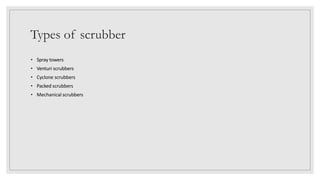
Types of scrubber
• Spray towers
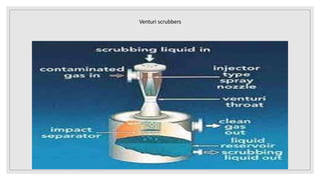
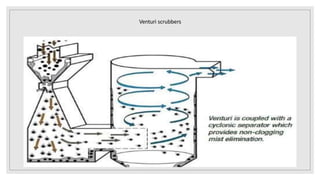
• Venturi scrubbers
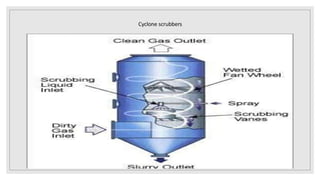
• Cyclone scrubbers
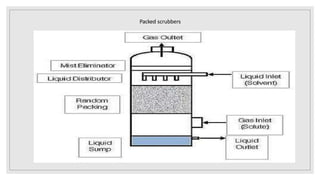
• Packed scrubbers
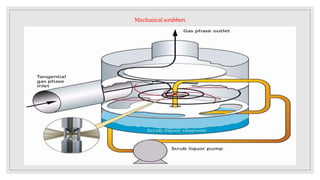
• Mechanical scrubbers
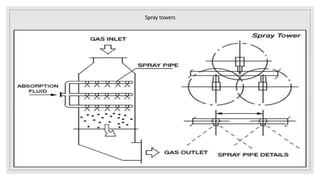
Spray towers
Venturi scrubbers
Venturi scrubbers
Cyclone scrubbers
Packed scrubbers
Mechanicalscrubbers
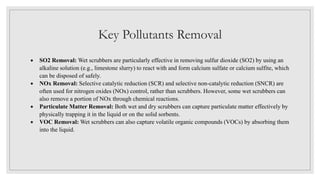
Key Pollutants Removal
 SO2 Removal: Wet scrubbers are particularly effective in removing sulfur dioxide (SO2) by using an
alkaline solution (e.g., limestone slurry) to react with and form calcium sulfate or calcium sulfite, which
can be disposed of safely.
 NOx Removal: Selective catalytic reduction (SCR) and selective non-catalytic reduction (SNCR) are
often used for nitrogen oxides (NOx) control, rather than scrubbers. However, some wet scrubbers can
also remove a portion of NOx through chemical reactions.
 Particulate Matter Removal: Both wet and dry scrubbers can capture particulate matter effectively by
physically trapping it in the liquid or on the solid sorbents.
 VOC Removal: Wet scrubbers can also capture volatile organic compounds (VOCs) by absorbing them
into the liquid.

rande.pptx

  • 1.
  • 2.
    Title Lorem Ipsum LOREMIPSUM DOLOR SIT AMET. LOREM IPSUM DOLOR SIT AMET LOREM IPSUM DOLOR SIT AMET
  • 3.
    Control of airpollution by scrubbers Scrubbers are air pollution control devices used to remove harmful pollutants from industrial exhaust gases before they are released into the atmosphere. They are commonly used in various industries, including power plants, chemical manufacturing, and metal processing, to reduce the emission of pollutants such as sulfur dioxide (SO2), nitrogen oxides (NOx), particulate matter (PM), and volatile organic compounds (VOCs).
  • 4.
    What are Scrubbers? Scrubbersare used as depuration systems that specifically eliminate the emissions of acid gases (SO2) produced in the combustion of pollutants. Wet scrubbers receive their name from the fact that liquids are used as a scrubbing medium and the by-products of the scrubbing system are liquid solution or slurry. Wet scrubbers can serve two simultaneous functions: particulate collection and acid gas control. Gas emissions are absorbed in devices columns that attempt to maximize liquid-to-gas contact to achieve maximum absorption of the pollutants into the liquid phase.
  • 5.
    Types of scrubber •Spray towers • Venturi scrubbers • Cyclone scrubbers • Packed scrubbers • Mechanical scrubbers
  • 6.
  • 7.
  • 8.
  • 9.
  • 10.
  • 11.
  • 12.
    Key Pollutants Removal SO2 Removal: Wet scrubbers are particularly effective in removing sulfur dioxide (SO2) by using an alkaline solution (e.g., limestone slurry) to react with and form calcium sulfate or calcium sulfite, which can be disposed of safely.  NOx Removal: Selective catalytic reduction (SCR) and selective non-catalytic reduction (SNCR) are often used for nitrogen oxides (NOx) control, rather than scrubbers. However, some wet scrubbers can also remove a portion of NOx through chemical reactions.  Particulate Matter Removal: Both wet and dry scrubbers can capture particulate matter effectively by physically trapping it in the liquid or on the solid sorbents.  VOC Removal: Wet scrubbers can also capture volatile organic compounds (VOCs) by absorbing them into the liquid.