†
108 WESTBUSINESS thewest.com.au
July 5-6, 2014
A reverse brain drain and recent
strong financial backing has
failed to address a severe lack of
talent in Perth’s fledgling tech
industry, its leaders say.
Speaking at this week’s
Australian Institute of
Management WA/WestBusiness
CEO Voice event, WA’s tech
leaders agreed that the State’s
dearth of IT graduates — and its
perceived poor status within the
WA business community —
contributed to Perth being
behind the eight ball.
However, the tide is changing.
According to Russell Francis,
chief executive of Perth-based
brand technology agency Dash
Digital, the reverse brain drain
— and the wave of money
coming into tech stocks over the
past eight months — is helping
turn things around.
“I’m part of the reverse brain
drain,” Mr Francis said.
“There’s great experience
here, and I look at some CVs
that come across my desk from
guys who have come back to
Perth and I’m like, oh my god,
look what these guys have been
doing.”
Marcus Tan, from Health
Engine — arguably WA’s
best-known start-up success
story — said finding the talent
in WA was a constant battle.
“It’s OK if you’re trying to
build a two or three-man
start-up, that’s fine, you can find
the talent,” Dr Tan said.
“When you’re trying to find 20
or 30 people, that’s when the
problems emerge.”
The talent issue was echoed
by IBM WA State manager
Malcolm De Silva, who said the
company spent a lot of its time
relocating people from the east
coast and overseas.
Applabs managing director
Stuart Kidd said he had to treat
his team “like rock stars” in
order to keep them from leaving
the app-focused business, which
listed in November.
For Deloitte managing
partner Michael McNulty the
issue came back to early
education about the
opportunities available in the
technology sector.
“From a private sector
employer example, the students
are going to study things that
give them great opportunities to
do exciting work after
university,” Mr McNulty said.
“There was a golden period
after the dotcom boom where we
had our best students studying
engineering and IT because they
saw the opportunity.
“I think as an industry we
don’t do it well — we see these
people studying for four years
and becoming a help desk
operator. That’s not something
that’s going to inspire them to
do IT.”
Curtin University IP
commercialisation director
Rohan McDougall, who is
heavily involved in the emerging
start-up scene across Perth,
agreed there needed to be more
collaboration between education
and industry.
“Kids need to be able to see
the next Steve Jobs or Mark
Zuckerbergs in their own
backyards,” Mr McDougall said.
“And there is a level of
engagement (between university
and industry), but there could
be more, and it’s about trying to
point out what model works.
“Who can promote WA as a
tech hub? Frankly, it’s not the
government . . . we’ve tried, it’s
got to be the responsibility of
the community.”
Where’s the government?
The lack of government
recognition of the industry was
a bugbear vented throughout the
panel discussion.
Fujitsu executive general
manager Robert Lislois said the
State Government was a
noticeable absentee in the
industry’s moves to brand Perth
as a tech hub.
The adaption of an Indian or
Irish-inspired model in Perth,
where specific areas received
tax breaks, was also a
suggestion from some panel
members as a way to kickstart
the industry.
Telstra WA State manager
David Ridgway pointed to the
Silicon Valley as an example of
how governments could help
incubate the sector.
“There’s research that Silicon
Valley would never have
occurred on the east coast of the
US because of the corporate
structure of what went on —
that’s where the
entrepreneurship comes in,” Mr
Ridgway said.
“Young people who are more
willing to take a risk.
“I would suggest governments
can play a point to creating the
right tax incentives . . . and then
get out of the way and let
innovation foster.”
Matthew Macfarlane, who
runs Perth’s only distinctly
tech-focused venture capital
firm, Yuuwa Capital, pointed to
taxation and regulation as
barriers to development.
“The employee share scheme
situation is the most red-flagged
barrier to getting things
happening (in the tech sector),”
he said.
“I don’t give equity to anyone
in my companies because we
have this ridiculous system in
Australia that when the day you
grant a stock option, even if it’s
not going to vest for four years,
the poor employee has to pay tax
on it — it’s insane.”
Excess government
intervention in the sector was
A long road for green
PERTH’S IT INDUSTRY STIRRING
There’s a lot of work ahead to turn Perth into a
Silicon Valley of the south but the potential is there,
local IT industry leaders tell Nick Sas
CEOVOICE
THE
SERIES
Tony
Grist
Rohan
McDougall Malcolm
De Silva
Matthew
Macfarlane
Russell
Francis
Doug
Bester
Kellie
Parker
David
Ridgway
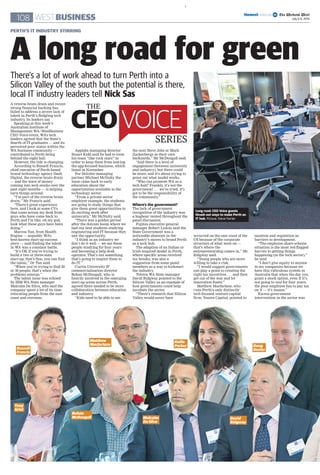
Long road: CEO Voice guests
thrash out ways to make Perth an
IT hub. Picture: Steve Ferrier

West Australia_CEO Voice

  • 1.
    † 108 WESTBUSINESS thewest.com.au July5-6, 2014 A reverse brain drain and recent strong financial backing has failed to address a severe lack of talent in Perth’s fledgling tech industry, its leaders say. Speaking at this week’s Australian Institute of Management WA/WestBusiness CEO Voice event, WA’s tech leaders agreed that the State’s dearth of IT graduates — and its perceived poor status within the WA business community — contributed to Perth being behind the eight ball. However, the tide is changing. According to Russell Francis, chief executive of Perth-based brand technology agency Dash Digital, the reverse brain drain — and the wave of money coming into tech stocks over the past eight months — is helping turn things around. “I’m part of the reverse brain drain,” Mr Francis said. “There’s great experience here, and I look at some CVs that come across my desk from guys who have come back to Perth and I’m like, oh my god, look what these guys have been doing.” Marcus Tan, from Health Engine — arguably WA’s best-known start-up success story — said finding the talent in WA was a constant battle. “It’s OK if you’re trying to build a two or three-man start-up, that’s fine, you can find the talent,” Dr Tan said. “When you’re trying to find 20 or 30 people, that’s when the problems emerge.” The talent issue was echoed by IBM WA State manager Malcolm De Silva, who said the company spent a lot of its time relocating people from the east coast and overseas. Applabs managing director Stuart Kidd said he had to treat his team “like rock stars” in order to keep them from leaving the app-focused business, which listed in November. For Deloitte managing partner Michael McNulty the issue came back to early education about the opportunities available in the technology sector. “From a private sector employer example, the students are going to study things that give them great opportunities to do exciting work after university,” Mr McNulty said. “There was a golden period after the dotcom boom where we had our best students studying engineering and IT because they saw the opportunity. “I think as an industry we don’t do it well — we see these people studying for four years and becoming a help desk operator. That’s not something that’s going to inspire them to do IT.” Curtin University IP commercialisation director Rohan McDougall, who is heavily involved in the emerging start-up scene across Perth, agreed there needed to be more collaboration between education and industry. “Kids need to be able to see the next Steve Jobs or Mark Zuckerbergs in their own backyards,” Mr McDougall said. “And there is a level of engagement (between university and industry), but there could be more, and it’s about trying to point out what model works. “Who can promote WA as a tech hub? Frankly, it’s not the government . . . we’ve tried, it’s got to be the responsibility of the community.” Where’s the government? The lack of government recognition of the industry was a bugbear vented throughout the panel discussion. Fujitsu executive general manager Robert Lislois said the State Government was a noticeable absentee in the industry’s moves to brand Perth as a tech hub. The adaption of an Indian or Irish-inspired model in Perth, where specific areas received tax breaks, was also a suggestion from some panel members as a way to kickstart the industry. Telstra WA State manager David Ridgway pointed to the Silicon Valley as an example of how governments could help incubate the sector. “There’s research that Silicon Valley would never have occurred on the east coast of the US because of the corporate structure of what went on — that’s where the entrepreneurship comes in,” Mr Ridgway said. “Young people who are more willing to take a risk. “I would suggest governments can play a point to creating the right tax incentives . . . and then get out of the way and let innovation foster.” Matthew Macfarlane, who runs Perth’s only distinctly tech-focused venture capital firm, Yuuwa Capital, pointed to taxation and regulation as barriers to development. “The employee share scheme situation is the most red-flagged barrier to getting things happening (in the tech sector),” he said. “I don’t give equity to anyone in my companies because we have this ridiculous system in Australia that when the day you grant a stock option, even if it’s not going to vest for four years, the poor employee has to pay tax on it — it’s insane.” Excess government intervention in the sector was A long road for green PERTH’S IT INDUSTRY STIRRING There’s a lot of work ahead to turn Perth into a Silicon Valley of the south but the potential is there, local IT industry leaders tell Nick Sas CEOVOICE THE SERIES Tony Grist Rohan McDougall Malcolm De Silva Matthew Macfarlane Russell Francis Doug Bester Kellie Parker David Ridgway Long road: CEO Voice guests thrash out ways to make Perth an IT hub. Picture: Steve Ferrier