Well-Formed Formula(WFF)
BY
Ms. Komal V Rokade.
Well-Formed Formula(WFF)
Well-Formed Formula(WFF) is an expression
consisting of variables(capitalletters),parentheses,
and connective symbols. An expression is basically
a combination of operands & operators and here
operands and operators are the connective
symbols.
Below are the possible Connective Symbols:
• ¬ (Negation)
• ∧ (Conjunction)
• ∨ (Disjunction)
• ⇒ (Rightwards Arrow)
• ⇔ (Left-Right Arrow)
Statement Formulas
1. Statements that do not contain any connectives
are called Atomic or Simple statements and these
statements in themselves are WFFs.
• For example,
• P, Q, R, etc.
2. Statements that contain one or more primary
statements are
called Molecular or Composite statements.
• For example,
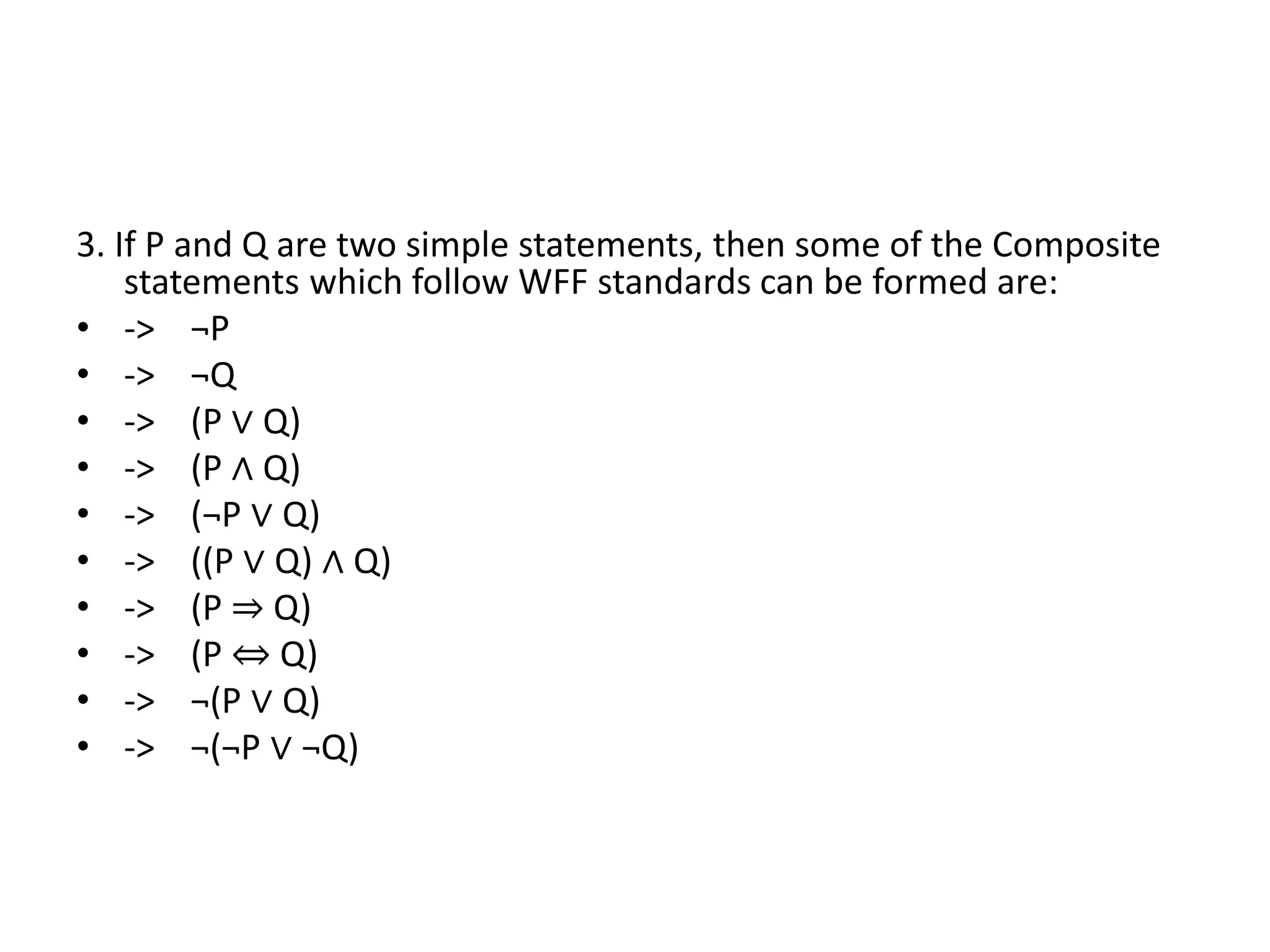
3. If P and Q are two simple statements, then some of the Composite
statements which follow WFF standards can be formed are:
• -> ¬P
• -> ¬Q
• -> (P ∨ Q)
• -> (P ∧ Q)
• -> (¬P ∨ Q)
• -> ((P ∨ Q) ∧ Q)
• -> (P ⇒ Q)
• -> (P ⇔ Q)
• -> ¬(P ∨ Q)
• -> ¬(¬P ∨ ¬Q)
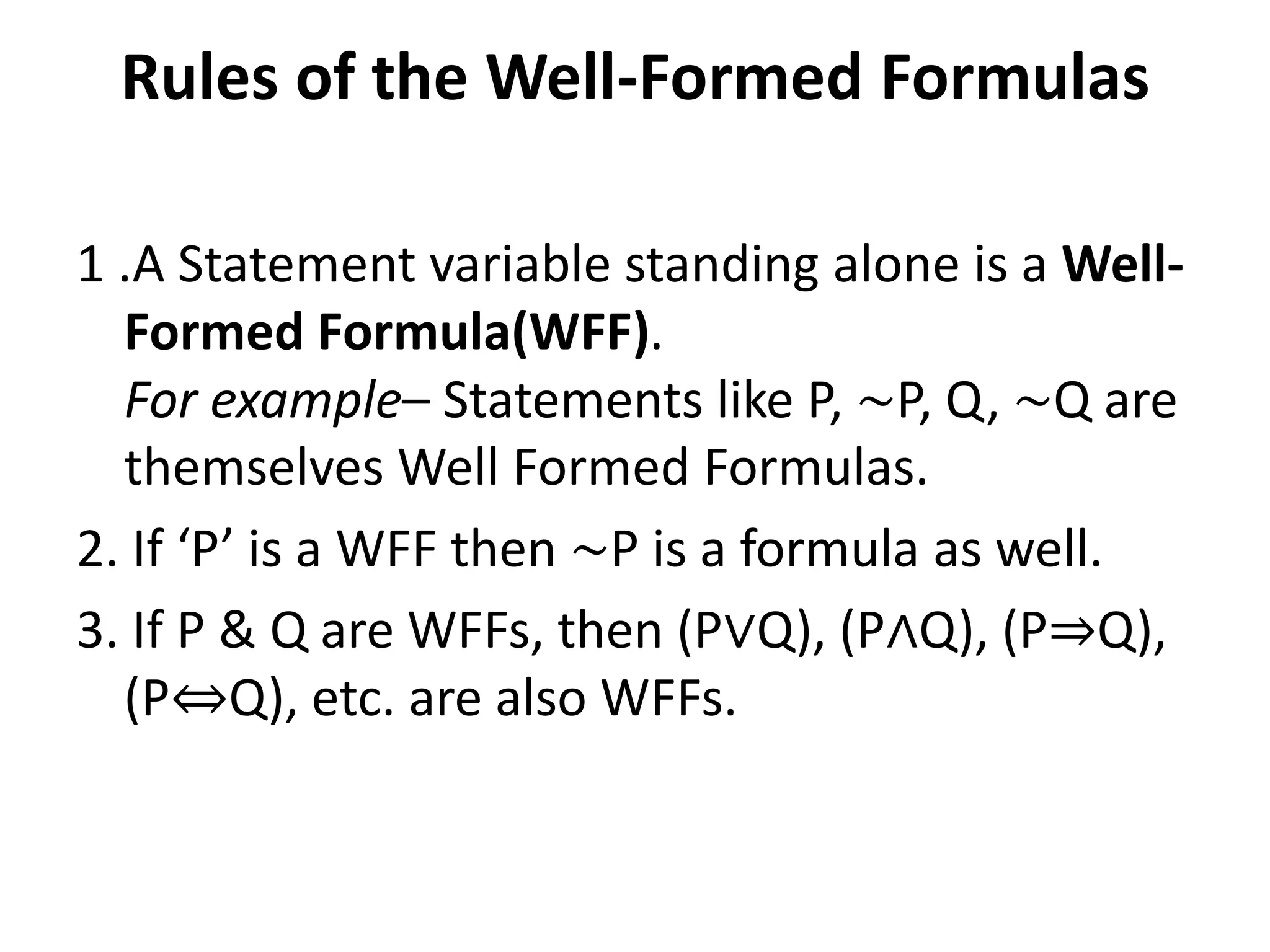
Rules of the Well-Formed Formulas
1 .A Statement variable standing alone is a Well-
Formed Formula(WFF).
For example– Statements like P, ∼P, Q, ∼Q are
themselves Well Formed Formulas.
2. If ‘P’ is a WFF then ∼P is a formula as well.
3. If P & Q are WFFs, then (P∨Q), (P∧Q), (P⇒Q),
(P⇔Q), etc. are also WFFs.
Example Of Well Formed Formulas:
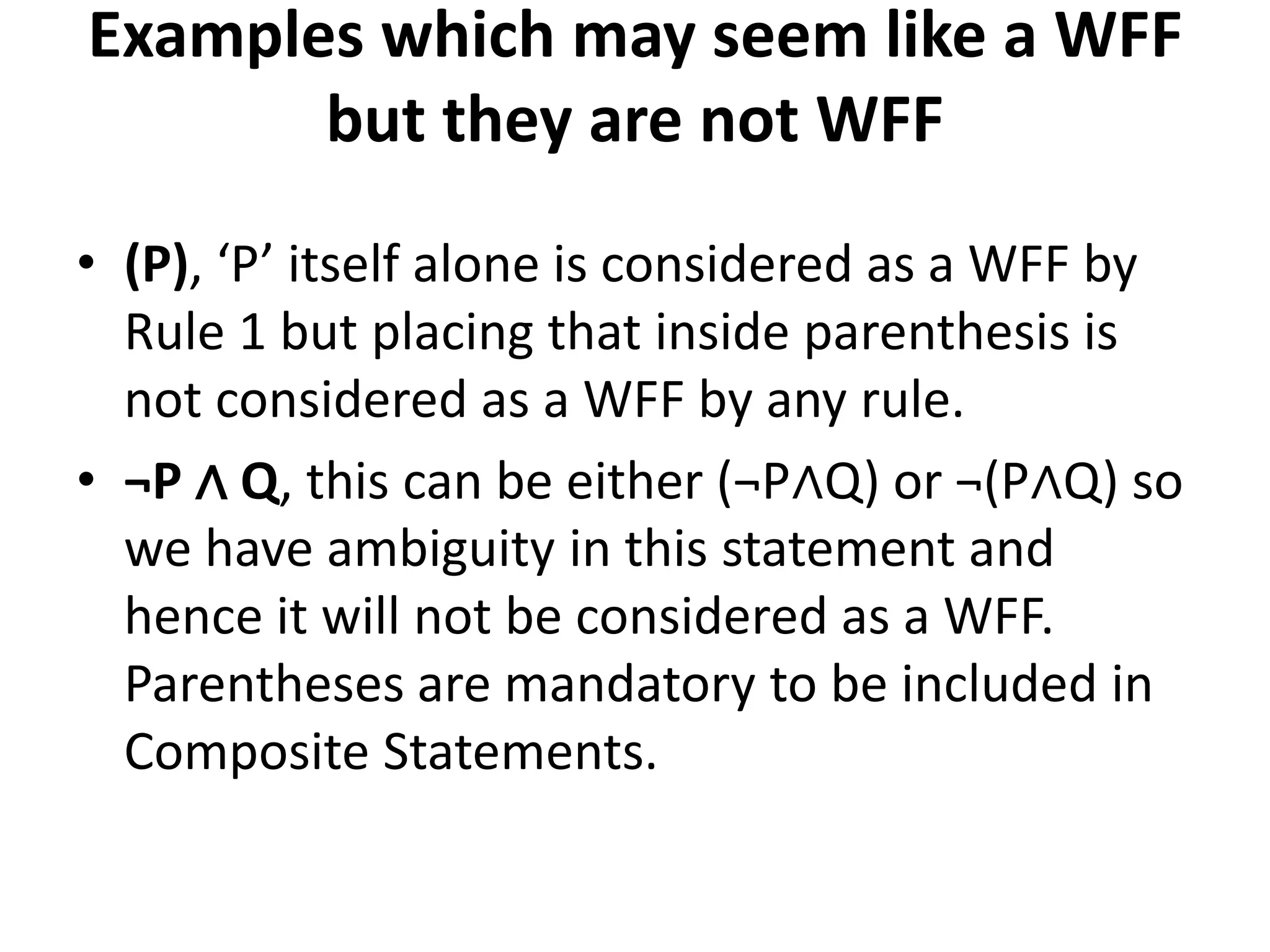
Examples which may seem like a WFF
but they are not WFF
• (P), ‘P’ itself alone is considered as a WFF by
Rule 1 but placing that inside parenthesis is
not considered as a WFF by any rule.
• ¬P ∧ Q, this can be either (¬P∧Q) or ¬(P∧Q) so
we have ambiguity in this statement and
hence it will not be considered as a WFF.
Parentheses are mandatory to be included in
Composite Statements.
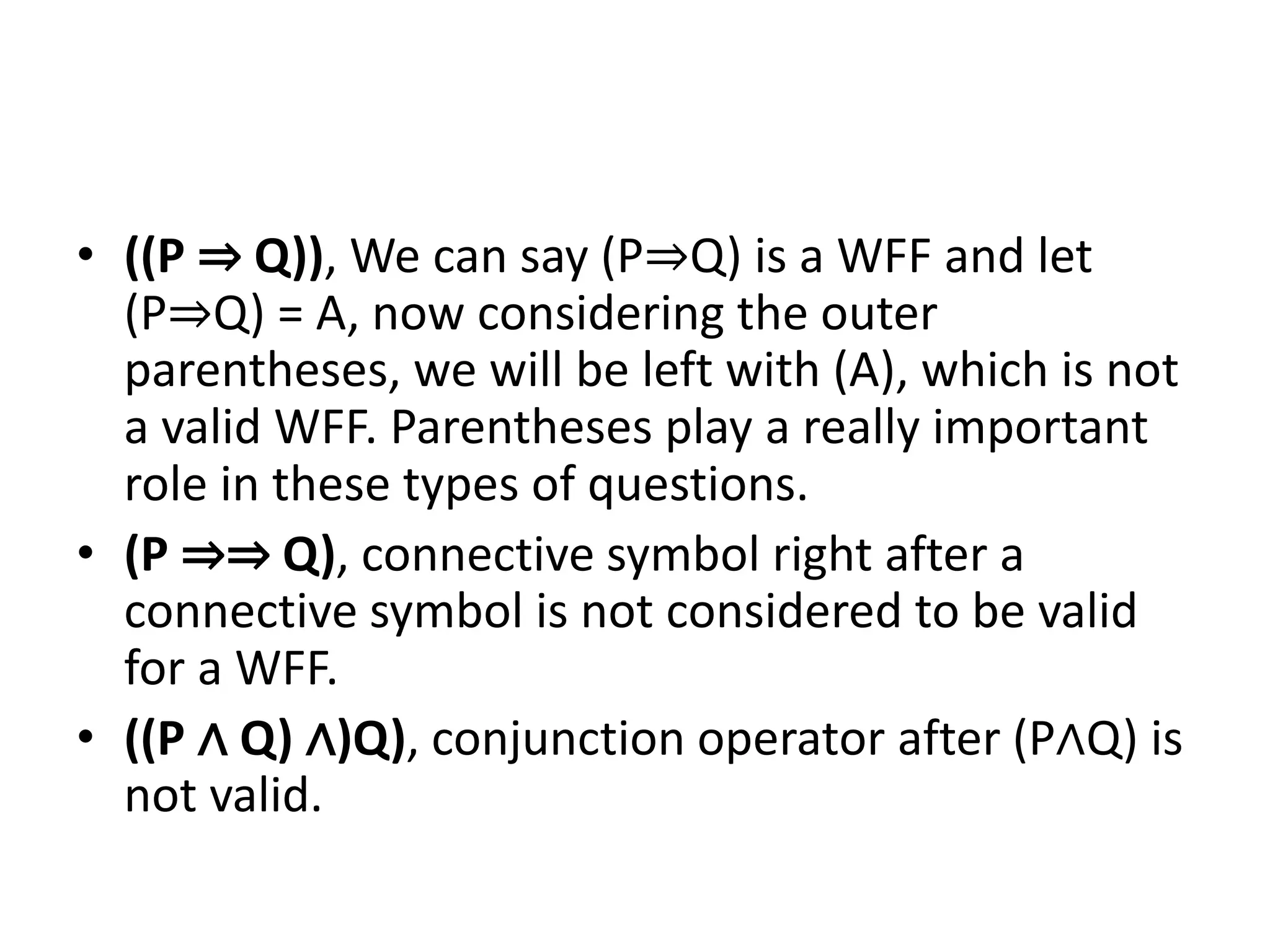
• ((P ⇒ Q)), We can say (P⇒Q) is a WFF and let
(P⇒Q) = A, now considering the outer
parentheses, we will be left with (A), which is not
a valid WFF. Parentheses play a really important
role in these types of questions.
• (P ⇒⇒ Q), connective symbol right after a
connective symbol is not considered to be valid
for a WFF.
• ((P ∧ Q) ∧)Q), conjunction operator after (P∧Q) is
not valid.
• ((P ∧ Q) ∧ PQ), invalid placement of
variables(PQ).
• (P ∨ Q) ⇒ (∧ Q), with the Conjunction
component, only one variable ‘Q’ is present. In
order to form an operation inside a
parentheses minimum of 2 variables are
required.

well formed formula DMS by Komal rokade.pptx

  • 1.
  • 2.
    Well-Formed Formula(WFF) Well-Formed Formula(WFF)is an expression consisting of variables(capitalletters),parentheses, and connective symbols. An expression is basically a combination of operands & operators and here operands and operators are the connective symbols.
  • 3.
    Below are thepossible Connective Symbols: • ¬ (Negation) • ∧ (Conjunction) • ∨ (Disjunction) • ⇒ (Rightwards Arrow) • ⇔ (Left-Right Arrow)
  • 4.
    Statement Formulas 1. Statementsthat do not contain any connectives are called Atomic or Simple statements and these statements in themselves are WFFs. • For example, • P, Q, R, etc. 2. Statements that contain one or more primary statements are called Molecular or Composite statements. • For example,
  • 5.
    3. If Pand Q are two simple statements, then some of the Composite statements which follow WFF standards can be formed are: • -> ¬P • -> ¬Q • -> (P ∨ Q) • -> (P ∧ Q) • -> (¬P ∨ Q) • -> ((P ∨ Q) ∧ Q) • -> (P ⇒ Q) • -> (P ⇔ Q) • -> ¬(P ∨ Q) • -> ¬(¬P ∨ ¬Q)
  • 6.
    Rules of theWell-Formed Formulas 1 .A Statement variable standing alone is a Well- Formed Formula(WFF). For example– Statements like P, ∼P, Q, ∼Q are themselves Well Formed Formulas. 2. If ‘P’ is a WFF then ∼P is a formula as well. 3. If P & Q are WFFs, then (P∨Q), (P∧Q), (P⇒Q), (P⇔Q), etc. are also WFFs.
  • 7.
    Example Of WellFormed Formulas:
  • 8.
    Examples which mayseem like a WFF but they are not WFF • (P), ‘P’ itself alone is considered as a WFF by Rule 1 but placing that inside parenthesis is not considered as a WFF by any rule. • ¬P ∧ Q, this can be either (¬P∧Q) or ¬(P∧Q) so we have ambiguity in this statement and hence it will not be considered as a WFF. Parentheses are mandatory to be included in Composite Statements.
  • 9.
    • ((P ⇒Q)), We can say (P⇒Q) is a WFF and let (P⇒Q) = A, now considering the outer parentheses, we will be left with (A), which is not a valid WFF. Parentheses play a really important role in these types of questions. • (P ⇒⇒ Q), connective symbol right after a connective symbol is not considered to be valid for a WFF. • ((P ∧ Q) ∧)Q), conjunction operator after (P∧Q) is not valid.
  • 10.
    • ((P ∧Q) ∧ PQ), invalid placement of variables(PQ). • (P ∨ Q) ⇒ (∧ Q), with the Conjunction component, only one variable ‘Q’ is present. In order to form an operation inside a parentheses minimum of 2 variables are required.