Welcome to IS431 Database Design, Management and Applications Dr. J. Scher
Our  Partnership in Learning The Instructor's Role in the Partnership: Prepare and teach the course material as best as I possibly can! Preparation and design of the presentation slides you will be seeing, which will  optimize your Database learning experience. Posting of the slides for downloading. Design meaningful/challenging assignments and projects to reinforce your understanding of database concepts presented  in the course.
Our  Partnership in Learning Your  role in the partnership: Prepare for IS431 each week, and learn the course material as best as you can. IS431 will be high on your list of priorities. Discipline yourself to read/view the requisite material each week. Never procrastinate on homework - assignments/projects should be 'attacked‘ as soon as practicable, and never left for the very end. Never fall behind - keep up with the readings in the text and the Powerpoints. Work diligently ( and independently ) on all assignments/projects.
A Philosophy for Learning "Tell me and I will forget. Show me and I may remember. Involve me and I will understand." Old Chinese Proverb (Confucius)
Some "FAQs" about course protocols, policies, etc.
FAQ 1 Q: How is the course grade determined? A:  There are three components to your grade: Midterm Exam {Closed Book} 33% Final Examination {Open Book} 34% Conceptual Assignments  & DBMS  Projects 33%
FAQ2a Q:  How can Dr. Scher be  reached? A:  There are several ways: Email :  [email_address] This is the most preferable way to reach Dr. Scher – do not use any of Dr. Scher’s NJIT email addresses Usually you will get a reply within a day.
FAQ2b Telephone : 1-973-596-3395 (if Dr. Scher is not in,  leave a message on voicemail, or, in a dire emergency, with the IS Department secretary at 973-596-3368). Office : Room 4105 Infotech
FAQ 3: What is Dr. Scher’s philosophy  of teaching? Dr. Scher has always admired the wisdom of Ben Franklin, who said: "Tell me and I'll forget. Teach me and I'll remember. Involve me and I will learn.” And, thus, I seek to “involve” my students by providing them with meaningful opportunities, via interesting projects and challenging assignments, to apply the database concepts covered in class lectures and the textbook.
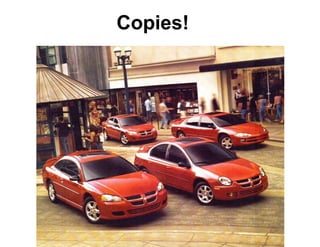
Copies!
FAQ 4 Q: What's your policy on cheating? A: Any student found cheating on  any  exam or homework/project assignment receives an automatic F  in the course . NJIT policy requires faculty to refer such students to the appropriate university committee for proper disciplinary action (including possible suspension and notation on permanent record.) Since assignments are part of the course grade, you are to work  independently  on each assignment and/or project.  COLLABORATION IS NOT PERMITTED. Each assignment/project is viewed as an Examination.
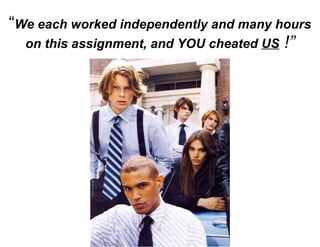
“ We each worked independently and many hours on this assignment, and YOU cheated  US  !”
FAQ 5 Q: What's your policy on lateness of projects assignments? A:  Do not procrastinate! Do not be late on assignments!!! Lateness is unacceptable. Assignments are due at  the specified due date and time !
FAQ6a Q: What advice can you give for a student to succeed? Remember these TEN two-letter words: "If it  is  to be, it is  up to me .“ The best investment you can make is to invest your time, your resources, in yourself and in your future. Do  not  rely on others; rely on  yourself . Establish  your  priorities. NEVER fall behind. Build up your confidence in yourself, and wear a smile, and most importantly….
Don’t allow “friends” to pull you away from your studies!
FAQ6b Q. What advice can you give to a student who does  not  want to succeed? (Adapted from J. C. Salak) "Failures are divided into two classes: those who thought and never did, and those who did and never thought."
And One More Piece of Excellent Advise, courtesy of Ben Franklin "By failing to prepare, you are preparing to fail”
FAQ 7 Q. What minimal "hardware" should we have access to, in order to install & run the software and do the DBMS projects in IS431? A. The  recommended  “ absolute  minimal" requirements would be: a 1500 mhz or greater PC (Intel, AMD) a CD-ROM drive (any speed) 512 meg RAM or more > 72 meg of available hard drive space MS Windows OS NOTE: You may use the NJIT PC Labs.
FAQ 8 Q. What is the software activity in IS431? A. We will be using  the following software: SnapDB  (a portable flat file database application) Microsoft Access (world’s leading desktop RDBMS) Table Designer 1.0  (graphical semantic object data modeling tool) Aqua Data Studio (an IDE/front-end for Oracle) Oracle (world’s leading relational DBMS) Several selected utilities and exemplary databases from Dr. Scher’s IS431 Resource Collection Possibly other DBMS products as time permits
FAQ 9 Q: Is IS431 a course in learning how to use a database product, such as Oracle A: The answer is, emphatically, NO ! Approximately 75% of the course is devoted to database design, concepts and theory. We will view the DBMS products as software vehicles we will invoke in order to: illustrate the functionality of a relational DBMS "concept map" numerous database design and theoretical issues into the pragmatics of a real-world environment
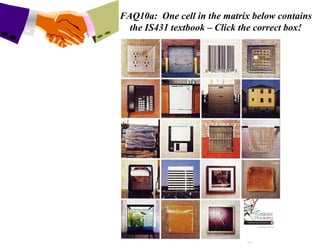
FAQ10a:  One cell in the matrix below contains the IS431 textbook – Click the correct box!
 
The IS431 textbook may be purchased at either The NJIT Bookstore, or An On-Line Book Seller, where, as with many other items, you possibly may obtain a better ‘deal’ than from a “brick and mortar” seller, and may also obtain a small rebate if you go through a cash-back shopping website – downside would be the shipping delays/costs Mr. Rebates ( http://www.mrrebates.com/categories/books.asp  ) is one example of a cash-back shopping website Half.com ( http://www.half.ebay.com/  ), which is an e-Bay company, is one example of an on-line book seller (Aside : if you go through Mr. Rebates to Half.com, you receive 7% cashback…) An on-line book rental service (see details in Moodle)  FAQ10b:  Purchasing the IS431 textbook
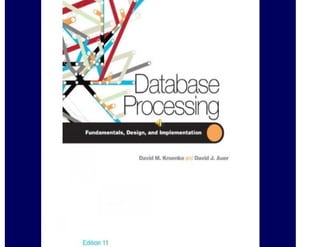
FAQ11:  What's 'cool' in IS431? DATABASE PROCESSING: Fundamentals, Design and Implementation  ( Eleventh  Edition) by D. Kroenke & D. Auer, Prentice-Hall, 2010 SnapDB, MS Access, TableDesigner, Aqua, Oracle, SQL Learn database design concepts, theory and pragmatics Data Modeling Several  database projects Several conceptual assignments Multimedia aware. Downloadable presentations IS431 Resource Collection
FAQ11:  What LMS will we be using in IS431? We will be using MOODLE, an Open Source  L earning  M anagement  S ystem, designed to foster on-line Learning Communities. Moodle is provided freely to NJIT as Open Source Software under the GNU Public License. MOODLE  =  M odular  O bject  O riented  D ynamic  L earning  E nvironment Moodle has an active development and support group with users/developers in over 212 countries worldwide, and over 1,000,000 registered users. (See  http://moodle.org )
Peruse them ! The Course Syllabus  NJIT University Code on Academic Integrity ACM Code of Professional Ethics Moodlemania (on-going posting of comments regarding Moodle) Administrative issues in IS431 Freeware/Open Source titles for IS431 Official NJIT Academic Calendar Faq12: What are the “objects” in “Week 0” in Moodle? What should I do with them?
 

Welcome is431 s11

  • 1.
    Welcome to IS431Database Design, Management and Applications Dr. J. Scher
  • 2.
    Our Partnershipin Learning The Instructor's Role in the Partnership: Prepare and teach the course material as best as I possibly can! Preparation and design of the presentation slides you will be seeing, which will optimize your Database learning experience. Posting of the slides for downloading. Design meaningful/challenging assignments and projects to reinforce your understanding of database concepts presented in the course.
  • 3.
    Our Partnershipin Learning Your role in the partnership: Prepare for IS431 each week, and learn the course material as best as you can. IS431 will be high on your list of priorities. Discipline yourself to read/view the requisite material each week. Never procrastinate on homework - assignments/projects should be 'attacked‘ as soon as practicable, and never left for the very end. Never fall behind - keep up with the readings in the text and the Powerpoints. Work diligently ( and independently ) on all assignments/projects.
  • 4.
    A Philosophy forLearning "Tell me and I will forget. Show me and I may remember. Involve me and I will understand." Old Chinese Proverb (Confucius)
  • 5.
    Some "FAQs" aboutcourse protocols, policies, etc.
  • 6.
    FAQ 1 Q:How is the course grade determined? A: There are three components to your grade: Midterm Exam {Closed Book} 33% Final Examination {Open Book} 34% Conceptual Assignments & DBMS Projects 33%
  • 7.
    FAQ2a Q: How can Dr. Scher be reached? A: There are several ways: Email : [email_address] This is the most preferable way to reach Dr. Scher – do not use any of Dr. Scher’s NJIT email addresses Usually you will get a reply within a day.
  • 8.
    FAQ2b Telephone :1-973-596-3395 (if Dr. Scher is not in, leave a message on voicemail, or, in a dire emergency, with the IS Department secretary at 973-596-3368). Office : Room 4105 Infotech
  • 9.
    FAQ 3: Whatis Dr. Scher’s philosophy of teaching? Dr. Scher has always admired the wisdom of Ben Franklin, who said: "Tell me and I'll forget. Teach me and I'll remember. Involve me and I will learn.” And, thus, I seek to “involve” my students by providing them with meaningful opportunities, via interesting projects and challenging assignments, to apply the database concepts covered in class lectures and the textbook.
  • 10.
  • 11.
    FAQ 4 Q:What's your policy on cheating? A: Any student found cheating on any exam or homework/project assignment receives an automatic F in the course . NJIT policy requires faculty to refer such students to the appropriate university committee for proper disciplinary action (including possible suspension and notation on permanent record.) Since assignments are part of the course grade, you are to work independently on each assignment and/or project. COLLABORATION IS NOT PERMITTED. Each assignment/project is viewed as an Examination.
  • 12.
    “ We eachworked independently and many hours on this assignment, and YOU cheated US !”
  • 13.
    FAQ 5 Q:What's your policy on lateness of projects assignments? A: Do not procrastinate! Do not be late on assignments!!! Lateness is unacceptable. Assignments are due at the specified due date and time !
  • 14.
    FAQ6a Q: Whatadvice can you give for a student to succeed? Remember these TEN two-letter words: "If it is to be, it is up to me .“ The best investment you can make is to invest your time, your resources, in yourself and in your future. Do not rely on others; rely on yourself . Establish your priorities. NEVER fall behind. Build up your confidence in yourself, and wear a smile, and most importantly….
  • 15.
    Don’t allow “friends”to pull you away from your studies!
  • 16.
    FAQ6b Q. Whatadvice can you give to a student who does not want to succeed? (Adapted from J. C. Salak) "Failures are divided into two classes: those who thought and never did, and those who did and never thought."
  • 17.
    And One MorePiece of Excellent Advise, courtesy of Ben Franklin "By failing to prepare, you are preparing to fail”
  • 18.
    FAQ 7 Q.What minimal "hardware" should we have access to, in order to install & run the software and do the DBMS projects in IS431? A. The recommended “ absolute minimal" requirements would be: a 1500 mhz or greater PC (Intel, AMD) a CD-ROM drive (any speed) 512 meg RAM or more > 72 meg of available hard drive space MS Windows OS NOTE: You may use the NJIT PC Labs.
  • 19.
    FAQ 8 Q.What is the software activity in IS431? A. We will be using the following software: SnapDB (a portable flat file database application) Microsoft Access (world’s leading desktop RDBMS) Table Designer 1.0 (graphical semantic object data modeling tool) Aqua Data Studio (an IDE/front-end for Oracle) Oracle (world’s leading relational DBMS) Several selected utilities and exemplary databases from Dr. Scher’s IS431 Resource Collection Possibly other DBMS products as time permits
  • 20.
    FAQ 9 Q:Is IS431 a course in learning how to use a database product, such as Oracle A: The answer is, emphatically, NO ! Approximately 75% of the course is devoted to database design, concepts and theory. We will view the DBMS products as software vehicles we will invoke in order to: illustrate the functionality of a relational DBMS "concept map" numerous database design and theoretical issues into the pragmatics of a real-world environment
  • 21.
    FAQ10a: Onecell in the matrix below contains the IS431 textbook – Click the correct box!
  • 22.
  • 23.
    The IS431 textbookmay be purchased at either The NJIT Bookstore, or An On-Line Book Seller, where, as with many other items, you possibly may obtain a better ‘deal’ than from a “brick and mortar” seller, and may also obtain a small rebate if you go through a cash-back shopping website – downside would be the shipping delays/costs Mr. Rebates ( http://www.mrrebates.com/categories/books.asp ) is one example of a cash-back shopping website Half.com ( http://www.half.ebay.com/ ), which is an e-Bay company, is one example of an on-line book seller (Aside : if you go through Mr. Rebates to Half.com, you receive 7% cashback…) An on-line book rental service (see details in Moodle) FAQ10b: Purchasing the IS431 textbook
  • 24.
    FAQ11: What's'cool' in IS431? DATABASE PROCESSING: Fundamentals, Design and Implementation ( Eleventh Edition) by D. Kroenke & D. Auer, Prentice-Hall, 2010 SnapDB, MS Access, TableDesigner, Aqua, Oracle, SQL Learn database design concepts, theory and pragmatics Data Modeling Several database projects Several conceptual assignments Multimedia aware. Downloadable presentations IS431 Resource Collection
  • 25.
    FAQ11: WhatLMS will we be using in IS431? We will be using MOODLE, an Open Source L earning M anagement S ystem, designed to foster on-line Learning Communities. Moodle is provided freely to NJIT as Open Source Software under the GNU Public License. MOODLE = M odular O bject O riented D ynamic L earning E nvironment Moodle has an active development and support group with users/developers in over 212 countries worldwide, and over 1,000,000 registered users. (See http://moodle.org )
  • 26.
    Peruse them !The Course Syllabus NJIT University Code on Academic Integrity ACM Code of Professional Ethics Moodlemania (on-going posting of comments regarding Moodle) Administrative issues in IS431 Freeware/Open Source titles for IS431 Official NJIT Academic Calendar Faq12: What are the “objects” in “Week 0” in Moodle? What should I do with them?
  • 27.