A Complete Guideline
Course Code: CSC 2108
Department of Computer Science
Faculty of Science and Technology
Lecture No: 01 Week No: 01 Semester: Summer
2019-2020
Lecturer: Kawser Irom Rushee & rushee@aiub.edu
Course Title: Introduction To Database
Lecture Outline
• American International University-Bangladesh (AIUB)
• Computer Science(CS) Department of AIUB
• Necessary Policies and Rules
• Outcome Based Education (OBE)
• Basic Information Regarding this Course
• Database Terminology
American International University- Bangladesh (AIUB)
Vision of AIUB
AMERICAN INTERNATIONAL UNIVERSITY-BANGLADESH (AIUB)
envisions promoting professionals and excellent leadership
catering to the technological progress and development needs of
the country.
American International University- Bangladesh (AIUB)
Mission of AIUB
AMERICAN INTERNATIONAL UNIVERSITY-BANGLADESH (AIUB) is
committed to provide quality and excellent computer-based
academic programs responsive to the emerging challenges of
the time. It is dedicated to nurture and produce competent
world class professional imbued with strong sense of ethical
values ready to face the competitive world of arts, business,
science, social science and technology.
Computer Science(CS) Department ofAIUB
Vision of CS Department
Our vision is to be the preeminent Department of Computer
Science through creating recognized professionals who will
provide innovative solutions by leveraging contemporary research
methods and development techniques of computing that is in line
with the national and global context.
Computer Science(CS) Department ofAIUB
Mission of CS Department
The mission of the Department of Computer Science of AIUB is to
educate students in a student-centric dynamic learning
environment; to provide advanced facilities for conducting
innovative research and development to meet the challenges
of the modern era of computing, and to motivate them
towards a life-long learning process.
Necessary Policies and Rules
General University Rules
• Entering the University without ID card is strictly prohibited
• No students will be allowed to sit in the class/exams without
student ID card
• Keep your campus clean
Necessary Policies and Rules
Classroom/ Laboratory Policy
• Please keep silent during lecture time
• There will be session for questioning after completing each topic/subtopic/chapter
• Please ask your personal question in break /after finishing lecture/ consulting hours
• If some of you already know the materials I am discussing, give chance to other students to
understand the matter
• Break will be given during class. However you are strictly advised to follow proper protocols
during the break time also. Remember break time is not for roaming around the halls or
creating ruckus in the class/lab rooms. Even during break time you are a student so behave
like a student.
• You are encouraged to take notes of the lecture in your notebook if deemed necessary
• Using smart phones/cameras to click photos during class is strictly prohibited.
• You are specially prohibited to take snapshots of the classroom whiteboard.
• Try to keep your smart phones/ mobile phones in your bag/pocket/purse during class hours
• Make sure to log out of any personal account i.e. AIUB Student Portal/email account on the
Lab PC that you are using once your allocated lab hours is over.
Outcome Based Education (OBE)
Significance
• Outcome Based Education
• OBE is an educational process
• Directed/focused at achieving certain specified outcomes in
terms of individual student learning
• Outcomes - key things students should understand and be able
to do or the qualities they should develop
Basic Information RegardingThis Course
COURSE CODE:CSC 2108
COURSE NAME:
INTRODUCTIONTO
DATABASE
COURSE TEACHER:TBA
Basic Information RegardingThis Course
Class Hours
• Theory class- Two(2) hours
• Lab class- Three(3) hours
Basic Information RegardingThis Course
Course Objective
To be able to:
•Identify the drawbacks of file-based management system and the necessity of
Database management system
•Use modern tools utilized in Database management system.
•Understand different types of terminologies used in Database management
system
•Discuss different tools and techniques for better performance of Database
management system
•Execute necessary and sufficient SQLs
•Design ER Models and Diagrams
•Use different types of Normalization process
•Analyze a system with a view to DBMS implementation
•Understand different types of joining and use of different complex queries
DatabaseTerminology
Data, Information, Knowledge and Wisdom
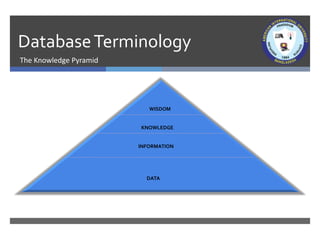
•Data-Raw facts and figures that on their own have no meaning
•Information-Data that has been processed within a context to
give it meaning
•Knowledge-The capability of understanding the relationship
between pieces of information and what to actually do with
the information
•Wisdom-Beckons to give understanding about which there has
previously been no understanding
DatabaseTerminology
The Knowledge Pyramid
WISDOM
KNOWLEDGE
INFORMATION
DATA
DatabaseTerminology
Database
•Database->A structured set of data held in a computer
especially one that is accessible in various ways.
•Inside a database, data is stored into tables.
DatabaseTerminology
Oracle Database
•A Relational Database Management System (RDBMS) produced
and marketed by Oracle Corporation.
•Oracle 10g
•Database Schema Scott
•Tables: DEPT, EMP, BONUS and SALGRADE
DatabaseTerminology
SQL
•SQL stands for Structured Query Language
•SQL is used to communicate with a database
•According to American National Standard Institute (ANSI), it is
standard language for Relational Database Management System
(RDBMS)
•SQL can execute queries against a Database.
•Synonyms of query-> ask,question,inquire etc.
Books
1. Modern Database Management (Sixth Edition) by Fred R. McFadden, Jeffrey A.
Hoffer, Mary B. Prescott
2. Database System Concepts (Fifth Edition) by Henry F. Korth, S. Sudarshan, A.
Silberschatz
3. Oracle-database-10g-sql-fundamentals-1-student-guide-volume-1
4. SQL and Relational Theory: How to Write Accurate SQL Code by C.J. Date
5. Database Systems: A Practical Approach to Design, Implementation and
Management (4th Edition) by Thomas M. Connolly, Carolyn E. Begg
6. Fundamentals of Database Systems, 5th Edition by RamezElmasri, Shamkant B.
Navathe
7. Database Design and Relational Theory: Normal Forms and All That Jazz by C. J. Date
8. An Introduction to Database Systems 8th Edition, by C.J. Date
References
1. https://www.db-book.com/db6/slide-dir/index.html
2. https://docs.oracle.com/en/database/oracle/oracle-database/20/sqlrf/SQL-
Standards.html#GUID-BCCCFF75-D2A4-43AD-8CAF-C3C97D92AC63
3. https://www.slideshare.net/HaaMeemMohiyuddin1/data-knowledge-and-
information
4. https://www.slideshare.net/tabinhasan/from-data-to-wisdom
5. https://www.slideshare.net/thinnaphat.bo/

Lecture01_IDB.pptx

  • 1.
    A Complete Guideline CourseCode: CSC 2108 Department of Computer Science Faculty of Science and Technology Lecture No: 01 Week No: 01 Semester: Summer 2019-2020 Lecturer: Kawser Irom Rushee & rushee@aiub.edu Course Title: Introduction To Database
  • 2.
    Lecture Outline • AmericanInternational University-Bangladesh (AIUB) • Computer Science(CS) Department of AIUB • Necessary Policies and Rules • Outcome Based Education (OBE) • Basic Information Regarding this Course • Database Terminology
  • 3.
    American International University-Bangladesh (AIUB) Vision of AIUB AMERICAN INTERNATIONAL UNIVERSITY-BANGLADESH (AIUB) envisions promoting professionals and excellent leadership catering to the technological progress and development needs of the country.
  • 4.
    American International University-Bangladesh (AIUB) Mission of AIUB AMERICAN INTERNATIONAL UNIVERSITY-BANGLADESH (AIUB) is committed to provide quality and excellent computer-based academic programs responsive to the emerging challenges of the time. It is dedicated to nurture and produce competent world class professional imbued with strong sense of ethical values ready to face the competitive world of arts, business, science, social science and technology.
  • 5.
    Computer Science(CS) DepartmentofAIUB Vision of CS Department Our vision is to be the preeminent Department of Computer Science through creating recognized professionals who will provide innovative solutions by leveraging contemporary research methods and development techniques of computing that is in line with the national and global context.
  • 6.
    Computer Science(CS) DepartmentofAIUB Mission of CS Department The mission of the Department of Computer Science of AIUB is to educate students in a student-centric dynamic learning environment; to provide advanced facilities for conducting innovative research and development to meet the challenges of the modern era of computing, and to motivate them towards a life-long learning process.
  • 7.
    Necessary Policies andRules General University Rules • Entering the University without ID card is strictly prohibited • No students will be allowed to sit in the class/exams without student ID card • Keep your campus clean
  • 8.
    Necessary Policies andRules Classroom/ Laboratory Policy • Please keep silent during lecture time • There will be session for questioning after completing each topic/subtopic/chapter • Please ask your personal question in break /after finishing lecture/ consulting hours • If some of you already know the materials I am discussing, give chance to other students to understand the matter • Break will be given during class. However you are strictly advised to follow proper protocols during the break time also. Remember break time is not for roaming around the halls or creating ruckus in the class/lab rooms. Even during break time you are a student so behave like a student. • You are encouraged to take notes of the lecture in your notebook if deemed necessary • Using smart phones/cameras to click photos during class is strictly prohibited. • You are specially prohibited to take snapshots of the classroom whiteboard. • Try to keep your smart phones/ mobile phones in your bag/pocket/purse during class hours • Make sure to log out of any personal account i.e. AIUB Student Portal/email account on the Lab PC that you are using once your allocated lab hours is over.
  • 9.
    Outcome Based Education(OBE) Significance • Outcome Based Education • OBE is an educational process • Directed/focused at achieving certain specified outcomes in terms of individual student learning • Outcomes - key things students should understand and be able to do or the qualities they should develop
  • 10.
    Basic Information RegardingThisCourse COURSE CODE:CSC 2108 COURSE NAME: INTRODUCTIONTO DATABASE COURSE TEACHER:TBA
  • 11.
    Basic Information RegardingThisCourse Class Hours • Theory class- Two(2) hours • Lab class- Three(3) hours
  • 12.
    Basic Information RegardingThisCourse Course Objective To be able to: •Identify the drawbacks of file-based management system and the necessity of Database management system •Use modern tools utilized in Database management system. •Understand different types of terminologies used in Database management system •Discuss different tools and techniques for better performance of Database management system •Execute necessary and sufficient SQLs •Design ER Models and Diagrams •Use different types of Normalization process •Analyze a system with a view to DBMS implementation •Understand different types of joining and use of different complex queries
  • 13.
    DatabaseTerminology Data, Information, Knowledgeand Wisdom •Data-Raw facts and figures that on their own have no meaning •Information-Data that has been processed within a context to give it meaning •Knowledge-The capability of understanding the relationship between pieces of information and what to actually do with the information •Wisdom-Beckons to give understanding about which there has previously been no understanding
  • 14.
  • 15.
    DatabaseTerminology Database •Database->A structured setof data held in a computer especially one that is accessible in various ways. •Inside a database, data is stored into tables.
  • 16.
    DatabaseTerminology Oracle Database •A RelationalDatabase Management System (RDBMS) produced and marketed by Oracle Corporation. •Oracle 10g •Database Schema Scott •Tables: DEPT, EMP, BONUS and SALGRADE
  • 17.
    DatabaseTerminology SQL •SQL stands forStructured Query Language •SQL is used to communicate with a database •According to American National Standard Institute (ANSI), it is standard language for Relational Database Management System (RDBMS) •SQL can execute queries against a Database. •Synonyms of query-> ask,question,inquire etc.
  • 18.
    Books 1. Modern DatabaseManagement (Sixth Edition) by Fred R. McFadden, Jeffrey A. Hoffer, Mary B. Prescott 2. Database System Concepts (Fifth Edition) by Henry F. Korth, S. Sudarshan, A. Silberschatz 3. Oracle-database-10g-sql-fundamentals-1-student-guide-volume-1 4. SQL and Relational Theory: How to Write Accurate SQL Code by C.J. Date 5. Database Systems: A Practical Approach to Design, Implementation and Management (4th Edition) by Thomas M. Connolly, Carolyn E. Begg 6. Fundamentals of Database Systems, 5th Edition by RamezElmasri, Shamkant B. Navathe 7. Database Design and Relational Theory: Normal Forms and All That Jazz by C. J. Date 8. An Introduction to Database Systems 8th Edition, by C.J. Date
  • 19.
    References 1. https://www.db-book.com/db6/slide-dir/index.html 2. https://docs.oracle.com/en/database/oracle/oracle-database/20/sqlrf/SQL- Standards.html#GUID-BCCCFF75-D2A4-43AD-8CAF-C3C97D92AC63 3.https://www.slideshare.net/HaaMeemMohiyuddin1/data-knowledge-and- information 4. https://www.slideshare.net/tabinhasan/from-data-to-wisdom 5. https://www.slideshare.net/thinnaphat.bo/