Public Health Nutrition: 7(1A), 123–146 DOI: 10.1079/PHN2003585 
Diet, nutrition and the prevention of excess weight gain and 
obesity 
BA Swinburn1,*, I Caterson2, JC Seidell3 and WPT James4 
1Physical Activity and Nutrition Research Unit, School of Health Sciences, Deakin University, Melbourne, Australia: 
2Faculty of Medicine, University of Sydney, Sydney, Australia: 3Free University of Amsterdam, Amsterdam, 
The Netherlands: 4International Obesity Task Force, London, UK 
Abstract 
Objective: To review the evidence on the diet and nutrition causes of obesity and to 
recommend strategies to reduce obesity prevalence. 
Design: The evidence for potential aetiological factors and strategies to reduce obesity 
prevalence was reviewed, and recommendations for public health action, population 
nutrition goals and further research were made. 
Results: Protective factors against obesity were considered to be: regular physical 
activity (convincing); a high intake of dietary non-starch polysaccharides (NSP)/fibre 
(convincing); supportive home and school environments for children (probable); and 
breastfeeding (probable). Risk factors for obesity were considered to be sedentary 
lifestyles (convincing); a high intake of energy-dense, micronutrient-poor foods 
(convincing); heavy marketing of energy-dense foods and fast food outlets 
(probable); sugar-sweetened soft drinks and fruit juices (probable); adverse social 
and economic conditions—developed countries, especially in women (probable). 
A broad range of strategies were recommended to reduce obesity prevalence 
including: influencing the food supply to make healthy choices easier; reducing the 
marketing of energy dense foods and beverages to children; influencing urban 
environments and transport systems to promote physical activity; developing 
community-wide programmes in multiple settings; increased communications about 
healthy eating and physical activity; and improved health services to promote 
breastfeeding and manage currently overweight or obese people. 
Conclusions: The increasing prevalence of obesity is a major health threat in both 
low- and high income countries. Comprehensive programmes will be needed to turn 
the epidemic around. 
Keywords 
Public health 
Overweight 
Obesity 
Evidence-base 
This review paper has been structured to provide an 
overview of the likely aetiological factors in the 
development of weight gain and obesity, to propose 
related population nutrient goals and content areas for 
food-based dietary guidelines, and to evaluate some of the 
potential food and diet related intervention strategies that 
might help to attenuate and eventually reverse this global 
epidemic. The process involved Medline searches on 
relevant topics determined by the authors and the 
participants in the Joint WHO/FAO Expert Consultation 
on diet, nutrition and the prevention of chronic diseases 
(Geneva, 28 January–1 February 2002). Recent reviews 
and key papers were sought, but this did not involve a full 
systematic review on each topic. 
The level of evidence that a dietary factor could be 
involved in the promotion of or protection against the 
development of obesity was assigned on the basis of the 
evidence review and the weighting of this evidence by 
the authors and Expert Consultation members. The 
evidence judgments were based on the framework and 
definitions used by the World Cancer Research Fund and 
American Institute for Cancer Research in their review on 
diet and cancer1. The evidence in that report was rated as 
convincing, probable, possible or insufficient for a 
positive, a negative or no relationship between the 
variable and cancer. However, because their outcome of 
interest was cancer, the framework mainly centred on 
epidemiological studies. In the current review, random-ised 
clinical trials were given the highest ranking with 
consistent results from several trials constituting convin-cing 
evidence. This is particularly important in the 
relationship between diet and obesity because of the 
major methodological problems of dietary underreport-ing. 
Obese people tend to underreport more than lean 
people and the underreporting may be the greatest for 
high fat and high carbohydrate foods2,3. Another difficulty 
*Corresponding author: Email swinburn@deakin.edu.au q The Authors 2004
124 BA Swinburn et al. 
arose in rating evidence in relation to some of the potential 
environmental causes of weight gain. For environmental 
factors, more associated evidence and expert opinion had 
to prevail because of the absence of direct studies or trials 
in the area4. 
It is important to note that this review on obesity has 
not covered the energy expenditure side of the energy 
balance equation in any depth. Physical activity is at least 
as important as energy intake in the genesis of weight 
gain and obesity and there are likely to be many 
interactions between the two sides of the equation in 
terms of aetiology and prevention. The role of physical 
inactivity in the development of obesity has been well 
described5 and a recent report from the US Center for 
Disease Control and Prevention summarises the evidence 
base for a variety of interventions to increase physical 
activity at the population level6. Also, a thorough review 
of weight control and physical activity has recently been 
conducted by the WHO International Agency for 
Research on Cancer and was also used as a basis for 
recommendations on physical activity7. 
Current global situation and trends 
Overview 
The prevalence of obesity is increasing throughout the 
world’s population. But the distribution varies greatly 
between and within countries. In the US, over the past 30 
years, the prevalence of obesity rose from about 12–20% 
of the population from 1978 to 19908. The UK has 
experienced an increase in the prevalence of obesity from 
7% in 1980 to 16% in 19958. Other countries, such as The 
Netherlands, have experienced much smaller increases 
from a low baseline of about 5% in the 1980s to about 8% 
in 19979. In Asia, the prevalence of obesity has rapidly 
increased. In the last 8 years the proportion of Chinese 
men with a body mass index (BMI) .25 kg/m2 has tripled 
from 4 to 15% of the population and the proportion in 
women has doubled from 10 to 20%10. Pacific populations 
have some of the world’s highest prevalence rates of 
obesity. The proportion of men and women with a BMI 
.30 kg/m2 in Nauru was 77% in 199411 and for Pacific 
people living in New Zealand in the early 1990s the 
prevalence rates were about 65–70%12. 
The obesity epidemic moves through a population in a 
reasonably consistent pattern over time and this is 
reflected in the different patterns in low- and high income 
countries. In low income countries, obesity is more 
common in people of higher socioeconomic status and in 
those living in urban communities. It is often first 
apparent among middle-aged women. In more affluent 
countries, it is associated with lower socioeconomic 
status, especially in women, and rural communities13,14. 
The sex differences are less marked in affluent countries 
and obesity is often common amongst adolescents and 
younger children. 
Brazil is an example of a country with well-documented 
changes in obesity prevalence as it under-goes 
rapid nutrition transition. There has been a rapid 
increase in obesity where the prevalence among urban 
men with high incomes is about 10%, but still only 1% in 
rural areas. Women in all regions are generally more 
obese than men and the prevalence for those on low 
income is still increasing. However, the rate of obesity 
among women with high income is becoming stable or 
even declining15. 
The standard definitions of overweight (BMI $ 25 
kg/m2) and obesity ($30 kg/m2) have been mainly 
derived from populations of European descent8. However, 
in populations with large body frames, such as Poly-nesians, 
higher cut-off points have been used16. In 
populations with smaller body frames, such as Chinese 
populations, lower cut-off points have been proposed17 
and studies are being undertaken to evaluate appropriate 
cut-off points for a variety of Asian populations18. 
Body fat distribution (often assessed by the waist 
circumference or the waist:hip ratio) is an important 
independent predictor of morbidity19,20. Although this 
review focuses on weight gain and the development of 
overweight and obesity, it is acknowledged that increases 
in abdominal fatness (particularly, intra-abdominal fat) 
pose a greater risk to health than increases in fatness 
around the hips and limbs. In general, the causes of weight 
gain and abdominal weight gain are the same and it is the 
characteristics of the individuals (such as sex, age, 
menopausal status) that influence the distribution of the 
fat that is gained. 
The nutrition transition 
The increasing westernisation, urbanisation and mechan-isation 
occurring in most countries around the world is 
associated with changes in the diet towards one of high fat, 
high energy-dense foods and a sedentary lifestyle8,21. This 
shift is also associated with the current rapid changes in 
childhood and adult obesity. Even in many low income 
countries, obesity is now rapidly increasing, and often 
coexists in the same population with chronic under-nutrition 
21. Life expectancy has increased due to 
advancement in nutrition, hygiene and the control of 
infectious disease. Infectious diseases and nutrient 
deficiency diseases are, therefore, being replaced in 
developing countries by new threats to the health of 
populations like obesity, cardiovascular disease and 
diabetes8. 
A sharp decline in cost of vegetable oils and sugar 
means that they are now in direct competition with cereals 
as the cheapest food ingredients in the world22. This has 
caused a reduction in the proportion of the diet that is 
derived from grain and grain products21 and has greatly 
increased world average energy consumption, although 
this increase is not distributed evenly throughout the 
world’s population22.
Diet, nutrition and the prevention of excess weight gain and obesity 125 
As populations become more urban and incomes rise, 
diets high in sugar, fat and animal products replace more 
traditional diets that were high in complex carbohydrates 
and fibre21,22. Ethnic cuisine and unique traditional food 
habits are being replaced by westernised fast foods, soft 
drinks and increased meat consumption22. Homogenis-ation 
and westernisation of the global diet has increased 
the energy density22 and this is particularly a problem for 
the poor in all countries who are at risk of both obesity and 
micronutrient deficiencies14. 
Health consequences of obesity 
Mortality rates increase with BMI and they are greatly 
increased above a BMI of 30 kg/m2 23. For example, a 
study in US women estimated that among people with a 
BMI .29 kg/m2, 53% of all deaths could be directly related 
to their obesity24. 
As obesity has increased over the last 30 years, the 
prevalence of type 2 diabetes has increased dramatically. 
The global numbers of people with diabetes (mainly type 
2) are predicted to rise by almost 50% in 10 years—151 
million in 2000 to 221 million in 201025. The most potent 
predictor for the risk of diabetes, apart from age, is the 
BMI23. Even at a BMI of 25 kg/m2 the risk of type 2 diabetes 
is significantly higher compared to BMI of less than 
22 kg/m2, but at BMI over 30 kg/m2, the relative risks are 
enormous26. Type 2 diabetes is becoming increasingly 
prevalent among children as obesity increases in those age 
groups. This was first reported among the Pima Indians in 
1979 where 1% of the 15–24-year-olds had diabetes 
(almost all type 2 diabetes)27. Now in many populations 
around the world, a substantial proportion of the 
teenagers with diabetes have the obesity-associated type 
2 variety28. Asian populations appear to develop diabetes 
at a lower BMI than other populations29. 
A high BMI is associated with higher blood pressure and 
risk of hypertension, higher total cholesterol, LDL-cholesterol 
and triglyceride levels and lower HDL-cholesterol 
levels. The overall risk of coronary heart 
disease and stroke, therefore, increases substantially with 
weight gain and obesity23. 
Gall bladder disease and the incidence of clinically 
symptomatic gallstones are positively related to BMI23. 
There is evidence to suggest increased cancer risk as BMI 
increases, such as colorectal cancer in men, cancer of the 
endometrium and biliary passage in women, and breast 
cancer in post-menopausal women8,23. Obese people are 
also at increased risk of gout, sleep apnoea, obstetric and 
surgical complications23. 
Health care costs of obesity 
The direct health care costs of obesity in the US have 
been estimated to account for 5.7% of total health care 
expenditure in 1995. Comparable figures are somewhat 
lower than this for other western countries such as France 
(2%), Australia (2%)30 and New Zealand (2.5%)31. These 
figures underestimated the full direct costs of weight-associated 
disease because they estimated the costs for 
the population with BMI . 30 kg/m2 and omitted any 
burden of lesser forms of overweight (BMI 25–30 kg/m2). 
A Dutch study suggests the costs attributed to BMI 
25–30 kg/m2 are three times the cost of BMI . 30 
kg/m2 32. The direct costs of obesity are predominantly 
from diabetes, cardiovascular disease and hypertension. 
Indirect costs, which are far greater than direct costs, 
include workdays lost, physician visits, disability pen-sions 
and premature mortality which all increase as BMI 
increases33. Intangible costs (impaired quality of life) 
have not been estimated, but given the social and 
psychological consequences of obesity, they are likely to 
be enormous. 
Potential aetiological factors in relation to obesity in 
populations 
The format for identifying potential nutritional causes of 
obesity at a population level is based on the Epidemio-logical 
Triad34 where the ‘hosts’ are the general 
population, the ‘vectors’ are the foods and nutrients and 
the ‘environment’ includes the physical, economic, policy 
and socio-cultural factors external to the individual. 
Issues were selected based on their relevance to 
approaches to reducing the burden of obesity at a 
population level. The evidence summary for identified 
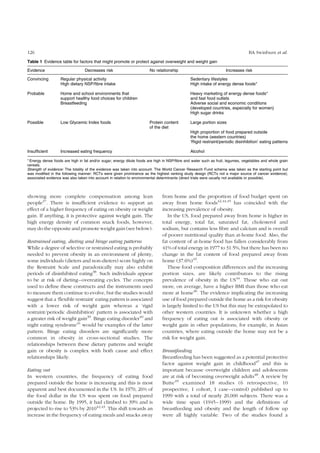
issues is shown in Table1. 
Host issues 
There are a variety of behaviours and other host factors 
that have a potential effect on a population’s level of 
obesity. These are, of course, closely linked to the vectors 
and the environments and in many cases the issues merge 
and overlap. Issues related to social aspects of eating are 
not covered. 
Snacking/eating frequency 
While there is no one definition of snacking, it is probably 
best to consider the content of snack foods and the 
increased eating frequency that snacking promotes as 
separate issues35. There is evidence from the US that 
snacking prevalence (i.e. occasions of snacking) is 
increasing, the energy density of snack foods is increasing 
and the contribution to total energy is increasing36. Snacks 
contribute to about 20–25% of total energy intake in 
countries like the US and UK35. However, there is little 
evidence that a higher frequency of eating per se is a 
potential cause of obesity. Cross-sectional studies tend to 
show a negative relationship or no relationship between 
meal frequency and BMI37. Low eating frequency may, of 
course, be a response to obesity rather than a cause. 
Experimental studies have found mixed results on the 
degree of caloric compensation that people make at meal 
time in response to a prior snack with some studies
126 BA Swinburn et al. 
Table 1 Evidence table for factors that might promote or protect against overweight and weight gain 
Evidence Decreases risk No relationship Increases risk 
Convincing Regular physical activity Sedentary lifestyles 
High dietary NSP/fibre intake High intake of energy dense foods* 
showing more complete compensation among lean 
people37. There is insufficient evidence to support an 
effect of a higher frequency of eating on obesity or weight 
gain. If anything, it is protective against weight gain. The 
high energy density of common snack foods, however, 
may do the opposite and promote weight gain (see below). 
Restrained eating, dieting and binge eating patterns 
While a degree of selective or restrained eating is probably 
needed to prevent obesity in an environment of plenty, 
some individuals (dieters and non-dieters) score highly on 
the Restraint Scale and paradoxically may also exhibit 
periods of disinhibited eating38. Such individuals appear 
to be at risk of dieting–overeating cycles. The concepts 
used to define these constructs and the instruments used 
to measure them continue to evolve, but the studies would 
suggest that a ‘flexible restraint’ eating pattern is associated 
with a lower risk of weight gain whereas a ‘rigid 
restraint/periodic disinhibition’ pattern is associated with 
a greater risk of weight gain39. Binge eating disorder40 and 
night eating syndrome41 would be examples of the latter 
pattern. Binge eating disorders are significantly more 
common in obesity in cross-sectional studies. The 
relationships between these dietary patterns and weight 
gain or obesity is complex with both cause and effect 
relationships likely. 
Eating out 
In western countries, the frequency of eating food 
prepared outside the home is increasing and this is most 
apparent and best documented in the US. In 1970, 26% of 
the food dollar in the US was spent on food prepared 
outside the home. By 1995, it had climbed to 39% and is 
projected to rise to 53% by 201042,43. This shift towards an 
increase in the frequency of eating meals and snacks away 
from home and the proportion of food budget spent on 
away from home foods42,44,45 has coincided with the 
increasing prevalence of obesity. 
In the US, food prepared away from home is higher in 
total energy, total fat, saturated fat, cholesterol and 
sodium, but contains less fibre and calcium and is overall 
of poorer nutritional quality than at-home food. Also, the 
fat content of at-home food has fallen considerably from 
41% of total energy in 1977 to 31.5%, but there has been no 
change in the fat content of food prepared away from 
home (37.6%)43. 
These food composition differences and the increasing 
portion sizes, are likely contributors to the rising 
prevalence of obesity in the US44. Those who eat out 
more, on average, have a higher BMI than those who eat 
more at home46. The evidence implicating the increasing 
use of food prepared outside the home as a risk for obesity 
is largely limited to the US but this may be extrapolated to 
other western countries. It is unknown whether a high 
frequency of eating out is associated with obesity or 
weight gain in other populations, for example, in Asian 
countries, where eating outside the home may not be a 
risk for weight gain. 
Breastfeeding 
Breastfeeding has been suggested as a potential protective 
factor against weight gain in childhood47 and this is 
important because overweight children and adolescents 
are at risk of becoming overweight adults48. A review by 
Butte49 examined 18 studies (6 retrospective, 10 
prospective, 1 cohort, 1 case–control) published up to 
1999 with a total of nearly 20,000 subjects. There was a 
wide time span (1945–1999) and the definitions of 
breastfeeding and obesity and the length of follow up 
were all highly variable. Two of the studies found a 
Probable Home and school environments that 
support healthy food choices for children 
Heavy marketing of energy dense foods* 
and fast food outlets 
Breastfeeding Adverse social and economic conditions 
(developed countries, especially for women) 
High sugar drinks 
Possible Low GIycemic Index foods Protein content 
of the diet 
Large portion sizes 
High proportion of food prepared outside 
the home (western countries) 
‘Rigid restraint/periodic disinhibition’ eating patterns 
Insufficient Increased eating frequency Alcohol 
* Energy dense foods are high in fat and/or sugar; energy dilute foods are high in NSP/fibre and water such as fruit, legumes, vegetables and whole grain 
cereals. 
Strength of evidence: The totality of the evidence was taken into account. The World Cancer Research Fund schema was taken as the starting point but 
was modified in the following manner: RCTs were given prominence as the highest ranking study design (RCTs not a major source of cancer evidence); 
associated evidence was also taken into account in relation to environmental determinants (direct trials were usually not available or possible).
Diet, nutrition and the prevention of excess weight gain and obesity 127 
positive association between breastfeeding and later 
obesity and four found a negative relationship (i.e. an 
apparent protective effect of breastfeeding). The remain-der 
found no differences. The largest study (n ¼ 9357 
children aged 5–6) found a prevalence of obesity among 
breastfed children of 2.8% compared to 4.5% in never 
breastfed children and there was an apparent dose 
response in relation to the duration of breastfeeding50. A 
similar study of 3731 6-year-old British children, however, 
found no such relationships51. 
Since that review, two further studies have been 
published. A US cohort study of over 15,000 boys and 
girls aged 9–14 years reported a significant (about 20%) 
reduction in the risk of becoming overweight associated 
with only or mostly breastfeeding in the first 6 months of 
life after adjusting for measured confounders52. The 
second study was a US cross-sectional survey of 2685 3–5- 
year-olds53. The risk reductions for breastfeeding were of 
a similar magnitude to the previous study but the lower 
power of the second study meant that the associations 
were not statistically significant. A significant reduction in 
risk was found with breastfeeding for being ‘at risk of 
overweight’ (between 85th and 94th percentiles for BMI). 
The influence of confounding factors is a major problem 
in these studies and controlling for them was only 
attempted in some of the studies. The BMI of the parents 
(especially the mother) is a strong determinant for 
childhood obesity49,52 and overweight mothers tend to 
breastfeed less and for a shorter duration52. There have 
been marked changes in formula composition and infant 
feeding practices over the decades and the early studies 
may be of limited relevance to the current day 
recommendations49. 
The current evidence was judged to show a probable 
protective effect of breastfeeding against childhood 
obesity. The prevention of unhealthy weight gain should, 
therefore, be added to all the other health reasons for 
promoting breastfeeding and complementary feeding. 
Early nutrition 
Birth weight is a crude indicator of intrauterine nutrition. A 
systematic review of predictors of obesity by Parsons et al. 
found that studies reported a consistent and positive 
relationship between birth weight and BMI (or risk of 
overweight) as a child or as an adult54. It is possible that 
low birth weights may also be associated with high adult 
BMI (i.e. that the relationship is a J-shaped curve rather 
than linear and positive). However, very low birth weight 
is a much weaker predictor of high adult BMI than high 
birth weight54. 
Maternal and childhood undernutrition are common in 
low income countries and childhood stunting is often used 
as a marker for this. A later exposure to more western-style 
diets and lifestyles (such as through migration to urban 
areas and/or improved economic conditions) may 
promote an excessive increase in body fatness or 
abdominal fatness. Popkin et al. studied 3–9-year-old 
children in cross-sectional studies in four countries (China, 
Russia, South Africa and Brazil) and found that stunted 
children (low height-for-age z-score) were more likely 
than non-stunted children to be overweight (high weight-for- 
height z-score) with relative risks between 1.7 and 
7.855. On the other hand, a cohort of children measured at 
age 3 in Guatemala and followed into adulthood showed 
that childhood stunting was associated with a low BMI and 
low percent body fat in men but no such relationships 
were seen in women56. Only when BMI or percent body 
were adjusted for, did an association between severe 
stunting and high waist:hip ratio become evident. 
The hypothesis that intrauterine and/or early childhood 
undernutrition leads to adult obesity or abdominal obesity 
is an important one that links with the other relationships 
between early undernutrition and adult diseases such as 
hypertension and diabetes57. This could pose a major 
problem for countries undergoing the economic and 
nutrition transition21. However, the relationships are 
clearly complex and the available data were judged 
insufficient to be able to make a single summary statement 
in the evidence table. 
Vector issues 
Percent fat, percent carbohydrate and energy density 
Background: Most of the debate about the fat and 
carbohydrate content of the diet in relation to obesity 
centres on the effects of altering the reciprocal proportions 
of carbohydrate and fat in the diet on energy density, total 
energy intake, body weight and lipoprotein profiles. The 
debate58 – 60 has become vigorous and, at times, muddled 
because several issues are usually debated at the same 
time. Also, the epidemiological evidence comes from 
different types of studies (ecological, cross-sectional and 
prospective) which suffer from multiple potential sources 
of bias, the instruments used to measure dietary intake are 
blunt, and there is substantial obesity-related under-reporting 
of energy and fat intake61. Even the clinical trials 
use a wide variety of different dietary manipulations, some 
are isocaloric and some are ad libitum and few are long 
term. The evidence is reviewed in several parts to try to 
bring some clarity to the debate. Firstly, the effects of 
reciprocal differences or alterations in percent fat and 
percent carbohydrate on body weight will be examined in 
different study designs: epidemiological studies; con-trolled 
trials of high percent fat or high percent 
carbohydrate diets under conditions of (a) fixed total 
energy intakes, (b) covert manipulations with ad libitum 
total intakes or (c) overt manipulations with ad libitum 
total intakes. Secondly, the high energy density of high fat 
diets will be examined as the potential mechanism to 
explain their propensity to promote weight gain. 
Percent fat in the diet—epidemiological studies: The 
epidemiological evidence presents mixed results on the 
relationship between the percent fat (or percent
128 BA Swinburn et al. 
carbohydrate) in the diet and obesity or weight gain. 
Ecological studies between populations tend to show a 
positive relationship between fat and obesity, especially if 
populations with low fat intakes are included60,61, but 
negative relationships are also seen62. Similarly, studies in 
the same population over time tend to show positive 
relationships between obesity and dietary fat intake in 
populations undergoing nutrition transition but a negative 
relationship in many westernised populations61,62. Cross-sectional 
and prospective studies also show mixed 
results62. In light of the methodological drawbacks of 
these types of studies and the mixed results they have 
produced61, controlled trials are needed to address the 
question. 
Percent fat in the diet—fixed total energy trials: 
According to Reaven63 the simplest way to answer the 
question about the impact of fat and carbohydrate in the 
diet on body weight ‘is to focus on studies that vary in 
macronutrient composition, but are equal in energy’. 
Studies that have done this63 – 65 have indeed found that 
‘clamping’ total energy produces similar weight changes 
irrespective of the macronutrient composition. The 
rationale for many of these studies was to assess the 
impact of macronutrient changes independent of total 
energy intake. They were not to emulate the real world 
where total intake is ad libitum. The conclusion from the 
fixed energy studies is that if a high percent fat diet 
promotes weight gain, the mechanism appears to be 
mediated by promoting a higher total energy intake. 
Percent fat in the diet—ad libitum trials, covert 
manipulations: Several trials have covertly manipulated 
the fat and carbohydrate proportions of equally palatable 
diets while allowing study participants to eat ad libitum 
total intakes66 – 73. Most of the studies were short term with 
the longest being 11 weeks73. These trials consistently 
show a progressive rise in total energy intake and body 
weight on the higher percent fat diets and the opposite on 
the lower percent fat diets. The amount (weight) of food 
eaten is similar on both types of diet. These covert 
manipulation studies are central to the debate on dietary 
fat and weight gain because they demonstrate that, other 
things being equal, the physiological–behavioural con-sequence 
of a high percent fat diet is a slow weight gain 
through the ‘passive overconsumption’ of total energy. 
Percent fat in the diet—ad libitum trials, overt 
manipulation: Longer term trials of high and low percent 
fat diets have generally used educational strategies to get 
participants to select reduced fat food options and 
compared them with standard or higher fat diets. The 
diet is unrestricted in total amount (weight) and 
replacement of lost energy from fat is not specifically 
replaced by carbohydrate. It is important to note that, 
unlike the covert manipulations, it is difficult to blind 
such studies and, therefore, psychosocial effects, 
personal preferences and other effects not directly related 
to physiology can confound the results74. A recent 
meta-analysis of 16 ad libitum dietary trials (19 interven-tions) 
of at least 2 months duration showed that reduced 
fat diets consistently result in a reduced total energy intake 
and reduced weight75. Interestingly, weight loss was not 
the primary goal in more than half the studies. A reduction 
in the proportion of fat in the diet by 10% points 
corresponded with a reduction of about 1MJ of total 
energy per day. The effects of such a dietary change on 
body weight have been estimated to be in the range of 
2.6–3.2 kg, although greater weight loss is seen in more 
overweight individuals75. The weight loss was not 
associated with the duration of the intervention but it 
was larger in overweight subjects compared to normal 
weight subjects. It is important to note that an absolute 
reduction in dietary fat (g/d) does not elicit a compensa-tory 
increase in absolute dietary carbohydrate intake 
(g/d), although the fat:carbohydrate ratio, of course, 
decreases76. 
An interesting study attempting to replicate realistic 
food choices randomised normal weight and overweight 
participants into two groups who selected either full fat or 
reduced fat foods from small, realistic ‘supermarkets’ in 
the study centres77. The free access to higher fat products 
resulted in a significant increase in energy intake 
(0.9 MJ/d) and body weight (0.7 kg) over 6 months 
compared to the reduced fat group. 
Reducing the fat content of the diet consistently 
produces modest reductions in body weight but one 
could argue that instructions to individuals to reduce other 
macronutrients in the diet or to restrict the intake of certain 
high volume foods (such as staple carbohydrates) would 
also result in weight loss. Indeed, there are a myriad of 
popular diets with a wide variety of food and drink 
restrictions and all have their champions who have lost 
weight. It is obvious that any such restrictions that result in 
a reduction in total energy intake will produce weight loss. 
The rationale for promoting a reduction in the fat content 
of the diet to prevent weight gain or promote weight loss is 
that it is concordant with the body’s physiological– 
behavioural mechanisms regulating food intake as 
evidenced by the covert manipulation studies. 
Another potential criticism of promoting a reduced fat 
content of the diet is that the ad libitum weight loss studies 
show a modest effect (a few kilograms) with a tendency to 
return towards the previous weight after the intervention 
period76. This rebound is common to all dietary 
interventions and there are a number of potential 
explanations for this. They include: a reduction in 
compliance to the diet, perhaps due to an environment 
that is unsupportive of healthy food choices; overeating of 
foods known to be low in fat and; physiological 
adaptations that attenuate the impact of negative energy 
balance on weight loss78. 
Extremely low fat, high carbohydrate diets are also very 
effective for weight loss79,80 but it must be stressed that 
large reductions in total fat intake would be unattainable at
Diet, nutrition and the prevention of excess weight gain and obesity 129 
a population level. Average changes in the order of 2–3 kg 
may seem small for individuals but they are important on a 
population level in the context of obesity prevention. A 
shift of one unit of BMI in the overall distribution in the 
population is associated with a 5% point change in the 
prevalence of obesity8. 
Percent fat in the diet—mechanisms that promote 
weight gain: Why does a high percent fat diet tend to result 
in a passive overconsumption of total energy and thus 
promote weight gain? Potential mechanisms are through 
satiety, energy density, palatability and/or metabolic 
responses. 
Foods high in fat are less satiating than foods high in 
carbohydrates81,82. When isocaloric amounts of foods are 
fed, a high satiety score is associated with a high volume of 
the food which in turn is related to a high complex 
carbohydrate content81. Is satiety related to the food 
volume (weight) per se or is it dependent on the different 
metabolic processes that fat and carbohydrate undergo 
after digestion? Pure fat (9 kcal/g) has more than twice the 
energy density of pure carbohydrate (4 kcal/g) or pure 
protein (4 kcal/g). These differences are accentuated 
when one considers real foods rather than nutrients 
because high carbohydrate foods, such as vegetables and 
cereals, also tend to include water and fibre which further 
dilute energy density whereas many high fat foods, such as 
oils, butter and margarine, have little water or fibre. 
Several carefully controlled studies have manipulated 
the fat and carbohydrate content, energy density, and 
volume independently of each other to further explore 
these relationships. If energy density and palatability are 
kept constant, no difference in energy intake occurs in 
diets with varying fat and carbohydrate content83. 
Conversely, variations in energy density at constant 
fat:carbohydrate ratios influences total energy intake84. 
This implies that under ad libitum conditions, it is the 
high energy density of fatty foods that results in a weak 
satiating effect for the energy eaten and, therefore, 
promotes passive overconsumption85,86. In the real 
world, the fat content of foods or dietary intakes are 
closely related to their energy density, so that the general 
statement that high dietary fat intakes are likely to 
promote weight gain still holds. However, three caveats 
to this statement need to be made. The first is that some 
food products such as snack bars and breakfast cereals 
have been manufactured to be low in fat, but the addition 
of large amounts of sugars into the products means that 
they contain about the same amount of energy per 100 g 
as their original full-fat counterparts87. The second is that 
the water incorporated into foods appears to have greater 
effects on promoting satiety and reducing subsequent 
intake than water incorporated into beverages88. This 
would mean that until further research claries the 
relationship between energy density, satiety and sub-sequent 
energy intake across foods and beverages, these 
latter two categories should be considered separately. 
The third caveat is that diets that are very high in energy 
dilute foods (such as vegetables, fruits and whole grain 
cereals) and have a significant addition of fat (such as oil) 
may achieve a high percent of energy as fat without being 
very energy dense. 
Prior to the elegant studies teasing out the impact of 
energy density and dietary fat (above), a ‘glycogenostatic 
model’ for energy balance had been proposed by Flatt as a 
metabolic explanation of the differential effects of high fat 
and high carbohydrate diets in animals and humans. This 
model was built on the experimental evidence from 
feeding trials, the largely separate metabolic pathways for 
carbohydrate and fat (nutrient partitioning), the minor 
conversion of carbohydrate into fat (de novo lipogenesis is 
a minor pathway in humans except under unusual 
conditions of massive carbohydrate overfeeding90), the 
lack of acute fat oxidation response to increased fat 
intake85,91 and the limited capacity of glycogen stores. 
While each of these building blocks of the model remain 
valid, studies that have grossly manipulated glycogen 
stores over 1–2 days have found no effect on energy 
intake92,93. 
Another potential metabolic mechanism by which 
dietary fat might promote weight gain is that it has a 
lower thermic effect (energetic cost of processing) than 
carbohydrate94 but this is likely to be a minor factor except 
under conditions of significant overfeeding91. 
Fats also carry many aromatic compounds that add 
flavour to foods and, therefore, high fat foods may be 
overconsumed, in part, because they are highly palatable. 
Percent fat in the diet—secular changes in diet and 
obesity: It is apparently paradoxical that in some countries 
the percent fat in the diet has decreased but obesity has 
increased—indeed this has been dubbed ‘The American 
paradox’95 because that is where it is most obvious. 
Accurate measurement of population macronutrient 
intakes is problematic because of serious (and probably 
increasing) underreporting in dietary surveys and the 
many assumptions incorporated into measuring food 
supply. However, it does appear that dietary carbohydrate 
intake has risen in absolute and relative terms, dietary fat 
has changed little in absolute terms and decreased in 
relative terms and that total energy intake has increased 
overall96. These trends coupled with continued reductions 
in physical activity would explain the apparent paradox. 
Messages about reducing fat in the diet appear to have 
been used interchangeably with increasing carbohydrate 
and this may have contributed to overconsumption of 
carbohydrates and total energy which then promotes the 
storage of dietary fat as body fat. This would also be 
accentuated by the marketing of high sugar, high energy 
dense foods as ‘low fat’ implying (falsely) that they are 
neutral or helpful for preventing weight gain87. 
Percent fat in the diet—effects on lipoproteins: This topic 
is covered in the chapter on cardiovascular diseases, but 
there is an interaction between dietary composition and
130 BA Swinburn et al. 
weight change on lipoprotein levels. Many studies have 
manipulated the macronutrient content of short term diets 
under isocaloric weight stable conditions (such as reducing 
saturated fat and replacing the energy with carbohydrate or 
other types of fat). In many58 but not all97 such studies, the 
high carbohydrate diet is associated with increased 
triglycerides and decreased HDL-cholesterol (especially if 
predominantly simple carbohydrates are used). 
The weight loss effect of a reduced-fat diet, ad libitum 
diet, however, appears to compensate for these potentially 
detrimental effects. Schaefer et al. directly compared the 
effects of shifting subjects from a high fat diet (35% of 
energy) to a low fat diet (15% of energy) under isocaloric 
(5–6 weeks) and ad libitum (10–12 weeks) conditions98. 
In order to achieve energy equivalence in the isocaloric 
part of the study, the weight and volume of the food 
consumed on the lower fat diet had to be increased by 
30%. Under weight-maintenance conditions, on the low 
fat diet there was a significant reduction total, LDL- and 
HDL-cholesterol and an increase in total:HDL cholesterol 
ratio and plasma triglyceride concentrations. At the end of 
the ad libitum diet, subjects had lost an average of 3.6 kg 
and achieved greater reductions in total and LDL-cholesterol 
compared to the low fat isocaloric diet. The 
total:HDL cholesterol ratio and triglyceride levels were no 
different at the end of the ad libitum period compared to 
baseline. 
This and other studies that assess the interaction 
between macronutrient composition and weight change 
on blood lipids77,99,100 suggest that the effects of short 
term, isocaloric manipulations under metabolic ward 
conditions on lipids cannot be extrapolated to long term, 
ad libitum conditions in free-living individuals. 
Summary of percent fat and obesity: At a macronutrient 
level, there is no evidence that energy from fat is more 
fattening than the same amount of energy from 
carbohydrate or protein. At a dietary level, there is still 
debate about the effects of diet composition on unhealthy 
weight gain, and more research is needed in this area. 
However, it was considered that the overall evidence from 
the randomised controlled trials was convincing that a 
high intake of energy-dense foods (which are often also 
micronutrient poor) promotes unhealthy weight gain. The 
short term, isocaloric substitution studies were considered 
far less relevant to free living individuals than the longer 
term, ad libitum studies. These latter studies show a highly 
consistent effect of a high fat content on promoting weight 
gain. The covert manipulations of fat content show that the 
effect is a physiological–behavioural one and is not 
dependent on conscious reductions in food eaten. The 
main mechanism for this appears to be that a diet high in 
fat has a weak impact on satiety because of its high energy 
density and this leads to a passive overconsumption of 
total energy. The high palatability of high fat foods and the 
relatively weak metabolic autoregulation in the face of a 
high fat diet are also likely contributors. While most high 
fat diets tend to be energy dense diets and thus weight-promoting 
diets, important caveats were noted. For 
example, many processed low fat foods were quite 
energy-dense and could promote weight gain if eaten in 
large amounts and conversely vegetable-based foods were 
quite energy dilute even with significant added fat and 
could protect against weight gain. 
Carbohydrate type (sugar, glycemic index (GI) and non-starch 
polysaccharide (NSP)) 
The definitions of carbohydrates are often confusing. 
Sugars are predominantly monosaccharides and disac-charides. 
The term ‘free sugars’ has been defined in 
relation to the sugars that promote dental caries and refers 
to all mono and disaccharides added by the manufacturer, 
cook or consumer plus sugars naturally present in fruit 
juice, honey and syrups. Polysaccharides are either starch 
or NSP, the latter having considerable commonality with 
the term ‘dietary fibre’ which is still in common parlance 
and was the term used in many of the studies reviewed. 
Sugars, GI and NSP/fibre are considered in turn, although 
of course there is significant overlap between these factors 
within foods. 
Sugar in foods: There is a reciprocal relationship 
between the percent fat and percent carbohydrate in the 
diet because these two nutrients generally contribute over 
80% of total energy. Therefore, the previous section on 
percent fat could also be stated as: diets with a high 
carbohydrate content provide protection against weight 
gain. However, if the diet is high in sugar, does the same 
association apply? Large population studies have demon-strated 
that those who have high total energy intakes tend 
to have a high total sugar intake101 – 106 although in relative 
terms, a reciprocal relationship is also seen between the 
percent fat and percent sugar in the diet106. Studies relating 
sugar intake to BMI consistently show an inverse relation 
between sugar intake as a percent of energy and BMI or 
obesity prevalence106. 
It is possible that the negative relationship between 
sucrose consumption and BMI is affected by confounding 
factors. For example, more active people need extra 
energy and this could be provided by sugar. Selective 
underreporting of high sugar foods and drinks by 
overweight/obese people is another possible confoun-der 
107. The high sugar content of some products with 
reduced fat claims may falsely imply that the products are 
low in energy as well. 
Simple sugars have hedonistic value. Sweetening 
increases the palatability of many foods and it has been 
suggested that sweetness may lead to overconsump-tion 
108. However, there appears to be a limit to the 
hedonistic response to sweetened foods109. Palatability of 
foods is also increased by fat and therefore processed 
foods containing both high sugar and fat content may lead 
to weight gain110. Overall, the mixed results, especially 
amongst the few available trials, does not allow a
Diet, nutrition and the prevention of excess weight gain and obesity 131 
judgment to be made about the sugar content of food and 
obesity. 
Studies have compared high fat diets with low fat diets 
that are high in either sugar or starch. Raben et al. found 
that similar amounts of energy were consumed on the 
high fat and high sucrose diets but there was a lower 
energy intake and weight loss with the high starch 
diets111. Saris et al. found a relative weight loss of 1.7 kg 
in the high sugar diet and 2.6 kg in the high starch diet 
compared to the high fat diet (both statistically 
significant) but the differences between carbohydrate 
types was not significant100. 
Sugar in drinks: The energy density of drinks such as 
regular soda drinks is low because of the high water 
content but physiologically the energy density of fluids 
and foods may have not have comparable effects on 
satiety and ad libitum food consumption88,112. It, there-fore, 
seems prudent to consider the impact of drinks that 
contribute a significant amount to total energy intake 
(such as high sugar soda drinks) separately from foods. 
In a cross-over study, Tordoff and Alleva113 compared 
the consumption of soda (1150 g/d for 3 weeks) which 
had been sweetened with either a high fructose corn syrup 
or aspartame on body weight. The high fructose soda 
condition increased total energy intake by 335 kcal/d and 
resulted in a significant mean weight gain of 0.66 kg 
compared to the aspartame soda condition where total 
energy intake decreased by 179 kcal/d and weight 
decreased non-significantly by 0.17 kg. 
From a US national survey, Harnack et al.114 found that 
children ingesting nine or more ounces of soft drink per 
day consumed nearly 200 kcal/d more than those who did 
not drink soft drinks. In a longitudinal study in the US, 
Ludwig et al.115 found a high intake of sugar drinks 
predicted the development of obesity over 19 months in 
12-year-old children. They estimated that an increase of 
one can of soda per day increased the risk of obesity 1.6 
times. This association was not seen with diet soda drinks. 
Some fruit drinks and cordial drinks can also be high in 
sugar and may promote weight gain if drunk in large 
quantities but this has been less extensively studied than 
soda drinks. 
Overall, the evidence that high sugar drinks promote 
weight gain is consistent and moderately strong, but is of 
most relevance in those populations with a high intake 
(such as children in many countries). 
Glycemic index: A further mechanism by which 
carbohydrates may influence energy intake and body 
weight is by their GI. Different carbohydrate foods 
increase blood glucose and serum insulin to varying 
extents even when the same amount of carbohydrate is 
eaten. The different changes in glucose and/or insulin may 
have subsequent effects on food intake or the promotion 
of overweight and obesity116, with lower GI diets 
producing greater satiety117,118. In addition to the effects 
of carbohydrates on satiety, there is a suggestion that low 
GI diets may provoke greater increases in cholecystokinin 
and fullness post-meal (satiation)118,119. 
Ludwig et al.116 demonstrated that voluntary food intake 
was greater after high GI meals were consumed compared 
to medium and low GI meals. They found that rapid 
absorption of glucose altered hormonal and metabolic 
functions and promoted excessive food intake after the 
ingestion of a high GI meal. Agus et al.120 found during a 
randomised cross-over trial that when the acute (9 days) 
effects of energy restricted diets of high and low glycemic 
loads were studied in overweight young men, the high 
glycemic load diet produced a greater decline in metabolic 
rate, more negative nitrogen balance and greater voluntary 
food intake. 
On energy restrained diets, a 12 week cross-over trial by 
Slabber et al.121 demonstrated that a low GI diet produced 
lower insulin levels and a greater weight loss than 
corresponding high GI diets. Spieth et al.122 found that 
after 4 months of intervention, low GI diets may be more 
effective than reduced-fat diets in treating childhood 
obesity. 
Low GI diets may influence fuel storage by promoting 
fat oxidation instead of carbohydrate oxidation118, 
whereas raised insulin levels in response to high GI diets 
inhibit lipolysis and encourage fat storage116,118, limiting 
available fuels and encouraging overeating116. 
Overall, the current evidence suggests a possible 
influence of GI on body weight and composition, but 
long term trials with changes in body weight as an 
outcome are needed before more definitive statements 
can be made123. 
Non-starch polysaccharide: A high intake of dietary 
NSP/fibre is generally, but not always associated with a 
lower BMI in epidemiological studies124,125, but these 
studies are highly susceptible to measurement errors and 
confounding factors. Two recent reviews of trials of high 
versus low dietary NSP/fibre showed that the majority of 
studies supported a beneficial effect of NSP/fibre. Pereira 
and Ludwig124 reported that 16 out of 27 trials reported 
beneficial subjective effects (satiety ratings) for high 
NSP/fibre meals or diets and 12 out of 19 showed 
beneficial objective effects (measured energy intake, 
gastric emptying, hormonal response or weight change). 
The review by Howarth et al. examined the impact of 
dietary NSP/fibre on satiety ratings, energy intake and 
weight change125. For studies of #2 days (n ¼ 20) and .2 
days (n ¼ 18), dietary NSP/fibre as a supplement or in 
foods either increased satiety or reduced hunger in the 
vast majority (n ¼ 27 studies). The high NSP/fibre 
condition also resulted in a decrease in energy intake of 
about 10% (n ¼ 23 studies). Studies of greater than 4 
weeks duration with either a fixed energy intake (n ¼ 11) 
or ad libitum intake (n ¼ 11) showed consistent 
reductions in body weight with the high NSP/fibre 
condition. The mean weight loss for the fixed intake 
studies was 1.3 kg over 2.9 months (20 g/d) and for the
132 BA Swinburn et al. 
adlibitum studies was 1.9 kg over 3.8 months (24 g/d). In 
general, there were no differences between soluble, 
insoluble, or mixed fibre or between fibre as a supplement 
and within foods. Obese or overweight people tended to 
lose more weight than lean individuals (2.4 versus 0.8 kg). 
A variety of mechanisms have been postulated to 
explain the effects of dietary NSP/fibre on energy balance 
and these include intrinsic effects of the NSP/fibre (such as 
on energy density and palatability), hormonal effects 
(such as gastric emptying and post-prandial glycemia and 
insulinemia), and colonic effects (such as fermentation to 
short chain fatty acids and effects on satiety)124 – 126. 
Overall, the evidence is convincing that a high dietary 
NSP/fibre intake helps to protect against weight gain. 
Protein 
The range of mean protein intakes across populations and 
across time is relatively small (10–15% of total energy)127 
and this limits the scope for influencing protein intake as a 
population measure to combat obesity. Nevertheless, 
protein is generally agreed to be the most satiating of 
macronutrients128, particularly among people with a low 
habitual protein intake129 and may influence body weight 
under ad libitum, reduced fat conditions130. Increasing 
protein intake may be beneficial for some individuals for 
weight control but the role of protein content of the diet at 
a population level is probably not an important 
determinant of obesity prevalence. 
Alcohol 
Alcohol is an energy dense nutrient (7 kcal/g) and because 
of its place at the top of the oxidative hierarchy131, its 
potential for sparing fat oxidation and promoting fat 
storage is significant132. However, some metabolic studies 
show that isocaloric substitution of alcohol for food energy 
results in weight loss while the addition of alcohol does 
not promote weight gain133. There is a similar paradox 
seen in epidemiological studies. Dietary intake surveys 
tend to show that energy from alcohol is additive to food 
energy intake such that total energy intake is higher with a 
higher alcohol consumption134. However, the relation-ships 
between reported alcohol intake and BMI show a 
mixed pattern. One review of the epidemiological 
evidence, listed 25 studies showing a positive association, 
18 showing a negative association and 11 showing no 
relationship135. For women, there was often a negative 
relationship134 or possibly U-shaped relationship131. For 
men, the relationship tends to be slightly positive134 or 
non-existent131. 
In an earlier review of 27 studies136, seven showed a 
negative relationship between adiposity and alcohol 
intake, seven showed a positive relationship, nine showed 
different associations for women and men, and eight 
showed no relationship. Emery et al. reviewed the 
epidemiological studies linking a high alcohol intake 
with abdominal fat distribution (high waist circumference 
or waist:hip ratio)137. They concluded that the evidence 
for a relationship was moderate for men and suggestive for 
women. 
The potential for confounding by concurrent lifestyle 
and socioeconomic factors is substantial, as is the 
tendency to underreport alcohol intake. Other factors 
also confound the relationships between alcohol and 
obesity: alcohol–macronutrient interactions; the possi-bility 
that obese people have reduced their alcohol 
consumption because of their obesity; metabolism 
through pathways with different energetic returns (e.g. 
alcohol dehydrogenase versus microsomal ethanol oxidiz-ing 
system); and the direct toxic effects of alcohol135. 
Overall, the epidemiological evidence is mixed and 
probably highly confounded. Randomised controlled 
trials on the issue are unlikely to be conducted. There is 
currently insufficient evidence to support a general role for 
alcohol in the development of obesity. 
Portion size 
The portion size in pre-packaged, ready-to-eat and 
restaurant foods is increasing in the US and elsewhere, 
building on the consumers’ desire for ‘value for money’. In 
recent years the number of restaurants offering ‘supersize’ 
options on their menu has rapidly risen, and other food 
items, especially snack foods, have increased package 
weight42. The increasing size of packaging indicates lower 
unit cost and encourages use of more product than small 
package size42,138. These trends are occurring in many 
western countries but are less well documented than they 
are in the US. 
‘Supersized’ portions potentially lead to increased 
energy intakes at the time and over the day and, therefore, 
could be a significant contributor to obesity, particularly in 
populations with a high use of meals prepared outside the 
home. Many people cannot accurately estimate portion 
size, and this leads to an underestimation of intake42,138. 
The energy compensation later in the day after a high 
energy meal is incomplete in many individuals139. Very 
few studies have examined the impact of portion size on 
overall energy consumption. One of these has shown that 
portion size promotes a higher total intake and that this 
seems to occur in adults and in 5 year olds, but not in 3 
year olds139. The age at which the external cues (such as 
portion size) begin to influence intake is, therefore, 
appears to be between 3 and 5 years. 
Overall, there is strong ecological evidence of a 
concurrent increase in portion sizing and obesity in 
countries such as the US. The proposition that large 
portion sizes promote overconsumption is logical and 
likely but the empirical studies, while supportive, are very 
few in number. 
Environmental issues 
The increasing ‘obesogenicity’ of the environments 
external to individuals is likely to be the major driving
Diet, nutrition and the prevention of excess weight gain and obesity 133 
force for the increasing obesity epidemic34. The environ-ments 
in which people live are complex and their 
individual and combined elements have a marked effect 
on people’s behaviours and dietary intakes. Individuals 
interact in a variety of micro-environments or settings such 
as schools, workplaces, homes, restaurants and fast food 
outlets140. These in turn are influenced by the broader 
macro-environments or sectors such as the food industry, 
all levels of government, and society’s attitudes and 
beliefs. Much of the evidence of the impact of 
environments on dietary intake and obesity comes from 
cross-sectional associations and some intervention studies, 
although it is generally very difficult to tease out the 
impacts of specific environmental elements. The same 
statements also apply to environments that promote 
physical inactivity. The car-oriented design of built 
environments (coupled with the heavy promotion and 
affordability of cars and petrol), the increasing use of 
machines to replace occupational physical work, the 
increasing availability of energy-saving machines for every 
day tasks, and the expanding opportunities for passive 
recreation and entertainment are some of the dominating 
forces in influencing behaviours towards more inactive 
lifestyles42. 
Socioeconomic circumstances 
While socioeconomic status (SES) is a characteristic of an 
individual (often measured by personal income or 
educational attainment), its underlying determinants are 
closely linked to the wider environment, especially to 
social, economic, employment and education policies. 
The relationship between SES and obesity is complex. The 
patterns are more exaggerated in women compared to 
men and children and generally show that in low income 
countries obesity is more prevalent in high SES individuals 
and in affluent countries, it is more prevalent in low SES 
individuals141. The change in obesity prevalence patterns 
can be seen in some countries that have monitored obesity 
prevalence rates over a period of economic transition142. It 
seems that in developed countries, the relationship may be 
bi-directional (i.e. low SES promotes obesity and obesity 
promotes low SES) as well as both obesity and low SES 
being independently influenced by other common factors 
such as intelligence141. The mechanisms by which high 
SES in developed countries provides some protection 
against obesity have not been well characterized and are 
likely to be multiple, including behaviours such as 
restrained eating practices and increased levels of 
recreational activity, living in less obesogenic environ-ments 
with greater opportunities for healthy eating and 
physical activity, and a greater capacity to manipulate their 
micro-environments to suit their needs. People living in 
low SES circumstances may be more at the mercy of the 
increasingly obesogenic environment and end up taking 
the default choices on offer. Poorer neighbourhoods tend 
to have fewer recreation amenities143, be less safe, and 
have a higher concentration of fast food outlets144. 
Overall, there is consistent support for the concept that, 
in affluent countries, a low SES is a risk factor for obesity in 
women and part of that effect is likely to be related to 
environments that are relatively deprived of healthier food 
choices and opportunities for physical activity. 
Schools and other educational settings 
Schools are key setting for influencing children and 
indeed, in a review of environment-based interventions to 
reduce energy intake or energy density145, 24 out of the 75 
identified studies were school-based. Overall, these 
interventions appeared to influence some of the beha-viours 
in relation to food intake but only one showed an 
effect on obesity prevalence (in girls but not boys)146. 
Another likely obesogenic element in schools (particu-larly 
in the US) is the increasing number of soft drink 
vending machines in the schools and contracts the schools 
sign to achieve a required volume of sales42. One study 
has shown that a high consumption of high sugar soft 
drinks predicts increased weight gain115. 
The elements that contribute to the overall school food 
environment are: school food and nutrition policies 
(including the types of foods and drinks available and 
promoted at school through the school food service or 
vending machines); training opportunities and resources 
for teachers and food service staff; guidelines for offering 
healthy food and drink choices; promotion of healthy 
options in food brought from home; the curriculum 
content on food and nutrition; and the overall school ethos 
or culture on food and nutrition. Collectively, they 
probably influence dietary intake and, coupled with the 
physical activity environment, probably affect obesity 
prevalence but definitive evidence is still lacking around 
which elements are most important. 
Home environment 
The home and family environment is undoubtedly the 
most important setting in relation to shaping children’s 
eating and physical activity behaviours, but, surprisingly, 
very little is known about the specific home influences. A 
recent review by Campbell and Crawford, however, has 
highlighted a number of elements in the home environ-ment 
that are likely to be influential147. The availability, 
accessibility and exposure to a range of fruits and 
vegetables in the home was correlated with consump-tion 
148, and at least two studies showed that repeated 
exposure to new foods seemed to reduce the propensity 
for young children to reject them149,150. Some aspects of 
the mother’s nutrition knowledge, attitudes and beha-viours 
are also significant predictors of a child’s 
consumption of fruits, vegetables and confectionery151. 
A 1993 meta-analysis of five studies showed only a weak 
correlation between the food preferences of parent–child 
pairs152 but the studies had significant design problems.
134 BA Swinburn et al. 
A more recent, better designed study found significant 
correlations between a toddler’s food preferences and 
those of its family members with the most limiting factor 
being that a food had never been offered to a toddler, 
possibly because the mother did not like the food153. 
The review also noted that the continued trend for 
eating more food prepared outside the home has reduced 
the exposure of children to cooking skills learned in the 
home. In addition, there was some evidence that role 
modelling by peers and parents is another potentially 
important influence over children’s eating patterns. Some 
experimental evidence suggests that using foods as a 
reward or restricting their availability increases the 
preference for those foods and that a high degree of 
parental control of a child’s food intake correlated with a 
lower ability of the child to self regulate energy intake147. 
In summary, there was some empirical evidence and 
compelling logic that a wide range of factors in the 
home environment influenced food intake, although the 
caveat is that most of the studies involved white, middle 
class, US children of normal weight. As a setting, 
however, it is difficult to influence because of the sheer 
numbers and heterogeneity of homes and the limited 
options for access (with television advertising campaigns 
being the most effective but very expensive access 
option). 
Food marketing sector 
Fast food restaurants and energy-dense foods and drinks 
are among the most advertised products on television42,154 
and children are often the targeted market. The fat, sugar 
and energy content of foods advertised to children is very 
high compared to their daily needs and most of the foods 
advertised fall into the ‘eat least’ or ‘eat occasionally’ 
sections of the recommended dietary guidelines155. Many 
studies have documented that the overwhelmingly 
dominant messages that are directed at children, 
particularly through the powerful medium of television 
advertising, are the antithesis of what is recommended for 
a healthful diet42,155 – 157. 
The food industry (mainly fast food restaurants and 
manufacturers of high fat or high sugar foods and drinks) 
spends huge sums on mass media advertising, mainly 
through television advertisements. In 1997, they spent 11 
billion US$ in the US alone42. The impact of this high 
volume of advertising on directing food choices to the 
products being advertised has undoubtedly been closely 
researched by the companies concerned but very little of 
this market research data is publicly available156. The high 
volume of advertising for energy dense foods and 
beverages is undoubtedly fuelling the increasing con-sumption 
of these products158. 
The prevalence of overweight and obesity is higher 
among children who watch more television159, and the 
increased energy intakes of these children42,160 may be 
partly responsible. Advertised products are more often 
requested for purchase and consumed by children157,159. 
Brand recognition not only encourages children to request 
products more often, but also targets those with 
discretionary spending money156. Children’s behaviour 
has been shown to reflect television advertising patterns 
even when they know what they should be eating157. 
Young children under the age of about 6–8 cannot 
distinguish regular programmes from advertisements161, 
nor do they understand the persuasive intent of 
commercials and overweight children with low self-esteem 
are more susceptible to commercials that promote 
consumption of foods for personal enhancement159. 
Overall, it is probable that the heavy advertising of fast 
foods and energy dense foods and drinks increases the 
consumption of those products. The evidence to support 
this rested on a wide variety of publicly available (often 
indirect evidence) studies and the huge advertising 
investment in influencing food choice behaviours which 
was based on more direct but proprietary evidence. 
Other environments 
There are a wide variety of settings in which people gather 
and that involve food and eating. Most of the evidence for 
their impact on eating patterns comes from cross-sectional 
surveys or intervention studies. Restaurants162, work-places 
163,164, supermarkets165 and a variety of other 
settings probably each provide modest influences on 
dietary intakes and obesity but good evidence is either 
limited or non-existent145. 
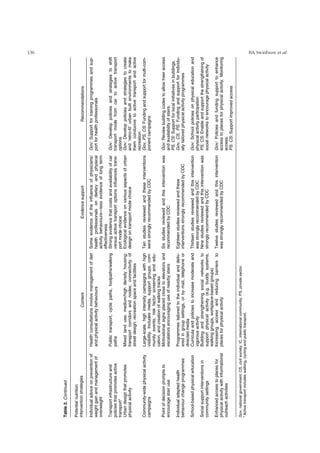
Potential strategies to reduce obesity 
A number of potential strategies to reduce obesity 
prevalence are described below and summarised in 
Table 2. The content of the potential intervention is 
outlined, along with a summary of the evidence of 
effectiveness and the implications for governments, civil 
society, the private sector and the international agencies. 
This is not an exhaustive list of potential interventions and 
indeed each intervention activity would need to be 
specific to the locality and culture of the intervention 
population. Strategies to increase physical activity levels 
would be a key part of any overall approach to obesity 
prevention, however, these are not considered in detail in 
this review of diet and nutrition approaches. A review of 
the evidence support for some strategies to increase 
physical activity has been published by the Center for 
Disease Control in the US6. 
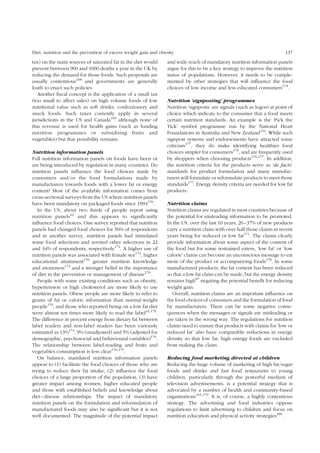
Fiscal food policies 
Food prices have a marked influence on food buying 
behaviour and consequently nutrient intakes166. 
Governments have price policy instruments at their 
disposal (principally subsidies and taxes) to influence 
buying patterns. In the case of cardiovascular disease, 
Marshall167 has estimated that a tax (17.5% value added
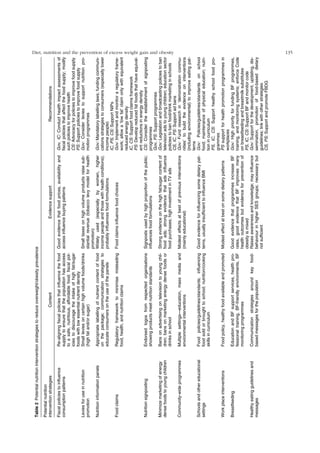
Table 2 Potential nutrition intervention strategies to reduce overweight/obesity prevalence 
Potential nutrition 
intervention strategies Content Evidence support Recommendations 
Fiscal policies to influence 
consumption patterns 
Re-aligning fiscal policies that influence the food 
supply to ensure that the population has access 
to a safe, nutritious, affordable food; fiscal pol-icies 
to discourage the intake of high fat/sugar 
foods with low essential nutrient density 
Good evidence that food prices, availability and 
access influence buying patterns 
Gov, IC: Conduct health impact assessments of 
fiscal policies that affect the food supply; modify 
such policies to improve health 
CS: Advocacy for policies to improve food supply 
PS: Support policies to improve food supply 
Levies for use in nutrition 
promotion 
Small levies on certain high volume foods/drinks 
(high fat and/or sugar) 
Small taxes on high volume products raise sub-stantial 
revenue (tobacco levy model for health 
promotion) 
Gov: Consider levies to support nutrition pro-motion 
programmes 
Nutrition information panels Appropriate labelling of nutrient content of food 
on the package; communication strategies to 
educate consumers on the use of the panels 
Widely used (especially by women, higher 
income people and those with health conditions); 
probably influences food formulations 
Gov: Mandatory labelling laws; funding communi-cations 
strategies to consumers (especially lower 
income people) 
IC, PS, CS: Support NIPs 
Food claims Regulatory framework to minimise misleading 
food, health, and nutrition claims 
Food claims influence food choices Gov: Implement and monitor a regulatory frame-work; 
allow a ‘low fat’ claim only with equivalent 
reduced energy density 
IC, CS: Support food claims framework 
PS: Develop reduced fat foods that have equival-ent 
reductions in energy density 
Nutrition signposting Endorsed logos from respected organisations 
showing products meet nutrition standards 
Signposts used by high proportion of the public; 
influences food formulations 
CS: Consider the establishment of signposting 
programmes 
Gov, PS: Support programmes 
Minimize marketing of energy 
dense foods to young children 
Bans on advertising on television to young chil-dren; 
bans on marketing energy dense foods or 
drinks in school 
Strong evidence on the high fat/sugar content of 
food ads; strong evidence that ads influence 
food purchases; high investment in TV ads 
Gov: Legislation and broadcasting policies to ban 
television ads to young children; education sector 
policies to ban food/drink marketing in schools 
CS, IC, PS: Support ad bans 
Community-wide programmes Multiple settings—education, mass media and 
environmental interventions 
Modest effects at best of previous interventions 
(mainly educational) 
Gov: Fund research in ‘demonstration commu-nities’ 
to build the evidence on interventions 
(including environmental) to improve eating pat-terns 
Schools and other educational 
settings 
Food policies/guidelines/standards; influencing 
food sold or brought to school; nutrition/cooking 
skills in curriculum 
Good evidence for influencing some dietary pat-terns, 
usually insufficient to influence BMI 
Gov: Policies/guidelines/standards on school 
food; maintenance of physical education; nutri-tion 
in curriculum 
PS, IC, CS: Support healthy school food pro-grammes 
Work place interventions Food policy, healthy food available and promoted Modest effect at best on some dietary patterns PS support for health promotion programmes in 
workplaces 
Breastfeeding Education and BF support services, health pro-fessional 
training, BF-friendly environments, BF 
monitoring programmes 
Good evidence that programmes increase BF 
rates, good evidence that BF improves many 
health outcomes but evidence for prevention of 
obesity is mixed 
Gov: High priority for funding BF programmes, 
training, and monitoring systems; enforce Code 
on breastfeeding and breastmilk substitutes 
PS, IC, CS: Support BF and monitor code 
Healthy eating guidelines and 
messages 
Communication strategies around key food-based 
messages for the population 
Raises awareness and knowledge; may influence 
behaviour in higher SES groups; necessary but 
not sufficient 
Gov: Support for the development, updating, dis-semination, 
promotion of food-based dietary 
guidelines; link with other strategies 
CS, PS: Support and promote FBDG 
Diet, nutrition and the prevention of excess weight gain and obesity 135
Table 2. Continued 
Potential nutrition 
intervention strategies Content Evidence support Recommendations 
Individual advice on prevention of 
weight gain and management of 
overweight 
Health consultations involve management of diet 
and physical activity behaviours 
Some evidence of the influence of physicians/ 
health professionals on dietary and physical 
activity behaviours—less evidence of long term 
effectiveness 
Gov: Support for training programmes and sup-port 
for health professionals 
Transport infrastructure and 
policies that promotes active 
transport* 
Public transport, cycle paths, footpaths/walking 
paths 
Strong evidence that costs and availability of car 
versus active transport options influences trans-port 
mode choice 
Gov: Develop policies and strategies to shift 
transport mode from car to active transport 
options 
Urban design that promotes 
physical activity 
Mixed land use; medium/high density housing; 
transport corridors and nodes; connectivity of 
street design; recreation space and facilities 
Ecological evidence on various aspects of urban 
design on transport mode choice 
Gov: Develop policies and strategies to create 
and ‘retro-fit’ urban built environments to make 
them conducive to active transport and active 
recreation 
Community-wide physical activity 
campaigns 
Large-scale, high intensity campaigns with high 
visibility. Includes media, support groups, com-munity 
events, risk factor screening and edu-cation, 
and creation of walking tracks 
Ten studies reviewed and these interventions 
were strongly recommended by CDC 
Gov, PS, CS: Funding and support for multi-com-ponent 
campaigns 
Point of decision prompts to 
encourage stair use 
Motivational signs placed close to elevators and 
escalators encouraging use of nearby stairs 
Six studies reviewed and this intervention was 
recommended by CDC 
Gov: Review building codes to allow freer access 
and availability of stairs. 
PS, CS: Support for local initiatives in buildings. 
Individual adapted health 
behaviour change programmes 
Programmes tailored to the individual and deliv-ered 
in group settings, or by mail, telephone or 
directed media 
Eighteen studies reviewed and these 
interventions strongly recommended by CDC 
Gov, CS, PS: Funding and support for individu-ally 
tailored physical activity programmes 
School-based physical education Curricula and policies to increase moderate and 
vigorous activity 
Thirteen studies reviewed and this intervention 
was strongly recommended by CDC 
Gov: School policies on physical education and 
physical activity participation 
Social support interventions in 
community settings 
Building and strengthening social networks to 
support physical activity (e.g. buddy systems, 
walking groups, workplace-based groups) 
Nine studies reviewed and this intervention was 
strongly recommended by CDC 
PS, CS: Enable and support the strengthening of 
social networks to encourage physical activity 
Enhanced access to places for 
physical activity with informational 
outreach activities 
Increasing access and reducing barriers to 
places for physical activity 
Twelve studies reviewed and this intervention 
was strongly recommended by CDC 
Gov: Policies and funding support to enhance 
access to places for physical activity. Monitoring 
access. 
PS. CS: Support improved access 
Gov, national government; CS, civil society; IC, international community; PS, private sector. 
* Active transport includes walking, cycling and public transport. 
136 BA Swinburn et al.
Diet, nutrition and the prevention of excess weight gain and obesity 137 
tax) on the main sources of saturated fat in the diet would 
prevent between 900 and 1000 deaths a year in the UK by 
reducing the demand for those foods. Such proposals are 
usually contentious168 and governments are generally 
loath to enact such policies. 
Another fiscal concept is the application of a small tax 
(too small to affect sales) on high volume foods of low 
nutritional value such as soft drinks, confectionery and 
snack foods. Such taxes currently apply in several 
jurisdictions in the US and Canada169 although none of 
this revenue is used for health gains (such as funding 
nutrition programmes or subsidising fruits and 
vegetables) but that possibility remains. 
Nutrition information panels 
Full nutrition information panels on foods have been or 
are being introduced by regulation in many countries. Do 
nutrition panels influence the food choices made by 
consumers and/or the food formulations made by 
manufacturers towards foods with a lower fat or energy 
content? Most of the available information comes from 
cross-sectional surveys from the US where nutrition panels 
have been mandatory on packaged foods since 1994170. 
In the US, about two thirds of people report using 
nutrition panels42 and this appears to significantly 
influence food choices. One survey reported that nutrition 
panels had changed food choices for 56% of respondents 
and in another survey, nutrition panels had stimulated 
some food selections and averted other selections in 22 
and 34% of respondents, respectively171. A higher use of 
nutrition panels was associated with female sex172, higher 
educational attainment170 greater nutrition knowledge 
and awareness173 and a stronger belief in the importance 
of diet in the prevention or management of disease170. 
People with some existing conditions such as obesity, 
hypertension or high cholesterol are more likely to use 
nutrition panels. Obese people are more likely to refer to 
grams of fat or calorie information than normal-weight 
people170, and those who reported being on a low fat diet 
were almost ten times more likely to read the label42,170. 
The difference in percent energy from dietary fat between 
label readers and non-label readers has been variously 
estimated as 13%174, 9% (unadjusted) and 5% (adjusted for 
demographic, psychosocial and behavioural variables)170. 
The relationship between label-reading and fruits and 
vegetables consumption is less clear170,175. 
On balance, mandated nutrition information panels 
appear to (1) facilitate the food choices of those who are 
trying to reduce their fat intake, (2) influence the food 
choices of a large proportion of the population, (3) have 
greater impact among women, higher educated people 
and those with established beliefs and knowledge about 
diet–disease relationships. The impact of mandatory 
nutrition panels on the formulation and reformulation of 
manufactured foods may also be significant but it is not 
well documented. The magnitude of the potential impact 
and wide reach of mandatory nutrition information panels 
argue for this to be a key strategy to improve the nutrition 
status of populations. However, it needs to be comple-mented 
by other strategies that will influence the food 
choices of low income and less educated consumers173. 
Nutrition ‘signposting’ programmes 
Nutrition ‘signposts’ are signals (such as logos) at point of 
choice which indicate to the consumer that a food meets 
certain nutrition standards. An example is the ‘Pick the 
Tick’ symbol programme run by the National Heart 
Foundations in Australia and New Zealand176. While such 
signpost systems and endorsements have attracted some 
criticism177, they do make identifying healthier food 
choices simpler for consumers176, and are frequently used 
by shoppers when choosing products176,177. In addition, 
the nutrition criteria for the products serve as ‘de facto’ 
standards for product formulation and many manufac-turers 
will formulate or reformulate products to meet those 
standards177. Energy density criteria are needed for low fat 
products. 
Nutrition claims 
Nutrition claims are regulated in most countries because of 
the potential for misleading information to be promoted. 
In the US, over the last 10 years, 20–37% of new products 
carry a nutrition claim with over half those claims in recent 
years being for reduced or low fat171. The claims clearly 
provide information about some aspect of the content of 
the food but for some restrained eaters, ‘low fat’ or ‘low 
calorie’ claims can become an unconscious message to eat 
more of the product or accompanying foods178. In some 
manufactured products, the fat content has been reduced 
so that a low fat claim can be made, but the energy density 
remains high87 negating the potential benefit for reducing 
weight gain. 
Overall, nutrition claims are an important influence on 
the food choices of consumers and the formulation of food 
by manufacturers. There can be some negative conse-quences 
when the messages or signals are misleading or 
are taken in the wrong way. The regulations for nutrition 
claims need to ensure that products with claims for ‘low or 
reduced fat’ also have comparable reductions in energy 
density so that low fat, high energy foods are excluded 
from making the claim. 
Reducing food marketing directed at children 
Reducing the huge volume of marketing of high fat/sugar 
foods and drinks and fast food restaurants to young 
children, particularly through the powerful medium of 
television advertisements, is a potential strategy that is 
advocated by a number of health and community-based 
organisations161,179. It is, of course, a highly contentious 
strategy. The advertising and food industries oppose 
regulations to limit advertising to children and focus on 
nutrition education and physical activity strategies180.
138 BA Swinburn et al. 
The evidence to show that banning television advertis-ing 
to young children influences behaviours is not 
available because there is very little experience in this 
strategy. Television advertising to children under 12 years 
has not been permitted in Sweden since commercial 
television began over a decade ago. Norway, Austria, 
Ireland, Australia, Greece and Denmark also have some 
restrictions on television advertising to young children. 
The implementation of this strategy will, therefore, rest 
on a strong rationale and the political will to reduce the 
use of young children as a target for promoting foods that 
are not recommended in the dietary guidelines181. The 
whole area is very complex and any regulations would not 
be able to protect children from all aspects of marketing of 
fast food restaurants and high fat/sugar foods and drinks 
and nor would advertising bans solve childhood obesity. 
However, there is currently a substantial imbalance in the 
volume and sophistication of messages aimed at children 
that promote energy dense, micronutrient-poor products 
versus healthier options. 
A strong argument could be made for banning all 
television advertisements aimed at young children 
because the advertisements depend on ‘pester power’ 
and seek to undermine the parents’ attempts at providing 
healthy food choices for their children. The fact that 
children would still be seeing some television advertise-ments 
during adult programming times or through other 
marketing strategies such as billboards and print media 
does not negate the rationale for controls on the use of the 
most persuasive medium (television) aimed at the most 
vulnerable and gullible of audiences (young children). 
Public debates over balancing the competing rights of 
companies versus parents and policy analyses of the 
potential impacts of advertisement bans would be 
important first steps in such a controversial strategy. 
Community-wide interventions 
There have been at least seventeen community-based 
interventions to improve dietary patterns and related risk 
factors such as BMI or serum cholesterol levels145. Many of 
the trials involved sizeable communities (over 1,00,000 
people) and long periods (some over 10 years) and most 
were in North America and Europe. Most of these studies, 
however, did not find any significant change in dietary 
behaviours or risk factors. In those studies with statistically 
significant changes, the magnitude of the change was only 
modest. The favourable results for reducing cardiovas-cular 
risk from the North Karelia project were impressive 
especially in the early years of the project, but reducing the 
population’s mean BMI was not one of the main targets for 
intervention and this remained unaffected by the 
project182. The Minnesota Heart Health programme was 
a large randomised field trial that failed to influence 
cardiovascular risk or obesity in the intervention 
populations over a 6-year period183. Many of the 
interventions had strong educational, mass media or 
mass screening components and few involved more 
environmental or policy initiatives. 
At the moment there is insufficient evidence to support 
the widespread use of community-based interventions to 
reduce obesity. The approach, however, remains attractive 
for further research because it has the potential to 
influence a large number of people in a variety of settings. 
A greater focus on environmental changes and limiting the 
interventions to ‘demonstration areas’ may help to build 
the evidence in this area. 
Schools and other educational institutions 
Schools, pre-schools and after-school care settings are well 
placed to influence the food environment and learning 
opportunities around nutrition as well as being a potential 
vehicle to influence parents and the wider community. A 
1997 review of school-based cardiovascular disease 
prevention studies that involved classroom health 
education identified 16 such studies, of which 10 were 
from the US184. While the average percent of positive 
outcomes across the trials was 31% (effect ratio), for 
adiposity it was only 16%. 
The largest study (CATCH) involved over 5000 children 
in 56 intervention schools and 40 control schools over 3 
school years185. The interventions were school food 
service modifications, enhanced physical education and 
increased classroom health curricula in 28 schools and the 
above components plus family education in another 28 
schools. While the interventions significantly decreased fat 
in the school lunches and increased vigorous activity, no 
differences in body size were seen between the 
intervention and control schools. A more recent, smaller 
study (10 schools) from the UK used a variety of school-based 
interventions, most of which were successfully 
implemented186. Despite these promising changes, there 
was no difference in body size changes between 
intervention and control schools187. 
The Planet Health study was a multi-dimensional 
intervention study that involved nearly 1300 children in 
10 schools and it did show a decrease in obesity 
prevalence (in girls only). The intervention was an 
educational one focused on decreasing television viewing, 
decreasing high fat food, increasing fruit and vegetable 
intake and increasing physical activity146. 
In a review of environmental interventions to reduce 
energy and fat intake in educational settings, Hider found 
24 studies, 21 of which were in primary schools145. 
Changes in food sales were noted in some studies188, but 
dietary behaviour was unaltered in most cases. 
Overall, it appears that school-related behaviours can be 
influenced by school-based programmes but these are not 
usually of sufficient magnitude to influence changes in 
obesity prevalence. This may not be surprising when one 
considers that the vast majority of children’s waking hours 
over a year are spent outside school. A reduction in 
television viewing seems to be a key strategy for
Diet, nutrition and the prevention of excess weight gain and obesity 139 
school-based education intervention189. Further interven-tion 
research is needed in school-based programmes with 
potentially greater effectiveness achieved by integrating 
school programmes into community programmes and by 
focusing on broader environmental and community 
changes145,184. 
Workplaces 
A review of studies of workplace-based interventions on 
aspects of dietary intake, found 16 studies, 10 of which 
were from the US and seven were randomised trials145. 
They used a mixture of educational and environmental 
strategies, mainly centred on the workplace canteen. The 
results were mixed with some showing no impact of the 
programme and others showing significant but modest 
benefits in dietary intake and food sales indicators. A 
sustained impact on reducing BMI has been difficult to 
achieve, although reduced serum cholesterol levels have 
been achieved in some studies190. 
While workplaces remain an important setting to reach 
adult men, the impact of intervention programmes have 
been modest at best. 
Breastfeeding 
In a systematic review of breastfeeding promotion 
programmes, Fairbank et al.191 found a positive effect of 
the programmes on increasing the initiation of breastfeed-ing 
in most (41 of 48) studies reviewed, with a statistically 
significant difference being demonstrated in just under 
half of the intervention groups (20 of 48) when compared 
to control groups. No interventions reported statistically 
significant negative effects. The provision of literature 
alone did not appear to be successful in increasing 
breastfeeding initiation192, however, group or regular one-on- 
one education not only increased the initiation but also 
duration of breastfeeding193, especially among women 
who planned to bottlefeed. More success was reported for 
immigrant women when culture-specific education was 
used194. From these studies, it has been demonstrated that 
breastfeeding initiation and duration rates can be 
increased when information is delivered in small, 
informal, culture-specific groups191. 
Promotion of healthy eating guidelines and 
messages 
The mass media campaigns and other communication 
strategies are used in many countries to educate the public 
about healthy eating choices. In the US, the ‘Healthy 
Eating Pyramid’, the ‘5-a-day for better health’ campaign 
and National Cholesterol Education Programme42 are well 
known examples. 
Such campaigns and promotions can have a significant 
impact on awareness, attitudes, knowledge, and intention 
to change195 but behavioural change is not usually 
influenced. An exception may be if the message is highly 
specific and achievable. An example of such a campaign 
targeted a behaviour change from using high fat to low fat 
milk. Low fat milk sales increased by about 50% (from 29% 
of total sales to 46%) and this was maintained 6 months 
after the campaign196. 
The messages appear to be more widely heard and 
acted upon by people from higher socioeconomic 
backgrounds and with a higher educational attainment197. 
Surveys have shown that although compliance with 
recommendations has risen since the 1980s, and many 
people had heard some messages, there was still a 
considerable number of people who were not familiar 
with the dietary guidelines197,198. Obesity is increasing at a 
time when healthy eating messages have never been more 
prevalent. 
Overall, the promotion of healthier eating choices 
appears to be a necessary strategy for improving dietary 
intake, but is unlikely to be sufficient for most people to 
change behaviours. It may be an important motivating 
force for higher income people (who tend to live in less 
obesogenic environments) but for low income groups it is 
generally not sufficient to effect significant behaviour 
changes. 
Treatment 
Substantial proportions of the population in many parts of 
the world are already overweight or obese, and therefore, 
efforts to reduce obesity prevalence must not only focus 
on the prevention of obesity in those who have not yet 
become obese (primary prevention), but also on preven-tion 
of further weight gain and promotion of weight loss in 
those who are already obese before they develop the 
complications of obesity (secondary prevention). In 
contrast to the primary prevention of obesity, where 
only limited evidence exists to support many of the 
potential interventions, substantial data exist on effica-cious 
approaches to treatment. The principal setting for 
weight loss is likely to be in physician offices or other 
health care settings. 
Approaches to weight loss and weight maintenance 
have been summarised in various evidence-based reports 
such as the NIH clinical guidelines on the identification, 
evaluation and treatment of overweight and obesity in 
adults199. In general, treatments using diet, physical 
activity and medications are ‘efficacious’ (i.e. they promote 
weight loss in clinical trial settings with careful patient 
selection, close monitoring and high adherence rates in 
the short term). Studies with long term follow up, 
however, are disappointing as patients return towards 
their original weights. What is, therefore, lacking are 
positive ‘effectiveness’ studies whereby the efficacious 
interventions are translated into practice in settings where 
medical care is routinely delivered. Because primary care 
settings are where most patients are seen and where most 
physicians work, demonstrably effective obesity treatment 
strategies are essential. Gastroplastic surgery is virtually
140 BA Swinburn et al. 
the only intervention with long term proven effectiveness 
and cost effectiveness200. 
It is evident that there are a number of major barriers to 
the effective management of obesity within most health 
systems. It is beyond the scope of this report to detail 
these, but they include a lack of effective interventions in 
primary care settings, the lack of self-efficacy on the part of 
physicians for managing obesity, the dearth of trained 
health professionals to oversee and provide these 
therapies201, and in most countries, the financial reimbur-sement 
systems that mitigate against best practice 
management of obesity. The paradox is that, while there 
is little investment in financing obesity management, there 
are huge downstream costs associated with the manage-ment 
of its complications. 
Physical activity 
Potential strategies for promoting physical activity are also 
shown in the table for completeness. Most of these come 
from the US Center for Disease Control and Prevention 
review of the effectiveness of interventions to increase 
physical activity6. 
Population goals and dietary guidelines 
Population monitoring programmes for obesity and 
certain nutrients are a vital part of a comprehensive 
strategy to reduce obesity. The classification categories of 
BMI and waist circumference are those defined in the 
previous WHO report on obesity8 although the debate 
continues about appropriate cut off points for some non- 
European ethnic groups17. A population goal for median 
BMI for adults is between 21 and 23 kg/m2 because this 
reflects an optimum distribution where the population 
proportions of underweight and overweight are mini-mised. 
For adults, individual goals should be to remain in 
the healthy weight range (BMI 18.5–25 kg/m2) and to gain 
less than 5 kg over adult life. 
The relevant population nutrient goals relate to dietary 
fat, free sugars and dietary NSP/fibre. The mean total fat 
intake of a population is an indicator of energy density and 
it should be less than 30% of energy. Similarly, a mean free 
sugar intake of less than 10% of energy would also reflect a 
low mean energy density of foods and drinks. The free 
sugar population goal is particularly important for 
children. Population groups that are very physically active 
and have a diets that are high in vegetables, legumes, fruits 
and whole grain cereals may sustain a total fat intake of up 
to 35% without the risk of unhealthy weight gain. 
Achieving these population goals will require, among 
other things, the development of food-based dietary 
guidelines that are relevant and specific for each country. 
Guidelines on the preparation and use of food-based 
dietary guidelines are published elsewhere202. The 
physical activity levels needed to avoid unhealthy weight 
gain in adult life are unknown but may in the order of an 
hour per day of moderate intensity activity on most days of 
the week7. 
Conclusions 
Obesity is arguably the biggest challenge among the 
epidemics facing the world because it is on the rise in low-and 
high income countries, no country has a track record 
in terms of attenuating and reversing the epidemic, and it 
has several major downstream health consequences in 
terms of diabetes, cardiovascular diseases, some cancers 
and arthritis that are very common and expensive to treat. 
The Epidemiological Triad is helpful in identifying 
potential food and nutrition drivers of the epidemic and 
strategies for interventions. The main food-related vectors 
that promote the passive overconsumption of total energy 
are: energy dense foods (principally related their fat 
content but sometimes their carbohydrate content), high 
energy drinks, and large portion sizes. The environmental 
factors tend to be multiple in each of the settings in which 
food is consumed and include physical, economic, policy 
and socio-cultural dimensions. There is an urgent need to 
focus attention on measuring these environmental 
influences, assessing their impacts on energy intake and 
testing interventions designed to make them less 
obesogenic. Much more research is needed in these area 
and some recommendations for priorities in future 
research are shown in Table 3. 
A variety of potential interventions and their impli-cations 
have also been outlined. Overall, the level of 
evidence for population-based interventions is weak 
either because they have been tried and shown to have 
a modest impact (such as dietary guidelines and 
workplace interventions) or they have not been tried 
and evaluated (such as fiscal food policies and banning 
Table 3 Research recommendations 
† Build evidence of the impact of environmental/educational 
interventions in a variety of settings such as schools and other 
educational settings, workplaces, restaurants/cafeterias/cafe´s and 
other settings and institutions with catered food. 
† Build the evidence of the impact of food labelling interventions 
(nutrition information panels, food claims, signposting pro-grammes) 
on consumer choice, food formulation and dietary pat-terns. 
† Improve the methods for measuring body composition, dietary 
intake, physical activity in populations. 
† Develop and validate indicators for environmental determi-nants 
of obesity and weight gain. 
† Maintain and enhance systems for monitoring trends in over-weight/ 
obesity, nutrition and physical activity and their environ-mental 
determinants. 
† Conduct the body composition studies and prospective studies 
needed to define equivalent (equivalent body composition/equiva-lent 
disease risk) BMI values across different ethnic groups and 
define ethnic-specific cut-off points. 
† Conduct studies to define the mechanisms by which low SES 
promotes overweight and obesity. 
† Conduct trials on the impact of carbohydrate type (glycemic 
index) on body weight.
Diet, nutrition and the prevention of excess weight gain and obesity 141 
television advertisements to young children). In either 
case, the need to continue to develop and evaluate 
population-based interventions (especially environmental 
interventions) is paramount. A failure to act in a 
substantive way will undoubtedly result in continued 
massive increases in obesity and its complications—the 
burden of which will become unbearable for most 
countries. 
Acknowledgements 
An earlier version of this paper was prepared for the Joint 
WHO/FAO Expert Consultation on diet, nutrition and the 
prevention of chronic diseases (Geneva, 28 January–1 
February 2002). The authors wish to thank Professor 
George A. Bray, Pennington Biomedical Research Center, 
Baton Rouge, USA, and Professor Stephen Ro¨ssner, 
Obesity Unit, Huddinge Hospital, Stockholm, Sweden, 
for the valuable comments they provided on the earlier 
version. The authors are particularly indebted to Dr Bill 
Dietz, Center for Disease Control and Prevention, Atlanta, 
USA, for his contribution to the paper, Dr Martijn Katan, 
Wageningen University, Wageningen, The Netherlands, 
for his comments and Ms Helen La Fontaine, Deakin 
University, Melbourne, Australia, for help in preparation of 
the manuscript. 
References 
1 World Cancer Research Fund. Food, Nutrition, and the 
Prevention of Cancer: A Global Perspective. Washington, 
DC: American Institute for Cancer Research, 1997. 
2 Black AE, Goldberg GR, Jebb SA, Livingstone MBE, Cole T, 
Prentice AM. Critical evaluation of energy intake data using 
fundamental principles of energy physiology: 2. Evaluating 
the results of published surveys. European Journal of 
Clinical Nutrition 1991; 45: 583–99. 
3 Heitmann BL, Lissner L. Dietary underreporting by obese 
individuals—is it specific or non-specific? British Medical 
Journal 1995; 311(7011): 986–9. 
4 Briss PA, Zaza S, Pappaioanou M, Fielding J, Wright-De 
Aguero L, Truman BI, et al. Developing an evidence-based 
Guide to Community Preventive Services—methods. The 
Task Force on Community Preventive Services. American 
Journal of Preventive Medicine 2000; 18(1): 35–43. 
5 DiPietro L. Physical activity, body weight, and adiposity: an 
epidemiologic perspective. Exercise and Sport Sciences 
Review 1995; 23: 275–303. 
6 Centers for Disease Control and Prevention. Increasing 
Physical Activity. A Report on Recommendations of the 
Task Force on Community Preventive Services. Atlanta GA.: 
Centers for Disease Control and Prevention, 2001. 
7 WHO. Weight control and physical activity. In: Bianchini F, 
ed. IARC Handbooks of Cancer Prevention. Lyon, France: 
IARC Press, 2002. 
8 Obesity: Preventing and Managing the Global Epidemic. 
Report of a WHO Consultation. WHO Technical Report 
Series No. 894. Geneva, Switzerland: WHO, 2000. 
9 Seidell JC. Obesity: a growing problem. Acta Paediatrica 
Supplement 1999; 88(428): 46–50. 
10 Bell AC, Ge K, Popkin BM. Weight gain and its predictors 
in Chinese adults. International Journal of Obesity and 
Related Metabolic Disorders 2001; 25(7): 1079–86. 
11 Hodge AM, Dowse GK, Zimmet PZ. Obesity in Pacific 
populations. Pacific Health Dialog 1996; 3(1): 77–86. 
12 Bell AC, Swinburn BA, Simmons D, Wang W, Amosa H, 
Gatland B. Heart disease and diabetes risk factors in Pacific 
Islands communities and relationships with measures of 
body fat. New Zealand Medical Journal 2001; 114: 208–13. 
13 Seidell JC, Rissanen A, Prevalence of Obesity in Adults: The 
Global Epidemic. In: Bray GA, Bouchard C, eds. Handbook 
of Obesity, 2004 (In press). 
14 Pena M, Bacallao J, ed. Obesity and Poverty: A New Public 
Health Challenge. Washington, DC: Pan American Health 
Organization (PAHO), 2000. 
15 Monteiro CA, Mondini L, de Souza AL, Popkin BM. The 
nutrition transition in Brazil. European Journal of Clinical 
Nutrition 1995; 49(2): 105–13. 
16 Swinburn BA, Ley SJ, Carmichael HE, Plank LD. Body size 
and composition in Polynesians. International Journal 
of Obesity and Related Metabolic Disorders 1999; 23(11): 
1178–83. 
17 WHO Regional Office for the Western Pacific. The Asia- 
Pacific Perspective: Redefining Obesity and its Treatment. 
Manila, Philippines: World Health Organization, 2000. 
18 Deurenberg P, Deurenberg-Yap M, Guricci S. Asians are 
different from Caucasians and from each other in their body 
mass index/body fat per cent relationship. Obesity Reviews 
2002; 3(3): 141–6. 
19 Sjostrom L. Impacts of body weight, body composition, and 
adipose tissue distribution on morbidity and mortality. In: 
Stunkard AJ,Wadden TA, eds. Obesity: Theory and Therapy. 
2nd ed; New York: Raven Press, 1992. 
20 McKeigue PM. Metabolic consequences of obesity and 
body fat pattern: lessons from migrant studies. In: Shetty 
PS, McPherson K, eds. The Origins and Consequences of 
Obesity. Chichester: John Wiley & Sons, 1996. 
21 Popkin BM. The nutrition transition and obesity in the 
developing world. Journal of Nutrition 2001; 131(3): 
871S–3S. 
22 Drewnowski A. Nutrition transition and global dietary 
trends. Nutrition 2000; 16(7–8): 486–7. 
23 Jung RT. Obesity as a disease. British Medical Bulletin 1997; 
53(2): 307–21. 
24 Manson JE, Willett WC, Stampfer MJ, Colditz GA, Hunter DJ, 
Hankinson SE, et al. Body weight and mortality among 
women. New England Journal of Medicine 1995; 333(11): 
677–85. 
25 Zimmet P, Alberti KG, Shaw J. Global and societal 
implications of the diabetes epidemic. Nature 2001; 
414(6865): 782–7. 
26 Colditz GA, Willett WC, Rotnitzky A, Manson JE. Weight 
gain as a risk factor for clinical diabetes mellitus in women. 
Annals of Internal Medicine 1995; 1221 April: 481–6. 
27 Savage PJ, Bennett PH, Senter RG, Miller M. High 
prevalence of diabetes in young Pima Indians: evidence 
of phenotypic variation in a genetically isolated population. 
Diabetes 1979; 28(10): 937–42. 
28 Rosenbloom AL, Joe JR, Young RS, Winter WE. Emerging 
epidemic of type 2 diabetes in youth. Diabetes Care 1999; 
22(2): 345–54. 
29 Cockram CS. The epidemiology of diabetes mellitus in the 
Asia-Pacific region. Hong Kong Medical Journal 2000; 6(1): 
43–52. 
30 Segal L, Carter R, Zimmet P. The cost of obesity: the 
Australian perspective. Pharmacoeconomics 1994; 
5(Suppl.): 45–52. 
31 Swinburn B, Ashton T, Gillespie J, Cox B, Menon A, 
Simmons D, et al. Health care costs of obesity in New 
Zealand. International Journal of Obesity and Related 
Metabolic Disorders 1997; 21(10): 891–6. 
32 Seidell JC. The impact of obesity on health status: some 
implications for health care costs. International Journal
142 BA Swinburn et al. 
of Obesity and Related Metabolic Disorders 1995; 
19(Suppl. 6): S13–6. 
33 Wolf AM, Colditz GA. Social and economic effects of body 
weight in the United States. American Journal of Clinical 
Nutrition 1996; 63(3 Suppl): 466S–9S. 
34 Egger G, Swinburn B. An “ecological” approach to the 
obesity pandemic. British Medical Journal 1997; 
315(7106): 477–80. 
35 Green SM, Burley VJ. The effects of snacking on energy 
intake and body weight. Nutrition Bulletin BNF 1996; 21: 
103–7. 
36 Zizza C, Siega-Riz AM, Popkin BM. Significant increase in 
young adults’ snacking between 1977–1978 and 1994– 
1996 represents a cause for concern! Preventive Medicine 
2001; 32(4): 303–10. 
37 Drummond S, Crombie N, Kirk T. A critique of the effects 
of snacking on body weight status. European Journal of 
Clinical Nutrition 1996; 50(12): 779–83. 
38 Mela DJ. Determinants of food choice: relationships with 
obesity and weight control. Obesity Research 2001; 
9(Suppl. 5): S249–55. 
39 Smith CF, Williamson DA, Bray GA, Ryan DH. Flexible vs. 
rigid dieting strategies: relationship with adverse beha-vioural 
outcomes. Appetite 1999; 32(3): 295–305. 
40 Yanovski SZ, Sebring NG. Recorded food intake of obese 
women with binge eating disorder before and after weight 
loss. International Journal of Eating Disorders 1994; 15(2): 
135–50. 
41 Schenck CH, Mahowald MW. Review of nocturnal sleep-related 
eating disorders. International Journal of Eating 
Disorders 1994; 15(4): 343–56. 
42 French SA, Story M, Jeffery RW. Environmental influences 
on eating and physical activity. Annual Reviews of Public 
Health 2001; 22: 309–35. 
43 Lin B-H, Frazao E, Guthrie J. Away-From-Home Foods 
Increasingly Important to Quality of American Diet. Jan. 
Report No.: Agriculture Information Bulletin No. 749. 
Washington, DC: Economic Research Service, US Dept of 
Agriculture, 1999. 
44 McCrory MA, Fuss PJ, Hays NP, Vinken AG, Greenberg AS, 
Roberts SB. Overeating in America: association between 
restaurant food consumption and body fatness in healthy 
adult men and women ages 19 to 80. Obesity Research 1999; 
7(6): 564–71. 
45 Jeffery RW, French SA. Epidemic obesity in the United 
States: are fast foods and television viewing contributing? 
American Journal of Public Health 1998; 88(2): 277–80. 
46 Binkley JK, Eales J, Jekanowski M. The relation between 
dietary change and rising US obesity. International Journal 
of Obesity and Related Metabolic Disorders 2000; 24(8): 
1032–9. 
47 Dietz WH. Breastfeeding may help prevent childhood 
overweight. Journal of the American Medical Association 
2001; 285(19): 2506–7. 
48 Stark O, Atkins E, Wolff OH, Douglas JW. Longitudinal 
study of obesity in the National Survey of Health and 
Development. British Medical Journal (Clinical Research 
Education) 1981; 283(6283): 13–7. 
49 Butte NF. The role of breastfeeding in obesity. Pediatric 
Clinics of North America 2001; 48(1): 189–98. 
50 von Kries R, Koletzko B, Sauerwald T, von Mutius E, 
Barnert D, Grunert V, et al. Breast feeding and obesity: 
cross sectional study. British Medical Journal 1999; 
319(7203): 147–50. 
51 Wadsworth M, Marshall S, Hardy R, Paul A. Breast 
feeding and obesity. Relation may be accounted for by 
social factors. British Medical Journal 1999; 319(7224): 
1576. 
52 Gillman MW, Rifas-Shiman SL, Camargo CA Jr., Berkey CS, 
Frazier AL, Rockett HR, et al. Risk of overweight among 
adolescents who were breastfed as infants. Journal of the 
American Medical Association 2001; 285(19): 2461–7. 
53 Hediger ML, Overpeck MD, Kuczmarski RJ, Ruan WJ. 
Association between infant breastfeeding and overweight 
in young children. Journal of the American Medical 
Association 2001; 285(19): 2453–60. 
54 Parsons TJ, Power C, Logan S, Summerbell CD. Childhood 
predictors of adult obesity: a systematic review. Inter-national 
Journal of Obesity and Related Metabolic 
Disorders 1999; 23(Suppl. 8): S1–107. 
55 Popkin BM, Richards MK, Montiero CA. Stunting is 
associated with overweight in children of four nations 
that are undergoing the nutrition transition. Journal of 
Nutrition 1996; 126(12): 3009–16. 
56 Schroeder DG, Martorell R, Flores R. Infant and child 
growth and fatness and fat distribution in Guatemalan 
adults. American Journal of Epidemiology 1999; 149(2): 
177–85. 
57 Godfrey KM, Barker DJ. Fetal nutrition and adult disease. 
American Journal of Clinical Nutrition 2000; 71(Suppl. 5): 
1344S–52S. 
58 Katan MB, Grundy SM, Willett WC. Should a low-fat, high-carbohydrate 
diet be recommended for everyone? Beyond 
low-fat diets. New England Journal of Medicine 1997; 
337(8): 563–6 Discussion 566–7. 
59 Willett WC. Dietary fat and obesity: an unconvincing 
relation. American Journal of Clinical Nutrition 1998; 
68(6): 1149–50. 
60 Bray GA, Popkin BM. Dietary fat intake does affect obesity! 
American Journal of Clinical Nutrition 1998; 68(6): 
1157–73. 
61 Seidell JC. Dietary fat and obesity: an epidemiologic 
perspective. American Journal of Clinical Nutrition 1998; 
67(Suppl. 3): 546S–50S. 
62 Lissner L, Heitmann BL. Dietary fat and obesity: evidence 
from epidemiology. European Journal of Clinical Nutrition 
1995; 49(2): 79–90. 
63 Reaven GM. Do high carbohydrate diets prevent the 
development or attenuate the manifestations (or both) of 
syndrome X? A viewpoint strongly against. Current 
Opinion in Lipidology 1997; 8(1): 23–7. 
64 Golay A, Eigenheer C, Morel Y, Kujawski P, Lehmann T, 
de Tonnac N. Weight-loss with low or high carbohydrate 
diet? International Journal of Obesity and Related 
Metabolic Disorders 1996; 20(12): 1067–72. 
65 Garg A, Bantle JP, Henry RR, Coulston AM, Griver KA, Raatz 
SK, et al. Effects of varying carbohydrate content of diet in 
patients with non-insulin-dependent diabetes mellitus. 
Journal of the American Medical Association 1994; 
271(18): 1421–8. 
66 Duncan KH, Bacon JA, Weinsier RL. The effects of high and 
low energy density diets on satiety, energy intake, and 
eating time of obese and nonobese subjects. American 
Journal of Clinical Nutrition 1983; 37(5): 763–7. 
67 Tremblay A, Lavallee N, Almeras N, Allard L, Despres JP, 
Bouchard C. Nutritional determinants of the increase in 
energy intake associated with a high-fat diet. American 
Journal of Clinical Nutrition 1991; 53(5): 1134–7. 
68 Stubbs RJ, Ritz P, Coward WA, Prentice AM. Covert 
manipulation of the ratio of dietary fat to carbohydrate 
and energy density: effect on food intake and energy 
balance in free-living men eating ad libitum. American 
Journal of Clinical Nutrition 1995; 62(2): 330–7. 
69 Stubbs RJ, Harbron CG, Murgatroyd PR, Prentice AM. 
Covert manipulation of dietary fat and energy density: 
effect on substrate flux and food intake in men eating ad 
libitum. American Journal of Clinical Nutrition 1995; 
62(2): 316–29. 
70 Tremblay A, Plourde G, Despres JP, Bouchard C. Impact of 
dietary fat content and fat oxidation on energy intake in
Diet, nutrition and the prevention of excess weight gain and obesity 143 
humans. American Journal of Clinical Nutrition 1989; 
49(5): 799–805. 
71 Thomas CD, Peters JC, Reed GW, Abumrad NN, Sun M, Hill 
JO. Nutrient balance and energy expenditure during ad 
libitum feeding of high-fat and high-carbohydrate diets in 
humans. American Journal of Clinical Nutrition 1992; 
55(5): 934–42. 
72 Lissner L, Levitsky DA, Strupp BJ, Kalkwarf HJ, Roe DA. 
Dietary fat and the regulation of energy intake in human 
subjects. American Journal of Clinical Nutrition 1987; 
46(6): 886–92. 
73 Kendall A, Levitsky DA, Strupp BJ, Lissner L. Weight loss 
on a low-fat diet: consequence of the imprecision of the 
control of food intake in humans. American Journal of 
Clinical Nutrition 1991; 53(5): 1124–9. 
74 Willett WC. Dietary fat plays a major role in obesity: no. 
Obesity Reviews 2002; 3(2): 59–68. 
75 Astrup A, Grunwald GK, Melanson EL, Saris WH, Hill JO. 
The role of low-fat diets in body weight control: a meta-analysis 
of ad libitum dietary intervention studies. 
International Journal of Obesity and Related Metabolic 
Disorders 2000; 24(12): 1545–52. 
76 Swinburn BA, Metcalf PA, Ley SJ. Long term (5 year) effects 
of a reduced-fat diet intervention in individuals with 
glucose intolerance. Diabetes Care 2001; 24: 619–24. 
77 Weststrate JA, van het Hof KH, van den Berg H, Velthuis-te- 
Wierik EJ, de Graaf C, Zimmermanns NJ, et al. A 
comparison of the effect of free access to reduced fat 
products or their full fat equivalents on food intake, body 
weight, blood lipids and fat-soluble antioxidants levels and 
haemostasis variables. European Journal of Clinical 
Nutrition 1998; 52(6): 389–95. 
78 Ravussin E, Swinburn BA. Metabolic predictors of obesity: 
cross-sectional versus longitudinal data. International 
Journal of Obesity and Related Metabolic Disorders 1993; 
17(Suppl. 3): S28–S31 Discussion S41–2. 
79 Ornish D, Brown SE, Scherwitz LW, Billings JH, Armstrong 
WT, Ports TA, et al. Lifestyle changes and heart disease. 
Lancet 1990; 336(8717): 741–2. 
80 Shintani TT, Hughes CK, Beckham S, O’Connor HK. 
Obesity and cardiovascular risk intervention through the ad 
libitum feeding of traditional Hawaiian diet. American 
Journal of Clinical Nutrition 1991; 53: 1647s–51s. 
81 Holt S, Miller JC, Petocz P, Farmakalidis E. A satiety index of 
common foods. European Journal of Clinical Nutrition 
1995; 49: 675–90. 
82 Blundell JE. Food intake and body weight regulation. In: 
Bouchard C, Bray GA, eds. Regulation Body Weight: 
Biological and Behavioural Mechanisms. Chichester/New 
York/Brisbane/Toronto/Singapore: John Wiley & Sons, 
1996. 
83 Stubbs RJ, Harbron CG, Prentice AM. Covert manipulation 
of the dietary fat to carbohydrate ratio of isoenergetically 
dense diets: effect on food intake in feeding men ad 
libitum. International Journal of Obesity and Related 
Metabolic Disorders 1996; 20(7): 651–60. 
84 Rolls BJ, Bell EA, Castellanos VH, Chow M, Pelkman CL, 
Thorwart ML. Energy density but not fat content of foods 
affected energy intake in lean and obese women. American 
Journal of Clinical Nutrition 1999; 69(5): 863–71. 
85 Prentice AM. Manipulation of dietary fat and energy density 
and subsequent effects on substrate flux and food intake. 
American Journal of Clinical Nutrition 1998; 67(3 Suppl.): 
535S–41S. 
86 Yao M, Roberts SB. Dietary energy density and weight 
regulation. Nutrition Reviews 2001; 59(8 Pt 1): 247–58. 
87 Seidell JC. Prevention of obesity: the role of the food 
industry. Nutrition, Metabolism, and Cardiovascular 
Diseases 1999; 9(1): 45–50. 
88 Rolls BJ, Bell EA, Thorwart ML. Water incorporated into a 
food but not served with a food decreases energy intake 
in lean women. American Journal of Clinical Nutrition 
1999; 70(4): 448–55. 
89 Flatt JP. The difference in the storage capacities for 
carbohydrate and for fat, and its implications in the 
regulation of body weight. Annals of the New York 
Academy of Sciences 1987; 499: 104–23. 
90 Hellerstein MK. De novo lipogenesis in humans: metabolic 
and regulatory aspects. European Journal of Clinical 
Nutrition 1999; 53(Suppl. 1): S53–65. 
91 Horton TJ, Drougas H, Brachey A, Reed GW, Peters JC, Hill 
JO. Fat and carbohydrate overfeeding in humans: different 
effects on energy storage. American Journal of Clinical 
Nutrition 1995; 62(1): 19–29. 
92 Stubbs RJ, Murgatroyd PR, Goldberg GR, Prentice AM. 
Carbohydrate balance and the regulation of day-to-day 
food intake in humans. American Journal of Clinical 
Nutrition 1993; 57(6): 897–903. 
93 Shetty PS, Prentice AM, Goldberg GR, Murgatroyd PR, 
McKenna AP, Stubbs RJ, et al. Alterations in fuel selection 
and voluntary food intake in response to isoenergetic 
manipulation of glycogen stores in humans. American 
Journal of Clinical Nutrition 1994; 60(4): 534–43. 
94 Schwartz M, Schultz Y, Piolino V, Schneider H, Febler JP. 
Thermogenesis in obese women: effect of fructose vs. 
glucose added to a meal. American Journal of Physiology 
1992; 262: 394–401. 
95 Heini AF, Weinsier RL. Divergent trends in obesity and fat 
intake patterns: the American paradox. American Journal 
of Medicine 1997; 102(3): 259–64. 
96 Harnack LJ, Jeffery RW, Boutelle KN. Temporal trends in 
energy intake in the United States: an ecologic perspective. 
American Journal of Clinical Nutrition 2000; 71(6): 
1478–84. 
97 Howard BV, Abbott WG, Swinburn BA. Evaluation of 
metabolic effects of substitution of complex carbohydrates 
for saturated fat in individuals with obesity and NIDDM. 
Diabetes Care 1991; 14(9): 786–95. 
98 Schaeffer EJ, Lichtenstein AH, Lamon-Fava S, McNamara JR, 
Schaefer MM, Rasmussen HM, et al. Body weight and low-density 
lipoprotein cholesterol changes after consumption 
of a low-fat ad libitum diet. Journal of the American 
Medical Association 1995; 274: 1450–5. 
99 Leenen R, van der Kooy K, Meyboom S, Seidell JC, 
Deurenberg P, Weststrate JA. Relative effects of weight loss 
and dietary fat modification on serum lipid levels in the 
dietary treatment of obesity. Journal of Lipid Research 1993; 
34(12): 2183–91. 
100 Saris WH, Astrup A, Prentice AM, Zunft HJ, Formiguera X, 
Verboeket-van de Venne WP, et al. Randomized controlled 
trial of changes in dietary carbohydrate/fat ratio and simple 
vs complex carbohydrates on body weight and blood 
lipids: the CARMEN study. The Carbohydrate Ratio 
Management in European National diets. International 
Journal of Obesity and Related Metabolic Disorders 2000; 
24(10): 1310–8. 
101 Williams PT. Viewpoint. Sugar: is there a need for a dietary 
guideline in Australia? Australian Journal of Nutrition and 
Dietetics 2000; 58: 26–31. 
102 Gibson SA. Consumption and sources of sugar in the diets 
of British school children. Are high sugar diets inferior? 
Journal of Human Nutrition and Dietetics 1993; 6: 355–71. 
103 Lewis CJ, Park YK, Dexter PB, Yetley EA. Nutrient intakes 
and body weights of persons consuming high and 
moderate levels of added sugars. Journal of the American 
Dietetic Association 1992; 92(6): 708–13. 
104 ‘Dietary sugars and human disease’: conclusions and 
recommendations. British Dental Journal 1990; 168(2): 46. 
105 Naismith DJ, Nelson M, Burley B, Gattenby S. Does a high-sugar 
diet promote overweight in children and lead to
144 BA Swinburn et al. 
nutrient deficiencies? Journal of Human Nutrition and 
Dietetics 1995; 8: 249–54. 
106 Hill JO, Prentice AM. Sugar and body weight regulation. 
American Journal of Clinical Nutrition 1995; 62(Suppl. 1): 
264S–73S Discussion 273S–74S. 
107 Bellisle F, Rolland-Cachera MF. How sugar-containing 
drinks might increase adiposity in children. Lancet 2001; 
357(9255): 490–1. 
108 Drewnowski A, Kurth C, Holden-Wiltse J, Saari J. Food 
preferences in human obesity: carbohydrates versus fats. 
Appetite 1992; 18(3): 207–21. 
109 Rolls BJ, Hetherington M. The role of variety in eating and 
body weight regulation. In: Sheperd R, ed. Handbook of the 
Psychophysiology of Human Eating. Sussex, England: John 
Wiley & Sons, 1989. 
110 Anderson GH. Sugars, sweetness, and food intake. 
American Journal of Clinical Nutrition 1995; 62(Suppl.): 
195s–202s. 
111 Raben A, Macdonald I, Astrup A. Replacement of dietary fat 
by sucrose or starch: effects on 14 d ad libitum energy 
intake, energy expenditure and body weight in formerly 
obese and never-obese subjects. International Journal of 
Obesity and Related Metabolic Disorders 1997; 21(10): 
846–59. 
112 Mattes RD. Dietary compensation by humans for sup-plemental 
energy provided as ethanol or carbohydrate in 
fluids. Physiology & Behavior 1996; 59(1): 179–87. 
113 Tordoff MG, Alleva AM. Effect of drinking soda sweetened 
with aspartame or high-fructose corn syrup on food intake 
and body weight. American Journal of Clinical Nutrition 
1990; 51(6): 963–9. 
114 Harnack L, Stang J, Story M. Soft drink consumption among 
US children and adolescents: nutritional consequences. 
Journal of the American Dietetic Association 1999; 99(4): 
436–41. 
115 Ludwig DS, Peterson KE, Gortmaker SL. Relation between 
consumption of sugar-sweetened drinks and childhood 
obesity: a prospective, observational analysis. Lancet 2001; 
357(9255): 505–8. 
116 Ludwig DS, Majzoub JA, Al-Zahrani A, Dallal GE, Blanco I, 
Roberts SB. High glycemic index foods, overeating, and 
obesity. Pediatrics 1999; 103(3): E26. 
117 Ludwig DS. Dietary glycemic index and obesity. Journal of 
Nutrition 2000; 130(2S Suppl.): 280S–3S. 
118 Brand-Miller J, Holt SHA, Pawlak DB, McMillan J. Glycemic 
index and obesity. American Journal of Clinical Nutrition 
2002; 76: 281S–5S. 
119 Holt S, Brand J, Soveny C, Hansky J. Relationship of satiety 
to postprandial glycemic, insulin and cholecystokinin 
responses. Appetite 1992; 18(2): 129–41. 
120 Agus MS, Swain JF, Larson CL, Eckert EA, Ludwig DS. 
Dietary composition and physiologic adaptations to energy 
restriction. American Journal of Clinical Nutrition 2000; 
71: 901–7. 
121 Slabber M, Barnard HC, Kuyl JM, Dannhauser A, Schall R. 
Effects of a low-insulin-response, energy-restricted diet on 
weight loss and plasma insulin concentrations in hyper-insulinemic 
obese females. American Journal of Clinical 
Nutrition 1994; 60(1): 48–53. 
122 Spieth LE, Harnish JD, Lenders CM, Raezer LB, Pereira MA, 
Hangen SJ, et al. A low-glycemic index diet in the treatment 
of pediatric obesity. Archives of Pediatrics & Adolescent 
Medicine 2000; 154(9): 947–51. 
123 Roberts SB. High-glycemic index foods, hunger, and 
obesity: is there a connection? Nutrition Reviews 2000; 
58(6): 163–9. 
124 Pereira MA, Ludwig DS. Dietary fiber and body-weight 
regulation. Observations and mechanisms. Pediatric 
Clinics of North America 2001; 48(4): 969–80. 
125 Howarth NC, Saltzman E, Roberts SB. Dietary fiber and 
weight regulation. Nutrition Reviews 2001; 59(5): 129–39. 
126 Burton-Freeman B. Dietary fiber and energy regulation. 
Journal of Nutrition 2000; 130(2S Suppl.): 272S–5S. 
127 Gurr MI. Diet, nutrition and the prevention of chronic 
diseases (WHO, 1990). European Journal of Clinical 
Nutrition 1991; 45(12): 619–23. 
128 Latner JD, Schwartz M. The effects of a high-carbohydrate, 
high-protein or balanced lunch upon later food intake and 
hunger ratings. Appetite 1999; 33(1): 119–28. 
129 Long SJ, Jeffcoat AR, Millward DJ. Effect of habitual dietary-protein 
intake on appetite and satiety. Appetite 2000; 35(1): 
79–88. 
130 Astrup A, Raben A. Carbohydrate and obesity. Inter-national 
Journal of Obesity and Related Metabolic 
Disorders 1995; 19(Suppl. 5): S27–37. 
131 Prentice AM. Alcohol and obesity. International Journal of 
Obesity and Related Metabolic Disorders 1995; 19(Suppl 5): 
S44–50. 
132 Sonko BJ, Prentice AM, Murgatroyd PR, Goldberg GR, van 
de Ven ML, Coward WA. Effect of alcohol on postmeal fat 
storage. American Journal of Clinical Nutrition 1994; 
59(3): 619–25. 
133 Lands WE. Alcohol and energy intake. American Journal of 
Clinical Nutrition 1995; 62(5 Suppl.): 1101S–6S. 
134 Rose D, Murphy SP, Hudes M, Viteri FE. Food energy 
remains constant with increasing alcohol intake. Journal of 
the American Dietetic Association 1995; 95(6): 698–700. 
135 Suter PM, Hasler E, Vetter W. Effects of alcohol on energy 
metabolism and body weight regulation: is alcohol a risk 
factor for obesity? Nutrition Reviews 1997; 55(5): 157–71. 
136 Hellerstedt WL, Jeffery RW, Murray DM. The association 
between alcohol intake and adiposity in the general 
population. American Journal of Epidemiology 1990; 
132(4): 594–611. 
137 Emery EM, Schmid TL, Kahn HS, Filozof PP. A review of the 
association between abdominal fat distribution, health 
outcome measures, and modifiable risk factors. American 
Journal of Health Promotion 1993; 7(5): 342–53. 
138 Wansink B. Can package size accelerate usage volume? 
Journal of Marketing 1996; 60(3): 1–22. 
139 Rolls BJ, Engell D, Birch LL. Serving portion size influences 
5-year-old but not 3-year-old children’s food intakes. 
Journal of the American Dietetic Association 2000; 100(2): 
232–4. 
140 Swinburn B, Egger G, Raza F. Dissecting obesogenic 
environments: the development and application of a 
framework for identifying and prioritizing environmental 
interventions for obesity. Preventive Medicine 1999; 29(6 Pt 
1): 563–70. 
141 Stunkard AJ. Socioeconomic status and obesity. In: 
Cadwick DJ, Cardew G, eds. The Origins and Conse-quences 
of Obesity. Chichester: Wiley, 1996, 174–93. 
142 Monteiro CA, Conde WL, Popkin BM. Independent effects 
of income and education on the risk of obesity in the 
Brazilian adult population. Journal of Nutrition 2001; 
131(3): 881S–6S. 
143 Subramania SV, Kawachi I, Kennedy BP. Does the state you 
live in make a difference? Multilevel analysis of self-rated 
health in the US. Social Science & Medicine 2001; 53(1): 
9–19. 
144 Reidpath DD, Burns C, Garrard J, Mahoney M, Townsend 
M. An ecological study of the relationship between 
socioeconomic status and obesogenic environments. 
Health and Place 2002; 8(2): 141–5. 
145 Hider P. Environmental interventions to reduce energy 
intake or density. A critical appraisal of the literature. New 
Zealand Health Technology Assessment Report 2001; 4(2). 
146 Gortmaker SL, Peterson K, Wiecha J, Sobol AM, Dixit S, 
Fox MK, et al. Reducing obesity via a school-based
Diet, nutrition and the prevention of excess weight gain and obesity 145 
interdisciplinary intervention among youth: Planet Health. 
Archives of Pediatrics & Adolescent Medicine 1999; 153(4): 
409–18. 
147 Campbell K, Crawford D. Family food environments 
as determinants of preschool-aged children’s eating 
behaviours: implications for obesity prevention policy: a 
review. Australian Journal of Nutrition and Dietetics 2001; 
58(1): 19–25. 
148 Hearn MD, Baranowski T, Baranowski J. Environmental 
influences on dietary behaviour among children: avail-ability 
and accessibility of fruits and vegetables enable 
consumption. Journal of Health Education 1998; 29(1): 
26–32. 
149 Sullivan SA, Birch L. Pass the sugar, pass the salt: 
experience dictates preference. Developmental Psychology 
1990; 26(546): 551. 
150 Sullivan SA, Birch LL. Infant dietary experience and 
acceptance of solid foods. Pediatrics 1994; 93(2): 271–7. 
151 Gibson EL, Wardle J, Watts CJ. Fruit and vegetable 
consumption, nutritional knowledge and beliefs in mothers 
and children. Appetite 1998; 31(2): 205–28. 
152 Borah-Giddens J, Falciglia GA. A meta-analysis of the 
relationship in food preferences between parents and 
children. Journal of Nutrition Education 1993; 25: 102–7. 
153 Skinner J, Carruth BR, Moran J, Houck K, Schmidhammer J, 
Reed A, et al. Toddler’s food preferences: concordance 
with family member’s preferences. Journal of Nutrition 
Education 1998; 30: 17–22. 
154 Endicott RC. Ad Age Datacenter–46th Annual Report: 10 
Leading National Advertisers. Advertising Age. http:// 
www.adage.com (verified September 2001). 
155 Hill JM, Radimer KL. A content analysis of food 
advertisements in television for Australian children. 
Australian Journal of Nutrition and Dietetics 1997; 54(4): 
174–81. 
156 Nestle M, Wing R, Birch L, DiSogra L, Drewnowski A, 
Middleton S, et al. Behavioral and social influences on food 
choice. Nutrition Reviews 1998; 56(5 Pt 2): S50–S64 
Discussion S64–74. 
157 Hammond KM, Wyllie A, Casswell S. The extent and nature 
of televised food advertising to New Zealand children and 
adolescents. Australian and New Zealand Journal of 
Public Health 1999; 23(1): 49–55. 
158 Feldwick P. Food advertising and the nation’s diet: what are 
the real issues? Business Strategy Reviews 1995; 6(1): 61–9. 
159 Lewis MK, Hill AJ. Food advertising on British children’s 
television: a content analysis and experimental study with 
nine-year olds. International Journal of Obesity and 
Related Metabolic Disorders 1998; 22(3): 206–14. 
160 Taras HL, Sallis JF, Patterson TL, Nader PR, Nelson JA. 
Television’s influence on children’s diet and physical 
activity. Journal of Developmental and Behavioral Pedi-atrics 
1989; 10(4): 176–80. 
161 Children, adolescents, and advertising. Committee on 
Communications, American Academy of Pediatrics. Pedi-atrics 
1995; 95(2): 295–7. 
162 Colby JJ, Elder JP, Peterson G, Knisley PM, Carleton RA. 
Promoting the selection of healthy food through menu item 
description in a family-style restaurant. American Journal 
of Preventive Medicine 1987; 3(3): 171–7. 
163 Chu C, Driscoll T, Dwyer S. The health-promoting 
workplace: an integrative perspective. Australian and 
New Zealand Journal of Public Health 1997; 21(4): 377–85. 
164 Schmitz M, Fielding J. Point-of-choice nutritional labeling— 
evaluation in a worksite cafeteria. Journal of Nutrition 
Education 1986; 18(1 Suppl.): 65s–8s. 
165 Winett RA,Wagner JL, Moore JF,Walker WB, Hite LA, Leahy 
M, et al. An experimental evaluation of a prototype public 
access nutrition information system for supermarkets. 
Health Psychology 1991; 10(1): 75–8. 
166 Guo X, Popkin BM, Mroz TA, Zhai F. Food price policy can 
favorably alter macronutrient intake in China. Journal of 
Nutrition 1999; 129(5): 994–1001. 
167 Marshall T. Exploring a fiscal food policy: the case of diet 
and ischaemic heart disease. British Medical Journal 2000; 
320(7230): 301–5. 
168 O’Rourke A. VAT and fat. Will sales tax influence 
consumption? British Medical Journal 2000; 320(7247): 
1469 Discussion 1470. 
169 Jacobson MF, Brownell KD. Small taxes on soft drinks and 
snack foods to promote health. American Journal of Public 
Health 2000; 90(6): 854–7. 
170 Neuhouser ML, Kristal AR, Patterson RE. Use of food 
nutrition labels is associated with lower fat intake. Journal 
of the American Dietetic Association 1999; 99(1): 45–53. 
171 Weimer J. Accelerating the trend toward healthy eating. 
America’s Eating Habits: Changes and Consequences. 
Washington, DC: USDA/Econ. Res. Serv., 1999, 385–401. 
172 Smith CS, Taylor JG, Stephen AM. Use of food labels and 
beliefs about diet–disease relationships among university 
students. Public Health Nutrition 1999; 3(2): 175–82. 
173 Wang G, Fletcher SM, Carley DH. Consumer utilization of 
food labeling as a source of nutrition information. Journal 
of Consumer Affairs 1995; 29(2): 368. 
174 Zarkin GA, Dean N, Mauskopf JA, Williams R. Potential 
health benefits of nutrition label changes. American 
Journal of Public Health 1993; 83(5): 717–24. 
175 Kreuter MW, Brennan LK, Scharff DP, Lukwago SN. Do 
nutrition label readers eat healthier diets? Behavioral 
correlates of adults’ use of food labels. American Journal 
of Preventive Medicine 1997; 13(4): 277–83. 
176 Noakes M, Crawford D. The National Heart Foundation’s 
“Pick the Tick” program. Consumer awareness, attitudes 
and interpretation. Food Australia 1991; 43(6): 266–62. 
177 Young LR, Swinburn B. The impact of the Pick the 
Tick food information programme on the salt content of 
food in New Zealand. Health Promotion International 
2002; 17(1): 13–9. 
178 Miller DL, Castellanos VH, Shide DJ, Peters JC, Rolls BJ. 
Effect of fat-free potato chips with and without nutrition 
labels on fat and energy intakes. American Journal of 
Clinical Nutrition 1998; 68(2): 282–90. 
179 Sustain: The Alliance for Better Food and Farming. TV 
Dinners – What’s being served up by the advertisers? 2001. 
London. ISBN 1903060168. 
180 O’Brien D. The gathering storm: Marketing food to 
children. American Association of Advertising Agencies. 
Bulletin 6228, 3 March 2003. 
181 Television food advertising during children’s viewing times. 
Policy statement of the Public Health Association of 
Australia. http://www.phaa.net.av/policy (verified October 
2002). 
182 Pietinen P, Nissinen A, Vartiainen E, Tuomilehto A, 
Uusitalo U, Ketola A, et al. Dietary changes in the North 
Karelia Project (1972–1982). Preventive Medicine 1988; 
17(2): 183–93. 
183 Luepker RV, Murray DM, Jacobs DR Jr., Mittelmark MB, 
Bracht N, Carlaw R, et al. Community education for 
cardiovascular disease prevention: risk factor changes in 
the Minnesota Heart Health Program. American Journal of 
Public Health 1994; 84(9): 1383–93. 
184 Resnicow K, Robinson TN. School-based cardiovascular 
disease prevention studies: review and synthesis. Annals of 
Epidemiology 1997; S7: S14–S31. 
185 Luepker RV, Perry CL, McKinlay SM, Nader PR, Parcel GS, 
Stone EJ, et al. Outcomes of a field trial to improve 
children’s dietary patterns and physical activity: The child 
and adolescent trial for cardiovascular health. CATCH 
collaborative group. Journal of the American Medical 
Association 1996; 275(10): 768–76.
146 BA Swinburn et al. 
186 Sahota P, Rudolf MC, Dixey R, Hill AJ, Barth JH, Cade J. 
Evaluation of implementation and effect of primary school 
based intervention to reduce risk factors for obesity. British 
Medical Journal 2001; 323(7320): 1027. 
187 Sahota P, Rudolf MC, Dixey R, Hill AJ, Barth JH, Cade J. 
Randomised controlled trial of primary school based 
intervention to reduce risk factors for obesity. British 
Medical Journal 2001; 323(7320): 1029–32. 
188 Carter M, Swinburn B. Measuring the impact of a school 
food programme on food sales in New Zealand. Health 
Promotion International 1999; 14(4): 307–16. 
189 Robinson TN. Reducing children’s television viewing to 
prevent obesity: a randomized controlled trial. Journal of 
the American Medical Association 1999; 282(16): 1561–7. 
190 Nicholson C, Shrapnel B, Bauman A, Booth M, Burt S. A 
controlled trial evaluation of a worksite nutrition education 
program. Australian Journal of Nutrition and Dietetics 
1993; 50(1): 4–8. 
191 Fairbank L, O’Meara S, Renfrew MJ, Woolridge M, 
Sowden AJ, Lister-Sharp D. A systematic review to evaluate 
the effectiveness of interventions to promote the initiation 
of breastfeeding. Health Technology Assessment 2000; 
4(25): 1–171. 
192 Gilmore M, O’Driscoll D, Murphy H. A pilot survey of an 
attempt to promote breastfeeding. Irish Journal of Medical 
Sciences 1979; 148(9–10): 272–5. 
193 Kistin N, Benton D, Rao S, Sullivan M. Breast-feeding rates 
among black urban low-income women: effect of prenatal 
education. Pediatrics 1990; 86(5): 741–6. 
194 Rossiter JC. The effect of a culture-specific education 
program to promote breastfeeding among Vietnamese 
women in Sydney. International Journal of Nursing 
Studies 1994; 31(4): 369–79. 
195 van Wechem SN, Brug J, van Assema P, Kistemaker C, 
Riedstra M, Lowik MR. FatWatch: a nationwide campaign in 
The Netherlands to reduce fat intake—effect evaluation. 
Nutrition and Health 1998; 12(2): 119–30. 
196 Reger B, Wootan MG, Booth-Butterfield S. Using mass 
media to promote healthy eating: a community-based 
demonstration project. Preventive Medicine 1999; 29(5): 
414–21. 
197 Turrell G. Compliance with the Australian Dietary Guide-lines 
in the early 1990’s: have population-based health 
promotion programs been effective? Nutrition and Health 
1997; 11(4): 271–88. 
198 Geiger CJ. Communicating dietary guidelines for Amer-icans: 
room for improvement. Journal of the American 
Dietetic Association 2001; 101(7): 793–7. 
199 Clinical guidelines on the identification, evaluation, and 
treatment of overweight and obesity in adults. National 
Heart, Lung, and Blood Institute, National Institutes of 
Health Publication 98–4083. 1998. 
200 Sjostrom L, Narbro K, Sjostrom D. Costs and benefits when 
treating obesity. International Journal of Obesity and 
Related Metabolic Disorders 1995; 19(Suppl. 6): S9–12. 
201 Galuska DA, Will JC, Serdula MK, Ford ES. Are health care 
professionals advising obese patients to lose weight? 
Journal of the American Medical Association 1999; 
282(16): 1576–8. 
202 Preparation and Use of Food-based Dietary Guidelines. 
Report of a Joint FAO/WHO Consultation. WHO Technical 
Report Series No. 880. Geneva, Switzerland: World Health 
Organisation, 1996.

Weight loss 15

  • 1.
    Public Health Nutrition:7(1A), 123–146 DOI: 10.1079/PHN2003585 Diet, nutrition and the prevention of excess weight gain and obesity BA Swinburn1,*, I Caterson2, JC Seidell3 and WPT James4 1Physical Activity and Nutrition Research Unit, School of Health Sciences, Deakin University, Melbourne, Australia: 2Faculty of Medicine, University of Sydney, Sydney, Australia: 3Free University of Amsterdam, Amsterdam, The Netherlands: 4International Obesity Task Force, London, UK Abstract Objective: To review the evidence on the diet and nutrition causes of obesity and to recommend strategies to reduce obesity prevalence. Design: The evidence for potential aetiological factors and strategies to reduce obesity prevalence was reviewed, and recommendations for public health action, population nutrition goals and further research were made. Results: Protective factors against obesity were considered to be: regular physical activity (convincing); a high intake of dietary non-starch polysaccharides (NSP)/fibre (convincing); supportive home and school environments for children (probable); and breastfeeding (probable). Risk factors for obesity were considered to be sedentary lifestyles (convincing); a high intake of energy-dense, micronutrient-poor foods (convincing); heavy marketing of energy-dense foods and fast food outlets (probable); sugar-sweetened soft drinks and fruit juices (probable); adverse social and economic conditions—developed countries, especially in women (probable). A broad range of strategies were recommended to reduce obesity prevalence including: influencing the food supply to make healthy choices easier; reducing the marketing of energy dense foods and beverages to children; influencing urban environments and transport systems to promote physical activity; developing community-wide programmes in multiple settings; increased communications about healthy eating and physical activity; and improved health services to promote breastfeeding and manage currently overweight or obese people. Conclusions: The increasing prevalence of obesity is a major health threat in both low- and high income countries. Comprehensive programmes will be needed to turn the epidemic around. Keywords Public health Overweight Obesity Evidence-base This review paper has been structured to provide an overview of the likely aetiological factors in the development of weight gain and obesity, to propose related population nutrient goals and content areas for food-based dietary guidelines, and to evaluate some of the potential food and diet related intervention strategies that might help to attenuate and eventually reverse this global epidemic. The process involved Medline searches on relevant topics determined by the authors and the participants in the Joint WHO/FAO Expert Consultation on diet, nutrition and the prevention of chronic diseases (Geneva, 28 January–1 February 2002). Recent reviews and key papers were sought, but this did not involve a full systematic review on each topic. The level of evidence that a dietary factor could be involved in the promotion of or protection against the development of obesity was assigned on the basis of the evidence review and the weighting of this evidence by the authors and Expert Consultation members. The evidence judgments were based on the framework and definitions used by the World Cancer Research Fund and American Institute for Cancer Research in their review on diet and cancer1. The evidence in that report was rated as convincing, probable, possible or insufficient for a positive, a negative or no relationship between the variable and cancer. However, because their outcome of interest was cancer, the framework mainly centred on epidemiological studies. In the current review, random-ised clinical trials were given the highest ranking with consistent results from several trials constituting convin-cing evidence. This is particularly important in the relationship between diet and obesity because of the major methodological problems of dietary underreport-ing. Obese people tend to underreport more than lean people and the underreporting may be the greatest for high fat and high carbohydrate foods2,3. Another difficulty *Corresponding author: Email swinburn@deakin.edu.au q The Authors 2004
  • 2.
    124 BA Swinburnet al. arose in rating evidence in relation to some of the potential environmental causes of weight gain. For environmental factors, more associated evidence and expert opinion had to prevail because of the absence of direct studies or trials in the area4. It is important to note that this review on obesity has not covered the energy expenditure side of the energy balance equation in any depth. Physical activity is at least as important as energy intake in the genesis of weight gain and obesity and there are likely to be many interactions between the two sides of the equation in terms of aetiology and prevention. The role of physical inactivity in the development of obesity has been well described5 and a recent report from the US Center for Disease Control and Prevention summarises the evidence base for a variety of interventions to increase physical activity at the population level6. Also, a thorough review of weight control and physical activity has recently been conducted by the WHO International Agency for Research on Cancer and was also used as a basis for recommendations on physical activity7. Current global situation and trends Overview The prevalence of obesity is increasing throughout the world’s population. But the distribution varies greatly between and within countries. In the US, over the past 30 years, the prevalence of obesity rose from about 12–20% of the population from 1978 to 19908. The UK has experienced an increase in the prevalence of obesity from 7% in 1980 to 16% in 19958. Other countries, such as The Netherlands, have experienced much smaller increases from a low baseline of about 5% in the 1980s to about 8% in 19979. In Asia, the prevalence of obesity has rapidly increased. In the last 8 years the proportion of Chinese men with a body mass index (BMI) .25 kg/m2 has tripled from 4 to 15% of the population and the proportion in women has doubled from 10 to 20%10. Pacific populations have some of the world’s highest prevalence rates of obesity. The proportion of men and women with a BMI .30 kg/m2 in Nauru was 77% in 199411 and for Pacific people living in New Zealand in the early 1990s the prevalence rates were about 65–70%12. The obesity epidemic moves through a population in a reasonably consistent pattern over time and this is reflected in the different patterns in low- and high income countries. In low income countries, obesity is more common in people of higher socioeconomic status and in those living in urban communities. It is often first apparent among middle-aged women. In more affluent countries, it is associated with lower socioeconomic status, especially in women, and rural communities13,14. The sex differences are less marked in affluent countries and obesity is often common amongst adolescents and younger children. Brazil is an example of a country with well-documented changes in obesity prevalence as it under-goes rapid nutrition transition. There has been a rapid increase in obesity where the prevalence among urban men with high incomes is about 10%, but still only 1% in rural areas. Women in all regions are generally more obese than men and the prevalence for those on low income is still increasing. However, the rate of obesity among women with high income is becoming stable or even declining15. The standard definitions of overweight (BMI $ 25 kg/m2) and obesity ($30 kg/m2) have been mainly derived from populations of European descent8. However, in populations with large body frames, such as Poly-nesians, higher cut-off points have been used16. In populations with smaller body frames, such as Chinese populations, lower cut-off points have been proposed17 and studies are being undertaken to evaluate appropriate cut-off points for a variety of Asian populations18. Body fat distribution (often assessed by the waist circumference or the waist:hip ratio) is an important independent predictor of morbidity19,20. Although this review focuses on weight gain and the development of overweight and obesity, it is acknowledged that increases in abdominal fatness (particularly, intra-abdominal fat) pose a greater risk to health than increases in fatness around the hips and limbs. In general, the causes of weight gain and abdominal weight gain are the same and it is the characteristics of the individuals (such as sex, age, menopausal status) that influence the distribution of the fat that is gained. The nutrition transition The increasing westernisation, urbanisation and mechan-isation occurring in most countries around the world is associated with changes in the diet towards one of high fat, high energy-dense foods and a sedentary lifestyle8,21. This shift is also associated with the current rapid changes in childhood and adult obesity. Even in many low income countries, obesity is now rapidly increasing, and often coexists in the same population with chronic under-nutrition 21. Life expectancy has increased due to advancement in nutrition, hygiene and the control of infectious disease. Infectious diseases and nutrient deficiency diseases are, therefore, being replaced in developing countries by new threats to the health of populations like obesity, cardiovascular disease and diabetes8. A sharp decline in cost of vegetable oils and sugar means that they are now in direct competition with cereals as the cheapest food ingredients in the world22. This has caused a reduction in the proportion of the diet that is derived from grain and grain products21 and has greatly increased world average energy consumption, although this increase is not distributed evenly throughout the world’s population22.
  • 3.
    Diet, nutrition andthe prevention of excess weight gain and obesity 125 As populations become more urban and incomes rise, diets high in sugar, fat and animal products replace more traditional diets that were high in complex carbohydrates and fibre21,22. Ethnic cuisine and unique traditional food habits are being replaced by westernised fast foods, soft drinks and increased meat consumption22. Homogenis-ation and westernisation of the global diet has increased the energy density22 and this is particularly a problem for the poor in all countries who are at risk of both obesity and micronutrient deficiencies14. Health consequences of obesity Mortality rates increase with BMI and they are greatly increased above a BMI of 30 kg/m2 23. For example, a study in US women estimated that among people with a BMI .29 kg/m2, 53% of all deaths could be directly related to their obesity24. As obesity has increased over the last 30 years, the prevalence of type 2 diabetes has increased dramatically. The global numbers of people with diabetes (mainly type 2) are predicted to rise by almost 50% in 10 years—151 million in 2000 to 221 million in 201025. The most potent predictor for the risk of diabetes, apart from age, is the BMI23. Even at a BMI of 25 kg/m2 the risk of type 2 diabetes is significantly higher compared to BMI of less than 22 kg/m2, but at BMI over 30 kg/m2, the relative risks are enormous26. Type 2 diabetes is becoming increasingly prevalent among children as obesity increases in those age groups. This was first reported among the Pima Indians in 1979 where 1% of the 15–24-year-olds had diabetes (almost all type 2 diabetes)27. Now in many populations around the world, a substantial proportion of the teenagers with diabetes have the obesity-associated type 2 variety28. Asian populations appear to develop diabetes at a lower BMI than other populations29. A high BMI is associated with higher blood pressure and risk of hypertension, higher total cholesterol, LDL-cholesterol and triglyceride levels and lower HDL-cholesterol levels. The overall risk of coronary heart disease and stroke, therefore, increases substantially with weight gain and obesity23. Gall bladder disease and the incidence of clinically symptomatic gallstones are positively related to BMI23. There is evidence to suggest increased cancer risk as BMI increases, such as colorectal cancer in men, cancer of the endometrium and biliary passage in women, and breast cancer in post-menopausal women8,23. Obese people are also at increased risk of gout, sleep apnoea, obstetric and surgical complications23. Health care costs of obesity The direct health care costs of obesity in the US have been estimated to account for 5.7% of total health care expenditure in 1995. Comparable figures are somewhat lower than this for other western countries such as France (2%), Australia (2%)30 and New Zealand (2.5%)31. These figures underestimated the full direct costs of weight-associated disease because they estimated the costs for the population with BMI . 30 kg/m2 and omitted any burden of lesser forms of overweight (BMI 25–30 kg/m2). A Dutch study suggests the costs attributed to BMI 25–30 kg/m2 are three times the cost of BMI . 30 kg/m2 32. The direct costs of obesity are predominantly from diabetes, cardiovascular disease and hypertension. Indirect costs, which are far greater than direct costs, include workdays lost, physician visits, disability pen-sions and premature mortality which all increase as BMI increases33. Intangible costs (impaired quality of life) have not been estimated, but given the social and psychological consequences of obesity, they are likely to be enormous. Potential aetiological factors in relation to obesity in populations The format for identifying potential nutritional causes of obesity at a population level is based on the Epidemio-logical Triad34 where the ‘hosts’ are the general population, the ‘vectors’ are the foods and nutrients and the ‘environment’ includes the physical, economic, policy and socio-cultural factors external to the individual. Issues were selected based on their relevance to approaches to reducing the burden of obesity at a population level. The evidence summary for identified issues is shown in Table1. Host issues There are a variety of behaviours and other host factors that have a potential effect on a population’s level of obesity. These are, of course, closely linked to the vectors and the environments and in many cases the issues merge and overlap. Issues related to social aspects of eating are not covered. Snacking/eating frequency While there is no one definition of snacking, it is probably best to consider the content of snack foods and the increased eating frequency that snacking promotes as separate issues35. There is evidence from the US that snacking prevalence (i.e. occasions of snacking) is increasing, the energy density of snack foods is increasing and the contribution to total energy is increasing36. Snacks contribute to about 20–25% of total energy intake in countries like the US and UK35. However, there is little evidence that a higher frequency of eating per se is a potential cause of obesity. Cross-sectional studies tend to show a negative relationship or no relationship between meal frequency and BMI37. Low eating frequency may, of course, be a response to obesity rather than a cause. Experimental studies have found mixed results on the degree of caloric compensation that people make at meal time in response to a prior snack with some studies
  • 4.
    126 BA Swinburnet al. Table 1 Evidence table for factors that might promote or protect against overweight and weight gain Evidence Decreases risk No relationship Increases risk Convincing Regular physical activity Sedentary lifestyles High dietary NSP/fibre intake High intake of energy dense foods* showing more complete compensation among lean people37. There is insufficient evidence to support an effect of a higher frequency of eating on obesity or weight gain. If anything, it is protective against weight gain. The high energy density of common snack foods, however, may do the opposite and promote weight gain (see below). Restrained eating, dieting and binge eating patterns While a degree of selective or restrained eating is probably needed to prevent obesity in an environment of plenty, some individuals (dieters and non-dieters) score highly on the Restraint Scale and paradoxically may also exhibit periods of disinhibited eating38. Such individuals appear to be at risk of dieting–overeating cycles. The concepts used to define these constructs and the instruments used to measure them continue to evolve, but the studies would suggest that a ‘flexible restraint’ eating pattern is associated with a lower risk of weight gain whereas a ‘rigid restraint/periodic disinhibition’ pattern is associated with a greater risk of weight gain39. Binge eating disorder40 and night eating syndrome41 would be examples of the latter pattern. Binge eating disorders are significantly more common in obesity in cross-sectional studies. The relationships between these dietary patterns and weight gain or obesity is complex with both cause and effect relationships likely. Eating out In western countries, the frequency of eating food prepared outside the home is increasing and this is most apparent and best documented in the US. In 1970, 26% of the food dollar in the US was spent on food prepared outside the home. By 1995, it had climbed to 39% and is projected to rise to 53% by 201042,43. This shift towards an increase in the frequency of eating meals and snacks away from home and the proportion of food budget spent on away from home foods42,44,45 has coincided with the increasing prevalence of obesity. In the US, food prepared away from home is higher in total energy, total fat, saturated fat, cholesterol and sodium, but contains less fibre and calcium and is overall of poorer nutritional quality than at-home food. Also, the fat content of at-home food has fallen considerably from 41% of total energy in 1977 to 31.5%, but there has been no change in the fat content of food prepared away from home (37.6%)43. These food composition differences and the increasing portion sizes, are likely contributors to the rising prevalence of obesity in the US44. Those who eat out more, on average, have a higher BMI than those who eat more at home46. The evidence implicating the increasing use of food prepared outside the home as a risk for obesity is largely limited to the US but this may be extrapolated to other western countries. It is unknown whether a high frequency of eating out is associated with obesity or weight gain in other populations, for example, in Asian countries, where eating outside the home may not be a risk for weight gain. Breastfeeding Breastfeeding has been suggested as a potential protective factor against weight gain in childhood47 and this is important because overweight children and adolescents are at risk of becoming overweight adults48. A review by Butte49 examined 18 studies (6 retrospective, 10 prospective, 1 cohort, 1 case–control) published up to 1999 with a total of nearly 20,000 subjects. There was a wide time span (1945–1999) and the definitions of breastfeeding and obesity and the length of follow up were all highly variable. Two of the studies found a Probable Home and school environments that support healthy food choices for children Heavy marketing of energy dense foods* and fast food outlets Breastfeeding Adverse social and economic conditions (developed countries, especially for women) High sugar drinks Possible Low GIycemic Index foods Protein content of the diet Large portion sizes High proportion of food prepared outside the home (western countries) ‘Rigid restraint/periodic disinhibition’ eating patterns Insufficient Increased eating frequency Alcohol * Energy dense foods are high in fat and/or sugar; energy dilute foods are high in NSP/fibre and water such as fruit, legumes, vegetables and whole grain cereals. Strength of evidence: The totality of the evidence was taken into account. The World Cancer Research Fund schema was taken as the starting point but was modified in the following manner: RCTs were given prominence as the highest ranking study design (RCTs not a major source of cancer evidence); associated evidence was also taken into account in relation to environmental determinants (direct trials were usually not available or possible).
  • 5.
    Diet, nutrition andthe prevention of excess weight gain and obesity 127 positive association between breastfeeding and later obesity and four found a negative relationship (i.e. an apparent protective effect of breastfeeding). The remain-der found no differences. The largest study (n ¼ 9357 children aged 5–6) found a prevalence of obesity among breastfed children of 2.8% compared to 4.5% in never breastfed children and there was an apparent dose response in relation to the duration of breastfeeding50. A similar study of 3731 6-year-old British children, however, found no such relationships51. Since that review, two further studies have been published. A US cohort study of over 15,000 boys and girls aged 9–14 years reported a significant (about 20%) reduction in the risk of becoming overweight associated with only or mostly breastfeeding in the first 6 months of life after adjusting for measured confounders52. The second study was a US cross-sectional survey of 2685 3–5- year-olds53. The risk reductions for breastfeeding were of a similar magnitude to the previous study but the lower power of the second study meant that the associations were not statistically significant. A significant reduction in risk was found with breastfeeding for being ‘at risk of overweight’ (between 85th and 94th percentiles for BMI). The influence of confounding factors is a major problem in these studies and controlling for them was only attempted in some of the studies. The BMI of the parents (especially the mother) is a strong determinant for childhood obesity49,52 and overweight mothers tend to breastfeed less and for a shorter duration52. There have been marked changes in formula composition and infant feeding practices over the decades and the early studies may be of limited relevance to the current day recommendations49. The current evidence was judged to show a probable protective effect of breastfeeding against childhood obesity. The prevention of unhealthy weight gain should, therefore, be added to all the other health reasons for promoting breastfeeding and complementary feeding. Early nutrition Birth weight is a crude indicator of intrauterine nutrition. A systematic review of predictors of obesity by Parsons et al. found that studies reported a consistent and positive relationship between birth weight and BMI (or risk of overweight) as a child or as an adult54. It is possible that low birth weights may also be associated with high adult BMI (i.e. that the relationship is a J-shaped curve rather than linear and positive). However, very low birth weight is a much weaker predictor of high adult BMI than high birth weight54. Maternal and childhood undernutrition are common in low income countries and childhood stunting is often used as a marker for this. A later exposure to more western-style diets and lifestyles (such as through migration to urban areas and/or improved economic conditions) may promote an excessive increase in body fatness or abdominal fatness. Popkin et al. studied 3–9-year-old children in cross-sectional studies in four countries (China, Russia, South Africa and Brazil) and found that stunted children (low height-for-age z-score) were more likely than non-stunted children to be overweight (high weight-for- height z-score) with relative risks between 1.7 and 7.855. On the other hand, a cohort of children measured at age 3 in Guatemala and followed into adulthood showed that childhood stunting was associated with a low BMI and low percent body fat in men but no such relationships were seen in women56. Only when BMI or percent body were adjusted for, did an association between severe stunting and high waist:hip ratio become evident. The hypothesis that intrauterine and/or early childhood undernutrition leads to adult obesity or abdominal obesity is an important one that links with the other relationships between early undernutrition and adult diseases such as hypertension and diabetes57. This could pose a major problem for countries undergoing the economic and nutrition transition21. However, the relationships are clearly complex and the available data were judged insufficient to be able to make a single summary statement in the evidence table. Vector issues Percent fat, percent carbohydrate and energy density Background: Most of the debate about the fat and carbohydrate content of the diet in relation to obesity centres on the effects of altering the reciprocal proportions of carbohydrate and fat in the diet on energy density, total energy intake, body weight and lipoprotein profiles. The debate58 – 60 has become vigorous and, at times, muddled because several issues are usually debated at the same time. Also, the epidemiological evidence comes from different types of studies (ecological, cross-sectional and prospective) which suffer from multiple potential sources of bias, the instruments used to measure dietary intake are blunt, and there is substantial obesity-related under-reporting of energy and fat intake61. Even the clinical trials use a wide variety of different dietary manipulations, some are isocaloric and some are ad libitum and few are long term. The evidence is reviewed in several parts to try to bring some clarity to the debate. Firstly, the effects of reciprocal differences or alterations in percent fat and percent carbohydrate on body weight will be examined in different study designs: epidemiological studies; con-trolled trials of high percent fat or high percent carbohydrate diets under conditions of (a) fixed total energy intakes, (b) covert manipulations with ad libitum total intakes or (c) overt manipulations with ad libitum total intakes. Secondly, the high energy density of high fat diets will be examined as the potential mechanism to explain their propensity to promote weight gain. Percent fat in the diet—epidemiological studies: The epidemiological evidence presents mixed results on the relationship between the percent fat (or percent
  • 6.
    128 BA Swinburnet al. carbohydrate) in the diet and obesity or weight gain. Ecological studies between populations tend to show a positive relationship between fat and obesity, especially if populations with low fat intakes are included60,61, but negative relationships are also seen62. Similarly, studies in the same population over time tend to show positive relationships between obesity and dietary fat intake in populations undergoing nutrition transition but a negative relationship in many westernised populations61,62. Cross-sectional and prospective studies also show mixed results62. In light of the methodological drawbacks of these types of studies and the mixed results they have produced61, controlled trials are needed to address the question. Percent fat in the diet—fixed total energy trials: According to Reaven63 the simplest way to answer the question about the impact of fat and carbohydrate in the diet on body weight ‘is to focus on studies that vary in macronutrient composition, but are equal in energy’. Studies that have done this63 – 65 have indeed found that ‘clamping’ total energy produces similar weight changes irrespective of the macronutrient composition. The rationale for many of these studies was to assess the impact of macronutrient changes independent of total energy intake. They were not to emulate the real world where total intake is ad libitum. The conclusion from the fixed energy studies is that if a high percent fat diet promotes weight gain, the mechanism appears to be mediated by promoting a higher total energy intake. Percent fat in the diet—ad libitum trials, covert manipulations: Several trials have covertly manipulated the fat and carbohydrate proportions of equally palatable diets while allowing study participants to eat ad libitum total intakes66 – 73. Most of the studies were short term with the longest being 11 weeks73. These trials consistently show a progressive rise in total energy intake and body weight on the higher percent fat diets and the opposite on the lower percent fat diets. The amount (weight) of food eaten is similar on both types of diet. These covert manipulation studies are central to the debate on dietary fat and weight gain because they demonstrate that, other things being equal, the physiological–behavioural con-sequence of a high percent fat diet is a slow weight gain through the ‘passive overconsumption’ of total energy. Percent fat in the diet—ad libitum trials, overt manipulation: Longer term trials of high and low percent fat diets have generally used educational strategies to get participants to select reduced fat food options and compared them with standard or higher fat diets. The diet is unrestricted in total amount (weight) and replacement of lost energy from fat is not specifically replaced by carbohydrate. It is important to note that, unlike the covert manipulations, it is difficult to blind such studies and, therefore, psychosocial effects, personal preferences and other effects not directly related to physiology can confound the results74. A recent meta-analysis of 16 ad libitum dietary trials (19 interven-tions) of at least 2 months duration showed that reduced fat diets consistently result in a reduced total energy intake and reduced weight75. Interestingly, weight loss was not the primary goal in more than half the studies. A reduction in the proportion of fat in the diet by 10% points corresponded with a reduction of about 1MJ of total energy per day. The effects of such a dietary change on body weight have been estimated to be in the range of 2.6–3.2 kg, although greater weight loss is seen in more overweight individuals75. The weight loss was not associated with the duration of the intervention but it was larger in overweight subjects compared to normal weight subjects. It is important to note that an absolute reduction in dietary fat (g/d) does not elicit a compensa-tory increase in absolute dietary carbohydrate intake (g/d), although the fat:carbohydrate ratio, of course, decreases76. An interesting study attempting to replicate realistic food choices randomised normal weight and overweight participants into two groups who selected either full fat or reduced fat foods from small, realistic ‘supermarkets’ in the study centres77. The free access to higher fat products resulted in a significant increase in energy intake (0.9 MJ/d) and body weight (0.7 kg) over 6 months compared to the reduced fat group. Reducing the fat content of the diet consistently produces modest reductions in body weight but one could argue that instructions to individuals to reduce other macronutrients in the diet or to restrict the intake of certain high volume foods (such as staple carbohydrates) would also result in weight loss. Indeed, there are a myriad of popular diets with a wide variety of food and drink restrictions and all have their champions who have lost weight. It is obvious that any such restrictions that result in a reduction in total energy intake will produce weight loss. The rationale for promoting a reduction in the fat content of the diet to prevent weight gain or promote weight loss is that it is concordant with the body’s physiological– behavioural mechanisms regulating food intake as evidenced by the covert manipulation studies. Another potential criticism of promoting a reduced fat content of the diet is that the ad libitum weight loss studies show a modest effect (a few kilograms) with a tendency to return towards the previous weight after the intervention period76. This rebound is common to all dietary interventions and there are a number of potential explanations for this. They include: a reduction in compliance to the diet, perhaps due to an environment that is unsupportive of healthy food choices; overeating of foods known to be low in fat and; physiological adaptations that attenuate the impact of negative energy balance on weight loss78. Extremely low fat, high carbohydrate diets are also very effective for weight loss79,80 but it must be stressed that large reductions in total fat intake would be unattainable at
  • 7.
    Diet, nutrition andthe prevention of excess weight gain and obesity 129 a population level. Average changes in the order of 2–3 kg may seem small for individuals but they are important on a population level in the context of obesity prevention. A shift of one unit of BMI in the overall distribution in the population is associated with a 5% point change in the prevalence of obesity8. Percent fat in the diet—mechanisms that promote weight gain: Why does a high percent fat diet tend to result in a passive overconsumption of total energy and thus promote weight gain? Potential mechanisms are through satiety, energy density, palatability and/or metabolic responses. Foods high in fat are less satiating than foods high in carbohydrates81,82. When isocaloric amounts of foods are fed, a high satiety score is associated with a high volume of the food which in turn is related to a high complex carbohydrate content81. Is satiety related to the food volume (weight) per se or is it dependent on the different metabolic processes that fat and carbohydrate undergo after digestion? Pure fat (9 kcal/g) has more than twice the energy density of pure carbohydrate (4 kcal/g) or pure protein (4 kcal/g). These differences are accentuated when one considers real foods rather than nutrients because high carbohydrate foods, such as vegetables and cereals, also tend to include water and fibre which further dilute energy density whereas many high fat foods, such as oils, butter and margarine, have little water or fibre. Several carefully controlled studies have manipulated the fat and carbohydrate content, energy density, and volume independently of each other to further explore these relationships. If energy density and palatability are kept constant, no difference in energy intake occurs in diets with varying fat and carbohydrate content83. Conversely, variations in energy density at constant fat:carbohydrate ratios influences total energy intake84. This implies that under ad libitum conditions, it is the high energy density of fatty foods that results in a weak satiating effect for the energy eaten and, therefore, promotes passive overconsumption85,86. In the real world, the fat content of foods or dietary intakes are closely related to their energy density, so that the general statement that high dietary fat intakes are likely to promote weight gain still holds. However, three caveats to this statement need to be made. The first is that some food products such as snack bars and breakfast cereals have been manufactured to be low in fat, but the addition of large amounts of sugars into the products means that they contain about the same amount of energy per 100 g as their original full-fat counterparts87. The second is that the water incorporated into foods appears to have greater effects on promoting satiety and reducing subsequent intake than water incorporated into beverages88. This would mean that until further research claries the relationship between energy density, satiety and sub-sequent energy intake across foods and beverages, these latter two categories should be considered separately. The third caveat is that diets that are very high in energy dilute foods (such as vegetables, fruits and whole grain cereals) and have a significant addition of fat (such as oil) may achieve a high percent of energy as fat without being very energy dense. Prior to the elegant studies teasing out the impact of energy density and dietary fat (above), a ‘glycogenostatic model’ for energy balance had been proposed by Flatt as a metabolic explanation of the differential effects of high fat and high carbohydrate diets in animals and humans. This model was built on the experimental evidence from feeding trials, the largely separate metabolic pathways for carbohydrate and fat (nutrient partitioning), the minor conversion of carbohydrate into fat (de novo lipogenesis is a minor pathway in humans except under unusual conditions of massive carbohydrate overfeeding90), the lack of acute fat oxidation response to increased fat intake85,91 and the limited capacity of glycogen stores. While each of these building blocks of the model remain valid, studies that have grossly manipulated glycogen stores over 1–2 days have found no effect on energy intake92,93. Another potential metabolic mechanism by which dietary fat might promote weight gain is that it has a lower thermic effect (energetic cost of processing) than carbohydrate94 but this is likely to be a minor factor except under conditions of significant overfeeding91. Fats also carry many aromatic compounds that add flavour to foods and, therefore, high fat foods may be overconsumed, in part, because they are highly palatable. Percent fat in the diet—secular changes in diet and obesity: It is apparently paradoxical that in some countries the percent fat in the diet has decreased but obesity has increased—indeed this has been dubbed ‘The American paradox’95 because that is where it is most obvious. Accurate measurement of population macronutrient intakes is problematic because of serious (and probably increasing) underreporting in dietary surveys and the many assumptions incorporated into measuring food supply. However, it does appear that dietary carbohydrate intake has risen in absolute and relative terms, dietary fat has changed little in absolute terms and decreased in relative terms and that total energy intake has increased overall96. These trends coupled with continued reductions in physical activity would explain the apparent paradox. Messages about reducing fat in the diet appear to have been used interchangeably with increasing carbohydrate and this may have contributed to overconsumption of carbohydrates and total energy which then promotes the storage of dietary fat as body fat. This would also be accentuated by the marketing of high sugar, high energy dense foods as ‘low fat’ implying (falsely) that they are neutral or helpful for preventing weight gain87. Percent fat in the diet—effects on lipoproteins: This topic is covered in the chapter on cardiovascular diseases, but there is an interaction between dietary composition and
  • 8.
    130 BA Swinburnet al. weight change on lipoprotein levels. Many studies have manipulated the macronutrient content of short term diets under isocaloric weight stable conditions (such as reducing saturated fat and replacing the energy with carbohydrate or other types of fat). In many58 but not all97 such studies, the high carbohydrate diet is associated with increased triglycerides and decreased HDL-cholesterol (especially if predominantly simple carbohydrates are used). The weight loss effect of a reduced-fat diet, ad libitum diet, however, appears to compensate for these potentially detrimental effects. Schaefer et al. directly compared the effects of shifting subjects from a high fat diet (35% of energy) to a low fat diet (15% of energy) under isocaloric (5–6 weeks) and ad libitum (10–12 weeks) conditions98. In order to achieve energy equivalence in the isocaloric part of the study, the weight and volume of the food consumed on the lower fat diet had to be increased by 30%. Under weight-maintenance conditions, on the low fat diet there was a significant reduction total, LDL- and HDL-cholesterol and an increase in total:HDL cholesterol ratio and plasma triglyceride concentrations. At the end of the ad libitum diet, subjects had lost an average of 3.6 kg and achieved greater reductions in total and LDL-cholesterol compared to the low fat isocaloric diet. The total:HDL cholesterol ratio and triglyceride levels were no different at the end of the ad libitum period compared to baseline. This and other studies that assess the interaction between macronutrient composition and weight change on blood lipids77,99,100 suggest that the effects of short term, isocaloric manipulations under metabolic ward conditions on lipids cannot be extrapolated to long term, ad libitum conditions in free-living individuals. Summary of percent fat and obesity: At a macronutrient level, there is no evidence that energy from fat is more fattening than the same amount of energy from carbohydrate or protein. At a dietary level, there is still debate about the effects of diet composition on unhealthy weight gain, and more research is needed in this area. However, it was considered that the overall evidence from the randomised controlled trials was convincing that a high intake of energy-dense foods (which are often also micronutrient poor) promotes unhealthy weight gain. The short term, isocaloric substitution studies were considered far less relevant to free living individuals than the longer term, ad libitum studies. These latter studies show a highly consistent effect of a high fat content on promoting weight gain. The covert manipulations of fat content show that the effect is a physiological–behavioural one and is not dependent on conscious reductions in food eaten. The main mechanism for this appears to be that a diet high in fat has a weak impact on satiety because of its high energy density and this leads to a passive overconsumption of total energy. The high palatability of high fat foods and the relatively weak metabolic autoregulation in the face of a high fat diet are also likely contributors. While most high fat diets tend to be energy dense diets and thus weight-promoting diets, important caveats were noted. For example, many processed low fat foods were quite energy-dense and could promote weight gain if eaten in large amounts and conversely vegetable-based foods were quite energy dilute even with significant added fat and could protect against weight gain. Carbohydrate type (sugar, glycemic index (GI) and non-starch polysaccharide (NSP)) The definitions of carbohydrates are often confusing. Sugars are predominantly monosaccharides and disac-charides. The term ‘free sugars’ has been defined in relation to the sugars that promote dental caries and refers to all mono and disaccharides added by the manufacturer, cook or consumer plus sugars naturally present in fruit juice, honey and syrups. Polysaccharides are either starch or NSP, the latter having considerable commonality with the term ‘dietary fibre’ which is still in common parlance and was the term used in many of the studies reviewed. Sugars, GI and NSP/fibre are considered in turn, although of course there is significant overlap between these factors within foods. Sugar in foods: There is a reciprocal relationship between the percent fat and percent carbohydrate in the diet because these two nutrients generally contribute over 80% of total energy. Therefore, the previous section on percent fat could also be stated as: diets with a high carbohydrate content provide protection against weight gain. However, if the diet is high in sugar, does the same association apply? Large population studies have demon-strated that those who have high total energy intakes tend to have a high total sugar intake101 – 106 although in relative terms, a reciprocal relationship is also seen between the percent fat and percent sugar in the diet106. Studies relating sugar intake to BMI consistently show an inverse relation between sugar intake as a percent of energy and BMI or obesity prevalence106. It is possible that the negative relationship between sucrose consumption and BMI is affected by confounding factors. For example, more active people need extra energy and this could be provided by sugar. Selective underreporting of high sugar foods and drinks by overweight/obese people is another possible confoun-der 107. The high sugar content of some products with reduced fat claims may falsely imply that the products are low in energy as well. Simple sugars have hedonistic value. Sweetening increases the palatability of many foods and it has been suggested that sweetness may lead to overconsump-tion 108. However, there appears to be a limit to the hedonistic response to sweetened foods109. Palatability of foods is also increased by fat and therefore processed foods containing both high sugar and fat content may lead to weight gain110. Overall, the mixed results, especially amongst the few available trials, does not allow a
  • 9.
    Diet, nutrition andthe prevention of excess weight gain and obesity 131 judgment to be made about the sugar content of food and obesity. Studies have compared high fat diets with low fat diets that are high in either sugar or starch. Raben et al. found that similar amounts of energy were consumed on the high fat and high sucrose diets but there was a lower energy intake and weight loss with the high starch diets111. Saris et al. found a relative weight loss of 1.7 kg in the high sugar diet and 2.6 kg in the high starch diet compared to the high fat diet (both statistically significant) but the differences between carbohydrate types was not significant100. Sugar in drinks: The energy density of drinks such as regular soda drinks is low because of the high water content but physiologically the energy density of fluids and foods may have not have comparable effects on satiety and ad libitum food consumption88,112. It, there-fore, seems prudent to consider the impact of drinks that contribute a significant amount to total energy intake (such as high sugar soda drinks) separately from foods. In a cross-over study, Tordoff and Alleva113 compared the consumption of soda (1150 g/d for 3 weeks) which had been sweetened with either a high fructose corn syrup or aspartame on body weight. The high fructose soda condition increased total energy intake by 335 kcal/d and resulted in a significant mean weight gain of 0.66 kg compared to the aspartame soda condition where total energy intake decreased by 179 kcal/d and weight decreased non-significantly by 0.17 kg. From a US national survey, Harnack et al.114 found that children ingesting nine or more ounces of soft drink per day consumed nearly 200 kcal/d more than those who did not drink soft drinks. In a longitudinal study in the US, Ludwig et al.115 found a high intake of sugar drinks predicted the development of obesity over 19 months in 12-year-old children. They estimated that an increase of one can of soda per day increased the risk of obesity 1.6 times. This association was not seen with diet soda drinks. Some fruit drinks and cordial drinks can also be high in sugar and may promote weight gain if drunk in large quantities but this has been less extensively studied than soda drinks. Overall, the evidence that high sugar drinks promote weight gain is consistent and moderately strong, but is of most relevance in those populations with a high intake (such as children in many countries). Glycemic index: A further mechanism by which carbohydrates may influence energy intake and body weight is by their GI. Different carbohydrate foods increase blood glucose and serum insulin to varying extents even when the same amount of carbohydrate is eaten. The different changes in glucose and/or insulin may have subsequent effects on food intake or the promotion of overweight and obesity116, with lower GI diets producing greater satiety117,118. In addition to the effects of carbohydrates on satiety, there is a suggestion that low GI diets may provoke greater increases in cholecystokinin and fullness post-meal (satiation)118,119. Ludwig et al.116 demonstrated that voluntary food intake was greater after high GI meals were consumed compared to medium and low GI meals. They found that rapid absorption of glucose altered hormonal and metabolic functions and promoted excessive food intake after the ingestion of a high GI meal. Agus et al.120 found during a randomised cross-over trial that when the acute (9 days) effects of energy restricted diets of high and low glycemic loads were studied in overweight young men, the high glycemic load diet produced a greater decline in metabolic rate, more negative nitrogen balance and greater voluntary food intake. On energy restrained diets, a 12 week cross-over trial by Slabber et al.121 demonstrated that a low GI diet produced lower insulin levels and a greater weight loss than corresponding high GI diets. Spieth et al.122 found that after 4 months of intervention, low GI diets may be more effective than reduced-fat diets in treating childhood obesity. Low GI diets may influence fuel storage by promoting fat oxidation instead of carbohydrate oxidation118, whereas raised insulin levels in response to high GI diets inhibit lipolysis and encourage fat storage116,118, limiting available fuels and encouraging overeating116. Overall, the current evidence suggests a possible influence of GI on body weight and composition, but long term trials with changes in body weight as an outcome are needed before more definitive statements can be made123. Non-starch polysaccharide: A high intake of dietary NSP/fibre is generally, but not always associated with a lower BMI in epidemiological studies124,125, but these studies are highly susceptible to measurement errors and confounding factors. Two recent reviews of trials of high versus low dietary NSP/fibre showed that the majority of studies supported a beneficial effect of NSP/fibre. Pereira and Ludwig124 reported that 16 out of 27 trials reported beneficial subjective effects (satiety ratings) for high NSP/fibre meals or diets and 12 out of 19 showed beneficial objective effects (measured energy intake, gastric emptying, hormonal response or weight change). The review by Howarth et al. examined the impact of dietary NSP/fibre on satiety ratings, energy intake and weight change125. For studies of #2 days (n ¼ 20) and .2 days (n ¼ 18), dietary NSP/fibre as a supplement or in foods either increased satiety or reduced hunger in the vast majority (n ¼ 27 studies). The high NSP/fibre condition also resulted in a decrease in energy intake of about 10% (n ¼ 23 studies). Studies of greater than 4 weeks duration with either a fixed energy intake (n ¼ 11) or ad libitum intake (n ¼ 11) showed consistent reductions in body weight with the high NSP/fibre condition. The mean weight loss for the fixed intake studies was 1.3 kg over 2.9 months (20 g/d) and for the
  • 10.
    132 BA Swinburnet al. adlibitum studies was 1.9 kg over 3.8 months (24 g/d). In general, there were no differences between soluble, insoluble, or mixed fibre or between fibre as a supplement and within foods. Obese or overweight people tended to lose more weight than lean individuals (2.4 versus 0.8 kg). A variety of mechanisms have been postulated to explain the effects of dietary NSP/fibre on energy balance and these include intrinsic effects of the NSP/fibre (such as on energy density and palatability), hormonal effects (such as gastric emptying and post-prandial glycemia and insulinemia), and colonic effects (such as fermentation to short chain fatty acids and effects on satiety)124 – 126. Overall, the evidence is convincing that a high dietary NSP/fibre intake helps to protect against weight gain. Protein The range of mean protein intakes across populations and across time is relatively small (10–15% of total energy)127 and this limits the scope for influencing protein intake as a population measure to combat obesity. Nevertheless, protein is generally agreed to be the most satiating of macronutrients128, particularly among people with a low habitual protein intake129 and may influence body weight under ad libitum, reduced fat conditions130. Increasing protein intake may be beneficial for some individuals for weight control but the role of protein content of the diet at a population level is probably not an important determinant of obesity prevalence. Alcohol Alcohol is an energy dense nutrient (7 kcal/g) and because of its place at the top of the oxidative hierarchy131, its potential for sparing fat oxidation and promoting fat storage is significant132. However, some metabolic studies show that isocaloric substitution of alcohol for food energy results in weight loss while the addition of alcohol does not promote weight gain133. There is a similar paradox seen in epidemiological studies. Dietary intake surveys tend to show that energy from alcohol is additive to food energy intake such that total energy intake is higher with a higher alcohol consumption134. However, the relation-ships between reported alcohol intake and BMI show a mixed pattern. One review of the epidemiological evidence, listed 25 studies showing a positive association, 18 showing a negative association and 11 showing no relationship135. For women, there was often a negative relationship134 or possibly U-shaped relationship131. For men, the relationship tends to be slightly positive134 or non-existent131. In an earlier review of 27 studies136, seven showed a negative relationship between adiposity and alcohol intake, seven showed a positive relationship, nine showed different associations for women and men, and eight showed no relationship. Emery et al. reviewed the epidemiological studies linking a high alcohol intake with abdominal fat distribution (high waist circumference or waist:hip ratio)137. They concluded that the evidence for a relationship was moderate for men and suggestive for women. The potential for confounding by concurrent lifestyle and socioeconomic factors is substantial, as is the tendency to underreport alcohol intake. Other factors also confound the relationships between alcohol and obesity: alcohol–macronutrient interactions; the possi-bility that obese people have reduced their alcohol consumption because of their obesity; metabolism through pathways with different energetic returns (e.g. alcohol dehydrogenase versus microsomal ethanol oxidiz-ing system); and the direct toxic effects of alcohol135. Overall, the epidemiological evidence is mixed and probably highly confounded. Randomised controlled trials on the issue are unlikely to be conducted. There is currently insufficient evidence to support a general role for alcohol in the development of obesity. Portion size The portion size in pre-packaged, ready-to-eat and restaurant foods is increasing in the US and elsewhere, building on the consumers’ desire for ‘value for money’. In recent years the number of restaurants offering ‘supersize’ options on their menu has rapidly risen, and other food items, especially snack foods, have increased package weight42. The increasing size of packaging indicates lower unit cost and encourages use of more product than small package size42,138. These trends are occurring in many western countries but are less well documented than they are in the US. ‘Supersized’ portions potentially lead to increased energy intakes at the time and over the day and, therefore, could be a significant contributor to obesity, particularly in populations with a high use of meals prepared outside the home. Many people cannot accurately estimate portion size, and this leads to an underestimation of intake42,138. The energy compensation later in the day after a high energy meal is incomplete in many individuals139. Very few studies have examined the impact of portion size on overall energy consumption. One of these has shown that portion size promotes a higher total intake and that this seems to occur in adults and in 5 year olds, but not in 3 year olds139. The age at which the external cues (such as portion size) begin to influence intake is, therefore, appears to be between 3 and 5 years. Overall, there is strong ecological evidence of a concurrent increase in portion sizing and obesity in countries such as the US. The proposition that large portion sizes promote overconsumption is logical and likely but the empirical studies, while supportive, are very few in number. Environmental issues The increasing ‘obesogenicity’ of the environments external to individuals is likely to be the major driving
  • 11.
    Diet, nutrition andthe prevention of excess weight gain and obesity 133 force for the increasing obesity epidemic34. The environ-ments in which people live are complex and their individual and combined elements have a marked effect on people’s behaviours and dietary intakes. Individuals interact in a variety of micro-environments or settings such as schools, workplaces, homes, restaurants and fast food outlets140. These in turn are influenced by the broader macro-environments or sectors such as the food industry, all levels of government, and society’s attitudes and beliefs. Much of the evidence of the impact of environments on dietary intake and obesity comes from cross-sectional associations and some intervention studies, although it is generally very difficult to tease out the impacts of specific environmental elements. The same statements also apply to environments that promote physical inactivity. The car-oriented design of built environments (coupled with the heavy promotion and affordability of cars and petrol), the increasing use of machines to replace occupational physical work, the increasing availability of energy-saving machines for every day tasks, and the expanding opportunities for passive recreation and entertainment are some of the dominating forces in influencing behaviours towards more inactive lifestyles42. Socioeconomic circumstances While socioeconomic status (SES) is a characteristic of an individual (often measured by personal income or educational attainment), its underlying determinants are closely linked to the wider environment, especially to social, economic, employment and education policies. The relationship between SES and obesity is complex. The patterns are more exaggerated in women compared to men and children and generally show that in low income countries obesity is more prevalent in high SES individuals and in affluent countries, it is more prevalent in low SES individuals141. The change in obesity prevalence patterns can be seen in some countries that have monitored obesity prevalence rates over a period of economic transition142. It seems that in developed countries, the relationship may be bi-directional (i.e. low SES promotes obesity and obesity promotes low SES) as well as both obesity and low SES being independently influenced by other common factors such as intelligence141. The mechanisms by which high SES in developed countries provides some protection against obesity have not been well characterized and are likely to be multiple, including behaviours such as restrained eating practices and increased levels of recreational activity, living in less obesogenic environ-ments with greater opportunities for healthy eating and physical activity, and a greater capacity to manipulate their micro-environments to suit their needs. People living in low SES circumstances may be more at the mercy of the increasingly obesogenic environment and end up taking the default choices on offer. Poorer neighbourhoods tend to have fewer recreation amenities143, be less safe, and have a higher concentration of fast food outlets144. Overall, there is consistent support for the concept that, in affluent countries, a low SES is a risk factor for obesity in women and part of that effect is likely to be related to environments that are relatively deprived of healthier food choices and opportunities for physical activity. Schools and other educational settings Schools are key setting for influencing children and indeed, in a review of environment-based interventions to reduce energy intake or energy density145, 24 out of the 75 identified studies were school-based. Overall, these interventions appeared to influence some of the beha-viours in relation to food intake but only one showed an effect on obesity prevalence (in girls but not boys)146. Another likely obesogenic element in schools (particu-larly in the US) is the increasing number of soft drink vending machines in the schools and contracts the schools sign to achieve a required volume of sales42. One study has shown that a high consumption of high sugar soft drinks predicts increased weight gain115. The elements that contribute to the overall school food environment are: school food and nutrition policies (including the types of foods and drinks available and promoted at school through the school food service or vending machines); training opportunities and resources for teachers and food service staff; guidelines for offering healthy food and drink choices; promotion of healthy options in food brought from home; the curriculum content on food and nutrition; and the overall school ethos or culture on food and nutrition. Collectively, they probably influence dietary intake and, coupled with the physical activity environment, probably affect obesity prevalence but definitive evidence is still lacking around which elements are most important. Home environment The home and family environment is undoubtedly the most important setting in relation to shaping children’s eating and physical activity behaviours, but, surprisingly, very little is known about the specific home influences. A recent review by Campbell and Crawford, however, has highlighted a number of elements in the home environ-ment that are likely to be influential147. The availability, accessibility and exposure to a range of fruits and vegetables in the home was correlated with consump-tion 148, and at least two studies showed that repeated exposure to new foods seemed to reduce the propensity for young children to reject them149,150. Some aspects of the mother’s nutrition knowledge, attitudes and beha-viours are also significant predictors of a child’s consumption of fruits, vegetables and confectionery151. A 1993 meta-analysis of five studies showed only a weak correlation between the food preferences of parent–child pairs152 but the studies had significant design problems.
  • 12.
    134 BA Swinburnet al. A more recent, better designed study found significant correlations between a toddler’s food preferences and those of its family members with the most limiting factor being that a food had never been offered to a toddler, possibly because the mother did not like the food153. The review also noted that the continued trend for eating more food prepared outside the home has reduced the exposure of children to cooking skills learned in the home. In addition, there was some evidence that role modelling by peers and parents is another potentially important influence over children’s eating patterns. Some experimental evidence suggests that using foods as a reward or restricting their availability increases the preference for those foods and that a high degree of parental control of a child’s food intake correlated with a lower ability of the child to self regulate energy intake147. In summary, there was some empirical evidence and compelling logic that a wide range of factors in the home environment influenced food intake, although the caveat is that most of the studies involved white, middle class, US children of normal weight. As a setting, however, it is difficult to influence because of the sheer numbers and heterogeneity of homes and the limited options for access (with television advertising campaigns being the most effective but very expensive access option). Food marketing sector Fast food restaurants and energy-dense foods and drinks are among the most advertised products on television42,154 and children are often the targeted market. The fat, sugar and energy content of foods advertised to children is very high compared to their daily needs and most of the foods advertised fall into the ‘eat least’ or ‘eat occasionally’ sections of the recommended dietary guidelines155. Many studies have documented that the overwhelmingly dominant messages that are directed at children, particularly through the powerful medium of television advertising, are the antithesis of what is recommended for a healthful diet42,155 – 157. The food industry (mainly fast food restaurants and manufacturers of high fat or high sugar foods and drinks) spends huge sums on mass media advertising, mainly through television advertisements. In 1997, they spent 11 billion US$ in the US alone42. The impact of this high volume of advertising on directing food choices to the products being advertised has undoubtedly been closely researched by the companies concerned but very little of this market research data is publicly available156. The high volume of advertising for energy dense foods and beverages is undoubtedly fuelling the increasing con-sumption of these products158. The prevalence of overweight and obesity is higher among children who watch more television159, and the increased energy intakes of these children42,160 may be partly responsible. Advertised products are more often requested for purchase and consumed by children157,159. Brand recognition not only encourages children to request products more often, but also targets those with discretionary spending money156. Children’s behaviour has been shown to reflect television advertising patterns even when they know what they should be eating157. Young children under the age of about 6–8 cannot distinguish regular programmes from advertisements161, nor do they understand the persuasive intent of commercials and overweight children with low self-esteem are more susceptible to commercials that promote consumption of foods for personal enhancement159. Overall, it is probable that the heavy advertising of fast foods and energy dense foods and drinks increases the consumption of those products. The evidence to support this rested on a wide variety of publicly available (often indirect evidence) studies and the huge advertising investment in influencing food choice behaviours which was based on more direct but proprietary evidence. Other environments There are a wide variety of settings in which people gather and that involve food and eating. Most of the evidence for their impact on eating patterns comes from cross-sectional surveys or intervention studies. Restaurants162, work-places 163,164, supermarkets165 and a variety of other settings probably each provide modest influences on dietary intakes and obesity but good evidence is either limited or non-existent145. Potential strategies to reduce obesity A number of potential strategies to reduce obesity prevalence are described below and summarised in Table 2. The content of the potential intervention is outlined, along with a summary of the evidence of effectiveness and the implications for governments, civil society, the private sector and the international agencies. This is not an exhaustive list of potential interventions and indeed each intervention activity would need to be specific to the locality and culture of the intervention population. Strategies to increase physical activity levels would be a key part of any overall approach to obesity prevention, however, these are not considered in detail in this review of diet and nutrition approaches. A review of the evidence support for some strategies to increase physical activity has been published by the Center for Disease Control in the US6. Fiscal food policies Food prices have a marked influence on food buying behaviour and consequently nutrient intakes166. Governments have price policy instruments at their disposal (principally subsidies and taxes) to influence buying patterns. In the case of cardiovascular disease, Marshall167 has estimated that a tax (17.5% value added
  • 13.
    Table 2 Potentialnutrition intervention strategies to reduce overweight/obesity prevalence Potential nutrition intervention strategies Content Evidence support Recommendations Fiscal policies to influence consumption patterns Re-aligning fiscal policies that influence the food supply to ensure that the population has access to a safe, nutritious, affordable food; fiscal pol-icies to discourage the intake of high fat/sugar foods with low essential nutrient density Good evidence that food prices, availability and access influence buying patterns Gov, IC: Conduct health impact assessments of fiscal policies that affect the food supply; modify such policies to improve health CS: Advocacy for policies to improve food supply PS: Support policies to improve food supply Levies for use in nutrition promotion Small levies on certain high volume foods/drinks (high fat and/or sugar) Small taxes on high volume products raise sub-stantial revenue (tobacco levy model for health promotion) Gov: Consider levies to support nutrition pro-motion programmes Nutrition information panels Appropriate labelling of nutrient content of food on the package; communication strategies to educate consumers on the use of the panels Widely used (especially by women, higher income people and those with health conditions); probably influences food formulations Gov: Mandatory labelling laws; funding communi-cations strategies to consumers (especially lower income people) IC, PS, CS: Support NIPs Food claims Regulatory framework to minimise misleading food, health, and nutrition claims Food claims influence food choices Gov: Implement and monitor a regulatory frame-work; allow a ‘low fat’ claim only with equivalent reduced energy density IC, CS: Support food claims framework PS: Develop reduced fat foods that have equival-ent reductions in energy density Nutrition signposting Endorsed logos from respected organisations showing products meet nutrition standards Signposts used by high proportion of the public; influences food formulations CS: Consider the establishment of signposting programmes Gov, PS: Support programmes Minimize marketing of energy dense foods to young children Bans on advertising on television to young chil-dren; bans on marketing energy dense foods or drinks in school Strong evidence on the high fat/sugar content of food ads; strong evidence that ads influence food purchases; high investment in TV ads Gov: Legislation and broadcasting policies to ban television ads to young children; education sector policies to ban food/drink marketing in schools CS, IC, PS: Support ad bans Community-wide programmes Multiple settings—education, mass media and environmental interventions Modest effects at best of previous interventions (mainly educational) Gov: Fund research in ‘demonstration commu-nities’ to build the evidence on interventions (including environmental) to improve eating pat-terns Schools and other educational settings Food policies/guidelines/standards; influencing food sold or brought to school; nutrition/cooking skills in curriculum Good evidence for influencing some dietary pat-terns, usually insufficient to influence BMI Gov: Policies/guidelines/standards on school food; maintenance of physical education; nutri-tion in curriculum PS, IC, CS: Support healthy school food pro-grammes Work place interventions Food policy, healthy food available and promoted Modest effect at best on some dietary patterns PS support for health promotion programmes in workplaces Breastfeeding Education and BF support services, health pro-fessional training, BF-friendly environments, BF monitoring programmes Good evidence that programmes increase BF rates, good evidence that BF improves many health outcomes but evidence for prevention of obesity is mixed Gov: High priority for funding BF programmes, training, and monitoring systems; enforce Code on breastfeeding and breastmilk substitutes PS, IC, CS: Support BF and monitor code Healthy eating guidelines and messages Communication strategies around key food-based messages for the population Raises awareness and knowledge; may influence behaviour in higher SES groups; necessary but not sufficient Gov: Support for the development, updating, dis-semination, promotion of food-based dietary guidelines; link with other strategies CS, PS: Support and promote FBDG Diet, nutrition and the prevention of excess weight gain and obesity 135
  • 14.
    Table 2. Continued Potential nutrition intervention strategies Content Evidence support Recommendations Individual advice on prevention of weight gain and management of overweight Health consultations involve management of diet and physical activity behaviours Some evidence of the influence of physicians/ health professionals on dietary and physical activity behaviours—less evidence of long term effectiveness Gov: Support for training programmes and sup-port for health professionals Transport infrastructure and policies that promotes active transport* Public transport, cycle paths, footpaths/walking paths Strong evidence that costs and availability of car versus active transport options influences trans-port mode choice Gov: Develop policies and strategies to shift transport mode from car to active transport options Urban design that promotes physical activity Mixed land use; medium/high density housing; transport corridors and nodes; connectivity of street design; recreation space and facilities Ecological evidence on various aspects of urban design on transport mode choice Gov: Develop policies and strategies to create and ‘retro-fit’ urban built environments to make them conducive to active transport and active recreation Community-wide physical activity campaigns Large-scale, high intensity campaigns with high visibility. Includes media, support groups, com-munity events, risk factor screening and edu-cation, and creation of walking tracks Ten studies reviewed and these interventions were strongly recommended by CDC Gov, PS, CS: Funding and support for multi-com-ponent campaigns Point of decision prompts to encourage stair use Motivational signs placed close to elevators and escalators encouraging use of nearby stairs Six studies reviewed and this intervention was recommended by CDC Gov: Review building codes to allow freer access and availability of stairs. PS, CS: Support for local initiatives in buildings. Individual adapted health behaviour change programmes Programmes tailored to the individual and deliv-ered in group settings, or by mail, telephone or directed media Eighteen studies reviewed and these interventions strongly recommended by CDC Gov, CS, PS: Funding and support for individu-ally tailored physical activity programmes School-based physical education Curricula and policies to increase moderate and vigorous activity Thirteen studies reviewed and this intervention was strongly recommended by CDC Gov: School policies on physical education and physical activity participation Social support interventions in community settings Building and strengthening social networks to support physical activity (e.g. buddy systems, walking groups, workplace-based groups) Nine studies reviewed and this intervention was strongly recommended by CDC PS, CS: Enable and support the strengthening of social networks to encourage physical activity Enhanced access to places for physical activity with informational outreach activities Increasing access and reducing barriers to places for physical activity Twelve studies reviewed and this intervention was strongly recommended by CDC Gov: Policies and funding support to enhance access to places for physical activity. Monitoring access. PS. CS: Support improved access Gov, national government; CS, civil society; IC, international community; PS, private sector. * Active transport includes walking, cycling and public transport. 136 BA Swinburn et al.
  • 15.
    Diet, nutrition andthe prevention of excess weight gain and obesity 137 tax) on the main sources of saturated fat in the diet would prevent between 900 and 1000 deaths a year in the UK by reducing the demand for those foods. Such proposals are usually contentious168 and governments are generally loath to enact such policies. Another fiscal concept is the application of a small tax (too small to affect sales) on high volume foods of low nutritional value such as soft drinks, confectionery and snack foods. Such taxes currently apply in several jurisdictions in the US and Canada169 although none of this revenue is used for health gains (such as funding nutrition programmes or subsidising fruits and vegetables) but that possibility remains. Nutrition information panels Full nutrition information panels on foods have been or are being introduced by regulation in many countries. Do nutrition panels influence the food choices made by consumers and/or the food formulations made by manufacturers towards foods with a lower fat or energy content? Most of the available information comes from cross-sectional surveys from the US where nutrition panels have been mandatory on packaged foods since 1994170. In the US, about two thirds of people report using nutrition panels42 and this appears to significantly influence food choices. One survey reported that nutrition panels had changed food choices for 56% of respondents and in another survey, nutrition panels had stimulated some food selections and averted other selections in 22 and 34% of respondents, respectively171. A higher use of nutrition panels was associated with female sex172, higher educational attainment170 greater nutrition knowledge and awareness173 and a stronger belief in the importance of diet in the prevention or management of disease170. People with some existing conditions such as obesity, hypertension or high cholesterol are more likely to use nutrition panels. Obese people are more likely to refer to grams of fat or calorie information than normal-weight people170, and those who reported being on a low fat diet were almost ten times more likely to read the label42,170. The difference in percent energy from dietary fat between label readers and non-label readers has been variously estimated as 13%174, 9% (unadjusted) and 5% (adjusted for demographic, psychosocial and behavioural variables)170. The relationship between label-reading and fruits and vegetables consumption is less clear170,175. On balance, mandated nutrition information panels appear to (1) facilitate the food choices of those who are trying to reduce their fat intake, (2) influence the food choices of a large proportion of the population, (3) have greater impact among women, higher educated people and those with established beliefs and knowledge about diet–disease relationships. The impact of mandatory nutrition panels on the formulation and reformulation of manufactured foods may also be significant but it is not well documented. The magnitude of the potential impact and wide reach of mandatory nutrition information panels argue for this to be a key strategy to improve the nutrition status of populations. However, it needs to be comple-mented by other strategies that will influence the food choices of low income and less educated consumers173. Nutrition ‘signposting’ programmes Nutrition ‘signposts’ are signals (such as logos) at point of choice which indicate to the consumer that a food meets certain nutrition standards. An example is the ‘Pick the Tick’ symbol programme run by the National Heart Foundations in Australia and New Zealand176. While such signpost systems and endorsements have attracted some criticism177, they do make identifying healthier food choices simpler for consumers176, and are frequently used by shoppers when choosing products176,177. In addition, the nutrition criteria for the products serve as ‘de facto’ standards for product formulation and many manufac-turers will formulate or reformulate products to meet those standards177. Energy density criteria are needed for low fat products. Nutrition claims Nutrition claims are regulated in most countries because of the potential for misleading information to be promoted. In the US, over the last 10 years, 20–37% of new products carry a nutrition claim with over half those claims in recent years being for reduced or low fat171. The claims clearly provide information about some aspect of the content of the food but for some restrained eaters, ‘low fat’ or ‘low calorie’ claims can become an unconscious message to eat more of the product or accompanying foods178. In some manufactured products, the fat content has been reduced so that a low fat claim can be made, but the energy density remains high87 negating the potential benefit for reducing weight gain. Overall, nutrition claims are an important influence on the food choices of consumers and the formulation of food by manufacturers. There can be some negative conse-quences when the messages or signals are misleading or are taken in the wrong way. The regulations for nutrition claims need to ensure that products with claims for ‘low or reduced fat’ also have comparable reductions in energy density so that low fat, high energy foods are excluded from making the claim. Reducing food marketing directed at children Reducing the huge volume of marketing of high fat/sugar foods and drinks and fast food restaurants to young children, particularly through the powerful medium of television advertisements, is a potential strategy that is advocated by a number of health and community-based organisations161,179. It is, of course, a highly contentious strategy. The advertising and food industries oppose regulations to limit advertising to children and focus on nutrition education and physical activity strategies180.
  • 16.
    138 BA Swinburnet al. The evidence to show that banning television advertis-ing to young children influences behaviours is not available because there is very little experience in this strategy. Television advertising to children under 12 years has not been permitted in Sweden since commercial television began over a decade ago. Norway, Austria, Ireland, Australia, Greece and Denmark also have some restrictions on television advertising to young children. The implementation of this strategy will, therefore, rest on a strong rationale and the political will to reduce the use of young children as a target for promoting foods that are not recommended in the dietary guidelines181. The whole area is very complex and any regulations would not be able to protect children from all aspects of marketing of fast food restaurants and high fat/sugar foods and drinks and nor would advertising bans solve childhood obesity. However, there is currently a substantial imbalance in the volume and sophistication of messages aimed at children that promote energy dense, micronutrient-poor products versus healthier options. A strong argument could be made for banning all television advertisements aimed at young children because the advertisements depend on ‘pester power’ and seek to undermine the parents’ attempts at providing healthy food choices for their children. The fact that children would still be seeing some television advertise-ments during adult programming times or through other marketing strategies such as billboards and print media does not negate the rationale for controls on the use of the most persuasive medium (television) aimed at the most vulnerable and gullible of audiences (young children). Public debates over balancing the competing rights of companies versus parents and policy analyses of the potential impacts of advertisement bans would be important first steps in such a controversial strategy. Community-wide interventions There have been at least seventeen community-based interventions to improve dietary patterns and related risk factors such as BMI or serum cholesterol levels145. Many of the trials involved sizeable communities (over 1,00,000 people) and long periods (some over 10 years) and most were in North America and Europe. Most of these studies, however, did not find any significant change in dietary behaviours or risk factors. In those studies with statistically significant changes, the magnitude of the change was only modest. The favourable results for reducing cardiovas-cular risk from the North Karelia project were impressive especially in the early years of the project, but reducing the population’s mean BMI was not one of the main targets for intervention and this remained unaffected by the project182. The Minnesota Heart Health programme was a large randomised field trial that failed to influence cardiovascular risk or obesity in the intervention populations over a 6-year period183. Many of the interventions had strong educational, mass media or mass screening components and few involved more environmental or policy initiatives. At the moment there is insufficient evidence to support the widespread use of community-based interventions to reduce obesity. The approach, however, remains attractive for further research because it has the potential to influence a large number of people in a variety of settings. A greater focus on environmental changes and limiting the interventions to ‘demonstration areas’ may help to build the evidence in this area. Schools and other educational institutions Schools, pre-schools and after-school care settings are well placed to influence the food environment and learning opportunities around nutrition as well as being a potential vehicle to influence parents and the wider community. A 1997 review of school-based cardiovascular disease prevention studies that involved classroom health education identified 16 such studies, of which 10 were from the US184. While the average percent of positive outcomes across the trials was 31% (effect ratio), for adiposity it was only 16%. The largest study (CATCH) involved over 5000 children in 56 intervention schools and 40 control schools over 3 school years185. The interventions were school food service modifications, enhanced physical education and increased classroom health curricula in 28 schools and the above components plus family education in another 28 schools. While the interventions significantly decreased fat in the school lunches and increased vigorous activity, no differences in body size were seen between the intervention and control schools. A more recent, smaller study (10 schools) from the UK used a variety of school-based interventions, most of which were successfully implemented186. Despite these promising changes, there was no difference in body size changes between intervention and control schools187. The Planet Health study was a multi-dimensional intervention study that involved nearly 1300 children in 10 schools and it did show a decrease in obesity prevalence (in girls only). The intervention was an educational one focused on decreasing television viewing, decreasing high fat food, increasing fruit and vegetable intake and increasing physical activity146. In a review of environmental interventions to reduce energy and fat intake in educational settings, Hider found 24 studies, 21 of which were in primary schools145. Changes in food sales were noted in some studies188, but dietary behaviour was unaltered in most cases. Overall, it appears that school-related behaviours can be influenced by school-based programmes but these are not usually of sufficient magnitude to influence changes in obesity prevalence. This may not be surprising when one considers that the vast majority of children’s waking hours over a year are spent outside school. A reduction in television viewing seems to be a key strategy for
  • 17.
    Diet, nutrition andthe prevention of excess weight gain and obesity 139 school-based education intervention189. Further interven-tion research is needed in school-based programmes with potentially greater effectiveness achieved by integrating school programmes into community programmes and by focusing on broader environmental and community changes145,184. Workplaces A review of studies of workplace-based interventions on aspects of dietary intake, found 16 studies, 10 of which were from the US and seven were randomised trials145. They used a mixture of educational and environmental strategies, mainly centred on the workplace canteen. The results were mixed with some showing no impact of the programme and others showing significant but modest benefits in dietary intake and food sales indicators. A sustained impact on reducing BMI has been difficult to achieve, although reduced serum cholesterol levels have been achieved in some studies190. While workplaces remain an important setting to reach adult men, the impact of intervention programmes have been modest at best. Breastfeeding In a systematic review of breastfeeding promotion programmes, Fairbank et al.191 found a positive effect of the programmes on increasing the initiation of breastfeed-ing in most (41 of 48) studies reviewed, with a statistically significant difference being demonstrated in just under half of the intervention groups (20 of 48) when compared to control groups. No interventions reported statistically significant negative effects. The provision of literature alone did not appear to be successful in increasing breastfeeding initiation192, however, group or regular one-on- one education not only increased the initiation but also duration of breastfeeding193, especially among women who planned to bottlefeed. More success was reported for immigrant women when culture-specific education was used194. From these studies, it has been demonstrated that breastfeeding initiation and duration rates can be increased when information is delivered in small, informal, culture-specific groups191. Promotion of healthy eating guidelines and messages The mass media campaigns and other communication strategies are used in many countries to educate the public about healthy eating choices. In the US, the ‘Healthy Eating Pyramid’, the ‘5-a-day for better health’ campaign and National Cholesterol Education Programme42 are well known examples. Such campaigns and promotions can have a significant impact on awareness, attitudes, knowledge, and intention to change195 but behavioural change is not usually influenced. An exception may be if the message is highly specific and achievable. An example of such a campaign targeted a behaviour change from using high fat to low fat milk. Low fat milk sales increased by about 50% (from 29% of total sales to 46%) and this was maintained 6 months after the campaign196. The messages appear to be more widely heard and acted upon by people from higher socioeconomic backgrounds and with a higher educational attainment197. Surveys have shown that although compliance with recommendations has risen since the 1980s, and many people had heard some messages, there was still a considerable number of people who were not familiar with the dietary guidelines197,198. Obesity is increasing at a time when healthy eating messages have never been more prevalent. Overall, the promotion of healthier eating choices appears to be a necessary strategy for improving dietary intake, but is unlikely to be sufficient for most people to change behaviours. It may be an important motivating force for higher income people (who tend to live in less obesogenic environments) but for low income groups it is generally not sufficient to effect significant behaviour changes. Treatment Substantial proportions of the population in many parts of the world are already overweight or obese, and therefore, efforts to reduce obesity prevalence must not only focus on the prevention of obesity in those who have not yet become obese (primary prevention), but also on preven-tion of further weight gain and promotion of weight loss in those who are already obese before they develop the complications of obesity (secondary prevention). In contrast to the primary prevention of obesity, where only limited evidence exists to support many of the potential interventions, substantial data exist on effica-cious approaches to treatment. The principal setting for weight loss is likely to be in physician offices or other health care settings. Approaches to weight loss and weight maintenance have been summarised in various evidence-based reports such as the NIH clinical guidelines on the identification, evaluation and treatment of overweight and obesity in adults199. In general, treatments using diet, physical activity and medications are ‘efficacious’ (i.e. they promote weight loss in clinical trial settings with careful patient selection, close monitoring and high adherence rates in the short term). Studies with long term follow up, however, are disappointing as patients return towards their original weights. What is, therefore, lacking are positive ‘effectiveness’ studies whereby the efficacious interventions are translated into practice in settings where medical care is routinely delivered. Because primary care settings are where most patients are seen and where most physicians work, demonstrably effective obesity treatment strategies are essential. Gastroplastic surgery is virtually
  • 18.
    140 BA Swinburnet al. the only intervention with long term proven effectiveness and cost effectiveness200. It is evident that there are a number of major barriers to the effective management of obesity within most health systems. It is beyond the scope of this report to detail these, but they include a lack of effective interventions in primary care settings, the lack of self-efficacy on the part of physicians for managing obesity, the dearth of trained health professionals to oversee and provide these therapies201, and in most countries, the financial reimbur-sement systems that mitigate against best practice management of obesity. The paradox is that, while there is little investment in financing obesity management, there are huge downstream costs associated with the manage-ment of its complications. Physical activity Potential strategies for promoting physical activity are also shown in the table for completeness. Most of these come from the US Center for Disease Control and Prevention review of the effectiveness of interventions to increase physical activity6. Population goals and dietary guidelines Population monitoring programmes for obesity and certain nutrients are a vital part of a comprehensive strategy to reduce obesity. The classification categories of BMI and waist circumference are those defined in the previous WHO report on obesity8 although the debate continues about appropriate cut off points for some non- European ethnic groups17. A population goal for median BMI for adults is between 21 and 23 kg/m2 because this reflects an optimum distribution where the population proportions of underweight and overweight are mini-mised. For adults, individual goals should be to remain in the healthy weight range (BMI 18.5–25 kg/m2) and to gain less than 5 kg over adult life. The relevant population nutrient goals relate to dietary fat, free sugars and dietary NSP/fibre. The mean total fat intake of a population is an indicator of energy density and it should be less than 30% of energy. Similarly, a mean free sugar intake of less than 10% of energy would also reflect a low mean energy density of foods and drinks. The free sugar population goal is particularly important for children. Population groups that are very physically active and have a diets that are high in vegetables, legumes, fruits and whole grain cereals may sustain a total fat intake of up to 35% without the risk of unhealthy weight gain. Achieving these population goals will require, among other things, the development of food-based dietary guidelines that are relevant and specific for each country. Guidelines on the preparation and use of food-based dietary guidelines are published elsewhere202. The physical activity levels needed to avoid unhealthy weight gain in adult life are unknown but may in the order of an hour per day of moderate intensity activity on most days of the week7. Conclusions Obesity is arguably the biggest challenge among the epidemics facing the world because it is on the rise in low-and high income countries, no country has a track record in terms of attenuating and reversing the epidemic, and it has several major downstream health consequences in terms of diabetes, cardiovascular diseases, some cancers and arthritis that are very common and expensive to treat. The Epidemiological Triad is helpful in identifying potential food and nutrition drivers of the epidemic and strategies for interventions. The main food-related vectors that promote the passive overconsumption of total energy are: energy dense foods (principally related their fat content but sometimes their carbohydrate content), high energy drinks, and large portion sizes. The environmental factors tend to be multiple in each of the settings in which food is consumed and include physical, economic, policy and socio-cultural dimensions. There is an urgent need to focus attention on measuring these environmental influences, assessing their impacts on energy intake and testing interventions designed to make them less obesogenic. Much more research is needed in these area and some recommendations for priorities in future research are shown in Table 3. A variety of potential interventions and their impli-cations have also been outlined. Overall, the level of evidence for population-based interventions is weak either because they have been tried and shown to have a modest impact (such as dietary guidelines and workplace interventions) or they have not been tried and evaluated (such as fiscal food policies and banning Table 3 Research recommendations † Build evidence of the impact of environmental/educational interventions in a variety of settings such as schools and other educational settings, workplaces, restaurants/cafeterias/cafe´s and other settings and institutions with catered food. † Build the evidence of the impact of food labelling interventions (nutrition information panels, food claims, signposting pro-grammes) on consumer choice, food formulation and dietary pat-terns. † Improve the methods for measuring body composition, dietary intake, physical activity in populations. † Develop and validate indicators for environmental determi-nants of obesity and weight gain. † Maintain and enhance systems for monitoring trends in over-weight/ obesity, nutrition and physical activity and their environ-mental determinants. † Conduct the body composition studies and prospective studies needed to define equivalent (equivalent body composition/equiva-lent disease risk) BMI values across different ethnic groups and define ethnic-specific cut-off points. † Conduct studies to define the mechanisms by which low SES promotes overweight and obesity. † Conduct trials on the impact of carbohydrate type (glycemic index) on body weight.
  • 19.
    Diet, nutrition andthe prevention of excess weight gain and obesity 141 television advertisements to young children). In either case, the need to continue to develop and evaluate population-based interventions (especially environmental interventions) is paramount. A failure to act in a substantive way will undoubtedly result in continued massive increases in obesity and its complications—the burden of which will become unbearable for most countries. Acknowledgements An earlier version of this paper was prepared for the Joint WHO/FAO Expert Consultation on diet, nutrition and the prevention of chronic diseases (Geneva, 28 January–1 February 2002). The authors wish to thank Professor George A. Bray, Pennington Biomedical Research Center, Baton Rouge, USA, and Professor Stephen Ro¨ssner, Obesity Unit, Huddinge Hospital, Stockholm, Sweden, for the valuable comments they provided on the earlier version. The authors are particularly indebted to Dr Bill Dietz, Center for Disease Control and Prevention, Atlanta, USA, for his contribution to the paper, Dr Martijn Katan, Wageningen University, Wageningen, The Netherlands, for his comments and Ms Helen La Fontaine, Deakin University, Melbourne, Australia, for help in preparation of the manuscript. References 1 World Cancer Research Fund. Food, Nutrition, and the Prevention of Cancer: A Global Perspective. Washington, DC: American Institute for Cancer Research, 1997. 2 Black AE, Goldberg GR, Jebb SA, Livingstone MBE, Cole T, Prentice AM. Critical evaluation of energy intake data using fundamental principles of energy physiology: 2. Evaluating the results of published surveys. European Journal of Clinical Nutrition 1991; 45: 583–99. 3 Heitmann BL, Lissner L. Dietary underreporting by obese individuals—is it specific or non-specific? British Medical Journal 1995; 311(7011): 986–9. 4 Briss PA, Zaza S, Pappaioanou M, Fielding J, Wright-De Aguero L, Truman BI, et al. Developing an evidence-based Guide to Community Preventive Services—methods. The Task Force on Community Preventive Services. American Journal of Preventive Medicine 2000; 18(1): 35–43. 5 DiPietro L. Physical activity, body weight, and adiposity: an epidemiologic perspective. Exercise and Sport Sciences Review 1995; 23: 275–303. 6 Centers for Disease Control and Prevention. Increasing Physical Activity. A Report on Recommendations of the Task Force on Community Preventive Services. Atlanta GA.: Centers for Disease Control and Prevention, 2001. 7 WHO. Weight control and physical activity. In: Bianchini F, ed. IARC Handbooks of Cancer Prevention. Lyon, France: IARC Press, 2002. 8 Obesity: Preventing and Managing the Global Epidemic. Report of a WHO Consultation. WHO Technical Report Series No. 894. Geneva, Switzerland: WHO, 2000. 9 Seidell JC. Obesity: a growing problem. Acta Paediatrica Supplement 1999; 88(428): 46–50. 10 Bell AC, Ge K, Popkin BM. Weight gain and its predictors in Chinese adults. International Journal of Obesity and Related Metabolic Disorders 2001; 25(7): 1079–86. 11 Hodge AM, Dowse GK, Zimmet PZ. Obesity in Pacific populations. Pacific Health Dialog 1996; 3(1): 77–86. 12 Bell AC, Swinburn BA, Simmons D, Wang W, Amosa H, Gatland B. Heart disease and diabetes risk factors in Pacific Islands communities and relationships with measures of body fat. New Zealand Medical Journal 2001; 114: 208–13. 13 Seidell JC, Rissanen A, Prevalence of Obesity in Adults: The Global Epidemic. In: Bray GA, Bouchard C, eds. Handbook of Obesity, 2004 (In press). 14 Pena M, Bacallao J, ed. Obesity and Poverty: A New Public Health Challenge. Washington, DC: Pan American Health Organization (PAHO), 2000. 15 Monteiro CA, Mondini L, de Souza AL, Popkin BM. The nutrition transition in Brazil. European Journal of Clinical Nutrition 1995; 49(2): 105–13. 16 Swinburn BA, Ley SJ, Carmichael HE, Plank LD. Body size and composition in Polynesians. International Journal of Obesity and Related Metabolic Disorders 1999; 23(11): 1178–83. 17 WHO Regional Office for the Western Pacific. The Asia- Pacific Perspective: Redefining Obesity and its Treatment. Manila, Philippines: World Health Organization, 2000. 18 Deurenberg P, Deurenberg-Yap M, Guricci S. Asians are different from Caucasians and from each other in their body mass index/body fat per cent relationship. Obesity Reviews 2002; 3(3): 141–6. 19 Sjostrom L. Impacts of body weight, body composition, and adipose tissue distribution on morbidity and mortality. In: Stunkard AJ,Wadden TA, eds. Obesity: Theory and Therapy. 2nd ed; New York: Raven Press, 1992. 20 McKeigue PM. Metabolic consequences of obesity and body fat pattern: lessons from migrant studies. In: Shetty PS, McPherson K, eds. The Origins and Consequences of Obesity. Chichester: John Wiley & Sons, 1996. 21 Popkin BM. The nutrition transition and obesity in the developing world. Journal of Nutrition 2001; 131(3): 871S–3S. 22 Drewnowski A. Nutrition transition and global dietary trends. Nutrition 2000; 16(7–8): 486–7. 23 Jung RT. Obesity as a disease. British Medical Bulletin 1997; 53(2): 307–21. 24 Manson JE, Willett WC, Stampfer MJ, Colditz GA, Hunter DJ, Hankinson SE, et al. Body weight and mortality among women. New England Journal of Medicine 1995; 333(11): 677–85. 25 Zimmet P, Alberti KG, Shaw J. Global and societal implications of the diabetes epidemic. Nature 2001; 414(6865): 782–7. 26 Colditz GA, Willett WC, Rotnitzky A, Manson JE. Weight gain as a risk factor for clinical diabetes mellitus in women. Annals of Internal Medicine 1995; 1221 April: 481–6. 27 Savage PJ, Bennett PH, Senter RG, Miller M. High prevalence of diabetes in young Pima Indians: evidence of phenotypic variation in a genetically isolated population. Diabetes 1979; 28(10): 937–42. 28 Rosenbloom AL, Joe JR, Young RS, Winter WE. Emerging epidemic of type 2 diabetes in youth. Diabetes Care 1999; 22(2): 345–54. 29 Cockram CS. The epidemiology of diabetes mellitus in the Asia-Pacific region. Hong Kong Medical Journal 2000; 6(1): 43–52. 30 Segal L, Carter R, Zimmet P. The cost of obesity: the Australian perspective. Pharmacoeconomics 1994; 5(Suppl.): 45–52. 31 Swinburn B, Ashton T, Gillespie J, Cox B, Menon A, Simmons D, et al. Health care costs of obesity in New Zealand. International Journal of Obesity and Related Metabolic Disorders 1997; 21(10): 891–6. 32 Seidell JC. The impact of obesity on health status: some implications for health care costs. International Journal
  • 20.
    142 BA Swinburnet al. of Obesity and Related Metabolic Disorders 1995; 19(Suppl. 6): S13–6. 33 Wolf AM, Colditz GA. Social and economic effects of body weight in the United States. American Journal of Clinical Nutrition 1996; 63(3 Suppl): 466S–9S. 34 Egger G, Swinburn B. An “ecological” approach to the obesity pandemic. British Medical Journal 1997; 315(7106): 477–80. 35 Green SM, Burley VJ. The effects of snacking on energy intake and body weight. Nutrition Bulletin BNF 1996; 21: 103–7. 36 Zizza C, Siega-Riz AM, Popkin BM. Significant increase in young adults’ snacking between 1977–1978 and 1994– 1996 represents a cause for concern! Preventive Medicine 2001; 32(4): 303–10. 37 Drummond S, Crombie N, Kirk T. A critique of the effects of snacking on body weight status. European Journal of Clinical Nutrition 1996; 50(12): 779–83. 38 Mela DJ. Determinants of food choice: relationships with obesity and weight control. Obesity Research 2001; 9(Suppl. 5): S249–55. 39 Smith CF, Williamson DA, Bray GA, Ryan DH. Flexible vs. rigid dieting strategies: relationship with adverse beha-vioural outcomes. Appetite 1999; 32(3): 295–305. 40 Yanovski SZ, Sebring NG. Recorded food intake of obese women with binge eating disorder before and after weight loss. International Journal of Eating Disorders 1994; 15(2): 135–50. 41 Schenck CH, Mahowald MW. Review of nocturnal sleep-related eating disorders. International Journal of Eating Disorders 1994; 15(4): 343–56. 42 French SA, Story M, Jeffery RW. Environmental influences on eating and physical activity. Annual Reviews of Public Health 2001; 22: 309–35. 43 Lin B-H, Frazao E, Guthrie J. Away-From-Home Foods Increasingly Important to Quality of American Diet. Jan. Report No.: Agriculture Information Bulletin No. 749. Washington, DC: Economic Research Service, US Dept of Agriculture, 1999. 44 McCrory MA, Fuss PJ, Hays NP, Vinken AG, Greenberg AS, Roberts SB. Overeating in America: association between restaurant food consumption and body fatness in healthy adult men and women ages 19 to 80. Obesity Research 1999; 7(6): 564–71. 45 Jeffery RW, French SA. Epidemic obesity in the United States: are fast foods and television viewing contributing? American Journal of Public Health 1998; 88(2): 277–80. 46 Binkley JK, Eales J, Jekanowski M. The relation between dietary change and rising US obesity. International Journal of Obesity and Related Metabolic Disorders 2000; 24(8): 1032–9. 47 Dietz WH. Breastfeeding may help prevent childhood overweight. Journal of the American Medical Association 2001; 285(19): 2506–7. 48 Stark O, Atkins E, Wolff OH, Douglas JW. Longitudinal study of obesity in the National Survey of Health and Development. British Medical Journal (Clinical Research Education) 1981; 283(6283): 13–7. 49 Butte NF. The role of breastfeeding in obesity. Pediatric Clinics of North America 2001; 48(1): 189–98. 50 von Kries R, Koletzko B, Sauerwald T, von Mutius E, Barnert D, Grunert V, et al. Breast feeding and obesity: cross sectional study. British Medical Journal 1999; 319(7203): 147–50. 51 Wadsworth M, Marshall S, Hardy R, Paul A. Breast feeding and obesity. Relation may be accounted for by social factors. British Medical Journal 1999; 319(7224): 1576. 52 Gillman MW, Rifas-Shiman SL, Camargo CA Jr., Berkey CS, Frazier AL, Rockett HR, et al. Risk of overweight among adolescents who were breastfed as infants. Journal of the American Medical Association 2001; 285(19): 2461–7. 53 Hediger ML, Overpeck MD, Kuczmarski RJ, Ruan WJ. Association between infant breastfeeding and overweight in young children. Journal of the American Medical Association 2001; 285(19): 2453–60. 54 Parsons TJ, Power C, Logan S, Summerbell CD. Childhood predictors of adult obesity: a systematic review. Inter-national Journal of Obesity and Related Metabolic Disorders 1999; 23(Suppl. 8): S1–107. 55 Popkin BM, Richards MK, Montiero CA. Stunting is associated with overweight in children of four nations that are undergoing the nutrition transition. Journal of Nutrition 1996; 126(12): 3009–16. 56 Schroeder DG, Martorell R, Flores R. Infant and child growth and fatness and fat distribution in Guatemalan adults. American Journal of Epidemiology 1999; 149(2): 177–85. 57 Godfrey KM, Barker DJ. Fetal nutrition and adult disease. American Journal of Clinical Nutrition 2000; 71(Suppl. 5): 1344S–52S. 58 Katan MB, Grundy SM, Willett WC. Should a low-fat, high-carbohydrate diet be recommended for everyone? Beyond low-fat diets. New England Journal of Medicine 1997; 337(8): 563–6 Discussion 566–7. 59 Willett WC. Dietary fat and obesity: an unconvincing relation. American Journal of Clinical Nutrition 1998; 68(6): 1149–50. 60 Bray GA, Popkin BM. Dietary fat intake does affect obesity! American Journal of Clinical Nutrition 1998; 68(6): 1157–73. 61 Seidell JC. Dietary fat and obesity: an epidemiologic perspective. American Journal of Clinical Nutrition 1998; 67(Suppl. 3): 546S–50S. 62 Lissner L, Heitmann BL. Dietary fat and obesity: evidence from epidemiology. European Journal of Clinical Nutrition 1995; 49(2): 79–90. 63 Reaven GM. Do high carbohydrate diets prevent the development or attenuate the manifestations (or both) of syndrome X? A viewpoint strongly against. Current Opinion in Lipidology 1997; 8(1): 23–7. 64 Golay A, Eigenheer C, Morel Y, Kujawski P, Lehmann T, de Tonnac N. Weight-loss with low or high carbohydrate diet? International Journal of Obesity and Related Metabolic Disorders 1996; 20(12): 1067–72. 65 Garg A, Bantle JP, Henry RR, Coulston AM, Griver KA, Raatz SK, et al. Effects of varying carbohydrate content of diet in patients with non-insulin-dependent diabetes mellitus. Journal of the American Medical Association 1994; 271(18): 1421–8. 66 Duncan KH, Bacon JA, Weinsier RL. The effects of high and low energy density diets on satiety, energy intake, and eating time of obese and nonobese subjects. American Journal of Clinical Nutrition 1983; 37(5): 763–7. 67 Tremblay A, Lavallee N, Almeras N, Allard L, Despres JP, Bouchard C. Nutritional determinants of the increase in energy intake associated with a high-fat diet. American Journal of Clinical Nutrition 1991; 53(5): 1134–7. 68 Stubbs RJ, Ritz P, Coward WA, Prentice AM. Covert manipulation of the ratio of dietary fat to carbohydrate and energy density: effect on food intake and energy balance in free-living men eating ad libitum. American Journal of Clinical Nutrition 1995; 62(2): 330–7. 69 Stubbs RJ, Harbron CG, Murgatroyd PR, Prentice AM. Covert manipulation of dietary fat and energy density: effect on substrate flux and food intake in men eating ad libitum. American Journal of Clinical Nutrition 1995; 62(2): 316–29. 70 Tremblay A, Plourde G, Despres JP, Bouchard C. Impact of dietary fat content and fat oxidation on energy intake in
  • 21.
    Diet, nutrition andthe prevention of excess weight gain and obesity 143 humans. American Journal of Clinical Nutrition 1989; 49(5): 799–805. 71 Thomas CD, Peters JC, Reed GW, Abumrad NN, Sun M, Hill JO. Nutrient balance and energy expenditure during ad libitum feeding of high-fat and high-carbohydrate diets in humans. American Journal of Clinical Nutrition 1992; 55(5): 934–42. 72 Lissner L, Levitsky DA, Strupp BJ, Kalkwarf HJ, Roe DA. Dietary fat and the regulation of energy intake in human subjects. American Journal of Clinical Nutrition 1987; 46(6): 886–92. 73 Kendall A, Levitsky DA, Strupp BJ, Lissner L. Weight loss on a low-fat diet: consequence of the imprecision of the control of food intake in humans. American Journal of Clinical Nutrition 1991; 53(5): 1124–9. 74 Willett WC. Dietary fat plays a major role in obesity: no. Obesity Reviews 2002; 3(2): 59–68. 75 Astrup A, Grunwald GK, Melanson EL, Saris WH, Hill JO. The role of low-fat diets in body weight control: a meta-analysis of ad libitum dietary intervention studies. International Journal of Obesity and Related Metabolic Disorders 2000; 24(12): 1545–52. 76 Swinburn BA, Metcalf PA, Ley SJ. Long term (5 year) effects of a reduced-fat diet intervention in individuals with glucose intolerance. Diabetes Care 2001; 24: 619–24. 77 Weststrate JA, van het Hof KH, van den Berg H, Velthuis-te- Wierik EJ, de Graaf C, Zimmermanns NJ, et al. A comparison of the effect of free access to reduced fat products or their full fat equivalents on food intake, body weight, blood lipids and fat-soluble antioxidants levels and haemostasis variables. European Journal of Clinical Nutrition 1998; 52(6): 389–95. 78 Ravussin E, Swinburn BA. Metabolic predictors of obesity: cross-sectional versus longitudinal data. International Journal of Obesity and Related Metabolic Disorders 1993; 17(Suppl. 3): S28–S31 Discussion S41–2. 79 Ornish D, Brown SE, Scherwitz LW, Billings JH, Armstrong WT, Ports TA, et al. Lifestyle changes and heart disease. Lancet 1990; 336(8717): 741–2. 80 Shintani TT, Hughes CK, Beckham S, O’Connor HK. Obesity and cardiovascular risk intervention through the ad libitum feeding of traditional Hawaiian diet. American Journal of Clinical Nutrition 1991; 53: 1647s–51s. 81 Holt S, Miller JC, Petocz P, Farmakalidis E. A satiety index of common foods. European Journal of Clinical Nutrition 1995; 49: 675–90. 82 Blundell JE. Food intake and body weight regulation. In: Bouchard C, Bray GA, eds. Regulation Body Weight: Biological and Behavioural Mechanisms. Chichester/New York/Brisbane/Toronto/Singapore: John Wiley & Sons, 1996. 83 Stubbs RJ, Harbron CG, Prentice AM. Covert manipulation of the dietary fat to carbohydrate ratio of isoenergetically dense diets: effect on food intake in feeding men ad libitum. International Journal of Obesity and Related Metabolic Disorders 1996; 20(7): 651–60. 84 Rolls BJ, Bell EA, Castellanos VH, Chow M, Pelkman CL, Thorwart ML. Energy density but not fat content of foods affected energy intake in lean and obese women. American Journal of Clinical Nutrition 1999; 69(5): 863–71. 85 Prentice AM. Manipulation of dietary fat and energy density and subsequent effects on substrate flux and food intake. American Journal of Clinical Nutrition 1998; 67(3 Suppl.): 535S–41S. 86 Yao M, Roberts SB. Dietary energy density and weight regulation. Nutrition Reviews 2001; 59(8 Pt 1): 247–58. 87 Seidell JC. Prevention of obesity: the role of the food industry. Nutrition, Metabolism, and Cardiovascular Diseases 1999; 9(1): 45–50. 88 Rolls BJ, Bell EA, Thorwart ML. Water incorporated into a food but not served with a food decreases energy intake in lean women. American Journal of Clinical Nutrition 1999; 70(4): 448–55. 89 Flatt JP. The difference in the storage capacities for carbohydrate and for fat, and its implications in the regulation of body weight. Annals of the New York Academy of Sciences 1987; 499: 104–23. 90 Hellerstein MK. De novo lipogenesis in humans: metabolic and regulatory aspects. European Journal of Clinical Nutrition 1999; 53(Suppl. 1): S53–65. 91 Horton TJ, Drougas H, Brachey A, Reed GW, Peters JC, Hill JO. Fat and carbohydrate overfeeding in humans: different effects on energy storage. American Journal of Clinical Nutrition 1995; 62(1): 19–29. 92 Stubbs RJ, Murgatroyd PR, Goldberg GR, Prentice AM. Carbohydrate balance and the regulation of day-to-day food intake in humans. American Journal of Clinical Nutrition 1993; 57(6): 897–903. 93 Shetty PS, Prentice AM, Goldberg GR, Murgatroyd PR, McKenna AP, Stubbs RJ, et al. Alterations in fuel selection and voluntary food intake in response to isoenergetic manipulation of glycogen stores in humans. American Journal of Clinical Nutrition 1994; 60(4): 534–43. 94 Schwartz M, Schultz Y, Piolino V, Schneider H, Febler JP. Thermogenesis in obese women: effect of fructose vs. glucose added to a meal. American Journal of Physiology 1992; 262: 394–401. 95 Heini AF, Weinsier RL. Divergent trends in obesity and fat intake patterns: the American paradox. American Journal of Medicine 1997; 102(3): 259–64. 96 Harnack LJ, Jeffery RW, Boutelle KN. Temporal trends in energy intake in the United States: an ecologic perspective. American Journal of Clinical Nutrition 2000; 71(6): 1478–84. 97 Howard BV, Abbott WG, Swinburn BA. Evaluation of metabolic effects of substitution of complex carbohydrates for saturated fat in individuals with obesity and NIDDM. Diabetes Care 1991; 14(9): 786–95. 98 Schaeffer EJ, Lichtenstein AH, Lamon-Fava S, McNamara JR, Schaefer MM, Rasmussen HM, et al. Body weight and low-density lipoprotein cholesterol changes after consumption of a low-fat ad libitum diet. Journal of the American Medical Association 1995; 274: 1450–5. 99 Leenen R, van der Kooy K, Meyboom S, Seidell JC, Deurenberg P, Weststrate JA. Relative effects of weight loss and dietary fat modification on serum lipid levels in the dietary treatment of obesity. Journal of Lipid Research 1993; 34(12): 2183–91. 100 Saris WH, Astrup A, Prentice AM, Zunft HJ, Formiguera X, Verboeket-van de Venne WP, et al. Randomized controlled trial of changes in dietary carbohydrate/fat ratio and simple vs complex carbohydrates on body weight and blood lipids: the CARMEN study. The Carbohydrate Ratio Management in European National diets. International Journal of Obesity and Related Metabolic Disorders 2000; 24(10): 1310–8. 101 Williams PT. Viewpoint. Sugar: is there a need for a dietary guideline in Australia? Australian Journal of Nutrition and Dietetics 2000; 58: 26–31. 102 Gibson SA. Consumption and sources of sugar in the diets of British school children. Are high sugar diets inferior? Journal of Human Nutrition and Dietetics 1993; 6: 355–71. 103 Lewis CJ, Park YK, Dexter PB, Yetley EA. Nutrient intakes and body weights of persons consuming high and moderate levels of added sugars. Journal of the American Dietetic Association 1992; 92(6): 708–13. 104 ‘Dietary sugars and human disease’: conclusions and recommendations. British Dental Journal 1990; 168(2): 46. 105 Naismith DJ, Nelson M, Burley B, Gattenby S. Does a high-sugar diet promote overweight in children and lead to
  • 22.
    144 BA Swinburnet al. nutrient deficiencies? Journal of Human Nutrition and Dietetics 1995; 8: 249–54. 106 Hill JO, Prentice AM. Sugar and body weight regulation. American Journal of Clinical Nutrition 1995; 62(Suppl. 1): 264S–73S Discussion 273S–74S. 107 Bellisle F, Rolland-Cachera MF. How sugar-containing drinks might increase adiposity in children. Lancet 2001; 357(9255): 490–1. 108 Drewnowski A, Kurth C, Holden-Wiltse J, Saari J. Food preferences in human obesity: carbohydrates versus fats. Appetite 1992; 18(3): 207–21. 109 Rolls BJ, Hetherington M. The role of variety in eating and body weight regulation. In: Sheperd R, ed. Handbook of the Psychophysiology of Human Eating. Sussex, England: John Wiley & Sons, 1989. 110 Anderson GH. Sugars, sweetness, and food intake. American Journal of Clinical Nutrition 1995; 62(Suppl.): 195s–202s. 111 Raben A, Macdonald I, Astrup A. Replacement of dietary fat by sucrose or starch: effects on 14 d ad libitum energy intake, energy expenditure and body weight in formerly obese and never-obese subjects. International Journal of Obesity and Related Metabolic Disorders 1997; 21(10): 846–59. 112 Mattes RD. Dietary compensation by humans for sup-plemental energy provided as ethanol or carbohydrate in fluids. Physiology & Behavior 1996; 59(1): 179–87. 113 Tordoff MG, Alleva AM. Effect of drinking soda sweetened with aspartame or high-fructose corn syrup on food intake and body weight. American Journal of Clinical Nutrition 1990; 51(6): 963–9. 114 Harnack L, Stang J, Story M. Soft drink consumption among US children and adolescents: nutritional consequences. Journal of the American Dietetic Association 1999; 99(4): 436–41. 115 Ludwig DS, Peterson KE, Gortmaker SL. Relation between consumption of sugar-sweetened drinks and childhood obesity: a prospective, observational analysis. Lancet 2001; 357(9255): 505–8. 116 Ludwig DS, Majzoub JA, Al-Zahrani A, Dallal GE, Blanco I, Roberts SB. High glycemic index foods, overeating, and obesity. Pediatrics 1999; 103(3): E26. 117 Ludwig DS. Dietary glycemic index and obesity. Journal of Nutrition 2000; 130(2S Suppl.): 280S–3S. 118 Brand-Miller J, Holt SHA, Pawlak DB, McMillan J. Glycemic index and obesity. American Journal of Clinical Nutrition 2002; 76: 281S–5S. 119 Holt S, Brand J, Soveny C, Hansky J. Relationship of satiety to postprandial glycemic, insulin and cholecystokinin responses. Appetite 1992; 18(2): 129–41. 120 Agus MS, Swain JF, Larson CL, Eckert EA, Ludwig DS. Dietary composition and physiologic adaptations to energy restriction. American Journal of Clinical Nutrition 2000; 71: 901–7. 121 Slabber M, Barnard HC, Kuyl JM, Dannhauser A, Schall R. Effects of a low-insulin-response, energy-restricted diet on weight loss and plasma insulin concentrations in hyper-insulinemic obese females. American Journal of Clinical Nutrition 1994; 60(1): 48–53. 122 Spieth LE, Harnish JD, Lenders CM, Raezer LB, Pereira MA, Hangen SJ, et al. A low-glycemic index diet in the treatment of pediatric obesity. Archives of Pediatrics & Adolescent Medicine 2000; 154(9): 947–51. 123 Roberts SB. High-glycemic index foods, hunger, and obesity: is there a connection? Nutrition Reviews 2000; 58(6): 163–9. 124 Pereira MA, Ludwig DS. Dietary fiber and body-weight regulation. Observations and mechanisms. Pediatric Clinics of North America 2001; 48(4): 969–80. 125 Howarth NC, Saltzman E, Roberts SB. Dietary fiber and weight regulation. Nutrition Reviews 2001; 59(5): 129–39. 126 Burton-Freeman B. Dietary fiber and energy regulation. Journal of Nutrition 2000; 130(2S Suppl.): 272S–5S. 127 Gurr MI. Diet, nutrition and the prevention of chronic diseases (WHO, 1990). European Journal of Clinical Nutrition 1991; 45(12): 619–23. 128 Latner JD, Schwartz M. The effects of a high-carbohydrate, high-protein or balanced lunch upon later food intake and hunger ratings. Appetite 1999; 33(1): 119–28. 129 Long SJ, Jeffcoat AR, Millward DJ. Effect of habitual dietary-protein intake on appetite and satiety. Appetite 2000; 35(1): 79–88. 130 Astrup A, Raben A. Carbohydrate and obesity. Inter-national Journal of Obesity and Related Metabolic Disorders 1995; 19(Suppl. 5): S27–37. 131 Prentice AM. Alcohol and obesity. International Journal of Obesity and Related Metabolic Disorders 1995; 19(Suppl 5): S44–50. 132 Sonko BJ, Prentice AM, Murgatroyd PR, Goldberg GR, van de Ven ML, Coward WA. Effect of alcohol on postmeal fat storage. American Journal of Clinical Nutrition 1994; 59(3): 619–25. 133 Lands WE. Alcohol and energy intake. American Journal of Clinical Nutrition 1995; 62(5 Suppl.): 1101S–6S. 134 Rose D, Murphy SP, Hudes M, Viteri FE. Food energy remains constant with increasing alcohol intake. Journal of the American Dietetic Association 1995; 95(6): 698–700. 135 Suter PM, Hasler E, Vetter W. Effects of alcohol on energy metabolism and body weight regulation: is alcohol a risk factor for obesity? Nutrition Reviews 1997; 55(5): 157–71. 136 Hellerstedt WL, Jeffery RW, Murray DM. The association between alcohol intake and adiposity in the general population. American Journal of Epidemiology 1990; 132(4): 594–611. 137 Emery EM, Schmid TL, Kahn HS, Filozof PP. A review of the association between abdominal fat distribution, health outcome measures, and modifiable risk factors. American Journal of Health Promotion 1993; 7(5): 342–53. 138 Wansink B. Can package size accelerate usage volume? Journal of Marketing 1996; 60(3): 1–22. 139 Rolls BJ, Engell D, Birch LL. Serving portion size influences 5-year-old but not 3-year-old children’s food intakes. Journal of the American Dietetic Association 2000; 100(2): 232–4. 140 Swinburn B, Egger G, Raza F. Dissecting obesogenic environments: the development and application of a framework for identifying and prioritizing environmental interventions for obesity. Preventive Medicine 1999; 29(6 Pt 1): 563–70. 141 Stunkard AJ. Socioeconomic status and obesity. In: Cadwick DJ, Cardew G, eds. The Origins and Conse-quences of Obesity. Chichester: Wiley, 1996, 174–93. 142 Monteiro CA, Conde WL, Popkin BM. Independent effects of income and education on the risk of obesity in the Brazilian adult population. Journal of Nutrition 2001; 131(3): 881S–6S. 143 Subramania SV, Kawachi I, Kennedy BP. Does the state you live in make a difference? Multilevel analysis of self-rated health in the US. Social Science & Medicine 2001; 53(1): 9–19. 144 Reidpath DD, Burns C, Garrard J, Mahoney M, Townsend M. An ecological study of the relationship between socioeconomic status and obesogenic environments. Health and Place 2002; 8(2): 141–5. 145 Hider P. Environmental interventions to reduce energy intake or density. A critical appraisal of the literature. New Zealand Health Technology Assessment Report 2001; 4(2). 146 Gortmaker SL, Peterson K, Wiecha J, Sobol AM, Dixit S, Fox MK, et al. Reducing obesity via a school-based
  • 23.
    Diet, nutrition andthe prevention of excess weight gain and obesity 145 interdisciplinary intervention among youth: Planet Health. Archives of Pediatrics & Adolescent Medicine 1999; 153(4): 409–18. 147 Campbell K, Crawford D. Family food environments as determinants of preschool-aged children’s eating behaviours: implications for obesity prevention policy: a review. Australian Journal of Nutrition and Dietetics 2001; 58(1): 19–25. 148 Hearn MD, Baranowski T, Baranowski J. Environmental influences on dietary behaviour among children: avail-ability and accessibility of fruits and vegetables enable consumption. Journal of Health Education 1998; 29(1): 26–32. 149 Sullivan SA, Birch L. Pass the sugar, pass the salt: experience dictates preference. Developmental Psychology 1990; 26(546): 551. 150 Sullivan SA, Birch LL. Infant dietary experience and acceptance of solid foods. Pediatrics 1994; 93(2): 271–7. 151 Gibson EL, Wardle J, Watts CJ. Fruit and vegetable consumption, nutritional knowledge and beliefs in mothers and children. Appetite 1998; 31(2): 205–28. 152 Borah-Giddens J, Falciglia GA. A meta-analysis of the relationship in food preferences between parents and children. Journal of Nutrition Education 1993; 25: 102–7. 153 Skinner J, Carruth BR, Moran J, Houck K, Schmidhammer J, Reed A, et al. Toddler’s food preferences: concordance with family member’s preferences. Journal of Nutrition Education 1998; 30: 17–22. 154 Endicott RC. Ad Age Datacenter–46th Annual Report: 10 Leading National Advertisers. Advertising Age. http:// www.adage.com (verified September 2001). 155 Hill JM, Radimer KL. A content analysis of food advertisements in television for Australian children. Australian Journal of Nutrition and Dietetics 1997; 54(4): 174–81. 156 Nestle M, Wing R, Birch L, DiSogra L, Drewnowski A, Middleton S, et al. Behavioral and social influences on food choice. Nutrition Reviews 1998; 56(5 Pt 2): S50–S64 Discussion S64–74. 157 Hammond KM, Wyllie A, Casswell S. The extent and nature of televised food advertising to New Zealand children and adolescents. Australian and New Zealand Journal of Public Health 1999; 23(1): 49–55. 158 Feldwick P. Food advertising and the nation’s diet: what are the real issues? Business Strategy Reviews 1995; 6(1): 61–9. 159 Lewis MK, Hill AJ. Food advertising on British children’s television: a content analysis and experimental study with nine-year olds. International Journal of Obesity and Related Metabolic Disorders 1998; 22(3): 206–14. 160 Taras HL, Sallis JF, Patterson TL, Nader PR, Nelson JA. Television’s influence on children’s diet and physical activity. Journal of Developmental and Behavioral Pedi-atrics 1989; 10(4): 176–80. 161 Children, adolescents, and advertising. Committee on Communications, American Academy of Pediatrics. Pedi-atrics 1995; 95(2): 295–7. 162 Colby JJ, Elder JP, Peterson G, Knisley PM, Carleton RA. Promoting the selection of healthy food through menu item description in a family-style restaurant. American Journal of Preventive Medicine 1987; 3(3): 171–7. 163 Chu C, Driscoll T, Dwyer S. The health-promoting workplace: an integrative perspective. Australian and New Zealand Journal of Public Health 1997; 21(4): 377–85. 164 Schmitz M, Fielding J. Point-of-choice nutritional labeling— evaluation in a worksite cafeteria. Journal of Nutrition Education 1986; 18(1 Suppl.): 65s–8s. 165 Winett RA,Wagner JL, Moore JF,Walker WB, Hite LA, Leahy M, et al. An experimental evaluation of a prototype public access nutrition information system for supermarkets. Health Psychology 1991; 10(1): 75–8. 166 Guo X, Popkin BM, Mroz TA, Zhai F. Food price policy can favorably alter macronutrient intake in China. Journal of Nutrition 1999; 129(5): 994–1001. 167 Marshall T. Exploring a fiscal food policy: the case of diet and ischaemic heart disease. British Medical Journal 2000; 320(7230): 301–5. 168 O’Rourke A. VAT and fat. Will sales tax influence consumption? British Medical Journal 2000; 320(7247): 1469 Discussion 1470. 169 Jacobson MF, Brownell KD. Small taxes on soft drinks and snack foods to promote health. American Journal of Public Health 2000; 90(6): 854–7. 170 Neuhouser ML, Kristal AR, Patterson RE. Use of food nutrition labels is associated with lower fat intake. Journal of the American Dietetic Association 1999; 99(1): 45–53. 171 Weimer J. Accelerating the trend toward healthy eating. America’s Eating Habits: Changes and Consequences. Washington, DC: USDA/Econ. Res. Serv., 1999, 385–401. 172 Smith CS, Taylor JG, Stephen AM. Use of food labels and beliefs about diet–disease relationships among university students. Public Health Nutrition 1999; 3(2): 175–82. 173 Wang G, Fletcher SM, Carley DH. Consumer utilization of food labeling as a source of nutrition information. Journal of Consumer Affairs 1995; 29(2): 368. 174 Zarkin GA, Dean N, Mauskopf JA, Williams R. Potential health benefits of nutrition label changes. American Journal of Public Health 1993; 83(5): 717–24. 175 Kreuter MW, Brennan LK, Scharff DP, Lukwago SN. Do nutrition label readers eat healthier diets? Behavioral correlates of adults’ use of food labels. American Journal of Preventive Medicine 1997; 13(4): 277–83. 176 Noakes M, Crawford D. The National Heart Foundation’s “Pick the Tick” program. Consumer awareness, attitudes and interpretation. Food Australia 1991; 43(6): 266–62. 177 Young LR, Swinburn B. The impact of the Pick the Tick food information programme on the salt content of food in New Zealand. Health Promotion International 2002; 17(1): 13–9. 178 Miller DL, Castellanos VH, Shide DJ, Peters JC, Rolls BJ. Effect of fat-free potato chips with and without nutrition labels on fat and energy intakes. American Journal of Clinical Nutrition 1998; 68(2): 282–90. 179 Sustain: The Alliance for Better Food and Farming. TV Dinners – What’s being served up by the advertisers? 2001. London. ISBN 1903060168. 180 O’Brien D. The gathering storm: Marketing food to children. American Association of Advertising Agencies. Bulletin 6228, 3 March 2003. 181 Television food advertising during children’s viewing times. Policy statement of the Public Health Association of Australia. http://www.phaa.net.av/policy (verified October 2002). 182 Pietinen P, Nissinen A, Vartiainen E, Tuomilehto A, Uusitalo U, Ketola A, et al. Dietary changes in the North Karelia Project (1972–1982). Preventive Medicine 1988; 17(2): 183–93. 183 Luepker RV, Murray DM, Jacobs DR Jr., Mittelmark MB, Bracht N, Carlaw R, et al. Community education for cardiovascular disease prevention: risk factor changes in the Minnesota Heart Health Program. American Journal of Public Health 1994; 84(9): 1383–93. 184 Resnicow K, Robinson TN. School-based cardiovascular disease prevention studies: review and synthesis. Annals of Epidemiology 1997; S7: S14–S31. 185 Luepker RV, Perry CL, McKinlay SM, Nader PR, Parcel GS, Stone EJ, et al. Outcomes of a field trial to improve children’s dietary patterns and physical activity: The child and adolescent trial for cardiovascular health. CATCH collaborative group. Journal of the American Medical Association 1996; 275(10): 768–76.
  • 24.
    146 BA Swinburnet al. 186 Sahota P, Rudolf MC, Dixey R, Hill AJ, Barth JH, Cade J. Evaluation of implementation and effect of primary school based intervention to reduce risk factors for obesity. British Medical Journal 2001; 323(7320): 1027. 187 Sahota P, Rudolf MC, Dixey R, Hill AJ, Barth JH, Cade J. Randomised controlled trial of primary school based intervention to reduce risk factors for obesity. British Medical Journal 2001; 323(7320): 1029–32. 188 Carter M, Swinburn B. Measuring the impact of a school food programme on food sales in New Zealand. Health Promotion International 1999; 14(4): 307–16. 189 Robinson TN. Reducing children’s television viewing to prevent obesity: a randomized controlled trial. Journal of the American Medical Association 1999; 282(16): 1561–7. 190 Nicholson C, Shrapnel B, Bauman A, Booth M, Burt S. A controlled trial evaluation of a worksite nutrition education program. Australian Journal of Nutrition and Dietetics 1993; 50(1): 4–8. 191 Fairbank L, O’Meara S, Renfrew MJ, Woolridge M, Sowden AJ, Lister-Sharp D. A systematic review to evaluate the effectiveness of interventions to promote the initiation of breastfeeding. Health Technology Assessment 2000; 4(25): 1–171. 192 Gilmore M, O’Driscoll D, Murphy H. A pilot survey of an attempt to promote breastfeeding. Irish Journal of Medical Sciences 1979; 148(9–10): 272–5. 193 Kistin N, Benton D, Rao S, Sullivan M. Breast-feeding rates among black urban low-income women: effect of prenatal education. Pediatrics 1990; 86(5): 741–6. 194 Rossiter JC. The effect of a culture-specific education program to promote breastfeeding among Vietnamese women in Sydney. International Journal of Nursing Studies 1994; 31(4): 369–79. 195 van Wechem SN, Brug J, van Assema P, Kistemaker C, Riedstra M, Lowik MR. FatWatch: a nationwide campaign in The Netherlands to reduce fat intake—effect evaluation. Nutrition and Health 1998; 12(2): 119–30. 196 Reger B, Wootan MG, Booth-Butterfield S. Using mass media to promote healthy eating: a community-based demonstration project. Preventive Medicine 1999; 29(5): 414–21. 197 Turrell G. Compliance with the Australian Dietary Guide-lines in the early 1990’s: have population-based health promotion programs been effective? Nutrition and Health 1997; 11(4): 271–88. 198 Geiger CJ. Communicating dietary guidelines for Amer-icans: room for improvement. Journal of the American Dietetic Association 2001; 101(7): 793–7. 199 Clinical guidelines on the identification, evaluation, and treatment of overweight and obesity in adults. National Heart, Lung, and Blood Institute, National Institutes of Health Publication 98–4083. 1998. 200 Sjostrom L, Narbro K, Sjostrom D. Costs and benefits when treating obesity. International Journal of Obesity and Related Metabolic Disorders 1995; 19(Suppl. 6): S9–12. 201 Galuska DA, Will JC, Serdula MK, Ford ES. Are health care professionals advising obese patients to lose weight? Journal of the American Medical Association 1999; 282(16): 1576–8. 202 Preparation and Use of Food-based Dietary Guidelines. Report of a Joint FAO/WHO Consultation. WHO Technical Report Series No. 880. Geneva, Switzerland: World Health Organisation, 1996.