Week 7 lecture
Topics:
1. Types of traditional organizational
structures
(Simple,
Functional, Divisional)
2. Contemporary organizational Structures
(team structure,
matrix structure,
Virtual Organization,
Flextime, Job Sharing)
Types of Organization Structure
Types of Organization Structures
1. Traditional Ones 2. More Contemporary Ones
1. Traditional Organizational Design
i. Simple Structure
 An organizational design with low departmentalization, wide span
of control, centralized authority and little formalization.
 However most companies don’t remain simple structure, tend to
become more specialized and formalized.
Organization Structure and Design
Types of Organization Structures
1. Traditional Organizational Design
ii. Functional Structure
 An organizational design that group similar or related
occupational specialties. You can say this structure is
functional departmentalization.
 Organization is divided into smaller groups based on
specialized functional areas, such as IT, finance, or
marketing.
Organization Structure and Design
Types of Organization Structures
1. Traditional Organizational Design
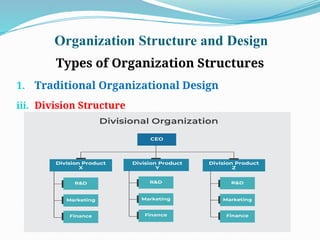
iii. Division Structure
 An organizational structure made up of separate business
units or division.
 Division manager has authority over his/her unit and
responsible for performance.
 Each division contains all the necessary resources and
functions within it to support that product line.
Organization Structure and Design
Types of Organization Structures
1. Traditional Organizational Design
iii. Division Structure
Organization Structure and Design
Types of Organization Structures
2. Contemporary Organizational Design
i. Team Structure
 An organizational structure in which entire organization is
made up of team or work group. Employee are more involved
and empowered, Reduce barriers among functional areas.
 They are less hierarchical and they have flexible structures that
reinforce problem-solving, decision-making and teamwork.
 No clear chain of command. Pressure on team to perform.
Organization Structure and Design
Types of Organization Structures
2. Contemporary Organizational Design
ii. Matrix Structure
 An organizational structure that assign specialist from different
department or functional area to work on project but return back to
their area when project is completed.
 For example, a project or task team established to develop a new
product might include engineers and design specialists as well as
those with marketing, financial, personnel and production skills.
 Flexible design, fast decision making but conflict exit among
individuals.
Continue…
• virtual organization :
An organization that consists of a small core of full-time
employees and outside specialists temporarily hired as
needed to work on projects.
• Flextime is a scheduling system in which employees
are required to work a specific number of hours a
week but are free to vary those hours within certain
limits.
• Job sharing is when two or more people split a full-
time job.

week 7 Lecture 5 Designing Organizational Structure.pptx

  • 1.
    Week 7 lecture Topics: 1.Types of traditional organizational structures (Simple, Functional, Divisional) 2. Contemporary organizational Structures (team structure, matrix structure, Virtual Organization, Flextime, Job Sharing)
  • 2.
    Types of OrganizationStructure Types of Organization Structures 1. Traditional Ones 2. More Contemporary Ones 1. Traditional Organizational Design i. Simple Structure  An organizational design with low departmentalization, wide span of control, centralized authority and little formalization.  However most companies don’t remain simple structure, tend to become more specialized and formalized.
  • 3.
    Organization Structure andDesign Types of Organization Structures 1. Traditional Organizational Design ii. Functional Structure  An organizational design that group similar or related occupational specialties. You can say this structure is functional departmentalization.  Organization is divided into smaller groups based on specialized functional areas, such as IT, finance, or marketing.
  • 4.
    Organization Structure andDesign Types of Organization Structures 1. Traditional Organizational Design iii. Division Structure  An organizational structure made up of separate business units or division.  Division manager has authority over his/her unit and responsible for performance.  Each division contains all the necessary resources and functions within it to support that product line.
  • 5.
    Organization Structure andDesign Types of Organization Structures 1. Traditional Organizational Design iii. Division Structure
  • 6.
    Organization Structure andDesign Types of Organization Structures 2. Contemporary Organizational Design i. Team Structure  An organizational structure in which entire organization is made up of team or work group. Employee are more involved and empowered, Reduce barriers among functional areas.  They are less hierarchical and they have flexible structures that reinforce problem-solving, decision-making and teamwork.  No clear chain of command. Pressure on team to perform.
  • 7.
    Organization Structure andDesign Types of Organization Structures 2. Contemporary Organizational Design ii. Matrix Structure  An organizational structure that assign specialist from different department or functional area to work on project but return back to their area when project is completed.  For example, a project or task team established to develop a new product might include engineers and design specialists as well as those with marketing, financial, personnel and production skills.  Flexible design, fast decision making but conflict exit among individuals.
  • 8.
    Continue… • virtual organization: An organization that consists of a small core of full-time employees and outside specialists temporarily hired as needed to work on projects. • Flextime is a scheduling system in which employees are required to work a specific number of hours a week but are free to vary those hours within certain limits. • Job sharing is when two or more people split a full- time job.