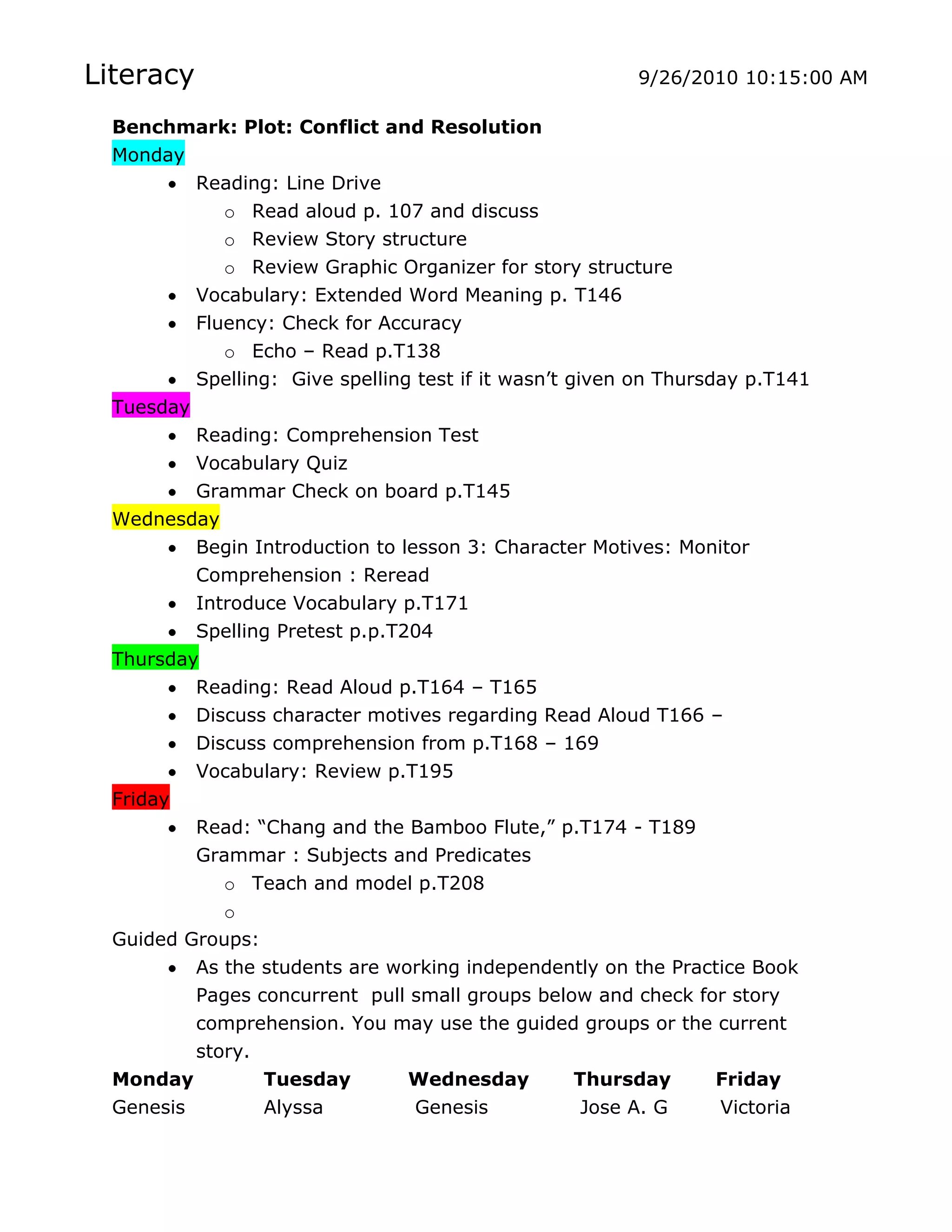
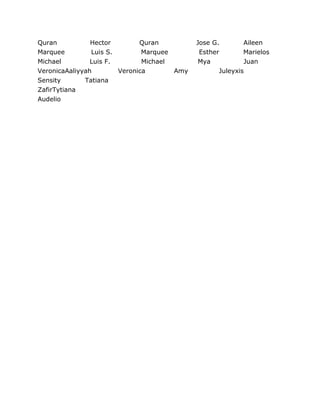
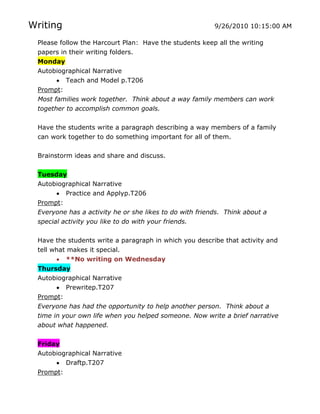
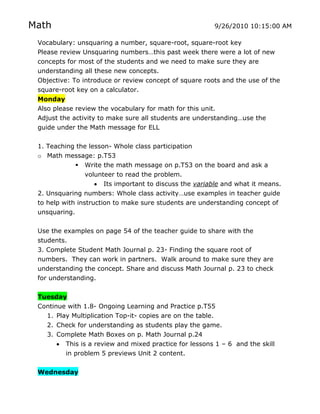
Benchmark: Plot: Conflict and Resolution<br />Monday<br />Reading: Line Drive<br />Read aloud p. 107 and discuss<br />Review Story structure<br />Review Graphic Organizer for story structure<br />Vocabulary: Extended Word Meaning p. T146<br />Fluency: Check for Accuracy<br />Echo – Read p.T138<br />Spelling:  Give spelling test if it wasn’t given on Thursday p.T141<br />Tuesday<br />Reading: Comprehension Test<br />Vocabulary Quiz<br />Grammar Check on board p.T145 <br />Wednesday<br />Begin Introduction to lesson 3: Character Motives: Monitor Comprehension : Reread<br />Introduce Vocabulary p.T171<br />Spelling Pretest p.p.T204<br />Thursday<br />Reading: Read Aloud p.T164 – T165<br />Discuss character motives regarding Read Aloud T166 – <br />Discuss comprehension from p.T168 – 169 <br />Vocabulary: Review p.T195<br />Friday<br />Read: “Chang and the Bamboo Flute,” p.T174 - T189<br />Grammar : Subjects and Predicates <br />Teach and model p.T208<br />Guided Groups:<br />As the students are working independently on the Practice Book Pages concurrent  pull small groups below and check for story comprehension. You may use the guided groups or the current story.<br />Monday           Tuesday         Wednesday       Thursday       Friday<br />Genesis            Alyssa              Genesis              Jose A. G        Victoria<br />Quran               Hector             Quran                 Jose G.           Aileen<br />Marquee            Luis S.             Marquee              Esther           Marielos<br />Michael             Luis F.              Michael               Mya               Juan<br />Veronica           Aaliyyah            Veronica             Amy              Juleyxis<br />                                                                        Sensity           Tatiana<br />                                                                        Zafir               Tytiana<br />                                                                                              Audelio<br />Please follow the Harcourt Plan:  Have the students keep all the writing papers in their writing folders.<br />Monday<br />Autobiographical Narrative<br />Teach and Model p.T206<br />Prompt: <br />Most families work together.  Think about a way family members can work together to accomplish common goals.   <br />Have the students write a paragraph describing a way members of a family can work together to do something important for all of them. <br />Brainstorm ideas and share and discuss.<br />Tuesday<br />Autobiographical Narrative<br />Practice and Apply p.T206<br />Prompt:<br />Everyone has a activity he or she likes to do with friends.  Think about a special activity you like to do with your friends. <br />Have the students write a paragraph in which you describe that activity and tell what makes it special.<br />**No writing on Wednesday<br />Thursday<br />Autobiographical Narrative<br />Prewrite p.T207<br />Prompt: <br />Everyone has had the opportunity to help another person.  Think about a time in your own life when you helped someone. Now write a brief narrative about what happened.<br />Friday<br />Autobiographical Narrative<br />Draft p.T207<br />Prompt: <br />Many people enjoy watching public performances. Thing about a public performance you have seen that you really enjoyed.  <br />Have the students write a paragraph in which they describe the performance and tell what they enjoyed about it. <br />Remember to have the students write these paragraphs on separate sheets and then place them in their writing folders. <br />Vocabulary: unsquaring a number, square-root, square-root key<br />Please review Unsquaring numbers…this past week there were a lot of new concepts for most of the students and we need to make sure they are understanding all these new concepts.  <br />Objective: To introduce or review concept of square roots and the use of the square-root key on a calculator.<br />Monday<br />Also please review the vocabulary for math for this unit.  <br />Adjust the activity to make sure all students are understanding…use the guide under the Math message for ELL<br />1. Teaching the lesson- Whole class participation<br />Math message: p.T53 <br />Write the math message on p.T53 on the board and ask a volunteer to read the problem. <br />Its important to discuss the variable and what it means.  <br />2. Unsquaring numbers: Whole class activity…use examples in teacher guide to help with instruction to make sure students are understanding concept of unsquaring.<br />Use the examples on page 54 of the teacher guide to share with the students.<br />3. Complete Student Math Journal p. 23- Finding the square root of numbers.  They can work in partners.  Walk around to make sure they are understanding the concept. Share and discuss Math Journal p. 23 to check for understanding. <br />Tuesday<br />Continue with 1.8- Ongoing Learning and Practice p.T55<br />Play Multiplication Top-it- copies are on the table.<br />Check for understanding as students play the game.<br />Complete Math Boxes on p. Math Journal p.24 <br />This is a review and mixed practice for lessons 1 – 6  and the skill in problem 5 previews Unit 2 content.<br />Wednesday<br />Comparing numbers with their squares-Partner activity<br />1.Complete Math Masters p.23 Here the students can work together and review the answers to check for understanding. <br />2. Extra practice 5-minute math p.108 <br />This can be done in small group activity.<br />3. Enrichment: the students can collect and compare representations of numbers with their squares using the counters. Example: make square root of 16= 4<br />Thursday<br />Begin 1.9 Factors Strings and Prime Factorization<br />Objective: To review equivalency concepts for whole numbers and to introduce factor strings and prime factorization.<br />*All copies should be on the table <br />Vocabulary: name-collection box, factor string, length of factor string, prime factorization<br />1. Do the Readiness Activity first….p.61 of the teacher guide- Whole group<br />Students identify the prime numbers between  1 and 30.<br />Copies should be on the table. Math Masters Pp.26 – 27 <br />2. Begin with the Math Message to teach the lesson- Whole group<br />Have the students list five other names for 16.<br />They can come to the board once they wrote examples in their notebooks.<br />Share and discuss and check for understanding<br />3. Introduce the factor string…A factor string is a multiplication expression that has at least two factors that are greater than 1. <br />A factor string for 24 is 2,3, 4. <br />Follow introducing factor strings on pages 58 and 59 and check for understanding.<br />Follow with Math Journal pp. 25 and 26- Partner Activity<br />Check for Understanding.<br />Friday<br />Review Math Journal pp. 25 and 26<br />Complete Math Master p.25 – Whole Group<br />Check for Understanding<br />Collect Math Master 25 once completed<br />Have the students begin this project on their own..Have them search different biomes. This can be done through out the week as time permits. How to Make a TerrariumMaterials:a large clear plastic container or juggravelsmall plants (suited to your growing conditions)rocks, branches, mossplastic wrapscreen or stockingobserving organisms chartTime:the terrarium will be built and developed in one class period, but the observations will take place over the course of several weeks.Method:Add a layer of pebbles to provide drainage at the bottom of the container.Cover the pebbles with about two inches of topsoil.Place a few rocks in the terrarium.Add branches, moss and small plants.Slightly moisten the terrarium with water. (Be careful not to use too much water.)Cover the opening with a sheet of plastic.If you would like to add worms or insects to the terrarium, cover the top with a screen to let air through.Deviations for different habitats:1.For a desert habitat, put 5-cm of sand on top of the gravel.
2. For a forest model, put a 5-cm layer of soil on top of the gravel and add a handful of crumpled leaves.
3. For a pond model, add another 5-cm of gravel and then add water until it is about 15-cm. deep.
4. For a grassland model, add 5-cm of soil on the gravel.Encourage the students to watch the terrarium for changes in growth of plants and animals with a magnifying glass. In a journal, they can note their observation of the classroom habitat, paying attention to such things as increases or decreases in the growth of plants, numbers of insects, changes in appearance of organisms and evidence of how these organisms meet their basic needs. <br /> <br />Monday<br />8:00 – 8:30 Breakfast and attendance<br />8:30 – 10:30 Literacy/Writing<br />10:30 – 11:00 Lunch<br />11:00 – 11:30 100 BC<br />11:30 – 1:00 Math<br />1:00 – 1:45 PE<br />1:45 – 2:30 Science<br />2:30 – 3:00 Writing/Social Studies<br />Tuesday<br />8:00 – 8:30 Breakfast and attendance<br />8:30 – 9:00  Literacy/Writing<br />9:00 – 9:45  Dance<br />9:45 – 10:30 Literacy<br />10:30 – 11:00 Lunch<br />11:00 – 11:30 100 BC<br />11:30 – 1:00 Math<br />1:00 – 1:45 Technology<br />1:45 – 2:30 Techology<br />2:30 – 3:00 Writing/Social Studies<br />Wednesday<br />8:00 – 8:30 Breakfast and attendance<br />8:30 – 9:30 TEST Prep<br />9:30 – 10:00 Lunch<br />10:00 – 11:00 Math<br />11:00 – 12:00 TECH SI<br />12:00 – 12:30 Literacy<br />12:30 – 1:00 100 BC<br />1:00 – Early Dismissal<br />Thursday<br />8:00 – 8:30 Breakfast and attendance<br />8:30 – 9:00  Literacy/Writing<br />9:00 – 9:45  Dance<br />9:45 – 10:30 Literacy<br />10:30 – 11:00 Lunch<br />11:00 – 11:30 100 BC<br />11:30 – 1:00 Math<br />1:00 – 1:45 Art<br />1:45 – 2:30 Social Studies- *Share current events that students bring in.<br />2:30 – 3:00 Writing<br />Friday<br />8:00 – 8:30 Breakfast and attendance<br />8:30 – 10:30 Literacy/Writing<br />10:30 – 11:00 Lunch<br />11:00 – 11:30 100 BC<br />11:30 – 1:00 Math<br />1:00 – 1:45 Spanish<br />1:45 – 2:30 Science<br />2:30 – 3:00 Writing/Social Studies<br />
Week 4 lesson plans
Week 4 lesson plans
Week 4 lesson plans
Week 4 lesson plans
Week 4 lesson plans
Week 4 lesson plans
Week 4 lesson plans
Week 4 lesson plans
Week 4 lesson plans
Week 4 lesson plans
Week 4 lesson plans

Week 4 lesson plans

  • 1.
    Benchmark: Plot: Conflictand Resolution<br />Monday<br />Reading: Line Drive<br />Read aloud p. 107 and discuss<br />Review Story structure<br />Review Graphic Organizer for story structure<br />Vocabulary: Extended Word Meaning p. T146<br />Fluency: Check for Accuracy<br />Echo – Read p.T138<br />Spelling: Give spelling test if it wasn’t given on Thursday p.T141<br />Tuesday<br />Reading: Comprehension Test<br />Vocabulary Quiz<br />Grammar Check on board p.T145 <br />Wednesday<br />Begin Introduction to lesson 3: Character Motives: Monitor Comprehension : Reread<br />Introduce Vocabulary p.T171<br />Spelling Pretest p.p.T204<br />Thursday<br />Reading: Read Aloud p.T164 – T165<br />Discuss character motives regarding Read Aloud T166 – <br />Discuss comprehension from p.T168 – 169 <br />Vocabulary: Review p.T195<br />Friday<br />Read: “Chang and the Bamboo Flute,” p.T174 - T189<br />Grammar : Subjects and Predicates <br />Teach and model p.T208<br />Guided Groups:<br />As the students are working independently on the Practice Book Pages concurrent pull small groups below and check for story comprehension. You may use the guided groups or the current story.<br />Monday Tuesday Wednesday Thursday Friday<br />Genesis Alyssa Genesis Jose A. G Victoria<br />Quran Hector Quran Jose G. Aileen<br />Marquee Luis S. Marquee Esther Marielos<br />Michael Luis F. Michael Mya Juan<br />Veronica Aaliyyah Veronica Amy Juleyxis<br /> Sensity Tatiana<br /> Zafir Tytiana<br /> Audelio<br />Please follow the Harcourt Plan: Have the students keep all the writing papers in their writing folders.<br />Monday<br />Autobiographical Narrative<br />Teach and Model p.T206<br />Prompt: <br />Most families work together. Think about a way family members can work together to accomplish common goals. <br />Have the students write a paragraph describing a way members of a family can work together to do something important for all of them. <br />Brainstorm ideas and share and discuss.<br />Tuesday<br />Autobiographical Narrative<br />Practice and Apply p.T206<br />Prompt:<br />Everyone has a activity he or she likes to do with friends. Think about a special activity you like to do with your friends. <br />Have the students write a paragraph in which you describe that activity and tell what makes it special.<br />**No writing on Wednesday<br />Thursday<br />Autobiographical Narrative<br />Prewrite p.T207<br />Prompt: <br />Everyone has had the opportunity to help another person. Think about a time in your own life when you helped someone. Now write a brief narrative about what happened.<br />Friday<br />Autobiographical Narrative<br />Draft p.T207<br />Prompt: <br />Many people enjoy watching public performances. Thing about a public performance you have seen that you really enjoyed. <br />Have the students write a paragraph in which they describe the performance and tell what they enjoyed about it. <br />Remember to have the students write these paragraphs on separate sheets and then place them in their writing folders. <br />Vocabulary: unsquaring a number, square-root, square-root key<br />Please review Unsquaring numbers…this past week there were a lot of new concepts for most of the students and we need to make sure they are understanding all these new concepts. <br />Objective: To introduce or review concept of square roots and the use of the square-root key on a calculator.<br />Monday<br />Also please review the vocabulary for math for this unit. <br />Adjust the activity to make sure all students are understanding…use the guide under the Math message for ELL<br />1. Teaching the lesson- Whole class participation<br />Math message: p.T53 <br />Write the math message on p.T53 on the board and ask a volunteer to read the problem. <br />Its important to discuss the variable and what it means. <br />2. Unsquaring numbers: Whole class activity…use examples in teacher guide to help with instruction to make sure students are understanding concept of unsquaring.<br />Use the examples on page 54 of the teacher guide to share with the students.<br />3. Complete Student Math Journal p. 23- Finding the square root of numbers. They can work in partners. Walk around to make sure they are understanding the concept. Share and discuss Math Journal p. 23 to check for understanding. <br />Tuesday<br />Continue with 1.8- Ongoing Learning and Practice p.T55<br />Play Multiplication Top-it- copies are on the table.<br />Check for understanding as students play the game.<br />Complete Math Boxes on p. Math Journal p.24 <br />This is a review and mixed practice for lessons 1 – 6 and the skill in problem 5 previews Unit 2 content.<br />Wednesday<br />Comparing numbers with their squares-Partner activity<br />1.Complete Math Masters p.23 Here the students can work together and review the answers to check for understanding. <br />2. Extra practice 5-minute math p.108 <br />This can be done in small group activity.<br />3. Enrichment: the students can collect and compare representations of numbers with their squares using the counters. Example: make square root of 16= 4<br />Thursday<br />Begin 1.9 Factors Strings and Prime Factorization<br />Objective: To review equivalency concepts for whole numbers and to introduce factor strings and prime factorization.<br />*All copies should be on the table <br />Vocabulary: name-collection box, factor string, length of factor string, prime factorization<br />1. Do the Readiness Activity first….p.61 of the teacher guide- Whole group<br />Students identify the prime numbers between 1 and 30.<br />Copies should be on the table. Math Masters Pp.26 – 27 <br />2. Begin with the Math Message to teach the lesson- Whole group<br />Have the students list five other names for 16.<br />They can come to the board once they wrote examples in their notebooks.<br />Share and discuss and check for understanding<br />3. Introduce the factor string…A factor string is a multiplication expression that has at least two factors that are greater than 1. <br />A factor string for 24 is 2,3, 4. <br />Follow introducing factor strings on pages 58 and 59 and check for understanding.<br />Follow with Math Journal pp. 25 and 26- Partner Activity<br />Check for Understanding.<br />Friday<br />Review Math Journal pp. 25 and 26<br />Complete Math Master p.25 – Whole Group<br />Check for Understanding<br />Collect Math Master 25 once completed<br />Have the students begin this project on their own..Have them search different biomes. This can be done through out the week as time permits. How to Make a TerrariumMaterials:a large clear plastic container or juggravelsmall plants (suited to your growing conditions)rocks, branches, mossplastic wrapscreen or stockingobserving organisms chartTime:the terrarium will be built and developed in one class period, but the observations will take place over the course of several weeks.Method:Add a layer of pebbles to provide drainage at the bottom of the container.Cover the pebbles with about two inches of topsoil.Place a few rocks in the terrarium.Add branches, moss and small plants.Slightly moisten the terrarium with water. (Be careful not to use too much water.)Cover the opening with a sheet of plastic.If you would like to add worms or insects to the terrarium, cover the top with a screen to let air through.Deviations for different habitats:1.For a desert habitat, put 5-cm of sand on top of the gravel.
2. For a forest model, put a 5-cm layer of soil on top of the gravel and add a handful of crumpled leaves.
3. For a pond model, add another 5-cm of gravel and then add water until it is about 15-cm. deep.
4. For a grassland model, add 5-cm of soil on the gravel.Encourage the students to watch the terrarium for changes in growth of plants and animals with a magnifying glass. In a journal, they can note their observation of the classroom habitat, paying attention to such things as increases or decreases in the growth of plants, numbers of insects, changes in appearance of organisms and evidence of how these organisms meet their basic needs. <br /> <br />Monday<br />8:00 – 8:30 Breakfast and attendance<br />8:30 – 10:30 Literacy/Writing<br />10:30 – 11:00 Lunch<br />11:00 – 11:30 100 BC<br />11:30 – 1:00 Math<br />1:00 – 1:45 PE<br />1:45 – 2:30 Science<br />2:30 – 3:00 Writing/Social Studies<br />Tuesday<br />8:00 – 8:30 Breakfast and attendance<br />8:30 – 9:00 Literacy/Writing<br />9:00 – 9:45 Dance<br />9:45 – 10:30 Literacy<br />10:30 – 11:00 Lunch<br />11:00 – 11:30 100 BC<br />11:30 – 1:00 Math<br />1:00 – 1:45 Technology<br />1:45 – 2:30 Techology<br />2:30 – 3:00 Writing/Social Studies<br />Wednesday<br />8:00 – 8:30 Breakfast and attendance<br />8:30 – 9:30 TEST Prep<br />9:30 – 10:00 Lunch<br />10:00 – 11:00 Math<br />11:00 – 12:00 TECH SI<br />12:00 – 12:30 Literacy<br />12:30 – 1:00 100 BC<br />1:00 – Early Dismissal<br />Thursday<br />8:00 – 8:30 Breakfast and attendance<br />8:30 – 9:00 Literacy/Writing<br />9:00 – 9:45 Dance<br />9:45 – 10:30 Literacy<br />10:30 – 11:00 Lunch<br />11:00 – 11:30 100 BC<br />11:30 – 1:00 Math<br />1:00 – 1:45 Art<br />1:45 – 2:30 Social Studies- *Share current events that students bring in.<br />2:30 – 3:00 Writing<br />Friday<br />8:00 – 8:30 Breakfast and attendance<br />8:30 – 10:30 Literacy/Writing<br />10:30 – 11:00 Lunch<br />11:00 – 11:30 100 BC<br />11:30 – 1:00 Math<br />1:00 – 1:45 Spanish<br />1:45 – 2:30 Science<br />2:30 – 3:00 Writing/Social Studies<br />