P R E P A R E D B Y :
M A Y S I E D . I L A G A N
Dance
REVIEW
What is the difference between
modern dance and
contemporary dance?
MOTIVATION
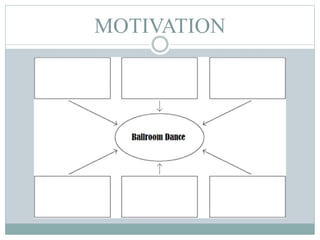
Ballroom Dance
Ballroom dance is a set of partner
dances, which are enjoyed both
socially and competitively around
the world.
Ballroom dance may refer, at its
widest definition, to almost any
type of partner dancing as
recreation.
 The term 'ballroom dancing' is derived
from the word ball which in turn
originates from the Latin word “ballare”
which means 'to dance' (a ball-room
being a large room specially designed
for such dances).
Competition
 In competition ballroom, dancers are
judged by diverse criteria such
as poise, the hold or frame, posture,
musicality and expression, timing,
body alignment and shape, floor
craft, foot and leg action, and
presentation.
Ballroom Dance
Cha Cha
Foxtrot
Waltz
Rumba
Swing
CHA CHA
 The Cha Cha is a lively, flirtatious
ballroom dance full of passion and
energy. The classic "Cuban motion"
gives the Cha Cha its unique style.
Partners work together to synchronize
each movement in perfect alignment.
Foxtrot
 The foxtrot is a smooth, progressive dance
characterized by long, continuous flowing
movements across the dance floor. It is
danced to big band (usually vocal) music.
The dance is similar in its look to waltz,
although the rhythm is in a 4/4 time
signature instead of ¾. Developed in the
1910s, the foxtrot reached its height of
popularity in the 1930s and remains
practiced today.
WALTZ
 The waltz is a ballroom and folk dance, normally in
triple time, performed primarily in closed position. It
became the ballroom dance par excellence of the
19th century, however, and tenaciously maintained
its popularity in the 20th. Its variations include the
rapid, whirling Viennese waltz and the gliding,
dipping Boston. Composers of famous waltzes
include Frédéric Chopin, Pyotr Ilyich Tchaikovsky,
and Johann Strauss and his sons, especially
Johann Strauss the Younger, who was known as
“the Waltz King.”
RUMBA
 Rumba, also spelled rhumba, ballroom dance
of Afro-Cuban folk-dance origin that became
internationally popular in the early 20th
century. Best known for the dancers’ subtle
side to side hip movements with the torso
erect, the rumba is danced with a basic pattern
of two quick side steps and a slow forward
step. Three steps are executed to each bar. The
music, in 4/4 time, has an insistent
syncopation.
SWING
 Swing dance, Social dance form dating from the
1940s. Danced in the U.S. to swing music, the
dance steps have distinct regional variations,
including forms such as the West Coast swing, the
East’s jitterbug-lindy, the South’s shag, and in
Texas the push (Dallas) and the whip (Houston).
Performance versions include extreme athletic
moves that distinguish them from everyday social
swing dance. Though swing dance had largely
disappeared by 1960, a revival began in the late
1980s and has since spread widely.
According to a Harvard Health
Review article, exercise such as
ballroom dancing can help by
relieving mental stress. Through this
ballroom dancing can help manage
one’s health.
 1. Promoting Chemical Balance: Simply
put, dancing has been proven to reduce
the levels of stress hormones while
stimulating the production of endorphins.
These endorphins are responsible for
post-workout feelings like optimism and
relaxation. The more regular the exercise,
the more endorphins are released to aid
in relaxation.
 2. Deepening the Mind-Body Connection:
Mental stress is known to manifest itself
physically in symptoms such as muscle
tenseness, cramps, rapid breathing, and
even lightheadedness. Dancing regularly,
though, can bring about a deeper mind-body
connection by reducing stress. This
awareness is key to maintaining good
overall health as well as keeping chronic
diseases at bay.
 3. Fun and Exercise: Ballroom dance is
a stellar workout that’s also fun! It
allows the body to work many muscle
groups in a rhythmic and repetitive
fashion, which increases stamina and
strength. What better way to both
exercise and promote relaxation than
while listening to good music.
REFERENCES
 https://en.wikipedia.org/wiki/Ballroom_dance
 https://simple.wikipedia.org/wiki/Ballroom_dance
 http://dance.about.com/od/partnerdancestyles/tp/Ball
room_Dances.htm

Week 4 ballroom dance power point presentation

  • 1.
    P R EP A R E D B Y : M A Y S I E D . I L A G A N Dance
  • 2.
    REVIEW What is thedifference between modern dance and contemporary dance?
  • 3.
  • 4.
    Ballroom Dance Ballroom danceis a set of partner dances, which are enjoyed both socially and competitively around the world.
  • 5.
    Ballroom dance mayrefer, at its widest definition, to almost any type of partner dancing as recreation.
  • 6.
     The term'ballroom dancing' is derived from the word ball which in turn originates from the Latin word “ballare” which means 'to dance' (a ball-room being a large room specially designed for such dances).
  • 7.
    Competition  In competitionballroom, dancers are judged by diverse criteria such as poise, the hold or frame, posture, musicality and expression, timing, body alignment and shape, floor craft, foot and leg action, and presentation.
  • 8.
  • 9.
    CHA CHA  TheCha Cha is a lively, flirtatious ballroom dance full of passion and energy. The classic "Cuban motion" gives the Cha Cha its unique style. Partners work together to synchronize each movement in perfect alignment.
  • 10.
    Foxtrot  The foxtrotis a smooth, progressive dance characterized by long, continuous flowing movements across the dance floor. It is danced to big band (usually vocal) music. The dance is similar in its look to waltz, although the rhythm is in a 4/4 time signature instead of ¾. Developed in the 1910s, the foxtrot reached its height of popularity in the 1930s and remains practiced today.
  • 11.
    WALTZ  The waltzis a ballroom and folk dance, normally in triple time, performed primarily in closed position. It became the ballroom dance par excellence of the 19th century, however, and tenaciously maintained its popularity in the 20th. Its variations include the rapid, whirling Viennese waltz and the gliding, dipping Boston. Composers of famous waltzes include Frédéric Chopin, Pyotr Ilyich Tchaikovsky, and Johann Strauss and his sons, especially Johann Strauss the Younger, who was known as “the Waltz King.”
  • 12.
    RUMBA  Rumba, alsospelled rhumba, ballroom dance of Afro-Cuban folk-dance origin that became internationally popular in the early 20th century. Best known for the dancers’ subtle side to side hip movements with the torso erect, the rumba is danced with a basic pattern of two quick side steps and a slow forward step. Three steps are executed to each bar. The music, in 4/4 time, has an insistent syncopation.
  • 13.
    SWING  Swing dance,Social dance form dating from the 1940s. Danced in the U.S. to swing music, the dance steps have distinct regional variations, including forms such as the West Coast swing, the East’s jitterbug-lindy, the South’s shag, and in Texas the push (Dallas) and the whip (Houston). Performance versions include extreme athletic moves that distinguish them from everyday social swing dance. Though swing dance had largely disappeared by 1960, a revival began in the late 1980s and has since spread widely.
  • 14.
    According to aHarvard Health Review article, exercise such as ballroom dancing can help by relieving mental stress. Through this ballroom dancing can help manage one’s health.
  • 15.
     1. PromotingChemical Balance: Simply put, dancing has been proven to reduce the levels of stress hormones while stimulating the production of endorphins. These endorphins are responsible for post-workout feelings like optimism and relaxation. The more regular the exercise, the more endorphins are released to aid in relaxation.
  • 16.
     2. Deepeningthe Mind-Body Connection: Mental stress is known to manifest itself physically in symptoms such as muscle tenseness, cramps, rapid breathing, and even lightheadedness. Dancing regularly, though, can bring about a deeper mind-body connection by reducing stress. This awareness is key to maintaining good overall health as well as keeping chronic diseases at bay.
  • 17.
     3. Funand Exercise: Ballroom dance is a stellar workout that’s also fun! It allows the body to work many muscle groups in a rhythmic and repetitive fashion, which increases stamina and strength. What better way to both exercise and promote relaxation than while listening to good music.
  • 18.