NATURAL HAZARDS
INSTRUCTOR:
Prof. JAVED N. MALIK
TA: ANCHANA P
WEEK 1
Earth is a Dynamic & Evolving Planet…
❖ Change in size, shape, and geographic distribution of continents and
ocean basins through time
❖ Evolution of life forms
❖ Change in atmospheric composition
❖ Wind, water, and ice have carved a variety of landscapes
❖ An active interior revealed by volcanic eruptions and earthquakes
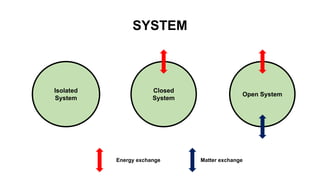
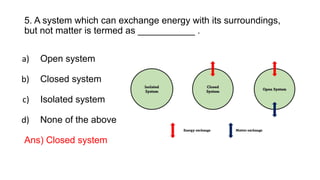
SYSTEM
Isolated
System
Open System
Closed
System
Energy exchange Matter exchange
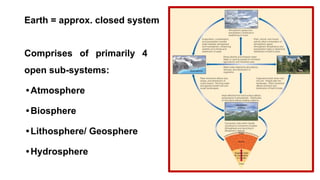
Earth = approx. closed system
Comprises of primarily 4
open sub-systems:
•Atmosphere
•Biosphere
•Lithosphere/ Geosphere
•Hydrosphere
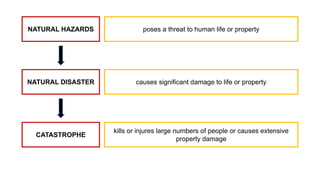
NATURAL HAZARDS
CATASTROPHE
NATURAL DISASTER
poses a threat to human life or property
causes significant damage to life or property
kills or injures large numbers of people or causes extensive
property damage
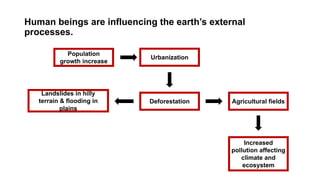
Human beings are influencing the earth’s external
processes.
Population
growth increase
Urbanization
Deforestation
Landslides in hilly
terrain & flooding in
plains
Agricultural fields
Increased
pollution affecting
climate and
ecosystem
PROBLEMS
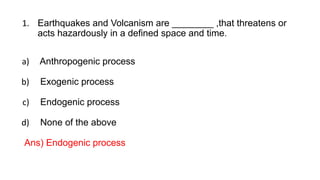
1. Earthquakes and Volcanism are ________ ,that threatens or
acts hazardously in a defined space and time.
a) Anthropogenic process
b) Exogenic process
c) Endogenic process
d) None of the above
Ans) Endogenic process
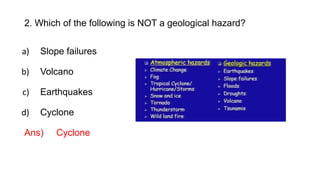
2. Which of the following is NOT a geological hazard?
a) Slope failures
b) Volcano
c) Earthquakes
d) Cyclone
Ans) Cyclone
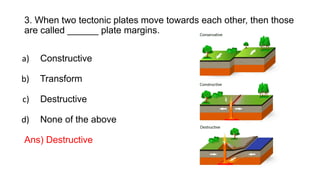
3. When two tectonic plates move towards each other, then those
are called ______ plate margins.
a) Constructive
b) Transform
c) Destructive
d) None of the above
Ans) Destructive
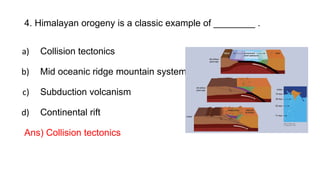
4. Himalayan orogeny is a classic example of ________ .
a) Collision tectonics
b) Mid oceanic ridge mountain system
c) Subduction volcanism
d) Continental rift
Ans) Collision tectonics
5. A system which can exchange energy with its surroundings,
but not matter is termed as ___________ .
a) Open system
b) Closed system
c) Isolated system
d) None of the above
Ans) Closed system
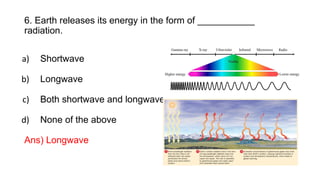
6. Earth releases its energy in the form of ___________
radiation.
a) Shortwave
b) Longwave
c) Both shortwave and longwave
d) None of the above
Ans) Longwave
7. Identify the CORRECT statement about cyclones:
a) High speed winds circulate around a high pressure region
b) High speed winds circulate around a low pressure region
c) The wind direction is clockwise in southern hemisphere
d) Both b & c
Ans) Both b & c
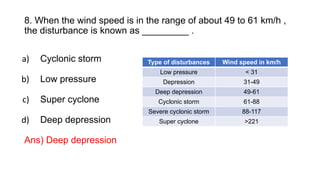
8. When the wind speed is in the range of about 49 to 61 km/h ,
the disturbance is known as _________ .
a) Cyclonic storm
b) Low pressure
c) Super cyclone
d) Deep depression
Ans) Deep depression
Type of disturbances Wind speed in km/h
Low pressure < 31
Depression 31-49
Deep depression 49-61
Cyclonic storm 61-88
Severe cyclonic storm 88-117
Super cyclone >221
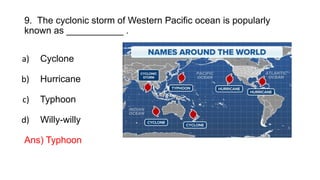
9. The cyclonic storm of Western Pacific ocean is popularly
known as ___________ .
a) Cyclone
b) Hurricane
c) Typhoon
d) Willy-willy
Ans) Typhoon
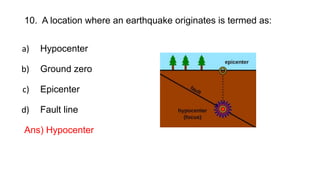
10. A location where an earthquake originates is termed as:
a) Hypocenter
b) Ground zero
c) Epicenter
d) Fault line
Ans) Hypocenter
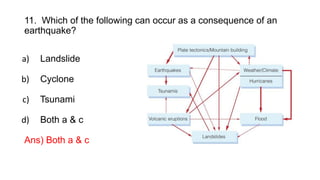
11. Which of the following can occur as a consequence of an
earthquake?
a) Landslide
b) Cyclone
c) Tsunami
d) Both a & c
Ans) Both a & c

Week 1_Natural Hazards.pdf

  • 1.
  • 2.
  • 3.
    Earth is aDynamic & Evolving Planet… ❖ Change in size, shape, and geographic distribution of continents and ocean basins through time ❖ Evolution of life forms ❖ Change in atmospheric composition ❖ Wind, water, and ice have carved a variety of landscapes ❖ An active interior revealed by volcanic eruptions and earthquakes
  • 5.
  • 6.
    Earth = approx.closed system Comprises of primarily 4 open sub-systems: •Atmosphere •Biosphere •Lithosphere/ Geosphere •Hydrosphere
  • 7.
    NATURAL HAZARDS CATASTROPHE NATURAL DISASTER posesa threat to human life or property causes significant damage to life or property kills or injures large numbers of people or causes extensive property damage
  • 8.
    Human beings areinfluencing the earth’s external processes. Population growth increase Urbanization Deforestation Landslides in hilly terrain & flooding in plains Agricultural fields Increased pollution affecting climate and ecosystem
  • 9.
  • 10.
    1. Earthquakes andVolcanism are ________ ,that threatens or acts hazardously in a defined space and time. a) Anthropogenic process b) Exogenic process c) Endogenic process d) None of the above Ans) Endogenic process
  • 11.
    2. Which ofthe following is NOT a geological hazard? a) Slope failures b) Volcano c) Earthquakes d) Cyclone Ans) Cyclone
  • 12.
    3. When twotectonic plates move towards each other, then those are called ______ plate margins. a) Constructive b) Transform c) Destructive d) None of the above Ans) Destructive
  • 13.
    4. Himalayan orogenyis a classic example of ________ . a) Collision tectonics b) Mid oceanic ridge mountain system c) Subduction volcanism d) Continental rift Ans) Collision tectonics
  • 14.
    5. A systemwhich can exchange energy with its surroundings, but not matter is termed as ___________ . a) Open system b) Closed system c) Isolated system d) None of the above Ans) Closed system
  • 15.
    6. Earth releasesits energy in the form of ___________ radiation. a) Shortwave b) Longwave c) Both shortwave and longwave d) None of the above Ans) Longwave
  • 16.
    7. Identify theCORRECT statement about cyclones: a) High speed winds circulate around a high pressure region b) High speed winds circulate around a low pressure region c) The wind direction is clockwise in southern hemisphere d) Both b & c Ans) Both b & c
  • 17.
    8. When thewind speed is in the range of about 49 to 61 km/h , the disturbance is known as _________ . a) Cyclonic storm b) Low pressure c) Super cyclone d) Deep depression Ans) Deep depression Type of disturbances Wind speed in km/h Low pressure < 31 Depression 31-49 Deep depression 49-61 Cyclonic storm 61-88 Severe cyclonic storm 88-117 Super cyclone >221
  • 18.
    9. The cyclonicstorm of Western Pacific ocean is popularly known as ___________ . a) Cyclone b) Hurricane c) Typhoon d) Willy-willy Ans) Typhoon
  • 19.
    10. A locationwhere an earthquake originates is termed as: a) Hypocenter b) Ground zero c) Epicenter d) Fault line Ans) Hypocenter
  • 20.
    11. Which ofthe following can occur as a consequence of an earthquake? a) Landslide b) Cyclone c) Tsunami d) Both a & c Ans) Both a & c