SECOND QUARTER LONG QUIZ
SCIENCE 8
Name: _____________________________ Date: ______________
Grade & Section: ____________________ Score: _____________
Directions: Read and understand each item carefully. Write the letter of your answer on the space provided
before each number.
___ 1. Which of the following refers to the shaking or the trembling of the earth’s crust?
a. tsunami b. vibration c. earthquake d. fault
___ 2. It is the fracture or break in the earth crust which causes the movement underneath.
a. epicenter b. fault c. mantle d. focus
___ 3. Resell lives in a nearby shore, while she was collecting pieces of shellfish she suddenly felt an earthquake. Some
minutes later, she saw the waves getting higher and nearer from the shore. Quickly, she told the people to evacuate or go
to higher places. What type of disaster did Resell and the people encounter after the quake?
a. tsunami b. earthquake c. typhoon d. landslide
___ 4. Which of the following correctly describes an epicenter?
a. The part of the earth surface directly above the focus.
b. The part of the earth surface where a fracture can be observed.
c. A magnitude of an earthquake having great extent presented in number.
d. The quality or state of being extreme such as force or energy.
___ 5. Silbano felt a sudden movement of the crust while he was walking down the street. What should he do to protect
himself?
a. Go inside an establishment and do duck, cover and hold.
b. Go to an open area away from tall trees and buildings.
c. Start to panic and run around the area.
d. Look and observe everyone.
___ 6. What are the two ways an earthquake can be described to determine as how strong or weak the shaking is?
a. magnitude and property c. magnitude and intensity
b. intensity and force d. magnitude and magnetism
___ 7. What does PHIVOLCS stands for?
a. Philippine Institution of Volcanology and Seismology c. Philippine Institute of Volcanoes and Seismology
b. Philippine Intensity of Volcanology and Seismology d. Philippine Institute of Volcanology and Seismology
___ 8. When an earthquake is described as Scarcely Perceptible, how strong could the intensity be?
a. Intensity Scale I b. Intensity Scale II c. Intensity Scale IV D. Intensity Scale VII
___ 9. An earthquake happened in one province, after the strong shaking and panicking of people, the government
observed that their railway tracks are either bent or broken. Concrete dikes and bridges are destroyed, numerous landslide
occurred and boulders are thrown out from its position. How high could the intensity of the earthquake be?
a. VI b. VII c. VIII d. IX
___ 10. The television report update about the earthquake said that the intensity scale is No. 7, what is its description?
a. Very Destructive b. Devastating c. Destructive d. Very Strong
___ 11. It is found directly at the top of the focus where movement in the earth crust occurs. What is it?
a. epicenter b. focus c. crust d. mantle
___ 12. Where does earthquake occurs?
a. outer core b. inner core c. mantle d. crust
___ 13. What should you do during an earthquake?
a. Panic and startle others. c. Keep calm and do the duck, cover and hold technique.
b. Run around the area. D Keep calm and play hide and seek with other people.
___ 14. It is a tropical cyclone with wind speed of about 34 kilometers per hour to greater than 200 kilometers per hor.
a. typhoon b. disaster c. depression d. pressure
___ 15. What are the 3 types of boundaries?
a. Convergent, divergent and stick n’ slip boundary c. Convergence, divergence and strike-slip boundary
b. Convergent, divergent and transforming boundary d. Convergent, divergent and transform-fault boundary
___ 16. The term typhoon is only used in the northwestern part of the Pacific Ocean, while people from the northeastern
part and northern part of Atlantic Ocean calls it _________.
a. typhoon b. depression c. hurricane d. pressure
___ 17. In tropical cyclone categories, if the maximum wind speed is about 30-64 kph what is its category?
a. typhoon b. tropical depression c. supertyphoon d. tropical storm
___ 18. What is the tropical cyclone category, if its maximum wind speed is 119-200 kph?
a. typhoon b. tropical depression c. supertyphoon d. tropical storm
___ 19. It was reported in television that there will be a supertyphoon that will enter the PAR. What could be its
maximum wind speed?
a.119-200 kph b. 65-118 kph c. 30-64 kph d. greater than 200 kph
___ 20. Tropical cyclone Odette that landed last December 2022 in Palawan is considered as ________ by PAGASA.
a. typhoon b. tropical depression c. supertyphoon d. tropical depression
___ 21. Which of the following agency is attached to the Department of Science and Technology (DOST) in the
Philippines which mandates to provide protection against natural calamities and utilize scientific knowledge as an
effective instrument to ensure safety, well-being and economic security?
a. PHIVOLCS b. NASA c. PAR d. PAGASA
___ 22. What does PAR stands for?
a. Palawan Area of Responsibility c. Philippine Area of Responsibility
b. Philippine Area of Responsiveness d. Palawan Area of Responsiveness
___ 23. How does typhoons move?
a. circular b. rectangular c. angular d. none of the above
___ 24. A tropical cyclone with a wind speed of 110 kph landed in the country. If a weather broadcaster will report about
it, what will be the category of the cyclone?
a. tropical depression b. typhoon c. tropical depression d. supertyphoon
___ 25. What is the category of the cyclone if its wind speed is between 119-200 kilometers per hour?
a. tropical depression b. typhoon c. tropical depression d. supertyphoon
___ 26. Which of the following is the correct category of a tropical cyclone if the speed of the wind is between 30-64
kph?
a. tropical depression b. typhoon c. tropical depression d. supertyphoon
___ 27. The following are needed for a tropical cyclone to form EXCEPT?
a. water vapor b. evaporation c. high temperature d. landmass
___ 28. Where does tropical cyclones usually forms?
a. Pacific Ocean b. Red Sea c. Yellow Sea d. Arctic Ocean
___ 29. When a tropical cyclones enter the PAR and it is on its way toward the land, warning signals are issued by
PAGASA. This warning signal is termed as PSWS, what does each letter stand for?
a. Philippine Storm Warning Signal c. Philippine Signal Warning for Storm
b. Public Storm Warning Signal d. Public Signal Warning for Storm
___ 30. How do typhoons affect people’s lives?
a. Heavy rains from typhoons may cause flooding, landslides or worse death.
b. Strong winds may not cause much damage.
c. Heavy rains and strong winds doesn’t have much effect on people’s lives.
d. Rains and winds from typhoon causes mostly only average damage.
___ 31. What is best to do if PAGASA issues a public storm warning signal before a tropical cyclone hits the land?
a. Follow the instructions by PAGASA and evacuate if needed.
a. Do not mind and continue what you are doing.
c. Remain unfazed and ignore the warning signals.
d. Remain at home even if an evacuation is being done.
___ 32. What does NASA stands for?
a. Natural Aeronautics and Space Administration c. Natural Aerial and Space Administration
b. National Aeronautics and Space Administration d. National Aerial and Space Administration
___ 33. What celestial body is composed mainly of ice or frozen water that has an irregular shape and appears as a fuzzy
head surrounding with bright light and travels slowly compared to other bodies?
a. meteor b. asteroid c. meteoroid d. comet
___ 34. What is this celestial body that is mostly made of silicate, iron and nickel, it travels faster than a comet and has a
rocky composition?
a. meteor b. asteroid c. meteoroid d. comet
___ 35. Where does comets usually originates in our solar system?
a. Asteroid belt b. Sun c. Kuiper belt and Oort cloud d. blackhole
___ 36. Where does asteroids usually originates in our solar system?
a. Asteroid belt b. Sun c. Kuiper belt and Oort cloud d. blackhole
___ 37. Where does the Oort cloud and Kuiper belt located?
a. at the middle of the solar system c. between planets Earth and Mars
b. at the end of the solar system d. between planets Mars and Jupiter
___ 38. Where does the Main Asteroid belt located?
a. at the middle of the solar system c. between planets Earth and Mars
b. at the end of the solar system d. between planets Mars and Jupiter
___ 39. A comet is usually going to what direction?
a. towards the Earth b. towards the Oort cloud c. towards the sun d. towards the Kuiper belt
___ 41. When a fragment of a meteoroid survives and make it to ground, this space rock is now called __________.
a. meteor b. meteoroid c. meteorite d. meteor shower
___ 42. What is the space rock that can be as small as a grain of sand or as big as a boulder and heats up when it enters the
atmosphere causing its materials to burn?
a. meteor b. meteoroid c. meteorite d. meteor shower
___ 43. What is a superstition?
a. a phenomenon that occurs naturally to earth c. a light phenomenon
b. a belief or practice resulting from false conception d. a bad omen
___ 44. What is a constellation?
a. a collection or group of planets c. a mass of comets and asteroids
b. a collection or group of stars d. a mass of thousands of meteors
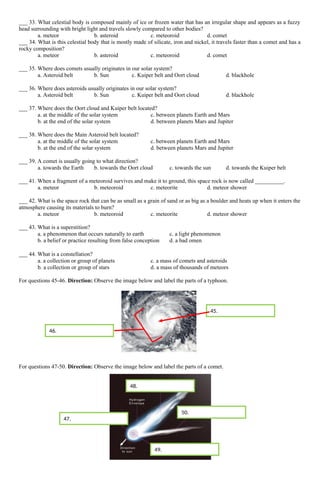
For questions 45-46. Direction: Observe the image below and label the parts of a typhoon.
For questions 47-50. Direction: Observe the image below and label the parts of a comet.
45.
46.
49.
50.
47.
48.
GOD BLESS!!!

Grade 8 Science Second Quarter Sample Long Quiz.docx

  • 1.
    SECOND QUARTER LONGQUIZ SCIENCE 8 Name: _____________________________ Date: ______________ Grade & Section: ____________________ Score: _____________ Directions: Read and understand each item carefully. Write the letter of your answer on the space provided before each number. ___ 1. Which of the following refers to the shaking or the trembling of the earth’s crust? a. tsunami b. vibration c. earthquake d. fault ___ 2. It is the fracture or break in the earth crust which causes the movement underneath. a. epicenter b. fault c. mantle d. focus ___ 3. Resell lives in a nearby shore, while she was collecting pieces of shellfish she suddenly felt an earthquake. Some minutes later, she saw the waves getting higher and nearer from the shore. Quickly, she told the people to evacuate or go to higher places. What type of disaster did Resell and the people encounter after the quake? a. tsunami b. earthquake c. typhoon d. landslide ___ 4. Which of the following correctly describes an epicenter? a. The part of the earth surface directly above the focus. b. The part of the earth surface where a fracture can be observed. c. A magnitude of an earthquake having great extent presented in number. d. The quality or state of being extreme such as force or energy. ___ 5. Silbano felt a sudden movement of the crust while he was walking down the street. What should he do to protect himself? a. Go inside an establishment and do duck, cover and hold. b. Go to an open area away from tall trees and buildings. c. Start to panic and run around the area. d. Look and observe everyone. ___ 6. What are the two ways an earthquake can be described to determine as how strong or weak the shaking is? a. magnitude and property c. magnitude and intensity b. intensity and force d. magnitude and magnetism ___ 7. What does PHIVOLCS stands for? a. Philippine Institution of Volcanology and Seismology c. Philippine Institute of Volcanoes and Seismology b. Philippine Intensity of Volcanology and Seismology d. Philippine Institute of Volcanology and Seismology ___ 8. When an earthquake is described as Scarcely Perceptible, how strong could the intensity be? a. Intensity Scale I b. Intensity Scale II c. Intensity Scale IV D. Intensity Scale VII ___ 9. An earthquake happened in one province, after the strong shaking and panicking of people, the government observed that their railway tracks are either bent or broken. Concrete dikes and bridges are destroyed, numerous landslide occurred and boulders are thrown out from its position. How high could the intensity of the earthquake be? a. VI b. VII c. VIII d. IX ___ 10. The television report update about the earthquake said that the intensity scale is No. 7, what is its description? a. Very Destructive b. Devastating c. Destructive d. Very Strong ___ 11. It is found directly at the top of the focus where movement in the earth crust occurs. What is it? a. epicenter b. focus c. crust d. mantle ___ 12. Where does earthquake occurs? a. outer core b. inner core c. mantle d. crust ___ 13. What should you do during an earthquake? a. Panic and startle others. c. Keep calm and do the duck, cover and hold technique. b. Run around the area. D Keep calm and play hide and seek with other people. ___ 14. It is a tropical cyclone with wind speed of about 34 kilometers per hour to greater than 200 kilometers per hor. a. typhoon b. disaster c. depression d. pressure ___ 15. What are the 3 types of boundaries? a. Convergent, divergent and stick n’ slip boundary c. Convergence, divergence and strike-slip boundary b. Convergent, divergent and transforming boundary d. Convergent, divergent and transform-fault boundary
  • 2.
    ___ 16. Theterm typhoon is only used in the northwestern part of the Pacific Ocean, while people from the northeastern part and northern part of Atlantic Ocean calls it _________. a. typhoon b. depression c. hurricane d. pressure ___ 17. In tropical cyclone categories, if the maximum wind speed is about 30-64 kph what is its category? a. typhoon b. tropical depression c. supertyphoon d. tropical storm ___ 18. What is the tropical cyclone category, if its maximum wind speed is 119-200 kph? a. typhoon b. tropical depression c. supertyphoon d. tropical storm ___ 19. It was reported in television that there will be a supertyphoon that will enter the PAR. What could be its maximum wind speed? a.119-200 kph b. 65-118 kph c. 30-64 kph d. greater than 200 kph ___ 20. Tropical cyclone Odette that landed last December 2022 in Palawan is considered as ________ by PAGASA. a. typhoon b. tropical depression c. supertyphoon d. tropical depression ___ 21. Which of the following agency is attached to the Department of Science and Technology (DOST) in the Philippines which mandates to provide protection against natural calamities and utilize scientific knowledge as an effective instrument to ensure safety, well-being and economic security? a. PHIVOLCS b. NASA c. PAR d. PAGASA ___ 22. What does PAR stands for? a. Palawan Area of Responsibility c. Philippine Area of Responsibility b. Philippine Area of Responsiveness d. Palawan Area of Responsiveness ___ 23. How does typhoons move? a. circular b. rectangular c. angular d. none of the above ___ 24. A tropical cyclone with a wind speed of 110 kph landed in the country. If a weather broadcaster will report about it, what will be the category of the cyclone? a. tropical depression b. typhoon c. tropical depression d. supertyphoon ___ 25. What is the category of the cyclone if its wind speed is between 119-200 kilometers per hour? a. tropical depression b. typhoon c. tropical depression d. supertyphoon ___ 26. Which of the following is the correct category of a tropical cyclone if the speed of the wind is between 30-64 kph? a. tropical depression b. typhoon c. tropical depression d. supertyphoon ___ 27. The following are needed for a tropical cyclone to form EXCEPT? a. water vapor b. evaporation c. high temperature d. landmass ___ 28. Where does tropical cyclones usually forms? a. Pacific Ocean b. Red Sea c. Yellow Sea d. Arctic Ocean ___ 29. When a tropical cyclones enter the PAR and it is on its way toward the land, warning signals are issued by PAGASA. This warning signal is termed as PSWS, what does each letter stand for? a. Philippine Storm Warning Signal c. Philippine Signal Warning for Storm b. Public Storm Warning Signal d. Public Signal Warning for Storm ___ 30. How do typhoons affect people’s lives? a. Heavy rains from typhoons may cause flooding, landslides or worse death. b. Strong winds may not cause much damage. c. Heavy rains and strong winds doesn’t have much effect on people’s lives. d. Rains and winds from typhoon causes mostly only average damage. ___ 31. What is best to do if PAGASA issues a public storm warning signal before a tropical cyclone hits the land? a. Follow the instructions by PAGASA and evacuate if needed. a. Do not mind and continue what you are doing. c. Remain unfazed and ignore the warning signals. d. Remain at home even if an evacuation is being done. ___ 32. What does NASA stands for? a. Natural Aeronautics and Space Administration c. Natural Aerial and Space Administration b. National Aeronautics and Space Administration d. National Aerial and Space Administration
  • 3.
    ___ 33. Whatcelestial body is composed mainly of ice or frozen water that has an irregular shape and appears as a fuzzy head surrounding with bright light and travels slowly compared to other bodies? a. meteor b. asteroid c. meteoroid d. comet ___ 34. What is this celestial body that is mostly made of silicate, iron and nickel, it travels faster than a comet and has a rocky composition? a. meteor b. asteroid c. meteoroid d. comet ___ 35. Where does comets usually originates in our solar system? a. Asteroid belt b. Sun c. Kuiper belt and Oort cloud d. blackhole ___ 36. Where does asteroids usually originates in our solar system? a. Asteroid belt b. Sun c. Kuiper belt and Oort cloud d. blackhole ___ 37. Where does the Oort cloud and Kuiper belt located? a. at the middle of the solar system c. between planets Earth and Mars b. at the end of the solar system d. between planets Mars and Jupiter ___ 38. Where does the Main Asteroid belt located? a. at the middle of the solar system c. between planets Earth and Mars b. at the end of the solar system d. between planets Mars and Jupiter ___ 39. A comet is usually going to what direction? a. towards the Earth b. towards the Oort cloud c. towards the sun d. towards the Kuiper belt ___ 41. When a fragment of a meteoroid survives and make it to ground, this space rock is now called __________. a. meteor b. meteoroid c. meteorite d. meteor shower ___ 42. What is the space rock that can be as small as a grain of sand or as big as a boulder and heats up when it enters the atmosphere causing its materials to burn? a. meteor b. meteoroid c. meteorite d. meteor shower ___ 43. What is a superstition? a. a phenomenon that occurs naturally to earth c. a light phenomenon b. a belief or practice resulting from false conception d. a bad omen ___ 44. What is a constellation? a. a collection or group of planets c. a mass of comets and asteroids b. a collection or group of stars d. a mass of thousands of meteors For questions 45-46. Direction: Observe the image below and label the parts of a typhoon. For questions 47-50. Direction: Observe the image below and label the parts of a comet. 45. 46. 49. 50. 47. 48.
  • 4.