ASSESSMENT &
      DATA-DRIVEN DECISION MAKING


EDUC W200 Week 10
WHY ASSESSMENT, REALLY?

• Discuss: What assessments did your teachers use in
  your subject areas when you were in school (K-12)?
   o What do you think worked? What did not?
   o How did they grade a project versus a written report?
• Reasons to assess learning
   o Because you have to
   o To understand how and how well your students are learning
   o To reflect back on your teaching and benefit student learning

One rule: standardized assessment tools like ISTEP are
   not an option IN teachers, since those are mandatory,
   and not something that the teacher can choose
 EDUC W200 Week 10
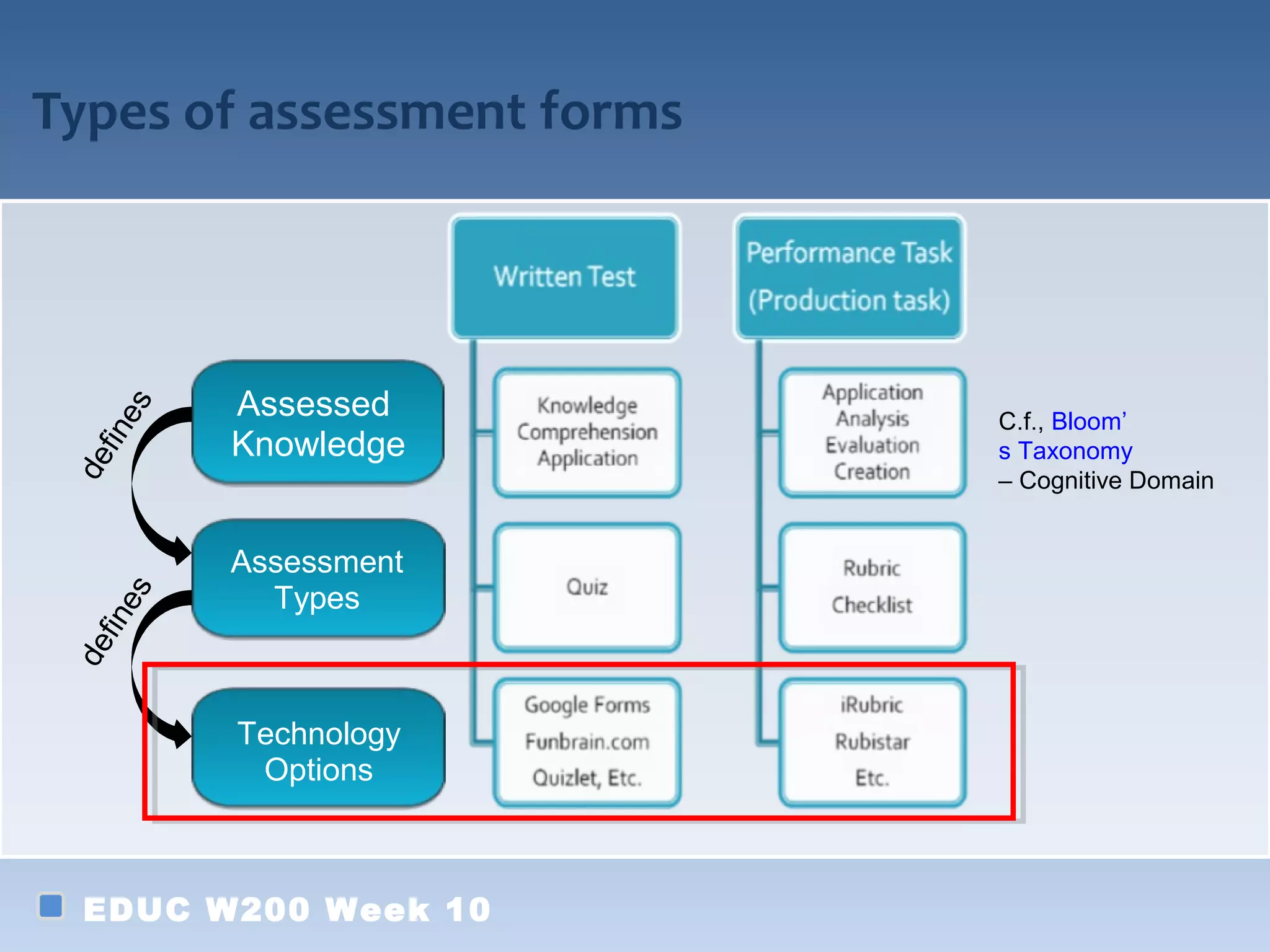
Types of assessment forms


          Assessed
      s


                            C.f., Bloom’
   ne


          Knowledge         s Taxonomy
    fi
 de


                            – Cognitive Domain


          Assessment
            Types
      s
   ne
    fi
 de


          Technology
           Options


  EDUC W200 Week 10
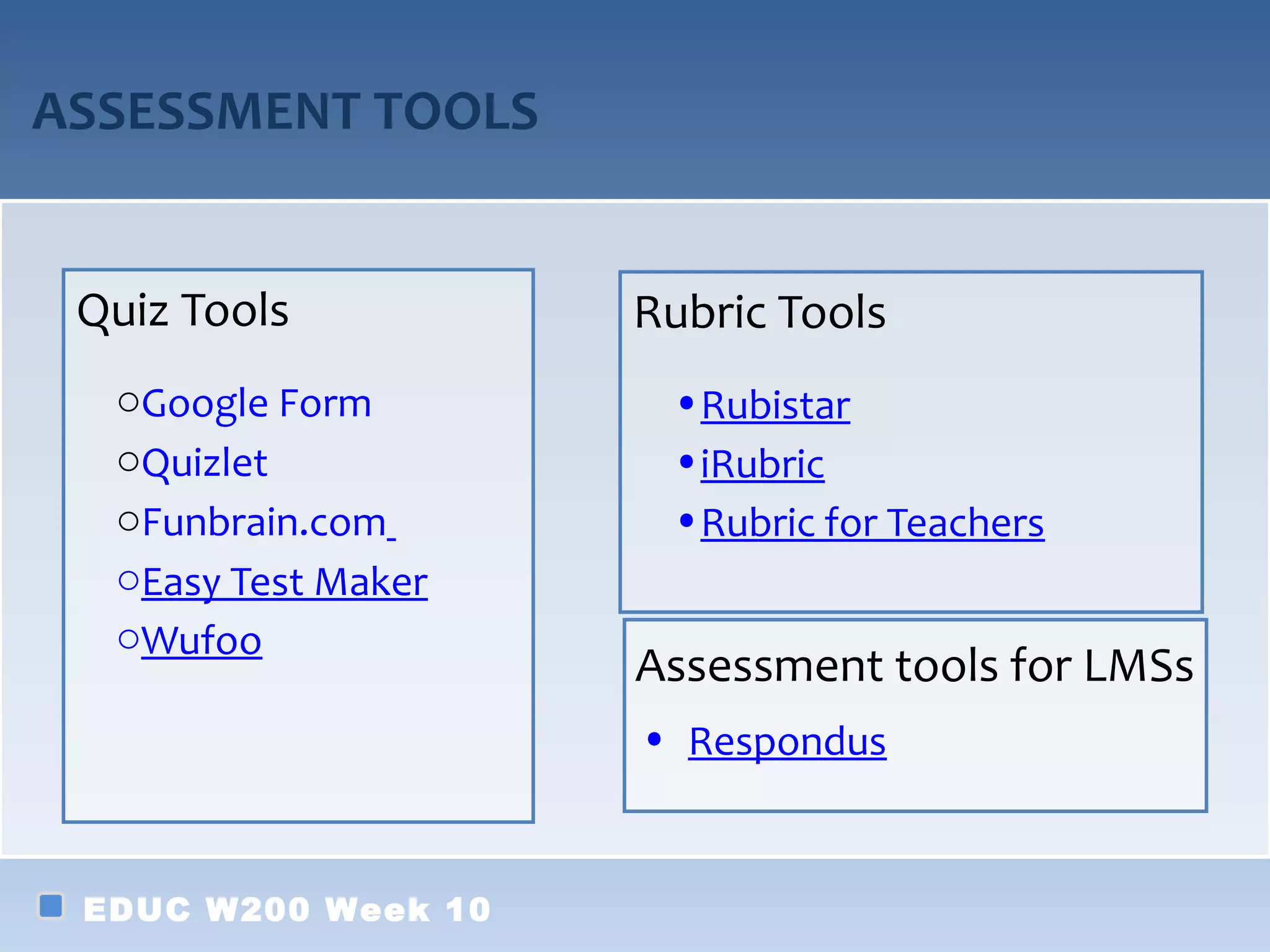
ASSESSMENT TOOLS


 Quiz Tools          Rubric Tools
  oGoogle Form        •Rubistar
  oQuizlet            •iRubric
  oFunbrain.com       •Rubric for Teachers
  oEasy Test Maker
  oWufoo
                     Assessment tools for LMSs
                     • Respondus


 EDUC W200 Week 10
What do we do WITH the data?


EDUC W200 Week 10
Data-driven decision making
 Differentiated Instruction


         https://www.youtube.com/watch?v=VT8mSAwIJdM

  EDUC W200 Week 10
Data-driven decision making

• What is Data-Driven Decision Making?
   o Your definitions?
   o My definition?


• Why should I use this in my classroom?
   o Already being required for schools – NCLB and State Required
   o Another way to systematically examine your students’ progress
     and performance
   o Can provide you with vital information to help you improve your
     teaching

• How can I do it?
  EDUC W200 Week 10

Week 10 sp13_part3

  • 1.
    ASSESSMENT & DATA-DRIVEN DECISION MAKING EDUC W200 Week 10
  • 2.
    WHY ASSESSMENT, REALLY? •Discuss: What assessments did your teachers use in your subject areas when you were in school (K-12)? o What do you think worked? What did not? o How did they grade a project versus a written report? • Reasons to assess learning o Because you have to o To understand how and how well your students are learning o To reflect back on your teaching and benefit student learning One rule: standardized assessment tools like ISTEP are not an option IN teachers, since those are mandatory, and not something that the teacher can choose EDUC W200 Week 10
  • 3.
    Types of assessmentforms Assessed s C.f., Bloom’ ne Knowledge s Taxonomy fi de – Cognitive Domain Assessment Types s ne fi de Technology Options EDUC W200 Week 10
  • 4.
    ASSESSMENT TOOLS QuizTools Rubric Tools oGoogle Form •Rubistar oQuizlet •iRubric oFunbrain.com •Rubric for Teachers oEasy Test Maker oWufoo Assessment tools for LMSs • Respondus EDUC W200 Week 10
  • 5.
    What do wedo WITH the data? EDUC W200 Week 10
  • 6.
    Data-driven decision making Differentiated Instruction https://www.youtube.com/watch?v=VT8mSAwIJdM EDUC W200 Week 10
  • 7.
    Data-driven decision making •What is Data-Driven Decision Making? o Your definitions? o My definition? • Why should I use this in my classroom? o Already being required for schools – NCLB and State Required o Another way to systematically examine your students’ progress and performance o Can provide you with vital information to help you improve your teaching • How can I do it? EDUC W200 Week 10

Editor's Notes

  • #4 Assessment itself is a big domain to be studied. However, in a simple version, teachers need to be aware of what learning outcomes they are measuring. The target of assessment defines the kinds of assessment. Then, based on your assessment type, you will know which technology to choose.
  • #5 Respondus 4.0 is a powerful tool for creating and managing exams that can be printed to paper or published directly to Blackboard, ANGEL, Desire2Learn, eCollege, Moodle, and other eLearning systems.
  • #7 This video is about Minnetonka staff uses data to differentiate instruction to students. You can play the video till 3:35. http://www.youtube.com/watch?v=VT8mSAwIJdM What types of data do they collect? When do they make adjustments? What are the formative adjustments? What are the summative adjustments?