PY7156: WEEK 10
Writing up Your Lab
Report
LAB REPORT
(ASSESSMENT COMPONENT 2)
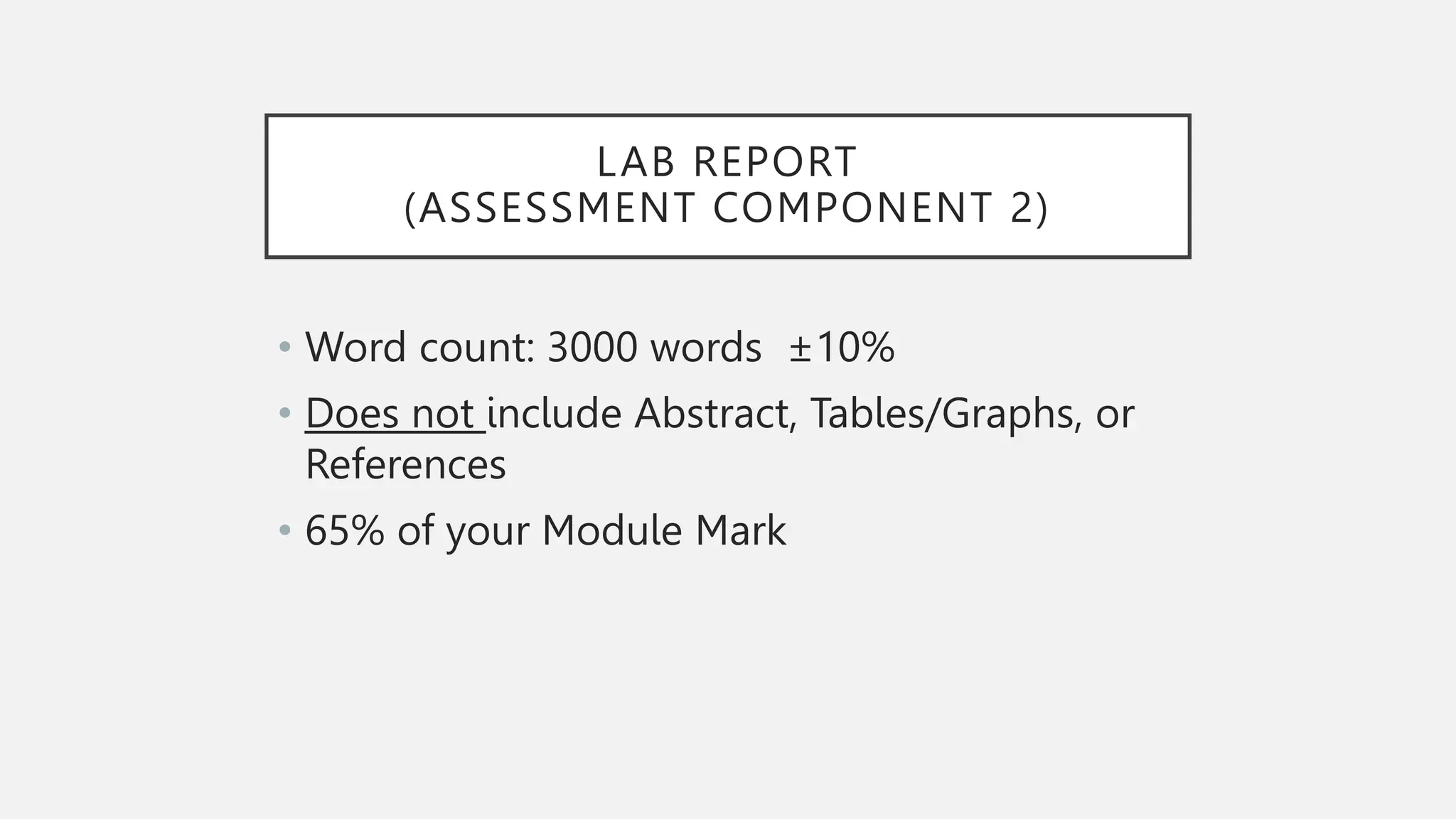
• Word count: 3000 words ±10%
• Does not include Abstract, Tables/Graphs, or
References
• 65% of your Module Mark
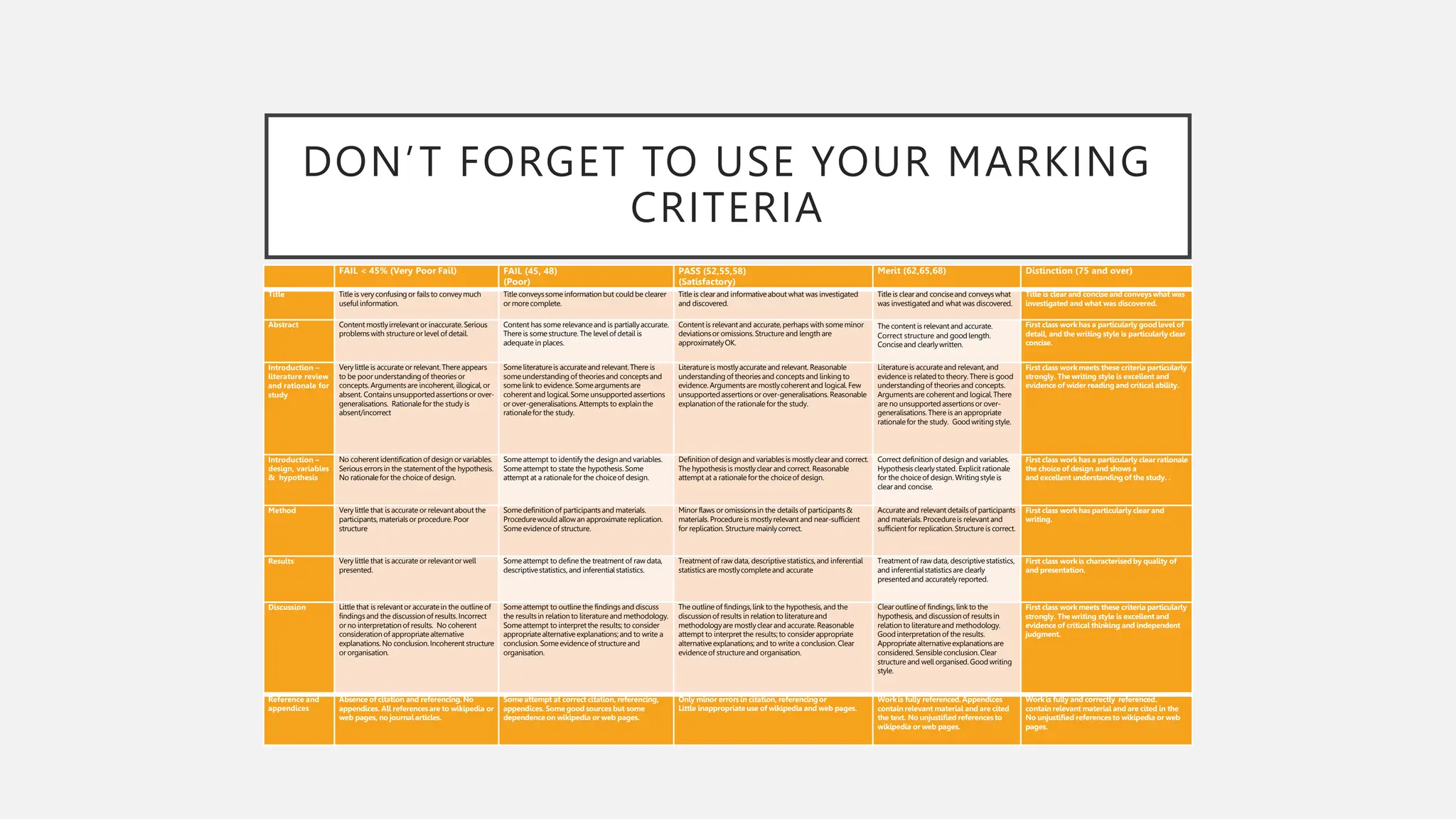
DON’T FORGET TO USE YOUR MARKING
CRITERIA
FAIL < 45% (Very Poor Fail) FAIL (45, 48)
(Poor)
PASS (52,55,58)
(Satisfactory)
Merit (62,65,68) Distinction (75 and over)
Title Title is very confusingor fails to conveymuch
useful information.
Title conveyssome informationbut couldbe clearer
or morecomplete.
Title is clear and informativeabout what was investigated
and discovered.
Title is clear and conciseand conveyswhat
was investigatedand what was discovered.
Title is clear and concise and conveys what was
investigated and what was discovered.
Abstract Content mostlyirrelevant or inaccurate.Serious
problemswith structureor level of detail.
Content has some relevanceand is partiallyaccurate.
There is somestructure. The level of detail is
adequate in places.
Content is relevantand accurate,perhaps with someminor
deviationsor omissions. Structure and length are
approximatelyOK.
The content is relevantand accurate.
Correct structure and goodlength.
Conciseand clearlywritten.
First class work has a particularly goodlevel of
detail, and the writing style is particularly clear
concise.
Introduction –
literature review
and rationale for
study
Very little is accurate or relevant.There appears
to be poor understandingof theoriesor
concepts.Argumentsare incoherent, illogical,or
absent. Containsunsupportedassertionsor over-
generalisations. Rationalefor the study is
absent/incorrect
Someliteratureis accurateand relevant.There is
someunderstandingof theoriesand conceptsand
somelink to evidence.Someargumentsare
coherent and logical.Some unsupportedassertions
or over-generalisations. Attempts to explainthe
rationalefor the study.
Literatureis mostlyaccurate and relevant. Reasonable
understandingof theoriesand conceptsand linkingto
evidence.Argumentsare mostlycoherentand logical. Few
unsupportedassertionsor over-generalisations. Reasonable
explanationof the rationalefor the study.
Literatureis accurateand relevant,and
evidenceis relatedto theory. There is good
understandingof theoriesand concepts.
Argumentsare coherent and logical.There
are no unsupportedassertionsor over-
generalisations. There is an appropriate
rationalefor the study. Goodwriting style.
First class work meets these criteria particularly
strongly. The writing style is excellent and
evidence of wider reading and critical ability.
Introduction –
design, variables
& hypothesis
No coherent identificationof design or variables.
Seriouserrorsin the statement of the hypothesis.
No rationalefor the choiceof design.
Someattempt to identify the designand variables.
Someattempt to state the hypothesis.Some
attempt at a rationalefor the choiceof design.
Definitionof design and variablesis mostlyclear and correct.
The hypothesisis mostlyclear and correct. Reasonable
attempt at a rationalefor the choiceof design.
Correct definitionof design and variables.
Hypothesisclearlystated. Explicit rationale
for the choiceof design. Writingstyle is
clear and concise.
First class work has a particularly clear rationale
the choice of design and shows a
and excellent understanding of the study. .
Method Very little that is accurate or relevantabout the
participants,materialsor procedure. Poor
structure
Somedefinitionof participantsand materials.
Procedurewould allowan approximatereplication.
Someevidenceof structure.
Minor flaws or omissionsin the details of participants&
materials. Procedureis mostlyrelevant and near-sufficient
for replication.Structure mainlycorrect.
Accurate and relevant detailsof participants
and materials.Procedureis relevantand
sufficientfor replication.Structure is correct.
First class work has particularly clear and
writing.
Results Very little that is accurate or relevantor well
presented.
Someattempt to define the treatment of raw data,
descriptivestatistics, and inferential statistics.
Treatment of raw data, descriptivestatistics,and inferential
statisticsare mostlycompleteand accurate
Treatment of raw data, descriptivestatistics,
and inferentialstatisticsare clearly
presentedand accuratelyreported.
First class work is characterised by quality of
and presentation.
Discussion Little that is relevantor accuratein the outlineof
findingsand the discussionof results.Incorrect
or no interpretationof results. No coherent
considerationof appropriatealternative
explanations. No conclusion.Incoherent structure
or organisation.
Someattempt to outlinethe findings and discuss
the resultsin relationto literatureand methodology.
Someattempt to interpretthe results; to consider
appropriatealternativeexplanations;and to write a
conclusion. Someevidenceof structureand
organisation.
The outlineof findings,link to the hypothesis,and the
discussionof results in relationto literatureand
methodologyare mostlyclear and accurate. Reasonable
attempt to interpret the results;to consider appropriate
alternativeexplanations; and to write a conclusion.Clear
evidenceof structureand organisation.
Clear outlineof findings,link to the
hypothesis, and discussionof resultsin
relationto literatureand methodology.
Goodinterpretationof the results.
Appropriatealternativeexplanationsare
considered.Sensibleconclusion.Clear
structure and well organised.Goodwriting
style.
First class work meets these criteria particularly
strongly. The writing style is excellent and
evidence of critical thinking and independent
judgment.
Reference and
appendices
Absence of citation and referencing. No
appendices. All referencesare to wikipedia or
web pages, no journalarticles.
Some attempt at correct citation, referencing,
appendices. Somegood sources but some
dependenceon wikipedia or web pages.
Only minor errors in citation, referencingor
Little inappropriate use of wikipedia and web pages.
Workis fully referenced.Appendices
contain relevant material and are cited
the text. No unjustified references to
wikipedia or web pages.
Workis fully and correctly referenced.
contain relevant material and are cited in the
No unjustified references to wikipedia or web
pages.
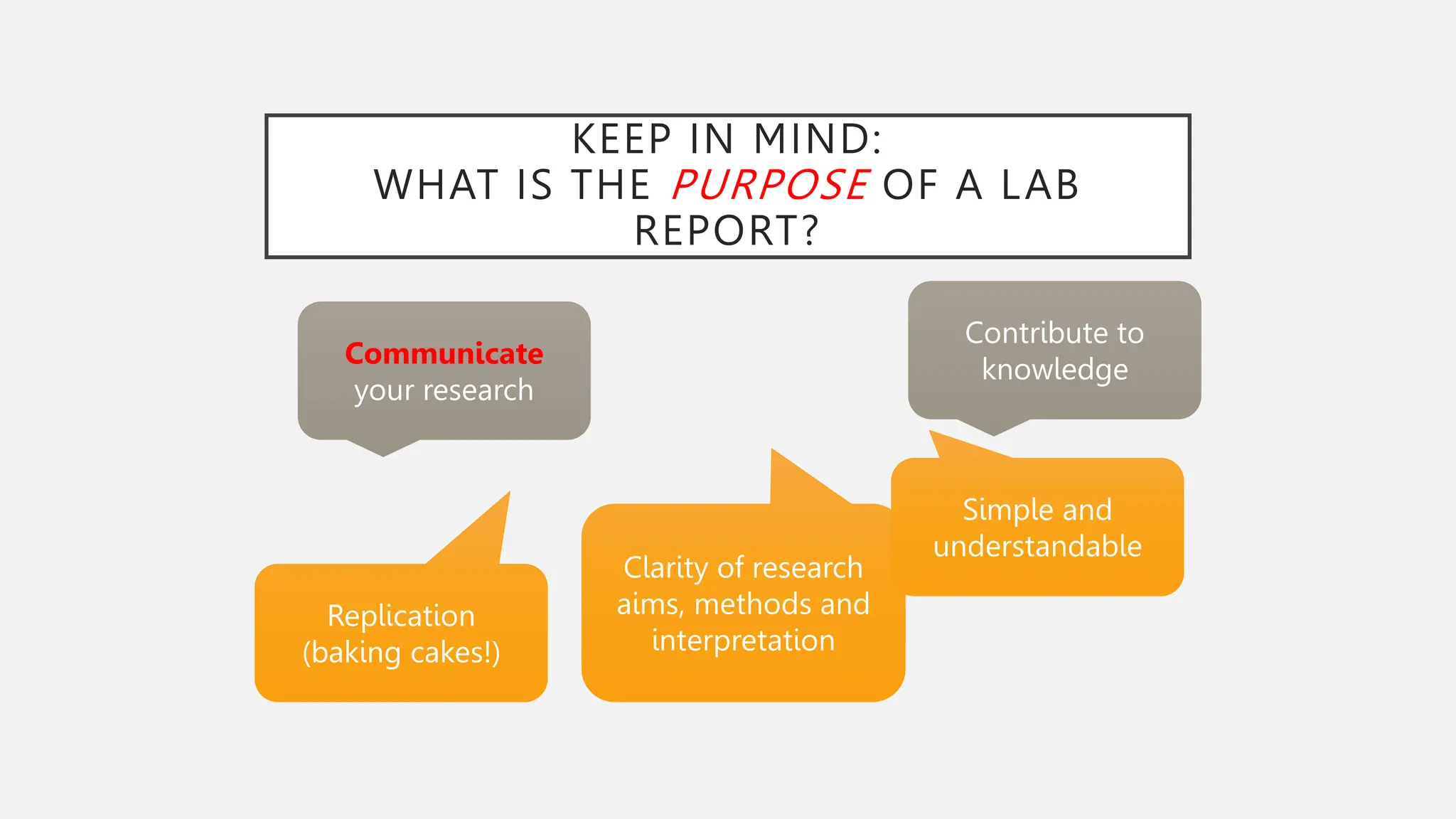
KEEP IN MIND:
WHAT IS THE PURPOSE OF A LAB
REPORT?
Contribute to
knowledge
Communicate
your research
Replication
(baking cakes!)
Clarity of research
aims, methods and
interpretation
Simple and
understandable
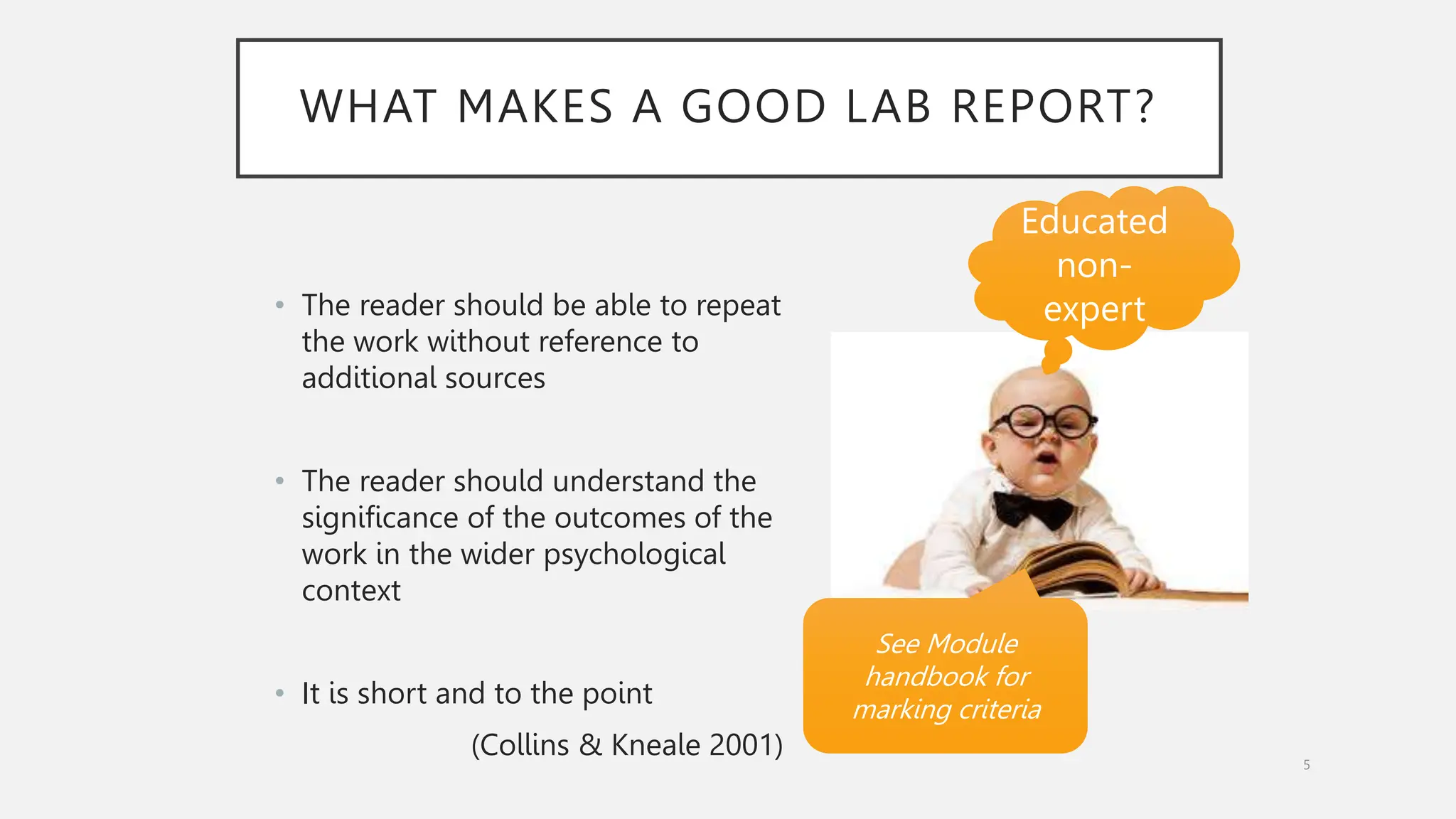
WHAT MAKES A GOOD LAB REPORT?
• The reader should be able to repeat
the work without reference to
additional sources
• The reader should understand the
significance of the outcomes of the
work in the wider psychological
context
• It is short and to the point
(Collins & Kneale 2001) 5
See Module
handbook for
marking criteria

Educated
non-
expert
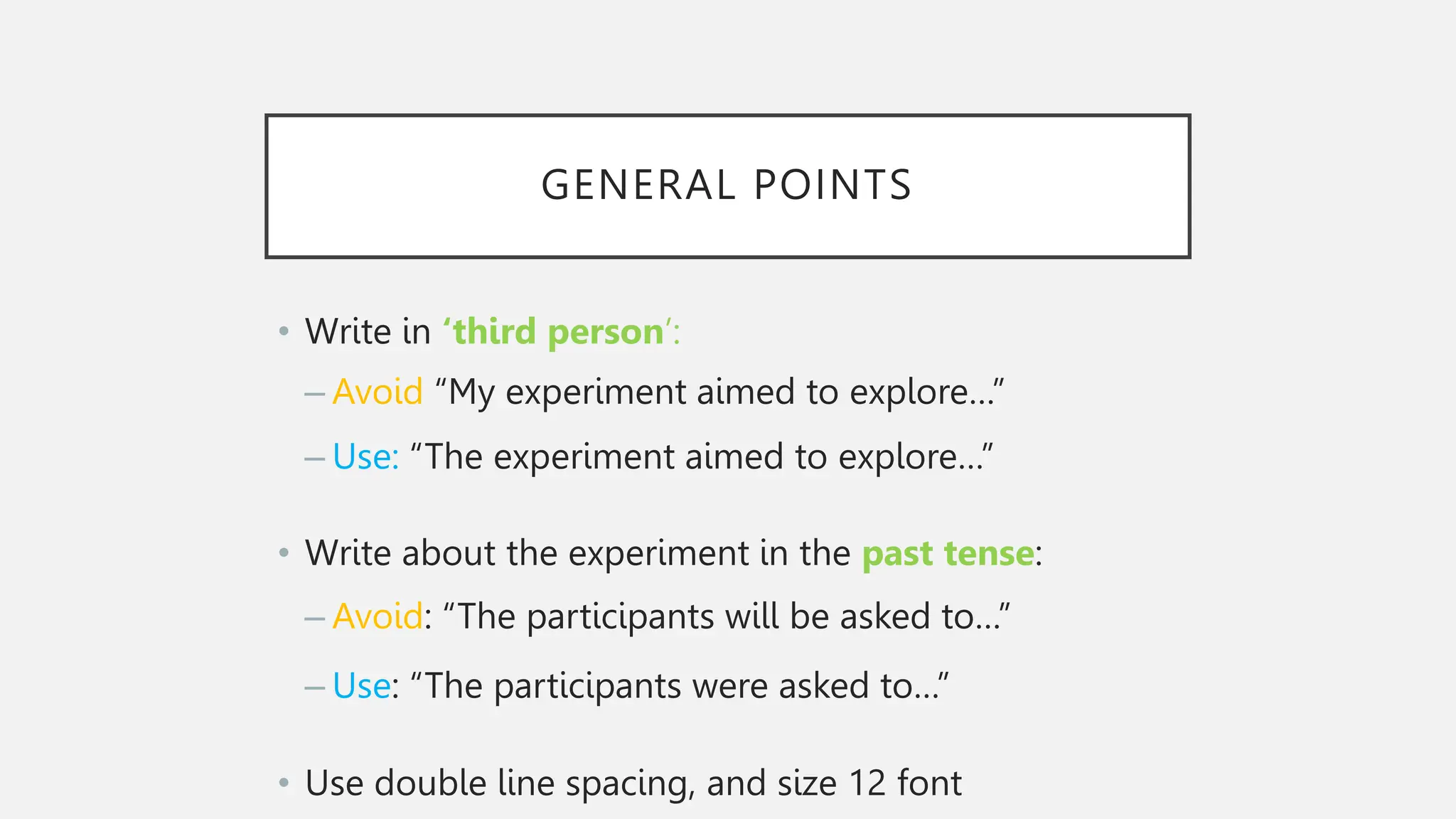
GENERAL POINTS
• Write in ‘third person’:
– Avoid “My experiment aimed to explore…”
– Use: “The experiment aimed to explore…”
• Write about the experiment in the past tense:
– Avoid: “The participants will be asked to…”
– Use: “The participants were asked to…”
• Use double line spacing, and size 12 font
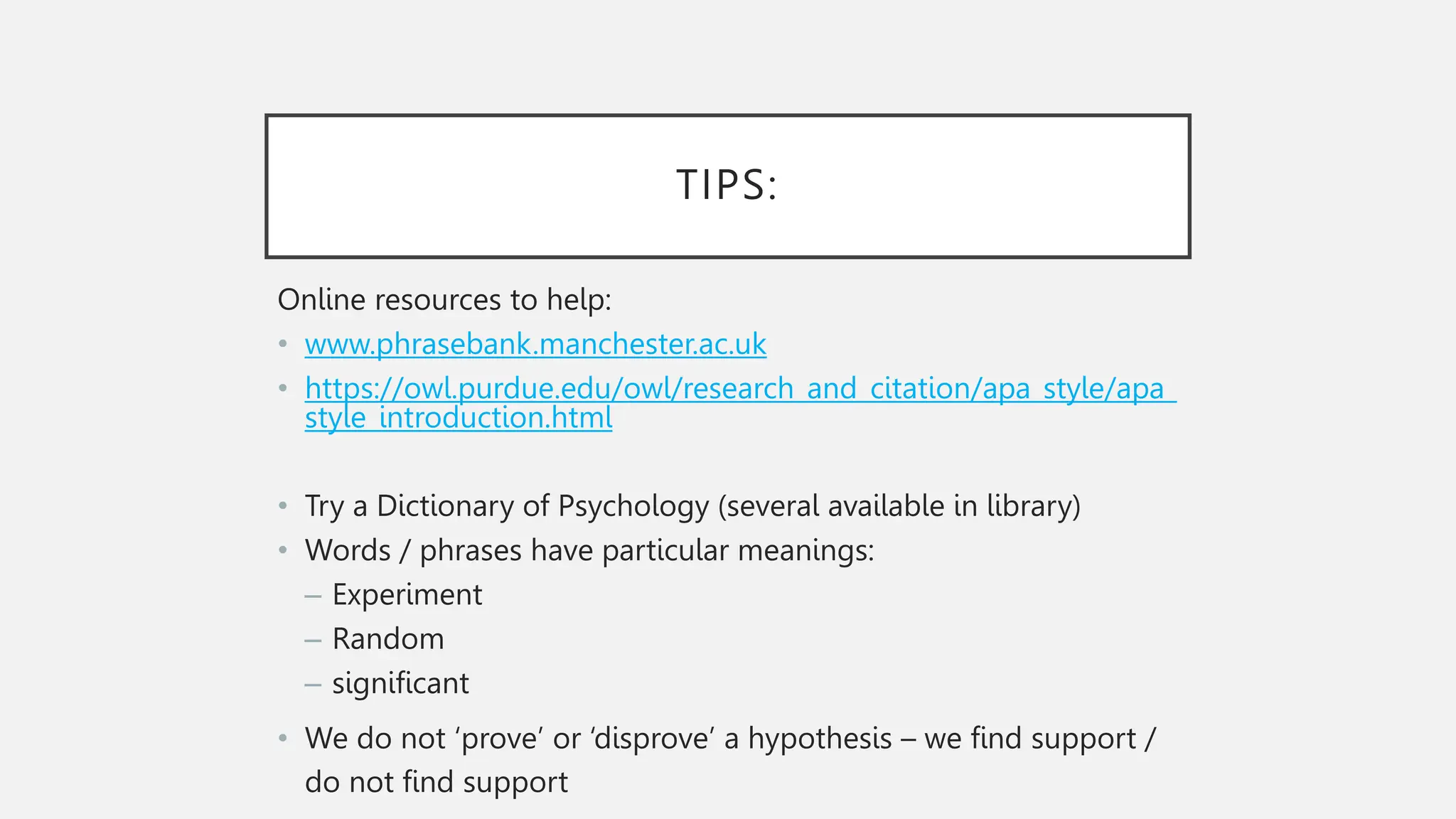
TIPS:
Online resources to help:
• www.phrasebank.manchester.ac.uk
• https://owl.purdue.edu/owl/research_and_citation/apa_style/apa_
style_introduction.html
• Try a Dictionary of Psychology (several available in library)
• Words / phrases have particular meanings:
– Experiment
– Random
– significant
• We do not ‘prove’ or ‘disprove’ a hypothesis – we find support /
do not find support
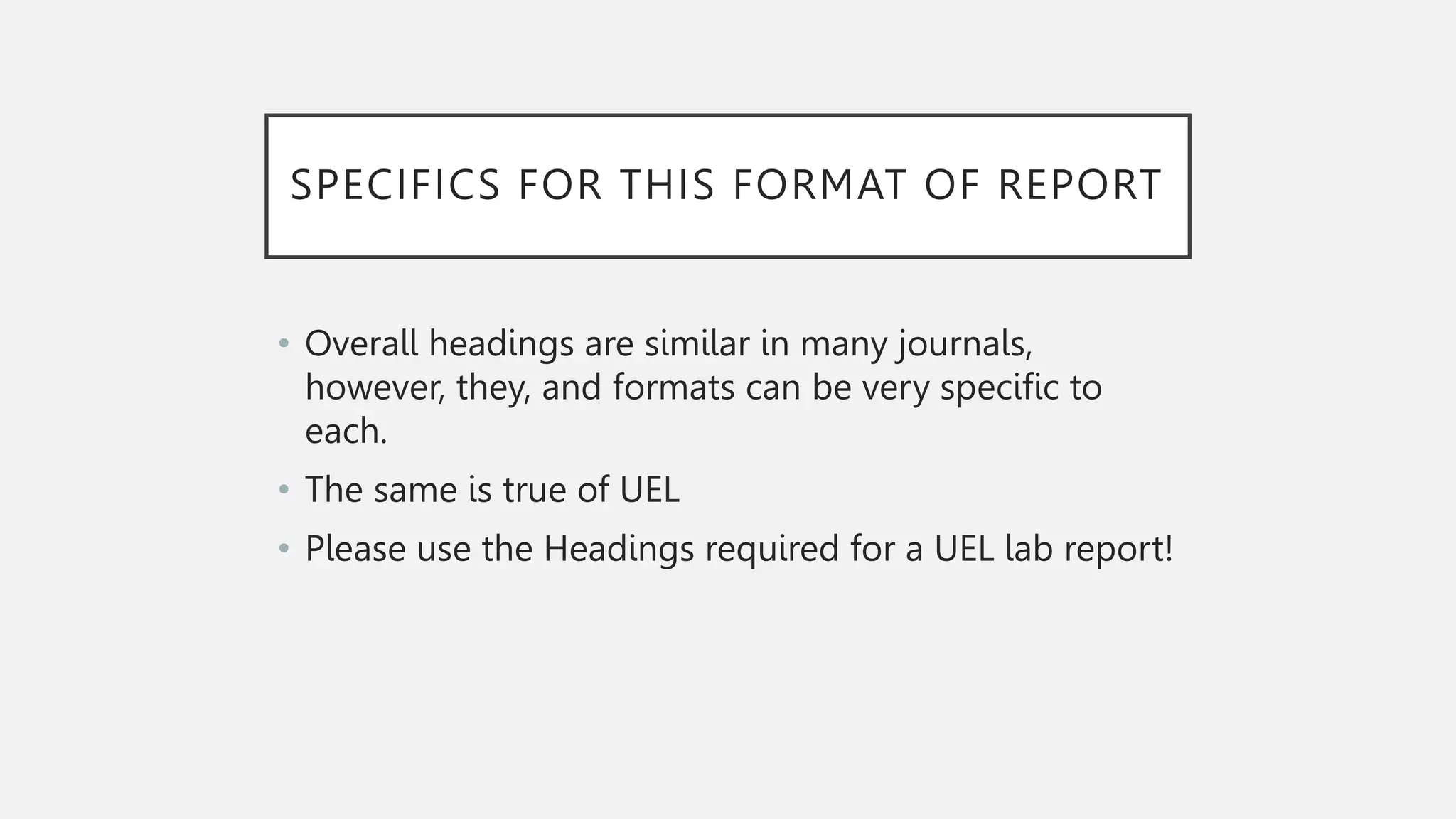
SPECIFICS FOR THIS FORMAT OF REPORT
• Overall headings are similar in many journals,
however, they, and formats can be very specific to
each.
• The same is true of UEL
• Please use the Headings required for a UEL lab report!
SECTIONS IN A LAB REPORT
• A lab report is very different to an essay
• It has a specific structure that you must follow – with
headings and sub-headings
• These must be presented in the correct order, with the
relevant information in each section
• It must be written in formal scientific language
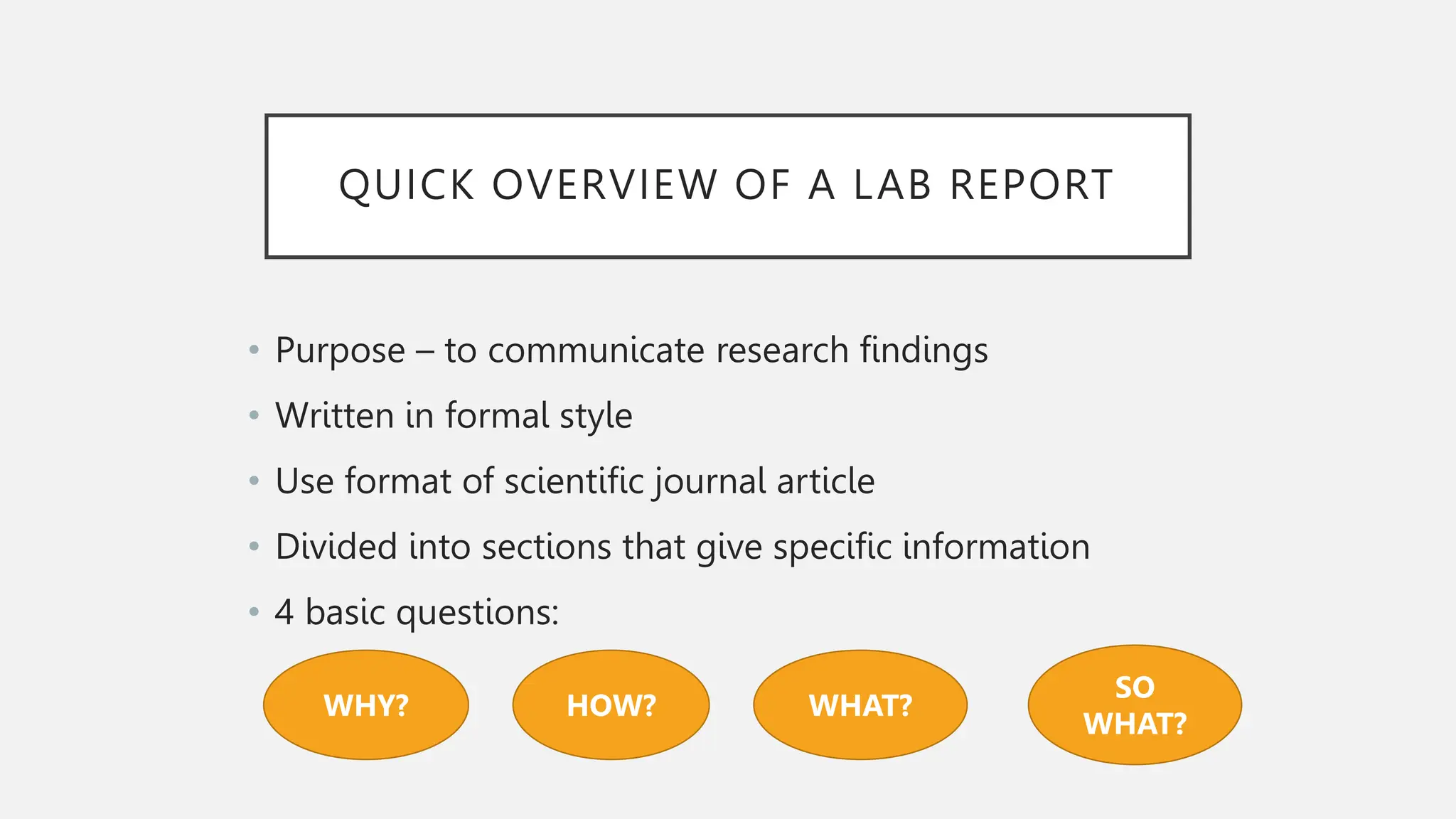
QUICK OVERVIEW OF A LAB REPORT
• Purpose – to communicate research findings
• Written in formal style
• Use format of scientific journal article
• Divided into sections that give specific information
• 4 basic questions:
WHY? HOW? WHAT?
SO
WHAT?
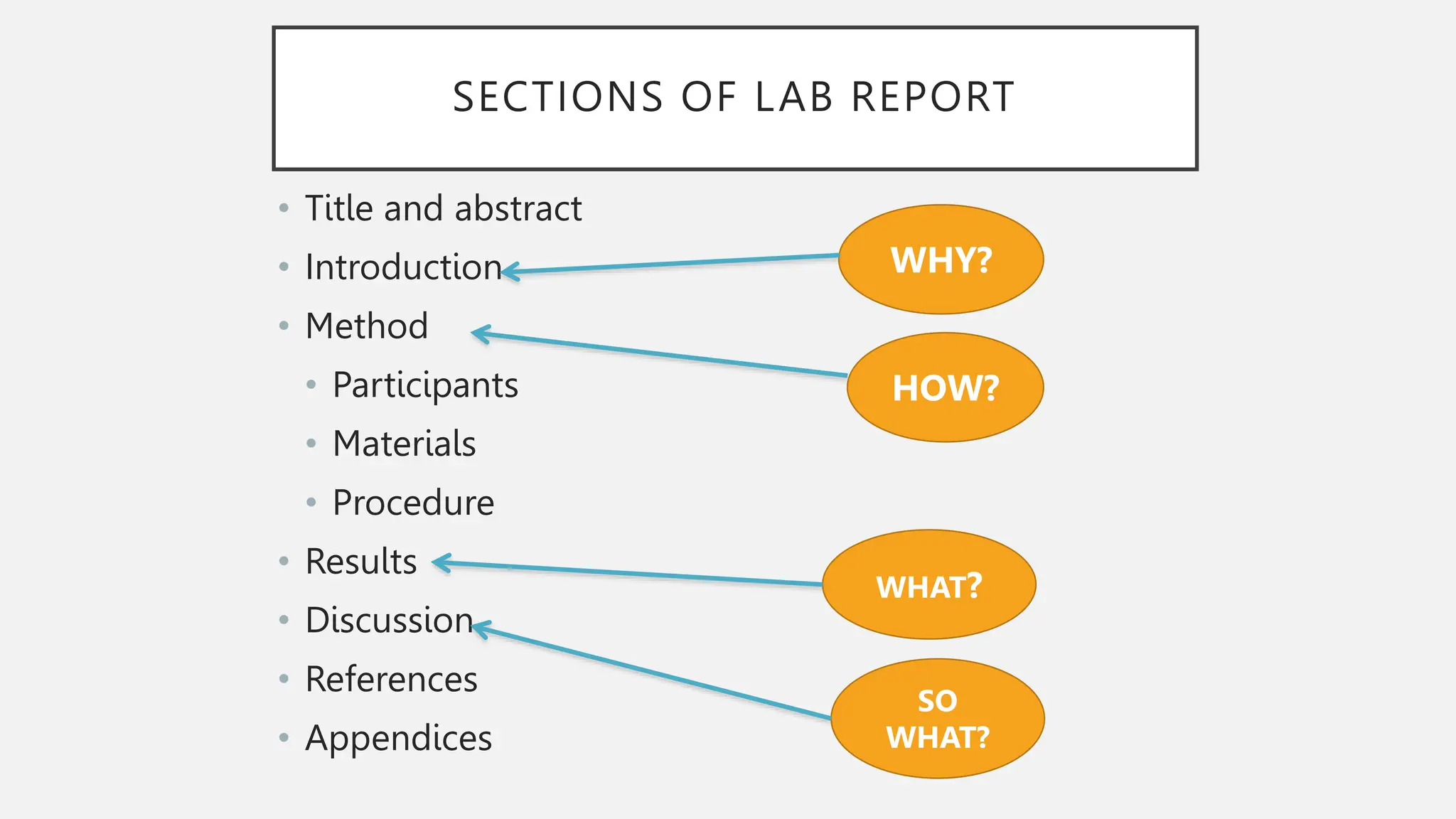
SECTIONS OF LAB REPORT
• Title and abstract
• Introduction
• Method
• Participants
• Materials
• Procedure
• Results
• Discussion
• References
• Appendices
WHY?
HOW?
WHAT?
SO
WHAT?
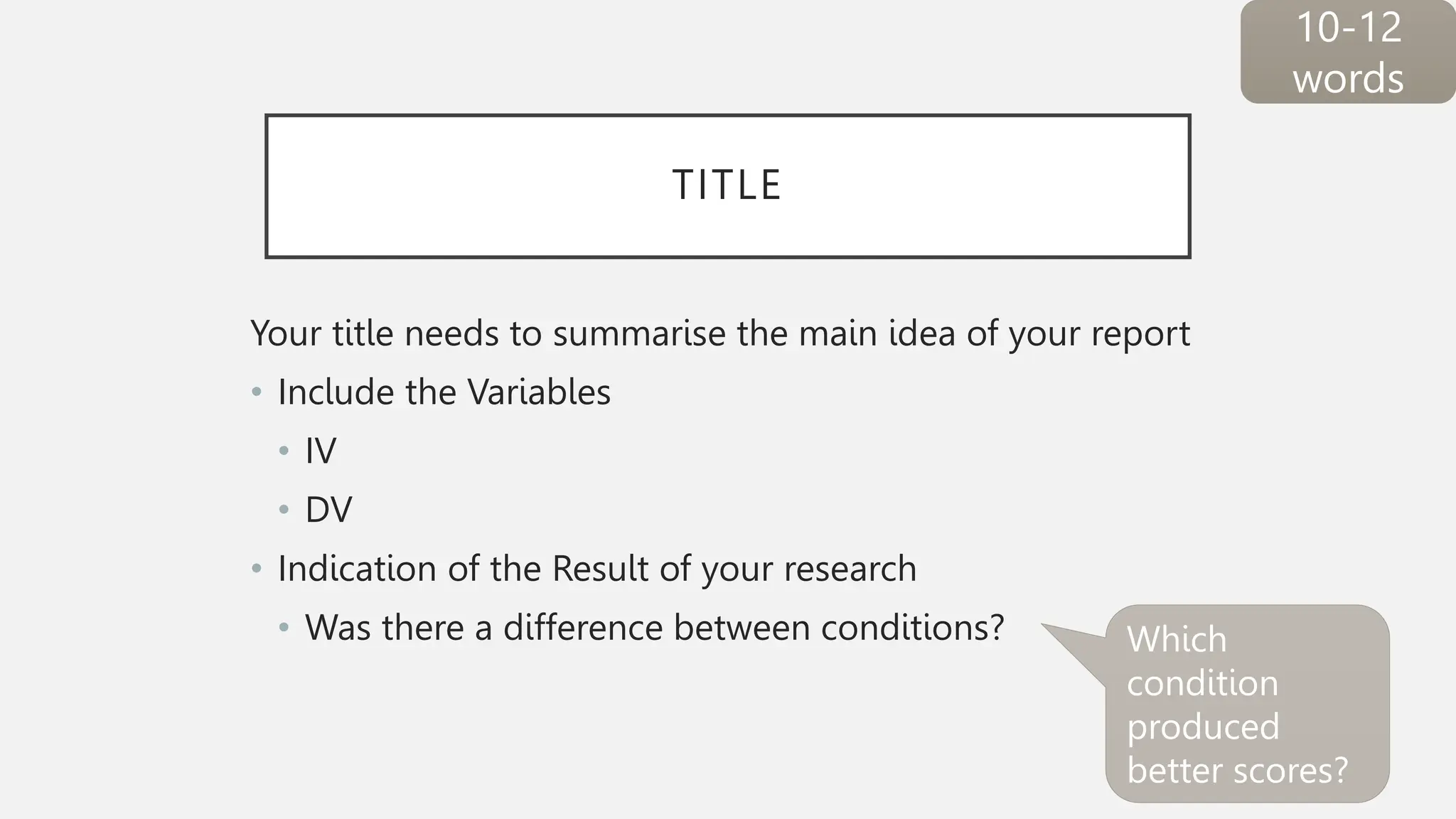
TITLE
10-12
words
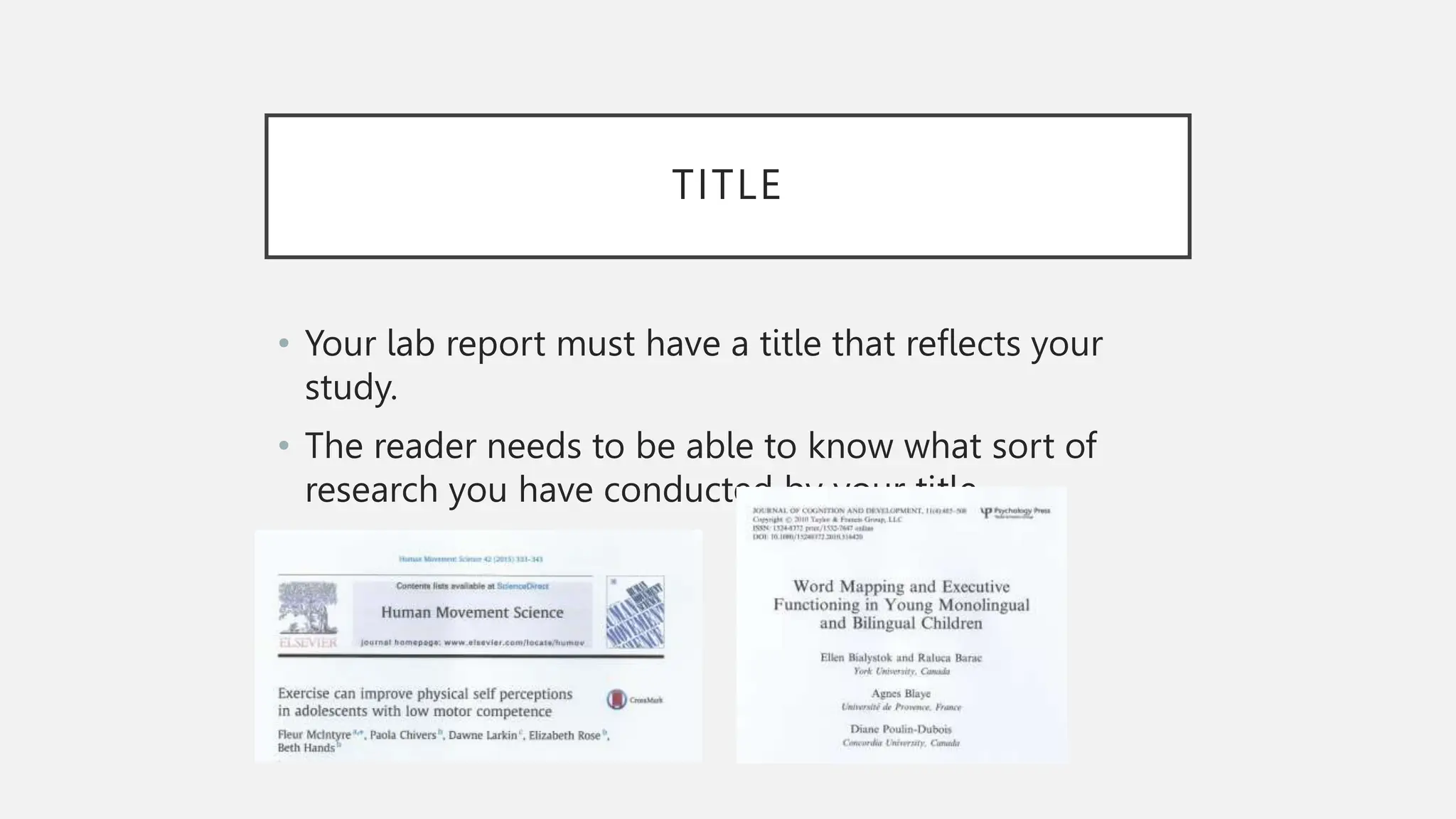
TITLE
• Your lab report must have a title that reflects your
study.
• The reader needs to be able to know what sort of
research you have conducted by your title
TITLE
Your title needs to summarise the main idea of your report
• Include the Variables
• IV
• DV
• Indication of the Result of your research
• Was there a difference between conditions?
10-12
words
Which
condition
produced
better scores?
ABSTRACT
150
words
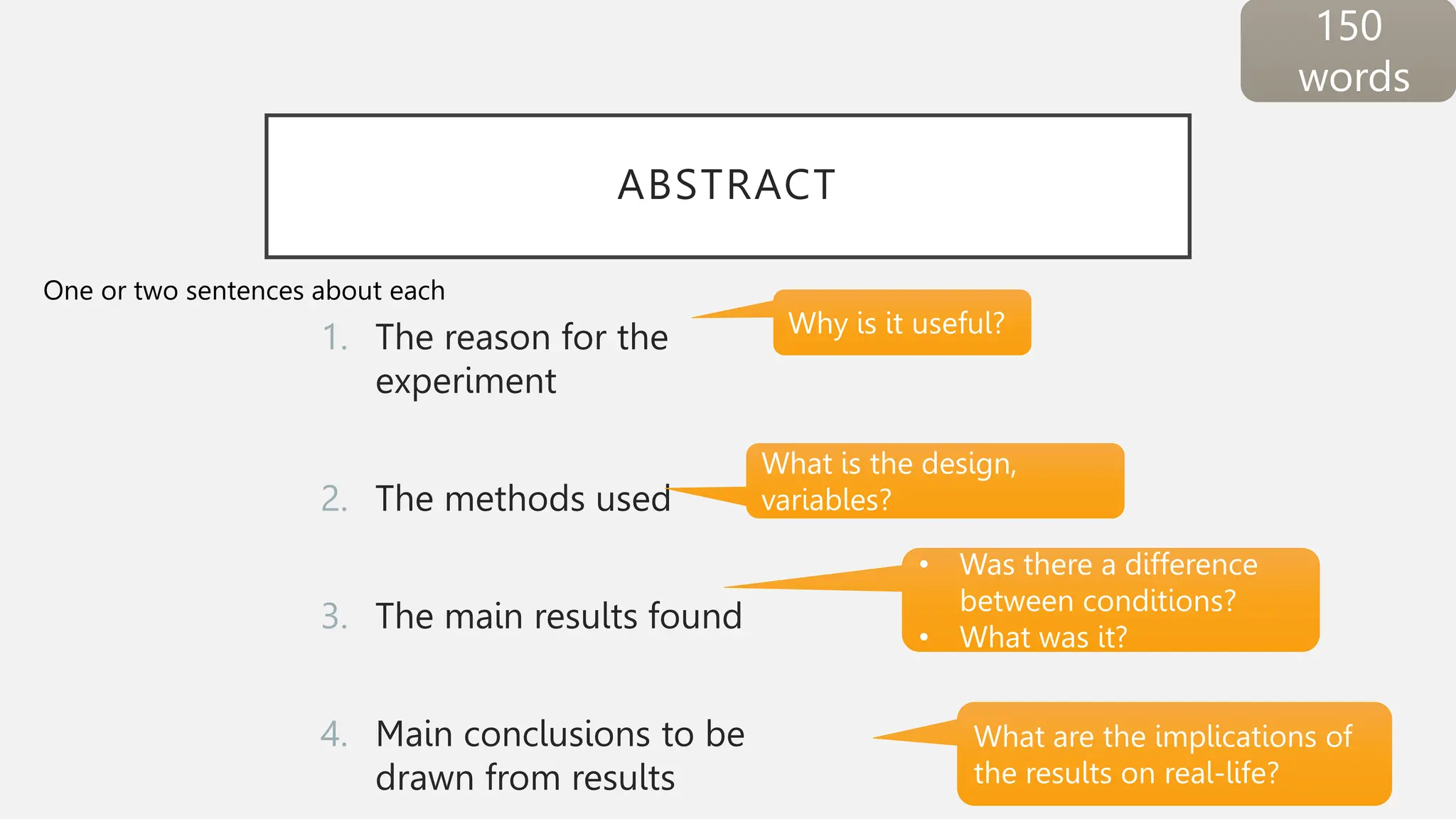
ABSTRACT
1. The reason for the
experiment
2. The methods used
3. The main results found
4. Main conclusions to be
drawn from results
150
words
Why is it useful?
What is the design,
variables?
• Was there a difference
between conditions?
• What was it?
What are the implications of
the results on real-life?
One or two sentences about each
INTRODUCTION
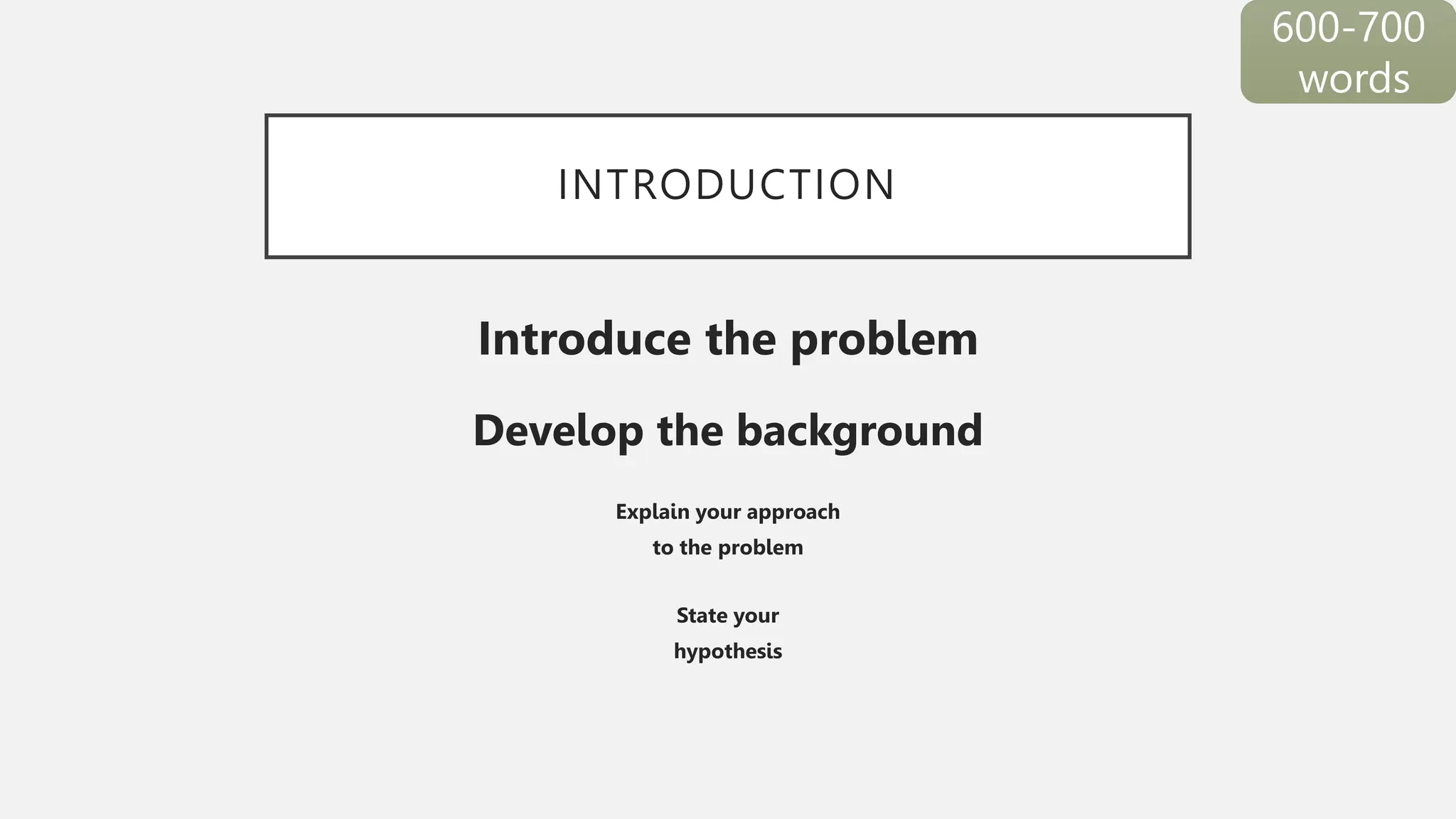
600-700
words
INTRODUCTION
Introduce the problem
Develop the background
Explain your approach
to the problem
State your
hypothesis
600-700
words
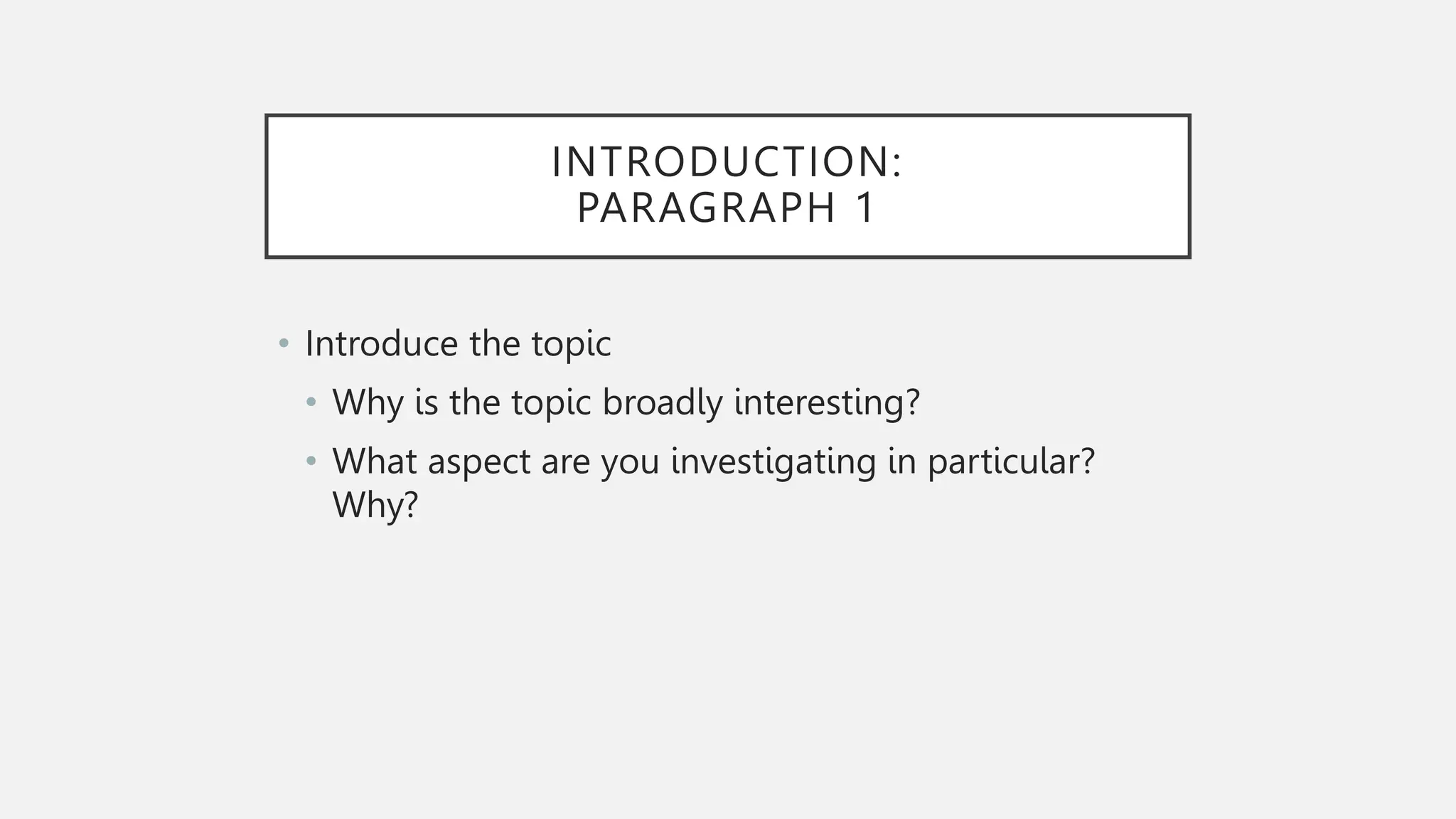
INTRODUCTION:
PARAGRAPH 1
• Introduce the topic
• Why is the topic broadly interesting?
• What aspect are you investigating in particular?
Why?
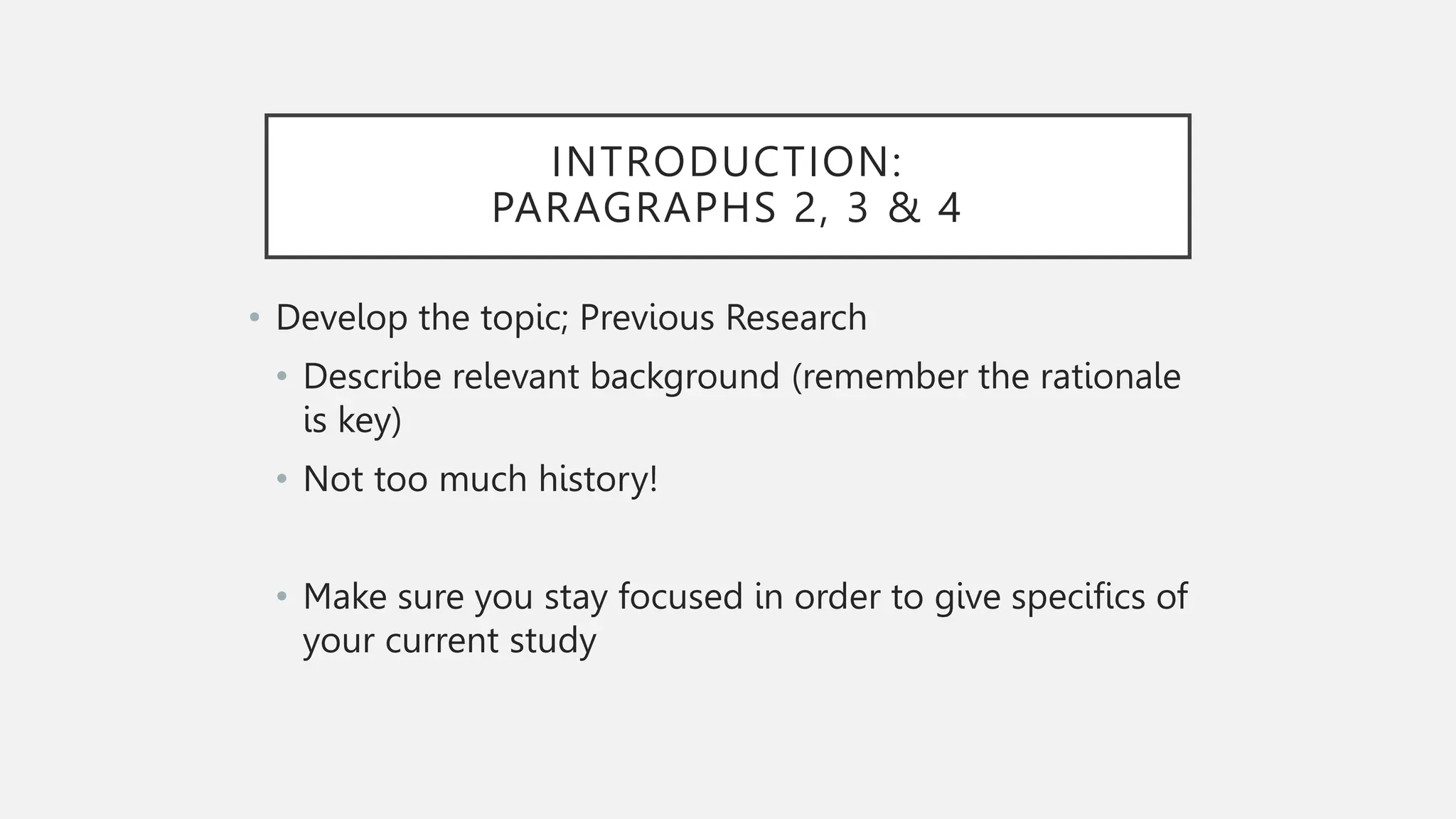
INTRODUCTION:
PARAGRAPHS 2, 3 & 4
• Develop the topic; Previous Research
• Describe relevant background (remember the rationale
is key)
• Not too much history!
• Make sure you stay focused in order to give specifics of
your current study
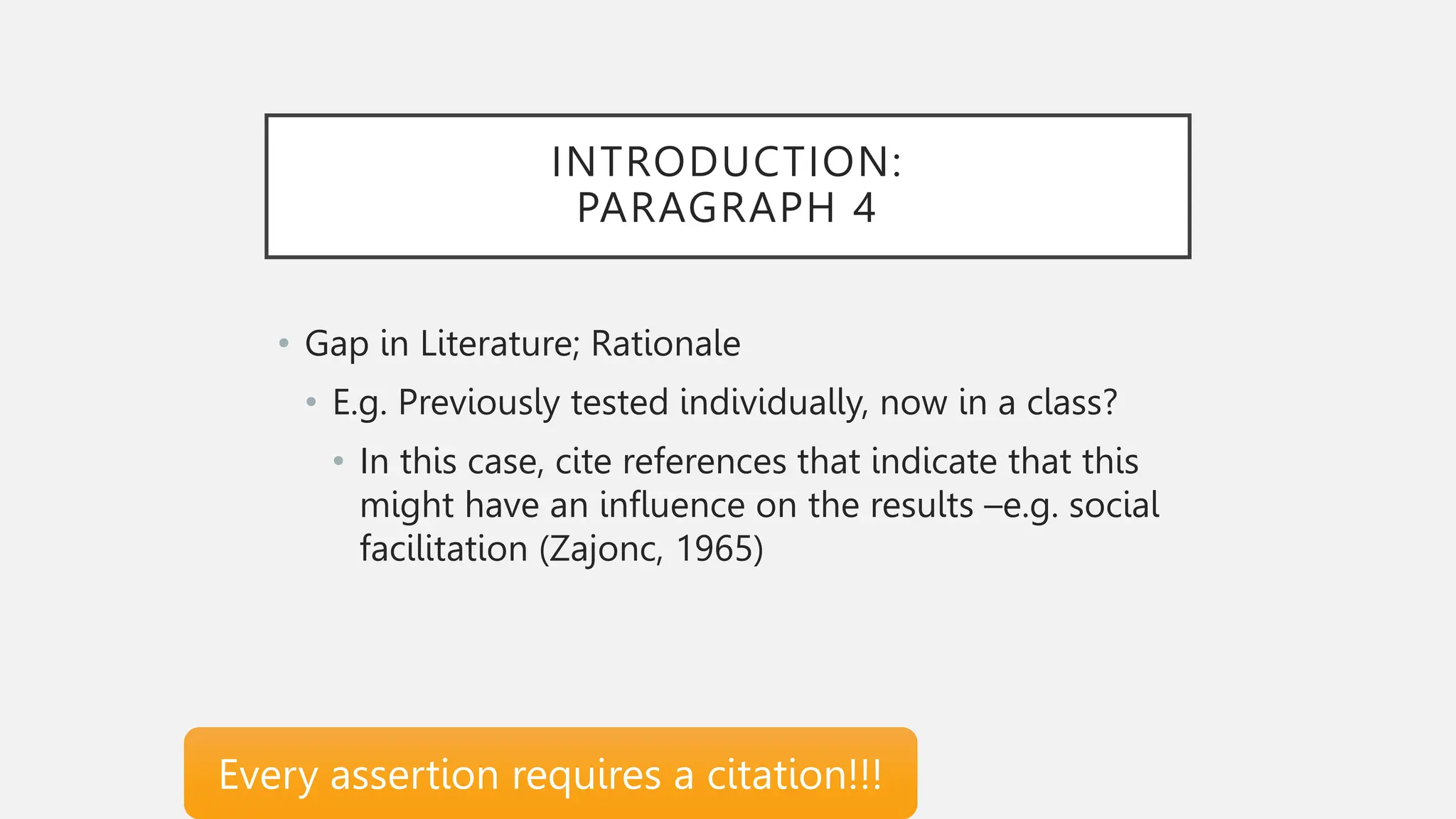
INTRODUCTION:
PARAGRAPH 4
• Gap in Literature; Rationale
• E.g. Previously tested individually, now in a class?
• In this case, cite references that indicate that this
might have an influence on the results –e.g. social
facilitation (Zajonc, 1965)
Every assertion requires a citation!!!
INTRODUCTION:
PARAGRAPH 5
• The Current (Present) study!
• What type of design was used?
• What were the IV and the DV?
• The hypothesis:
• Based on the previous research findings, it was
predicted that…
METHODS
300-400
words
METHOD: GENERAL TIPS
• Need to get the right balance between having
enough detail for replication but avoid unnecessary
detail
• E.g. in a recipe, the fact you use sugar is important,
but not which brand!
• Write in paragraphs with full sentences: do not use
bullet points / list
METHODS:
PARTICIPANTS
Participants
“___participants took part in an online survey (__were
male, __were female), they were aged between __ -__
years, mean age __ years (S.D. = __)” Opportunity
sample of UEL Psychology Undergraduates.
Only section to
use sub-
headings
METHODS:
MATERIALS
• Anything used in the study –remember the emphasis
is on replication, so avoid unnecessary detail!
• Think of the what you would need to collect together
if you wanted to do the study exactly the same way
again. Avoid vagueness, e.g. “some pictures”, instead
e.g. “3 cm x 3 cm black and white line drawings of
everyday objects”
Like the Ingredients in
a cooking recipe
METHODS:
PROCEDURE
AGAIN remember the emphasis is on replication, so
avoid unnecessary detail!
• Step by step instructions
• Imagine you can give it to your friend and they will
follow your steps in the way you did it exactly
Like the Methods in a
cooking recipe
RESULTS
300-400
words
RESULTS
• Paragraph 1: Treatment of the raw data. Incomplete
Responses.
• Paragraph 2: Present the Descriptive Statistics.
• Paragraph 3: Present the Inferential Statistics.
• Paragraph 4: What does this mean for the hypotheses?
300-400
words
You can combine the
descriptive and inferentials as
long as all the information
required is there!
DISCUSSION
600-700
words
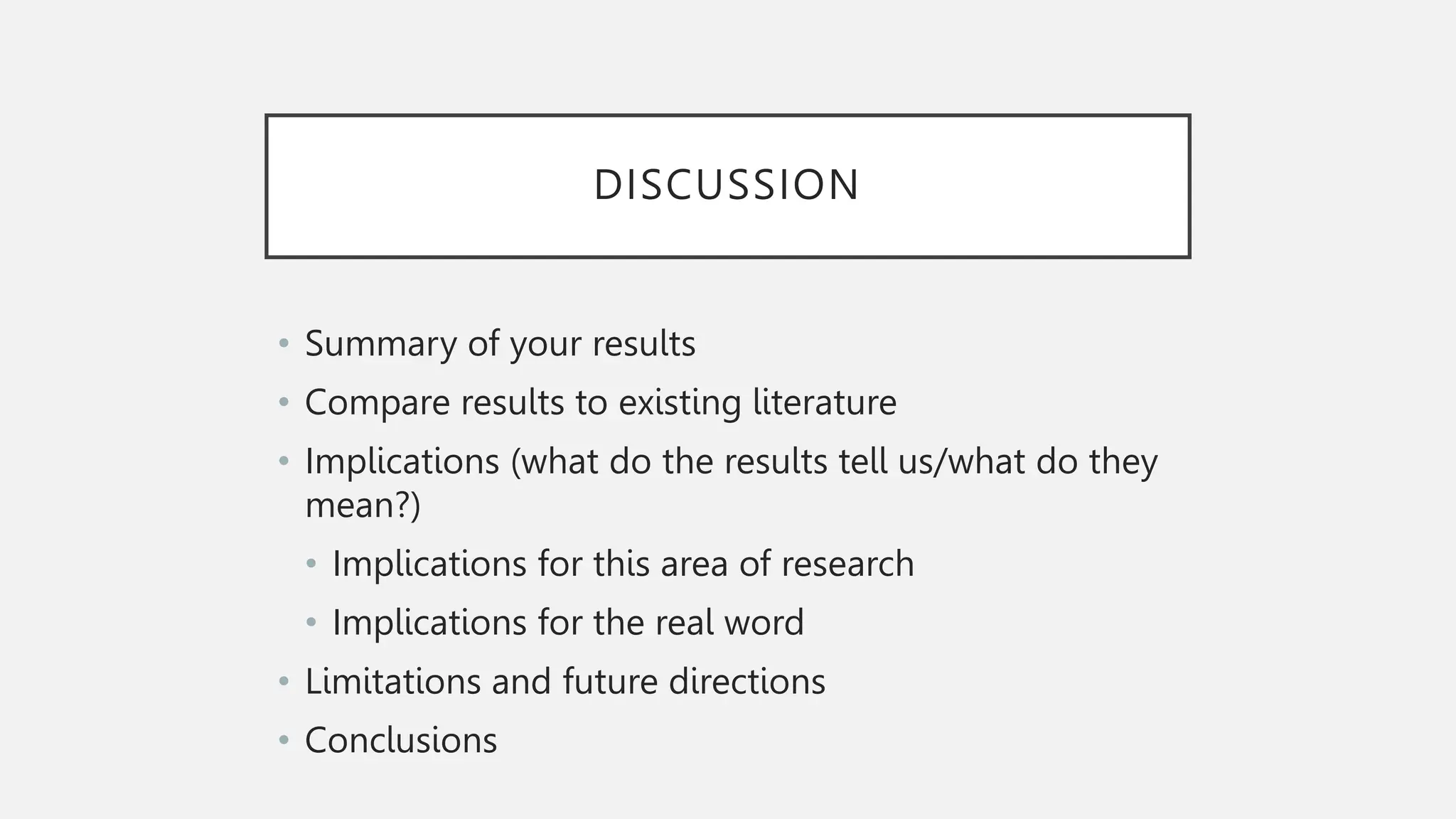
DISCUSSION
• Summary of your results
• Compare results to existing literature
• Implications (what do the results tell us/what do they
mean?)
• Implications for this area of research
• Implications for the real word
• Limitations and future directions
• Conclusions
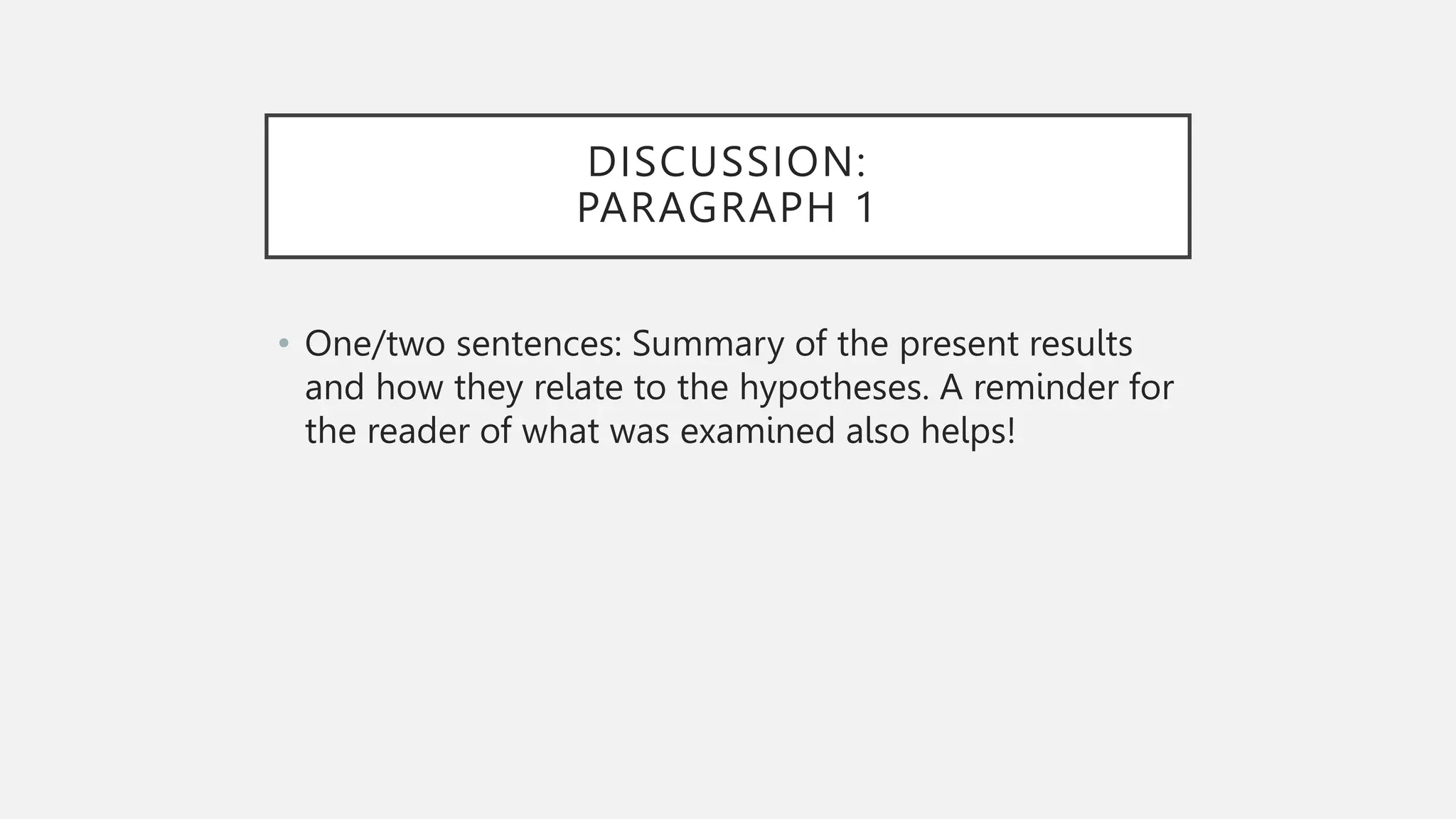
DISCUSSION:
PARAGRAPH 1
• One/two sentences: Summary of the present results
and how they relate to the hypotheses. A reminder for
the reader of what was examined also helps!
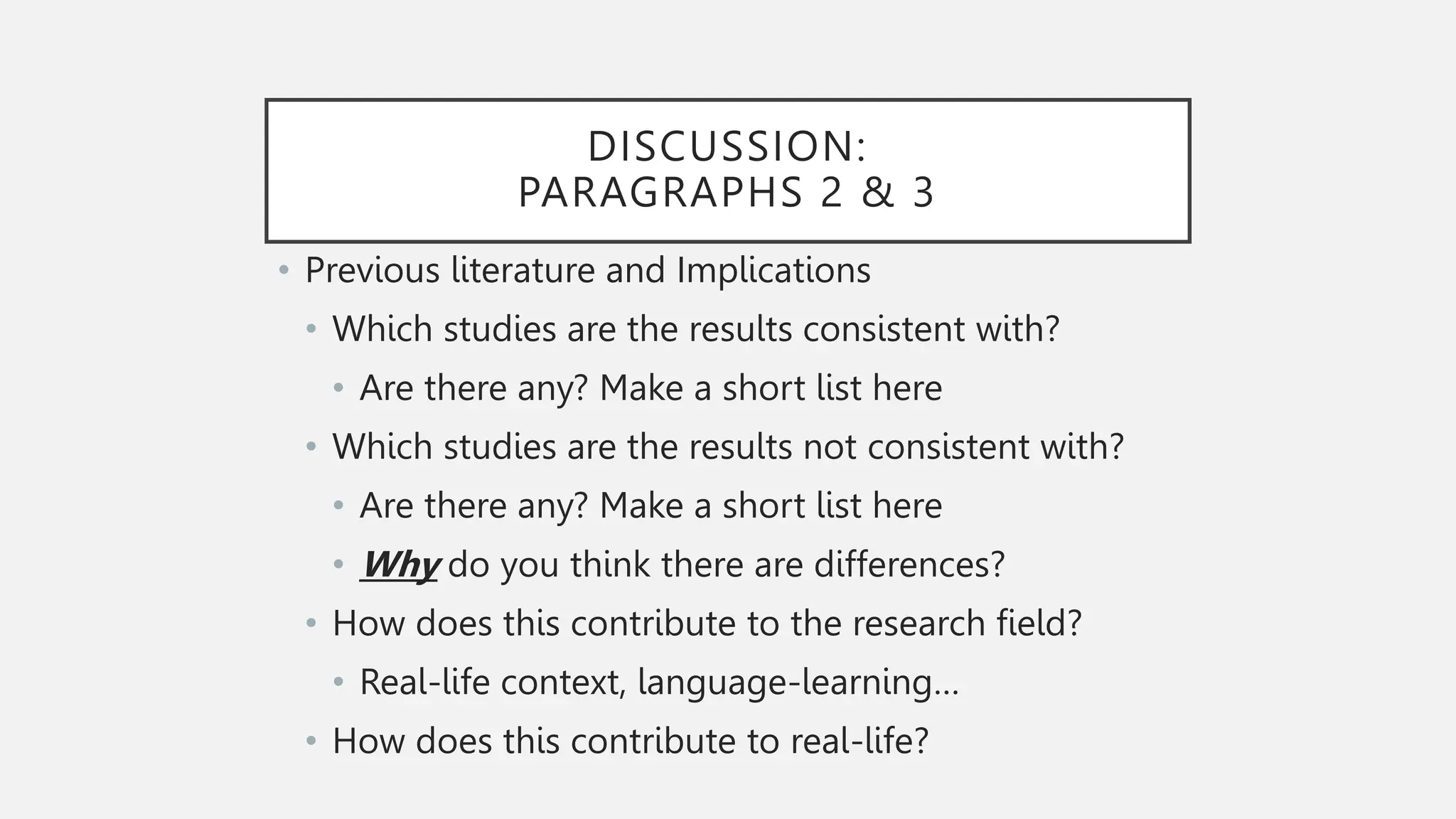
DISCUSSION:
PARAGRAPHS 2 & 3
• Previous literature and Implications
• Which studies are the results consistent with?
• Are there any? Make a short list here
• Which studies are the results not consistent with?
• Are there any? Make a short list here
• Why do you think there are differences?
• How does this contribute to the research field?
• Real-life context, language-learning…
• How does this contribute to real-life?
DISCUSSION:
PARAGRAPH 4
• Limitations and Future studies
• Discuss some key limitations of the study and how
you would improve next time
• Don’t undermine your own study!!
• Try to back up suggestions with references e.g. a
limitation might be the type of words (REFERENCE)
DISCUSSION:
PARAGRAPH 5
• One sentence:
• Conclusions and real-life impact
WHAT YOU
NEED TO
KNOW!
REFERENCES
• Need to provide details of
all references referred to in
the lab report
• Alphabetical order
• Present in APA format
APPENDICES
• All appendices need to be correctly labelled and
referred to in the text
• DO NOT include SPSS print outs or any of the real
data!
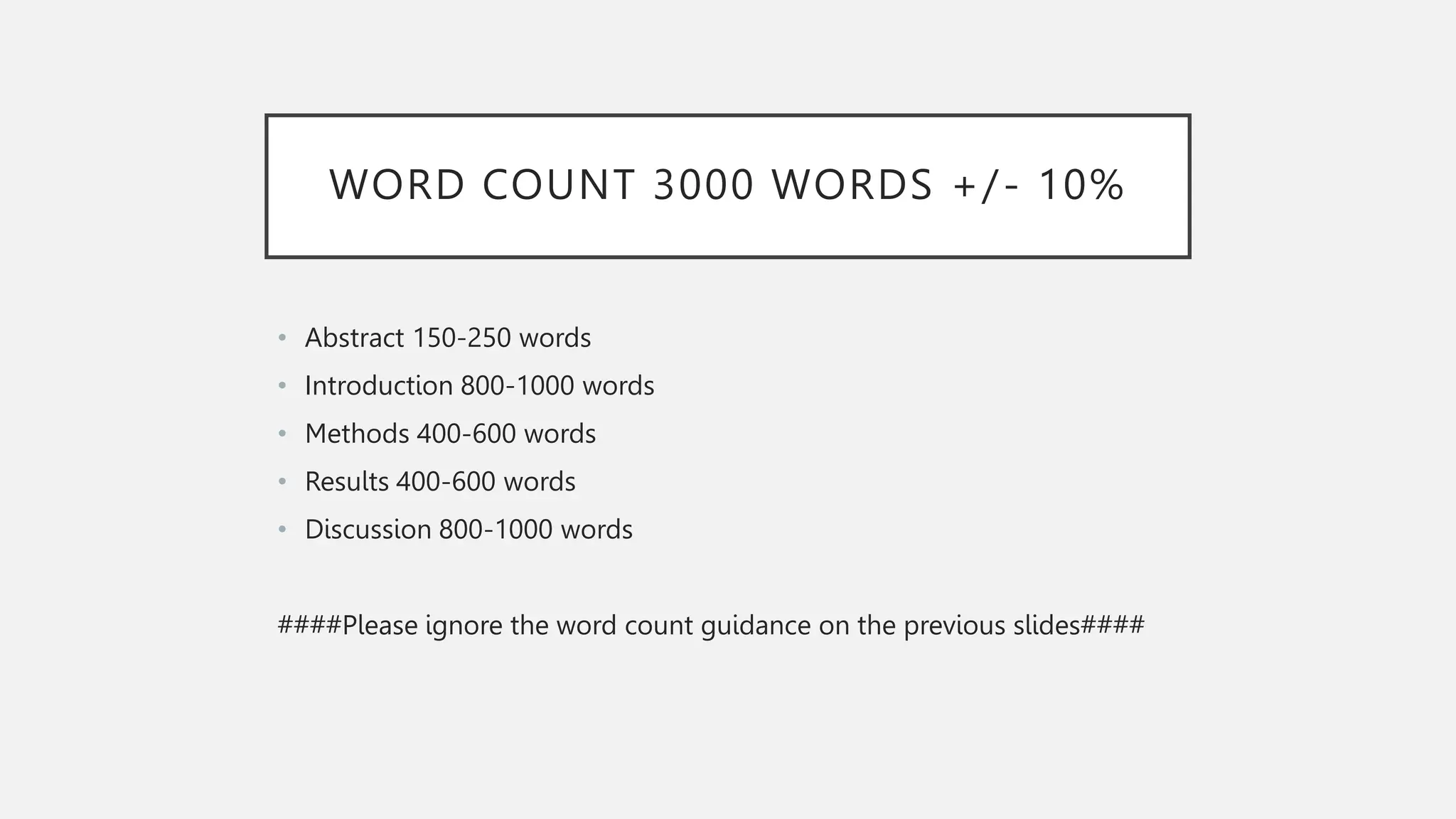
WORD COUNT 3000 WORDS +/- 10%
• Abstract 150-250 words
• Introduction 800-1000 words
• Methods 400-600 words
• Results 400-600 words
• Discussion 800-1000 words
####Please ignore the word count guidance on the previous slides####
THAT’S IT 

week 10 PY7156 LabReportWriteUp 2022 (1).pptx

  • 1.
    PY7156: WEEK 10 Writingup Your Lab Report
  • 2.
    LAB REPORT (ASSESSMENT COMPONENT2) • Word count: 3000 words ±10% • Does not include Abstract, Tables/Graphs, or References • 65% of your Module Mark
  • 3.
    DON’T FORGET TOUSE YOUR MARKING CRITERIA FAIL < 45% (Very Poor Fail) FAIL (45, 48) (Poor) PASS (52,55,58) (Satisfactory) Merit (62,65,68) Distinction (75 and over) Title Title is very confusingor fails to conveymuch useful information. Title conveyssome informationbut couldbe clearer or morecomplete. Title is clear and informativeabout what was investigated and discovered. Title is clear and conciseand conveyswhat was investigatedand what was discovered. Title is clear and concise and conveys what was investigated and what was discovered. Abstract Content mostlyirrelevant or inaccurate.Serious problemswith structureor level of detail. Content has some relevanceand is partiallyaccurate. There is somestructure. The level of detail is adequate in places. Content is relevantand accurate,perhaps with someminor deviationsor omissions. Structure and length are approximatelyOK. The content is relevantand accurate. Correct structure and goodlength. Conciseand clearlywritten. First class work has a particularly goodlevel of detail, and the writing style is particularly clear concise. Introduction – literature review and rationale for study Very little is accurate or relevant.There appears to be poor understandingof theoriesor concepts.Argumentsare incoherent, illogical,or absent. Containsunsupportedassertionsor over- generalisations. Rationalefor the study is absent/incorrect Someliteratureis accurateand relevant.There is someunderstandingof theoriesand conceptsand somelink to evidence.Someargumentsare coherent and logical.Some unsupportedassertions or over-generalisations. Attempts to explainthe rationalefor the study. Literatureis mostlyaccurate and relevant. Reasonable understandingof theoriesand conceptsand linkingto evidence.Argumentsare mostlycoherentand logical. Few unsupportedassertionsor over-generalisations. Reasonable explanationof the rationalefor the study. Literatureis accurateand relevant,and evidenceis relatedto theory. There is good understandingof theoriesand concepts. Argumentsare coherent and logical.There are no unsupportedassertionsor over- generalisations. There is an appropriate rationalefor the study. Goodwriting style. First class work meets these criteria particularly strongly. The writing style is excellent and evidence of wider reading and critical ability. Introduction – design, variables & hypothesis No coherent identificationof design or variables. Seriouserrorsin the statement of the hypothesis. No rationalefor the choiceof design. Someattempt to identify the designand variables. Someattempt to state the hypothesis.Some attempt at a rationalefor the choiceof design. Definitionof design and variablesis mostlyclear and correct. The hypothesisis mostlyclear and correct. Reasonable attempt at a rationalefor the choiceof design. Correct definitionof design and variables. Hypothesisclearlystated. Explicit rationale for the choiceof design. Writingstyle is clear and concise. First class work has a particularly clear rationale the choice of design and shows a and excellent understanding of the study. . Method Very little that is accurate or relevantabout the participants,materialsor procedure. Poor structure Somedefinitionof participantsand materials. Procedurewould allowan approximatereplication. Someevidenceof structure. Minor flaws or omissionsin the details of participants& materials. Procedureis mostlyrelevant and near-sufficient for replication.Structure mainlycorrect. Accurate and relevant detailsof participants and materials.Procedureis relevantand sufficientfor replication.Structure is correct. First class work has particularly clear and writing. Results Very little that is accurate or relevantor well presented. Someattempt to define the treatment of raw data, descriptivestatistics, and inferential statistics. Treatment of raw data, descriptivestatistics,and inferential statisticsare mostlycompleteand accurate Treatment of raw data, descriptivestatistics, and inferentialstatisticsare clearly presentedand accuratelyreported. First class work is characterised by quality of and presentation. Discussion Little that is relevantor accuratein the outlineof findingsand the discussionof results.Incorrect or no interpretationof results. No coherent considerationof appropriatealternative explanations. No conclusion.Incoherent structure or organisation. Someattempt to outlinethe findings and discuss the resultsin relationto literatureand methodology. Someattempt to interpretthe results; to consider appropriatealternativeexplanations;and to write a conclusion. Someevidenceof structureand organisation. The outlineof findings,link to the hypothesis,and the discussionof results in relationto literatureand methodologyare mostlyclear and accurate. Reasonable attempt to interpret the results;to consider appropriate alternativeexplanations; and to write a conclusion.Clear evidenceof structureand organisation. Clear outlineof findings,link to the hypothesis, and discussionof resultsin relationto literatureand methodology. Goodinterpretationof the results. Appropriatealternativeexplanationsare considered.Sensibleconclusion.Clear structure and well organised.Goodwriting style. First class work meets these criteria particularly strongly. The writing style is excellent and evidence of critical thinking and independent judgment. Reference and appendices Absence of citation and referencing. No appendices. All referencesare to wikipedia or web pages, no journalarticles. Some attempt at correct citation, referencing, appendices. Somegood sources but some dependenceon wikipedia or web pages. Only minor errors in citation, referencingor Little inappropriate use of wikipedia and web pages. Workis fully referenced.Appendices contain relevant material and are cited the text. No unjustified references to wikipedia or web pages. Workis fully and correctly referenced. contain relevant material and are cited in the No unjustified references to wikipedia or web pages.
  • 4.
    KEEP IN MIND: WHATIS THE PURPOSE OF A LAB REPORT? Contribute to knowledge Communicate your research Replication (baking cakes!) Clarity of research aims, methods and interpretation Simple and understandable
  • 5.
    WHAT MAKES AGOOD LAB REPORT? • The reader should be able to repeat the work without reference to additional sources • The reader should understand the significance of the outcomes of the work in the wider psychological context • It is short and to the point (Collins & Kneale 2001) 5 See Module handbook for marking criteria Educated non- expert
  • 6.
    GENERAL POINTS • Writein ‘third person’: – Avoid “My experiment aimed to explore…” – Use: “The experiment aimed to explore…” • Write about the experiment in the past tense: – Avoid: “The participants will be asked to…” – Use: “The participants were asked to…” • Use double line spacing, and size 12 font
  • 7.
    TIPS: Online resources tohelp: • www.phrasebank.manchester.ac.uk • https://owl.purdue.edu/owl/research_and_citation/apa_style/apa_ style_introduction.html • Try a Dictionary of Psychology (several available in library) • Words / phrases have particular meanings: – Experiment – Random – significant • We do not ‘prove’ or ‘disprove’ a hypothesis – we find support / do not find support
  • 8.
    SPECIFICS FOR THISFORMAT OF REPORT • Overall headings are similar in many journals, however, they, and formats can be very specific to each. • The same is true of UEL • Please use the Headings required for a UEL lab report!
  • 9.
    SECTIONS IN ALAB REPORT • A lab report is very different to an essay • It has a specific structure that you must follow – with headings and sub-headings • These must be presented in the correct order, with the relevant information in each section • It must be written in formal scientific language
  • 10.
    QUICK OVERVIEW OFA LAB REPORT • Purpose – to communicate research findings • Written in formal style • Use format of scientific journal article • Divided into sections that give specific information • 4 basic questions: WHY? HOW? WHAT? SO WHAT?
  • 11.
    SECTIONS OF LABREPORT • Title and abstract • Introduction • Method • Participants • Materials • Procedure • Results • Discussion • References • Appendices WHY? HOW? WHAT? SO WHAT?
  • 12.
  • 13.
    TITLE • Your labreport must have a title that reflects your study. • The reader needs to be able to know what sort of research you have conducted by your title
  • 14.
    TITLE Your title needsto summarise the main idea of your report • Include the Variables • IV • DV • Indication of the Result of your research • Was there a difference between conditions? 10-12 words Which condition produced better scores?
  • 15.
  • 16.
    ABSTRACT 1. The reasonfor the experiment 2. The methods used 3. The main results found 4. Main conclusions to be drawn from results 150 words Why is it useful? What is the design, variables? • Was there a difference between conditions? • What was it? What are the implications of the results on real-life? One or two sentences about each
  • 17.
  • 18.
    INTRODUCTION Introduce the problem Developthe background Explain your approach to the problem State your hypothesis 600-700 words
  • 19.
    INTRODUCTION: PARAGRAPH 1 • Introducethe topic • Why is the topic broadly interesting? • What aspect are you investigating in particular? Why?
  • 20.
    INTRODUCTION: PARAGRAPHS 2, 3& 4 • Develop the topic; Previous Research • Describe relevant background (remember the rationale is key) • Not too much history! • Make sure you stay focused in order to give specifics of your current study
  • 21.
    INTRODUCTION: PARAGRAPH 4 • Gapin Literature; Rationale • E.g. Previously tested individually, now in a class? • In this case, cite references that indicate that this might have an influence on the results –e.g. social facilitation (Zajonc, 1965) Every assertion requires a citation!!!
  • 22.
    INTRODUCTION: PARAGRAPH 5 • TheCurrent (Present) study! • What type of design was used? • What were the IV and the DV? • The hypothesis: • Based on the previous research findings, it was predicted that…
  • 23.
  • 24.
    METHOD: GENERAL TIPS •Need to get the right balance between having enough detail for replication but avoid unnecessary detail • E.g. in a recipe, the fact you use sugar is important, but not which brand! • Write in paragraphs with full sentences: do not use bullet points / list
  • 25.
    METHODS: PARTICIPANTS Participants “___participants took partin an online survey (__were male, __were female), they were aged between __ -__ years, mean age __ years (S.D. = __)” Opportunity sample of UEL Psychology Undergraduates. Only section to use sub- headings
  • 26.
    METHODS: MATERIALS • Anything usedin the study –remember the emphasis is on replication, so avoid unnecessary detail! • Think of the what you would need to collect together if you wanted to do the study exactly the same way again. Avoid vagueness, e.g. “some pictures”, instead e.g. “3 cm x 3 cm black and white line drawings of everyday objects” Like the Ingredients in a cooking recipe
  • 27.
    METHODS: PROCEDURE AGAIN remember theemphasis is on replication, so avoid unnecessary detail! • Step by step instructions • Imagine you can give it to your friend and they will follow your steps in the way you did it exactly Like the Methods in a cooking recipe
  • 28.
  • 29.
    RESULTS • Paragraph 1:Treatment of the raw data. Incomplete Responses. • Paragraph 2: Present the Descriptive Statistics. • Paragraph 3: Present the Inferential Statistics. • Paragraph 4: What does this mean for the hypotheses? 300-400 words You can combine the descriptive and inferentials as long as all the information required is there!
  • 30.
  • 31.
    DISCUSSION • Summary ofyour results • Compare results to existing literature • Implications (what do the results tell us/what do they mean?) • Implications for this area of research • Implications for the real word • Limitations and future directions • Conclusions
  • 32.
    DISCUSSION: PARAGRAPH 1 • One/twosentences: Summary of the present results and how they relate to the hypotheses. A reminder for the reader of what was examined also helps!
  • 33.
    DISCUSSION: PARAGRAPHS 2 &3 • Previous literature and Implications • Which studies are the results consistent with? • Are there any? Make a short list here • Which studies are the results not consistent with? • Are there any? Make a short list here • Why do you think there are differences? • How does this contribute to the research field? • Real-life context, language-learning… • How does this contribute to real-life?
  • 34.
    DISCUSSION: PARAGRAPH 4 • Limitationsand Future studies • Discuss some key limitations of the study and how you would improve next time • Don’t undermine your own study!! • Try to back up suggestions with references e.g. a limitation might be the type of words (REFERENCE)
  • 35.
    DISCUSSION: PARAGRAPH 5 • Onesentence: • Conclusions and real-life impact WHAT YOU NEED TO KNOW!
  • 36.
    REFERENCES • Need toprovide details of all references referred to in the lab report • Alphabetical order • Present in APA format
  • 37.
    APPENDICES • All appendicesneed to be correctly labelled and referred to in the text • DO NOT include SPSS print outs or any of the real data!
  • 38.
    WORD COUNT 3000WORDS +/- 10% • Abstract 150-250 words • Introduction 800-1000 words • Methods 400-600 words • Results 400-600 words • Discussion 800-1000 words ####Please ignore the word count guidance on the previous slides####
  • 39.