Week 1
Canadian Securities 1 – FIN 4002
Module I: The Capital Market
Prof. Shalu Bansal
Contents
What is Investment Capital?
Sources of Capital
Users of Capital
What are the Financial Instruments?
What are the Financial Markets?
Canadian Stock Exchange
Trends in Financial Markets
What is Investment Capital?
Capital is wealth – both real, material things such as land and buildings, and
representational items such as money, stocks and bonds.
It is invested savings of individuals, corporations, government and many other
organisations and associations.
Direct use of capital – by individuals for investing in home, government investing in a
new highway or project, or foreign company paying start up cost.
Indirect use of capital – savers buys the securities issued by governments and
corporation, who in turn use the funds for direct productive investment.
Characteristics of capital
•Mobile
•Scarce
•Sensitive to environment
◦ Political environment
◦ Economic trends
◦ Fiscal policy
◦ Monetary policy
◦ Investment Opportunities
◦ Labour Force
Sources of Capital
•Retail Investors
•Institutional Investors
•Foreign Investors
Users of Capital
•Individuals
•Businesses
•Government
◦ Federal Government
◦ Provincial Governments
◦ Municipal Governments
What are the Financial Instruments?
Financial Instruments
◦ Debt Instruments
◦ Bonds
◦ Debentures
◦ Mortgages
◦ Treasury Bills
◦ Commercial Papers
◦ Equity Instruments
◦ Common
◦ Preferred
Continue..
◦ Investment Funds
◦ Open End Funds
◦ Mutual Funds
◦ Derivatives
◦ Option
◦ Forward
◦ Future
◦ Other Financial Instruments
◦ Linked Notes
◦ Exchange Traded Funds
Private Equity
Ways of financing firms by private equity investors:
◦ Leveraged Buyout
◦ Growth Capital
◦ Turnaround
◦ Early Stage Venture Capital
◦ Late Stage Venture Capital
◦ Distressed Debt
What are the Financial Markets?
Securities/Capital Markets
◦ Primary Market
◦ In the primary market new securities are sold by companies and government to investors for first time. Sale is known as
an Initial Public Offerings (IPO).
◦ Secondary Market
◦ In the secondary market investors trade securities that have already been issued by companies and governments.
Continue…
Auction Market
◦ In an auction market, buyers enter bids and sellers enter offers for a stock.
Dealer Markets/OTC/Unlisted Market
◦ Dealer markets are the second major type of market on which securities trade. They consists of
a network of dealers who trade with each other, usually over the telephone or over a computer
network.
Example
Let’s say there are three investors who want to buy a share of ABC and they enter the
following bids on the stock: $5, %5.03 and $5.06. on the other side of the trade, there
are three investors that want to sell their sharer in ABC. These sellers offers to sell their
ABC stock at the following prices: $5.06, $5.07 and $5.11.
The trade is executed and settles only when there is a match in the bid and offer prices.
On the ABC trade, which investors will be able to execute their orders.
What is last price of ABC?
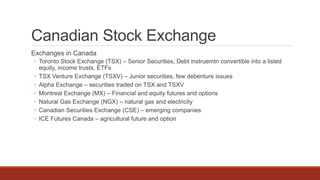
Canadian Stock Exchange
Exchanges in Canada
◦ Toronto Stock Exchange (TSX) – Senior Securities, Debt instruemtn convertible into a listed
equity, income trusts, ETFs
◦ TSX Venture Exchange (TSXV) – Junior securities, few debenture issues
◦ Alpha Exchange – securities traded on TSX and TSXV
◦ Montreal Exchange (MX) – Financial and equity futures and options
◦ Natural Gas Exchange (NGX) – natural gas and electricity
◦ Canadian Securities Exchange (CSE) – emerging companies
◦ ICE Futures Canada – agricultural future and option
Fixed Income Electronic Trading
Systems
•CANDEAL
•CBID
•CANPX
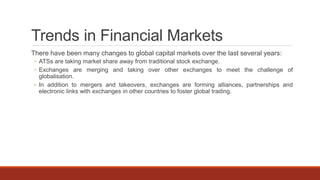
Trends in Financial Markets
There have been many changes to global capital markets over the last several years:
◦ ATSs are taking market share away from traditional stock exchange.
◦ Exchanges are merging and taking over other exchanges to meet the challenge of
globalisation.
◦ In addition to mergers and takeovers, exchanges are forming alliances, partnerships and
electronic links with exchanges in other countries to foster global trading.
References
•Canadian Security Course (CSC), June 2016, The Canadian Securities Institute, www.csi.ca
•CSC Study Notes Volume 1. Oliver’s Publishing,
•www.oliverslearning.com

Week 1 (Module 1).pptx

  • 1.
    Week 1 Canadian Securities1 – FIN 4002 Module I: The Capital Market Prof. Shalu Bansal
  • 2.
    Contents What is InvestmentCapital? Sources of Capital Users of Capital What are the Financial Instruments? What are the Financial Markets? Canadian Stock Exchange Trends in Financial Markets
  • 3.
    What is InvestmentCapital? Capital is wealth – both real, material things such as land and buildings, and representational items such as money, stocks and bonds. It is invested savings of individuals, corporations, government and many other organisations and associations. Direct use of capital – by individuals for investing in home, government investing in a new highway or project, or foreign company paying start up cost. Indirect use of capital – savers buys the securities issued by governments and corporation, who in turn use the funds for direct productive investment.
  • 4.
    Characteristics of capital •Mobile •Scarce •Sensitiveto environment ◦ Political environment ◦ Economic trends ◦ Fiscal policy ◦ Monetary policy ◦ Investment Opportunities ◦ Labour Force
  • 5.
    Sources of Capital •RetailInvestors •Institutional Investors •Foreign Investors
  • 6.
    Users of Capital •Individuals •Businesses •Government ◦Federal Government ◦ Provincial Governments ◦ Municipal Governments
  • 7.
    What are theFinancial Instruments? Financial Instruments ◦ Debt Instruments ◦ Bonds ◦ Debentures ◦ Mortgages ◦ Treasury Bills ◦ Commercial Papers ◦ Equity Instruments ◦ Common ◦ Preferred
  • 8.
    Continue.. ◦ Investment Funds ◦Open End Funds ◦ Mutual Funds ◦ Derivatives ◦ Option ◦ Forward ◦ Future ◦ Other Financial Instruments ◦ Linked Notes ◦ Exchange Traded Funds
  • 9.
    Private Equity Ways offinancing firms by private equity investors: ◦ Leveraged Buyout ◦ Growth Capital ◦ Turnaround ◦ Early Stage Venture Capital ◦ Late Stage Venture Capital ◦ Distressed Debt
  • 10.
    What are theFinancial Markets? Securities/Capital Markets ◦ Primary Market ◦ In the primary market new securities are sold by companies and government to investors for first time. Sale is known as an Initial Public Offerings (IPO). ◦ Secondary Market ◦ In the secondary market investors trade securities that have already been issued by companies and governments.
  • 11.
    Continue… Auction Market ◦ Inan auction market, buyers enter bids and sellers enter offers for a stock. Dealer Markets/OTC/Unlisted Market ◦ Dealer markets are the second major type of market on which securities trade. They consists of a network of dealers who trade with each other, usually over the telephone or over a computer network.
  • 12.
    Example Let’s say thereare three investors who want to buy a share of ABC and they enter the following bids on the stock: $5, %5.03 and $5.06. on the other side of the trade, there are three investors that want to sell their sharer in ABC. These sellers offers to sell their ABC stock at the following prices: $5.06, $5.07 and $5.11. The trade is executed and settles only when there is a match in the bid and offer prices. On the ABC trade, which investors will be able to execute their orders. What is last price of ABC?
  • 13.
    Canadian Stock Exchange Exchangesin Canada ◦ Toronto Stock Exchange (TSX) – Senior Securities, Debt instruemtn convertible into a listed equity, income trusts, ETFs ◦ TSX Venture Exchange (TSXV) – Junior securities, few debenture issues ◦ Alpha Exchange – securities traded on TSX and TSXV ◦ Montreal Exchange (MX) – Financial and equity futures and options ◦ Natural Gas Exchange (NGX) – natural gas and electricity ◦ Canadian Securities Exchange (CSE) – emerging companies ◦ ICE Futures Canada – agricultural future and option
  • 14.
    Fixed Income ElectronicTrading Systems •CANDEAL •CBID •CANPX
  • 15.
    Trends in FinancialMarkets There have been many changes to global capital markets over the last several years: ◦ ATSs are taking market share away from traditional stock exchange. ◦ Exchanges are merging and taking over other exchanges to meet the challenge of globalisation. ◦ In addition to mergers and takeovers, exchanges are forming alliances, partnerships and electronic links with exchanges in other countries to foster global trading.
  • 16.
    References •Canadian Security Course(CSC), June 2016, The Canadian Securities Institute, www.csi.ca •CSC Study Notes Volume 1. Oliver’s Publishing, •www.oliverslearning.com