Multidisciplinary approaches to understanding
auditory hallucinations

Flavie Waters – University of Western Australia, Perth
Paul Allen – Institute of Psychiatry, London
Judith Ford – University of California, San Francisco
Iris Sommer - University Medical Center Utrecht


WEBINAR THURSDAY, 13 SEPTEMBER 2012 AT 10 A.M., EST (2 P.M.,
GMT).
WWW.SCHIZOPHRENIAFORUM.ORG
• World Hearing Voices Day - Friday 14 September 2012

• International Consortium on Hallucination Research -
  http://hallucinationconsortium.org/
        • 1st meeting: 13 September 2011
        • 2nd meeting: September 2013
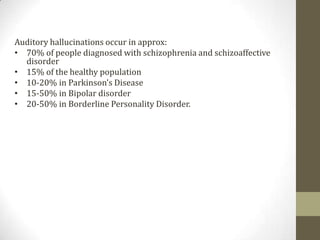
Auditory hallucinations occur in approx:
• 70% of people diagnosed with schizophrenia and schizoaffective
  disorder
• 15% of the healthy population
• 10-20% in Parkinson’s Disease
• 15-50% in Bipolar disorder
• 20-50% in Borderline Personality Disorder.
Some questions of interest:
i) Are the brain mechanisms underlying auditory hallucinations similar, or
different, across diagnostic groups?
ii) Which brain mechanisms are specific to auditory hallucinations, and
independent of symptoms that commonly co-occur with auditory
hallucinations?
Cognitive processes
Auditory Hallucinations in schizophrenia and schizoaffective disorder
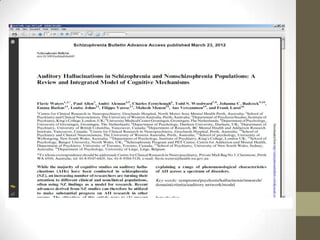
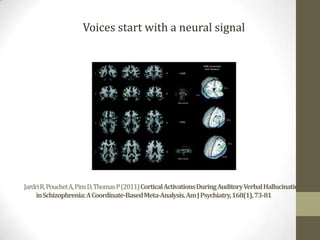
Voices start with a neural signal


Jardri R, Pouchet A, Pins D, Thomas P (2011) Cortical Activations During Auditory Verbal Hallucinations
     in Schizophrenia: A Coordinate-Based Meta-Analysis. Am J Psychiatry, 168(1), 73-81
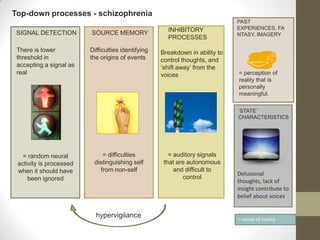
Top-down processes - schizophrenia
                                                                              PAST
                                                      INHIBITORY              EXPERIENCES, FA
 SIGNAL DETECTION        SOURCE MEMORY                                        NTASY, IMAGERY
                                                      PROCESSES

 There is lower          Difficulties identifying   Breakdown in ability to
 threshold in            the origins of events      control thoughts, and
 accepting a signal as                              ‘shift away’ from the
 real                                               voices                    = perception of
                                                                              reality that is
                                                                              personally
                                                                              meaningful.

                                                                              ‘STATE’
                                                                              CHARACTERISTICS


   = random neural           = difficulties            = auditory signals
 activity is processed    distinguishing self        that are autonomous
 when it should have        from non-self                and difficult to
                                                                              Delusional
     been ignored                                           control
                                                                              thoughts, lack of
                                                                              insight contribute to
                                                                              belief about voices


                           hypervigilance                                     = sense of reality
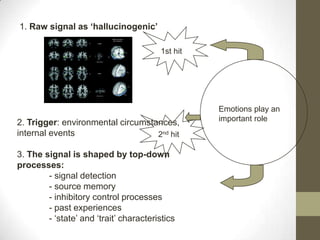
1. Raw signal as ‘hallucinogenic’

                                        1st hit


                                                  Emotions play an
                                                  important role
2. Trigger: environmental circumstances,
internal events                    2nd hit

3. The signal is shaped by top-down
processes:
        - signal detection
        - source memory
        - inhibitory control processes
        - past experiences
        - ‘state’ and ‘trait’ characteristics
Cognitive processes
Auditory Hallucinations in other population groups
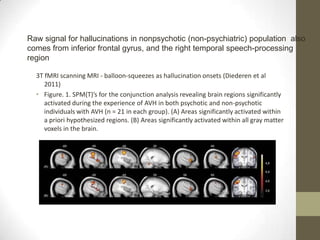
Raw signal for hallucinations in nonpsychotic (non-psychiatric) population also
comes from inferior frontal gyrus, and the right temporal speech-processing
region

  3T fMRI scanning MRI - balloon-squeezes as hallucination onsets (Diederen et al
     2011)
  • Figure. 1. SPM(T)’s for the conjunction analysis revealing brain regions significantly
     activated during the experience of AVH in both psychotic and non-psychotic
     individuals with AVH (n = 21 in each group). (A) Areas significantly activated within
     a priori hypothesized regions. (B) Areas significantly activated within all gray matter
     voxels in the brain.
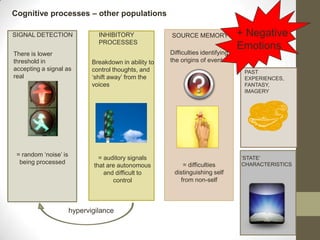
Cognitive processes – other populations

SIGNAL DETECTION                INHIBITORY              SOURCE MEMORY              + Negative
                                PROCESSES
                                                                                   Emotions
There is lower                                          Difficulties identifying
threshold in                  Breakdown in ability to   the origins of events
accepting a signal as         control thoughts, and                                 PAST
real                          ‘shift away’ from the                                 EXPERIENCES,
                              voices                                                FANTASY,
                                                                                    IMAGERY


 = random ‘noise’ is
                                = auditory signals                                 ‘STATE’
  being processed                                           = difficulties         CHARACTERISTICS
                              that are autonomous
                                  and difficult to       distinguishing self
                                     control               from non-self


                       hypervigilance

Flavie Waters Presentation - SRF Webinar Sep 13, 2012

  • 1.
    Multidisciplinary approaches tounderstanding auditory hallucinations Flavie Waters – University of Western Australia, Perth Paul Allen – Institute of Psychiatry, London Judith Ford – University of California, San Francisco Iris Sommer - University Medical Center Utrecht WEBINAR THURSDAY, 13 SEPTEMBER 2012 AT 10 A.M., EST (2 P.M., GMT). WWW.SCHIZOPHRENIAFORUM.ORG
  • 2.
    • World HearingVoices Day - Friday 14 September 2012 • International Consortium on Hallucination Research - http://hallucinationconsortium.org/ • 1st meeting: 13 September 2011 • 2nd meeting: September 2013
  • 3.
    Auditory hallucinations occurin approx: • 70% of people diagnosed with schizophrenia and schizoaffective disorder • 15% of the healthy population • 10-20% in Parkinson’s Disease • 15-50% in Bipolar disorder • 20-50% in Borderline Personality Disorder.
  • 4.
    Some questions ofinterest: i) Are the brain mechanisms underlying auditory hallucinations similar, or different, across diagnostic groups? ii) Which brain mechanisms are specific to auditory hallucinations, and independent of symptoms that commonly co-occur with auditory hallucinations?
  • 6.
    Cognitive processes Auditory Hallucinationsin schizophrenia and schizoaffective disorder
  • 7.
    Voices start witha neural signal Jardri R, Pouchet A, Pins D, Thomas P (2011) Cortical Activations During Auditory Verbal Hallucinations in Schizophrenia: A Coordinate-Based Meta-Analysis. Am J Psychiatry, 168(1), 73-81
  • 8.
    Top-down processes -schizophrenia PAST INHIBITORY EXPERIENCES, FA SIGNAL DETECTION SOURCE MEMORY NTASY, IMAGERY PROCESSES There is lower Difficulties identifying Breakdown in ability to threshold in the origins of events control thoughts, and accepting a signal as ‘shift away’ from the real voices = perception of reality that is personally meaningful. ‘STATE’ CHARACTERISTICS = random neural = difficulties = auditory signals activity is processed distinguishing self that are autonomous when it should have from non-self and difficult to Delusional been ignored control thoughts, lack of insight contribute to belief about voices hypervigilance = sense of reality
  • 9.
    1. Raw signalas ‘hallucinogenic’ 1st hit Emotions play an important role 2. Trigger: environmental circumstances, internal events 2nd hit 3. The signal is shaped by top-down processes: - signal detection - source memory - inhibitory control processes - past experiences - ‘state’ and ‘trait’ characteristics
  • 10.
  • 11.
    Raw signal forhallucinations in nonpsychotic (non-psychiatric) population also comes from inferior frontal gyrus, and the right temporal speech-processing region 3T fMRI scanning MRI - balloon-squeezes as hallucination onsets (Diederen et al 2011) • Figure. 1. SPM(T)’s for the conjunction analysis revealing brain regions significantly activated during the experience of AVH in both psychotic and non-psychotic individuals with AVH (n = 21 in each group). (A) Areas significantly activated within a priori hypothesized regions. (B) Areas significantly activated within all gray matter voxels in the brain.
  • 12.
    Cognitive processes –other populations SIGNAL DETECTION INHIBITORY SOURCE MEMORY + Negative PROCESSES Emotions There is lower Difficulties identifying threshold in Breakdown in ability to the origins of events accepting a signal as control thoughts, and PAST real ‘shift away’ from the EXPERIENCES, voices FANTASY, IMAGERY = random ‘noise’ is = auditory signals ‘STATE’ being processed = difficulties CHARACTERISTICS that are autonomous and difficult to distinguishing self control from non-self hypervigilance