WebJobs & Azure Functions in
modern and Serverless applications
Paris Polyzos
Software Engineer at ZuluTrade Inc
Microsoft Azure MVP
Paris Polyzos
Senior Software
Engineer
Microsoft Azure MVP
@ppolyzos
ppolyzos.com
AzureHeads.gr
ns 2016The ZuluTrade Group
WebJobs, Azure Functions in modern Serverless applications
Goals
3
• What,	when	and	how	to	use	the	“Functions”	
programming	model
• WebJobs	Overview
• Serverless	Computing
• Azure	Functions	Overview
WebJobs, Azure Functions in modern Serverless applications
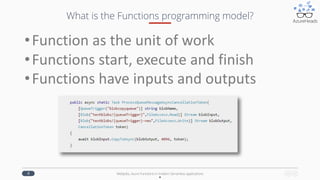
What is the Functions programming model?
4
•Function	as	the	unit	of	work
•Functions	start,	execute	and	finish
•Functions	have	inputs	and	outputs
WebJobs, Azure Functions in modern Serverless applications
Best Practices
5
Functions	should:	
• do	one	thing
• be	idempotent
• finish	as	quickly	as	possible
WebJobs, Azure Functions in modern Serverless applications
How and when to use them?
6
Questions:
1. What	is	that	you	want	to	do?
2. What	triggers	the	function?
3. Do	I	need	additional	data?
4. Is	there	output	I	should	produce?
Conclude:
“When	__,	get	__,	do	__,	and	output	__”.
WebJobs, Azure Functions in modern Serverless applications
Azure WebJobs
7
“Azure	WebJobs	provide	an	easy	way	to	run	scripts	or	
programs,	on	demand,	continuously	or	on	a	schedule,	as	
background	processes	on	App	Service	Web	Apps.”
WebJobs	SDK provide	bindings	and	trigger	system	which	
works	with	Storage	Blobs,	Queues,	Tables,	Service	Bus.
WebJobs	Extensions
WebJobs, Azure Functions in modern Serverless applications
WebJobs Demo
8
DEMO
WebJobs, Azure Functions in modern Serverless applications
Serverless Computing
9
“Serverless architectures refer to applications that
significantly depend on third-party services (knows as
Backend as a Service or "BaaS") or on custom code that's
run in ephemeral containers (Function as a Service or
"FaaS")”
Martin Fowler
Benefits
• Reduced	Operational	&	Development	Costs
• Fast	and	easy	Scaling
• Reduced	Packaging	&	Deployment	
Complexity
• Easy	scheduling	&	event	processing
• Reduced	time	to	market	/	Experimentation
Drawbacks
• Vendor	control
• Execution	Duration
• Unit	Testing
• Limited	Tooling
WebJobs, Azure Functions in modern Serverless applications
Azure Functions
10
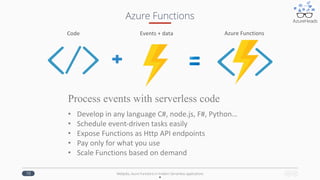
Process events with serverless code
• Develop	in	any	language	C#,	node.js,	F#,	Python…
• Schedule	event-driven	tasks	easily
• Expose	Functions	as	Http	API	endpoints
• Pay	only	for	what	you	use
• Scale	Functions	based	on	demand
WebJobs, Azure Functions in modern Serverless applications
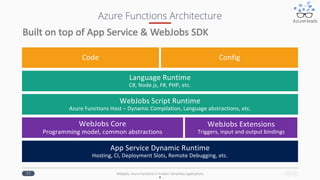
Azure Functions Architecture
11
Built	on	top	of	App	Service	&	WebJobs	SDK
WebJobs, Azure Functions in modern Serverless applications
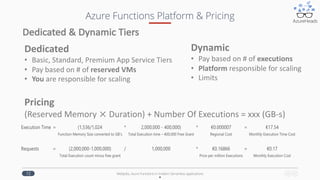
Azure Functions Platform & Pricing
12
Dedicated	&	Dynamic	Tiers
Dedicated
• Basic,	Standard,	Premium	App	Service	Tiers
• Pay	based	on	#	of	reserved	VMs
• You are	responsible	for	scaling
Dynamic
• Pay	based	on	#	of	executions
• Platform	responsible	for	scaling
• Limits
Pricing
(Reserved	Memory	✕ Duration)	+	Number	Of	Executions	=	xxx	(GB-s)
WebJobs, Azure Functions in modern Serverless applications
Azure Functions
13
DEMO
WebJobs, Azure Functions in modern Serverless applications
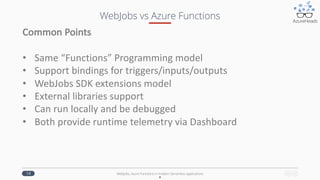
WebJobs vs Azure Functions
14
Common	Points
• Same	“Functions”	Programming	model
• Support	bindings	for	triggers/inputs/outputs
• WebJobs	SDK	extensions	model
• External	libraries	support
• Can	run	locally	and	be	debugged
• Both	provide	runtime	telemetry	via	Dashboard
WebJobs, Azure Functions in modern Serverless applications
WebJobs vs Azure Functions
15
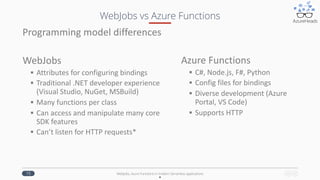
Programming	model	differences
WebJobs
§ Attributes	for	configuring	bindings
§ Traditional	.NET	developer	experience	
(Visual	Studio,	NuGet,	MSBuild)
§ Many	functions	per	class
§ Can	access	and	manipulate	many	core	
SDK	features
§ Can’t	listen	for	HTTP	requests*
Azure	Functions
§ C#,	Node.js,	F#,	Python
§ Config files	for	bindings
§ Diverse	development	(Azure	
Portal,	VS	Code)
§ Supports	HTTP
WebJobs, Azure Functions in modern Serverless applications
WebJobs vs Azure Functions
16
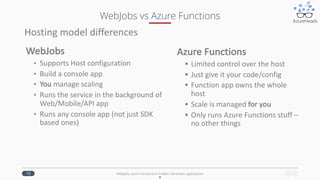
Hosting	model	differences
WebJobs
• Supports	Host	configuration
• Build	a	console	app
• You manage	scaling
• Runs	the	service	in	the	background	of	
Web/Mobile/API	app
• Runs	any	console	app	(not	just	SDK	
based	ones)
Azure	Functions
§ Limited	control	over	the	host
§ Just	give	it	your	code/config
§ Function	app	owns	the	whole	
host
§ Scale	is	managed	for	you
§ Only	runs	Azure	Functions	stuff	–
no	other	things
Thank You
https://azure.microsoft.com/en-us/documentation/articles/websites-webjobs-resources/
https://azure.microsoft.com/en-gb/services/functions/
www.azureheads.gr
www.ppolyzos.com
WebJobs, Azure Functions in modern Serverless applications
Supported Bindings
18
Type Service Trigger	 Input Output
Schedule Azure	Functions ✔
HTTP (REST	or	WebHook) Azure	Functions ✔ ✔
Blob	Storage Azure	Storage ✔ ✔ ✔
Queues Azure	Storage ✔ ✔
Tables Azure	Storage ✔ ✔
Tables Azure	Mobile	Apps	Easy	
Tables
✔ ✔
No-SQL	DB Azure DocumentDB ✔ ✔
Streams Azure	EventHubs ✔ ✔
Push	Notifications Azure	Notification Hubs ✔
SaaS Twillio,	SendGrid
(experimental)
✔

Web jobs, Azure Functions and Serverless Computing

  • 1.
    WebJobs & AzureFunctions in modern and Serverless applications Paris Polyzos Software Engineer at ZuluTrade Inc Microsoft Azure MVP
  • 2.
    Paris Polyzos Senior Software Engineer MicrosoftAzure MVP @ppolyzos ppolyzos.com AzureHeads.gr ns 2016The ZuluTrade Group
  • 3.
    WebJobs, Azure Functionsin modern Serverless applications Goals 3 • What, when and how to use the “Functions” programming model • WebJobs Overview • Serverless Computing • Azure Functions Overview
  • 4.
    WebJobs, Azure Functionsin modern Serverless applications What is the Functions programming model? 4 •Function as the unit of work •Functions start, execute and finish •Functions have inputs and outputs
  • 5.
    WebJobs, Azure Functionsin modern Serverless applications Best Practices 5 Functions should: • do one thing • be idempotent • finish as quickly as possible
  • 6.
    WebJobs, Azure Functionsin modern Serverless applications How and when to use them? 6 Questions: 1. What is that you want to do? 2. What triggers the function? 3. Do I need additional data? 4. Is there output I should produce? Conclude: “When __, get __, do __, and output __”.
  • 7.
    WebJobs, Azure Functionsin modern Serverless applications Azure WebJobs 7 “Azure WebJobs provide an easy way to run scripts or programs, on demand, continuously or on a schedule, as background processes on App Service Web Apps.” WebJobs SDK provide bindings and trigger system which works with Storage Blobs, Queues, Tables, Service Bus. WebJobs Extensions
  • 8.
    WebJobs, Azure Functionsin modern Serverless applications WebJobs Demo 8 DEMO
  • 9.
    WebJobs, Azure Functionsin modern Serverless applications Serverless Computing 9 “Serverless architectures refer to applications that significantly depend on third-party services (knows as Backend as a Service or "BaaS") or on custom code that's run in ephemeral containers (Function as a Service or "FaaS")” Martin Fowler Benefits • Reduced Operational & Development Costs • Fast and easy Scaling • Reduced Packaging & Deployment Complexity • Easy scheduling & event processing • Reduced time to market / Experimentation Drawbacks • Vendor control • Execution Duration • Unit Testing • Limited Tooling
  • 10.
    WebJobs, Azure Functionsin modern Serverless applications Azure Functions 10 Process events with serverless code • Develop in any language C#, node.js, F#, Python… • Schedule event-driven tasks easily • Expose Functions as Http API endpoints • Pay only for what you use • Scale Functions based on demand
  • 11.
    WebJobs, Azure Functionsin modern Serverless applications Azure Functions Architecture 11 Built on top of App Service & WebJobs SDK
  • 12.
    WebJobs, Azure Functionsin modern Serverless applications Azure Functions Platform & Pricing 12 Dedicated & Dynamic Tiers Dedicated • Basic, Standard, Premium App Service Tiers • Pay based on # of reserved VMs • You are responsible for scaling Dynamic • Pay based on # of executions • Platform responsible for scaling • Limits Pricing (Reserved Memory ✕ Duration) + Number Of Executions = xxx (GB-s)
  • 13.
    WebJobs, Azure Functionsin modern Serverless applications Azure Functions 13 DEMO
  • 14.
    WebJobs, Azure Functionsin modern Serverless applications WebJobs vs Azure Functions 14 Common Points • Same “Functions” Programming model • Support bindings for triggers/inputs/outputs • WebJobs SDK extensions model • External libraries support • Can run locally and be debugged • Both provide runtime telemetry via Dashboard
  • 15.
    WebJobs, Azure Functionsin modern Serverless applications WebJobs vs Azure Functions 15 Programming model differences WebJobs § Attributes for configuring bindings § Traditional .NET developer experience (Visual Studio, NuGet, MSBuild) § Many functions per class § Can access and manipulate many core SDK features § Can’t listen for HTTP requests* Azure Functions § C#, Node.js, F#, Python § Config files for bindings § Diverse development (Azure Portal, VS Code) § Supports HTTP
  • 16.
    WebJobs, Azure Functionsin modern Serverless applications WebJobs vs Azure Functions 16 Hosting model differences WebJobs • Supports Host configuration • Build a console app • You manage scaling • Runs the service in the background of Web/Mobile/API app • Runs any console app (not just SDK based ones) Azure Functions § Limited control over the host § Just give it your code/config § Function app owns the whole host § Scale is managed for you § Only runs Azure Functions stuff – no other things
  • 17.
  • 18.
    WebJobs, Azure Functionsin modern Serverless applications Supported Bindings 18 Type Service Trigger Input Output Schedule Azure Functions ✔ HTTP (REST or WebHook) Azure Functions ✔ ✔ Blob Storage Azure Storage ✔ ✔ ✔ Queues Azure Storage ✔ ✔ Tables Azure Storage ✔ ✔ Tables Azure Mobile Apps Easy Tables ✔ ✔ No-SQL DB Azure DocumentDB ✔ ✔ Streams Azure EventHubs ✔ ✔ Push Notifications Azure Notification Hubs ✔ SaaS Twillio, SendGrid (experimental) ✔