WEB DESIGNING
AND
DEVELOPMENT
TOPICS
Introduction to Web Designing.
Web Trends.
Basic CSS and Workshop.
 Bonus Topic: Doing business
with web development.
What is web designing?
Web Designing is the process of
building and maintaining websites. Web
Designing includes different aspects
like Front End coding, website
wireframe, website layout design, color
combinations, fonts, graphic design,
webpage interactions etc.
What is Web Development?
Web development broadly refers to the
tasks associated with developing websites
for hosting via intranet or internet. The web
development process includes web
design, web content development, client-
side/server-side scripting and network
security configuration, among other tasks.
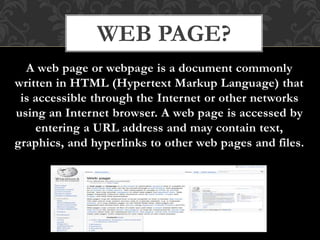
A web page or webpage is a document commonly
written in HTML (Hypertext Markup Language) that
is accessible through the Internet or other networks
using an Internet browser. A web page is accessed by
entering a URL address and may contain text,
graphics, and hyperlinks to other web pages and files.
WEB PAGE?
Basically there are two types of
web pages:
 Static Web Page
Dynamic Web Page
TYPES OF PAGES
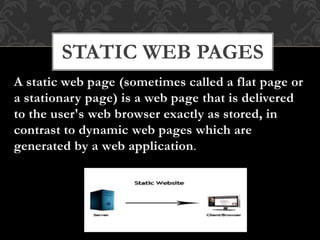
A static web page (sometimes called a flat page or
a stationary page) is a web page that is delivered
to the user's web browser exactly as stored, in
contrast to dynamic web pages which are
generated by a web application.
STATIC WEB PAGES
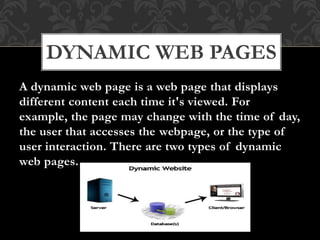
A dynamic web page is a web page that displays
different content each time it's viewed. For
example, the page may change with the time of day,
the user that accesses the webpage, or the type of
user interaction. There are two types of dynamic
web pages.
DYNAMIC WEB PAGES
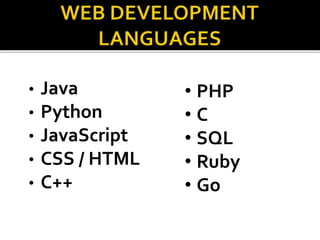
• Java
• Python
• JavaScript
• CSS / HTML
• C++
• PHP
• C
• SQL
• Ruby
• Go
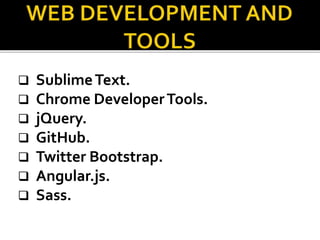
 SublimeText.
 Chrome DeveloperTools.
 jQuery.
 GitHub.
 Twitter Bootstrap.
 Angular.js.
 Sass.
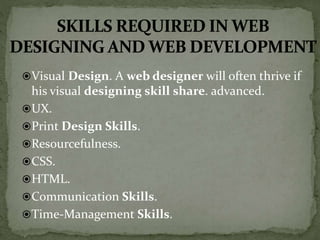
Visual Design. A web designer will often thrive if
his visual designing skill share. advanced.
UX.
Print Design Skills.
Resourcefulness.
CSS.
HTML.
Communication Skills.
Time-Management Skills.
HTML 5
JAVA SCRIPT
CSS & CSS 3
WEB PAGE CREATION
WORK ON LIVE PROJECTS
DREAM WEAVER NOTEPAD++
HTML5 is the latest version of Hypertext
Markup Language, the code that
describes web pages. It's actually three
kinds of code: HTML, which provides
the structure; Cascading Style Sheets
(CSS), which take care
of presentation; and JavaScript,
 which makes things happen.
 JavaScript is a programming language that can
be included on web pages to make them more
interactive. ... JavaScript is a client side,
interpreted, object oriented, high level scripting
language, while Java is a client side, compiled,
object oriented high level language.
 CSS stands for Cascading Style
Sheets. CSS describes how HTML elements are to
be displayed on screen, paper, or in other
media. CSS saves a lot of work. It can control the
layout of multiple web pages all at once. External
style sheets are stored in CSS files.
 CSS3 is the latest evolution of the Cascading Style
Sheets language and aims at extending CSS2.1. It
brings a lot of long-awaited novelties, like rounded
corners, shadows, gradients, transitions or
animations, as well as new layouts like multi-
columns, flexible box or grid layouts.
Basic Web Page Creation. ... Web
pages are built using HTML (Hyper Text
Markup Language). The technology for this
has been around long before there
were web pages or even the Internet so it's
not really unique to the Web. A Markup
Language is simply inserting special
symbols into a body of text to give it some
formatting.
Live projects are projects that can be
worked on in real-time and with a defined
deadline. These projects provide a hands-
on experience on any ongoing work in a
company. A live project can be called as an
internship or training because a student
can gain real work expertise before getting
a full-time job.
 Combined with an array of site management tools,
Dreamweaver allows for its users to design, code and
manage websites, as well as mobile content.
Dreamweaver is an Integrated Development
Environment (IDE) tool. You can live preview of
changes for the frontend
 An HTML document is a plain text file that can be
created or modified with any word processing
program that can handle text. ... A much better plan
though is to use, Notepad because it is a very simple
text editor that you will find easy to use for editing
your HTML documents.
Web design encompasses many different
skills and disciplines in the production
and maintenance of websites. The
different areas of web
design include web graphic design;
interface design; authoring, including
standardized code and proprietary
software; user experience design; and
search engine optimization.
USE OF WEB DESIGNING
Web apps are developed
with programming languages such as
HTML and CSS, which are well known
among IT professionals. Unlike native
apps, a single web app is able to reach
out to all devices. It's programmed to run
on any operating system.
USE OF WEB DEVELOPMENT
ANY QUERY?
THANK
YOU

Web designing and development

  • 1.
  • 2.
    TOPICS Introduction to WebDesigning. Web Trends. Basic CSS and Workshop.  Bonus Topic: Doing business with web development.
  • 3.
    What is webdesigning? Web Designing is the process of building and maintaining websites. Web Designing includes different aspects like Front End coding, website wireframe, website layout design, color combinations, fonts, graphic design, webpage interactions etc.
  • 4.
    What is WebDevelopment? Web development broadly refers to the tasks associated with developing websites for hosting via intranet or internet. The web development process includes web design, web content development, client- side/server-side scripting and network security configuration, among other tasks.
  • 5.
    A web pageor webpage is a document commonly written in HTML (Hypertext Markup Language) that is accessible through the Internet or other networks using an Internet browser. A web page is accessed by entering a URL address and may contain text, graphics, and hyperlinks to other web pages and files. WEB PAGE?
  • 6.
    Basically there aretwo types of web pages:  Static Web Page Dynamic Web Page TYPES OF PAGES
  • 7.
    A static webpage (sometimes called a flat page or a stationary page) is a web page that is delivered to the user's web browser exactly as stored, in contrast to dynamic web pages which are generated by a web application. STATIC WEB PAGES
  • 8.
    A dynamic webpage is a web page that displays different content each time it's viewed. For example, the page may change with the time of day, the user that accesses the webpage, or the type of user interaction. There are two types of dynamic web pages. DYNAMIC WEB PAGES
  • 9.
    • Java • Python •JavaScript • CSS / HTML • C++ • PHP • C • SQL • Ruby • Go
  • 10.
     SublimeText.  ChromeDeveloperTools.  jQuery.  GitHub.  Twitter Bootstrap.  Angular.js.  Sass.
  • 11.
    Visual Design. Aweb designer will often thrive if his visual designing skill share. advanced. UX. Print Design Skills. Resourcefulness. CSS. HTML. Communication Skills. Time-Management Skills.
  • 12.
    HTML 5 JAVA SCRIPT CSS& CSS 3 WEB PAGE CREATION WORK ON LIVE PROJECTS DREAM WEAVER NOTEPAD++
  • 13.
    HTML5 is thelatest version of Hypertext Markup Language, the code that describes web pages. It's actually three kinds of code: HTML, which provides the structure; Cascading Style Sheets (CSS), which take care of presentation; and JavaScript,  which makes things happen.
  • 14.
     JavaScript isa programming language that can be included on web pages to make them more interactive. ... JavaScript is a client side, interpreted, object oriented, high level scripting language, while Java is a client side, compiled, object oriented high level language.
  • 15.
     CSS standsfor Cascading Style Sheets. CSS describes how HTML elements are to be displayed on screen, paper, or in other media. CSS saves a lot of work. It can control the layout of multiple web pages all at once. External style sheets are stored in CSS files.  CSS3 is the latest evolution of the Cascading Style Sheets language and aims at extending CSS2.1. It brings a lot of long-awaited novelties, like rounded corners, shadows, gradients, transitions or animations, as well as new layouts like multi- columns, flexible box or grid layouts.
  • 16.
    Basic Web PageCreation. ... Web pages are built using HTML (Hyper Text Markup Language). The technology for this has been around long before there were web pages or even the Internet so it's not really unique to the Web. A Markup Language is simply inserting special symbols into a body of text to give it some formatting.
  • 17.
    Live projects areprojects that can be worked on in real-time and with a defined deadline. These projects provide a hands- on experience on any ongoing work in a company. A live project can be called as an internship or training because a student can gain real work expertise before getting a full-time job.
  • 18.
     Combined withan array of site management tools, Dreamweaver allows for its users to design, code and manage websites, as well as mobile content. Dreamweaver is an Integrated Development Environment (IDE) tool. You can live preview of changes for the frontend  An HTML document is a plain text file that can be created or modified with any word processing program that can handle text. ... A much better plan though is to use, Notepad because it is a very simple text editor that you will find easy to use for editing your HTML documents.
  • 19.
    Web design encompassesmany different skills and disciplines in the production and maintenance of websites. The different areas of web design include web graphic design; interface design; authoring, including standardized code and proprietary software; user experience design; and search engine optimization. USE OF WEB DESIGNING
  • 20.
    Web apps aredeveloped with programming languages such as HTML and CSS, which are well known among IT professionals. Unlike native apps, a single web app is able to reach out to all devices. It's programmed to run on any operating system. USE OF WEB DEVELOPMENT
  • 21.
  • 22.