Taking advantage of Web 2.0 to grow your business Sandeep Bakhshi ASEAN Business Unit Executive, Lotus Software Singapore Digital Media Festival – October 2008
What is Web 2.0?  Why should care about it? Some Industry examples Putting it all together Summary Topics
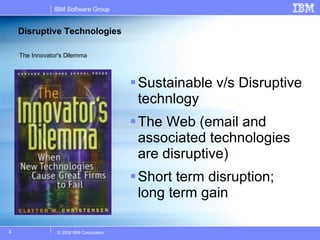
Disruptive Technologies Sustainable v/s Disruptive technlogy The Web (email and associated technologies are disruptive) Short term disruption; long term gain The Innovator's Dilemma
Disruptive Innovation: The Internet, the Web, e-business
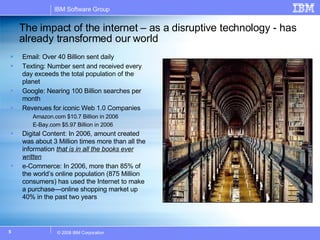
The impact of the internet – as a disruptive technology - has already transformed our world Email: Over 40 Billion sent daily Texting: Number sent and received every day exceeds the total population of the planet Google: Nearing 100 Billion searches per month Revenues for iconic Web 1.0 Companies  Amazon.com $10.7 Billion in 2006 E-Bay.com $5.97 Billion in 2006 Digital Content: In 2006, amount created was about 3 Million times more than all the information  that is in all the books ever written e-Commerce: In 2006, more than 85% of the world’s online population (875 Million consumers) has used the Internet to make a purchase—online shopping market up 40% in the past two years
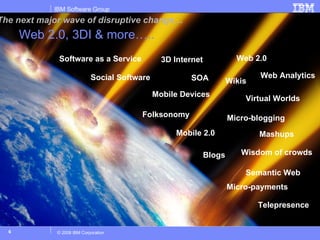
Web 2.0, 3DI & more….. Web 2.0 Virtual Worlds SOA Mashups Mobile Devices Social Software Blogs Folksonomy Web Analytics Software as a Service Wikis Mobile 2.0 3D Internet Telepresence The next major wave of disruptive change… Wisdom of crowds Micro-blogging Semantic Web  Micro-payments
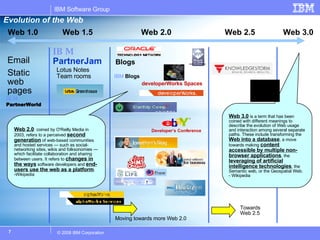
IBM   PartnerJam Web 1.0 Web 1.5 Web 2.0 Web 2.5 Web 3.0 IBM   PartnerWorld Email Static web pages Evolution of the Web Moving towards more Web 2.0 Towards Web 2.5 Web 2.0 : coined by O'Reilly Media in 2003, refers to a perceived  second generation  of web-based communities and hosted services — such as social-networking sites, wikis and folksonomies — which facilitate collaboration and sharing between users. It refers to  changes in the ways  software developers and  end-users use the web as a platform . -Wikipedia Web 3.0  is a term that has been coined with different meanings to describe the evolution of Web usage and interaction among several separate paths. These include transforming the  Web into a database , a move towards making  content accessible by multiple non-browser applications , the  leveraging of artificial intelligence technologies , the Semantic web, or the Geospatial Web. - Wikipedia Lotus Notes Team rooms COBRA IBM   Blogs developerWorks Spaces Developer’s Conference Blogs
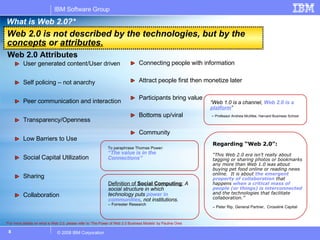
What is Web 2.0?* User generated content/User driven Self policing – not anarchy Peer communication and interaction Transparency/Openness Low Barriers to Use Social Capital Utilization Sharing Collaboration Connecting people with information Attract people first then monetize later Participants bring value Bottoms up/viral Community Web 2.0 is not described by the technologies, but by the  concepts  or  attributes. Definition of  Social Computing :   A social structure in which technology puts  power in communities , not institutions.  –  Forrester Research Web 2.0 Attributes *For more details on what is Web 2.0, please refer to ‘The Power of Web 2.0 Business Models’ by Pauline Ores To paraphrase Thomas Power: “ The value is in the Connections” “ Web 1.0 is a channel,  Web 2.0 is a  platform ” –  Professor Andrew McAfee, Harvard Business School Regarding “Web 2.0”:   “ This Web 2.0 era isn’t really about tagging or sharing photos or bookmarks any more than Web 1.0 was about buying pet food online or reading news online.  It is   about  the emergent property of collaboration  that happens  when a critical mass of people (or things) is interconnected  and the technologies that facilitate collaboration.” –  Peter Rip, General Partner,  Crosslink Capital
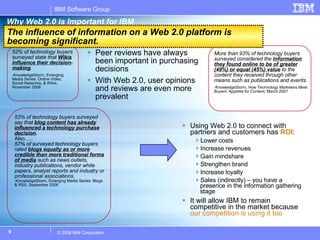
Why Web 2.0 is Important for IBM Using Web 2.0 to connect with partners and customers has  ROI : Lower costs Increase revenues Gain mindshare Strengthen brand Increase loyalty Sales (indirectly) – you have a presence in the information gathering stage It will allow IBM to remain competitive in the market because  our competition is using it too The influence of information on a Web 2.0 platform is becoming significant. Peer reviews have always been important in purchasing decisions With Web 2.0, user opinions and reviews are even more prevalent 52% of technology buyers surveyed state  that  Wikis influence their decision-making .   -KnowledgeStorm, Emerging Media Series: Online Video, Social Networks, & Wikis, November 2006 53% of technology buyers surveyed say that   blog content has already influenced a technology purchase decision .  Also….. 57% of surveyed technology buyers  rated  blogs equally as or more credible than more traditional forms of media   such as news outlets, industry publications, vendor white papers, analyst reports and industry or professional associations. -KnowledgeStorm, Emerging Media Series: Blogs & RSS, September 2006 More than 93% of technology buyers  surveyed considered the  information they found online to be of greater (49%) or equal (45%) value  to the content they received through other means such as publications and events. -KnowledgeStorm, How Technology Marketers Meet Buyers’ Appetite for Content, March 2007
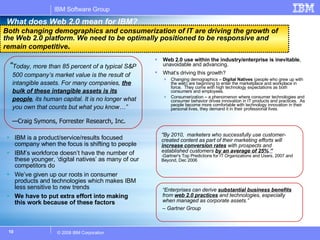
What does Web 2.0 mean for IBM? Web 2.0 use within the industry/enterprise is inevitable ,  unavoidable and advancing. What’s driving this growth?   Changing demographics –  Digital Natives  (people who grew up with the web) are beginning to enter the marketplace and workplace in force.  They come with high technology expectations as both consumers and employees. Consumerization – a phenomenon where consumer technologies and consumer behavior drives innovation in IT products and practices.  As people become more comfortable with technology innovation in their personal lives, they demand it in their professional lives. Both changing demographics and consumerization of IT are driving the growth of the Web 2.0 platform. We need to be optimally positioned to be responsive and remain competitive .  IBM is a product/service/results focused company when the focus is shifting to people IBM’s workforce doesn’t have the number of these younger, ‘digital natives’ as many of our competitors do We’ve given up our roots in consumer products and technologies which makes IBM less sensitive to new trends We have to put extra effort into making this work because of these factors “ Today, more than 85 percent of a typical S&P 500 company’s market value is the result of intangible assets. For many companies,  the bulk of these intangible assets is its people , its human capital. It is no longer what you own that counts but what you know…”  — Craig Symons, Forrester Research, Inc. "By 2010,  marketers who successfully use customer-created content as part of their marketing efforts will  increase conversion rates   with prospects and established customers  by an average of 25% . ” - Gartner's Top Predictions for IT Organizations and Users, 2007 and Beyond, Dec 2006 “ Enterprises can derive  substantial business benefits  from  web 2.0 practices   and technologies, especially when managed as corporate assets.”  –  Gartner Group
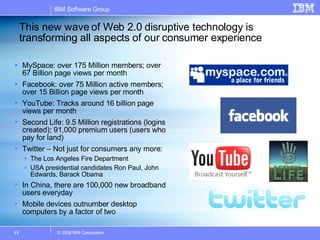
This new wave of Web 2.0 disruptive technology is transforming all aspects of our consumer experience MySpace: over 175 Million members; over 67 Billion page views per month Facebook: over 75 Million active members; over 15 Billion page views per month YouTube: Tracks around 16 billion page views per month Second Life: 9.5 Million registrations (logins created); 91,000 premium users (users who pay for land) Twitter – Not just for consumers any more: The Los Angeles Fire Department  USA presidential candidates Ron Paul, John Edwards, Barack Obama  In China, there are 100,000 new broadband users everyday Mobile devices outnumber desktop computers by a factor of two
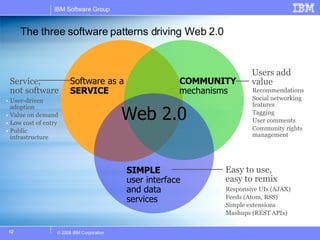
The three software patterns driving Web 2.0 Web 2.0 User-driven adoption Value on demand Low cost of entry Public infrastructure Software as a SERVICE Service,  not software COMMUNITY mechanisms Recommendations Social networking features Tagging User comments Community rights management Users add value SIMPLE user interface  and data services Responsive UIs (AJAX) Feeds (Atom, RSS) Simple extensions Mashups (REST APIs) Easy to use,  easy to remix
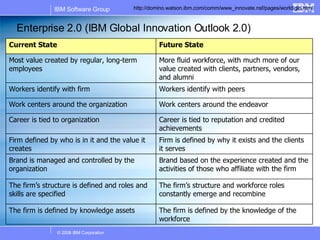
Enterprise 2.0 (IBM Global Innovation Outlook 2.0) http://domino.watson.ibm.com/comm/www_innovate.nsf/pages/world.gio.html Current State Future State Most value created by regular, long-term employees More fluid workforce, with much more of our value created with clients, partners, vendors, and alumni Workers identify with firm Workers identify with peers Work centers around the organization Work centers around the endeavor Career is tied to organization Career is tied to reputation and credited achievements Firm defined by who is in it and the value it creates Firm is defined by why it exists and the clients it serves Brand is managed and controlled by the organization Brand based on the experience created and the activities of those who affiliate with the firm The firm’s structure is defined and roles and skills are specified The firm’s structure and workforce roles constantly emerge and recombine The firm is defined by knowledge assets The firm is defined by the knowledge of the workforce
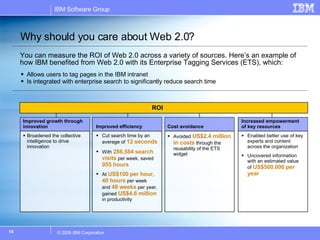
Why should you care about Web 2.0? You can measure the ROI of Web 2.0 across a variety of sources. Here’s an example of how IBM benefited from Web 2.0 with its Enterprise Tagging Services (ETS), which: Allows users to tag pages in the IBM intranet Is integrated with enterprise search to significantly reduce search time ROI Improved growth through innovation Broadened the collective intelligence to drive innovation Improved efficiency Cut search time by an average of  12 seconds   With  286,584   search visits  per week, saved  955 hours At  US$100   per hour ,  40 hours  per week  and  48 weeks  per year, gained  US$4.6 million  in productivity Cost avoidance Avoided  US$2.4 million   in costs  through the reusability of the ETS widget Increased empowerment  of key resources Enabled better use of key experts and content across the organization Uncovered information with an estimated value of  US$500,000   per year
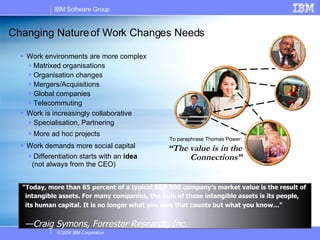
Changing Nature of Work Changes Needs Work environments are more complex Matrixed organisations Organisation changes Mergers/Acquisitions Global companies Telecommuting Work is increasingly collaborative Specialisation, Partnering More ad hoc projects Work demands more social capital Differentiation starts with an  idea (not always from the CEO) “ Today, more than 85 percent of a typical S&P 500 company’s market value is the result of intangible assets. For many companies, the bulk of these intangible assets is its people, its human capital. It is no longer what you own that counts but what you know…”   — Craig Symons, Forrester Research, Inc. To paraphrase Thomas Power: “ The value is in the Connections”
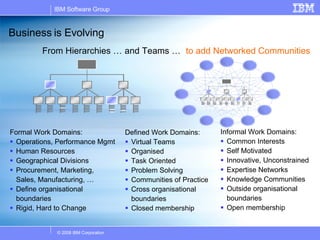
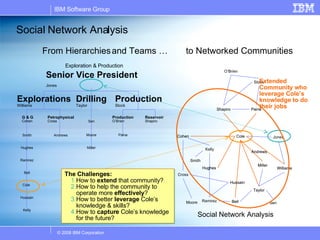
Business is Evolving Informal Work Domains: Common Interests Self Motivated Innovative, Unconstrained Expertise Networks Knowledge Communities Outside organisational boundaries Open membership Formal Work Domains: Operations, Performance Mgmt Human Resources Geographical Divisions Procurement,  Marketing, Sales, Manufacturing, … Define organisational boundaries Rigid, Hard to Change From Hierarchies … and Teams … to add Networked Communities Defined Work Domains: Virtual Teams Organised Task Oriented Problem Solving Communities of Practice Cross organisational boundaries Closed membership
Social Network Analysis Exploration & Production Explorations Williams Drilling Taylor Production Stock Senior Vice President Jones G & G Cohen Petrophysical Cross Production O’Brien Reservoir Shapiro Paine Smith Andrews Moore Hughes Miller Ramirez Bell Cole Hussain Kelly Sen From Hierarchies  and Teams … to Networked Communities Extended Community who leverage Cole’s knowledge to do their jobs The Challenges: How to  extend  that community? How to help the community to operate more  effectively ? How to better  leverage  Cole’s knowledge & skills? How to  capture  Cole’s knowledge for the future? Social Network Analysis Paine Smith Moore Hughes Miller Ramirez Bell Cole Hussain Kelly Sen Cohen Jones Cross Taylor Williams Shapiro O’Brien Stock Andrews Paine Hughes Miller Bell Cole Hussain Cohen Taylor Williams Shapiro Andrews
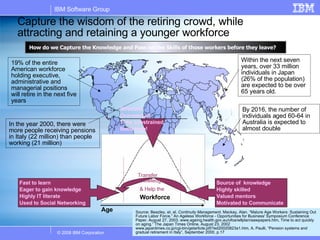
Capture the wisdom of the retiring crowd, while  attracting and retaining a younger workforce 19% of the entire American workforce holding executive, administrative and managerial positions will retire in the next five years Source: Beazley, et. al,  Continuity Management,  Mackay, Alan. “Mature Age Workers: Sustaining Out Future Labor Force.” An Ageless Workforce - Opportunities for Business' Symposium Conference Paper. August 27, 2003.  www.ageing.health.gov.au/ofoa/wllplan/aawpapers.htm , Time to act quickly on aging.” The Japan Times Online. August 23, 2002  www.japantimes.co.jp/cgi-bin/getarticle.pl5?ed20020823a1.htm , A. Paulli, “Pension systems and gradual retirement in Italy”, September 2000, p.17  In the year 2000, there were more people receiving pensions in Italy (22 million) than people working (21 million)  Within the next seven  years, over 33 million individuals in Japan (26% of the population) are expected to be over 65 years old.  By 2016, the number of individuals aged 60-64 in Australia is expected to almost double How do we Capture the Knowledge and Pass on the Skills of those workers before they leave? Fast to learn Eager to gain knowledge Highly IT literate Used to Social Networking Source of  knowledge Highly skilled Valued mentors Motivated to Communicate Stressed Overworked Time constrained Need Help! & Help the Age Workforce Transfer Knowledge
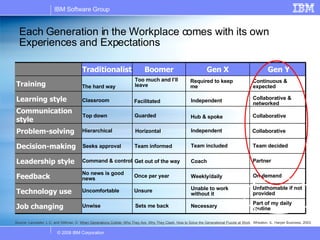
Each Generation in the Workplace comes with its own Experiences and Expectations Source: Lancaster, L.C. and Stillman, D.  When Generations Collide: Who They Are. Why They Clash. How to Solve the Generational Puzzle at Work .  Wheaton, IL. Harper Business, 2003. Classroom The hard way Top down Hierarchical Unwise Team informed Get out of the way Unsure Once per year Sets me back Seeks approval Command & control No news is good news Uncomfortable Too much and I’ll leave Hub & spoke Horizontal Coach Weekly/daily Unable to work without it Necessary Part of my daily routine Unfathomable if not provided On demand Partner Team decided Collaborative Collaborative Collaborative & networked Continuous & expected Facilitated Guarded Team included Independent Independent Required to keep me Traditionalist Boomer Gen X Gen Y Training  Learning style Communication style Problem-solving Decision-making Leadership style Feedback Technology use Job changing
INDUSTRY EXAMPLES Taking advantage of Web 2.0 to grow your business
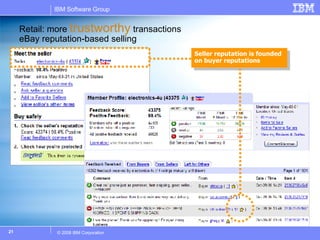
Retail: more  trustworthy  transactions eBay reputation-based selling Seller reputation is founded on buyer reputations
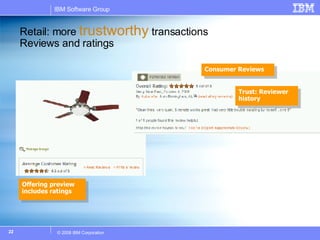
Retail: more  trustworthy  transactions Reviews and ratings Consumer Reviews Trust: Reviewer history Offering preview includes ratings
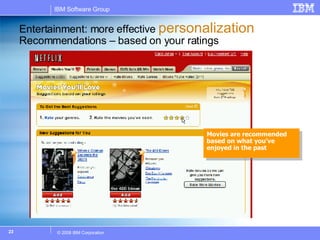
Entertainment: more effective  personalization Recommendations – based on your ratings Movies are recommended based on what you’ve enjoyed in the past
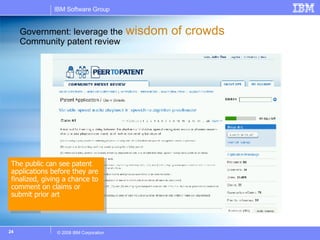
Government: leverage the   wisdom of crowds Community patent review The public can see patent applications before they are finalized, giving a chance to comment on claims or submit prior art
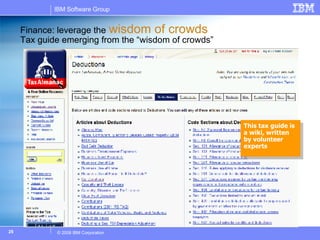
Finance: leverage the   wisdom of crowds  Tax guide emerging from the “wisdom of crowds” This tax guide is a wiki, written by volunteer experts
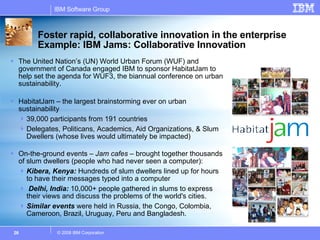
The United Nation’s (UN) World Urban Forum (WUF) and government of Canada engaged IBM to sponsor HabitatJam to help set the agenda for WUF3, the biannual conference on urban sustainability. HabitatJam – the largest brainstorming ever on urban sustainability 39,000 participants from 191 countries Delegates, Politicans, Academics, Aid Organizations, & Slum Dwellers (whose lives would ultimately be impacted) On-the-ground events –  Jam cafes  – brought together thousands of slum dwellers (people who had never seen a computer):  Kibera, Kenya:  Hundreds of slum dwellers lined up for hours to have their messages typed into a computer Delhi, India:  10,000+ people gathered in slums to express their views and discuss the problems of the world's cities. Similar events  were held in Russia, the Congo, Colombia, Cameroon, Brazil, Uruguay, Peru and Bangladesh. Foster rapid, collaborative innovation in the enterprise Example: IBM Jams: Collaborative Innovation
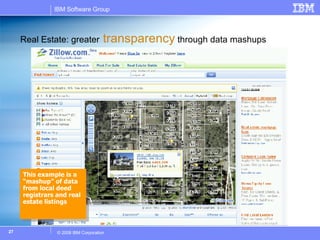
Real Estate: greater  transparency  through data mashups This example is a “mashup” of data from local deed registrars and real estate listings
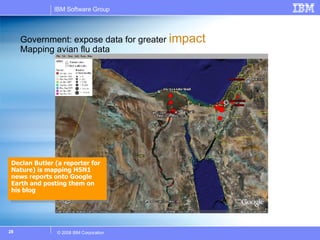
Government: expose data for greater  impact  Mapping avian flu data Declan Butler (a reporter for Nature) is mapping H5N1 news reports onto Google Earth and posting them on his blog
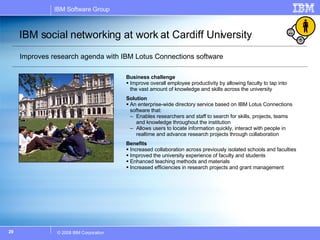
IBM social networking at work at Cardiff University   Improves research agenda with IBM Lotus Connections software Business challenge Improve overall employee productivity by allowing faculty to tap into  the vast amount of knowledge and skills across the university Solution An enterprise-wide directory service based on IBM Lotus Connections software that: Enables researchers and staff to search for skills, projects, teams  and knowledge throughout the institution Allows users to locate information quickly, interact with people in  realtime and advance research projects through collaboration Benefits Increased collaboration across previously isolated schools and faculties Improved the university experience of faculty and students Enhanced teaching methods and materials Increased efficiencies in research projects and grant management
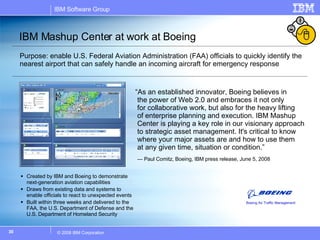
IBM Mashup Center at work at Boeing Purpose: enable U.S. Federal Aviation Administration (FAA) officials to quickly identify the nearest airport that can safely handle an incoming aircraft for emergency response Created by IBM and Boeing to demonstrate next-generation aviation capabilities  Draws from existing data and systems to enable officials to react to unexpected events Built within three weeks and delivered to the FAA, the U.S. Department of Defense and the U.S. Department of Homeland Security “ As an established innovator, Boeing believes in  the power of Web 2.0 and embraces it not only  for collaborative work, but also for the heavy lifting  of enterprise planning and execution. IBM Mashup Center is playing a key role in our visionary approach to strategic asset management. It's critical to know where your major assets are and how to use them  at any given time, situation or condition.”  —  Paul Comitz, Boeing, IBM press release, June 5, 2008 Boeing Air Traffic Management
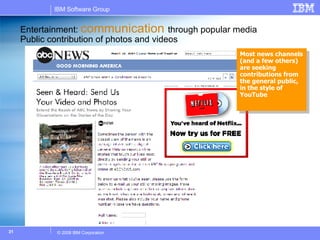
Entertainment:  communication  through popular media Public contribution of photos and videos Most news channels (and a few others) are seeking contributions from the general public, in the style of YouTube
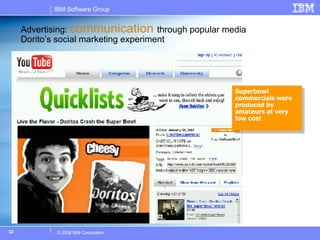
Advertising:  communication  through popular media Dorito’s social marketing experiment Superbowl commercials were produced by amateurs at very low cost
Lotus Connections Accelerates Project Execution Needed to improve productivity when working with contractors and partners across the US on education curriculums. Challenge Built strong relationships across several art archival and preservation organizations  Improved communication and status tracking of projects Accelerated the delivery of education curriculums created by a disconnected teams Business Value Using the Activities component of Lotus Connections so their entire network of employees, partners and customers can collaborate on the execution of projects. Solution Small Non-Profit Arts Organization  Film Foundation
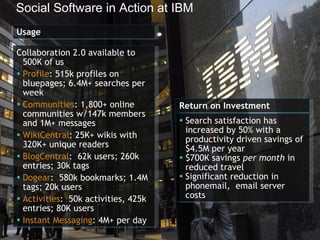
Collaboration 2.0 available to 500K of us Profile : 515k profiles on bluepages; 6.4M+ searches per week Communities : 1,800+ online communities w/147k members and 1M+ messages WikiCentral : 25K+ wikis with 320K+ unique readers BlogCentral :  62k users; 260k entries; 30k tags Dogear :  580k bookmarks; 1.4M tags; 20k users Activities :  50k activities, 425k entries; 80K users Instant Messaging : 4M+ per day Usage Search satisfaction has increased by 50% with a productivity driven savings of $4.5M per year $700K savings  per month  in reduced travel Significant reduction in phonemail,  email server costs Social Software in Action at IBM Return on Investment
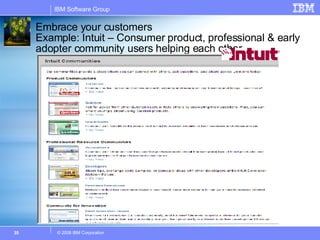
Embrace your customers Example: Intuit – Consumer product, professional & early adopter community users helping each other
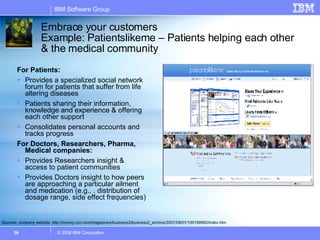
Embrace your customers Example: Patientslikeme – Patients helping each other & the medical community For Patients: Provides a specialized social network forum for patients that suffer from life altering diseases  Patients sharing their information, knowledge and experience & offering each other support Consolidates personal accounts and tracks progress For Doctors, Researchers, Pharma, Medical companies: Provides Researchers insight & access to patient communities  Provides Doctors insight to how peers are approaching a particular ailment and medication (e.g., . distribution of dosage range, side effect frequencies) Sources: company website,  http://money.cnn.com/magazines/business2/business2_archive/2007/09/01/100169862/index.htm
HOW DOES THIS ALL WORK? Taking advantage of Web 2.0 to grow your business
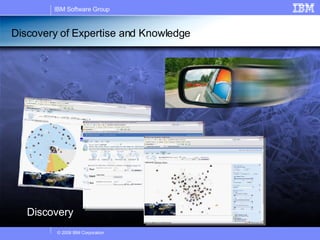
Discovery of Expertise and Knowledge Discovery
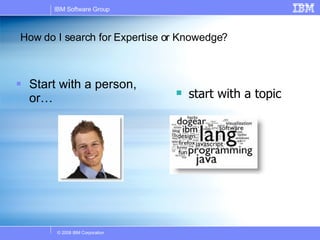
Start with a person, or… How do I search for Expertise or Knowedge? start with a topic
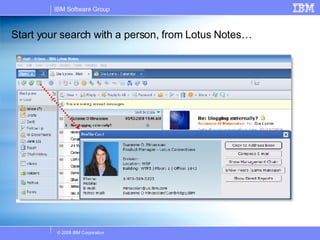
Start your search with a person, from Lotus Notes…
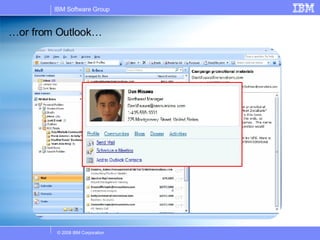
… or from Outlook…
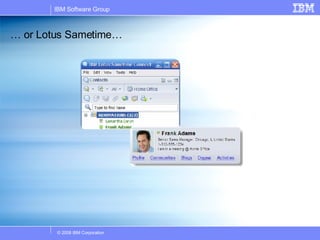
…  or Lotus Sametime…
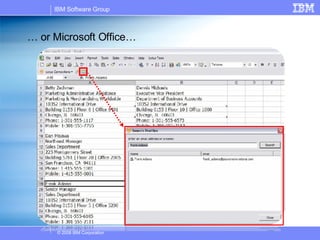
…  or Microsoft Office…
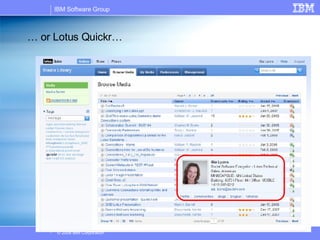
…  or Lotus Quickr…
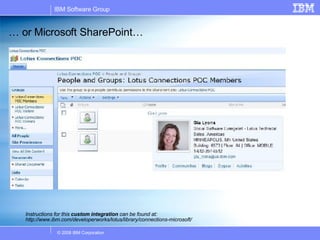
…  or Microsoft SharePoint… Instructions for this  custom integration  can be found at: http://www.ibm.com/developerworks/lotus/library/connections-microsoft/
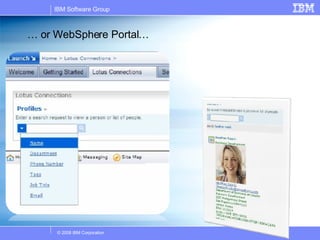
…  or WebSphere Portal…
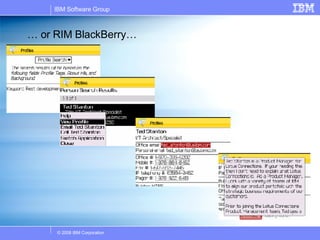
…  or RIM BlackBerry…
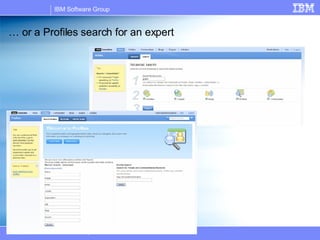
…  or a Profiles search for an expert
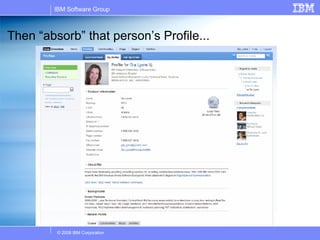
Then “absorb” that person’s Profile...
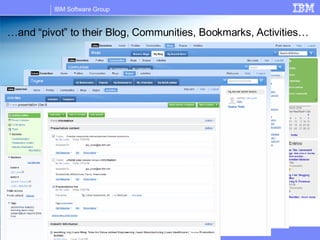
… and “pivot” to their Blog, Communities, Bookmarks, Activities…
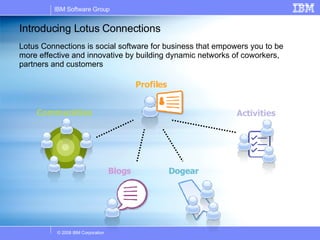
Introducing Lotus Connections Lotus Connections is social software for business that empowers you to be more effective and innovative by building dynamic networks of coworkers, partners and customers  Communities Blogs Dogear Activities Profiles
People are key to my business.  How can Connections help me  find expertise  and build a  social network ?
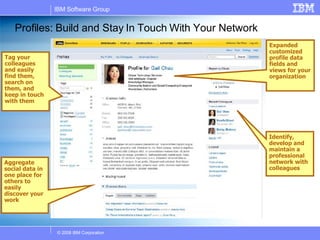
Profiles: Build and Stay In Touch With Your Network Expanded customized profile data fields and views for your organization Aggregate social data in one place for others to easily discover your work Identify, develop and maintain a professional network with colleagues Tag your colleagues and easily find them, search on them, and keep in touch with them
How do you chat over lunch when your colleagues are spread around the world? How can you  share information ,  get to know each other  and find out how they can help you to  do your job ?
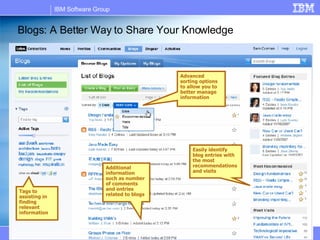
Blogs: A Better Way to Share Your Knowledge Additional information such as number of comments and entries related to blogs Easily identify blog entries with the most recommendations and visits Advanced sorting options to allow you to better manage information Tags to assisting in finding relevant information
Information is all over the place. How can Lotus Connections help me be more effective at  finding information  that is  valuable  and  relevant ?
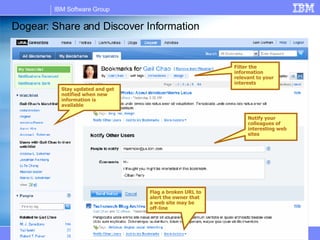
Dogear: Share and Discover Information Flag a broken URL to alert the owner that a web site may be off-line Notify your colleagues of interesting web sites Filter the information relevant to your interests Stay updated and get notified when new information is available
People are key to growth.  How can Connections help me  reach out  to customers, partners, and my employees to drive  innovation  into my business?
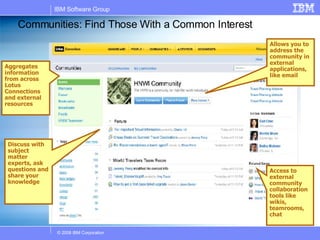
Communities: Find Those With a Common Interest Aggregates information from across Lotus Connections and external resources Access to external community collaboration tools like wikis, teamrooms, chat Discuss with subject matter experts, ask questions and share your knowledge Allows you to address the community in external applications, like email
Business is constantly changing. How can Connections help me  work more  effectively and share  best practices ?
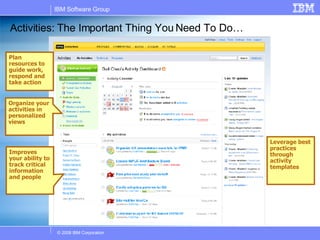
Activities: The Important Thing You Need To Do… Plan resources to guide work, respond and take action  Improves your ability to track critical information and people Leverage best practices through activity templates Organize your activities in personalized views
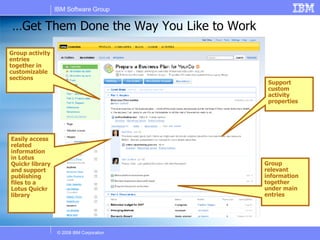
… Get Them Done the Way You Like to Work Group activity entries together in customizable sections Group relevant information together under main entries Easily access related information in Lotus Quickr library and support publishing files to a Lotus Quickr library Support custom activity properties
Social data is ever expanding. How can Connections help me  keep track of it all ?
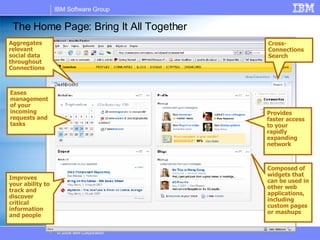
The Home Page: Bring It All Together Aggregates relevant social data throughout Connections Improves your ability to track and discover critical information and people Eases management of your incoming requests and tasks Provides faster access to your rapidly expanding network Composed of widgets that can be used in other web applications, including custom pages or mashups Cross-Connections Search
I won’t change the way I work.  How can I use Connections without leaving the  tools  I  use  most?
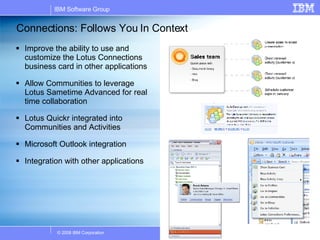
Connections: Follows You In Context Improve the ability to use and customize the Lotus Connections business card in other applications Allow Communities to leverage Lotus Sametime Advanced for real time collaboration Lotus Quickr integrated into Communities and Activities Microsoft Outlook integration Integration with other applications
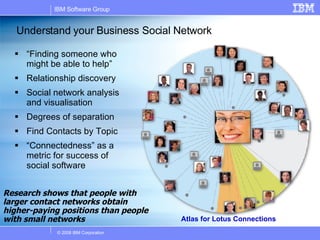
Understand your Business Social Network “ Finding someone who might be able to help” Relationship discovery Social network analysis and visualisation Degrees of separation Find Contacts by Topic “ Connectedness” as a metric for success of social software Research shows that people with larger contact networks obtain higher-paying positions than people with small networks Atlas for Lotus Connections
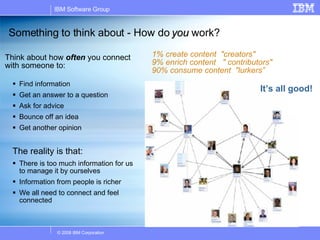
Something to think about - How do  you  work? Find information Get an answer to a question Ask for advice Bounce off an idea  Get another opinion The reality is that: There is too much information for us to manage it by ourselves Information from people is richer We all need to connect and feel connected Think about how  often  you connect with someone to: 1% create content  "creators" 9% enrich content  " contributors" 90% consume content  "lurkers” It’s all good!
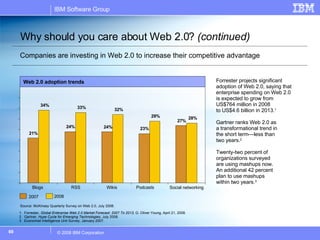
Why should you care about Web 2.0?  (continued) Companies are investing in Web 2.0 to increase their competitive advantage Source: McKinsey Quarterly Survey on Web 2.0, July 2008. 1.   Forrester,  Global Enterprise Web 2.0 Market Forecast: 2007 To 2013,  G.   Oliver Young, April 21, 2008.   2  Gartner , Hype Cycle for Emerging Technologies,  July   2008. 3  Economist Intelligence Unit Survey, January 2007. Forrester projects significant adoption of Web 2.0, saying that enterprise spending on Web 2.0 is expected to grow from US$764 million in 2008  to US$4.6 billion in 2013. 1 Gartner ranks Web 2.0 as  a transformational trend in  the short term—less than  two years. 2 Twenty-two percent of organizations surveyed  are using mashups now.  An additional 42 percent  plan to use mashups  within two years. 3   Web 2.0 adoption trends 21% 24% 24% 23% 27% 34% 33% 32% 29% 28% Blogs RSS Wikis Podcasts Social networking 2007 2008
Summary - Use social networks to create solutions Innovative technologies are opening up an entirely new dimension to integrating an ecosystem – a long establish solution strategy Solutions require better integration across business partners to meet client needs.  Social networks, enabled by innovative technologies, are critical components for creating these web-based solutions driving value in key areas: Building loyalty, trust and camaraderie in an increasingly mobile and global marketplace Fostering innovative discussion and support among online communities with committed participants, expert users and early adopters Creating advocates for the company in the increasingly transparent world of the social web, where information and misinformation disperses instantaneously. Our analysis identified 55% of sampled large enterprises and 37% of start-ups are exploring Web 2.0 through social networks & corresponding ecosystems
Summary – Use Web 2.0 for business advantage More  trustworthy  transactions More effective  personalization Increased sense of  community Richer   interaction Extended   reach   through open data access Improved   service   through feedback methods COMMUNITY SIMPLE
Summary: The Value of Social Software for Business Questions? Thank You [email_address] Facebook: sandeep.bakhshi Twitter: sbakhshi Web 2.0 is Us(ing)/Us Complete Tasks Faster Execute with Confidence Grow through Innovation Empower People

Web 20 For Acra

  • 1.
    Taking advantage ofWeb 2.0 to grow your business Sandeep Bakhshi ASEAN Business Unit Executive, Lotus Software Singapore Digital Media Festival – October 2008
  • 2.
    What is Web2.0? Why should care about it? Some Industry examples Putting it all together Summary Topics
  • 3.
    Disruptive Technologies Sustainablev/s Disruptive technlogy The Web (email and associated technologies are disruptive) Short term disruption; long term gain The Innovator's Dilemma
  • 4.
    Disruptive Innovation: TheInternet, the Web, e-business
  • 5.
    The impact ofthe internet – as a disruptive technology - has already transformed our world Email: Over 40 Billion sent daily Texting: Number sent and received every day exceeds the total population of the planet Google: Nearing 100 Billion searches per month Revenues for iconic Web 1.0 Companies Amazon.com $10.7 Billion in 2006 E-Bay.com $5.97 Billion in 2006 Digital Content: In 2006, amount created was about 3 Million times more than all the information that is in all the books ever written e-Commerce: In 2006, more than 85% of the world’s online population (875 Million consumers) has used the Internet to make a purchase—online shopping market up 40% in the past two years
  • 6.
    Web 2.0, 3DI& more….. Web 2.0 Virtual Worlds SOA Mashups Mobile Devices Social Software Blogs Folksonomy Web Analytics Software as a Service Wikis Mobile 2.0 3D Internet Telepresence The next major wave of disruptive change… Wisdom of crowds Micro-blogging Semantic Web Micro-payments
  • 7.
    IBM PartnerJam Web 1.0 Web 1.5 Web 2.0 Web 2.5 Web 3.0 IBM PartnerWorld Email Static web pages Evolution of the Web Moving towards more Web 2.0 Towards Web 2.5 Web 2.0 : coined by O'Reilly Media in 2003, refers to a perceived second generation of web-based communities and hosted services — such as social-networking sites, wikis and folksonomies — which facilitate collaboration and sharing between users. It refers to changes in the ways software developers and end-users use the web as a platform . -Wikipedia Web 3.0 is a term that has been coined with different meanings to describe the evolution of Web usage and interaction among several separate paths. These include transforming the Web into a database , a move towards making content accessible by multiple non-browser applications , the leveraging of artificial intelligence technologies , the Semantic web, or the Geospatial Web. - Wikipedia Lotus Notes Team rooms COBRA IBM Blogs developerWorks Spaces Developer’s Conference Blogs
  • 8.
    What is Web2.0?* User generated content/User driven Self policing – not anarchy Peer communication and interaction Transparency/Openness Low Barriers to Use Social Capital Utilization Sharing Collaboration Connecting people with information Attract people first then monetize later Participants bring value Bottoms up/viral Community Web 2.0 is not described by the technologies, but by the concepts or attributes. Definition of Social Computing : A social structure in which technology puts power in communities , not institutions. – Forrester Research Web 2.0 Attributes *For more details on what is Web 2.0, please refer to ‘The Power of Web 2.0 Business Models’ by Pauline Ores To paraphrase Thomas Power: “ The value is in the Connections” “ Web 1.0 is a channel, Web 2.0 is a platform ” – Professor Andrew McAfee, Harvard Business School Regarding “Web 2.0”: “ This Web 2.0 era isn’t really about tagging or sharing photos or bookmarks any more than Web 1.0 was about buying pet food online or reading news online.  It is about the emergent property of collaboration that happens when a critical mass of people (or things) is interconnected and the technologies that facilitate collaboration.” – Peter Rip, General Partner, Crosslink Capital
  • 9.
    Why Web 2.0is Important for IBM Using Web 2.0 to connect with partners and customers has ROI : Lower costs Increase revenues Gain mindshare Strengthen brand Increase loyalty Sales (indirectly) – you have a presence in the information gathering stage It will allow IBM to remain competitive in the market because our competition is using it too The influence of information on a Web 2.0 platform is becoming significant. Peer reviews have always been important in purchasing decisions With Web 2.0, user opinions and reviews are even more prevalent 52% of technology buyers surveyed state that Wikis influence their decision-making . -KnowledgeStorm, Emerging Media Series: Online Video, Social Networks, & Wikis, November 2006 53% of technology buyers surveyed say that blog content has already influenced a technology purchase decision . Also….. 57% of surveyed technology buyers rated blogs equally as or more credible than more traditional forms of media such as news outlets, industry publications, vendor white papers, analyst reports and industry or professional associations. -KnowledgeStorm, Emerging Media Series: Blogs & RSS, September 2006 More than 93% of technology buyers surveyed considered the information they found online to be of greater (49%) or equal (45%) value to the content they received through other means such as publications and events. -KnowledgeStorm, How Technology Marketers Meet Buyers’ Appetite for Content, March 2007
  • 10.
    What does Web2.0 mean for IBM? Web 2.0 use within the industry/enterprise is inevitable , unavoidable and advancing. What’s driving this growth? Changing demographics – Digital Natives (people who grew up with the web) are beginning to enter the marketplace and workplace in force. They come with high technology expectations as both consumers and employees. Consumerization – a phenomenon where consumer technologies and consumer behavior drives innovation in IT products and practices. As people become more comfortable with technology innovation in their personal lives, they demand it in their professional lives. Both changing demographics and consumerization of IT are driving the growth of the Web 2.0 platform. We need to be optimally positioned to be responsive and remain competitive . IBM is a product/service/results focused company when the focus is shifting to people IBM’s workforce doesn’t have the number of these younger, ‘digital natives’ as many of our competitors do We’ve given up our roots in consumer products and technologies which makes IBM less sensitive to new trends We have to put extra effort into making this work because of these factors “ Today, more than 85 percent of a typical S&P 500 company’s market value is the result of intangible assets. For many companies, the bulk of these intangible assets is its people , its human capital. It is no longer what you own that counts but what you know…” — Craig Symons, Forrester Research, Inc. "By 2010, marketers who successfully use customer-created content as part of their marketing efforts will increase conversion rates with prospects and established customers by an average of 25% . ” - Gartner's Top Predictions for IT Organizations and Users, 2007 and Beyond, Dec 2006 “ Enterprises can derive substantial business benefits from web 2.0 practices and technologies, especially when managed as corporate assets.” – Gartner Group
  • 11.
    This new waveof Web 2.0 disruptive technology is transforming all aspects of our consumer experience MySpace: over 175 Million members; over 67 Billion page views per month Facebook: over 75 Million active members; over 15 Billion page views per month YouTube: Tracks around 16 billion page views per month Second Life: 9.5 Million registrations (logins created); 91,000 premium users (users who pay for land) Twitter – Not just for consumers any more: The Los Angeles Fire Department USA presidential candidates Ron Paul, John Edwards, Barack Obama In China, there are 100,000 new broadband users everyday Mobile devices outnumber desktop computers by a factor of two
  • 12.
    The three softwarepatterns driving Web 2.0 Web 2.0 User-driven adoption Value on demand Low cost of entry Public infrastructure Software as a SERVICE Service, not software COMMUNITY mechanisms Recommendations Social networking features Tagging User comments Community rights management Users add value SIMPLE user interface and data services Responsive UIs (AJAX) Feeds (Atom, RSS) Simple extensions Mashups (REST APIs) Easy to use, easy to remix
  • 13.
    Enterprise 2.0 (IBMGlobal Innovation Outlook 2.0) http://domino.watson.ibm.com/comm/www_innovate.nsf/pages/world.gio.html Current State Future State Most value created by regular, long-term employees More fluid workforce, with much more of our value created with clients, partners, vendors, and alumni Workers identify with firm Workers identify with peers Work centers around the organization Work centers around the endeavor Career is tied to organization Career is tied to reputation and credited achievements Firm defined by who is in it and the value it creates Firm is defined by why it exists and the clients it serves Brand is managed and controlled by the organization Brand based on the experience created and the activities of those who affiliate with the firm The firm’s structure is defined and roles and skills are specified The firm’s structure and workforce roles constantly emerge and recombine The firm is defined by knowledge assets The firm is defined by the knowledge of the workforce
  • 14.
    Why should youcare about Web 2.0? You can measure the ROI of Web 2.0 across a variety of sources. Here’s an example of how IBM benefited from Web 2.0 with its Enterprise Tagging Services (ETS), which: Allows users to tag pages in the IBM intranet Is integrated with enterprise search to significantly reduce search time ROI Improved growth through innovation Broadened the collective intelligence to drive innovation Improved efficiency Cut search time by an average of 12 seconds With 286,584 search visits per week, saved 955 hours At US$100 per hour , 40 hours per week and 48 weeks per year, gained US$4.6 million in productivity Cost avoidance Avoided US$2.4 million in costs through the reusability of the ETS widget Increased empowerment of key resources Enabled better use of key experts and content across the organization Uncovered information with an estimated value of US$500,000 per year
  • 15.
    Changing Nature ofWork Changes Needs Work environments are more complex Matrixed organisations Organisation changes Mergers/Acquisitions Global companies Telecommuting Work is increasingly collaborative Specialisation, Partnering More ad hoc projects Work demands more social capital Differentiation starts with an idea (not always from the CEO) “ Today, more than 85 percent of a typical S&P 500 company’s market value is the result of intangible assets. For many companies, the bulk of these intangible assets is its people, its human capital. It is no longer what you own that counts but what you know…” — Craig Symons, Forrester Research, Inc. To paraphrase Thomas Power: “ The value is in the Connections”
  • 16.
    Business is EvolvingInformal Work Domains: Common Interests Self Motivated Innovative, Unconstrained Expertise Networks Knowledge Communities Outside organisational boundaries Open membership Formal Work Domains: Operations, Performance Mgmt Human Resources Geographical Divisions Procurement, Marketing, Sales, Manufacturing, … Define organisational boundaries Rigid, Hard to Change From Hierarchies … and Teams … to add Networked Communities Defined Work Domains: Virtual Teams Organised Task Oriented Problem Solving Communities of Practice Cross organisational boundaries Closed membership
  • 17.
    Social Network AnalysisExploration & Production Explorations Williams Drilling Taylor Production Stock Senior Vice President Jones G & G Cohen Petrophysical Cross Production O’Brien Reservoir Shapiro Paine Smith Andrews Moore Hughes Miller Ramirez Bell Cole Hussain Kelly Sen From Hierarchies and Teams … to Networked Communities Extended Community who leverage Cole’s knowledge to do their jobs The Challenges: How to extend that community? How to help the community to operate more effectively ? How to better leverage Cole’s knowledge & skills? How to capture Cole’s knowledge for the future? Social Network Analysis Paine Smith Moore Hughes Miller Ramirez Bell Cole Hussain Kelly Sen Cohen Jones Cross Taylor Williams Shapiro O’Brien Stock Andrews Paine Hughes Miller Bell Cole Hussain Cohen Taylor Williams Shapiro Andrews
  • 18.
    Capture the wisdomof the retiring crowd, while attracting and retaining a younger workforce 19% of the entire American workforce holding executive, administrative and managerial positions will retire in the next five years Source: Beazley, et. al, Continuity Management, Mackay, Alan. “Mature Age Workers: Sustaining Out Future Labor Force.” An Ageless Workforce - Opportunities for Business' Symposium Conference Paper. August 27, 2003. www.ageing.health.gov.au/ofoa/wllplan/aawpapers.htm , Time to act quickly on aging.” The Japan Times Online. August 23, 2002 www.japantimes.co.jp/cgi-bin/getarticle.pl5?ed20020823a1.htm , A. Paulli, “Pension systems and gradual retirement in Italy”, September 2000, p.17 In the year 2000, there were more people receiving pensions in Italy (22 million) than people working (21 million) Within the next seven years, over 33 million individuals in Japan (26% of the population) are expected to be over 65 years old. By 2016, the number of individuals aged 60-64 in Australia is expected to almost double How do we Capture the Knowledge and Pass on the Skills of those workers before they leave? Fast to learn Eager to gain knowledge Highly IT literate Used to Social Networking Source of knowledge Highly skilled Valued mentors Motivated to Communicate Stressed Overworked Time constrained Need Help! & Help the Age Workforce Transfer Knowledge
  • 19.
    Each Generation inthe Workplace comes with its own Experiences and Expectations Source: Lancaster, L.C. and Stillman, D. When Generations Collide: Who They Are. Why They Clash. How to Solve the Generational Puzzle at Work . Wheaton, IL. Harper Business, 2003. Classroom The hard way Top down Hierarchical Unwise Team informed Get out of the way Unsure Once per year Sets me back Seeks approval Command & control No news is good news Uncomfortable Too much and I’ll leave Hub & spoke Horizontal Coach Weekly/daily Unable to work without it Necessary Part of my daily routine Unfathomable if not provided On demand Partner Team decided Collaborative Collaborative Collaborative & networked Continuous & expected Facilitated Guarded Team included Independent Independent Required to keep me Traditionalist Boomer Gen X Gen Y Training Learning style Communication style Problem-solving Decision-making Leadership style Feedback Technology use Job changing
  • 20.
    INDUSTRY EXAMPLES Takingadvantage of Web 2.0 to grow your business
  • 21.
    Retail: more trustworthy transactions eBay reputation-based selling Seller reputation is founded on buyer reputations
  • 22.
    Retail: more trustworthy transactions Reviews and ratings Consumer Reviews Trust: Reviewer history Offering preview includes ratings
  • 23.
    Entertainment: more effective personalization Recommendations – based on your ratings Movies are recommended based on what you’ve enjoyed in the past
  • 24.
    Government: leverage the wisdom of crowds Community patent review The public can see patent applications before they are finalized, giving a chance to comment on claims or submit prior art
  • 25.
    Finance: leverage the wisdom of crowds Tax guide emerging from the “wisdom of crowds” This tax guide is a wiki, written by volunteer experts
  • 26.
    The United Nation’s(UN) World Urban Forum (WUF) and government of Canada engaged IBM to sponsor HabitatJam to help set the agenda for WUF3, the biannual conference on urban sustainability. HabitatJam – the largest brainstorming ever on urban sustainability 39,000 participants from 191 countries Delegates, Politicans, Academics, Aid Organizations, & Slum Dwellers (whose lives would ultimately be impacted) On-the-ground events – Jam cafes – brought together thousands of slum dwellers (people who had never seen a computer): Kibera, Kenya: Hundreds of slum dwellers lined up for hours to have their messages typed into a computer Delhi, India: 10,000+ people gathered in slums to express their views and discuss the problems of the world's cities. Similar events were held in Russia, the Congo, Colombia, Cameroon, Brazil, Uruguay, Peru and Bangladesh. Foster rapid, collaborative innovation in the enterprise Example: IBM Jams: Collaborative Innovation
  • 27.
    Real Estate: greater transparency through data mashups This example is a “mashup” of data from local deed registrars and real estate listings
  • 28.
    Government: expose datafor greater impact Mapping avian flu data Declan Butler (a reporter for Nature) is mapping H5N1 news reports onto Google Earth and posting them on his blog
  • 29.
    IBM social networkingat work at Cardiff University Improves research agenda with IBM Lotus Connections software Business challenge Improve overall employee productivity by allowing faculty to tap into the vast amount of knowledge and skills across the university Solution An enterprise-wide directory service based on IBM Lotus Connections software that: Enables researchers and staff to search for skills, projects, teams and knowledge throughout the institution Allows users to locate information quickly, interact with people in realtime and advance research projects through collaboration Benefits Increased collaboration across previously isolated schools and faculties Improved the university experience of faculty and students Enhanced teaching methods and materials Increased efficiencies in research projects and grant management
  • 30.
    IBM Mashup Centerat work at Boeing Purpose: enable U.S. Federal Aviation Administration (FAA) officials to quickly identify the nearest airport that can safely handle an incoming aircraft for emergency response Created by IBM and Boeing to demonstrate next-generation aviation capabilities Draws from existing data and systems to enable officials to react to unexpected events Built within three weeks and delivered to the FAA, the U.S. Department of Defense and the U.S. Department of Homeland Security “ As an established innovator, Boeing believes in the power of Web 2.0 and embraces it not only for collaborative work, but also for the heavy lifting of enterprise planning and execution. IBM Mashup Center is playing a key role in our visionary approach to strategic asset management. It's critical to know where your major assets are and how to use them at any given time, situation or condition.” — Paul Comitz, Boeing, IBM press release, June 5, 2008 Boeing Air Traffic Management
  • 31.
    Entertainment: communication through popular media Public contribution of photos and videos Most news channels (and a few others) are seeking contributions from the general public, in the style of YouTube
  • 32.
    Advertising: communication through popular media Dorito’s social marketing experiment Superbowl commercials were produced by amateurs at very low cost
  • 33.
    Lotus Connections AcceleratesProject Execution Needed to improve productivity when working with contractors and partners across the US on education curriculums. Challenge Built strong relationships across several art archival and preservation organizations Improved communication and status tracking of projects Accelerated the delivery of education curriculums created by a disconnected teams Business Value Using the Activities component of Lotus Connections so their entire network of employees, partners and customers can collaborate on the execution of projects. Solution Small Non-Profit Arts Organization Film Foundation
  • 34.
    Collaboration 2.0 availableto 500K of us Profile : 515k profiles on bluepages; 6.4M+ searches per week Communities : 1,800+ online communities w/147k members and 1M+ messages WikiCentral : 25K+ wikis with 320K+ unique readers BlogCentral : 62k users; 260k entries; 30k tags Dogear : 580k bookmarks; 1.4M tags; 20k users Activities : 50k activities, 425k entries; 80K users Instant Messaging : 4M+ per day Usage Search satisfaction has increased by 50% with a productivity driven savings of $4.5M per year $700K savings per month in reduced travel Significant reduction in phonemail, email server costs Social Software in Action at IBM Return on Investment
  • 35.
    Embrace your customersExample: Intuit – Consumer product, professional & early adopter community users helping each other
  • 36.
    Embrace your customersExample: Patientslikeme – Patients helping each other & the medical community For Patients: Provides a specialized social network forum for patients that suffer from life altering diseases Patients sharing their information, knowledge and experience & offering each other support Consolidates personal accounts and tracks progress For Doctors, Researchers, Pharma, Medical companies: Provides Researchers insight & access to patient communities Provides Doctors insight to how peers are approaching a particular ailment and medication (e.g., . distribution of dosage range, side effect frequencies) Sources: company website, http://money.cnn.com/magazines/business2/business2_archive/2007/09/01/100169862/index.htm
  • 37.
    HOW DOES THISALL WORK? Taking advantage of Web 2.0 to grow your business
  • 38.
    Discovery of Expertiseand Knowledge Discovery
  • 39.
    Start with aperson, or… How do I search for Expertise or Knowedge? start with a topic
  • 40.
    Start your searchwith a person, from Lotus Notes…
  • 41.
    … or fromOutlook…
  • 42.
    … orLotus Sametime…
  • 43.
    … orMicrosoft Office…
  • 44.
    … orLotus Quickr…
  • 45.
    … orMicrosoft SharePoint… Instructions for this custom integration can be found at: http://www.ibm.com/developerworks/lotus/library/connections-microsoft/
  • 46.
    … orWebSphere Portal…
  • 47.
    … orRIM BlackBerry…
  • 48.
    … ora Profiles search for an expert
  • 49.
    Then “absorb” thatperson’s Profile...
  • 50.
    … and “pivot”to their Blog, Communities, Bookmarks, Activities…
  • 51.
    Introducing Lotus ConnectionsLotus Connections is social software for business that empowers you to be more effective and innovative by building dynamic networks of coworkers, partners and customers Communities Blogs Dogear Activities Profiles
  • 52.
    People are keyto my business. How can Connections help me find expertise and build a social network ?
  • 53.
    Profiles: Build andStay In Touch With Your Network Expanded customized profile data fields and views for your organization Aggregate social data in one place for others to easily discover your work Identify, develop and maintain a professional network with colleagues Tag your colleagues and easily find them, search on them, and keep in touch with them
  • 54.
    How do youchat over lunch when your colleagues are spread around the world? How can you share information , get to know each other and find out how they can help you to do your job ?
  • 55.
    Blogs: A BetterWay to Share Your Knowledge Additional information such as number of comments and entries related to blogs Easily identify blog entries with the most recommendations and visits Advanced sorting options to allow you to better manage information Tags to assisting in finding relevant information
  • 56.
    Information is allover the place. How can Lotus Connections help me be more effective at finding information that is valuable and relevant ?
  • 57.
    Dogear: Share andDiscover Information Flag a broken URL to alert the owner that a web site may be off-line Notify your colleagues of interesting web sites Filter the information relevant to your interests Stay updated and get notified when new information is available
  • 58.
    People are keyto growth. How can Connections help me reach out to customers, partners, and my employees to drive innovation into my business?
  • 59.
    Communities: Find ThoseWith a Common Interest Aggregates information from across Lotus Connections and external resources Access to external community collaboration tools like wikis, teamrooms, chat Discuss with subject matter experts, ask questions and share your knowledge Allows you to address the community in external applications, like email
  • 60.
    Business is constantlychanging. How can Connections help me work more effectively and share best practices ?
  • 61.
    Activities: The ImportantThing You Need To Do… Plan resources to guide work, respond and take action Improves your ability to track critical information and people Leverage best practices through activity templates Organize your activities in personalized views
  • 62.
    … Get ThemDone the Way You Like to Work Group activity entries together in customizable sections Group relevant information together under main entries Easily access related information in Lotus Quickr library and support publishing files to a Lotus Quickr library Support custom activity properties
  • 63.
    Social data isever expanding. How can Connections help me keep track of it all ?
  • 64.
    The Home Page:Bring It All Together Aggregates relevant social data throughout Connections Improves your ability to track and discover critical information and people Eases management of your incoming requests and tasks Provides faster access to your rapidly expanding network Composed of widgets that can be used in other web applications, including custom pages or mashups Cross-Connections Search
  • 65.
    I won’t changethe way I work. How can I use Connections without leaving the tools I use most?
  • 66.
    Connections: Follows YouIn Context Improve the ability to use and customize the Lotus Connections business card in other applications Allow Communities to leverage Lotus Sametime Advanced for real time collaboration Lotus Quickr integrated into Communities and Activities Microsoft Outlook integration Integration with other applications
  • 67.
    Understand your BusinessSocial Network “ Finding someone who might be able to help” Relationship discovery Social network analysis and visualisation Degrees of separation Find Contacts by Topic “ Connectedness” as a metric for success of social software Research shows that people with larger contact networks obtain higher-paying positions than people with small networks Atlas for Lotus Connections
  • 68.
    Something to thinkabout - How do you work? Find information Get an answer to a question Ask for advice Bounce off an idea Get another opinion The reality is that: There is too much information for us to manage it by ourselves Information from people is richer We all need to connect and feel connected Think about how often you connect with someone to: 1% create content "creators" 9% enrich content " contributors" 90% consume content "lurkers” It’s all good!
  • 69.
    Why should youcare about Web 2.0? (continued) Companies are investing in Web 2.0 to increase their competitive advantage Source: McKinsey Quarterly Survey on Web 2.0, July 2008. 1. Forrester, Global Enterprise Web 2.0 Market Forecast: 2007 To 2013, G. Oliver Young, April 21, 2008. 2 Gartner , Hype Cycle for Emerging Technologies, July 2008. 3 Economist Intelligence Unit Survey, January 2007. Forrester projects significant adoption of Web 2.0, saying that enterprise spending on Web 2.0 is expected to grow from US$764 million in 2008 to US$4.6 billion in 2013. 1 Gartner ranks Web 2.0 as a transformational trend in the short term—less than two years. 2 Twenty-two percent of organizations surveyed are using mashups now. An additional 42 percent plan to use mashups within two years. 3 Web 2.0 adoption trends 21% 24% 24% 23% 27% 34% 33% 32% 29% 28% Blogs RSS Wikis Podcasts Social networking 2007 2008
  • 70.
    Summary - Usesocial networks to create solutions Innovative technologies are opening up an entirely new dimension to integrating an ecosystem – a long establish solution strategy Solutions require better integration across business partners to meet client needs. Social networks, enabled by innovative technologies, are critical components for creating these web-based solutions driving value in key areas: Building loyalty, trust and camaraderie in an increasingly mobile and global marketplace Fostering innovative discussion and support among online communities with committed participants, expert users and early adopters Creating advocates for the company in the increasingly transparent world of the social web, where information and misinformation disperses instantaneously. Our analysis identified 55% of sampled large enterprises and 37% of start-ups are exploring Web 2.0 through social networks & corresponding ecosystems
  • 71.
    Summary – UseWeb 2.0 for business advantage More trustworthy transactions More effective personalization Increased sense of community Richer interaction Extended reach through open data access Improved service through feedback methods COMMUNITY SIMPLE
  • 72.
    Summary: The Valueof Social Software for Business Questions? Thank You [email_address] Facebook: sandeep.bakhshi Twitter: sbakhshi Web 2.0 is Us(ing)/Us Complete Tasks Faster Execute with Confidence Grow through Innovation Empower People