Peace & Dialogue Platform
Secretariat
Assicurazione Generale Building, 2nd floor
Nejmeh Square, Beirut Central District
Lebanon
Tel: (+961) 1 980 274/5/6
Fax: (+961) 1 980 275
info@peaceanddialogueplatform.org
Peace & Dialogue
Platform
Table of Contents
Introduction ……………………………………………………………….. 1
Shared Knowledge.….……………..……………………………………. 2
Membership......................................................................................... 9
Features ……………………………………...…………………...…. 10
Facebook
Blog
Country Profile
Resource Guides
Thematic Areas
Interactive Tools………………………….………………….………… 19
National Dialogues Process Tool
Dialogue Design Tool
One Text Negotiation Tool
Timelines
Multi-layer Maps
Negotiation Table
Partners. ………………………………………………………………….... 24
Introduction
What is the Peace & Dialogue Platform?
The Peace & Dialogue Platform is a collaborative on-line platform, space
and shared knowledge resource for peace and dialogue processes and
structures. It offers a dynamic platform for joint knowledge creation,
and a structured space to share experiences and capture unfolding
processes.
The platform was created as a resource to those who design, manage
and participate in peace and dialogue processes and structures in their
respective countries. Each country and regional partner on the platform
manages their own “spaces” and has final editorial control to maximize
the use in their specific context and meet their process needs.
Aims
 Capture process, technical and thematic knowledge that
emerges out of particular national and regional contexts;
 Provide an inclusive platform that captures diverse narratives
in and from national and regional conflicts;
 Create dynamic and open frameworks to analyze, design and
manage peace and dialogue processes;
 Link national experiences, process knowledge and technical
expertise to bridge the gap between practice and theory;
 Deconstruct the power structure of knowledge creation
focusing on the essential source of knowledge emanation from
the processes and stakeholders themselves.
1
Shared Knowledge
Creating shared knowledge
Shared knowledge creation in peace and dialogue processes is the
shifting from “I know” to “we know”. The purpose for integrating shared
knowledge into facilitation and dialogue processes is to explore,
discover and create common understanding between conflicting parties.
In this process the parties develop deeper and informed understanding,
awareness and appreciation of their different and shared realities and
normative frameworks. Shared knowledge is an essential element of
deadlock breaking and consensus building, and it enables knowledge-
based dialogues.
Shared knowledge in dialogue processes
One of the key contributing factors to conflict are data-conflicts: lack of
information; misinformation; distorted information; disparity of
available (and access to) essential data between conflicting parties;
information without sufficient context; and our limited lenses through
which we look at each other’s realities. Conflicting parties in dialogue or
negotiations often lack the knowledge necessary to reach informed
decisions which both sides would regard as fair, just and reasonable.
Integrating shared knowledge into the facilitation strategy of dialogue
processes helps each party to more accurately interpret each other’s
realities.
Shared knowledge creation does not only involve research, data
collection, reports, surveys, publications etc., it needs to be built into the
dialogue and negotiations processes itself. This will enable:
 Policy-making that are more needs-based and within shared
value-frameworks - serving the interests of all people, groups
and parties involved;
 The generating of realistic and creative options for deadlock
breaking and consensus building;
 Transform and contribute to a culture of dialogue based on
shared knowledge and not exclusive and competing realities.
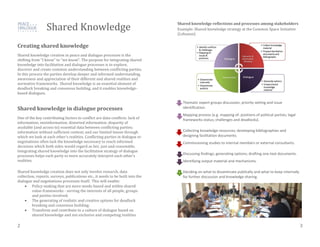
Shared knowledge reflections and processes among stakeholders
Example: Shared knowledge strategy at the Common Space Initiative
(Lebanon)
Thematic expert groups discussion, priority setting and issue
identification.
Mapping process (e.g. mapping of: positions of political parties; legal
frameworks status; challenges and deadlocks).
Collecting knowledge resources; developing bibliographies and
designing facilitation documents.
Commissioning studies to internal members or external consultants.
Discussing findings; generating options; drafting one-text documents.
Identifying output material and mechanisms.
Deciding on what to disseminate publically and what to keep internally
for further discussion and knowledge sharing.
2 3
How does the Peace & Dialogue Platform support shared
knowledge creation and stakeholders in dialogue processes?
Knowledge resources
Interactive tools
Interactive tools are developed in response to the needs of a process to
support actors/stakeholders, practitioners and facilitators in their
facilitation strategies and processes. Interactive tools include the
National Dialogues & Negotiation Index and Compare Tool, as well as an
interactive Timeline. Other tools are under development.
How does the Peace & Dialogue Platform support shared
knowledge reflections between its partners?
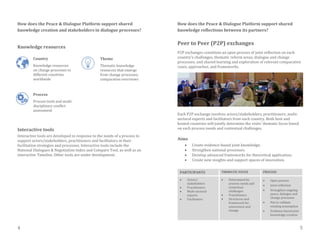
Peer to Peer (P2P) exchanges
P2P exchanges constitute an open process of joint reflection on each
country’s challenges, thematic reform areas, dialogue and change
processes; and shared learning and exploration of relevant comparative
cases, approaches, and frameworks.
Each P2P exchange involves actors/stakeholders, practitioners, multi-
sectoral experts and facilitators from each country. Both host and
hosted countries will jointly determine the visits’ thematic focus based
on each process needs and contextual challenges.
Aims
 Create evidence-based joint knowledge;
 Strengthen national processes;
 Develop advanced frameworks for theoretical application;
 Create new insights and support spaces of innovation.

PARTICIPANTS THEMATIC FOCUS PROCESS
 Actors/
stakeholders
 Practitioners
 Multi-sectoral
experts
 Facilitators
 Determined by
process needs and
contextual
challenges
 Practitioners
 Structures and
framework for
assessment and
change
 Open process
 Joint reflection
 Strengthen ongoing
peace, dialogue and
change processes
 Not to validate
existing assumption
 Evidence based joint
knowledge creation
4 5
Country
Knowledge resources
on change processes in
different countries
worldwide
Theme
Thematic knowledge
resources that emerge
from change processes;
comparative overviews
Process
Process tools and multi-
disciplinary conflict
assessment
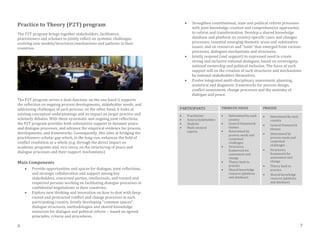
Practice to Theory (P2T) program
The P2T program brings together stakeholders, facilitators,
practitioners and scholars to jointly reflect on systemic challenges,
evolving new models/structures/mechanisms and patterns in their
countries.
The P2T program serves a dual-function: on the one hand it supports
the reflection on ongoing process developments, stakeholder needs, and
addressing challenges of each process; on the other hand, it looks at
existing conceptual underpinnings and its impact on larger practice and
scholarly debates. With these systematic and ongoing joint reflections,
the P2T program provides both substantive support to dynamic peace
and dialogue processes, and advance the empirical evidence for process
developments, and frameworks. Consequently, this aims at bridging the
practitioners-scholar gap which, in the long-run, enhances the field of
conflict resolution as a whole (e.g. through the direct impact on
academic programs and, vice versa, on the structuring of peace and
dialogue processes and their support mechanisms)
Main Components
 Provide opportunities and spaces for dialogue, joint reflections,
and strategic collaboration and support among key
stakeholders, concerned parties, intellectuals, and trusted and
respected persons working on facilitating dialogue processes or
confidential negotiations in their countries;
 Explore new thinking and innovation on how to deal with deep-
rooted and protracted conflict and change processes in each
participating country. Jointly developing “common spaces”,
dialogue structures, methodologies and shared knowledge
resources for dialogue and political reform -- based on agreed
principles, criteria and procedures.
 Strengthen constitutional, state and political reform processes
with joint knowledge creation and comprehensive approaches
to reform and transformation. Develop a shared knowledge
database and platform on country-specific cases and changes
processes; essential emerging thematic areas and substantive
issues; and on resources and “tools” that emerged from various
processes, dialogues mechanisms and structures.
 Jointly respond (and support) to expressed need to create
strong and inclusive national dialogues, based on sovereignty,
national ownership and political inclusion. The focus of such
support will on the creation of such structures and mechanisms
by national stakeholders themselves.
 Evolve integrated multi-disciplinary assessment, planning,
analytical and diagnostic frameworks for process design,
conflict assessment, change processes and the anatomy of
dialogue and peace.
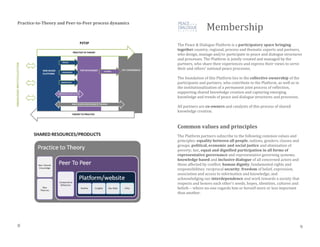
PARTICIPANTS THEMATIC FOCUS PROCESS
 Practitioner
 Actors/stakeholders
 Analysts
 Multi-sectoral
experts
 Determined by each
country
 General framework
themes
 Determined by
process needs and
contextual
challenges
 Structures;
framework for
assessment and
change
 Theory back to
practice
 Shared knowledge
resource (platform
and database)
 Determined by each
country
 General framework
themes
 Determined by
process needs and
contextual
challenges
 Structures;
framework for
assessment and
change
 Theory back to
practice
 Shared knowledge
resource (platform
and database)
6 7
Practice-to-Theory and Peer-to-Peer process dynamics
Membership
The Peace & Dialogue Platform is a participatory space bringing
together country, regional, process and thematic experts and partners,
who design, manage and/or participate in peace and dialogue structures
and processes. The Platform is jointly created and managed by the
partners, who share their experiences and express their views to serve
their and others’ national peace processes.
The foundation of this Platform lies in the collective ownership of the
participants and partners, who contribute to the Platform, as well as in
the institutionalization of a permanent joint process of reflection,
supporting shared knowledge creation and capturing emerging
knowledge and trends of peace and dialogue structures and processes.
All partners are co-owners and catalysts of this process of shared
knowledge creation.
Common values and principles
The Platform partners subscribe to the following common values and
principles: equality between all people, nations, genders, classes and
groups; political, economic and social justice and elimination of
poverty; fair, equal and dignified participation in all forms of
representative governance and representative governing systems;
knowledge based and inclusive dialogue of all concerned actors and
those affected by conflict; human dignity, fundamental rights and
responsibilities; reciprocal security; freedom of belief, expression,
association and access to information and knowledge; and
acknowledging our interdependence and work towards a society that
respects and honors each other’s needs, hopes, identities, cultures and
beliefs – where no-one regards him or herself more or less important
than another.
8 9
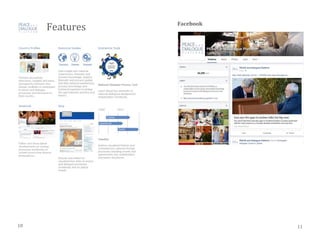
Features Facebook
10 11
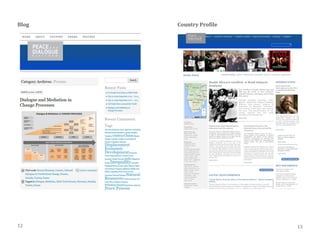
Blog Country Profile
12 13
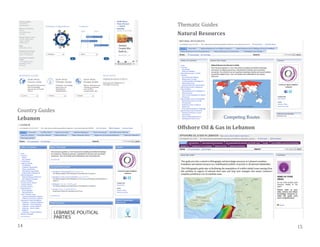
Country Guides
Lebanon
Thematic Guides
Natural Resources
Offshore Oil & Gas in Lebanon
14 15
7
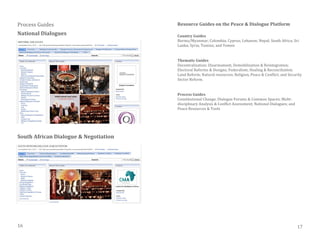
Process Guides
National Dialogues
South African Dialogue & Negotiation
Resource Guides on the Peace & Dialogue Platform
Country Guides
Burma/Myanmar; Colombia; Cyprus; Lebanon; Nepal; South Africa; Sri
Lanka; Syria; Tunisia; and Yemen
Thematic Guides
Decentralization; Disarmament, Demobilization & Reintegration;
Electoral Reforms & Designs; Federalism; Healing & Reconciliation;
Land Reform; Natural resources; Religion, Peace & Conflict; and Security
Sector Reform.
Process Guides
Constitutional Change; Dialogue Forums & Common Spaces; Multi-
disciplinary Analysis & Conflict Assessment; National Dialogues; and
Peace Resources & Tools
16 17
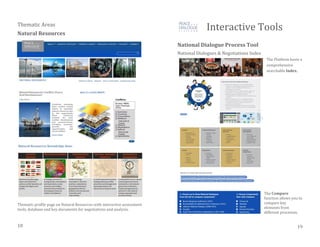
Thematic Areas
Natural Resources
Thematic profile page on Natural Resources with interactive assessment
tools, database and key documents for negotiations and analysis.
Interactive Tools
National Dialogue Process Tool
National Dialogues & Negotiations Index
The Platform hosts a
comprehensive
searchable Index.
The Compare
function allows you to
compare key
elements from
different processes.
18 19
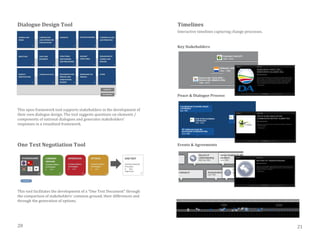
Dialogue Design Tool
This open framework tool supports stakeholders in the development of
their own dialogue design. The tool suggests questions on elements /
components of national dialogues and generates stakeholders’
responses in a visualized framework.
One Text Negotiation Tool
This tool facilitates the development of a “One Text Document” through
the comparison of stakeholders’ common ground, their differences and
through the generation of options.
Timelines
Interactive timelines capturing change processes.
Key Stakeholders
Peace & Dialogue Process
Events & Agreements
20 21
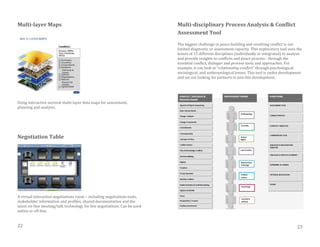
Multi-layer Maps
Using interactive sectoral multi-layer data maps for assessment,
planning and analysis.
Negotiation Table
A virtual interactive negotiations room – including negotiations tools,
stakeholder information and profiles, shared documentation and the
latest on-line meeting/talk technology for live negotiations. Can be used
online or off-line.
Multi-disciplinary Process Analysis & Conflict
Assessment Tool
The biggest challenge to peace building and resolving conflict is our
limited diagnostic or assessment capacity. This exploratory tool uses the
lenses of 15 different disciplines (individually or integrated) to analyze
and provide insights to conflicts and peace process - through the
essential conflict, dialogue and process tools and approaches. For
example, it can look at “relationship conflict” through psychological,
sociological, and anthropological lenses. This tool is under development
and we are looking for partners to join this development.
22 23
Partners
Syria Initiative (Syria)
24 25
Nepal Transition to Peace Institute
One-Text Initiative

P&D Platform Brochure Final for READING (Feb. 09, 2016)

  • 1.
    Peace & DialoguePlatform Secretariat Assicurazione Generale Building, 2nd floor Nejmeh Square, Beirut Central District Lebanon Tel: (+961) 1 980 274/5/6 Fax: (+961) 1 980 275 info@peaceanddialogueplatform.org Peace & Dialogue Platform
  • 2.
    Table of Contents Introduction……………………………………………………………….. 1 Shared Knowledge.….……………..……………………………………. 2 Membership......................................................................................... 9 Features ……………………………………...…………………...…. 10 Facebook Blog Country Profile Resource Guides Thematic Areas Interactive Tools………………………….………………….………… 19 National Dialogues Process Tool Dialogue Design Tool One Text Negotiation Tool Timelines Multi-layer Maps Negotiation Table Partners. ………………………………………………………………….... 24 Introduction What is the Peace & Dialogue Platform? The Peace & Dialogue Platform is a collaborative on-line platform, space and shared knowledge resource for peace and dialogue processes and structures. It offers a dynamic platform for joint knowledge creation, and a structured space to share experiences and capture unfolding processes. The platform was created as a resource to those who design, manage and participate in peace and dialogue processes and structures in their respective countries. Each country and regional partner on the platform manages their own “spaces” and has final editorial control to maximize the use in their specific context and meet their process needs. Aims  Capture process, technical and thematic knowledge that emerges out of particular national and regional contexts;  Provide an inclusive platform that captures diverse narratives in and from national and regional conflicts;  Create dynamic and open frameworks to analyze, design and manage peace and dialogue processes;  Link national experiences, process knowledge and technical expertise to bridge the gap between practice and theory;  Deconstruct the power structure of knowledge creation focusing on the essential source of knowledge emanation from the processes and stakeholders themselves. 1
  • 3.
    Shared Knowledge Creating sharedknowledge Shared knowledge creation in peace and dialogue processes is the shifting from “I know” to “we know”. The purpose for integrating shared knowledge into facilitation and dialogue processes is to explore, discover and create common understanding between conflicting parties. In this process the parties develop deeper and informed understanding, awareness and appreciation of their different and shared realities and normative frameworks. Shared knowledge is an essential element of deadlock breaking and consensus building, and it enables knowledge- based dialogues. Shared knowledge in dialogue processes One of the key contributing factors to conflict are data-conflicts: lack of information; misinformation; distorted information; disparity of available (and access to) essential data between conflicting parties; information without sufficient context; and our limited lenses through which we look at each other’s realities. Conflicting parties in dialogue or negotiations often lack the knowledge necessary to reach informed decisions which both sides would regard as fair, just and reasonable. Integrating shared knowledge into the facilitation strategy of dialogue processes helps each party to more accurately interpret each other’s realities. Shared knowledge creation does not only involve research, data collection, reports, surveys, publications etc., it needs to be built into the dialogue and negotiations processes itself. This will enable:  Policy-making that are more needs-based and within shared value-frameworks - serving the interests of all people, groups and parties involved;  The generating of realistic and creative options for deadlock breaking and consensus building;  Transform and contribute to a culture of dialogue based on shared knowledge and not exclusive and competing realities. Shared knowledge reflections and processes among stakeholders Example: Shared knowledge strategy at the Common Space Initiative (Lebanon) Thematic expert groups discussion, priority setting and issue identification. Mapping process (e.g. mapping of: positions of political parties; legal frameworks status; challenges and deadlocks). Collecting knowledge resources; developing bibliographies and designing facilitation documents. Commissioning studies to internal members or external consultants. Discussing findings; generating options; drafting one-text documents. Identifying output material and mechanisms. Deciding on what to disseminate publically and what to keep internally for further discussion and knowledge sharing. 2 3
  • 4.
    How does thePeace & Dialogue Platform support shared knowledge creation and stakeholders in dialogue processes? Knowledge resources Interactive tools Interactive tools are developed in response to the needs of a process to support actors/stakeholders, practitioners and facilitators in their facilitation strategies and processes. Interactive tools include the National Dialogues & Negotiation Index and Compare Tool, as well as an interactive Timeline. Other tools are under development. How does the Peace & Dialogue Platform support shared knowledge reflections between its partners? Peer to Peer (P2P) exchanges P2P exchanges constitute an open process of joint reflection on each country’s challenges, thematic reform areas, dialogue and change processes; and shared learning and exploration of relevant comparative cases, approaches, and frameworks. Each P2P exchange involves actors/stakeholders, practitioners, multi- sectoral experts and facilitators from each country. Both host and hosted countries will jointly determine the visits’ thematic focus based on each process needs and contextual challenges. Aims  Create evidence-based joint knowledge;  Strengthen national processes;  Develop advanced frameworks for theoretical application;  Create new insights and support spaces of innovation.  PARTICIPANTS THEMATIC FOCUS PROCESS  Actors/ stakeholders  Practitioners  Multi-sectoral experts  Facilitators  Determined by process needs and contextual challenges  Practitioners  Structures and framework for assessment and change  Open process  Joint reflection  Strengthen ongoing peace, dialogue and change processes  Not to validate existing assumption  Evidence based joint knowledge creation 4 5 Country Knowledge resources on change processes in different countries worldwide Theme Thematic knowledge resources that emerge from change processes; comparative overviews Process Process tools and multi- disciplinary conflict assessment
  • 5.
    Practice to Theory(P2T) program The P2T program brings together stakeholders, facilitators, practitioners and scholars to jointly reflect on systemic challenges, evolving new models/structures/mechanisms and patterns in their countries. The P2T program serves a dual-function: on the one hand it supports the reflection on ongoing process developments, stakeholder needs, and addressing challenges of each process; on the other hand, it looks at existing conceptual underpinnings and its impact on larger practice and scholarly debates. With these systematic and ongoing joint reflections, the P2T program provides both substantive support to dynamic peace and dialogue processes, and advance the empirical evidence for process developments, and frameworks. Consequently, this aims at bridging the practitioners-scholar gap which, in the long-run, enhances the field of conflict resolution as a whole (e.g. through the direct impact on academic programs and, vice versa, on the structuring of peace and dialogue processes and their support mechanisms) Main Components  Provide opportunities and spaces for dialogue, joint reflections, and strategic collaboration and support among key stakeholders, concerned parties, intellectuals, and trusted and respected persons working on facilitating dialogue processes or confidential negotiations in their countries;  Explore new thinking and innovation on how to deal with deep- rooted and protracted conflict and change processes in each participating country. Jointly developing “common spaces”, dialogue structures, methodologies and shared knowledge resources for dialogue and political reform -- based on agreed principles, criteria and procedures.  Strengthen constitutional, state and political reform processes with joint knowledge creation and comprehensive approaches to reform and transformation. Develop a shared knowledge database and platform on country-specific cases and changes processes; essential emerging thematic areas and substantive issues; and on resources and “tools” that emerged from various processes, dialogues mechanisms and structures.  Jointly respond (and support) to expressed need to create strong and inclusive national dialogues, based on sovereignty, national ownership and political inclusion. The focus of such support will on the creation of such structures and mechanisms by national stakeholders themselves.  Evolve integrated multi-disciplinary assessment, planning, analytical and diagnostic frameworks for process design, conflict assessment, change processes and the anatomy of dialogue and peace. PARTICIPANTS THEMATIC FOCUS PROCESS  Practitioner  Actors/stakeholders  Analysts  Multi-sectoral experts  Determined by each country  General framework themes  Determined by process needs and contextual challenges  Structures; framework for assessment and change  Theory back to practice  Shared knowledge resource (platform and database)  Determined by each country  General framework themes  Determined by process needs and contextual challenges  Structures; framework for assessment and change  Theory back to practice  Shared knowledge resource (platform and database) 6 7
  • 6.
    Practice-to-Theory and Peer-to-Peerprocess dynamics Membership The Peace & Dialogue Platform is a participatory space bringing together country, regional, process and thematic experts and partners, who design, manage and/or participate in peace and dialogue structures and processes. The Platform is jointly created and managed by the partners, who share their experiences and express their views to serve their and others’ national peace processes. The foundation of this Platform lies in the collective ownership of the participants and partners, who contribute to the Platform, as well as in the institutionalization of a permanent joint process of reflection, supporting shared knowledge creation and capturing emerging knowledge and trends of peace and dialogue structures and processes. All partners are co-owners and catalysts of this process of shared knowledge creation. Common values and principles The Platform partners subscribe to the following common values and principles: equality between all people, nations, genders, classes and groups; political, economic and social justice and elimination of poverty; fair, equal and dignified participation in all forms of representative governance and representative governing systems; knowledge based and inclusive dialogue of all concerned actors and those affected by conflict; human dignity, fundamental rights and responsibilities; reciprocal security; freedom of belief, expression, association and access to information and knowledge; and acknowledging our interdependence and work towards a society that respects and honors each other’s needs, hopes, identities, cultures and beliefs – where no-one regards him or herself more or less important than another. 8 9
  • 7.
  • 8.
  • 9.
    Country Guides Lebanon Thematic Guides NaturalResources Offshore Oil & Gas in Lebanon 14 15 7
  • 10.
    Process Guides National Dialogues SouthAfrican Dialogue & Negotiation Resource Guides on the Peace & Dialogue Platform Country Guides Burma/Myanmar; Colombia; Cyprus; Lebanon; Nepal; South Africa; Sri Lanka; Syria; Tunisia; and Yemen Thematic Guides Decentralization; Disarmament, Demobilization & Reintegration; Electoral Reforms & Designs; Federalism; Healing & Reconciliation; Land Reform; Natural resources; Religion, Peace & Conflict; and Security Sector Reform. Process Guides Constitutional Change; Dialogue Forums & Common Spaces; Multi- disciplinary Analysis & Conflict Assessment; National Dialogues; and Peace Resources & Tools 16 17
  • 11.
    Thematic Areas Natural Resources Thematicprofile page on Natural Resources with interactive assessment tools, database and key documents for negotiations and analysis. Interactive Tools National Dialogue Process Tool National Dialogues & Negotiations Index The Platform hosts a comprehensive searchable Index. The Compare function allows you to compare key elements from different processes. 18 19
  • 12.
    Dialogue Design Tool Thisopen framework tool supports stakeholders in the development of their own dialogue design. The tool suggests questions on elements / components of national dialogues and generates stakeholders’ responses in a visualized framework. One Text Negotiation Tool This tool facilitates the development of a “One Text Document” through the comparison of stakeholders’ common ground, their differences and through the generation of options. Timelines Interactive timelines capturing change processes. Key Stakeholders Peace & Dialogue Process Events & Agreements 20 21
  • 13.
    Multi-layer Maps Using interactivesectoral multi-layer data maps for assessment, planning and analysis. Negotiation Table A virtual interactive negotiations room – including negotiations tools, stakeholder information and profiles, shared documentation and the latest on-line meeting/talk technology for live negotiations. Can be used online or off-line. Multi-disciplinary Process Analysis & Conflict Assessment Tool The biggest challenge to peace building and resolving conflict is our limited diagnostic or assessment capacity. This exploratory tool uses the lenses of 15 different disciplines (individually or integrated) to analyze and provide insights to conflicts and peace process - through the essential conflict, dialogue and process tools and approaches. For example, it can look at “relationship conflict” through psychological, sociological, and anthropological lenses. This tool is under development and we are looking for partners to join this development. 22 23
  • 14.
    Partners Syria Initiative (Syria) 2425 Nepal Transition to Peace Institute One-Text Initiative