Confidential | © 2018 SunPower Corporation
Improved model of solar resource variability based
on aggregation by region and climate zone
Gregory M. Kimball1, Chetan Chaudhari1, Patrick Keelin2, John Dise2, Mark Grammatico2, Ben Bourne1
1Sunpower Corporation, 77 Rio Robles, San Jose, USA
2Clean Power Research, Napa, CA 94559, USA
WCPEC-7
Area 9: Solar Resource, Wed Jun 13, 2:00p #808
2Confidential | © 2018 SunPower Corporation |
Solar resource variability
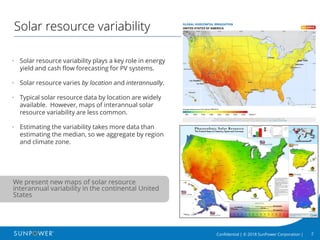
• Solar resource variability plays a key role in energy
yield and cash flow forecasting for PV systems.
• Solar resource varies by location and interannually.
• Typical solar resource data by location are widely
available. However, maps of interannual solar
resource variability are less common.
• Estimating the variability takes more data than
estimating the median, so we aggregate by region
and climate zone.
We present new maps of solar resource
interannual variability in the continental United
States
3Confidential | © 2018 SunPower Corporation |
Data sources for GHI (global horizontal insolation)
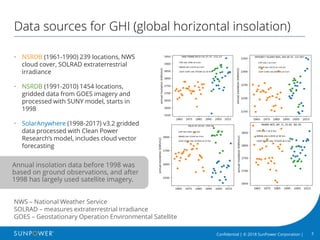
• NSRDB (1961-1990) 239 locations, NWS
cloud cover, SOLRAD extraterrestrial
irradiance
• NSRDB (1991-2010) 1454 locations,
gridded data from GOES imagery and
processed with SUNY model, starts in
1998
• SolarAnywhere (1998-2017) v3.2 gridded
data processed with Clean Power
Research’s model, includes cloud vector
forecasting
NWS – National Weather Service
SOLRAD – measures extraterrestrial irradiance
GOES – Geostationary Operation Environmental Satellite
Annual insolation data before 1998 was
based on ground observations, and after
1998 has largely used satellite imagery.
4Confidential | © 2018 SunPower Corporation |
How many samples?
• For sites in the United States we have about
20 years of satellite-based insolation data
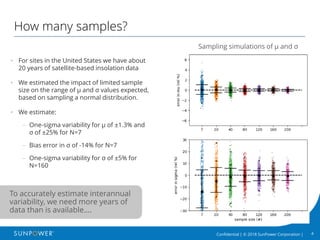
• We estimated the impact of limited sample
size on the range of µ and σ values expected,
based on sampling a normal distribution.
• We estimate:
– One-sigma variability for µ of ±1.3% and
σ of ±25% for N=7
– Bias error in σ of -14% for N=7
– One-sigma variability for σ of ±5% for
N=160
To accurately estimate interannual
variability, we need more years of
data than is available….
Sampling simulations of µ and σ
5Confidential | © 2018 SunPower Corporation |
Aggregation method
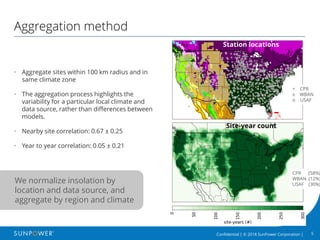
• Aggregate sites within 100 km radius and in
same climate zone
• The aggregation process highlights the
variability for a particular local climate and
data source, rather than differences between
models.
• Nearby site correlation: 0.67 ± 0.25
• Year to year correlation: 0.05 ± 0.21
We normalize insolation by
location and data source, and
aggregate by region and climate
Station locations
+ CPR
x WBAN
o USAF
Site-year count
CPR (58%)
WBAN (12%)
USAF (30%)
6Confidential | © 2018 SunPower Corporation |
Group by climate zone
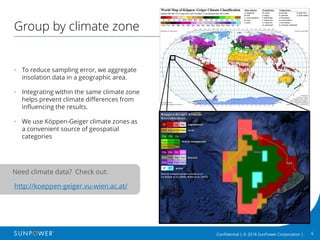
• To reduce sampling error, we aggregate
insolation data in a geographic area.
• Integrating within the same climate zone
helps prevent climate differences from
influencing the results.
• We use Köppen-Geiger climate zones as
a convenient source of geospatial
categories
Need climate data? Check out:
http://koeppen-geiger.vu-wien.ac.at/
7Confidential | © 2018 SunPower Corporation |
Insolation variability by climate zone
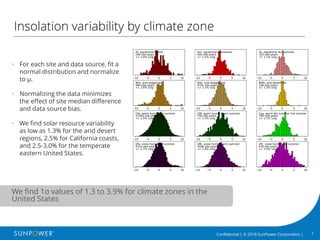
• For each site and data source, fit a
normal distribution and normalize
to µ.
• Normalizing the data minimizes
the effect of site median difference
and data source bias.
• We find solar resource variability
as low as 1.3% for the arid desert
regions, 2.5% for California coasts,
and 2.5-3.0% for the temperate
eastern United States.
We find 1σ values of 1.3 to 3.9% for climate zones in the
United States
8Confidential | © 2018 SunPower Corporation |
Median solar resource map
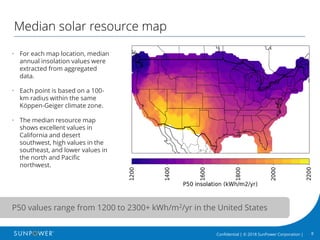
• For each map location, median
annual insolation values were
extracted from aggregated
data.
• Each point is based on a 100-
km radius within the same
Köppen-Geiger climate zone.
• The median resource map
shows excellent values in
California and desert
southwest, high values in the
southeast, and lower values in
the north and Pacific
northwest.
P50 values range from 1200 to 2300+ kWh/m2/yr in the United States
9Confidential | © 2018 SunPower Corporation |
Variability in solar resource map
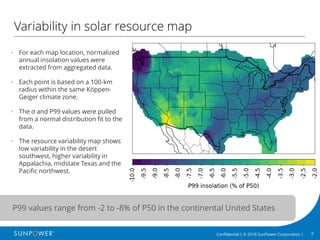
• For each map location, normalized
annual insolation values were
extracted from aggregated data.
• Each point is based on a 100-km
radius within the same Köppen-
Geiger climate zone.
• The σ and P99 values were pulled
from a normal distribution fit to the
data.
• The resource variability map shows
low variability in the desert
southwest, higher variability in
Appalachia, midstate Texas and the
Pacific northwest.
P99 values range from -2 to -8% of P50 in the continental United States
10Confidential | © 2018 SunPower Corporation |
Comparison with previous work
Variability estimates will continue to improve as we
accumulate more insolation data!
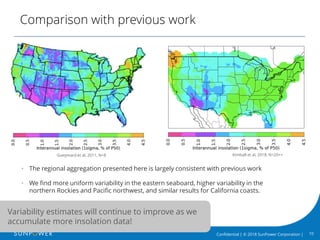
Gueymard et al, 2011, N=8 Kimball et al, 2018, N=20++
• The regional aggregation presented here is largely consistent with previous work
• We find more uniform variability in the eastern seaboard, higher variability in the
northern Rockies and Pacific northwest, and similar results for California coasts.
11Confidential | © 2018 SunPower Corporation |
Future work
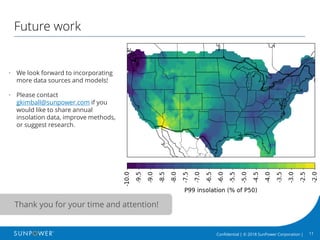
• We look forward to incorporating
more data sources and models!
• Please contact
gkimball@sunpower.com if you
would like to share annual
insolation data, improve methods,
or suggest research.
Thank you for your time and attention!
Confidential | © 2018 SunPower Corporation
Thank you!

Inter annual insolation variability (solar resource)

  • 1.
    Confidential | ©2018 SunPower Corporation Improved model of solar resource variability based on aggregation by region and climate zone Gregory M. Kimball1, Chetan Chaudhari1, Patrick Keelin2, John Dise2, Mark Grammatico2, Ben Bourne1 1Sunpower Corporation, 77 Rio Robles, San Jose, USA 2Clean Power Research, Napa, CA 94559, USA WCPEC-7 Area 9: Solar Resource, Wed Jun 13, 2:00p #808
  • 2.
    2Confidential | ©2018 SunPower Corporation | Solar resource variability • Solar resource variability plays a key role in energy yield and cash flow forecasting for PV systems. • Solar resource varies by location and interannually. • Typical solar resource data by location are widely available. However, maps of interannual solar resource variability are less common. • Estimating the variability takes more data than estimating the median, so we aggregate by region and climate zone. We present new maps of solar resource interannual variability in the continental United States
  • 3.
    3Confidential | ©2018 SunPower Corporation | Data sources for GHI (global horizontal insolation) • NSRDB (1961-1990) 239 locations, NWS cloud cover, SOLRAD extraterrestrial irradiance • NSRDB (1991-2010) 1454 locations, gridded data from GOES imagery and processed with SUNY model, starts in 1998 • SolarAnywhere (1998-2017) v3.2 gridded data processed with Clean Power Research’s model, includes cloud vector forecasting NWS – National Weather Service SOLRAD – measures extraterrestrial irradiance GOES – Geostationary Operation Environmental Satellite Annual insolation data before 1998 was based on ground observations, and after 1998 has largely used satellite imagery.
  • 4.
    4Confidential | ©2018 SunPower Corporation | How many samples? • For sites in the United States we have about 20 years of satellite-based insolation data • We estimated the impact of limited sample size on the range of µ and σ values expected, based on sampling a normal distribution. • We estimate: – One-sigma variability for µ of ±1.3% and σ of ±25% for N=7 – Bias error in σ of -14% for N=7 – One-sigma variability for σ of ±5% for N=160 To accurately estimate interannual variability, we need more years of data than is available…. Sampling simulations of µ and σ
  • 5.
    5Confidential | ©2018 SunPower Corporation | Aggregation method • Aggregate sites within 100 km radius and in same climate zone • The aggregation process highlights the variability for a particular local climate and data source, rather than differences between models. • Nearby site correlation: 0.67 ± 0.25 • Year to year correlation: 0.05 ± 0.21 We normalize insolation by location and data source, and aggregate by region and climate Station locations + CPR x WBAN o USAF Site-year count CPR (58%) WBAN (12%) USAF (30%)
  • 6.
    6Confidential | ©2018 SunPower Corporation | Group by climate zone • To reduce sampling error, we aggregate insolation data in a geographic area. • Integrating within the same climate zone helps prevent climate differences from influencing the results. • We use Köppen-Geiger climate zones as a convenient source of geospatial categories Need climate data? Check out: http://koeppen-geiger.vu-wien.ac.at/
  • 7.
    7Confidential | ©2018 SunPower Corporation | Insolation variability by climate zone • For each site and data source, fit a normal distribution and normalize to µ. • Normalizing the data minimizes the effect of site median difference and data source bias. • We find solar resource variability as low as 1.3% for the arid desert regions, 2.5% for California coasts, and 2.5-3.0% for the temperate eastern United States. We find 1σ values of 1.3 to 3.9% for climate zones in the United States
  • 8.
    8Confidential | ©2018 SunPower Corporation | Median solar resource map • For each map location, median annual insolation values were extracted from aggregated data. • Each point is based on a 100- km radius within the same Köppen-Geiger climate zone. • The median resource map shows excellent values in California and desert southwest, high values in the southeast, and lower values in the north and Pacific northwest. P50 values range from 1200 to 2300+ kWh/m2/yr in the United States
  • 9.
    9Confidential | ©2018 SunPower Corporation | Variability in solar resource map • For each map location, normalized annual insolation values were extracted from aggregated data. • Each point is based on a 100-km radius within the same Köppen- Geiger climate zone. • The σ and P99 values were pulled from a normal distribution fit to the data. • The resource variability map shows low variability in the desert southwest, higher variability in Appalachia, midstate Texas and the Pacific northwest. P99 values range from -2 to -8% of P50 in the continental United States
  • 10.
    10Confidential | ©2018 SunPower Corporation | Comparison with previous work Variability estimates will continue to improve as we accumulate more insolation data! Gueymard et al, 2011, N=8 Kimball et al, 2018, N=20++ • The regional aggregation presented here is largely consistent with previous work • We find more uniform variability in the eastern seaboard, higher variability in the northern Rockies and Pacific northwest, and similar results for California coasts.
  • 11.
    11Confidential | ©2018 SunPower Corporation | Future work • We look forward to incorporating more data sources and models! • Please contact gkimball@sunpower.com if you would like to share annual insolation data, improve methods, or suggest research. Thank you for your time and attention!
  • 12.
    Confidential | ©2018 SunPower Corporation Thank you!