West and Central Africa 2009 Regional Result Management Plan
Presentation Outline Regional Overview Structural Characteristics of the Regional Portfolio & Project Implementation Performance IFAD’s Vision for the Region Divisional Management Plan
Regional Overview of West and Central Africa 24 countries of which: 5 represent the lowest rankings in the Human Development Index 13 are in the bottom 22 in the Human Development Index 5 countries face civil war or conflict 3 are only just emerging from conflict 1/3 rd  of the area of WCA is located in the arid or semi-arid zone: drought and famine are common
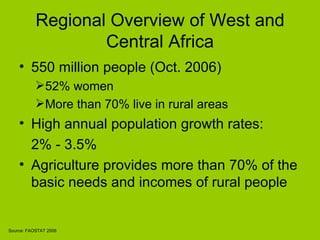
Regional Overview of West and Central Africa 550 million people (Oct. 2006) 52% women More than 70% live in rural areas High annual population growth rates: 2% - 3.5% Agriculture provides more than 70% of the basic needs and incomes of rural people Source: FAOSTAT 2006
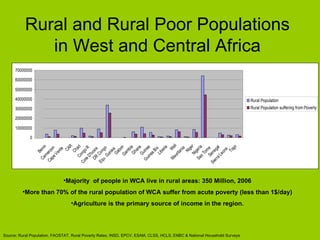
Rural and Rural Poor Populations in West and Central Africa Majority  of people in WCA live in rural areas: 350 Million, 2006 More than 70% of the rural population of WCA suffer from acute poverty (less than 1$/day) Agriculture is the primary source of income in the region. Source: Rural Population, FAOSTAT, Rural Poverty Rates,  INSD, EPCV, ESAM, CLSS, HCLS, ENBC & National Household Surveys
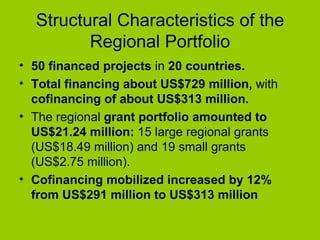
Structural Characteristics of the Regional Portfolio 50 financed projects  in  20 countries.  Total financing about US$729 million,  with  cofinancing of about US$313 million.   The regional  grant portfolio amounted to US$21.24 million:  15 large regional grants (US$18.49 million) and 19 small grants (US$2.75 million).  Cofinancing mobilized increased by 12% from US$291 million to US$313 million
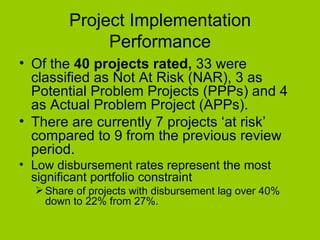
Project Implementation Performance Of the  40 projects rated,  33 were classified as Not At Risk (NAR), 3 as Potential Problem Projects (PPPs) and 4 as Actual Problem Project (APPs).  There are currently 7 projects ‘at risk’ compared to 9 from the previous review period.  Low disbursement rates represent the most significant portfolio constraint Share of projects with disbursement lag over 40% down to 22% from 27%.
IFAD’s Vision for the Region “ West Africa is enabled to lift itself out of poverty and hunger”   Achieved through promotion of innovative and effective programmes and support to policies to ensure expanded agricultural and rural development growth
Loan and Grant Programme Priorities in WCA Support the building of inclusive value chains and rural enterprises including access of the rural poor to technology and innovations to promote sustainable agricultural productivity and food security. Access of rural households and enterprises to financial services  and local, regional and international input-supply and output markets Access to natural resources (especially land and water) and maintaining the quality of the resource base for agriculture in the context of climate change Institutional development and capacity-building
Divisional Management Plan Better programme design Better project design Better project implementation Knowledge management and innovation Partnership within & outside IFAD
Better Programme Design 4 result based COSOPs to be designed in 2009 Use the CPMT approach to produce high quality COSOPs in harmony with the Paris declaration Contribute to national and regional policy generation and transformation through partnership (IFPRI, FAO, OECD, etc.)
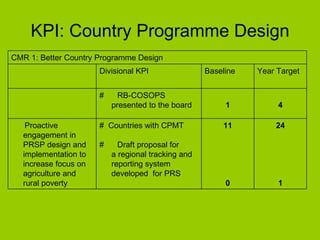
KPI: Country Programme Design 24 1 11 0 #  Countries with CPMT #  Draft proposal for a regional tracking and reporting system developed  for PRS Proactive engagement in PRSP design and implementation to increase focus on agriculture and rural poverty 4 1 #  RB-COSOPS presented to the board Year Target Baseline  Divisional KPI CMR 1: Better Country Programme Design
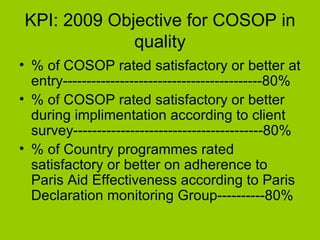
KPI: 2009 Objective for COSOP in quality % of COSOP rated satisfactory or better at entry------------------------------------------80% % of COSOP rated satisfactory or better during implimentation according to client survey----------------------------------------80% % of Country programmes rated satisfactory or better on adherence to Paris Aid Effectiveness according to Paris Declaration monitoring Group----------80%
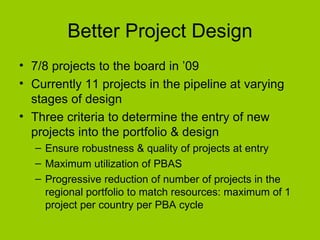
Better Project Design 7/8 projects to the board in ’09 Currently 11 projects in the pipeline at varying stages of design  Three criteria to determine the entry of new projects into the portfolio & design Ensure robustness & quality of projects at entry Maximum utilization of PBAS Progressive reduction of number of projects in the regional portfolio to match resources: maximum of 1 project per country per PBA cycle
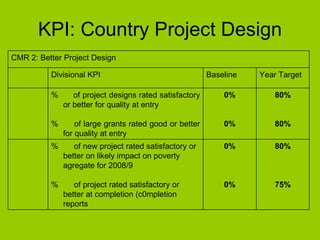
KPI: Country Project Design 80% 75% 0% 0% %  of new project rated satisfactory or better on likely impact on poverty agregate for 2008/9 %  of project rated satisfactory or better at completion (c0mpletion reports 80% 80% 0% 0% %  of project designs rated satisfactory or better for quality at entry %  of large grants rated good or better for quality at entry  Year Target Baseline  Divisional KPI CMR 2: Better Project Design
Better Project Implementation Areas of focus Reduction and eventual removal of projects  at risk Reduction of implementation problems, especially relating to:  Disbursement rating Counterpart funds M&E  Project management
Better Project Implementation Improve development effectiveness by: Taking over supervision of projects:  3 projects directly supervised in 2006,  12 in 2007, 23 in 2008, 35 in 2009, all projects in 2010 Increasing the country presence Outposting of CPMs (starting with Senegal and Ghana in 2009; Newly established portofolio suport unit  Divisional dashboard to monitor portfolio performance
KPI: Country project implementation Average time from project effectiveness to approval-----------------------------13 months % of projects with supervision rating satisfactory or better (sup. Reports---80% Pro-activity index--------------------------70% Project at risk -----------------------25% max
KPI: On Human Resource Management % of positions filed within 3 months from close of vacancy---------------------------95% Ratio of GS to Professional staff------70% Staff survey showing improvement of staff moral-----------------------------Improvement 360 degre introduced ------------------100% % of staff attendind training-----------100%
Knowledge  Management  and Innovation Expected Results: Mainstreaming of KM in country programmes and projects starting with new projects and at mid-term review Improving M&E (M&E regional grant) Learning from field experiences (Scouting innovations through supervision)
Knowledge  Management  and Innovation: Expected Results Continued… Strengthening Fidafrique and linking to ES Africa Improving the effectiveness of knowledge grants (Knowledge Grants: IITA Grants, Microfinance, Future focus on Rice, R&T, Millet/Sorghum) Improving the skills of IFAD staff and partners in supervision, implementation support, innovation and KM
Partnerships Within IFAD Closer cooperation with PF (Fidafrique, NEPAD, market access) Systematized cooperation through joint programmes with  FC, EC, EO (project information management, support implementation performance, policy) External Partners Professional organizations and Private Sector Co Financers (AfDB, WB, BSF, OPEC, BOAD, IsDB, BADEA) Policy support (OECD, IFPRI) All above: within the context of the Paris Declaration
Risk Management Civil Strife Increase project pipeline to ensure delivery Poor resource management Enforce submissions of project audit Introduce continuous audit processes where risk is high Include component on corruption in project design
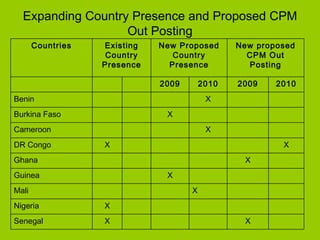
Expanding Country Presence and Proposed CPM Out Posting X X Senegal X Nigeria X Mali X Guinea X Ghana X X DR Congo X Cameroon X Burkina Faso X Benin 2010 2009 2010 2009 New proposed CPM Out Posting New Proposed Country Presence Existing Country Presence Countries

WCA Regional Result Management Plan

  • 1.
    West and CentralAfrica 2009 Regional Result Management Plan
  • 2.
    Presentation Outline RegionalOverview Structural Characteristics of the Regional Portfolio & Project Implementation Performance IFAD’s Vision for the Region Divisional Management Plan
  • 3.
    Regional Overview ofWest and Central Africa 24 countries of which: 5 represent the lowest rankings in the Human Development Index 13 are in the bottom 22 in the Human Development Index 5 countries face civil war or conflict 3 are only just emerging from conflict 1/3 rd of the area of WCA is located in the arid or semi-arid zone: drought and famine are common
  • 4.
    Regional Overview ofWest and Central Africa 550 million people (Oct. 2006) 52% women More than 70% live in rural areas High annual population growth rates: 2% - 3.5% Agriculture provides more than 70% of the basic needs and incomes of rural people Source: FAOSTAT 2006
  • 5.
    Rural and RuralPoor Populations in West and Central Africa Majority of people in WCA live in rural areas: 350 Million, 2006 More than 70% of the rural population of WCA suffer from acute poverty (less than 1$/day) Agriculture is the primary source of income in the region. Source: Rural Population, FAOSTAT, Rural Poverty Rates, INSD, EPCV, ESAM, CLSS, HCLS, ENBC & National Household Surveys
  • 6.
    Structural Characteristics ofthe Regional Portfolio 50 financed projects in 20 countries. Total financing about US$729 million, with cofinancing of about US$313 million. The regional grant portfolio amounted to US$21.24 million: 15 large regional grants (US$18.49 million) and 19 small grants (US$2.75 million). Cofinancing mobilized increased by 12% from US$291 million to US$313 million
  • 7.
    Project Implementation PerformanceOf the 40 projects rated, 33 were classified as Not At Risk (NAR), 3 as Potential Problem Projects (PPPs) and 4 as Actual Problem Project (APPs). There are currently 7 projects ‘at risk’ compared to 9 from the previous review period. Low disbursement rates represent the most significant portfolio constraint Share of projects with disbursement lag over 40% down to 22% from 27%.
  • 8.
    IFAD’s Vision forthe Region “ West Africa is enabled to lift itself out of poverty and hunger” Achieved through promotion of innovative and effective programmes and support to policies to ensure expanded agricultural and rural development growth
  • 9.
    Loan and GrantProgramme Priorities in WCA Support the building of inclusive value chains and rural enterprises including access of the rural poor to technology and innovations to promote sustainable agricultural productivity and food security. Access of rural households and enterprises to financial services and local, regional and international input-supply and output markets Access to natural resources (especially land and water) and maintaining the quality of the resource base for agriculture in the context of climate change Institutional development and capacity-building
  • 10.
    Divisional Management PlanBetter programme design Better project design Better project implementation Knowledge management and innovation Partnership within & outside IFAD
  • 11.
    Better Programme Design4 result based COSOPs to be designed in 2009 Use the CPMT approach to produce high quality COSOPs in harmony with the Paris declaration Contribute to national and regional policy generation and transformation through partnership (IFPRI, FAO, OECD, etc.)
  • 12.
    KPI: Country ProgrammeDesign 24 1 11 0 # Countries with CPMT # Draft proposal for a regional tracking and reporting system developed  for PRS Proactive engagement in PRSP design and implementation to increase focus on agriculture and rural poverty 4 1 # RB-COSOPS presented to the board Year Target Baseline Divisional KPI CMR 1: Better Country Programme Design
  • 13.
    KPI: 2009 Objectivefor COSOP in quality % of COSOP rated satisfactory or better at entry------------------------------------------80% % of COSOP rated satisfactory or better during implimentation according to client survey----------------------------------------80% % of Country programmes rated satisfactory or better on adherence to Paris Aid Effectiveness according to Paris Declaration monitoring Group----------80%
  • 14.
    Better Project Design7/8 projects to the board in ’09 Currently 11 projects in the pipeline at varying stages of design Three criteria to determine the entry of new projects into the portfolio & design Ensure robustness & quality of projects at entry Maximum utilization of PBAS Progressive reduction of number of projects in the regional portfolio to match resources: maximum of 1 project per country per PBA cycle
  • 15.
    KPI: Country ProjectDesign 80% 75% 0% 0% % of new project rated satisfactory or better on likely impact on poverty agregate for 2008/9 % of project rated satisfactory or better at completion (c0mpletion reports 80% 80% 0% 0% % of project designs rated satisfactory or better for quality at entry % of large grants rated good or better for quality at entry Year Target Baseline Divisional KPI CMR 2: Better Project Design
  • 16.
    Better Project ImplementationAreas of focus Reduction and eventual removal of projects at risk Reduction of implementation problems, especially relating to: Disbursement rating Counterpart funds M&E Project management
  • 17.
    Better Project ImplementationImprove development effectiveness by: Taking over supervision of projects: 3 projects directly supervised in 2006, 12 in 2007, 23 in 2008, 35 in 2009, all projects in 2010 Increasing the country presence Outposting of CPMs (starting with Senegal and Ghana in 2009; Newly established portofolio suport unit Divisional dashboard to monitor portfolio performance
  • 18.
    KPI: Country projectimplementation Average time from project effectiveness to approval-----------------------------13 months % of projects with supervision rating satisfactory or better (sup. Reports---80% Pro-activity index--------------------------70% Project at risk -----------------------25% max
  • 19.
    KPI: On HumanResource Management % of positions filed within 3 months from close of vacancy---------------------------95% Ratio of GS to Professional staff------70% Staff survey showing improvement of staff moral-----------------------------Improvement 360 degre introduced ------------------100% % of staff attendind training-----------100%
  • 20.
    Knowledge Management and Innovation Expected Results: Mainstreaming of KM in country programmes and projects starting with new projects and at mid-term review Improving M&E (M&E regional grant) Learning from field experiences (Scouting innovations through supervision)
  • 21.
    Knowledge Management and Innovation: Expected Results Continued… Strengthening Fidafrique and linking to ES Africa Improving the effectiveness of knowledge grants (Knowledge Grants: IITA Grants, Microfinance, Future focus on Rice, R&T, Millet/Sorghum) Improving the skills of IFAD staff and partners in supervision, implementation support, innovation and KM
  • 22.
    Partnerships Within IFADCloser cooperation with PF (Fidafrique, NEPAD, market access) Systematized cooperation through joint programmes with FC, EC, EO (project information management, support implementation performance, policy) External Partners Professional organizations and Private Sector Co Financers (AfDB, WB, BSF, OPEC, BOAD, IsDB, BADEA) Policy support (OECD, IFPRI) All above: within the context of the Paris Declaration
  • 23.
    Risk Management CivilStrife Increase project pipeline to ensure delivery Poor resource management Enforce submissions of project audit Introduce continuous audit processes where risk is high Include component on corruption in project design
  • 24.
    Expanding Country Presenceand Proposed CPM Out Posting X X Senegal X Nigeria X Mali X Guinea X Ghana X X DR Congo X Cameroon X Burkina Faso X Benin 2010 2009 2010 2009 New proposed CPM Out Posting New Proposed Country Presence Existing Country Presence Countries