
PD25888 – Business
Recovery Management
   (in 10 minutes)
Wayne Harrop MBCI MEPS, MICPEM, CBRM, CBRA
BSI BCM/1 member / RM/1 member / SSM/1 member
ISO TC223 WG-1 Workgroup member
Director – Centre for Disaster Management
E: w.harrop@coventry.ac.uk
Agenda

 Why is BS25888 being developed;
  what is it all about?
 How does it relate to BS25999?
 What are some of the key messages
  it contains?
Business Recovery Management
BRM provides an organization with a capability to recover (restore
or reconfigure) to an agreed strategic and operational equilibrium
following a single (or series of) damaging incident(s). BRM is
defined as…


“The process of rebuilding, restoring and
rehabilitating the organization following
an incident”.
Relationship with BS25999
   BRM is designed to complement the guidance and requirements
    contained within BS 25999-1:2006 and BS 25999- 2:2007

   PD25888 states…“It is necessary that an organization’s recovery
    plans interface with any incident/crisis management and business
    continuity management plans”.

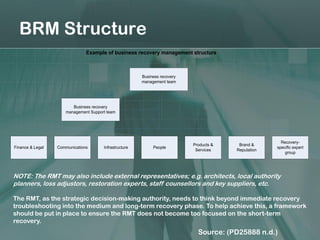
   The size and configuration of the RMT structure depends on the
    organization, which might be made up of a very small number of
    individuals or involve numerous subgroups to aid the delivery of the
    recovery strategy.
BRM Structure
                               Example of business recovery management structure


                                                       Business recovery
                                                       management team


                        Business recovery
                     management Support team


                                                                                                       Recovery-
                                                                           Products &    Brand &
Finance & Legal   Communications      Infrastructure        People                                   specific expert
                                                                            Services    Reputation
                                                                                                         group


NOTE: The RMT may also include external representatives; e.g. architects, local authority
planners, loss adjustors, restoration experts, staff counsellors and key suppliers, etc.

The RMT, as the strategic decision-making authority, needs to think beyond immediate recovery
troubleshooting into the medium and long-term recovery phase. To help achieve this, a framework
should be put in place to ensure the RMT does not become too focused on the short-term
recovery.
                                                                             Source: (PD25888 n.d.)
PD25888 Examples

Some of the issues that might be considered include:

•   Products and services: Do products/services need to be discontinued and/or new
    ones brought in?
•   Reassembling infrastructure: Do new sites need to be acquired? Does new
    technology need to be implemented?
•   Reassembling staff: Do new staff/skills need to be acquired? Do staff need to be
    moved?
•   Logistics: Do new supplies need to be sourced? Do new methods and routes of
    transportation need to be developed?
•   Contingency arrangements: Do new contingency arrangements need to be put in
    place?
•   Finance: How are actions going to be financed?
•   Legal: What are the legal and regulatory implications of any changes?


                                                          Source: ( PD25888 n.d.)
Situation Assessments

The situation assessment should inform the strategic decisions
that need to be taken by the RMT. Some of these might include:

   redirection of resources;
   re-evaluation of priorities;
   re-evaluation of policies/strategies;
   communication decisions.
The End

PD25888: Recovery Planning

  • 1.
    PD25888 – Business RecoveryManagement (in 10 minutes) Wayne Harrop MBCI MEPS, MICPEM, CBRM, CBRA BSI BCM/1 member / RM/1 member / SSM/1 member ISO TC223 WG-1 Workgroup member Director – Centre for Disaster Management E: w.harrop@coventry.ac.uk
  • 2.
    Agenda  Why isBS25888 being developed; what is it all about?  How does it relate to BS25999?  What are some of the key messages it contains?
  • 3.
    Business Recovery Management BRMprovides an organization with a capability to recover (restore or reconfigure) to an agreed strategic and operational equilibrium following a single (or series of) damaging incident(s). BRM is defined as… “The process of rebuilding, restoring and rehabilitating the organization following an incident”.
  • 4.
    Relationship with BS25999  BRM is designed to complement the guidance and requirements contained within BS 25999-1:2006 and BS 25999- 2:2007  PD25888 states…“It is necessary that an organization’s recovery plans interface with any incident/crisis management and business continuity management plans”.  The size and configuration of the RMT structure depends on the organization, which might be made up of a very small number of individuals or involve numerous subgroups to aid the delivery of the recovery strategy.
  • 5.
    BRM Structure Example of business recovery management structure Business recovery management team Business recovery management Support team Recovery- Products & Brand & Finance & Legal Communications Infrastructure People specific expert Services Reputation group NOTE: The RMT may also include external representatives; e.g. architects, local authority planners, loss adjustors, restoration experts, staff counsellors and key suppliers, etc. The RMT, as the strategic decision-making authority, needs to think beyond immediate recovery troubleshooting into the medium and long-term recovery phase. To help achieve this, a framework should be put in place to ensure the RMT does not become too focused on the short-term recovery. Source: (PD25888 n.d.)
  • 6.
    PD25888 Examples Some ofthe issues that might be considered include: • Products and services: Do products/services need to be discontinued and/or new ones brought in? • Reassembling infrastructure: Do new sites need to be acquired? Does new technology need to be implemented? • Reassembling staff: Do new staff/skills need to be acquired? Do staff need to be moved? • Logistics: Do new supplies need to be sourced? Do new methods and routes of transportation need to be developed? • Contingency arrangements: Do new contingency arrangements need to be put in place? • Finance: How are actions going to be financed? • Legal: What are the legal and regulatory implications of any changes? Source: ( PD25888 n.d.)
  • 7.
    Situation Assessments The situationassessment should inform the strategic decisions that need to be taken by the RMT. Some of these might include:  redirection of resources;  re-evaluation of priorities;  re-evaluation of policies/strategies;  communication decisions.
  • 8.