Introduction to Waves
• Waves transfer energy and information
without transferring matter.
• Examples include water ripples and sound
waves.
• Types: Transverse and Longitudinal waves.
Describing Wave Motion
• Amplitude: Maximum displacement from the
undisturbed position.
• Wavelength: Distance between two similar
points on consecutive waves.
• Frequency: Number of waves passing a point
per second.
• Wave velocity: Speed of the wave.
Transverse & Longitudinal Waves
• Transverse waves: Vibrations perpendicular to
energy transfer.
• Longitudinal waves: Vibrations parallel to
energy transfer.
• Examples: Light (transverse) and sound
(longitudinal).
The Wave Equation
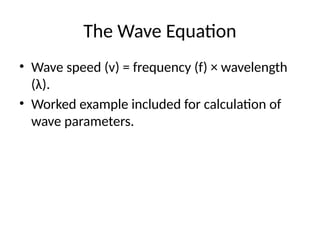
• Wave speed (v) = frequency (f) × wavelength
(λ).
• Worked example included for calculation of
wave parameters.
Measuring Wave Speed
• Method 1: Sound between two points.
• Method 2: Using echoes.
• Method 3: Using an oscilloscope.
Calculating Depth & Distance
• Using the time of reflected sound waves to
calculate depth.
• Worked examples provided.
Wave Interactions
• Reflection: Wave bounces off a surface.
• Refraction: Wave changes speed and direction
at boundaries.
• Absorption: Wave energy absorbed by
material.
Core Practical: Investigating Wave
Properties
• Experiment 1: Water waves in a ripple tank.
• Experiment 2: Stationary waves on a vibrating
string.
• Key safety considerations.

waves brief description for students gcse

  • 1.
    Introduction to Waves •Waves transfer energy and information without transferring matter. • Examples include water ripples and sound waves. • Types: Transverse and Longitudinal waves.
  • 2.
    Describing Wave Motion •Amplitude: Maximum displacement from the undisturbed position. • Wavelength: Distance between two similar points on consecutive waves. • Frequency: Number of waves passing a point per second. • Wave velocity: Speed of the wave.
  • 3.
    Transverse & LongitudinalWaves • Transverse waves: Vibrations perpendicular to energy transfer. • Longitudinal waves: Vibrations parallel to energy transfer. • Examples: Light (transverse) and sound (longitudinal).
  • 4.
    The Wave Equation •Wave speed (v) = frequency (f) × wavelength (λ). • Worked example included for calculation of wave parameters.
  • 5.
    Measuring Wave Speed •Method 1: Sound between two points. • Method 2: Using echoes. • Method 3: Using an oscilloscope.
  • 6.
    Calculating Depth &Distance • Using the time of reflected sound waves to calculate depth. • Worked examples provided.
  • 7.
    Wave Interactions • Reflection:Wave bounces off a surface. • Refraction: Wave changes speed and direction at boundaries. • Absorption: Wave energy absorbed by material.
  • 8.
    Core Practical: InvestigatingWave Properties • Experiment 1: Water waves in a ripple tank. • Experiment 2: Stationary waves on a vibrating string. • Key safety considerations.