Whatapp Messanger,
 Instant Messaging.
 Proerietary Liecence.
 Cross-platform.
 Subscription Based.
 Used on Smartphones.
 Utilizes Data.
SOFTWARRE SPECIFICATION
Developer(s): WhatsApp Inc.
Stable Release: Android version :APK v2.17.32.32
Type : Instant Messaging
Website : whatsapp.com
ACHIVEMENTS
WhatsApp tops the list with over 1 billion
monthly active users.
 All over the world and is used in 109 countries,
or 55.6 percent of the world.
1 billion messages a day is a significant
milestone.
FEATURES
Multimedia
Group chat
 No international charges
 No need to log in/out
 No need to add buddies
 And much more
HISTORY
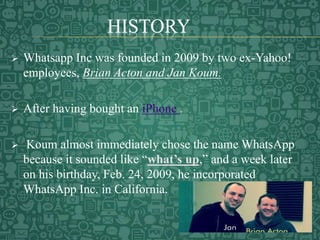
 Whatsapp Inc was founded in 2009 by two ex-Yahoo!
employees, Brian Acton and Jan Koum.
 After having bought an iPhone .
 Koum almost immediately chose the name WhatsApp
because it sounded like “what’s up,” and a week later
on his birthday, Feb. 24, 2009, he incorporated
WhatsApp Inc. in California.
HOW IT WORKS?
 It’s messaging app which allows you to exchange
messages without having to pay for SMS.
 Users can create groups, send each other unlimited
images, video and audio messages and etc.
 Technical specifies-A customized version.
Developed for Third Generation IC
Integrated smartphones
DOWNLOADING AND INSTALLING
PROTOCOL USED
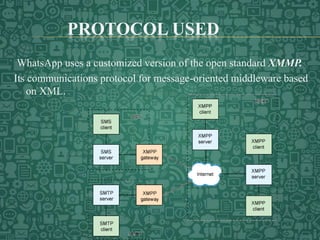
WhatsApp uses a customized version of the open standard XMMP.
Its communications protocol for message-oriented middleware based
on XML.
XMPP
XMPP is defined in an open standard and uses an
open systems approach of development and
application, by which anyone may implement an
XMPP service and interoperate with other
organizations' implementations.
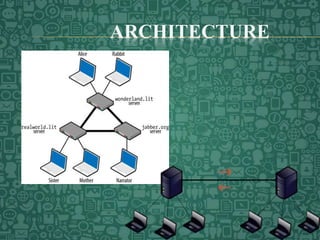
ARCHITECTURE
 XML - XMPP is essentially a technology for
transmitting XML.
 Instant Messaging - The messages are the most
important part of any instant messenger system
 MD5 - It has been utilized in a wide variety of
cryptographic applications, and is also commonly
used to verify data integrity
SECURE COMMUNICATION
The XMPP communications between clients and
servers are safely implemented mainly through
two mechanisms:
1. TLS protocol applied to the transport
layer protocol .
2. SASL layer applied to the Simple
Authentication and Security.
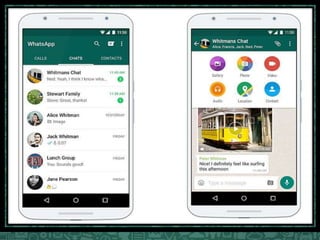
FEATURES OF WHATSAPP
Sending Places
Group Icon
Group chat
Media transfer:
Message delivery receipts
Call and video call
FUTURE SCOPE
LATEST UPDATES
 In the past year or two, there have been a lot of major
WhatsApp updates, like the addition of video calling, end-
to-end encryption, voicemail, tons of new emoji, Google
Drive backups and the end of the subscription fee. And
now, you can convert videos into GIFs, share them and
search for them on Giphy.
CONCLUSION
 Whatsapp is a famous and popular messaging
application around the world using for personal
media.
 Allow easy messaging as text ,send a video, audio
and image to retrieve and allow user to search for a
particular record .
 H storage of internal memory have large to store
the data retrieve. As size of data very large and
need special data structure for storing and indexing
THANK YOU

Watsup ppt

  • 3.
    Whatapp Messanger,  InstantMessaging.  Proerietary Liecence.  Cross-platform.  Subscription Based.  Used on Smartphones.  Utilizes Data.
  • 4.
    SOFTWARRE SPECIFICATION Developer(s): WhatsAppInc. Stable Release: Android version :APK v2.17.32.32 Type : Instant Messaging Website : whatsapp.com
  • 5.
    ACHIVEMENTS WhatsApp tops thelist with over 1 billion monthly active users.  All over the world and is used in 109 countries, or 55.6 percent of the world. 1 billion messages a day is a significant milestone.
  • 6.
    FEATURES Multimedia Group chat  Nointernational charges  No need to log in/out  No need to add buddies  And much more
  • 7.
    HISTORY  Whatsapp Incwas founded in 2009 by two ex-Yahoo! employees, Brian Acton and Jan Koum.  After having bought an iPhone .  Koum almost immediately chose the name WhatsApp because it sounded like “what’s up,” and a week later on his birthday, Feb. 24, 2009, he incorporated WhatsApp Inc. in California.
  • 8.
    HOW IT WORKS? It’s messaging app which allows you to exchange messages without having to pay for SMS.  Users can create groups, send each other unlimited images, video and audio messages and etc.  Technical specifies-A customized version. Developed for Third Generation IC Integrated smartphones
  • 9.
  • 11.
    PROTOCOL USED WhatsApp usesa customized version of the open standard XMMP. Its communications protocol for message-oriented middleware based on XML.
  • 12.
    XMPP XMPP is definedin an open standard and uses an open systems approach of development and application, by which anyone may implement an XMPP service and interoperate with other organizations' implementations.
  • 13.
  • 14.
     XML -XMPP is essentially a technology for transmitting XML.  Instant Messaging - The messages are the most important part of any instant messenger system  MD5 - It has been utilized in a wide variety of cryptographic applications, and is also commonly used to verify data integrity
  • 15.
    SECURE COMMUNICATION The XMPPcommunications between clients and servers are safely implemented mainly through two mechanisms: 1. TLS protocol applied to the transport layer protocol . 2. SASL layer applied to the Simple Authentication and Security.
  • 16.
    FEATURES OF WHATSAPP SendingPlaces Group Icon Group chat Media transfer: Message delivery receipts Call and video call
  • 17.
  • 18.
    LATEST UPDATES  Inthe past year or two, there have been a lot of major WhatsApp updates, like the addition of video calling, end- to-end encryption, voicemail, tons of new emoji, Google Drive backups and the end of the subscription fee. And now, you can convert videos into GIFs, share them and search for them on Giphy.
  • 19.
    CONCLUSION  Whatsapp isa famous and popular messaging application around the world using for personal media.  Allow easy messaging as text ,send a video, audio and image to retrieve and allow user to search for a particular record .  H storage of internal memory have large to store the data retrieve. As size of data very large and need special data structure for storing and indexing
  • 21.