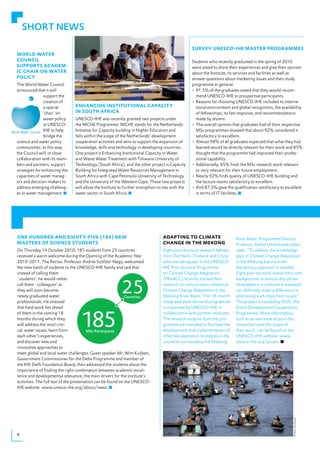
INTERVIEW | Unilever: “Changing mentalities”
 FIELD REPORT | Pakistan floods and their causes
 IN FOCUS | Educational partners sign agreement
 ONLINE | Hope in a changing climate


UPDATE
MAGAZINE UNESCO-IHE INSTITUTE FOR WATER EDUCATION


                                                   2011
                                                   JANUARY


                                                             1
EDITORIAL                                        Welcome to the January issue of UPDATE Magazine.
                                                     Allow me to take you back to the beginning of the year 2010
                                                     when the Institute was on the brink of an Institute-wide
                                                     informal consultation process with a view towards building
                                                     consensus concerning a step-by-step comprehensive reform
                                                     process of the Institute.

                                                     At recently held board meetings in Delft, the IHE Delft
                                                     Foundation Board and the UNESCO-IHE Governing Board
                                                     endorsed the need for a new response strategy to further increase
                                                     the impact of UNESCO-IHE in meeting the challenges of the
                                                     rapidly expanding global, regional and national needs of the
                                                     water sector in terms of human resources, relevant knowledge
                                                     and institutional effectiveness.

                                                     New players and potential competitors have appeared. With a
                                                     growing market for water education, these new challenges will
                                                     require a 300 percent increase in the number of water leaders in
                                                     Africa, 250 percent in Asia and 50 percent in Latin America.

                                                     The Institute has reached its delivery limits in Delft. The 8/10
                                                     syndrome whereby eight out of ten qualified candidates were
                                                     not admitted each academic year entails that annually 1800
ARE YOU AN                                           potential students are not admitted due to the lack of resources,
                                                     including that of physical space. Clearly, the 1800 aspiring
ALUMNUS?
                                                     young professionals cannot all be brought to Delft at the same
We are living in an international                    time. But perhaps we could bring Delft, or rather the spirit and
world where email is the fastest                     the water knowledge of Delft, to the world, particularly to the
way of keeping in touch across                       developing world where most of the pressing water issues are,
the globe. UNESCO-IHE follows                        whether one speaks of Africa, Asia or Latin America.
this trend and we are increasingly
sending you information by email.                    Working closely with partners who operate in the context of
Do not hesitate to get in touch                      the Institute is an important mechanism for the institute to
with us and send us your most                        fulfil its functions. The signing of a vision document with 18
up-to-date contact details. Your                     key educational institutes in the world recently paves the way
details will only be used to send                    forward towards achieving our ambitious mandate. In the
you information about UNESCO-                        coming months we will present a ‘Comprehensive Strategy
IHE. We will respect your privacy                    for UNESCO-IHE 2010-2020’ that will guide the process
at all times and will not share your                 that lies ahead. Your invaluable comments and support in this
information with others without                      transitional period will be highly appreciated.
your prior consent.
                                                     Professor András Szöllösi-Nagy
                                                     Rector, UNESCO-IHE


editorial board           graphic design             In UPDATE freedom of expression and opinion           about the magazine                                   unesco-ihe institute for water education
András Szöllösi-Nagy      Peter Stroo                is encouraged. Opinions need to be expressed          UNESCO-IHE Institute for Water Education             UNESCO-IHE is the largest international
Joop de Schutter          Manuela Porceddu           fully and clearly in the content. It should also be   produces a biennial magazine called UPDATE.          postgraduate water education institute in the
Erwin Ploeger                                        clear whose opinion the article represents. The       We print 12,000 free copies per issue, which         world and the only institution in the UN system
                          print                      Editorial Committee reserves the right to refrain     are sent to our counterparts across the world.       authorised to confer accredited MSc degrees and
editorial committee       Prints & Proms/Rotterdam   from publishing articles, editorial contributions     UPDATE features institutional information            promote PhDs. The mission of UNESCO-IHE
Jan Herman Koster                                    and letters to the editor or to publish them in       related to water education, research and capacity    is to contribute to the education and training
Ann van Griensven         published by unesco-ihe    consultation with the author.                         development activities undertaken by UNESCO-         of professionals and to develop the capacity of
Henk Lubberding           PO Box 3015                The Editorial Commitee encourages editorial           IHE, its alumni and partners.                        sector organisations, knowledge centres and
                          2601 DA Delft              contributions from readers. The sections known        We have tried to make this issue of UPDATE           other institutions active in the fields of water, the
editor-in-chief           The Netherlands            as The Column, Op-Ed and Report from the              Magazine as eco-friendly as possible. The paper,     environment and infrastructure, in developing
Alida Pham                                           Field are intended to provide a platform for such     Cocoon Offset, is a high-quality, uncoated offset    countries and countries in transition.
                          t +31 15 215 1715          contributions. Please note that editorial sections    paper. The range is produced using ecological        Since 1957, the Institute has provided
editorial                 f +31 15 212 2921          are subject to change.                                technology at the company’s Greenfield S.A.S.        postgraduate education to over 14,500 water
contributions             e info@unesco-ihe.org      UPDATE Magazine is interested in hearing more         mill in France from 100%-recycled and                professionals from 162 countries, the vast
Abraham Mehari Haile      i www.unesco-ihe.org       from the Institute’s alumni, especially about         FSC-certified de-inked pulp. The plastic that        majority of whom come from the developing
Ellen Brandenburg                                    projects they are currently undertaking and the       is used to cover UPDATE Magazine is made             world. Currently over 100 candidates are
Ewoud Kok                                            organisations to which they are affiliated. Please    of environmentally biodegradable polymers            registered PhD fellows, and numerous research
Arthur Mynett                                        send your updates to the editor by sending an         by the company A.V.I. B.V. in Volendam, the          and capacity development projects are carried
Michael van der Valk                                 email to update@unesco-ihe.org.                       Netherlands.                                         out throughout the world.
Jehangir Shah
Maria Sorrentino                                     about the cover photo
Laura Kwak                                           A woman waters young seedlings at the Burka Jalala Tree nursery in the Deder district in the Eastern Highlands in Ethiopia. The area is a community
                                                     plantation site, which has been developed in order to provide trees for the regeneration of a badly eroded local hilly area. Photo: Panos/Crispin Hughes
2
CONTENTS
                                                                                                 6

 6 | Interview with John Verbakel, Vice-
     President Supply Chain at Unilever about
     changing mentalities.
12 | Flood Resilience: Advancing scientific
     knowledge and practical application to
     manage floods in urban areas


                      12                              13
                                                           13 | Pakistan floods and their causes, a report
                                                                from the field

                                                           14 | Interview with Jude Mathooko, Professor
                                                                of Aquatic Science at Egerton University in
                                                                Kenya about partnership, joint education
                                                                programmes and limnology

                      14                              16   16 | Presenting representatives from 19
                                                                universities, research institutes and
                                                                international entities as part of the
                                                                UNESCO-IHE Global Partnership for Water
                                                                Education and Research


                                                            4|    Short news
                                                            9|    Interview Arjen Hoekstra
                                                            9|    Column
                                                           10 |   New Beadle & Mace
                                                           11 |   Interview Alumnus
                                                           15 |   Partnership agreement
                                                           18 |   Partners AIT & ICID
  ALUMNI TRACER SURVEY                                     20 |   Capacity Development Lake Victoria
  In an effort to better understand the relevance          22 |   Capacity Development Mediterranean
  and impact of our study programmes, and in
  view of further improving our services for future
                                                           23 |   Opinion
  generations of water professionals, we ask all           24 |   Alumni Refresher Seminars
  alumni of (UNESCO-)IHE to participate in a tracer
  survey. The survey contains questions about the
                                                           26 |   Past events
  educational profile, career development, and             28 |   Staff news
  professional networks of alumni. Ten book
  coupons of US$300,- will be made available
                                                           29 |   Online water resources
  for ten randomly selected respondents. Visit             31 |   Course information 2011
  www.unesco-ihe.org/alumnisurvey to take part.
                                                           32 |   New publications                            3
SHORT NEWS

                                                                                                  sURveY UNesCo-ihe mAsteR pRogRAmmes
WoRld WAteR
CoUNCil                                                                                           Students who recently graduated in the spring of 2010
sUppoRts ACAdem-                                                                                  were asked to share their experiences and give their opinion
iC ChAiR oN WAteR                                                                                 about the Institute, its services and facilities as well as
poliCY                                                                                            answer questions about marketing issues and their study
The World Water Council                                                                           programme in general.
announced that it will                                                                            •	91.5%	of	the	graduates	stated	that	they	would	recom-
                support the                                                                         mend UNESCO-IHE to prospective participants.
                creation of                                                                       •	Reasons	for	choosing	UNESCO-IHE	included	its	interna-
                a special      eNhANCiNg iNstitUtioNAl CApACitY                                     tional environment and global recognition, the availability
                ‘chair’ on     iN soUth AfRiCA                                                      of fellowships, its fast response, and recommendations
                water policy   UNESCO-IHE was recently granted two projects under                   made by alumni.
                at UNESCO-     the NICHE Programme. NICHE stands for the Netherlands              •	The	overall	opinion	that	graduates	had	of	their	respective	
                IHE to help    Initiative for Capacity building in Higher Education and             MSc	programmes	showed	that	about	92%	considered	it	
                bridge the     falls within the scope of the Netherlands’ development               satisfactory to excellent.
science and water policy       cooperation activities and aims to support the expansion of        •	Almost	98%	of	all	graduates	expected	that	what	they	had	
communities. In this way       knowledge, skills and technology in developing countries.            learned	would	be	directly	relevant	for	their	work	and	85%	
the Council will, in close     One project is Enhancing Institutional Capacity in Water             thought that the programme had improved their profes-
collaboration with its mem-    and Waste Water Treatment with Tshwane University of                 sional capability.
bers and partners, support     Technology (South Africa), and the other project is Capacity       •	Additionally,	85%	finds	the	MSc	research	work	relevant	
strategies for enhancing the   Building for Integrated Water Resources Management in                or very relevant for their future employment.
capacities of water manag-     South Africa with Cape Peninsula University of Technology          •	Nearly	92%	finds	quality	of	UNESCO-IHE	building	and	
ers and decision-makers to     and the University of the Western Cape. These two projects           the lecture rooms satisfactory to excellent.
address emerging challeng-     will allow the Institute to further strengthen its ties with the   •	And	87.5%	gave	the	qualification	satisfactory	to	excellent	
es in water management.        water sector in South Africa.                                        in terms of IT facilities.


oNe hUNdRed ANd eightY-five (185) NeW                                            AdAptiNg to ClimAte                      River Basin. Programme Director
mAsteRs of sCieNCe stUdeNts                                                      ChANge iN the mekoNg                     Professor Stefan Uhlenbrook elabo-
On Thursday 14 October 2010, 185 students from 25 countries                      Eight post-doctoral research fellows     rates: “To address the knowledge
received a warm welcome during the Opening of the Academic Year                  from Viet Nam, Thailand and China        gaps in Climate Change Adaptation
2010-2011. The Rector, Professor András Szöllösi-Nagy, welcomed                  who are taking part in the UNESCO-       in the Mekong basin a multi-
the new batch of students to the UNESCO-IHE family and said that                 IHE Post-doctoral Programme              disciplinary approach is needed.
instead of calling them                                                          on Climate Change Adaptation             Eight post-doctoral researchers with
`students’, he would rather                                                      (PRoACC) recently started their          backgrounds in various disciplines
call them `colleagues’ as                                                        research on various topics related to    embedded in a coherent framework
they will soon become                                                            Climate Change Adaptation in the         can definitely make a difference in
newly graduated water                                                            Mekong River Basin. This 18-month        addressing such important issues.”
professionals. He stressed                                                       integrated post-doctoral programme       The project is funded by DGIS, the
that hard work lies ahead                                                        is organised by UNESCO-IHE in            Dutch Development Cooperation
of them in the coming 18                                                         collaboration with partner institutes.   Programme. More information,
months during which they                                                         The research outputs from the pro-       such as an overview of post-doc
will address the most criti-                                                     gramme are intended to facilitate the    researchers and the scope of
cal water issues, learn from                                                     development and implementation of        their work, can be found on the
each other’s experiences,                                                        effective adaptation strategies in the   UNESCO-IHE website: www.
and discover new and                                                             countries surrounding the Mekong         unesco-ihe.org/proacc.
innovative approaches to
meet global and local water challenges. Guest speaker Mr. Wim Kuijken,
Government Commissioner for the Delta Programme and member of
the IHE Delft Foundation Board, then addressed the students about the
importance of finding the right combination between academic excel-
lence and developmental relevance; the main drivers for the institute’s
activities. The full text of the presentation can be found on the UNESCO-
IHE website: www.unesco-ihe.org/about/news.
                                                                                                                                                         © Panos, Chris Stowers


4
eRAsmUs mUNdUs
                                                                                                                                             sCholARships

                                                                                                                                                 Starting in 2011,
                                                                                                                                                  UNESCO-IHE will
                                                                                                                                                  offer three Joint
                                                                                                                                                  Master of Science
                                                                                                                                                 programmes


                                                                                            © Panos, Tim Smith
                                                                                                                                               under the European
                                                                                                                                            Erasmus Mundus
                                                                                                                                        framework. These are the
                                                                                                                   Environmental Technology and Engineering
sUstAiNAble WAteR                                results to a wider audience, considering the                      specialisation under the MSc Programme in
mANAgemeNt iN Cities                             different development contexts and regional                       Environmental Science, and the Ecohydrology
CoNfeReNCe                                       characteristics. The Conference is being                          and Flood Risk Management specialisations un-
The Sustainable Water Management in              organised by the United Nations Office to                         der the MSc Programme in Water Science and
Cities Conference is a four-day conference       Support the International Decade for Action                       Engineering. The European Commission will
scheduled to take place in Zaragoza, Spain       ‘Water for Life’ 2005-2015, the city of                           make full fellowships for all three programmes
from	13	to	17	December	2010.	More	than	          Zaragoza in Spain, and the SWITCH con-                            available. See the website for more information
200 experts, local government officials,         sortium including both UNESCO-IHE and the                         about the partners, programme structure, and
media specialists, key water operators and       IRC International Water and Sanitation Centre.                    fellowship admission procedure.
political representatives of cities and stake-   It draws on the approaches of the SWITCH
holder groups will discuss sustainable water     project and the Learning Alliances. Some                          http://ow.ly/3moiD
management in cities. The meeting will also      specific outcomes of the meeting – especially
propose practical ways to move forward to        case studies – will be presented as part of the
meet the challenges of disseminating             World Water Day on 22 March 2011.


                                                                                                                          SHORT NEWS

NeW libRARY
CAtAlogUe sYstem                                                                    lAtest RoUNd of UNesCo-keizo obUChi felloW-
From October onwards the UNESCO-IHE                                                 ships foR YoUNg
Library presents its collection via a new                                           ReseARCheRs
platform provided by OCLC software. The          CollAboRAtioN
catalogue can be accessed online through         With                               UNESCO is calling on young researchers from developing coun-
the UNESCO-IHE website: http://www.              hidRoeX                            tries to apply for a series of grants under the UNESCO-Keizo Obuchi
unesco-ihe.org/About/Facilities/Library.         The Brazilian International        Research Fellowships Programme (UNESCO/Japan Young Researchers’
The UNESCO-IHE Library Catalogue                 Center Foundation of               Fellowships Programme) funded by Japan.
contains all the bibliographical data of the     Education, Capacity Building                                                         The programme, named in honour
Library collection including the abstracts       and Applied Research in                                                              of a former Prime Minister of Japan,
and PDF of PhD dissertations and MSc             Water (HIDROEX) and                                                                  provides twenty research fellow-
theses. Due to copyright restrictions one        UNESCO-IHE have agreed                                                               ships worth between US$6,000 –
can only access the PDFs of documents that       to jointly work towards                      United Nations  Supported by            US$10,000 each. Eligible candidates
                                                                                   Educational, Scientific and Japanese Funds-in-Trust
are contained in the Library collection on       a large capacity develop-             Cultural Organization  to UNESCO               are postgraduate researchers (holding
the UNESCO-IHE premises at Westvest              ment project in the coming                                                           a Masters degree or its equivalent) in
or through login authentication via the          four years. Activities will        four areas – the environment (with particular emphasis on water sciences),
UNESCO-IHE portal.                               include the training of            intercultural dialogue, information and communication technologies, and
The former version of the Library Catalogue      Brazilian water profession-        peaceful resolution of conflicts.
(BIBIS) will remain operational until the end    als as well as HIDROEX             Young researchers from 140 countries are invited to apply to their
of December 2010 and will be discontin-          staff members through a            respective National Commissions, which will select a maximum of two
ued after this date. UNESCO-IHE alumni           number of short courses            candidates. All applications must reach UNESCO’s Paris Headquarters by
will be provided with a new username and         and Masters of Science and         7	January	2011.	A	special	committee	comprising	experts	from	the	four	
password to access the new UNESCO-IHE            PhD programmes in various          research fields will study the applications and present the donor country
Library Catalogue upon request. Please           disciplines.                       with their short-list.
address your request to library@unesco-                                             Cecilia Tamara Avellán from Uruguay was awarded the fellowship in 2008.
ihe.org. An instruction manual of the new                                           Avellán used this fellowship in 2009 to carry out research at UNESCO-IHE
Library Catalogue is embedded in the soft-                                          in constructed wetlands for use in Uruguayan dairy farm waste waters.
ware itself under the ‘HELP’ function.


                                                                                                                                                                         5
BOARD MEMBER INTERVIEW


    UNILEVER
    “CHANGING
    MENTALITIES”


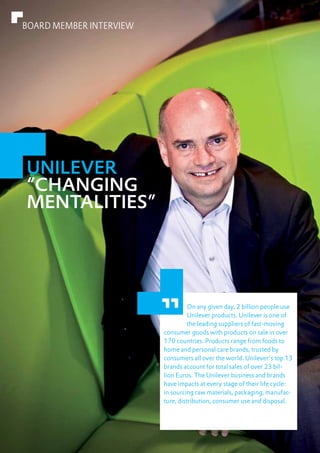
                                       On any given day, 2 billion people use
                                       Unilever products. Unilever is one of
                                       the leading suppliers of fast-moving
                             consumer goods with products on sale in over
                             170	countries.	Products	range	from	foods	to	
                             home and personal care brands, trusted by
                             consumers all over the world. Unilever’s top 13
                             brands account for total sales of over 23 bil-
                             lion Euros. The Unilever business and brands
                             have impacts at every stage of their life cycle:
                             in sourcing raw materials, packaging, manufac-
                             ture, distribution, consumer use and disposal.


6
The Unilever      “Unilever has a long tradition and great ambition in sus-             soCietY demANds CoRpoRAte RespoNsibilitY
                                            business and      tainability. We have learned that the only way to succeed             But where does Unilever draw the line in taking responsi-
                                            brands have       in this field is to work in partnership with governments,             bility for impacting the environment, climate change and
                                            impacts at        NGO’s, knowledge institutes and other companies. Unile-               economic development? “ We fully recognise the impact
                                            every stage       ver stimulates its staff to play an active role far beyond the        of our products and critically assess our entire value chain,
                                            of their life     borders of the company. As part of the Governing Board of             from the sourcing of raw materials, production and trans-
                           cycle: in sourcing raw materi-     UNESCO-IHE I can play a bridging role between the Insti-              port to consumer end-use and waste,” Verbakel elaborates.
                           als, packaging, manufacture,       tute and Unilever or other companies. Within the board,               In November 2010, the company announced the Unilever
                           distribution, consumer use and     I can perform what I call ‘reality checks’ to see if a certain        Sustainable Living Plan, to decouple growth from its envi-
                           disposal. UPDATE Magazine          concept works in a commercial environment.”                           ronmental footprint. Under the sweeping plan, by 2020,
                           interviewed John Verbakel,         Verbakel continues: “As sustainability issues become more             the company has committed to halve its environmental
                           Vice-President Supply Chain at     and more important worldwide, we need many highly                     footprint of its products; help more than 1 billion people
                           Unilever and since July 2009 a     motivated and educated people who can contribute to                   take action to improve their health and well-being and
                           member of the UNESCO-IHE           addressing these challenges. All efforts within UNESCO-               source 100% of our agricultural raw materials sustainably.
                           Governing Board about these        IHE have to focus on the continuation of being a centre of            “ This commitment follows on Unilever’s vision an-
                           developments and his commit-       academic excellence, and being able to deliver scientists             nounced by CEO Paul Polman in 2009 that Unilever will
                           ment to help Unilever get a bet-   and water professionals who can conduct state-of-the-art              double the size of the company whilst reducing its impact
                           ter understanding of the entire    research as well as top leading figures who understand how            on the environment. “ With this goal,” says Verbakel,
                           supply chain and contributing to   to apply these research outcomes in the water sector and in           “we want to be at the forefront of taking corporate social
                           making even quicker and better     communities.”                                                         responsibility. Not only do we believe in the importance of
                           innovations in the Research and                                                                          it, society also demands it.”
                           Development department.            RedUCiNg eNviRoNmeNtAl impACt                                         “ The ambition has been defined. Now we are in the
                                                              “ We spend a large amount on Research & Development,”                 process of making it happen. This is a daunting but very
                           By Ewoud Kok                       Verbakel explains. “ The budget comes close to one billion            challenging task, especially since technology plays such
                                                              US Dollars. This is not the most important factor though,             a fundamental role and the Research and Development
                                                              but rather where one puts the focus. We continuously                  department is tasked to come up with the innovative solu-
                                                              measure our impact so that we can register improvements.              tions. Luckily everyone is extremely motivated to work on
                                                              With every new product or newly built factory we have to              achieving these ambitions.”
                                                              show how we can reduce environmental impact, forcing
                                                              innovation in every little detail of what we do. This cannot          ACCoUNtAbilitY ANd metRiCs
                                                              be done all at once but gradually we have to improve our              In 2009 Unilever developed a set of metrics covering
                                                              performance.”                                                         social impacts. These metrics seek to measure the benefits
                                                                                                                                    Unilever brings to society. In the November 2010 an-
                                                              ChANgiNg meNtAlities                                                  nouncement, Unilever has put forth 50 separate metrics
                                                              “In addition, our outspoken ambition generates a snow-                addressing economic, environmental and social targets. It
                                                              ball effect. For example in the United States, the retailer           involves amongst others slashing the carbon, water and
                                                              Walmart approached us to help us co-produce environ-                  waste impact of its products in half – primarily through
                                                              mentally sound goods. In fact, we pioneered concentrated              innovation in the way the company sources, manufactures
                                                              laundry detergent and launched “Small & Mighty” with                  and packages its products.
                                                              this retailer. In 2007, Walmart announced it would sell               Verbakel noted that in 2010, the Lifebuoy hand washing
                                                              only concentrated liquid laundry detergents in its US                 soap brand became the first among the many Unilever
                                                              stores. So, if we develop more environmentally friendly               brands to pilot the new metrics, helping track the impact
                                                              products, we can partner with retailers such as Walmart               of Lifebuoy programmes on hand washing behaviours over
                                                              to help us sell those products, increasing the products’              a five-year period. The development of these metrics will
                                                              chances of success so more resources can be spent develop-            allow Unilever to track performance across all products and
                                                              ing it. Such examples generate a positive wave that really            enable the company to show consumers how their small,
                                                              changes mentalities within companies.”                                individual actions can make a big difference.
© Photo: Michel de Groot


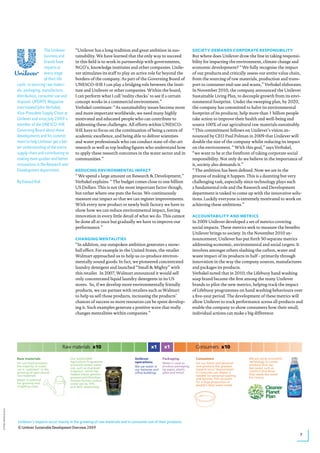
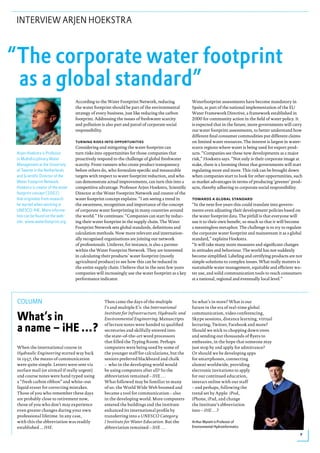
                           Unilever’s impacts occur mainly in the growing of raw materials and in consumer use of their products.
                           © Unilever Sustainable Development Overview 2009
                                                                                                                                                                                               7
Verbakel explains: “In order to be held accountable we can-    children to turn off the water tap when brushing their         a new vision
not develop our own set of rules and use internal measure-     teeth or to demonstrate the best way to wash one’s hands.      2009 saw the launch of a new
ment systems. Official recognition and the right quantifica-   We use role-model stars to make strong statements in our       vision for Unilever – to double
tion are very important in this process. UNESCO-IHE, the       commercials. We have noticed that people tend to pick up       the size of the company while
Water Footprint Network and other knowledge institutes         messages through these stars much faster than when read-       reducing the overall impact on
are instrumental in developing these measurement tools to      ing it from a government-distributed leaflet.”                 the environment. The commit-
measure high relevancy in society.”                                                                                           ment presents Unilever with a
                                                               CoNsUmeR Use                                                   major challenge. The reduction
sCARCe CommoditY                                               “In water-scarce countries, 40% of Unilever’s domestic wa-     they are talking about is an
“For the production of Unilever’s personal care products       ter footprint comes from washing clothes, usually by hand.     absolute one. It incorporates all
and (agricultural) food products much water is needed.         As an example, our Comfort One Rinse fabric conditioner        impacts right across the value
With water being such a scarce commodity we need to find       enables users to need only one bucket to rinse rather than     chain – from the sourcing of
even more innovative solutions to minimise the uptake of       three, saving time and money. Some 500 billion litres of       our raw materials through to
this resource – even though we’ve managed to reduce our        water would be saved if all our Unilever laundry product       consumer use and disposal of
own water usage in our factories by 67% since 1995. In         users in Asia and South Africa used Comfort One Rinse.         the products. In short, Unilever
the past two to three years, we have treated the measure-      “ We collaborate closely with various consumer organisa-       intends to decouple growth
ment of these figures with equal importance to our profit      tions in almost every country where we have an active          from environmental impact.
targets.”                                                      presence. Multiple assessments and polls provide us with
Verbakel explains the segmentation of the water footprint      good estimates of consumer use. Among many other               unilever facts
into three segments of the value chain: the production         companies, Unilever is an active partner within the Water      •	 Unilever	is	the	global	market	
of raw materials, the manufacturing of the products and        Footprint Network. We think that our experiences with          leader in all the Food categories
consumer use. “At the supply side (raw material) of our        the methodologies and the ways we measure should be            in which it operates: Savoury,
products, we use the concept of sustainable agriculture. For   shared with anyone, with governments and institutes but        Spreads, Dressings, Tea and
example, in 2015 all Lipton tea (the world’s best-selling      also with businesses.                                          Ice Cream. They are also global
tea brand) will be certified according to the standards set    “Sustainability is not merely a nice-to-have business          market leader in Mass Skin Care
by the Rainforest Alliance, an international environmental     feature but an integral part of all businesses. Often it is    and Deodorants, and have very
NGO. In this way, the continuous improvements in worker        difficult to share this belief with other companies, but the   strong positions in other Home
welfare, farm management and environmental protection,         trend to realise the need and importance for corporate so-     and Personal Care categories.
including wise water use is guaranteed. A similar set-up is    cial responsibility is increasing in every way, and we hope    •	 In	2009	Unilever	invested	
used in sustainable palm oil sourcing where we work with       to be a real catalyst in this regard. We don’t have all the    €891 million in Research and
GreenPalm certification. To date, 30% of our palm oil pur-     answers, but we know we must work in partnership with          Development.
chases are covered by sustainable GreenPalm certificates.      customers, suppliers, governments and Ngo’s to achieve         •	 Unilever	has	264	manufac-
“ With regard to the operations side, we have established      our goals.”                                                    turing sites worldwide. Around
a leading position in lowering CO2 production and water                                                                       50% of the raw materials that
use for many years now. Currently, with the establishment                                                                     they use for their products
of new factories in the US, we aim at zero landfill, which                                                                    originate from agriculture and
is highly stimulated by the US government. It is interest-                                                                    forestry. The company buys ap-
ing to see that also in developing countries now the most                                                                     proximately 12% of the world’s
sophisticated factories are built, mainly because of the new                                                                  black tea, 6% of its tomatoes
insights in minimal water use and zero landfill goals can                                                                     and 3% of its palm oil.
be applied.” Verbakel also noted that Unilever has been                                                                       •	 The	top	13	brands	of	
the Food Industry Leader in the Dow Jones Sustainability                                                                      Unilever account for total
World Indexes for the 12th year running.                                                                                      sales of more than €23 bil-
                                                                                                                              lion. These brands are Axe/
CoNCeNtRAted deteRgeNts                                                                                                       Lynx, Blue Band, Dove, Flora/
“On the consumer side, when taking into consideration                                                                         Becel, Heartbrand ice creams,
that per day an estimated two billion people make use of                                                                      Hellmann’s, Knorr, Lipton, Lux,
our products, the impact we leave behind is enormous,”                                                                        Omo, Rexona, Sunsilk and Surf.
says Verbakel. “One of our best practices includes the                                                                        •	 In	2009	Unilever’s	sales	
concentrated detergents, which use less energy to produce,                                                                    were €39.8 billion. Their
package and transport. In addition, this product allows                                                                       share of sales in developing
consumers to do their laundry using less water and at                                                                         and emerging markets reached
lower temperatures.                                                                                                           49% in 2009, up from 47% in
“Another example is taking responsibility in changing us-                                                                     2008. These markets include
er’s behaviour. This is a major component of the Unilever                                                                     all countries in Latin America,
Sustainable Living Plan, and we know we have much work                                                                        Central & Eastern Europe,
to do in this area to achieve our goals. We believe we’ve                                                                     Africa and Asia, except Japan
made some inroads, but have a way to go. For example, in       Water use 1995-2009 (m3/tonne of production)                   and Australia.
cooperation with local or central governments, we instruct     © Unilever Sustainable Development Overview 2009


8
INTERVIEW ARJEN HOEKSTRA


                                   According to the Water Footprint Network, reducing              Waterfootprint assessments have become mandatory in
                                   the water footprint should be part of the environmental         Spain, as part of the national implementation of the EU
                                   strategy of every business, just like reducing the carbon       Water Framework Directive, a framework established in
                                   footprint. Addressing the issues of freshwater scarcity         2000 for community action in the field of water policy. It
                                   and pollution is also part and parcel of corporate social       is expected that in the future, more governments will carry
                                   responsibility.                                                 out water footprint assessments, to better understand how
                                                                                                   different final consumer commodities put different claims
                                   turning risks into opportunities                                on limited water resources. The interest is largest in water-
                                   Considering and mitigating the water footprint can              scarce regions where water is being used for export prod-
Arjen Hoekstra is Professor        turn risks into opportunities for those companies that          ucts. “Companies see these new developments as a major
in Multidisciplinary Water         proactively respond to the challenge of global freshwater       risk,” Hoekstra says. “Not only is their corporate image at
Management at the University       scarcity. Front runners who create product transparency         stake, there is a looming threat that governments will start
of Twente in the Netherlands       before others do, who formulate specific and measurable         regulating more and more. This risk can be brought down
and Scientific Director of the     targets with respect to water footprint reduction, and who      when companies start to look for other opportunities, such
Water Footprint Network.           can demonstrate actual improvements, can turn this into a       as market advantages in terms of producing ‘greener’ prod-
Hoekstra is creator of the water   competitive advantage. Professor Arjen Hoekstra, Scientific     ucts, thereby adhering to corporate social responsibility.
footprint concept (2002)           Director at the Water Footprint Network and creator of the
that originates from research      water footprint concept explains: “I am seeing a trend in       towards a global standard
he started when working at         the awareness, recognition and importance of the concept        “In the next five years this could translate into govern-
UNESCO-IHE. More informa-          of corporate water footprinting in many countries around        ments even adjusting their development policies based on
tion can be found on the web-      the world.” He continues: “Companies can start by reduc-        the water footprint data. The pitfall is that everyone will
site: www.waterfootprint.org.      ing their water footprint in the supply chain. The Water        use it to their own benefit; so much so that it will become
                                   Footprint Network sets global standards, definitions and        a meaningless metaphor. The challenge is to try to regulate
                                   calculation methods. Now more relevant and internation-         the corporate water footprint and mainstream it as a global
                                   ally recognised organisations are joining our network           standard,” explains Hoekstra.
                                   of professionals. Unilever, for instance, is also a partner     “It will take many more measures and significant changes
                                   within the Water Footprint Network. They are interested         in attitudes and behaviour. The world has not suddenly
                                   in calculating their products’ water footprint (mostly          become simplified. Labeling and certifying products are not
                                   agricultural produce) to see how this can be reduced in         simple solutions to complex issues. What really matters is
                                   the entire supply chain. I believe that in the next few years   sustainable water management, equitable and efficient wa-
                                   companies will increasingly use the water footprint as a key    ter use, and solid communication tools to reach consumers
                                   performance indicator.                                          at a national, regional and eventually local level.”


COLUMN                                             Then came the days of the multiple              So what’s in store? What is our
                                                   I’s and multiple E’s: the International         future in the era of real-time global

What’s in                                          Institute for Infrastructure, Hydraulic and
                                                   Environmental Engineering. Manuscripts
                                                                                                   communication, video conferencing,
                                                                                                   Skype sessions, distance learning, virtual

a name – iHE …?                                    of lecture notes were handed to qualified
                                                   secretaries and skilfully entered into
                                                   the state-of-the-art word processors
                                                                                                   lecturing, Twitter, Facebook and more?
                                                                                                   Should we stick to chopping down trees
                                                                                                   and sending out thousands of flyers to
                                                   that filled the Typing Room. Perhaps            embassies, in the hope that someone may
When the international course in                   computers were being used by some of            just stop by and apply for admittance?
Hydraulic Engineering started way back             the younger staff for calculations, but the     Or should we be developing apps
in 1957, the means of communication                seniors preferred blackboard and chalk          for smartphones, connecting
were quite simple. Letters were sent via           – who in the developing world would             alumni worldwide, providing
surface mail (or airmail if really urgent)         be using computers after all? So the            electronic invitations to apply
and course notes were hand typed using             abbreviation remained – IHE …                   for our continued education,
a “fresh carbon ribbon” and white-out              What followed may be familiar to many           interact online with our staff
liquid eraser for correcting mistakes.             of us: the World Wide Web boomed and            – and perhaps, following the
Those of you who remember these days               became a tool for communication – also          trend set by Apple: iPod,
are probably close to retirement now,              in the developing world. More computers         iPhone, iPad, and change
those of you who don’t may experience              entered the buildings and the institute         the Institute’s abbreviation
even greater changes during your own               enhanced its international profile by           into – iHE …?
professional lifetime. In any case,                transferring into a UNESCO Category
with this the abbreviation was readily             I Institute for Water Education. But the        Arthur Mynett is Professor of
established ... IHE.                               abbreviation remained – IHE …                   Environmental Hydroinformatics

                                                                                                                                                              9
NEW
     BEADLE
     & MACE
     The academic scepter, or mace, was one of the
     earliest distinctive signs of medieval university
     officials. The mace was originally a wooden staff
     carried by royal messengers. The early wooden
     staff evolved in the 14th century into an elaborate
     silver mace. It was carried by the beadle during
     processions and graduation ceremonies, and was
     displayed as a symbol to command order during
     classes. In the 15th century it became symbolic of
     academic dignity.

     The UNESCO-IHE mace was hand-crafted by artist
     Hans Karreman with inlaid durable woods from
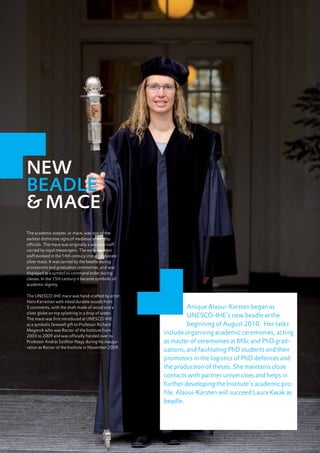
     5 continents, with the shaft made of wood and a                 Anique Alaoui-Karsten began as
     silver globe on top splashing in a drop of water.
     The mace was first introduced at UNESCO-IHE
                                                                     UNESCO-IHE’s new beadle at the
     as a symbolic farewell gift to Professor Richard                beginning of August 2010. Her tasks
     Meganck who was Rector of the Institute from
     2003 to 2009 and was officially handed over to
                                                           include organising academic ceremonies, acting
     Professor András Szöllösi-Nagy during his inaugu-     as master of ceremonies at MSc and PhD grad-
     ration as Rector of the Institute in November 2009.
                                                           uations, and facilitating PhD students and their
                                                           promotors in the logistics of PhD defences and
                                                           the production of theses. She maintains close
                                                           contacts with partner universities and helps in
                                                           further developing the Institute’s academic pro-
                                                           file. Alaoui-Karsten will succeed Laura Kwak as
                                                           beadle.


10
INTERVIEW ALUMNUS

“Knowledge is forever; no one
 can take that away from you.”
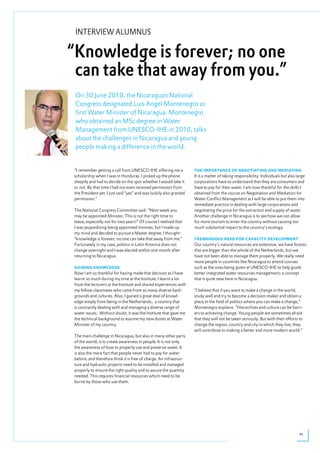
 On 30 June 2010, the Nicaraguan National
 Congress designated Luis Angel Montenegro as
 first Water Minister of Nicaragua. Montenegro
 who obtained an MSc degree in Water
 Management from UNESCO-IHE in 2010, talks
 about the challenges in Nicaragua and young
 people making a difference in the world.


 “I remember getting a call from UNESCO-IHE offering me a            the impoRtANCe of NegotiAtiNg ANd mediAtiNg
 scholarship when I was in Honduras. I picked up the phone           It is a matter of taking responsibility. Individuals but also large
 sleepily and had to decide on the spot whether I would take it      corporations have to understand that they are consumers and
 or not. By that time I had not even received permission from        have to pay for their water. I am now thankful for the skills I
 the President yet. I just said “yes” and was luckily also granted   obtained from the course on Negotiation and Mediation for
 permission.”                                                        Water Conflict Management as I will be able to put them into
                                                                     immediate practice in dealing with large corporations and
 The National Congress Committee said: “Next week you                negotiating the price for the extraction and supply of water.
 may be appointed Minister. This is not the right time to            Another challenge in Nicaragua is to see how we can allow
 leave, especially not for two years!” Of course I realised that     for more tourism to enter the country without causing too
 I was jeopardising being appointed minister, but I made up          much substantial impact to the country’s ecology.
 my mind and decided to pursue a Master degree. I thought:
 “knowledge is forever; no one can take that away from me.”          tRemeNdoUs Need foR CApACitY developmeNt
 Fortunately in my case, politics in Latin America does not          Our country’s natural resources are extensive, we have forests
 change overnight and I was elected within one month after           that are bigger than the whole of the Netherlands, but we
 returning to Nicaragua.                                             have not been able to manage them properly. We really need
                                                                     more people in countries like Nicaragua to attend courses
 gAiNiNg kNoWledge                                                   such as the ones being given at UNESCO-IHE to help guide
 Now I am so thankful for having made that decision as I have        better integrated water resources management; a concept
 learnt so much during my time at the Institute. I learnt a lot      that is quite new here in Nicaragua.
 from the lecturers at the Institute and shared experiences with
 my fellow classmates who came from so many diverse back-            “I believe that if you want to make a change in the world,
 grounds and cultures. Also, I gained a great deal of knowl-         study well and try to become a decision-maker and obtain a
 edge simply from being in the Netherlands; a country that           place in the field of politics where you can make a change,”
 is constantly dealing with and managing a diverse range of          Montenegro explains. “Hierarchies and culture can be barri-
 water issues. Without doubt, it was the Institute that gave me      ers to achieving change. Young people are sometimes afraid
 the technical background to assume my new duties as Water           that they will not be taken seriously. But with their efforts to
 Minister of my country.                                             change the region, country and city in which they live, they
                                                                     will contribute to making a better and more modern world.”
 The main challenge in Nicaragua, but also in many other parts
 of the world, is to create awareness in people. It is not only
 the awareness of how to properly use and preserve water. It
 is also the mere fact that people never had to pay for water
 before, and therefore think it is free of charge. An infrastruc-
 ture and hydraulic projects need to be installed and managed
 properly to ensure the right quality and to assure the quantity
 needed. This requires financial resources which need to be
 borne by those who use them.


                                                                                                                                    11
Urban floods cannot be managed in isolation at city scale and responses
to potential flood impacts are further complicated by overlapping politi-
cal, socio-economic and environmental changes. To reverse the trend of
increasing flood risk in urban areas, a major rethink of current planning
and flood management policies and practices at different spatial and tem-
poral scales is required.

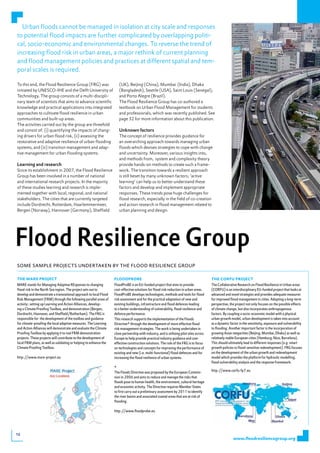
To this end, the Flood Resilience Group (FRG) was                     (UK), Beijing (China), Mumbai (India), Dhaka
initiated by UNESCO-IHE and the Delft University of                   (Bangladesh), Seattle (USA), Saint Louis (Senegal),
Technology. The group consists of a multi-discipli-                   and Porto Alegre (Brazil).
nary team of scientists that aims to advance scientific               The Flood Resilience Group has co-authored a
knowledge and practical applications into integrated                  textbook on Urban Flood Management for students
approaches to cultivate flood resilience in urban                     and professionals, which was recently published. See
communities and built-up areas.                                       page 32 for more information about this publication.
The activities carried out by the group are threefold
and consist of: (i) quantifying the impacts of chang-                 Unknown factors
ing drivers for urban flood risk, (ii) assessing the                  The concept of resilience provides guidance for
restorative and adaptive resilience of urban flooding                 an overarching approach towards managing urban
systems, and (iii) transition management and adap-                    floods which devises strategies to cope with change
tive management for urban flooding systems.                           and uncertainty. Moreover, various insights into,
                                                                      and methods from, system and complexity theory
Learning and research                                                 provide hands-on methods to create such a frame-
Since	its	establishment	in	2007,	the	Flood	Resilience	                work. The transition towards a resilient approach
Group has been involved in a number of national                       is still beset by many unknown factors; ‘active
and international research projects. In the majority                  learning’ can help us to better understand these
of these studies learning and research is imple-                      factors and develop and implement appropriate
mented together with local, regional, and national                    responses. These trends pose huge challenges for
stakeholders. The cities that are currently targeted                  flood research, especially in the field of co-creation
include Dordrecht, Rotterdam, Haarlemmermeer,                         and action research in flood management related to
Bergen (Norway), Hannover (Germany), Sheffield                        urban planning and design.


Flood Resilience Group
SOME SAMPLE PROJECTS UNDERTAKEN bY THE FLOOD RESILIENCE GROUP

the mARe pRoJeCt                                                   floodpRobe                                                             the CoRfU pRoJeCt
MARE stands for Managing Adaptive REsponses to changing            FloodProBE is an EU-funded project that aims to provide                The Collaborative Research on Flood Resilience in Urban areas
flood risk in the North Sea region. The project sets out to        cost-effective solutions for flood risk reduction in urban areas.      (CORFU) is an interdisciplinary EU-funded project that looks at
develop and demonstrate a transnational approach to local Flood    FloodProBE develops technologies, methods and tools for flood          advanced and novel strategies and provides adequate measures
Risk Management (FRM) through the following parallel areas of      risk assessment and for the practical adaptation of new and            for improved flood management in cities. Adopting a long-term
activity: setting up Learning and Action Alliances, develop-       existing buildings, infrastructure and flood defences leading          perspective, the project not only focuses on the possible effects
ing a Climate Proofing Toolbox, and demonstration (Bergen,         to a better understanding of vulnerability, flood resilience and       of climate change, but also incorporates anthropogenous
Dordrecht, Hannover, and Sheffield/Rotherham). The FRG is          defence performance.                                                   factors. By coupling a socio-economic model with a physical
responsible for the development of the toolbox and guidance        This research supports the implementation of the Floods                urban growth model, urban development is taken into account
for climate-proofing the local adaptive measures. The Learning     Directive* through the development of more effective flood             as a dynamic factor in the sensitivity, exposure and vulnerability
and Action Alliances will demonstrate and evaluate the Climate     risk management strategies. The work is being undertaken in            to flooding. Another important factor is the incorporation of
Proofing Toolbox by applying it to real FRM demonstration          close partnership with industry, and is utilising pilot sites across   growing Asian megacities (Beijing, Mumbai, Dhaka) as well as
projects. These projects will contribute to the development of     Europe to help provide practical industry guidance and cost-           relatively stable European cities (Hamburg, Nice, Barcelona).
local FRM plans, as well as validating or helping to enhance the   effective construction solutions. The role of the FRG is to focus      This should ultimately lead to different responses (e.g. smart
Climate Proofing Toolbox.                                          on technologies and concepts for improving the performance of          growth policies vs flood-sensitive redevelopment). FRG focuses
                                                                   existing and new (i.e. multi-functional) flood defences and for        on the development of the urban growth and redevelopment
http://www.mare-project.eu                                         increasing the flood resilience of urban systems.                      model which provides the platform for hydraulic modelling,
                                                                                                                                          flood vulnerability analysis and the response framework.
                                                                   *
                                                                   The Floods Directive was proposed by the European Commis-              http://www.corfu-fp7.eu
                                                                   sion in 2006 and aims to reduce and manage the risks that
                                                                   floods pose to human health, the environment, cultural heritage
                                                                   and economic activity. The Directive requires Member States
                                                                   to first carry out a preliminary assessment by 2011 to identify
                                                                   the river basins and associated coastal areas that are at risk of
                                                                   flooding.

                                                                   http://www.floodprobe.eu


12
                                                                                                                                                         www.floodresiliencegroup.org
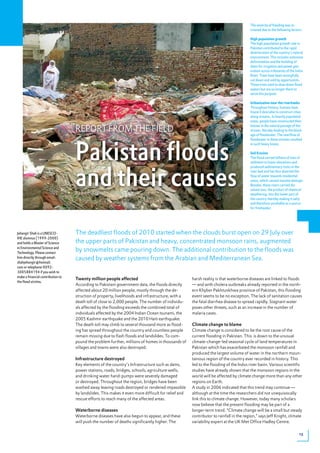
The severity of flooding was in-
                                                                                                                                       creased due to the following factors:

                                                                                                                                       High population growth
                                                                                                                                       The high population growth rate in
                                                                                                                                       Pakistan contributed to the rapid
                                                                                                                                       deterioration of the country’s natural
                                                                                                                                       environment. This includes extensive
                                                                                                                                       deforestation and the building of
                                                                                                                                       dams for irrigation and power gen-
                                                                                                                                       eration across tributaries of the Indus
                                                                                                                                       River. Trees have been wrongfully
                                                                                                                                       cut down and sold by opportunists.
                                                                                                                                       These trees used to slow down flood
                                                                                                                                       waters but are no longer there to
                                                                                                                                       serve this purpose.

                                                                                                                                       Urbanisation near the riverbanks
                                                                                                                                       Throughout history, humans have
                                                                                                                                       found it desirable to construct cities
                                                                                                                                       along streams. In heavily populated
                                                                                                                                       areas, people have constructed their

                                   REPORT FROM THE FIELD
                                                                                                                                       houses in the natural passage of the
                                                                                                                                       stream, thereby leading to the block-
                                                                                                                                       age of floodwater. The overflow of


                                   Pakistan floods
                                                                                                                                       floodwater in these streams resulted
                                                                                                                                       in such heavy losses.

                                                                                                                                       Soil Erosion
                                                                                                                                       The flood carried billions of tons of
                                                                                                                                       sediment to lower elevations and


                                   and their causes
                                                                                                                                       produced sedimentary rocks in the
                                                                                                                                       river bed and has thus diverted the
                                                                                                                                       flow of water towards residential
                                                                                                                                       areas, which caused massive damage.
                                                                                                                                       Besides, these rivers carried dis-
                                                                                                                                       solved ions, the product of chemical
                                   By Jehangir Shah                                                                                    weathering, into the lower part of
                                                                                                                                       the country thereby making it salty
                                                                                                                                       and therefore unreliable as a source
                                                                                                                                       for freshwater.


Jehangir Shah is a UNESCO-         The deadliest floods of 2010 started when the clouds burst open on 29 July over
IHE alumnus (1999-2000)
and holds a Master of Science      the upper parts of Pakistan and heavy, concentrated monsoon rains, augmented
in Environmental Science and
Technology. Please contact
                                   by snowmelts came pouring down. The additional contribution to the floods was
him directly through email:        caused by weather systems from the Arabian and Mediterranean Sea.
shahjehangir@hotmail.
com or telephone 0092-
3005884194 if you wish to
make a financial contribution to
                                   Twenty million people affected                                    harsh reality is that waterborne diseases are linked to floods
the flood victims.
                                   According to Pakistani government data, the floods directly       — and with cholera outbreaks already reported in the north-
                                   affected about 20 million people, mostly through the de-          ern Khyber Pakhtunkhwa province of Pakistan, this flooding
                                   struction of property, livelihoods and infrastructure, with a     event seems to be no exception. The lack of sanitation causes
                                   death toll of close to 2,000 people. The number of individu-      the fatal diarrhea disease to spread rapidly. Stagnant water
                                   als affected by the flooding exceeds the combined total of        poses other threats, such as an increase in the number of
                                   individuals affected by the 2004 Indian Ocean tsunami, the        malaria cases.
                                   2005 Kashmir earthquake and the 2010 Haiti earthquake.
                                   The death toll may climb to several thousand more as flood-       Climate change to blame
                                   ing has spread throughout the country and countless people        Climate change is considered to be the root cause of the
                                   remain missing due to flash floods and landslides. To com-        current flooding in Pakistan. This is down to the unusual
                                   pound the problem further, millions of homes in thousands of      climate-change-led seasonal cycle of land temperatures in
                                   villages and towns were also destroyed.                           Pakistan which has exacerbated the monsoon rainfall and
                                                                                                     produced the largest volume of water in the northern moun-
                                   Infrastructure destroyed                                          tainous region of the country ever recorded in history. This
                                   Key elements of the country’s Infrastructure such as dams,        led to the flooding of the Indus river basin. Various scientific
                                   power stations, roads, bridges, schools, agriculture wells,       studies have already shown that the monsoon regions in the
                                   and drinking water hand-pumps were severely damaged               world will be affected by climate change more than any other
                                   or destroyed. Throughout the region, bridges have been            regions on Earth.
                                   washed away leaving roads destroyed or rendered impassible        A study in 2006 indicated that this trend may continue —
                                   by landslides. This makes it even more difficult for relief and   although at the time the researchers did not unequivocally
                                   rescue efforts to reach many of the affected areas.               link this to climate change. However, today many scholars
                                                                                                     now believe that the present flooding may be part of a
                                   Waterborne diseases                                               longer-term trend. “Climate change will be a small but steady
                                   Waterborne diseases have also begun to appear, and these          contributor to rainfall in the region,” says Jeff Knight, climate
                                   will push the number of deaths significantly higher. The          variability expert at the UK Met Office Hadley Centre.

                                                                                                                                                                           13
JOINT EDUCATION

Benefiting from the knowledge ex-
change with partner institutes in the
areas of research, capacity development
and joint education programmes is in-
valuable when responding to new global
challenges. Egerton University in Kenya
is an excellent example of one of those
partner institutes with which UNESCO-
IHE has a longstanding history.


The current specialisation in Limnology and Wetland
Ecosystems is the result of a new approach towards the
training of professionals in environmental research and
education, whereby an international network was created,
and several European and East African partners have agreed


                                                                 “Only the scientist
to pursue the streamlining of selected post-graduate course
activities. The specialisation is jointly given by UNESCO-
IHE and the Austrian Academy of Sciences, in cooperation


                                                                  understands why
with Egerton University in Kenya. UPDATE Magazine
interviewed Professor Jude Mathooko, Deputy Vice-Chan-
cellor of Egerton University in Kenya on this partnership


                                                                  the wilderness
and his views for the future.
“I come from an area where we do not have much water.
My home place is a dry area but what surprised me most
is that the small streams I saw when I was young are no
longer there,” Mathooko explains. “ Water is an essential
resource. I just followed a dream to know more about
water. The more I knew about water, the more complicated
                                                                  explains human
                                                                  activity and
it became.”

dried out


                                                                  fills it with sense.”
Limnology, the study of freshwater systems, including
saline water systems and the resources therein, was not so
much known back then in Africa. Knowledge on limnol-
ogy was mainly concentrated in Europe and in some parts
of America. Scientists would come from Europe to collect             Quote by Aldo Leopold (1948)
samples from Africa, not even training people about lim-
nology. In Africa large lakes and rivers used to exist. People
used to find the remains of aquatic animals there. These
rivers have now dried out completely. I strongly believe
that limnology is the answer to questions on past climate
change and a solution to the current and future climate
change.

Research of the stomach
When we come to know the finer details of research in the
South and the North the two are extremely far apart in the
research continuum. Europe is looking at the finer details
of nature, while the South is focusing on the resources for
food security. This is why in the South much more research
is done on fish and fisheries. In the North they can also
look at bacteria in more detail. In the South no one really
wants to research this. I call it research of the stomach. The
government will also understand researchers better who
are able to solve issues that give answers to questions on
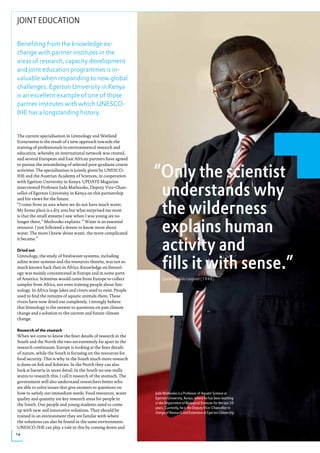
how to satisfy our immediate needs. Food resources, water        Jude Mathooko is a Professor of Aquatic Science at
quality and quantity are key research areas for people in        Egerton University, Kenya, where he has been teaching
the South. Our people and young students need to come            in the Department of Biological Sciences for the last 20
                                                                 years. Currently, he is the Deputy Vice-Chancellor in
up with new and innovative solutions. They should be
                                                                 charge of Research and Extension at Egerton University.
trained in an environment they are familar with where
the solutions can also be found in the same environment.
UNESCO-IHE can play a role in this by coming down and
14
further developing their capacities. Limnology should


                                                                             Partnership
be given a boost and a critical mass of students should be
trained to meet this daunting challenge.


                                                                             signed with 18
familiar environment
“I was introduced to limnology in Austria. I immediately
saw the opportunity to take the training to the South in a


                                                                             key education
more familiar environment, rather than getting sophisti-
cated material in Europe and sophisticated computers that
are available in the North. This equipment and hardware
should work in a familiar environment, Egerton University
for instance. The equipment could then also be used by
more students,” explains Mathooko.
“Of course, one can also gain from the positive effects of
                                                                             and research
                                                                             institutes
getting a different experience by interacting with other
students in an unfamiliar country. So, a wise decision was
made by UNESCO-IHE, the Austrian government and
Egerton University to team up and work together in this
course. This is the direction the world is heading in. One
cannot work in isolation. One needs to work with others
in mutual understanding, where everyone works as equals.
This is how the world should be. And now we have been
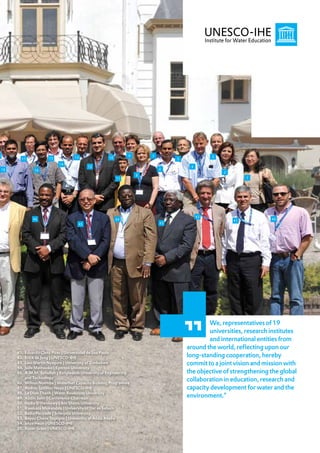
working at an equal level, it is now that we can talk about                  UNESCO-IHE signed a vision statement on strengthening collabora-
success of the programme,” he says.                                          tion in water education, research and capacity development with 18
One of the advances in limnology is that the integrated                      key education and research institutes in higher learning from around
research in this area has become so apparent. The holistic                   the world. High-level representatives from partner institutes assem-
view is that we now combine the catchment with the                           bled in Delft in July 2010, to discuss the possibilities and opportunities
water systems, whereas before they were treated indepen-                     for setting up joint educational programmes at the Master’s level in
dently.                                                                      the water sector. The development of joint educational programmes
                                                                             with partner institutes is one of the cornerstones of UNESCO-IHE’s
improve, diversify and expand                                                policy to serve the world water sector with good quality, relevant edu-
Mathooko explains: “In my view, UNESCO-IHE and                               cation and training at a scale required by the sector.
Egerton University can improve, diversify and expand its
current programmes. Apart from limnology and wetland                         Ambitions and collaboration
ecosystems, there are elements of water engineering that                     Such programmes are based on a form of credit transfer systems be-
may be interesting to either take over or join up with. In                   tween the (two) institutes and a joint responsibility in delivering part
addition, UNESCO-IHE could make a large impact in the                        of the educational programme. The aim of the conference was to learn
area of water and sanitation here, especially in rural and ur-               better the ambitions of the different institutes and to explore the best
ban areas. Also, I believe that further progress can be made                 approach to developing such programmes and other forms of collabo-
in integrated project management and proposal writing to                     ration.
request for funding. I find that my staff members are quite
weak in this area. If we could further develop this skill-set,               Partner Institutions
I believe it would really help us.”                                          Participants included dignitaries from Addis Ababa University in
                                                                             Ethopia, Ain Shams University in Egypt, Asian Institute of Technology
bridging the gap                                                             in Thailand, bangladesh University of Engineering and Technology,
He continues by saying: “ The South and the North                            birzeit University in Palestine, Dundee University, School of Natural
research far apart from each other at the extreme ends of                    Resources, Law, Policy and Management in Scotland, Egerton
an aquatic continuum. The South more on the fish and the                     University in Kenya, Hohai University in China, Kwame Nkrumah
fisheries. The North more on the microbio loop. It is this                   University of Science and Technology in Ghana, Mondsee University
distance that we have to close. Offering joint education                     of Limnology in Austria, The University of the West Indies, St
programmes, jointly promoting publications, jointly dis-                     Augustine, Campus, Universidad del Valle in Colombia, Universitas
seminating information and jointly forming policies to the                   Sriwijaya in Indonesia, University of Dar es Salaam in Tanzania,
benefit of both continents are important steps in bridging                   Universidade de Sao Paolo Engineering School of Sao Carlos in brazil,
the gap.”                                                                    University of Zimbabwe, Water Resources University in Viet Nam and
                                                                             the WaterNet Capacity building Programme in Southern Africa.

                                                                             Joint activities
Joint MSc Programme in Limnology and Wetland Ecosystems                      The main objectives of the conference include the development of a
The joint programme in Limnology and Wetland Ecosystems is given as an       (joint) vision on the establishment of joint educational programmes
MSc programme. This specialisation is jointly given by UNESCO-IHE and        (need, ambition, sense of purpose), having consultations on a com-
the Austrian Academy of Sciences (Mondsee, Austria), in cooperation with     mon framework for the delivery of joint educational programmes
Egerton University (Egerton, Kenya). The duration of this joint programme
                                                                             (shape and layout, presentation, acknowledgement); discussing ma-
is 18 months containing 14 three-week-modules, equally spread over the
three locations, followed by a research period of 6 months. Egerton Uni-     jor operational principles for the delivery of joint programmes (credit
versity teaches the modules on ‘Lake Ecology’, ‘Stream and River Ecology’,   transfers, marketing, finances); formulating a road map for achieving
‘Wetlands for Water Ecology’, and ‘Fisheries and Aquaculture’.               medium-term objectives (objectives, milestones, activities, policy
                                                                             and operational decisions); and identifying support programmes for
Egerton University, Kenya
                                                                             development (staff exchange, training of trainers, lecture material de-
Egerton University was founded as a farm school in 1939 by Lord Maurice
Egerton of Tatton, a British National. In 1950, the school was upgraded to
                                                                             velopment, online learning).
a College. In 1986, the College was gazetted as a constituent college of
Nairobi University. In 1987, Egerton was fully established as a University   A full (photographic) report on the conference can be
through an Act of Parliament. See more info: www.egerton.ac.ke/.             found at www.unesco-ihe.org/educonference2010.

                                                                                                                                                    15
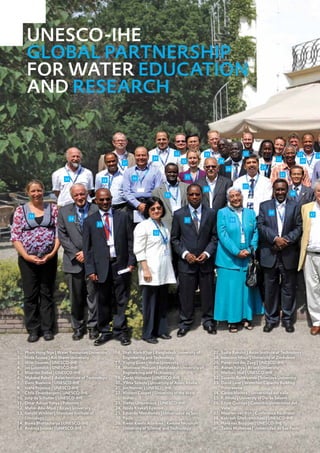
UNESCO-IHE
      GLOBAL PARTNERSHIP
      FOR WATER EDUCATION
      AND RESEARCH


                                                                                   33                29                     25                             21         19
                                                                       34                                                                       23
                                                                                        32                  28                                              20
                                                       37
                                                                                                                   26                 24

                                                                                                                                                 22
                                                            36                           31
                         39                    38
                                                                                                                            27
                                                                                                     30
                                                                              35                                                                      48


                                                                                                                                           49
      55                                                                                                                                                         47
                              54                                                         51                          50
                                          53

                                                                        52


1.  Pham Hong Nga | Water Resources University      16. Shah Alam Khan | Bangladesh University of         27.   Sudip Rakshit | Asian Institute of Technology
2.  Hoda Soussa | Ain Shams University                  Engineering and Technology                        28.   Innocent Nhapi | University of Zimbabwe
3.  Wim Douven | UNESCO-IHE                         17. Yiqing Guan | Hohai University                    29.   Pieter van der Zaag | UNESCO-IHE
4.  Jan Luijendijk | UNESCO-IHE                     18. Monowar Hossain | Bangladesh University of        30.   Adnan Yahya | Birzeit University
5.  Maarten Siebel | UNESCO-IHE                         Engineering and Technology                        31.   Marloes Mul | UNESCO-IHE
6.  Mukand Babel | Asian Institute of Technology    19. Zoran Vojinovic | UNESCO-IHE                      32.   Susanto Robbiyanto | Sriwijaya University
7.  Dano Roelvink | UNESCO-IHE                      20. Yilma Seleshi | University of Addis Ababa         33.   David Love | WaterNet Capacity Building
8.  Ioana Popescu | UNESCO-IHE                      21. Jan Nonner | UNESCO-IHE                                 Programme
9.  Chris Zevenbergen | UNESCO-IHE                  22. Vincent Cooper | University of the West           34.   Carlos Madera | Universidad del Valle
10. Joop de Schutter | UNESCO-IHE                       Indies                                            35.   F. Mtalo | Universty of Dar es Salaam
11. Omar Adnan Yahya | Palestine                    23. Stefan Uhlenbrook | UNESCO-IHE                    36.   Edgar Quiroga | Colombia Universidad del
12. Maher Abu-Madi | Birzeit University             24. Nzula Kitaka | Egerton                                  Valle
13. Gerold Winkler | Mondsee Institute of           25. Eduardo Mendiondo | Universidad de Sao            37.   Maarten van Rijn | Conference Facilitator
    Limnology                                           Paulo                                             38.   Kebreab Ghebremichael | UNESCO-IHE
14. Biswa Bhattacharya | UNESCO-IHE                 26. Kwasi Kwafo Adarkwa | Kwame Nkrumah               39.   Hans van Bruggen | UNESCO-IHE
15. Andreja Jonoski | UNESCO-IHE                        University of Science and Technology              40.   Tadeu Malheiros | Universidad de Sao Paolo
16
9                                        13                          9       7                      3
           17              15                              10                         5
                                 14
                                                12                                         4
    18             16                                                            6
                                                                                                        2
                                                                         8
                                                                11                                               1


                                                                                               42
                   46                                           44                                          41           40
                                           45                                    43


                                                                                                  We, representatives of 19
                                                                                                  universities, research institutes
                                                                                                  and international entities from
                                                                                          around the world, reflecting upon our
         41.   Eduardo Cleto Pires | Universidad de Sao Paolo
         42.   Erick de Jong | UNESCO-IHE                                                 long-standing cooperation, hereby
         43.   Levi Martin Nyagura | University of Zimbabwe                               commit to a joint vision and mission with
         44.   Jude Mathooko | Egerton University
         45.   A.M.M. Safiullah | Bangladesh University of Engineering                    the objective of strengthening the global
         46.
               and Technology
               Wilson Nyemba | WaterNet Capacity Building Programme
                                                                                          collaboration in education, research and
         47.   András Szöllösi-Nagy | UNESCO-IHE                                          capacity development for water and the
         48.   Le Dinh Thanh | Water Resources University
         49.   Abdin Salih | Conference Chairman                                          environment.”
         50.   Hadia El Hennawy | Ain Shams University
         51.   Rwekaza Mukandala | University of Dar es Salaam
         52.   Badia Perizade | Sriwijaya University
         53.   Bayou Chane Tegegne | University of Addis Ababa
         54.   Jetze Heun | UNESCO-IHE
         55.   Susan Graas | UNESCO-IHE
                                                                                                                                      17
ICID and UNESCO-IHE:
                                                   a complementary
AIT:
strengthening                                      partnership
and consolidating
activities                                         “I would like to see a stronger link               with recruitment drives and advertisements.
                                                   between ICID and UNESCO-IHE.” Hayde                Uniting the best minds in the field in this
                                                   is convinced that UNESCO-IHE and ICID              way, and giving them an internationally
                                                   will be able to deepen their collaboration         renowned network through which they can
                                                   on a number of different levels “... Several       exchange knowledge and share best prac-
The Asian Institute of Technology (AIT)            Masters and PhD students are already               tices about irrigation and drainage, is already
promotes technological change and sus-             involved in joint activities, such as the World    having a far-reaching impact on the water
tainable development in the Asian-Pacific          History of Water Management Short Course           sector. Hayde encapsulated this as follows:
region through higher education, research          at UNESCO-IHE”.                                    “Our presence in ICID is not only important
and outreach. Established in Bangkok in                                                               for personal scientific networking, but brings
1959, AIT has become a leading regional            Far-reaching impact                                opportunities in advertising the activities of
postgraduate institution and is actively           The current partnership is mutually ben-           UNESCO-IHE, recruiting potential partici-
working with public and private sector             eficial and has been in existence since the        pants for our programmes, short courses
partners throughout the region and with            1950s. For over half a century, UNESCO-            and holds the potential of scientific research
some of the top universities in the world.         IHE has been teaching generations of water         projects, as well. All these opportunities have
                                                   experts. For its part, ICID has provided           already been realised in my past activity in
In October 2009, the double degree pro-            an international platform for networking,          ICID and at UNESCO-IHE at the same time
gramme in Urban Water Engineering and              policy debates and dialogue since it was first     and I hope to continue these efforts as well.
Management was launched, replacing the             established in 1950. ICID is keen to publish       Indeed, through networking, I have brought
UNESCO-IHE, Delft-based Integrated Urban           research findings of young water profession-       in many projects and have helped the organi-
Engineering specialisation. Worldwide, this        als. Its high profile, international network can   sation maintain a high profile.”
is the first specialisation in urban water man-    be used to disseminate the knowledge.              When asked about ICID’s plans for the next
agement that covers the entire water cycle,        ICID can also help up-and-coming water             biennium, Hayde explained: “We combine
addressing engineering, management and             professionals, and the industry as a whole,        our efforts and expertise to look at different
institutional aspects.
Currently two other double degree pro-
grammes have been developed with the
Institute, namely Environmental Technology
for Sustainable Development and Agricultural
Water Management for Enhanced Land and                         prof. madramootoo                      What are iCid’s main challenges?
Water Productivity.                                                                                   The main challenges are the growing level
Professor Sudip Rakshit, Vice-President              “There is a personal                             of water scarcity, competition for water,
for Research at AIT elaborates: “Currently
we have three joint education programmes                link which forges                             and how agriculture can be a more efficient
                                                                                                      user of water, especially in light of climate
with UNESCO-IHE but we would like to do
more in terms of extending our collabora-
                                                     strong human bonds                               change. The debate of food vs fuel is also
                                                                                                      of concern since we are using scarce land
tion, also in the area of joint research activi-         of friendship and                            and water resources to produce fuel. This
ties. Strengthening and consolidating the ac-
tivities we are currently undertaking must, of             collaboration.”                            is a very critical debate in light of the food
                                                                                                      security issues. The overall performance of
course, not be overlooked in this process.”                                                           our irrigation and drainage networks is also
“There is so much that AIT can learn from                                                             facing scrutiny given the large public in-
UNESCO-IHE and vice versa of course,”                                                                 vestments in the sector. In terms of public
Rakshit explains. “Both our institutes are                                                            financing and accountability, the question
similar in so many regards, that we can only                                                          is often asked whether the socio-economic
complement each other. Also at AIT no one                       Interview with                        and financial benefits of these invest-
is considered a foreigner with so much                          Professor Chandra                     ments are being achieved for the public
diversity in experiences, backgrounds and                       A. Madramootoo,                       good. Irrigation and drainage systems are
                                                                President of ICID
nationalities. We see the same at UNESCO-                                                             complex enterprises in that we are dealing
                                                                and Professor and
IHE where people from all over the world                        Dean of the Faculty                   with numerous small farmers who are very
come to study and undertake research. Some                      of Agricultural and                   heterogeneous in their farming operations.
conservative minds may think that we are                        Environmental                         This makes it extremely difficult to man-
competitors, but we feel the opposite: it is a                  Sciences at McGill                    age the system, especially with an ageing
                                                                University in
win-win situation.”                                                                                   infrastructure. For this reason, we are
                                                                Canada.
                                                                                                      thinking of the best institutional, finan-
18
                            www.ait.ac.th
key issues in the world and identify ways                                                        “ICID places a high emphasis
to address the most urgent challenges.”
Challenges such as adapting and managing
                                                                                                 on involving young water
land and water resources for urban, rural and                                                    professionals in its activities,
industrial areas, producing enough food to
meet the demands of the expanding popula-
                                                                                                 and young water profession-
tion, and improving water safety and flood                                                       als are precisely UNESCO-
protection.
Hayde is part of a long line of UNESCO-IHE
                                                                                                 IHE’s audiences”, explains
staff and alumni who have held positions                                                         Dr Laszlo Hayde. As Vice
on ICID’s Executive Council. Professor
Bart Schultz, Professor of Land and Water
                                                                                                 President (2009-2012) of
Development at UNESCO-IHE wasPresident           Works:	Ir.	Siswoko	(grad.	in	1977),	Ir.	        ICID, the largest interna-
of ICID in the period 1999-2002. Ir. Dato’ Ir.   Iwan Nursirwan (grad. in 1983) and two
Hj. Keizrul bin Abdullah from Malaysia was       ex-Secretaries of the Directorate General of
                                                                                                 tional NGO specialising in
Vice President of ICID from 2002 to 2005.        Water Resources: Ir. Susilo Soekardi (grad.     irrigation, drainage and water
On his appointment, Hayde stated “... I am       in	1979)	and	Ir.	Eddy	A.	Djajadiredja	(grad.	
very much honoured to take on this position      in 1981). The Director General of Research
                                                                                                 management for food pro-
[of Vice President] and I certainly believe      and Development of Water Resources: Ir.         duction, and Senior Lecturer
that the work at ICID complements my work        Moh. Hasan (grad. in 1980) and the Director
at UNESCO-IHE.”                                  of Rivers: Ir. Pitoyo Subandrio (grad. in
                                                                                                 in Irrigation Engineering at
                                                 1986) were also present.                        UNESCO-IHE, Hayde is ide-
UNESCO-IHE alumni gathering                      Several UNESCO-IHE staff members
Several generations of UNESCO-IHE                attended this impromptu reunion, includ-
                                                                                                 ally placed to understand the
alumni from Indonesia met for an informal        ing: Professor Bart Schultz, Dr Abraham         complementary partnership
dinner on 13 October 2010. The most              Mehari Haile, Dr Laszlo Hayde and Dr
senior alumnus, a former Director General        F.X. Suryadi. Special guests included Dr
                                                                                                 between UNESCO-IHE and
of Water Resources from the Ministry of          Robiyanto Hendro Susanto from Sriwijaya         ICID, and its future potential.
Public	Works,	graduated	in	1977	while	           University (UNESCO-IHE’s Double Degree
the youngest alumnus graduated in 2010.          Programme partner in Indonesia) and Ir.
The group numbered 34 in total and had           Paul van Hofwegen (World Bank and former
originally gathered in Yogyakarta, Indonesia     UNESCO-IHE lecturer). The meeting was
for the Executive Council meeting of the         greatly appreciated by the alumni and they
International Commission on Irrigation and       expressed their wish and strong intention
Drainage (ICID). The group consisted of          to have such meetings in the future to foster
two ex-Director Generals of Water                informal exchanges of information between
Resources from the Ministry of Public            UNESCO-IHE staff and Indonesian alumni.                                www.icid.org


cial, economic and technical models for          the control of sedimentation in irrigation      Why do you consider UNesCo-ihe to be
operating and maintaining these systems in       reservoirs, energy costs and savings in         a valuable partner for linking your activities
order to maximise the benefits. The impact       irrigation and drainage, and water-saving       to ongoing research?
of both poverty and the role of women            technologies.                                   I hope that IHE can sponsor some special
irrigators are socio-economic drivers which                                                      training programmes in different ICID
will force us to rethink how we manage and       iCid and UNesCo-ihe have been partners          member countries, and also contribute to
deliver water in parts of sub-Saharan Africa     for the past 50 years. how have you seen        the new IPTRID by helping our NCs to
and Asia. Of course, the problems of water       this relationship developing?                   build and develop their research capacity.
quality in irrigation and drainage and the       It has been an extremely active partnership.
linkage to ecosystems is also high on our        UNESCO-IHE has always supported our             how would you like to see the
agenda.                                          efforts in a committed and concerted way.       partnership with UNesCo-ihe develop in
                                                 Various Rectors and UNESCO-IHE staff            the coming years?
What other areas is iCid currently               have contributed to our work programme,         I place a lot of importance on this special
working on?                                      technical activities, and special projects.     relationship between the two institutions.
We wish to intensify irrigation and drain-       President Hon Bart Schultz has been a           With the active participation of many
age research at ICID, especially in light of     driving force in our Country Policy Support     UNESCO-IHE staff in ICID and our
the issues mentioned earlier. However,           Studies, and also in organising ICID’s in-      member countries, there is a personal
to do this effectively we need the sup-          puts to the recent World Water Forums. He       link which forges strong human bonds of
port of the NCs. We wish to build up a           also Chairs the Editorial Board of the ICID     friendship and collaboration.
grass-roots research agenda, approved and        Journal and has been the driving force be-
supported by the NCs. We are therefore           hind the success of the journal. Now with
trying to rebuild the International Program      the recent election of Vice President Laszlo
for Technology and Research in Irrigation        Hayde, UNESCO-IHE is poised to play a
and Drainage (IPTRID). Several research          significant role in building up the European
issues are emerging right now, including         linkages and support for ICID.
                                                                                                                                                  19
CAPACITY DEVELOPMENT


Twenty-seven capacity development interventions
are being implemented and around 3,000 people
will be trained as part of the ‘Lake Victoria Region
Water and Sanitation Initiative’, that is promoted
by UN-HABITAT. A 5-member Capacity Building
Consortium contracted for this project consists
of the Federation of Canadian Municipalities,
UNESCO-IHE, the Gender and Water Alliance,
SNV Netherlands Development Organisation and
Netwas International.


Lake Victoria:
WATSAN in Small Towns
                      The ‘Lake Victoria Region Water and Sanitation Initiative’       prevalence of water related diseases. Also, high rates of leak-
                      (LVWATSANI) supports the Governments of the riparian             age, high energy and water treatment costs, and low billing
                      states to achieve the Millennium Development Goals for           and collection ratios form a large constraint. As a result,
                      water supply and sanitation, with emphasis on innovative         operational expenses for water services are often in excess
                      solutions and speedy delivery in small towns in the Lake         of revenues. Sanitation and solid waste services are virtually
                      Victoria basin. The LVWATSANI includes an initial invest-        non-existent.
                      ment component; capacity development; and follow-up
                      investments. Work is ongoing in an initial group of 10 small     Progress up-to-date
                      towns in Kenya, Tanzania and Uganda with a joint population      Initial investments in eight of the ten towns have now been
                      of about 390,000 and preparations are underway to start          substantially completed. These have included the rehabilita-
                      work in a second group of 15 towns.                              tion of the water infrastructure, construction of distribution
                                                                                       mains including water meters, valves and water kiosks, the
                      Lake Victoria                                                    construction of rainwater tanks, public latrines in schools, in-
                      Lake Victoria is the second largest fresh water lake in the      stitutions and public spaces, the establishment of micro credit
                      world and the largest lake in Africa. The Lake catchment         facilities for household latrines, the supply of solid waste
                      provides the livelihood of about one third of the combined       tractors with trailers and bins, the construction of waste
                      populations in the three countries or about 30 million people,   transfer stations, the supply of computers, lab equipment and
                      of which more than 50 percent lives below the poverty line.      tools, and fast-track capacity building in 5 key areas.
                      The rapidly growing urban centers in the Lake Victoria basin     The immediate investments, including some fast-track train-
                      are playing an increasingly important role in the economic       ing and capacity building, have already resulted in a signifi-
                      development of the region. Most of these towns are expe-         cant improvement in the performance of the water utilities in
                      riencing unplanned growth and this is negatively affecting       the project towns. For example, unaccounted-for-water has
                      basic infrastructure, living conditions, the environment and     been	reduced	from	an	average	of	56%	of	water	produced	
                      the fragile ecosystem of the Lake.                               to	42%.	Revenues	have	increased	by	an	average	of	65%.	As	
                                                                                       more water has become available, the utilities are now mak-
                      Water-related challenges                                         ing efforts to increase the number of water connections. The
                      Challenges in the towns around Lake Victoria include the         achievement of cost recovery for operations and mainte-
                      recent water sector reform that has not yet fully matured,       nance is a major improvement. The impact of interventions
                      run-down infrastructure where no major investments were          so far has encouraged the stakeholders to engage in the
                      made in the past decades, and the lack of recognition for        capacity building and long-term investment processes.
                      the different needs of women, men, children, minorities
                      and vulnerable groups. The water distribution networks           Capacity Development
                      usually	cover	less	than	30%	of	the	urban	area	and	there	is	a	    With a growing awareness of the benefits of a regional
                      heavy dependence on unsafe water sources causing a high          approach among East African Community countries, the


20
Situation at the
                                                                                                                                         start of the Lake
                                                                                                                                         Victoria Water
                                                                                                                                         and Sanitation
                                                                                                                                         Initiative


                                                                                       observations and the study of related documents, the teams
                                                                                       designed	a	programme	consisting	of	27	different	demand-
                                                                                       responsive CD interventions for a target group of about
                                                                                       3000 people in the towns. This target group includes all
                                                                                       stakeholders that have been subdivided in 6 main groups and
                                                                                       29 subgroups. The six groups include the water utility, the
                                                                                       local government, supra-local government bodies, vulner-
                                                                                       able groups, the private sector, and other groups.
                                                                                       The 29 subgroups represent the different entities, task
                                                                                       groups and/or hierarchical levels within the 6 groups. In the
                                                                                       case of the water utility four subgroups are distinguished,
                                                                                       including the Board and Managing Director, Senior manag-
                                                                                       ers, Middle level managers and professional staff, and
                                                                                       Technicians and operators.
                                                                                       The CD interventions have durations between 1 and 3
                                                                                       days, with some being implemented once and others more
                                                                                       often depending on demand and size of the target group. A
                     regional capacity building initiatives emphasize regional net-    programme with 110 CD events is presently being imple-
                     working as a model to protect and manage Lake Victoria as a       mented in the ten towns, but also at national and regional
                     shared resource. Capacity development (CD) is considered          levels.	The	set	of	27	interventions	includes	ten	interventions	
                     an essential tool to increase the local ‘ownership’ of environ-   on environmental services (water, sanitation, solid waste),
                     mental (drinking water, sanitation, solid waste) services. The    four on pro-poor governance, three on gender and vulner-
                     project aims to empower local stakeholders with a view to         able groups, and ten on local economic development. The
                     secure their active interest in the sustainable and equitable     interventions were designed by the group of international
                     delivery of the services. The capacity building is phased in      partners and are being implemented by a regional capac-
                     between the immediate and long-term investment compo-             ity builder, Netwas International. The group of Netwas
                     nents of the project, and it is expected that the empowered       facilitators was capacitated through a Training for Trainers
                     stakeholders will participate in the formulation of the long-     workshop and one-on-one contacts with their colleagues
                     term investment component, but also beyond that in the            in the international partners group. The interventions are
                     development and management of environmental services.             problem-oriented and output-focused. All interventions
                     The CD interventions have been designed in response to            conclude with a Personal Action Plan with a set of activi-
                     specific on-the-ground issues in each town. These issues          ties that will make a contribution to the improvement of the
                     were surfaced through systemic action research, a methodol-       water environmental services. The Action Plans emphasise
                     ogy where multi-disciplinary teams of experts conducted           ‘quick wins’ that will demonstrate the ability of empowered
                     in-depth interviews with all stakeholders. Together with field    stakeholders to achieve immediate results.


                                                                                                                                                       21
http://ow.ly/3lQnl
CAPACITY DEVELOPMENT

               80 Mediterranean
     professionals trained in Delft


                                                                                                                         © Wink
The third in a series of workshops organised by        moRe demANd foR ReUse
                                                       Damir Brdjanovic, Professor of Sanitary Engineering
the EU-funded Horizon 2020 Capacity Building/          at UNESCO-IHE and Thematic Expert for Wastewater
Mediterranean Environment Programme (CB/               Treatment for the Project, elaborated: “Water scarcity is a
                                                       major issue for the Maghreb and Mashrek countries, where
MEP) in partnership with UNESCO-IHE recently           a warmer climate, less rainfall and more demand for reuse
delivered eighty professionals from fourteen           of wastewater prevails. Currently the targeted number
                                                       of water professionals to be trained through 150 various
Mediterranean countries. Focusing on Advances          capacity development activities is around 3,500 people.” The
in Urban Wastewater Management in Coastal              main learning objective was to update the knowledge of the
                                                       participants and give a state-of-the-art overview of urban
Areas, the specific training workshops support the     wastewater management with a specific focus on coastal
Horizon 2020 initiative and its objective to de-pol-   areas. Although these three courses were similar in theory,
                                                       they did not mirror each other in every way. A tailor-made
lute the Mediterranean Sea by 2020. This is envis-     approach to sub-regional characteristics (differences) was
aged through developing the capacities of partici-     adopted by choosing lecturers who had particular experience
                                                       in these regions and by adjusting the practical part of the
pants from Algeria, Egypt, Israel, Jordan, Lebanon,    materials to the characteristics of the sub-region in question.
Morocco, occupied Palestinian territory, Syria, and    One of the specific challenges was finding the right content
                                                       and learning objectives for all the participants, given the
Tunisia. Albania, Bosnia and Herzegovina, Croatia,     enormous heterogeneity of the group: different nationalities,
Montenegro and Turkey are also covered by an           age, experience and backgrounds. The participants repre-
                                                       sented various organisations, and occupied a wide variety
extension of the project.                              of functions within the water sector. So far all the course
                                                       participants have actively engaged in the traning courses and
                                                       gave us very positive feedback about them afterwards.

                                                       stRoNg impACt
                                                       For the upcoming 150 courses in which UNESCO-IHE and
                                                       approximately 10 staff members will be involved, it will be
                                                       interesting to see whether we can get a more homogene-
                                                       ous group of people, for instance, from ministries and other
22
OPINION

                                                                                                                     Missed
                                                                                                                     oppurtunities
                                                                                                                     We live in a world where the pressure on water
                                                                                                                     resources is growing and where many of the surface
                                                                                                                     water resources are over-committed. Yet there are
                                                                                                                     still many opportunities that are not being utilised.
                                                                                                                     It is this gap between responding to a crisis and
                                                                                                                     making the most of existing opportunities that
governmental organisations (institutions where decisions                           Horizon 2020 aims to sub-         should concern us.
about the water sector are made). In this way, our capacity                        stantially reduce the pollution   One such opportunity is to make combined use of
development activities would directly target people who                            of the Mediterranean Sea by       surface and groundwater. During recent periods
                                                                                   2020 and tackles the sources
are making decisions. This would have a very strong impact                                                           of drought , agricultural production in several of
                                                                                   that account for around 80%,
of these capacity development projects. Then, a separate                           i.e. municipal waste, urban       South Asia’s mega irrigation systems actually went
training programme could be developed with more specific                           waste water and industrial        up rather than down: a little known fact that was
content and material for participants with training needs in,                      emissions. A 2007-2013            not widely reported. Production levels increased
for instance, operation and maintenance. “I also greatly ap-                       Road-Map was adopted by           because local farmers made more effective use of
                                                                                   the Environment Ministerial
preciated the fact that the participants were enthusiastic and                                                       shallow underlying groundwater and were therefore
                                                                                   Conference held in Cairo,
positive about learning from and exchanging each other’s                           Egypt in November 2006,           less susceptible to water-logging. Another option
experiences. The way in which we encouraged communica-                             and for its implementation        is to use flood-based farming systems, such as spate
tion helped establish networks within countries, as well as                        and monitoring three working      irrigation, which is currently used by millions of
networks between countries, thereby enabling participants                          groups/components were            farmers, although it is still under-exploited.
to share their views and problems with each other. A spin-off                      formed: one on investments        The three ‘R’s: recharge, retain and reuse
                                                                                   for pollution reduction (PR);
for UNESCO-IHE may be an increase in the number of PhD                                                               Better use of groundwater buffers has equal
                                                                                   one on the required capacity
researchers. Our network in the Francophone countries is                           building (CB) for achieving       potential. Discussions about the use of groundwater
currently not so strong. We are seen as international players,                     H2020 objectives; and one         have often been limited to its overuse, yet much
but in these areas we do not have a very strong presence. This                     on H2020 review, monitor-         can be gained by focusing on recharge, retention
opens up new venues (European, African and Asian initia-                           ing, and research (RMR).          and reuse efforts (the three Rs). This, in turn, is
                                                                                   Under each component, a
tives). In this way the Institute can expand its network and at                                                      linked to moisture conservation. There is much
                                                                                   project is currently being run.
the same time UNESCO-IHE staff can acquire new teaching                                                              potential to increase yields in rain-dependent areas
experience outside the Netherlands, which is also a good                                                             by better soil water management, using a range of
training exercise,” Brdjanovic adds.                                                                                 techniques. The common denominator in all of this
                                                                                                                     is that the solutions mentioned above are a little
Contact: Professor Damir Brdjanovic b.brdjanovic@unesco-ihe.org                                                      more complex than conventional approaches as they
                                                                                                                     require an understanding of local realities – as well
                                                                                                                     as the capacity to recognize the ingenuity of local
Horizon 2020                                                                                                         management or the potential for it.
The quality of the Mediterranean environment is          •	 Identifying	projects	to	reduce	the	most	significant	     In order to capitalise on the new approaches, the
increasingly being jeopardised by human activities.         sources of pollution.                                    way in which we approach water management
The coastal and marine areas in particular are under     •	 Identifying	capacity-building	measures	to	help	          needs a complete overhaul. The water harvesting
threat. Rapid and insufficiently controlled urbanisa-       neighbouring countries create national environ-          community is in danger of locking itself into
tion, as well as the unsustainable development of           mental administrations that are able to develop
industry, agriculture and tourism play an important                                                                  seeking to “upscale small-scale solutions” and
                                                            and police environmental laws.
role in this degradation process, which has so far                                                                   not seeing the bigger picture, where water can
resulted in: water scarcity, pollution of the environ-   •	 Using	the	EC’s	research	budget	to	develop	a	great-       be buffered at scale. The irrigation and drainage
ment (water, soils, air) by untreated wastewater,           er knowledge of environmental issues relevant to         community has not been as innovative as it might
municipal, agricultural and industrial waste, coastal       the Mediterranean and ensure that this is shared.        have been, and is not coming to
degradation due to the pressure of human activity
and the effects of climate change, land degradation,     •	 Developing	indicators	to	monitor	the	success	of	         terms with the multiple functions
desertification and biodiversity losses.                    Horizon 2020.                                            that irrigation systems serve.
                                                         •	 The	Partners	also	committed	themselves	to	imple-         The Integrated Water Resources
During the 10th Anniversary of the Barcelona                ment the Mediterranean Strategy for Sustainable          Management community
Process Summit in 2005, the Euro-Mediterranean              Development, launched by the Mediterranean               has focused too much on the
Partners committed themselves to increasing efforts         Commission for Sustainable Development es-
                                                                                                                     process side. A huge range of
to substantially reduce the pollution of the Mediter-       tablished under the United Nations Environment
ranean by 2020 in what is called the “Horizon               Programme Mediterranean Action Plan (UNEP/               opportunities is seen between -
2020 Initiative” (H2020). Horizon 2020 was en-              MAP), and to ensure close coordination and               not within - these communities
dorsed during the Ministerial Conference about the          cooperation with other relevant stakeholders.            of practice. There is therefore
Environment which took place in Cairo in November                                                                    a need for a new élan in water
2006 and is one of the key initiatives operating
                                                                                                                     management, a need to learn from
under the Union for the Mediterranean (UfM). It
specifically tackles the following sources of pollu-                                                                 the evidence of what is already
tion: municipal waste, the treatment of wastewater                                                                   happening on the ground, and
and industrial emissions. A 2007-2013 Road-Map                                                                       to better understand the science
has now been adopted: it focuses on the following                                                                    behind it in order to seek out new
four pillars:                                                                                                        applications.

                                                                                                                     Abraham Mehari Haile is Senior Lecturer in
                                                                                                                     Integrated Land and Water Development,
                                                                                                                     a.meharihaile@unesco-ihe.org

                                                                                                                                                                        23
                                                                        http://ow.ly/3lRRn
ALUMNI REFRESHER SEMINAR


Turning floods into an asset
The Regional Refresher
Seminar on Flood-Based
Farming was held in Alem
Maya, Ethiopia at the end of
July 2010 for UNESCO-IHE
alumni from Sub-Saharan
Africa. The Seminar was or-
ganised jointly by Haramaya
University, the Oromia Water
Resource Bureau in Ethiopia,
Meta Meta, UNESCO-IHE and
the Spate Irrigation Network.


Raising awareness on this issue has so far been very success-     that of perennial systems where water can be regulated at
ful in this Seminar through the high level of participation of    one intake and where there is a well defined water regulation
over 30 enthusiastic participants from over 10 countries in       system. In my view it is necessary for the new generation of
Sub-Saharan Africa. With the growing acceptance of the            irrigation engineers to be aware of these differences so the
reality of climate change in Sub-Saharan Africa (SSA) and         systems can be properly designed and managed.”
elsewhere, flood-based farming systems that harness water
in variable conditions are increasingly being recognised as an    otheR sYstems Needed
important, yet currently underdeveloped, form of irriga-          “Small floods need to be regulated through simple intakes
tion, water management and route to food security. For a          and stabilising the river beds through long-crested weirs,”
long time, policy focused on conventional irrigation and          Haile explains. “Large floods can be regulated by having
on the creation of storage reservoirs, ignoring other forms       several off-takes downstream, directly taking water from the
of irrigation. Using flood flows and maximising returns in        wadi or the river. The level of concentration of sediment is
flood-based farming are still not routinely practiced. The        also much higher in spate irrigation systems, ten percent ver-
techniques and approaches are insufficiently understood           sus 0.2 percent in perennial systems. This means other sedi-
by the majority of land and water professionals. Yet, an          ment control and management systems are needed. Another
estimated 5,000,000 ha of land is suitable for flood-based        big difference is that for spate irrigation to be successfully
farming systems.                                                  implemented, a very coherent local farmers’ association is
                                                                  needed. When floods destroy one diversion band, the entire
soURCes of food                                                   community will be affected. Establishing this requires differ-
Abraham Mehari Haile, Senior Lecturer in Irrigation and           ent approaches.”
Drainage Systems Design and Management and Agronomy
at UNESCO-IHE and Coordinator for the Seminar explains:           AlleviAte poveRtY
“Flood-based farming or spate irrigation has a long history of    Henrie Manford Njoloma, Associate Director of the
being one of the major sources of food for the marginalised       Foundation for Irrigation and Sustainable Development in
and the poor. Millions of people depend for their basic liveli-   Malawi and alumnus class of 2002 says: “In my country
hoods on these systems. It is extremely important that we         flood-based farming systems have not been seen much as
push this forward.” He continues: “It is important to distin-     ways to alleviate poverty. It is enlightening to know that
guish why flood-based farming or spate irrigation is different    floods are not just a menace, but rather an asset. I want to
from the conventional systems. In conventional irrigation         introduce this system to the current livelihood projects in
systems there is always some kind of water supply. In the case    flood-prone areas in Malawi. Currently the projects we have
of spate irrigation, one needs to deal with the uncertainty       established are not sustainable due to the heavy flooding.”
of floods. We need to mitigate these floods and change it         Tena Alamirew, Academic Vice-President at Haramaya
for a more beneficial use. Special techniques are required        University, explains: “In Ethiopia water means everything
to divert these floods. A broader perspective is needed than      to us. Harvesting and managing water is definitely a primary
24
area for intervention at the national, regional and local level.   over the banks of the rivers and when they recede, we usu-                          Kamil Aron Nkya,
All of the major critical issues we are dealing with in our        ally plant in those plains. That is a more natural way of using                     Civil Engineer at the
country are concerned with water. Flood is a new venture for       floods for irrigation. When using the spate way, you can even                       Ministry of Water
                                                                                                                                                       and Irrigation in Tan-
us. Until now we have been focusing much on the construc-          release water so you do not break the banks of the rivers.
                                                                                                                                                       zania and alumnus
tion of weirs on perennial rivers. The use of flash floods,        I heard this for the first time during this Seminar. In Zambia    class of 1989 explains: “We have al-
particularly in the lowland areas in support of the pastoral       we are using Lake Kariba, one of the largest man-made lakes       ready been implementing the concept
communities is a recent undertaking.”                              in the world, to generate hydro-electric power for the coun-      of spate irrigation, but didn’t exactly
“When looking at the topographic distribution of the land,         try and are now even exporting it to neighbouring countries,”     know what it was called. I wanted
                                                                                                                                     to meet people from the region and
one can see that the highland areas are extremely eroded and       Musia elaborates. ”Now the water in the lake is rising so the
                                                                                                                                     update my knowledge on spate irriga-
less productive in terms of agriculture,” he says. “There is       sewage gates need to be opened to protect the dam wall.           tion. The course has greatly increased
plenty of rainfall in those highlands. In the lowlands rainfall    The water then flows downstream and destroys all the crops.       my technical capabilities.”
is minimal but there are deep soils. In the event of a rainfall    With a spate irrigation system this could have been pre-
burst, water will be coming down from the highlands as flash       vented. You do not have to anticipate the floods and with the
floods. Managing this water properly in the lowlands will be       regulated opening of the gates at least you know the amount                          Dassalegn Bezabih
important but is currently a major constraint. Only ten per-       of water that will come through and you know the timing, so                          Kassie, Civil Engi-
cent of the people live in the lowlands due to water scarcity.     you can plan better. Implementing this in Zambia will be my                          neer and Consultant
                                                                                                                                                        from Ethiopia and
Flood-based farming could be a way for the low-land areas          first task. Instead of destroying people’s fields, at least now
                                                                                                                                                        alumnus class of
to develop further.” An important component of flood-based         we can help them water their crops.”                              1994 says: “Spate irrigation is very
farming systems is the potential to use environmental flow                                                                           important for the livelihood of people
allocation releases from hydropower or storage reservoirs.         mAiNstReAmiNg spAte                                               living in the rural areas especially.
As more and more storage dams are being constructed, the           Recently a workshop on Mainstreaming Spate Irrigation             I am glad to be part of the Spate
                                                                                                                                     Irrigation Network now so I can keep
need for well-managed flood releases becomes imperative to         in Higher Education was organised in partnership with the
                                                                                                                                     updating my knowledge on the topic
manage water distribution to a variety of downstream users,        UN-Water Decade Programme on Capacity Development,                and at the same time I can share with
including the environment. The nature of these releases must       the Food and Agriculture Organization and MetaMeta at             others my experience and knowledge.
consider different components of the flow release; including       UNESCO-IHE. Currently subjects on flood-based farming             I will also look for increased efficiency
timing, volume of flood releases and interaction with hydrau-      are yet to be incorporated into the curriculum of universities,   in the livelihood and food security
lic works, the environment and co-management with users.           colleges and vocational training centres in SSA. Most edu-        programmes in Ethiopia that I am
                                                                                                                                     currently working on.”
                                                                   cational, research and development investments have been
NeW CoNCept                                                        channelled into the perennial and conventional irrigation
Joyce Musia, Agricultural Engineer at the Ministry of              systems as these have relatively reliable water sources and are
Agriculture in Zambia and alumnus class of 1994 elaborates:        perceived to have a higher sustainable return, and fewerrisks
“As my background is in agricultural engineering and I am          and uncertainties with regard to crop and livestock produc-
involved in many irrigation design projects and the running        tions. More information on this workshop can be found
of irrigation schemes I gained a lot of insights from the course   on page 24 in this magazine. Also see the Spate Irrigation
that I can now take home with me. Spate irrigation is a com-       Guidelines on page 32.
pletely new concept in my country. Until now we have been
undertaking more research in agriculture. When floods come         a.meharihaile@unesco-ihe.org


                                                                                                                    Impacts

  Asian alumni
                                                                   Human as well as natural activities have
                                                                   been altering the planet for centuries. The      Floods remain one of the most frequent and
                                                                   climate is changing and these changes            devastating natural hazards worldwide and


  enhance
                                                                   pose threats. The projected consequence          cause impacts on society that go far beyond
                                                                   of climate change includes an increase of        the economic cost and disrupted facili-
                                                                   extreme hydro-meteorological events.             ties. These impacts include family upheav-


  knowledge
                                                                   The increased incidence of flood events,         als, community disruptions, injuries and
                                                                   stronger hurricanes, typhoons, other             unemployment. In Nepal alone, an average
                                                                   storms and heat waves in recent years            of 300 people die every year due to floods


  on flood risk                                                    seems to confirm these projections.              that occur together with landslides and
                                                                                                                    debris flows. These hazards also continue to
                                                                   A Regional Refresher Seminar on                  be a threat in many Asian countries such as

  management                                                       ‘Participatory management of flood risk in
                                                                   the changing climate’ was held in August
                                                                   2010 in Kathmandu, Nepal. Eighteen
                                                                                                                    Bangladesh, China, India, Nepal, Thailand
                                                                                                                    and Viet Nam.

                                                                   UNESCO-IHE alumni from Asia attended the         The Seminar stimulated participants to view
                                                                   8-day course.                                    flood risk and its management in the context
                                                                                                                    of the changing climate. The benefits and
                                                                   Improved techniques and strategies               importance of involving all stakeholders,
                                                                   The Seminar brought Asian and European           including the groups that are most vulner-
                                                                   experts and flood management practition-         able to floods, into the flood risk manage-
                                                                   ers together to learn from each other’s          ment processes (preparedness, monitoring,
                                                                   knowledge, experience and current practices      prediction and mitigation), were discussed.
                                                                   and explore improved techniques and strate-      The participants were shown state-of-the-
                                                                   gies to tackle the increased flood risk due      art hydrological and flood modelling, as well
                                                                   to climate change. Participants established      as operational flood forecasting and warning
                                                                   a common framework for a community of            systems, together with case studies from
                                                                   practice that would help them maintain a         Europe and from the region.
                                                                   sustainable and continuous network to share
                                                                   their experiences and good practices.            s.maskey@unesco-ihe.org
                                                                                                                                                                          25
PAST EVENTS


MOU WITH NWWEC                  MAINSTREAMING                    STOCKHOLM WORLD                 1ST INTERNATIONAL                                   ‘DELTA CITY OF THE
The National Water and          SPATE IRRIGATION IN              WATER WEEK 2010                 DELTA CONFERENCE                                    FUTURE’ DESIGN
Wastewater Engineering          HIGHER EDUCATION                 As in recent years              The first international                             COMPETITION
Company of Iran                 At the end of September          UNESCO-IHE was present          delta conference ‘Deltas in                         The Harcourt Habitat team
(NWWEC) recently signed         a workshop on                    in Stockholm, Sweden            Times of Climate Change’,                           from Denmark won the
a cooperation agree-            Mainstreaming Spate              for the annual Stockholm        which was held at the end                           Delta City of the Future
ment with UNESCO-IHE            Irrigation in Higher             World Water Week, which         of September in Rotterdam,                          design competition which
expressing interest for con-    Education was held at the        was held in early September     was a tremendous success.                           was organised by the city of
tinued cooperation after the    Institute. The Workshop          2010. UNESCO-IHE co-            The conference attracted                            Rotterdam in cooperation
termination of the Training     was organised in partner-        convened a session on the       over 1,200 participants                             with UNESCO-IHE’s Flood
and Capacity Building           ship with the UN-Water           United Nations Capacity         from all over the world                             Resilience Group. After an
Project for the Iranian water   Decade Programme on              Development for Water and       and from different back-                            initial elimination round,
and wastewater compa-           Capacity Development,            Waste Water Management          grounds: science, policy and                        seven teams were invited
nies, a project in which        the Food and Agriculture         in Coastal Areas together       practice. The participants                          to participate in a 24-hour
some 1,000 professionals        Organization and                 with the United Nations         debated climate adaptation                          pressure-cooker session
were trained. NWWEC             MetaMeta. Plans for main-        Environment Programme           strategies for deltas and                           during which they worked
Chairman Samareh Hashemi        streaming were prepared          (UNEP), the UNESCO              delta cities and exchanged                          on a new design task. This
indicated his intention to      for seven countries. In          International Centre for        knowledge. Many contacts                            task consisted of creating
engage UNESCO-IHE in            addition, a website with         Coastal Ecohydrology, and       between scientists, policy-                         a safe-haven located in the
strengthening the capacity      the resource material was        the University of Algarve       makers and practitioners                            Rotterdam unembanked
                                created and will serve as the    (ICCE). Participants were       were established, refreshed                         area combined with an
                                workspace for support-           challenged to share their       and deepened. Relations                             international disaster center
                                ing the inclusion of spate       experiences with water and      between delta cities in                             from which aid can be
                                irrigation in the curricula of   waste water management          and outside Connecting                              shipped to any part of the
                                universities and polytech-       in coastal zones and small      Delta Cities (CDC) were                             world. Gain an impression
                                nics. More information can       island development states.      strengthened and the Delta                          of the final session on the
                                be found on the website:         A workshop on Resilience,       Alliance was launched.                              website by visiting:
                                http://www.unwater.unu.          Uncertainty and Tipping         More information can be                             www.unesco-ihe.org/
                                edu/workshops/. During           Points was organised by         found on the www.climat-                            Delta-City-of-the-Future.
                                the Workshop the publica-        the Challenge Program on        edeltaconference.org.
                                tion ‘Guidelines for Spate       Water and Food (CPWF),
of the Power and Water          Irrigation’ was launched.        the Stockholm Resilience
University of Technology        For more details about this      Centre, UNESCO-IHE
as the in-service capacity      publication go to page 32.       and the World Wide Fund
building organisation of the                                     for Nature (WWF). The
Iranian water and wastewa-                                       workshop focused on how
ter sector.                                                      to assess and manage the
                                                                 resilience of social-ecolog-
                                                                                                                                © Delta Conference


                                                                 ical systems in relation to
                                                                 water quality challenges. It
                                                                 examined the existence of
                                                                 regime shifts and tipping
                                                                 points in aquatic systems,
                                                                 how these regime shifts
                                                                 can be predicted and/or
                                                                 anticipated, and which strat-
                                                                 egies need to be adopted
                                                                 when faced with the risk
                                                                 of regime shifts. A special
                                                                 emphasis was given to
                                                                 identifying tools that can be
                                                                 useful tor dealing with un-
                                                                 certainty, such as adaptive
                                                                 management and scenario
                                                                 planning, to improve land
                                                                 and water management
                                                                 interventions.


26
past events
COOPERATION                    IWA WORLD WATER                 WATER SECTOR                    WATER RIGHTS AND A CHANGING CLIMATE
WITH GERMAN                    CONGRESS AND                    LEADERS DISCUSS                 With a changing climate,        United Nations. H.E. Barend
WATER HISTORY                  EXHIBITION                      SOLUTIONS TO                    will the right to water and     ter Haar, the Netherlands’
ASSOCIATION                    The IWA World Congress          WATER PROBLEMS                  water rights change as          Ambassador to UNESCO,
The German Water History       was held in Montréal,           IN THE ARAB WORLD               well? On 22 September           explained the reasoning
Association (Deutsche          Canada, at the end of           Leaders from the water          2010 a colloquium on this       behind the Dutch absten-
Wasserhistorische              September 2010 and              sector in the Arab world        topic was held at UNESCO-       tion, and emphasised that
Gesellschaft, DWhG)            gathered over 3,500             came together mid-July          IHE in the framework of         the right to water alone is
signed a cooperation agree-    water professionals from        2010 in Abu Dhabi to dis-       celebrating the 30th an-        not enough and should be
ment with UNESCO-IHE on        90 different countries.                                         niversary of the University     part of a functioning legal
collaboration in education,    UNESCO-IHE was actively                                         for Peace. Diplomats,           and governance system.
training and research in the   present at the Congress                                         lawyers and water experts       The presentations of the day
historical aspects of water    through various sessions                                        came together for the event     are available for download
and environmental manage-      and in the exhibition. The                                      which was co-organised          from the www.hydrology.
ment and hydraulic engi-       Institute co-convened the                                       by the Netherlands IHP          nl website. A publication
neering. Professor András      workshop on ‘Sustainable                                        Committee, UNESCO-              on the topic, based on the
Szöllösi-Nagy, Rector          Water Services for the                                          IHE, CPWC, the Alliance         lectures, will be published
of UNESCO-IHE and              Urban Poor: Indicators and                                      for UPEACE and the              later this year.
Vice Chairman Professor        Benchmarking for Improved                                       Netherlands National            By Michael van der Valk
Henning Fahlbusch rep-         Utility Performance’. This                                      Commission for UNESCO.
                               was done together with the      cuss solutions to the Arab      As the first speaker,           http://www.hydrology.nl/
                               Universidad Sao Paulo, IWA      World’s water problems.         Professor Laurence Boisson      ihpnews/222-presenta-
                               and other partners in the       They looked at green            de Chazournes (University       tions-colloquim-on-water-
                               PROBE (Benchmarking for         growth, renewed dialogue        of Geneva) gave an over-        and-rights-available.html
                               Pro-poor Water Services         and diplomacy to resolve        view of the international
                               Provision) research project.    pressing issues. These          legal frameworks con-
                               Water and sanitation utili-     issues included the need to     cerning (access to) water,
                               ties, regulators, practicing    focus on capacity building      noting inter alia that water
                               water professionals and         for senior water managers,      was not yet well embed-
                               academics were invited to       transborder water issues,       ded in the international
                               share their knowledge and       and the shift to demand         legal discourse on climate
resented both respective       experiences and to give rec-    management. The discus-         change. Professor Thea
organisations at this event.   ommendations for further        sions were underpinned by       Hilhorst (Wageningen
The signing occurred at the    actions. At the Montréal        the recognition that resolv-    University) highlighted the
end of the opening recep-      Congress, the new Journal       ing issues goes beyond          importance of considering
tion of the Water History      of Water, Sanitation and        technical solutions and must    the social, institutional and
Conference held at the end     Hygiene for Development         include politics and commu-     socio-economical contexts,
of June and co-organised       was officially launched (see    nication. “We need a shift      and Professor Joyeeta Gupta
by the International Water     page 32 for more informa-       in the way we think about       (VU University Amsterdam
History Association, Delft     tion about this publication).   water, one that moves away      and UNESCO-IHE) em-
University of Technology                                       from supply management          ployed the framework by
and UNESCO-IHE.                                                to one that better integrates   Boisson de Chazournes to
                                                               demand management,”             present three competing
                                                               stated H.E. Mohammed Al         legal discourses.
                                                               Bowardi Secretary-General       In his keynote speech,
                                                               of the Abu Dhabi Executive      Justice Gregory Hobbs
                                                               Council, in a message to        (Colorado Supreme Court,
                                                               the meeting. The Forum          USA) explained how legal
                                                               was organised by the Arab       cases on water often start
                                                               Water Academy. Professor        and are subsequently dealt
                                                               András Szöllösi-Nagy,           with. H.E. the ambassador
                                                               Rector of UNESCO-IHE            of Bolivia brought atten-
                                                               delivered a key-note speech     tion to the resolution on
                                                               on policy discussions and       access to clean water and
                                                               capacities for water sector     sanitation as a human right,
                                                               decision-makers in the 21st     recently adopted at the
                                                               century.                        General Assembly of the


                                                                                                                                                         27
STAFF NEWS                                                                        professor daniel pete loucks was
                                                                                            awarded the UNesCo-ihe honorary
                                                                                                fellowship in April 2010 during the
              pRofessoR heNk voNhoff
              Hendrik (Henk) Lubert Vonhoff, Chairman of the IHE Delft Foun-
                                                                                       Institute’s Master of Science graduation cer-
              dation Board, passed away at the age of 79 on 25 July 2010 after          emony. Loucks has been a visiting professor
              a short period of illness. He was a well-known Dutch politician
                                   and one of the longest serving members of the
                                                                                          in water resources environmental systems
                                   People’s Party for Freedom and Democracy            engineering	at	UNESCO-IHE	since	1976.	A	
                                   (VVD) since its inception in 1948. In his
                                   younger years, he was a history teacher.
                                                                                       widely acclaimed lecturer in his field, Loucks
                                   He served as Secretary of State for Culture,           has contributed significantly to enhancing
                                   Recreation and Social Work from 1971-
              1973. He was mayor of Utrecht from 1974-1980, and Queen’s
                                                                                         the quality of education at the Institute. On
              Commissioner to Groningen for 16 years.                                       a global level, he is an internationally re-
              In the past, he directed various institutions including the Industrial
              Relations Center (CAOP), the Royal Library in The Hague, the
                                                                                       nowned professor in his field and has made a
              General Dutch Association of Manufacturers and Wholesalers               key contribution to the development of new
              and Soft Drinks Beverages (BBM) and various other supervisory
              bodies. Since 2003, when the UNESCO-IHE Institute for Water
                                                                                                               knowledge in this area.
              Education came into existence, Henk Vonhoff has acted as Chair-
In memoriam


              man of the IHE Foundation Board.
              Those who were fortunate enough to work with him at UNESCO-
              IHE will remember him as a man with an engaging personality. He
              was very intelligent, and an eloquent speaker and debater. He also
              made it a priority to enjoy life, including good company, and good
              food & drinks.


              pRofessoR JAmes C.i. dooge
              Professor James Dooge passed away at the age of 88 on 20
              August 2010. He was an Irish hydrologist, politician, engineer
              and academic. UNESCO-IHE awarded him an Honorary Fellow-
                                   ship of the Institute in 1992 at the Institute’s
                                   35th anniversary. For many years he was
                                   invited to Delft to present a series of lectures
                                   (1968-1981) on Deterministic Hydrology
                                   to students from countries around the world.
                                   Dooge lived a multifaceted existence with
              roles that included a period as Irish Minister for Foreign Affairs,
              Chairman of the Irish Senate, President of the International
              Council for Science, President of the International Association
              of Hydrological Sciences and Professor of Hydrology at Dublin
              University. He played a significant role in the development of the
              European Union during the Irish presidency of 1984.
              Professor Dooge was a towering figure and pioneer in hydrology.
              With fellow Irishman, the late Professor Eamon Nash, he was the
              founder in the early 1960s of what we now call systems hydrolo-
              gy. He had a tremendous influence on generations of hydrologists
              all over the world and was responsible for transforming hydrology           He obtained a BSc from Pennsylvania State University (1954),
              from an empirical technology into the science we know today.                 followed by an M.F. from Yale University (1955) and a PhD
                                                                                                from Cornell University (1965). Since 1965, Professor
                                                                                           Loucks has been working in the faculty of the School of Civil
                                                                                            and Environmental Engineering at Cornell University. More
                                                                                           recently, he was appointed chief author of the Fourth World
                                                                                           Water Development Report. His office will be situated at the
                                                                                                 World Water Assessment Programme in Perugia, Italy.

                                                                                                 Appointment of the UNESCO-IHE Honorary Fellowship
                                                                                               in a learned or professional society can be either to honour
                                                                                         exceptional achievement and/or service within the professional
                                                                                         domain of the awarding body or to honour contributions related
                                                                                           to the domain from someone who is professionally outside it.
     28
ReCeNtlY AppoiNted peRsoNNel
                                                                                            Viola Heijdra-Hermans, P&O Advisor
                                                                                            Anique Alaoui-Karsten, Beadle
                                                                                            Ger Tielemans, Moodle and e-learning Advisor
                                                                                            Gretchen Gettel, Lecturer in Aquatic Ecology/Water Quality
                                                                                            Jeroen Snijders, Senior Application Manager
                                                                                            Amit Kumar, Post-Doctoral Fellow
                                                                                            Wilmar Ceton, ICT Manager

                                   Drs. Santo Koesoebjono,                                  Gordon de Wit, Service Desk Officer

                                   Guest lecturer in Demography                             Maarten Hofstra, Senior Advisor Policy Analysis and Water Governance

                                   from 1999 to 2010                                        Macarena Acevedo Johns, Lecturer/Researcher in Water Resources Economics


                               “ This will be my last year teaching at                      ChANged positioNs

                              UNESCO-IHE,” Koesoebjono says. “I will                        Stefan Uhlenbrook, Director Academic Affairs, a.i.
                                                                                            Maria Kennedy, Professor in Water Treatment Technology
                              soon turn 70 and it is time to say goodbye.
Farewell to guest lecturers


                                                                                            Vera Schouten-Sutter, Secretary of the Rectorate
                              For eleven years I focused my lectures on
                                                                                            Tineke Hooijmans, Senior Lecturer in Sanitary Engineering
                              the relation of population trends and the                     Mick van der Wegen, Senior Lecturer in Hydraulic Engineering
                              need for services, particularly in water and                  Kebreab Ghebremichael, Senior Lecturer in Water Supply
                              sanitation. I tried to convey to the students                 Abraham Mehari Haile, Senior Lecturer in Land and Water Development

                              the dynamics of population growth and the                                                                                                 Wim deetmAN
                              components of this growth.                                                                                                                AppoiNted ChAiR
                                                                                            depARted stAff
                              I am highly convinced that the application                                                                                                of ihe delft
                                                                                            Jan Bartacek, Researcher
                              of demographic analysis is of great impor-                                                                                                foUNdAtioN boARd
                                                                                            Iris Peereboom, Secretary of the Rector
                              tance in the fields of ‘water and sanitation’,                Durga Lal Shrestha, Post-Doctoral Fellow                                    On 1 September 2010, Mr Wim
                              which are very relevant with regard to                        Lindsay Beevers, Senior Lecturer in Hydraulic Engineering                   Deetman was appointed Chair of
                              reaching the Millennium Development                           Diana Schaarman, Reproduction Officer                                       the IHE Delft Foundation Board.
                                                                                            Ineke Eissens-Zuijderduin, Receptionist/Administrative Assistant            Deetman is a Dutch politician and
                              Goals. I felt encouraged to take on this task
                                                                                            Amaury Tilmant, Senior Lecturer in Water Resources Management               statesman and former Minister of
                              as I knew I would be teaching students                        Mathew Kurian, Senior Lecturer in Management & Organisation of Sanitation   Education. He will succeed Mr Henk
                              from developing countries and I could                         Hendrik Bijnsdorp, Programme Coordinator Water Science and Engineering      Vonhoff who was Chair of the IHE
                              share much of my experience from working                      Sandra Querol-Mannie, Project Assistant                                     Delft Foundation Board since 2003.
                              in different continents.”                                     Marco Schouten, Senior Lecturer in Water Services Management


                                                                                                                                                                   staff news

                                                                               that we learn from the mistakes we make.                                                 mARiA keNNedY
                                                                               Sometimes you can predict when problems                                                  AppoiNted
                                                                               arise, but we need to learn from the errors                                              pRofessoR of
                                   Dr. Peter Leeuwangh,                        and then take the appropriate measures to                                                WAteR tReAtmeNt
                                   Guest lecturer in Toxicology                prevent them from happening again.                                                       teChNologY
                                   from 1974 to 2010                           In all cases one needs to assess the risks for                                           Maria Kennedy was promoted
                                                                               the user (man on the land), the consumer,                                                to Professor of Water Treatment
                              “ When I first started lecturing in Delft        the environment, as well as the effective-                                               Technology in the Urban Water
                                                                                                                                                                        and Sanitation Department per 1st
                              people were not expecting more than              ness of counter measures and the frame-
                                                                                                                                                                        October 2010. As a result of this ap-
                              an interesting story. It was enough to           work for decision makers. They decide                                                    pointment, she also became Head of
                              interest them. Over the years I saw the          which standards will be tested, taking into                                              the Water Supply Engineering Core.
                              courses develop into Masters of Science          account the economical weight, whether
                              programmes,” Dr. Leeuwangh explains.             it is wise and has benefits or whether the
                              “But what has always remained the same is        risks are too high. The difficulty in this is
                              the high level of enthusiasm the students        clearly that toxicologists do not make the
                              brought with them to class. Most people          decisions. They merely know what the
                              who arrived in Delft were very eager to          risks entail and need to subsequently advise
                              learn anything that they could apply to          on the various options and consequences.
                              their home countries. They found ways to         Politicians are becoming more and more
                              use this information in their own setting.       aware of the importance of having legal
                              This has not changed and made me eager to        frameworks to deal with such polluters.
                              stay on as guest lecturer for 36 years.”         I am happy to see that the world has gradu-
                              He continues: “I was a lecturer in ecotoxi-      ally become a different place and there is
                              cology. The ultimate goal in this field is       a better understanding of an integrated
                              assessing the risks that chemicals pose to       approach to solving environmental chal-
                              the environment. When you are able to do         lenges. Knowing that many UNESCO-IHE
                              a risk analysis it will be the starting point    alumni form part of this network of change
                              for what you are going to do to extract the      gives me great comfort. It was such a great
                              polluting toxins. In some cases you may          pleasure to have taught at the Institute. I
                              decide not to do anything because that in        have now reached the age of 67 and have
                              itself may harm the environment. This ap-        decided to go and travel the world. And
                              proach is very much dealing from the basis       finally UNESCO-IHE can put that overhead
                              of understanding. I tried to teach the stu-      projector in the museum as I am probably
                              dents that toxicology is a living science, and   the last person who insisted on using it.”
                                                                                                                                                                                                         29
Online
                                                                 viRtUAl WAteR
                                                                 The basis for the water footprint concept
                                                                 and methodology has been laid by Professor


Water
                                                                 Arjen Hoekstra at UNESCO-IHE and further
                                                                 developed at the University of Twente, the
                                                                 Netherlands. The concept and methods have
                                                                 been firmly established in scientific literature.
                                                                 Today, tens of institutions and thousands of


Resources
                                                                 individuals have expressed interest in further
                                                                 developing and/or applying the water foot-
                                                                 print methodology.
                                                                 The interest focuses on questions such as:
                                                                 How can I implement proper water footprint
                                                                 accounting in the context of my country or or-
                                                                 ganisation? How can I identify the spots where
                                                                 water footprints have the largest impact? How
                                                                 can those impacts be reduced or possibly off-
The internet has be-                                             set? Carry the Virtual Water digital companion
                                                                 anywhere and become more conscious about
come an increasingly                                             how much water our everyday food and bever-
important source of                                              ages really consume.
                                                                 The Virtual Water app offers a broader range
information. A di-                                               of products than the printed edition—plus
verse range of online                                            full interactivity. Use the slider to adjust the
                                                                 amount of each product. Swipe to navigate and
resources on water,                                              compare products and flip to get quick facts.
infrastructure and                                               Website: http://virtualwater.eu/ and don’t
                         WAteR, ClimAte ANd …                    forget to have a look at http://www.water-
the environment can      WiNNeRs!                                footprint.org too.
provide useful tools
                         Max Edkins from Cape Town is the        In addition, see the interview with UNESCO-
for water profes-        recent winner of the ‘Water, Climate    IHE Governing Board member John Verbakel
sionals and others       and... Action’ video contest for his    on page 6 about Unilever’s efforts in corporate
                         entry ‘Climate Theatre.’ The video      water footprinting and read the interview
interested in water-     travels with a street theatre troupe    with Professor Arjen Hoekstra on page 9 on
related teaching         and captures its pursuit of raising     reducing the water footprint across the entire
                         Climate Change awareness among          supply chain.
materials, scientific    rural communities. Sergio Canella
research findings,       from Italy won the second prize for
                         his feature ‘Carpa Diem,’ a tale of a
sharing the best (and    fish, and two siblings engaged in an
worst) practices         intense conflict over water! ‘Modern
                         Day Uab,’ the third prize-winner,
from the field, and      shows how an ancient folktale from      most popUlAR video oN
much more. In every      Palau is unfolding again in today’s     theWAteRChANNel.tv
                         world of GHG emissions and chang-
issue of UPDATE          ing climate. The contest was organ-
Magazine we would        ised by the United Nations World
                         Water Assessment Programme and
like to share three      TheWaterChannel.tv. The contest
online resources         was supported by CONAGUA
                         and Consejo Consultivo del Agua,
with you. Send an        Mexico.
email to the editor      For more information and to see the
                         winning videos: www.waterclimate-
to update@unesco-        action.org
ihe.org if you wish
                                                                 hope in a changing climate
to share any of the                                              Shot on location in China, Rwanda and Ethiopia,
websites, blogs,                                                 Hope in a Changing Climate is being broadcast-
                                                                 ed globally by BBC World and screened in 19
twitter streams, net-                                            nations. The film documents the uplifting story
works or communi-                                                of how ecosystem restoration helps stabilize
                                                                 climate, reduce poverty, and support sustainable
ties with our readers.                                           agriculture. The video was produced in 2009
                                                                 by the Environmental Education Media Project.
                                                                 More info: www.hopeinachangingclimate.org.
                                                                 View the video on www.thewaterchannel.tv


30
COURSE INFORMATION | 2011
Innovative learning at the UNESCO-IHE Institute for Water Education equips professionals with the research, managerial and technical skills needed to deal
with challenges in the fields of water, the environment and infrastructure in their countries. For the latest information on the above courses, including content,
dates, duration and tuition fees, please see our website: www.unesco-ihe.org/education.

msc pRogRAmmes                                                                            shoRt CoURses                                                                   2011


MSc PROGRAMME IN ENVIRONMENTAL SCIENCE                                                    Coastal Systems                                                          10.01 - 28.01
Environmental Planning and Management                                             Db      Coastal and Port Structures I                                            07.02	-	25.02
Environmental Science and Technology                                              Db      Conventional Surface Water Treatment                                     07.02	-	25.02
Environmental Technology and Engineering                                         Jem      Water Quality Assessment                                                 07.02	-	25.02
Environmental Technology for Sustainable Development                              Jdd     Negotiation and Mediation for Water Conflict Management I                07.02	-	25.02
Limnology and Wetland Ecosystems                                                      J   Lake Ecology **                                                          14.02 - 04.03
Water Quality Management                                                          Db      Coastal and Port Structures II                                           28.02 - 18.03
                                                                                          Constructed Wetlands for Wastewater Treatment                            28.02 - 18.03
MSc PROGRAMME IN MUNICIPAL WATER AND INFRASTRUCTURE                                       Environmental Engineering                                                28.02 - 18.03
Sanitary Engineering                                                         Db | Jdd     Environmental Policy Making                                              28.02 - 18.03
Urban Water Engineering and Management                                            Jdd     Groundwater Resources and Treatment                                      28.02 - 18.03
Water Supply Engineering                                                     Db | Jdd     Negotiation and Mediation for Water Conflict Management II               28.02 - 18.03
                                                                                          Stream and River Ecology **                                              07.03	-	25.03
MSc PROGRAMME IN WATER MANAGEMENT                                                         Nanotechnology for Water Technology                                      28.03 - 08.04
Water Conflict Management                                                             J   Advanced Water Treatment Technology                                      28.03 - 15.04
Water Resources Management                                                        Db      Environmental Monitoring and Modelling                                   28.03 - 15.04
Water Services Management                                                         Db      Environmental Planning and Implementation                                28.03 - 15.04
Water Quality Management                                                          Db      Financial Management of Water Organisations                              28.03 - 15.04
                                                                                          Groundwater Exploration and Monitoring                                   28.03 - 15.04
MSc PROGRAMME IN WATER SCIENCE AND ENGINEERING                                            Hydrological Data Collection and Processing                              28.03 - 15.04
Agricultural Water Management for Enhanced Land and Water Productivity            Jdd     Integrated Asset Management Systems                                      28.03 - 15.04
Ecohydrology                                                                     Jem      River Basin Modelling                                                    28.03 - 15.04
Flood Risk Management                                                            Jem      Service Oriented Management of Irrigation Systems                        28.03 - 15.04
Hydraulic Engineering and River Basin Development                                 Db      Resource Oriented Sanitation                                             28.03 - 15.04
Hydraulic Engineering - Coastal Engineering and Port Development                Db | J    Water Resources Planning                                                 28.03 - 15.04
Hydraulic Engineering - Land and Water Development                                Db      East-African Wetlands for Water Quality **                               04.04 - 22.04
Hydroinformatics - Modelling and Information Systems for Water Management Db | J | Jdd    Fisheries and Aquaculture **                                             25.04 - 13.05
Hydrology and Water Resources                                                  Db | J     Integrated Coastal Zone Management                                       26.04 - 06.05
Integrated Lowland Development and Management Planning                            Jdd     International Port Seminar                                               26.04 - 13.05
Db    Delft-based MSc specialisation                                                      Cleaner Production and the Water Cycle                                   26.04 - 13.05
J     Joint programme                                                                     Tracer Hydrology and Flow System Analysis                                26.04 - 13.05
Jdd   Joint double degree programme                                                       Urban Flood Modelling and Disaster Management                            26.04 - 13.05
Jem   Joint Erasmus Mundus programme
                                                                                          Water and Environmental Law and Institutions                             26.04 - 13.05
                                                                                          Water Transport and Distribution I                                       26.04 - 13.05
                                                                                          Modelling Wastewater Treatment Processes and Plants                      26.04 - 13.05
oNliNe CoURses                                                                  2011      Introduction to River Flood Modelling                                    26.04 - 13.05
                                                                                          Environment and Global Change: Uncertainty & Risk Assessment             02.05 - 13.05
Service Oriented Management of Irrigation Systems                     15.01 - 15.05       Applied Groundwater Modelling                                            14.06	-	01.07
Flood Modelling for Management                                        01.03 - 15.05       Aquatic Ecosystems: Processes and Applications                           14.06	-	01.07
Ecological Sanitation                                                 01.03 - 30.06       Environmental Systems Modelling                                          14.06	-	01.07
Integrated Coastal Zone Management                                    01.03 - 30.06       Flood Risk Management                                                    14.06	-	01.07
Integrated River Basin Management                                     01.03 - 30.06       Industrial Effluents Treatment and Residuals Management                  14.06	-	01.07
Sanitation-related Urban Groundwater Pollution                        01.03 - 30.06       Managing Water Organisations                                             14.06	-	01.07
Water Quality Assessment                                              01.03 - 30.06       Urban Water Systems Modelling                                            14.06	-	01.07
Wetland Management                                                    01.03 - 30.06       Water Treatment Processes and Plants                                     14.06	-	01.07
Policy and Management in Developing Countries                         01.03 - 30.06       Decentralised Water Supply and Sanitation                                04.07	-	22.07
Biological WastewaterTreatment: Principles, Modeling and Design       01.03 - 30.06       Public-Private Partnerships in the Water Sector                          04.07	-	22.07
Water and Environmental Law and Policy                                01.04	-	15.07       Solid Waste Management                                                   04.07	-	22.07
Cleaner Production and the Water Cycle                                01.09 - 31.12       Watershed and River Basin Management                                     04.07	-	22.07
Public Private Partnerships                                           01.09 - 31.12       Water Transport and Distribution II                                      04.07	-	22.07
Solid Waste Management                                                01.09 - 31.12       Climate Change in Integrated Water Management                            04.07	-	22.07
IWRM as a Tool for Adaptation to Climate Change                       01.09 - 31.12       Modelling Urban Drainage and Sewerage                                    04.07	-	22.07
Water Transport and Distribution                                      01.09 - 31.12       Remediation and Handling of Contaminated Sediments *                     29.08 - 02.09
Constructed wetlands for wastewater treatment                         01.09 - 31.12       Spate Irrigation and Water Management under Drought and Water Scarcity   05.09 - 16.09
Participatory Approaches to Sanitation *                              01.09 - 31.12       Morphological Modeling Using Delft3D *                                   12.09 - 16.09
Sanitation, Hygiene and Public Health *                               01.09 - 31.12       World History of Water Management *                                      12.09 - 16.09
Greywater Management, Treatment and Use *                             01.09 - 31.12       Soil and Water Assessment Tool *                                         19.09 - 23.09
Finances and Economic Instruments in Sanitation *                     01.09 - 31.12       Membranes in Drinking & Industrial Water Treatment *                     03.10	-	07.10
Decision Support Systems in River Basin Management                    15.09 - 30.11       GIS and Remote Sensing                                                   31.10 - 11.11
Modelling Sanitation Systems                                          01.11 - 29.02       GIS Modelling SWAT                                                       31.10 - 11.11
* These online courses are NOT eligible for NFP fellowships.                              * These short courses are NOT eligible for NFP fellowships.
                                                                                          ** These short courses are held at Egerton University in Kenya.
                                                                                                                                                                              31
      www.unesco-ihe.org/education
Publications                                                                                          Urban Hydroinformatics
                                                                                                           Roland Price and Zoran Vojinovic
                                                                                                           isbn: 9781843392743, 1 december 2010, iwa publishing

                                                                                                           This book is an introduction to hydroinformatics
                                                                                                           applied to urban water management. It shows
                                                                                                           how to make the best use of information
                                                                                                           and communication technologies (ICTs) to               Journal of Water, Sanitation and
PhD Dissertations 2010                                                                                     manipulate information to manage water in              Hygiene for Development
                                                                                                           the urban environment. The book covers the             Editors-in-Chief are Damir Brdjanovic,
                                                                                                           acquisition and analysis of data from urban water      UNESCO-IHE and Jamie Bartram,
Development of an Environmental Impact Assessment and Decision Support System for Seawater
                                                                                                           systems to instantiate mathematical models             University of North Carolina at Chapel
Desalination Plants - Sabine Lattemann
                                                                                                           or calculations, which describe the physical           Hill.
Rejection of Emerging Organic Contaminants by Nanofiltration and Reverse Osmosis Membranes:                processes that have been identified. The models        issn print: 2043-9083, vol 1, 4 issues, 2010,
Effects of Fouling, Modelling and Water Reuse - Victor Augusto Yangali Quintanilla                         are operated within prescribed management              iwa publishing

Modeling morphodynamic evolution in alluvial estuaries - Mick van der Wegen                                procedures to inform decision-makers who
                                                                                                           are responsible to recognized stakeholders.            The Journal of Water, Sanitation
Water Productivity in Rainfed Agriculture. Redrawing the rainbow of water to achieve food security         Urban Hydroinformatics pays particular                 and Hygiene for Development is a
in rainfed smallholder systems - Hodson Makurira                                                           attention to modeling, decision support through        peer-reviewed journal devoted to
Multiple Objective Treatment Aspects of Bank Filtration - Sung Kyu Maeng                                   procedures, economics and management, and              the dissemination of high-quality
                                                                                                           implementation in developing countries. The            information about the science, policy
Optimisation of Monitoring Networks for Water Systems: Information Theory, Value of Information                                                                   and practice of drinking-water supply,
                                                                                                           book is written with post-graduate students,
and Public Participation - José Leonardo Alfonso Segura                                                                                                           sanitation and hygiene at local, national
                                                                                                           researchers and practising engineers with all
Role of Sediment in the Design and Management of Irrigation Canals: Sunsari Morang Irrigation              aspects of urban water management in mind.             and international levels.
Scheme, Nepal - Mr. Krishna Prasad Paudel


Full text versions of most of the UNESCO-IHE PhD dissertations
are available through NARCIS. NARCIS provides access to 163,228
full-text publications and research output from all Dutch universities,
KNAW, NWO and a number of scientific institutes. Visit the website
at: www.narcis.info/repositories/repository/unesco/language/uk/

Alternatively you can also purchase the dissertations from CRC Press/
Balkema, Taylor & Francis Group. www.crcpress.com


Guidelines for Spate Irrigation.                        Recursive Streamflow Forecasting.                 Peri-urban Water and Sanitation                         Urban Flood Management
Irrigation and Drainage. Paper 65                       A State Space Approach                            Services - Policy, Planning and                         Chris Zevenbergen, Adrian Cashman,
Frank van Steenbergen, Philip Lawrence,                 Jozsef Szilagyi and Andras Szollosi Nagy          Method                                                  Niki Evelpidou, Erik Pasche, Stephen
Abraham Mehari Haile, Maher Salman                      isbn: 978-0-415-56901-9, 25 june 2010, taylor &   Mathew Kurian and Patricia McCarney                     Garvin and Richard Ashley
and Jean-Marc Faurès                                    francis group                                     isbn: 978-90-481-9424-7, 2010, springer                 isbn: 978-0-415-55944-7, september 2010,
isbn: 978-92-5-106608-09, 2010, fao                                                                                                                               crc press
                                                        A practical guide to real-time streamflow         Peri-urban Water and Sanitation
This publication brings together ideas                  forecasting that provides a rigorous              Services is a collection of papers that                 Along with windstorms, floods are
and practices on improving various                      description of a coupled stochastic and           was initially developed to support                      the most common and widespread of
aspects of spate irrigation: social                     physically-based flow routing method and          a distance-learning course at the                       all natural disasters. Although they
organisation, engineering, water                        its practical applications. This method is used   UNESCO-IHE Institute for Water                          can often be predicted, they cause
management, water rights, agronomy,                     in today’s era of record-breaking floods to       Education in Delft, the Netherlands. It                 significant loss of life, damage and
economics and links with river                          forecast flood levels by various Hydrological     challenges professionals to pursue water                destruction, as many urban communities
management. Spate irrigation is very                    Forecasting Services. By knowing in advance       services dilemmas within a broader                      are located near coasts and rivers.
different from other water systems:                     when, where and at what level a river will        developmental framework that addresses                  As flood events appear to be rapidly
there is a large uncertainty – whether                  crest, appropriate protection works can           issues of autonomy and accountability                   increasing worldwide, an advanced
and when floods will come, whether they                 be organised, thereby reducing damage to          intrinsic to intergovernmental relations.               and universal approach to urban floods
are manageable, and which area they                     life and property. Through its real-life case     This book draws on literature at the                    and how to manage them will help to
will cover. This uncertainty makes the                  examples and problem listings, the book           interface of common pool resources,                     reduce their impact. Developed by
cooperation between farmers different                   teaches hydrology and civil engineering           co-production, new public management                    a team of specialists, this volume is
and very unique. Countries and regions                  students and water-resources practitioners        and political ecology to discuss important              intended for use in teaching university
with large areas of spate irrigation                    the physical forecasting model and allows         policy concerns that relate to rural-                   students of hydrology, geography,
include Yemen, Pakistan, Iran, Ethiopia,                them to apply it directly in real-life problems   urban transformation, budget support,                   civil and environmental engineering,
Sudan and North Africa, many of which                   of streamflow simulation and forecasting. The     waste-water reuse and performance                       and management about urban flood
have had a recent history of disturbance.               guide was designed to be used as a textbook       benchmarking.                                           management. Professionals will also
Though inherently linked to enormous                    for courses on Hydroinformatics and Water                                                                 find this book a useful reference tool.
risks, these flood-based farming systems                Management, and includes exercises. A                                                                     See for more information: www.
can be very productive, and in many                     CD-ROM with MATLAB codes is enclosed                                                                      floodresiliencegroup.org
parts of the world, spate irrigation, is the            for simulating streamflows and creating real-
‘only means available’ for survival.                    time hydrological forecasts.
32

WATER ISSUES - UPDATE January-2011

  • 1.
    INTERVIEW | Unilever:“Changing mentalities” FIELD REPORT | Pakistan floods and their causes IN FOCUS | Educational partners sign agreement ONLINE | Hope in a changing climate UPDATE MAGAZINE UNESCO-IHE INSTITUTE FOR WATER EDUCATION 2011 JANUARY 1
  • 2.
    EDITORIAL Welcome to the January issue of UPDATE Magazine. Allow me to take you back to the beginning of the year 2010 when the Institute was on the brink of an Institute-wide informal consultation process with a view towards building consensus concerning a step-by-step comprehensive reform process of the Institute. At recently held board meetings in Delft, the IHE Delft Foundation Board and the UNESCO-IHE Governing Board endorsed the need for a new response strategy to further increase the impact of UNESCO-IHE in meeting the challenges of the rapidly expanding global, regional and national needs of the water sector in terms of human resources, relevant knowledge and institutional effectiveness. New players and potential competitors have appeared. With a growing market for water education, these new challenges will require a 300 percent increase in the number of water leaders in Africa, 250 percent in Asia and 50 percent in Latin America. The Institute has reached its delivery limits in Delft. The 8/10 syndrome whereby eight out of ten qualified candidates were not admitted each academic year entails that annually 1800 ARE YOU AN potential students are not admitted due to the lack of resources, including that of physical space. Clearly, the 1800 aspiring ALUMNUS? young professionals cannot all be brought to Delft at the same We are living in an international time. But perhaps we could bring Delft, or rather the spirit and world where email is the fastest the water knowledge of Delft, to the world, particularly to the way of keeping in touch across developing world where most of the pressing water issues are, the globe. UNESCO-IHE follows whether one speaks of Africa, Asia or Latin America. this trend and we are increasingly sending you information by email. Working closely with partners who operate in the context of Do not hesitate to get in touch the Institute is an important mechanism for the institute to with us and send us your most fulfil its functions. The signing of a vision document with 18 up-to-date contact details. Your key educational institutes in the world recently paves the way details will only be used to send forward towards achieving our ambitious mandate. In the you information about UNESCO- coming months we will present a ‘Comprehensive Strategy IHE. We will respect your privacy for UNESCO-IHE 2010-2020’ that will guide the process at all times and will not share your that lies ahead. Your invaluable comments and support in this information with others without transitional period will be highly appreciated. your prior consent. Professor András Szöllösi-Nagy Rector, UNESCO-IHE editorial board graphic design In UPDATE freedom of expression and opinion about the magazine unesco-ihe institute for water education András Szöllösi-Nagy Peter Stroo is encouraged. Opinions need to be expressed UNESCO-IHE Institute for Water Education UNESCO-IHE is the largest international Joop de Schutter Manuela Porceddu fully and clearly in the content. It should also be produces a biennial magazine called UPDATE. postgraduate water education institute in the Erwin Ploeger clear whose opinion the article represents. The We print 12,000 free copies per issue, which world and the only institution in the UN system print Editorial Committee reserves the right to refrain are sent to our counterparts across the world. authorised to confer accredited MSc degrees and editorial committee Prints & Proms/Rotterdam from publishing articles, editorial contributions UPDATE features institutional information promote PhDs. The mission of UNESCO-IHE Jan Herman Koster and letters to the editor or to publish them in related to water education, research and capacity is to contribute to the education and training Ann van Griensven published by unesco-ihe consultation with the author. development activities undertaken by UNESCO- of professionals and to develop the capacity of Henk Lubberding PO Box 3015 The Editorial Commitee encourages editorial IHE, its alumni and partners. sector organisations, knowledge centres and 2601 DA Delft contributions from readers. The sections known We have tried to make this issue of UPDATE other institutions active in the fields of water, the editor-in-chief The Netherlands as The Column, Op-Ed and Report from the Magazine as eco-friendly as possible. The paper, environment and infrastructure, in developing Alida Pham Field are intended to provide a platform for such Cocoon Offset, is a high-quality, uncoated offset countries and countries in transition. t +31 15 215 1715 contributions. Please note that editorial sections paper. The range is produced using ecological Since 1957, the Institute has provided editorial f +31 15 212 2921 are subject to change. technology at the company’s Greenfield S.A.S. postgraduate education to over 14,500 water contributions e info@unesco-ihe.org UPDATE Magazine is interested in hearing more mill in France from 100%-recycled and professionals from 162 countries, the vast Abraham Mehari Haile i www.unesco-ihe.org from the Institute’s alumni, especially about FSC-certified de-inked pulp. The plastic that majority of whom come from the developing Ellen Brandenburg projects they are currently undertaking and the is used to cover UPDATE Magazine is made world. Currently over 100 candidates are Ewoud Kok organisations to which they are affiliated. Please of environmentally biodegradable polymers registered PhD fellows, and numerous research Arthur Mynett send your updates to the editor by sending an by the company A.V.I. B.V. in Volendam, the and capacity development projects are carried Michael van der Valk email to update@unesco-ihe.org. Netherlands. out throughout the world. Jehangir Shah Maria Sorrentino about the cover photo Laura Kwak A woman waters young seedlings at the Burka Jalala Tree nursery in the Deder district in the Eastern Highlands in Ethiopia. The area is a community plantation site, which has been developed in order to provide trees for the regeneration of a badly eroded local hilly area. Photo: Panos/Crispin Hughes 2
  • 3.
    CONTENTS 6 6 | Interview with John Verbakel, Vice- President Supply Chain at Unilever about changing mentalities. 12 | Flood Resilience: Advancing scientific knowledge and practical application to manage floods in urban areas 12 13 13 | Pakistan floods and their causes, a report from the field 14 | Interview with Jude Mathooko, Professor of Aquatic Science at Egerton University in Kenya about partnership, joint education programmes and limnology 14 16 16 | Presenting representatives from 19 universities, research institutes and international entities as part of the UNESCO-IHE Global Partnership for Water Education and Research 4| Short news 9| Interview Arjen Hoekstra 9| Column 10 | New Beadle & Mace 11 | Interview Alumnus 15 | Partnership agreement 18 | Partners AIT & ICID ALUMNI TRACER SURVEY 20 | Capacity Development Lake Victoria In an effort to better understand the relevance 22 | Capacity Development Mediterranean and impact of our study programmes, and in view of further improving our services for future 23 | Opinion generations of water professionals, we ask all 24 | Alumni Refresher Seminars alumni of (UNESCO-)IHE to participate in a tracer survey. The survey contains questions about the 26 | Past events educational profile, career development, and 28 | Staff news professional networks of alumni. Ten book coupons of US$300,- will be made available 29 | Online water resources for ten randomly selected respondents. Visit 31 | Course information 2011 www.unesco-ihe.org/alumnisurvey to take part. 32 | New publications 3
  • 4.
    SHORT NEWS sURveY UNesCo-ihe mAsteR pRogRAmmes WoRld WAteR CoUNCil Students who recently graduated in the spring of 2010 sUppoRts ACAdem- were asked to share their experiences and give their opinion iC ChAiR oN WAteR about the Institute, its services and facilities as well as poliCY answer questions about marketing issues and their study The World Water Council programme in general. announced that it will • 91.5% of the graduates stated that they would recom- support the mend UNESCO-IHE to prospective participants. creation of • Reasons for choosing UNESCO-IHE included its interna- a special eNhANCiNg iNstitUtioNAl CApACitY tional environment and global recognition, the availability ‘chair’ on iN soUth AfRiCA of fellowships, its fast response, and recommendations water policy UNESCO-IHE was recently granted two projects under made by alumni. at UNESCO- the NICHE Programme. NICHE stands for the Netherlands • The overall opinion that graduates had of their respective IHE to help Initiative for Capacity building in Higher Education and MSc programmes showed that about 92% considered it bridge the falls within the scope of the Netherlands’ development satisfactory to excellent. science and water policy cooperation activities and aims to support the expansion of • Almost 98% of all graduates expected that what they had communities. In this way knowledge, skills and technology in developing countries. learned would be directly relevant for their work and 85% the Council will, in close One project is Enhancing Institutional Capacity in Water thought that the programme had improved their profes- collaboration with its mem- and Waste Water Treatment with Tshwane University of sional capability. bers and partners, support Technology (South Africa), and the other project is Capacity • Additionally, 85% finds the MSc research work relevant strategies for enhancing the Building for Integrated Water Resources Management in or very relevant for their future employment. capacities of water manag- South Africa with Cape Peninsula University of Technology • Nearly 92% finds quality of UNESCO-IHE building and ers and decision-makers to and the University of the Western Cape. These two projects the lecture rooms satisfactory to excellent. address emerging challeng- will allow the Institute to further strengthen its ties with the • And 87.5% gave the qualification satisfactory to excellent es in water management. water sector in South Africa. in terms of IT facilities. oNe hUNdRed ANd eightY-five (185) NeW AdAptiNg to ClimAte River Basin. Programme Director mAsteRs of sCieNCe stUdeNts ChANge iN the mekoNg Professor Stefan Uhlenbrook elabo- On Thursday 14 October 2010, 185 students from 25 countries Eight post-doctoral research fellows rates: “To address the knowledge received a warm welcome during the Opening of the Academic Year from Viet Nam, Thailand and China gaps in Climate Change Adaptation 2010-2011. The Rector, Professor András Szöllösi-Nagy, welcomed who are taking part in the UNESCO- in the Mekong basin a multi- the new batch of students to the UNESCO-IHE family and said that IHE Post-doctoral Programme disciplinary approach is needed. instead of calling them on Climate Change Adaptation Eight post-doctoral researchers with `students’, he would rather (PRoACC) recently started their backgrounds in various disciplines call them `colleagues’ as research on various topics related to embedded in a coherent framework they will soon become Climate Change Adaptation in the can definitely make a difference in newly graduated water Mekong River Basin. This 18-month addressing such important issues.” professionals. He stressed integrated post-doctoral programme The project is funded by DGIS, the that hard work lies ahead is organised by UNESCO-IHE in Dutch Development Cooperation of them in the coming 18 collaboration with partner institutes. Programme. More information, months during which they The research outputs from the pro- such as an overview of post-doc will address the most criti- gramme are intended to facilitate the researchers and the scope of cal water issues, learn from development and implementation of their work, can be found on the each other’s experiences, effective adaptation strategies in the UNESCO-IHE website: www. and discover new and countries surrounding the Mekong unesco-ihe.org/proacc. innovative approaches to meet global and local water challenges. Guest speaker Mr. Wim Kuijken, Government Commissioner for the Delta Programme and member of the IHE Delft Foundation Board, then addressed the students about the importance of finding the right combination between academic excel- lence and developmental relevance; the main drivers for the institute’s activities. The full text of the presentation can be found on the UNESCO- IHE website: www.unesco-ihe.org/about/news. © Panos, Chris Stowers 4
  • 5.
    eRAsmUs mUNdUs sCholARships Starting in 2011, UNESCO-IHE will offer three Joint Master of Science programmes © Panos, Tim Smith under the European Erasmus Mundus framework. These are the Environmental Technology and Engineering sUstAiNAble WAteR results to a wider audience, considering the specialisation under the MSc Programme in mANAgemeNt iN Cities different development contexts and regional Environmental Science, and the Ecohydrology CoNfeReNCe characteristics. The Conference is being and Flood Risk Management specialisations un- The Sustainable Water Management in organised by the United Nations Office to der the MSc Programme in Water Science and Cities Conference is a four-day conference Support the International Decade for Action Engineering. The European Commission will scheduled to take place in Zaragoza, Spain ‘Water for Life’ 2005-2015, the city of make full fellowships for all three programmes from 13 to 17 December 2010. More than Zaragoza in Spain, and the SWITCH con- available. See the website for more information 200 experts, local government officials, sortium including both UNESCO-IHE and the about the partners, programme structure, and media specialists, key water operators and IRC International Water and Sanitation Centre. fellowship admission procedure. political representatives of cities and stake- It draws on the approaches of the SWITCH holder groups will discuss sustainable water project and the Learning Alliances. Some http://ow.ly/3moiD management in cities. The meeting will also specific outcomes of the meeting – especially propose practical ways to move forward to case studies – will be presented as part of the meet the challenges of disseminating World Water Day on 22 March 2011. SHORT NEWS NeW libRARY CAtAlogUe sYstem lAtest RoUNd of UNesCo-keizo obUChi felloW- From October onwards the UNESCO-IHE ships foR YoUNg Library presents its collection via a new ReseARCheRs platform provided by OCLC software. The CollAboRAtioN catalogue can be accessed online through With UNESCO is calling on young researchers from developing coun- the UNESCO-IHE website: http://www. hidRoeX tries to apply for a series of grants under the UNESCO-Keizo Obuchi unesco-ihe.org/About/Facilities/Library. The Brazilian International Research Fellowships Programme (UNESCO/Japan Young Researchers’ The UNESCO-IHE Library Catalogue Center Foundation of Fellowships Programme) funded by Japan. contains all the bibliographical data of the Education, Capacity Building The programme, named in honour Library collection including the abstracts and Applied Research in of a former Prime Minister of Japan, and PDF of PhD dissertations and MSc Water (HIDROEX) and provides twenty research fellow- theses. Due to copyright restrictions one UNESCO-IHE have agreed ships worth between US$6,000 – can only access the PDFs of documents that to jointly work towards United Nations Supported by US$10,000 each. Eligible candidates Educational, Scientific and Japanese Funds-in-Trust are contained in the Library collection on a large capacity develop- Cultural Organization to UNESCO are postgraduate researchers (holding the UNESCO-IHE premises at Westvest ment project in the coming a Masters degree or its equivalent) in or through login authentication via the four years. Activities will four areas – the environment (with particular emphasis on water sciences), UNESCO-IHE portal. include the training of intercultural dialogue, information and communication technologies, and The former version of the Library Catalogue Brazilian water profession- peaceful resolution of conflicts. (BIBIS) will remain operational until the end als as well as HIDROEX Young researchers from 140 countries are invited to apply to their of December 2010 and will be discontin- staff members through a respective National Commissions, which will select a maximum of two ued after this date. UNESCO-IHE alumni number of short courses candidates. All applications must reach UNESCO’s Paris Headquarters by will be provided with a new username and and Masters of Science and 7 January 2011. A special committee comprising experts from the four password to access the new UNESCO-IHE PhD programmes in various research fields will study the applications and present the donor country Library Catalogue upon request. Please disciplines. with their short-list. address your request to library@unesco- Cecilia Tamara Avellán from Uruguay was awarded the fellowship in 2008. ihe.org. An instruction manual of the new Avellán used this fellowship in 2009 to carry out research at UNESCO-IHE Library Catalogue is embedded in the soft- in constructed wetlands for use in Uruguayan dairy farm waste waters. ware itself under the ‘HELP’ function. 5
  • 6.
    BOARD MEMBER INTERVIEW UNILEVER “CHANGING MENTALITIES” On any given day, 2 billion people use Unilever products. Unilever is one of the leading suppliers of fast-moving consumer goods with products on sale in over 170 countries. Products range from foods to home and personal care brands, trusted by consumers all over the world. Unilever’s top 13 brands account for total sales of over 23 bil- lion Euros. The Unilever business and brands have impacts at every stage of their life cycle: in sourcing raw materials, packaging, manufac- ture, distribution, consumer use and disposal. 6
  • 7.
    The Unilever “Unilever has a long tradition and great ambition in sus- soCietY demANds CoRpoRAte RespoNsibilitY business and tainability. We have learned that the only way to succeed But where does Unilever draw the line in taking responsi- brands have in this field is to work in partnership with governments, bility for impacting the environment, climate change and impacts at NGO’s, knowledge institutes and other companies. Unile- economic development? “ We fully recognise the impact every stage ver stimulates its staff to play an active role far beyond the of our products and critically assess our entire value chain, of their life borders of the company. As part of the Governing Board of from the sourcing of raw materials, production and trans- cycle: in sourcing raw materi- UNESCO-IHE I can play a bridging role between the Insti- port to consumer end-use and waste,” Verbakel elaborates. als, packaging, manufacture, tute and Unilever or other companies. Within the board, In November 2010, the company announced the Unilever distribution, consumer use and I can perform what I call ‘reality checks’ to see if a certain Sustainable Living Plan, to decouple growth from its envi- disposal. UPDATE Magazine concept works in a commercial environment.” ronmental footprint. Under the sweeping plan, by 2020, interviewed John Verbakel, Verbakel continues: “As sustainability issues become more the company has committed to halve its environmental Vice-President Supply Chain at and more important worldwide, we need many highly footprint of its products; help more than 1 billion people Unilever and since July 2009 a motivated and educated people who can contribute to take action to improve their health and well-being and member of the UNESCO-IHE addressing these challenges. All efforts within UNESCO- source 100% of our agricultural raw materials sustainably. Governing Board about these IHE have to focus on the continuation of being a centre of “ This commitment follows on Unilever’s vision an- developments and his commit- academic excellence, and being able to deliver scientists nounced by CEO Paul Polman in 2009 that Unilever will ment to help Unilever get a bet- and water professionals who can conduct state-of-the-art double the size of the company whilst reducing its impact ter understanding of the entire research as well as top leading figures who understand how on the environment. “ With this goal,” says Verbakel, supply chain and contributing to to apply these research outcomes in the water sector and in “we want to be at the forefront of taking corporate social making even quicker and better communities.” responsibility. Not only do we believe in the importance of innovations in the Research and it, society also demands it.” Development department. RedUCiNg eNviRoNmeNtAl impACt “ The ambition has been defined. Now we are in the “ We spend a large amount on Research & Development,” process of making it happen. This is a daunting but very By Ewoud Kok Verbakel explains. “ The budget comes close to one billion challenging task, especially since technology plays such US Dollars. This is not the most important factor though, a fundamental role and the Research and Development but rather where one puts the focus. We continuously department is tasked to come up with the innovative solu- measure our impact so that we can register improvements. tions. Luckily everyone is extremely motivated to work on With every new product or newly built factory we have to achieving these ambitions.” show how we can reduce environmental impact, forcing innovation in every little detail of what we do. This cannot ACCoUNtAbilitY ANd metRiCs be done all at once but gradually we have to improve our In 2009 Unilever developed a set of metrics covering performance.” social impacts. These metrics seek to measure the benefits Unilever brings to society. In the November 2010 an- ChANgiNg meNtAlities nouncement, Unilever has put forth 50 separate metrics “In addition, our outspoken ambition generates a snow- addressing economic, environmental and social targets. It ball effect. For example in the United States, the retailer involves amongst others slashing the carbon, water and Walmart approached us to help us co-produce environ- waste impact of its products in half – primarily through mentally sound goods. In fact, we pioneered concentrated innovation in the way the company sources, manufactures laundry detergent and launched “Small & Mighty” with and packages its products. this retailer. In 2007, Walmart announced it would sell Verbakel noted that in 2010, the Lifebuoy hand washing only concentrated liquid laundry detergents in its US soap brand became the first among the many Unilever stores. So, if we develop more environmentally friendly brands to pilot the new metrics, helping track the impact products, we can partner with retailers such as Walmart of Lifebuoy programmes on hand washing behaviours over to help us sell those products, increasing the products’ a five-year period. The development of these metrics will chances of success so more resources can be spent develop- allow Unilever to track performance across all products and ing it. Such examples generate a positive wave that really enable the company to show consumers how their small, changes mentalities within companies.” individual actions can make a big difference. © Photo: Michel de Groot Unilever’s impacts occur mainly in the growing of raw materials and in consumer use of their products. © Unilever Sustainable Development Overview 2009 7
  • 8.
    Verbakel explains: “Inorder to be held accountable we can- children to turn off the water tap when brushing their a new vision not develop our own set of rules and use internal measure- teeth or to demonstrate the best way to wash one’s hands. 2009 saw the launch of a new ment systems. Official recognition and the right quantifica- We use role-model stars to make strong statements in our vision for Unilever – to double tion are very important in this process. UNESCO-IHE, the commercials. We have noticed that people tend to pick up the size of the company while Water Footprint Network and other knowledge institutes messages through these stars much faster than when read- reducing the overall impact on are instrumental in developing these measurement tools to ing it from a government-distributed leaflet.” the environment. The commit- measure high relevancy in society.” ment presents Unilever with a CoNsUmeR Use major challenge. The reduction sCARCe CommoditY “In water-scarce countries, 40% of Unilever’s domestic wa- they are talking about is an “For the production of Unilever’s personal care products ter footprint comes from washing clothes, usually by hand. absolute one. It incorporates all and (agricultural) food products much water is needed. As an example, our Comfort One Rinse fabric conditioner impacts right across the value With water being such a scarce commodity we need to find enables users to need only one bucket to rinse rather than chain – from the sourcing of even more innovative solutions to minimise the uptake of three, saving time and money. Some 500 billion litres of our raw materials through to this resource – even though we’ve managed to reduce our water would be saved if all our Unilever laundry product consumer use and disposal of own water usage in our factories by 67% since 1995. In users in Asia and South Africa used Comfort One Rinse. the products. In short, Unilever the past two to three years, we have treated the measure- “ We collaborate closely with various consumer organisa- intends to decouple growth ment of these figures with equal importance to our profit tions in almost every country where we have an active from environmental impact. targets.” presence. Multiple assessments and polls provide us with Verbakel explains the segmentation of the water footprint good estimates of consumer use. Among many other unilever facts into three segments of the value chain: the production companies, Unilever is an active partner within the Water • Unilever is the global market of raw materials, the manufacturing of the products and Footprint Network. We think that our experiences with leader in all the Food categories consumer use. “At the supply side (raw material) of our the methodologies and the ways we measure should be in which it operates: Savoury, products, we use the concept of sustainable agriculture. For shared with anyone, with governments and institutes but Spreads, Dressings, Tea and example, in 2015 all Lipton tea (the world’s best-selling also with businesses. Ice Cream. They are also global tea brand) will be certified according to the standards set “Sustainability is not merely a nice-to-have business market leader in Mass Skin Care by the Rainforest Alliance, an international environmental feature but an integral part of all businesses. Often it is and Deodorants, and have very NGO. In this way, the continuous improvements in worker difficult to share this belief with other companies, but the strong positions in other Home welfare, farm management and environmental protection, trend to realise the need and importance for corporate so- and Personal Care categories. including wise water use is guaranteed. A similar set-up is cial responsibility is increasing in every way, and we hope • In 2009 Unilever invested used in sustainable palm oil sourcing where we work with to be a real catalyst in this regard. We don’t have all the €891 million in Research and GreenPalm certification. To date, 30% of our palm oil pur- answers, but we know we must work in partnership with Development. chases are covered by sustainable GreenPalm certificates. customers, suppliers, governments and Ngo’s to achieve • Unilever has 264 manufac- “ With regard to the operations side, we have established our goals.” turing sites worldwide. Around a leading position in lowering CO2 production and water 50% of the raw materials that use for many years now. Currently, with the establishment they use for their products of new factories in the US, we aim at zero landfill, which originate from agriculture and is highly stimulated by the US government. It is interest- forestry. The company buys ap- ing to see that also in developing countries now the most proximately 12% of the world’s sophisticated factories are built, mainly because of the new black tea, 6% of its tomatoes insights in minimal water use and zero landfill goals can and 3% of its palm oil. be applied.” Verbakel also noted that Unilever has been • The top 13 brands of the Food Industry Leader in the Dow Jones Sustainability Unilever account for total World Indexes for the 12th year running. sales of more than €23 bil- lion. These brands are Axe/ CoNCeNtRAted deteRgeNts Lynx, Blue Band, Dove, Flora/ “On the consumer side, when taking into consideration Becel, Heartbrand ice creams, that per day an estimated two billion people make use of Hellmann’s, Knorr, Lipton, Lux, our products, the impact we leave behind is enormous,” Omo, Rexona, Sunsilk and Surf. says Verbakel. “One of our best practices includes the • In 2009 Unilever’s sales concentrated detergents, which use less energy to produce, were €39.8 billion. Their package and transport. In addition, this product allows share of sales in developing consumers to do their laundry using less water and at and emerging markets reached lower temperatures. 49% in 2009, up from 47% in “Another example is taking responsibility in changing us- 2008. These markets include er’s behaviour. This is a major component of the Unilever all countries in Latin America, Sustainable Living Plan, and we know we have much work Central & Eastern Europe, to do in this area to achieve our goals. We believe we’ve Africa and Asia, except Japan made some inroads, but have a way to go. For example, in Water use 1995-2009 (m3/tonne of production) and Australia. cooperation with local or central governments, we instruct © Unilever Sustainable Development Overview 2009 8
  • 9.
    INTERVIEW ARJEN HOEKSTRA According to the Water Footprint Network, reducing Waterfootprint assessments have become mandatory in the water footprint should be part of the environmental Spain, as part of the national implementation of the EU strategy of every business, just like reducing the carbon Water Framework Directive, a framework established in footprint. Addressing the issues of freshwater scarcity 2000 for community action in the field of water policy. It and pollution is also part and parcel of corporate social is expected that in the future, more governments will carry responsibility. out water footprint assessments, to better understand how different final consumer commodities put different claims turning risks into opportunities on limited water resources. The interest is largest in water- Considering and mitigating the water footprint can scarce regions where water is being used for export prod- Arjen Hoekstra is Professor turn risks into opportunities for those companies that ucts. “Companies see these new developments as a major in Multidisciplinary Water proactively respond to the challenge of global freshwater risk,” Hoekstra says. “Not only is their corporate image at Management at the University scarcity. Front runners who create product transparency stake, there is a looming threat that governments will start of Twente in the Netherlands before others do, who formulate specific and measurable regulating more and more. This risk can be brought down and Scientific Director of the targets with respect to water footprint reduction, and who when companies start to look for other opportunities, such Water Footprint Network. can demonstrate actual improvements, can turn this into a as market advantages in terms of producing ‘greener’ prod- Hoekstra is creator of the water competitive advantage. Professor Arjen Hoekstra, Scientific ucts, thereby adhering to corporate social responsibility. footprint concept (2002) Director at the Water Footprint Network and creator of the that originates from research water footprint concept explains: “I am seeing a trend in towards a global standard he started when working at the awareness, recognition and importance of the concept “In the next five years this could translate into govern- UNESCO-IHE. More informa- of corporate water footprinting in many countries around ments even adjusting their development policies based on tion can be found on the web- the world.” He continues: “Companies can start by reduc- the water footprint data. The pitfall is that everyone will site: www.waterfootprint.org. ing their water footprint in the supply chain. The Water use it to their own benefit; so much so that it will become Footprint Network sets global standards, definitions and a meaningless metaphor. The challenge is to try to regulate calculation methods. Now more relevant and internation- the corporate water footprint and mainstream it as a global ally recognised organisations are joining our network standard,” explains Hoekstra. of professionals. Unilever, for instance, is also a partner “It will take many more measures and significant changes within the Water Footprint Network. They are interested in attitudes and behaviour. The world has not suddenly in calculating their products’ water footprint (mostly become simplified. Labeling and certifying products are not agricultural produce) to see how this can be reduced in simple solutions to complex issues. What really matters is the entire supply chain. I believe that in the next few years sustainable water management, equitable and efficient wa- companies will increasingly use the water footprint as a key ter use, and solid communication tools to reach consumers performance indicator. at a national, regional and eventually local level.” COLUMN Then came the days of the multiple So what’s in store? What is our I’s and multiple E’s: the International future in the era of real-time global What’s in Institute for Infrastructure, Hydraulic and Environmental Engineering. Manuscripts communication, video conferencing, Skype sessions, distance learning, virtual a name – iHE …? of lecture notes were handed to qualified secretaries and skilfully entered into the state-of-the-art word processors lecturing, Twitter, Facebook and more? Should we stick to chopping down trees and sending out thousands of flyers to that filled the Typing Room. Perhaps embassies, in the hope that someone may When the international course in computers were being used by some of just stop by and apply for admittance? Hydraulic Engineering started way back the younger staff for calculations, but the Or should we be developing apps in 1957, the means of communication seniors preferred blackboard and chalk for smartphones, connecting were quite simple. Letters were sent via – who in the developing world would alumni worldwide, providing surface mail (or airmail if really urgent) be using computers after all? So the electronic invitations to apply and course notes were hand typed using abbreviation remained – IHE … for our continued education, a “fresh carbon ribbon” and white-out What followed may be familiar to many interact online with our staff liquid eraser for correcting mistakes. of us: the World Wide Web boomed and – and perhaps, following the Those of you who remember these days became a tool for communication – also trend set by Apple: iPod, are probably close to retirement now, in the developing world. More computers iPhone, iPad, and change those of you who don’t may experience entered the buildings and the institute the Institute’s abbreviation even greater changes during your own enhanced its international profile by into – iHE …? professional lifetime. In any case, transferring into a UNESCO Category with this the abbreviation was readily I Institute for Water Education. But the Arthur Mynett is Professor of established ... IHE. abbreviation remained – IHE … Environmental Hydroinformatics 9
  • 10.
    NEW BEADLE & MACE The academic scepter, or mace, was one of the earliest distinctive signs of medieval university officials. The mace was originally a wooden staff carried by royal messengers. The early wooden staff evolved in the 14th century into an elaborate silver mace. It was carried by the beadle during processions and graduation ceremonies, and was displayed as a symbol to command order during classes. In the 15th century it became symbolic of academic dignity. The UNESCO-IHE mace was hand-crafted by artist Hans Karreman with inlaid durable woods from 5 continents, with the shaft made of wood and a Anique Alaoui-Karsten began as silver globe on top splashing in a drop of water. The mace was first introduced at UNESCO-IHE UNESCO-IHE’s new beadle at the as a symbolic farewell gift to Professor Richard beginning of August 2010. Her tasks Meganck who was Rector of the Institute from 2003 to 2009 and was officially handed over to include organising academic ceremonies, acting Professor András Szöllösi-Nagy during his inaugu- as master of ceremonies at MSc and PhD grad- ration as Rector of the Institute in November 2009. uations, and facilitating PhD students and their promotors in the logistics of PhD defences and the production of theses. She maintains close contacts with partner universities and helps in further developing the Institute’s academic pro- file. Alaoui-Karsten will succeed Laura Kwak as beadle. 10
  • 11.
    INTERVIEW ALUMNUS “Knowledge isforever; no one can take that away from you.” On 30 June 2010, the Nicaraguan National Congress designated Luis Angel Montenegro as first Water Minister of Nicaragua. Montenegro who obtained an MSc degree in Water Management from UNESCO-IHE in 2010, talks about the challenges in Nicaragua and young people making a difference in the world. “I remember getting a call from UNESCO-IHE offering me a the impoRtANCe of NegotiAtiNg ANd mediAtiNg scholarship when I was in Honduras. I picked up the phone It is a matter of taking responsibility. Individuals but also large sleepily and had to decide on the spot whether I would take it corporations have to understand that they are consumers and or not. By that time I had not even received permission from have to pay for their water. I am now thankful for the skills I the President yet. I just said “yes” and was luckily also granted obtained from the course on Negotiation and Mediation for permission.” Water Conflict Management as I will be able to put them into immediate practice in dealing with large corporations and The National Congress Committee said: “Next week you negotiating the price for the extraction and supply of water. may be appointed Minister. This is not the right time to Another challenge in Nicaragua is to see how we can allow leave, especially not for two years!” Of course I realised that for more tourism to enter the country without causing too I was jeopardising being appointed minister, but I made up much substantial impact to the country’s ecology. my mind and decided to pursue a Master degree. I thought: “knowledge is forever; no one can take that away from me.” tRemeNdoUs Need foR CApACitY developmeNt Fortunately in my case, politics in Latin America does not Our country’s natural resources are extensive, we have forests change overnight and I was elected within one month after that are bigger than the whole of the Netherlands, but we returning to Nicaragua. have not been able to manage them properly. We really need more people in countries like Nicaragua to attend courses gAiNiNg kNoWledge such as the ones being given at UNESCO-IHE to help guide Now I am so thankful for having made that decision as I have better integrated water resources management; a concept learnt so much during my time at the Institute. I learnt a lot that is quite new here in Nicaragua. from the lecturers at the Institute and shared experiences with my fellow classmates who came from so many diverse back- “I believe that if you want to make a change in the world, grounds and cultures. Also, I gained a great deal of knowl- study well and try to become a decision-maker and obtain a edge simply from being in the Netherlands; a country that place in the field of politics where you can make a change,” is constantly dealing with and managing a diverse range of Montenegro explains. “Hierarchies and culture can be barri- water issues. Without doubt, it was the Institute that gave me ers to achieving change. Young people are sometimes afraid the technical background to assume my new duties as Water that they will not be taken seriously. But with their efforts to Minister of my country. change the region, country and city in which they live, they will contribute to making a better and more modern world.” The main challenge in Nicaragua, but also in many other parts of the world, is to create awareness in people. It is not only the awareness of how to properly use and preserve water. It is also the mere fact that people never had to pay for water before, and therefore think it is free of charge. An infrastruc- ture and hydraulic projects need to be installed and managed properly to ensure the right quality and to assure the quantity needed. This requires financial resources which need to be borne by those who use them. 11
  • 12.
    Urban floods cannotbe managed in isolation at city scale and responses to potential flood impacts are further complicated by overlapping politi- cal, socio-economic and environmental changes. To reverse the trend of increasing flood risk in urban areas, a major rethink of current planning and flood management policies and practices at different spatial and tem- poral scales is required. To this end, the Flood Resilience Group (FRG) was (UK), Beijing (China), Mumbai (India), Dhaka initiated by UNESCO-IHE and the Delft University of (Bangladesh), Seattle (USA), Saint Louis (Senegal), Technology. The group consists of a multi-discipli- and Porto Alegre (Brazil). nary team of scientists that aims to advance scientific The Flood Resilience Group has co-authored a knowledge and practical applications into integrated textbook on Urban Flood Management for students approaches to cultivate flood resilience in urban and professionals, which was recently published. See communities and built-up areas. page 32 for more information about this publication. The activities carried out by the group are threefold and consist of: (i) quantifying the impacts of chang- Unknown factors ing drivers for urban flood risk, (ii) assessing the The concept of resilience provides guidance for restorative and adaptive resilience of urban flooding an overarching approach towards managing urban systems, and (iii) transition management and adap- floods which devises strategies to cope with change tive management for urban flooding systems. and uncertainty. Moreover, various insights into, and methods from, system and complexity theory Learning and research provide hands-on methods to create such a frame- Since its establishment in 2007, the Flood Resilience work. The transition towards a resilient approach Group has been involved in a number of national is still beset by many unknown factors; ‘active and international research projects. In the majority learning’ can help us to better understand these of these studies learning and research is imple- factors and develop and implement appropriate mented together with local, regional, and national responses. These trends pose huge challenges for stakeholders. The cities that are currently targeted flood research, especially in the field of co-creation include Dordrecht, Rotterdam, Haarlemmermeer, and action research in flood management related to Bergen (Norway), Hannover (Germany), Sheffield urban planning and design. Flood Resilience Group SOME SAMPLE PROJECTS UNDERTAKEN bY THE FLOOD RESILIENCE GROUP the mARe pRoJeCt floodpRobe the CoRfU pRoJeCt MARE stands for Managing Adaptive REsponses to changing FloodProBE is an EU-funded project that aims to provide The Collaborative Research on Flood Resilience in Urban areas flood risk in the North Sea region. The project sets out to cost-effective solutions for flood risk reduction in urban areas. (CORFU) is an interdisciplinary EU-funded project that looks at develop and demonstrate a transnational approach to local Flood FloodProBE develops technologies, methods and tools for flood advanced and novel strategies and provides adequate measures Risk Management (FRM) through the following parallel areas of risk assessment and for the practical adaptation of new and for improved flood management in cities. Adopting a long-term activity: setting up Learning and Action Alliances, develop- existing buildings, infrastructure and flood defences leading perspective, the project not only focuses on the possible effects ing a Climate Proofing Toolbox, and demonstration (Bergen, to a better understanding of vulnerability, flood resilience and of climate change, but also incorporates anthropogenous Dordrecht, Hannover, and Sheffield/Rotherham). The FRG is defence performance. factors. By coupling a socio-economic model with a physical responsible for the development of the toolbox and guidance This research supports the implementation of the Floods urban growth model, urban development is taken into account for climate-proofing the local adaptive measures. The Learning Directive* through the development of more effective flood as a dynamic factor in the sensitivity, exposure and vulnerability and Action Alliances will demonstrate and evaluate the Climate risk management strategies. The work is being undertaken in to flooding. Another important factor is the incorporation of Proofing Toolbox by applying it to real FRM demonstration close partnership with industry, and is utilising pilot sites across growing Asian megacities (Beijing, Mumbai, Dhaka) as well as projects. These projects will contribute to the development of Europe to help provide practical industry guidance and cost- relatively stable European cities (Hamburg, Nice, Barcelona). local FRM plans, as well as validating or helping to enhance the effective construction solutions. The role of the FRG is to focus This should ultimately lead to different responses (e.g. smart Climate Proofing Toolbox. on technologies and concepts for improving the performance of growth policies vs flood-sensitive redevelopment). FRG focuses existing and new (i.e. multi-functional) flood defences and for on the development of the urban growth and redevelopment http://www.mare-project.eu increasing the flood resilience of urban systems. model which provides the platform for hydraulic modelling, flood vulnerability analysis and the response framework. * The Floods Directive was proposed by the European Commis- http://www.corfu-fp7.eu sion in 2006 and aims to reduce and manage the risks that floods pose to human health, the environment, cultural heritage and economic activity. The Directive requires Member States to first carry out a preliminary assessment by 2011 to identify the river basins and associated coastal areas that are at risk of flooding. http://www.floodprobe.eu 12 www.floodresiliencegroup.org
  • 13.
    The severity offlooding was in- creased due to the following factors: High population growth The high population growth rate in Pakistan contributed to the rapid deterioration of the country’s natural environment. This includes extensive deforestation and the building of dams for irrigation and power gen- eration across tributaries of the Indus River. Trees have been wrongfully cut down and sold by opportunists. These trees used to slow down flood waters but are no longer there to serve this purpose. Urbanisation near the riverbanks Throughout history, humans have found it desirable to construct cities along streams. In heavily populated areas, people have constructed their REPORT FROM THE FIELD houses in the natural passage of the stream, thereby leading to the block- age of floodwater. The overflow of Pakistan floods floodwater in these streams resulted in such heavy losses. Soil Erosion The flood carried billions of tons of sediment to lower elevations and and their causes produced sedimentary rocks in the river bed and has thus diverted the flow of water towards residential areas, which caused massive damage. Besides, these rivers carried dis- solved ions, the product of chemical By Jehangir Shah weathering, into the lower part of the country thereby making it salty and therefore unreliable as a source for freshwater. Jehangir Shah is a UNESCO- The deadliest floods of 2010 started when the clouds burst open on 29 July over IHE alumnus (1999-2000) and holds a Master of Science the upper parts of Pakistan and heavy, concentrated monsoon rains, augmented in Environmental Science and Technology. Please contact by snowmelts came pouring down. The additional contribution to the floods was him directly through email: caused by weather systems from the Arabian and Mediterranean Sea. shahjehangir@hotmail. com or telephone 0092- 3005884194 if you wish to make a financial contribution to Twenty million people affected harsh reality is that waterborne diseases are linked to floods the flood victims. According to Pakistani government data, the floods directly — and with cholera outbreaks already reported in the north- affected about 20 million people, mostly through the de- ern Khyber Pakhtunkhwa province of Pakistan, this flooding struction of property, livelihoods and infrastructure, with a event seems to be no exception. The lack of sanitation causes death toll of close to 2,000 people. The number of individu- the fatal diarrhea disease to spread rapidly. Stagnant water als affected by the flooding exceeds the combined total of poses other threats, such as an increase in the number of individuals affected by the 2004 Indian Ocean tsunami, the malaria cases. 2005 Kashmir earthquake and the 2010 Haiti earthquake. The death toll may climb to several thousand more as flood- Climate change to blame ing has spread throughout the country and countless people Climate change is considered to be the root cause of the remain missing due to flash floods and landslides. To com- current flooding in Pakistan. This is down to the unusual pound the problem further, millions of homes in thousands of climate-change-led seasonal cycle of land temperatures in villages and towns were also destroyed. Pakistan which has exacerbated the monsoon rainfall and produced the largest volume of water in the northern moun- Infrastructure destroyed tainous region of the country ever recorded in history. This Key elements of the country’s Infrastructure such as dams, led to the flooding of the Indus river basin. Various scientific power stations, roads, bridges, schools, agriculture wells, studies have already shown that the monsoon regions in the and drinking water hand-pumps were severely damaged world will be affected by climate change more than any other or destroyed. Throughout the region, bridges have been regions on Earth. washed away leaving roads destroyed or rendered impassible A study in 2006 indicated that this trend may continue — by landslides. This makes it even more difficult for relief and although at the time the researchers did not unequivocally rescue efforts to reach many of the affected areas. link this to climate change. However, today many scholars now believe that the present flooding may be part of a Waterborne diseases longer-term trend. “Climate change will be a small but steady Waterborne diseases have also begun to appear, and these contributor to rainfall in the region,” says Jeff Knight, climate will push the number of deaths significantly higher. The variability expert at the UK Met Office Hadley Centre. 13
  • 14.
    JOINT EDUCATION Benefiting fromthe knowledge ex- change with partner institutes in the areas of research, capacity development and joint education programmes is in- valuable when responding to new global challenges. Egerton University in Kenya is an excellent example of one of those partner institutes with which UNESCO- IHE has a longstanding history. The current specialisation in Limnology and Wetland Ecosystems is the result of a new approach towards the training of professionals in environmental research and education, whereby an international network was created, and several European and East African partners have agreed “Only the scientist to pursue the streamlining of selected post-graduate course activities. The specialisation is jointly given by UNESCO- IHE and the Austrian Academy of Sciences, in cooperation understands why with Egerton University in Kenya. UPDATE Magazine interviewed Professor Jude Mathooko, Deputy Vice-Chan- cellor of Egerton University in Kenya on this partnership the wilderness and his views for the future. “I come from an area where we do not have much water. My home place is a dry area but what surprised me most is that the small streams I saw when I was young are no longer there,” Mathooko explains. “ Water is an essential resource. I just followed a dream to know more about water. The more I knew about water, the more complicated explains human activity and it became.” dried out fills it with sense.” Limnology, the study of freshwater systems, including saline water systems and the resources therein, was not so much known back then in Africa. Knowledge on limnol- ogy was mainly concentrated in Europe and in some parts of America. Scientists would come from Europe to collect Quote by Aldo Leopold (1948) samples from Africa, not even training people about lim- nology. In Africa large lakes and rivers used to exist. People used to find the remains of aquatic animals there. These rivers have now dried out completely. I strongly believe that limnology is the answer to questions on past climate change and a solution to the current and future climate change. Research of the stomach When we come to know the finer details of research in the South and the North the two are extremely far apart in the research continuum. Europe is looking at the finer details of nature, while the South is focusing on the resources for food security. This is why in the South much more research is done on fish and fisheries. In the North they can also look at bacteria in more detail. In the South no one really wants to research this. I call it research of the stomach. The government will also understand researchers better who are able to solve issues that give answers to questions on how to satisfy our immediate needs. Food resources, water Jude Mathooko is a Professor of Aquatic Science at quality and quantity are key research areas for people in Egerton University, Kenya, where he has been teaching the South. Our people and young students need to come in the Department of Biological Sciences for the last 20 years. Currently, he is the Deputy Vice-Chancellor in up with new and innovative solutions. They should be charge of Research and Extension at Egerton University. trained in an environment they are familar with where the solutions can also be found in the same environment. UNESCO-IHE can play a role in this by coming down and 14
  • 15.
    further developing theircapacities. Limnology should Partnership be given a boost and a critical mass of students should be trained to meet this daunting challenge. signed with 18 familiar environment “I was introduced to limnology in Austria. I immediately saw the opportunity to take the training to the South in a key education more familiar environment, rather than getting sophisti- cated material in Europe and sophisticated computers that are available in the North. This equipment and hardware should work in a familiar environment, Egerton University for instance. The equipment could then also be used by more students,” explains Mathooko. “Of course, one can also gain from the positive effects of and research institutes getting a different experience by interacting with other students in an unfamiliar country. So, a wise decision was made by UNESCO-IHE, the Austrian government and Egerton University to team up and work together in this course. This is the direction the world is heading in. One cannot work in isolation. One needs to work with others in mutual understanding, where everyone works as equals. This is how the world should be. And now we have been working at an equal level, it is now that we can talk about UNESCO-IHE signed a vision statement on strengthening collabora- success of the programme,” he says. tion in water education, research and capacity development with 18 One of the advances in limnology is that the integrated key education and research institutes in higher learning from around research in this area has become so apparent. The holistic the world. High-level representatives from partner institutes assem- view is that we now combine the catchment with the bled in Delft in July 2010, to discuss the possibilities and opportunities water systems, whereas before they were treated indepen- for setting up joint educational programmes at the Master’s level in dently. the water sector. The development of joint educational programmes with partner institutes is one of the cornerstones of UNESCO-IHE’s improve, diversify and expand policy to serve the world water sector with good quality, relevant edu- Mathooko explains: “In my view, UNESCO-IHE and cation and training at a scale required by the sector. Egerton University can improve, diversify and expand its current programmes. Apart from limnology and wetland Ambitions and collaboration ecosystems, there are elements of water engineering that Such programmes are based on a form of credit transfer systems be- may be interesting to either take over or join up with. In tween the (two) institutes and a joint responsibility in delivering part addition, UNESCO-IHE could make a large impact in the of the educational programme. The aim of the conference was to learn area of water and sanitation here, especially in rural and ur- better the ambitions of the different institutes and to explore the best ban areas. Also, I believe that further progress can be made approach to developing such programmes and other forms of collabo- in integrated project management and proposal writing to ration. request for funding. I find that my staff members are quite weak in this area. If we could further develop this skill-set, Partner Institutions I believe it would really help us.” Participants included dignitaries from Addis Ababa University in Ethopia, Ain Shams University in Egypt, Asian Institute of Technology bridging the gap in Thailand, bangladesh University of Engineering and Technology, He continues by saying: “ The South and the North birzeit University in Palestine, Dundee University, School of Natural research far apart from each other at the extreme ends of Resources, Law, Policy and Management in Scotland, Egerton an aquatic continuum. The South more on the fish and the University in Kenya, Hohai University in China, Kwame Nkrumah fisheries. The North more on the microbio loop. It is this University of Science and Technology in Ghana, Mondsee University distance that we have to close. Offering joint education of Limnology in Austria, The University of the West Indies, St programmes, jointly promoting publications, jointly dis- Augustine, Campus, Universidad del Valle in Colombia, Universitas seminating information and jointly forming policies to the Sriwijaya in Indonesia, University of Dar es Salaam in Tanzania, benefit of both continents are important steps in bridging Universidade de Sao Paolo Engineering School of Sao Carlos in brazil, the gap.” University of Zimbabwe, Water Resources University in Viet Nam and the WaterNet Capacity building Programme in Southern Africa. Joint activities Joint MSc Programme in Limnology and Wetland Ecosystems The main objectives of the conference include the development of a The joint programme in Limnology and Wetland Ecosystems is given as an (joint) vision on the establishment of joint educational programmes MSc programme. This specialisation is jointly given by UNESCO-IHE and (need, ambition, sense of purpose), having consultations on a com- the Austrian Academy of Sciences (Mondsee, Austria), in cooperation with mon framework for the delivery of joint educational programmes Egerton University (Egerton, Kenya). The duration of this joint programme (shape and layout, presentation, acknowledgement); discussing ma- is 18 months containing 14 three-week-modules, equally spread over the three locations, followed by a research period of 6 months. Egerton Uni- jor operational principles for the delivery of joint programmes (credit versity teaches the modules on ‘Lake Ecology’, ‘Stream and River Ecology’, transfers, marketing, finances); formulating a road map for achieving ‘Wetlands for Water Ecology’, and ‘Fisheries and Aquaculture’. medium-term objectives (objectives, milestones, activities, policy and operational decisions); and identifying support programmes for Egerton University, Kenya development (staff exchange, training of trainers, lecture material de- Egerton University was founded as a farm school in 1939 by Lord Maurice Egerton of Tatton, a British National. In 1950, the school was upgraded to velopment, online learning). a College. In 1986, the College was gazetted as a constituent college of Nairobi University. In 1987, Egerton was fully established as a University A full (photographic) report on the conference can be through an Act of Parliament. See more info: www.egerton.ac.ke/. found at www.unesco-ihe.org/educonference2010. 15
  • 16.
    UNESCO-IHE GLOBAL PARTNERSHIP FOR WATER EDUCATION AND RESEARCH 33 29 25 21 19 34 23 32 28 20 37 26 24 22 36 31 39 38 27 30 35 48 49 55 47 54 51 50 53 52 1. Pham Hong Nga | Water Resources University 16. Shah Alam Khan | Bangladesh University of 27. Sudip Rakshit | Asian Institute of Technology 2. Hoda Soussa | Ain Shams University Engineering and Technology 28. Innocent Nhapi | University of Zimbabwe 3. Wim Douven | UNESCO-IHE 17. Yiqing Guan | Hohai University 29. Pieter van der Zaag | UNESCO-IHE 4. Jan Luijendijk | UNESCO-IHE 18. Monowar Hossain | Bangladesh University of 30. Adnan Yahya | Birzeit University 5. Maarten Siebel | UNESCO-IHE Engineering and Technology 31. Marloes Mul | UNESCO-IHE 6. Mukand Babel | Asian Institute of Technology 19. Zoran Vojinovic | UNESCO-IHE 32. Susanto Robbiyanto | Sriwijaya University 7. Dano Roelvink | UNESCO-IHE 20. Yilma Seleshi | University of Addis Ababa 33. David Love | WaterNet Capacity Building 8. Ioana Popescu | UNESCO-IHE 21. Jan Nonner | UNESCO-IHE Programme 9. Chris Zevenbergen | UNESCO-IHE 22. Vincent Cooper | University of the West 34. Carlos Madera | Universidad del Valle 10. Joop de Schutter | UNESCO-IHE Indies 35. F. Mtalo | Universty of Dar es Salaam 11. Omar Adnan Yahya | Palestine 23. Stefan Uhlenbrook | UNESCO-IHE 36. Edgar Quiroga | Colombia Universidad del 12. Maher Abu-Madi | Birzeit University 24. Nzula Kitaka | Egerton Valle 13. Gerold Winkler | Mondsee Institute of 25. Eduardo Mendiondo | Universidad de Sao 37. Maarten van Rijn | Conference Facilitator Limnology Paulo 38. Kebreab Ghebremichael | UNESCO-IHE 14. Biswa Bhattacharya | UNESCO-IHE 26. Kwasi Kwafo Adarkwa | Kwame Nkrumah 39. Hans van Bruggen | UNESCO-IHE 15. Andreja Jonoski | UNESCO-IHE University of Science and Technology 40. Tadeu Malheiros | Universidad de Sao Paolo 16
  • 17.
    9 13 9 7 3 17 15 10 5 14 12 4 18 16 6 2 8 11 1 42 46 44 41 40 45 43 We, representatives of 19 universities, research institutes and international entities from around the world, reflecting upon our 41. Eduardo Cleto Pires | Universidad de Sao Paolo 42. Erick de Jong | UNESCO-IHE long-standing cooperation, hereby 43. Levi Martin Nyagura | University of Zimbabwe commit to a joint vision and mission with 44. Jude Mathooko | Egerton University 45. A.M.M. Safiullah | Bangladesh University of Engineering the objective of strengthening the global 46. and Technology Wilson Nyemba | WaterNet Capacity Building Programme collaboration in education, research and 47. András Szöllösi-Nagy | UNESCO-IHE capacity development for water and the 48. Le Dinh Thanh | Water Resources University 49. Abdin Salih | Conference Chairman environment.” 50. Hadia El Hennawy | Ain Shams University 51. Rwekaza Mukandala | University of Dar es Salaam 52. Badia Perizade | Sriwijaya University 53. Bayou Chane Tegegne | University of Addis Ababa 54. Jetze Heun | UNESCO-IHE 55. Susan Graas | UNESCO-IHE 17
  • 18.
    ICID and UNESCO-IHE: a complementary AIT: strengthening partnership and consolidating activities “I would like to see a stronger link with recruitment drives and advertisements. between ICID and UNESCO-IHE.” Hayde Uniting the best minds in the field in this is convinced that UNESCO-IHE and ICID way, and giving them an internationally will be able to deepen their collaboration renowned network through which they can on a number of different levels “... Several exchange knowledge and share best prac- The Asian Institute of Technology (AIT) Masters and PhD students are already tices about irrigation and drainage, is already promotes technological change and sus- involved in joint activities, such as the World having a far-reaching impact on the water tainable development in the Asian-Pacific History of Water Management Short Course sector. Hayde encapsulated this as follows: region through higher education, research at UNESCO-IHE”. “Our presence in ICID is not only important and outreach. Established in Bangkok in for personal scientific networking, but brings 1959, AIT has become a leading regional Far-reaching impact opportunities in advertising the activities of postgraduate institution and is actively The current partnership is mutually ben- UNESCO-IHE, recruiting potential partici- working with public and private sector eficial and has been in existence since the pants for our programmes, short courses partners throughout the region and with 1950s. For over half a century, UNESCO- and holds the potential of scientific research some of the top universities in the world. IHE has been teaching generations of water projects, as well. All these opportunities have experts. For its part, ICID has provided already been realised in my past activity in In October 2009, the double degree pro- an international platform for networking, ICID and at UNESCO-IHE at the same time gramme in Urban Water Engineering and policy debates and dialogue since it was first and I hope to continue these efforts as well. Management was launched, replacing the established in 1950. ICID is keen to publish Indeed, through networking, I have brought UNESCO-IHE, Delft-based Integrated Urban research findings of young water profession- in many projects and have helped the organi- Engineering specialisation. Worldwide, this als. Its high profile, international network can sation maintain a high profile.” is the first specialisation in urban water man- be used to disseminate the knowledge. When asked about ICID’s plans for the next agement that covers the entire water cycle, ICID can also help up-and-coming water biennium, Hayde explained: “We combine addressing engineering, management and professionals, and the industry as a whole, our efforts and expertise to look at different institutional aspects. Currently two other double degree pro- grammes have been developed with the Institute, namely Environmental Technology for Sustainable Development and Agricultural Water Management for Enhanced Land and prof. madramootoo What are iCid’s main challenges? Water Productivity. The main challenges are the growing level Professor Sudip Rakshit, Vice-President “There is a personal of water scarcity, competition for water, for Research at AIT elaborates: “Currently we have three joint education programmes link which forges and how agriculture can be a more efficient user of water, especially in light of climate with UNESCO-IHE but we would like to do more in terms of extending our collabora- strong human bonds change. The debate of food vs fuel is also of concern since we are using scarce land tion, also in the area of joint research activi- of friendship and and water resources to produce fuel. This ties. Strengthening and consolidating the ac- tivities we are currently undertaking must, of collaboration.” is a very critical debate in light of the food security issues. The overall performance of course, not be overlooked in this process.” our irrigation and drainage networks is also “There is so much that AIT can learn from facing scrutiny given the large public in- UNESCO-IHE and vice versa of course,” vestments in the sector. In terms of public Rakshit explains. “Both our institutes are financing and accountability, the question similar in so many regards, that we can only is often asked whether the socio-economic complement each other. Also at AIT no one Interview with and financial benefits of these invest- is considered a foreigner with so much Professor Chandra ments are being achieved for the public diversity in experiences, backgrounds and A. Madramootoo, good. Irrigation and drainage systems are President of ICID nationalities. We see the same at UNESCO- complex enterprises in that we are dealing and Professor and IHE where people from all over the world Dean of the Faculty with numerous small farmers who are very come to study and undertake research. Some of Agricultural and heterogeneous in their farming operations. conservative minds may think that we are Environmental This makes it extremely difficult to man- competitors, but we feel the opposite: it is a Sciences at McGill age the system, especially with an ageing University in win-win situation.” infrastructure. For this reason, we are Canada. thinking of the best institutional, finan- 18 www.ait.ac.th
  • 19.
    key issues inthe world and identify ways “ICID places a high emphasis to address the most urgent challenges.” Challenges such as adapting and managing on involving young water land and water resources for urban, rural and professionals in its activities, industrial areas, producing enough food to meet the demands of the expanding popula- and young water profession- tion, and improving water safety and flood als are precisely UNESCO- protection. Hayde is part of a long line of UNESCO-IHE IHE’s audiences”, explains staff and alumni who have held positions Dr Laszlo Hayde. As Vice on ICID’s Executive Council. Professor Bart Schultz, Professor of Land and Water President (2009-2012) of Development at UNESCO-IHE wasPresident Works: Ir. Siswoko (grad. in 1977), Ir. ICID, the largest interna- of ICID in the period 1999-2002. Ir. Dato’ Ir. Iwan Nursirwan (grad. in 1983) and two Hj. Keizrul bin Abdullah from Malaysia was ex-Secretaries of the Directorate General of tional NGO specialising in Vice President of ICID from 2002 to 2005. Water Resources: Ir. Susilo Soekardi (grad. irrigation, drainage and water On his appointment, Hayde stated “... I am in 1979) and Ir. Eddy A. Djajadiredja (grad. very much honoured to take on this position in 1981). The Director General of Research management for food pro- [of Vice President] and I certainly believe and Development of Water Resources: Ir. duction, and Senior Lecturer that the work at ICID complements my work Moh. Hasan (grad. in 1980) and the Director at UNESCO-IHE.” of Rivers: Ir. Pitoyo Subandrio (grad. in in Irrigation Engineering at 1986) were also present. UNESCO-IHE, Hayde is ide- UNESCO-IHE alumni gathering Several UNESCO-IHE staff members Several generations of UNESCO-IHE attended this impromptu reunion, includ- ally placed to understand the alumni from Indonesia met for an informal ing: Professor Bart Schultz, Dr Abraham complementary partnership dinner on 13 October 2010. The most Mehari Haile, Dr Laszlo Hayde and Dr senior alumnus, a former Director General F.X. Suryadi. Special guests included Dr between UNESCO-IHE and of Water Resources from the Ministry of Robiyanto Hendro Susanto from Sriwijaya ICID, and its future potential. Public Works, graduated in 1977 while University (UNESCO-IHE’s Double Degree the youngest alumnus graduated in 2010. Programme partner in Indonesia) and Ir. The group numbered 34 in total and had Paul van Hofwegen (World Bank and former originally gathered in Yogyakarta, Indonesia UNESCO-IHE lecturer). The meeting was for the Executive Council meeting of the greatly appreciated by the alumni and they International Commission on Irrigation and expressed their wish and strong intention Drainage (ICID). The group consisted of to have such meetings in the future to foster two ex-Director Generals of Water informal exchanges of information between Resources from the Ministry of Public UNESCO-IHE staff and Indonesian alumni. www.icid.org cial, economic and technical models for the control of sedimentation in irrigation Why do you consider UNesCo-ihe to be operating and maintaining these systems in reservoirs, energy costs and savings in a valuable partner for linking your activities order to maximise the benefits. The impact irrigation and drainage, and water-saving to ongoing research? of both poverty and the role of women technologies. I hope that IHE can sponsor some special irrigators are socio-economic drivers which training programmes in different ICID will force us to rethink how we manage and iCid and UNesCo-ihe have been partners member countries, and also contribute to deliver water in parts of sub-Saharan Africa for the past 50 years. how have you seen the new IPTRID by helping our NCs to and Asia. Of course, the problems of water this relationship developing? build and develop their research capacity. quality in irrigation and drainage and the It has been an extremely active partnership. linkage to ecosystems is also high on our UNESCO-IHE has always supported our how would you like to see the agenda. efforts in a committed and concerted way. partnership with UNesCo-ihe develop in Various Rectors and UNESCO-IHE staff the coming years? What other areas is iCid currently have contributed to our work programme, I place a lot of importance on this special working on? technical activities, and special projects. relationship between the two institutions. We wish to intensify irrigation and drain- President Hon Bart Schultz has been a With the active participation of many age research at ICID, especially in light of driving force in our Country Policy Support UNESCO-IHE staff in ICID and our the issues mentioned earlier. However, Studies, and also in organising ICID’s in- member countries, there is a personal to do this effectively we need the sup- puts to the recent World Water Forums. He link which forges strong human bonds of port of the NCs. We wish to build up a also Chairs the Editorial Board of the ICID friendship and collaboration. grass-roots research agenda, approved and Journal and has been the driving force be- supported by the NCs. We are therefore hind the success of the journal. Now with trying to rebuild the International Program the recent election of Vice President Laszlo for Technology and Research in Irrigation Hayde, UNESCO-IHE is poised to play a and Drainage (IPTRID). Several research significant role in building up the European issues are emerging right now, including linkages and support for ICID. 19
  • 20.
    CAPACITY DEVELOPMENT Twenty-seven capacitydevelopment interventions are being implemented and around 3,000 people will be trained as part of the ‘Lake Victoria Region Water and Sanitation Initiative’, that is promoted by UN-HABITAT. A 5-member Capacity Building Consortium contracted for this project consists of the Federation of Canadian Municipalities, UNESCO-IHE, the Gender and Water Alliance, SNV Netherlands Development Organisation and Netwas International. Lake Victoria: WATSAN in Small Towns The ‘Lake Victoria Region Water and Sanitation Initiative’ prevalence of water related diseases. Also, high rates of leak- (LVWATSANI) supports the Governments of the riparian age, high energy and water treatment costs, and low billing states to achieve the Millennium Development Goals for and collection ratios form a large constraint. As a result, water supply and sanitation, with emphasis on innovative operational expenses for water services are often in excess solutions and speedy delivery in small towns in the Lake of revenues. Sanitation and solid waste services are virtually Victoria basin. The LVWATSANI includes an initial invest- non-existent. ment component; capacity development; and follow-up investments. Work is ongoing in an initial group of 10 small Progress up-to-date towns in Kenya, Tanzania and Uganda with a joint population Initial investments in eight of the ten towns have now been of about 390,000 and preparations are underway to start substantially completed. These have included the rehabilita- work in a second group of 15 towns. tion of the water infrastructure, construction of distribution mains including water meters, valves and water kiosks, the Lake Victoria construction of rainwater tanks, public latrines in schools, in- Lake Victoria is the second largest fresh water lake in the stitutions and public spaces, the establishment of micro credit world and the largest lake in Africa. The Lake catchment facilities for household latrines, the supply of solid waste provides the livelihood of about one third of the combined tractors with trailers and bins, the construction of waste populations in the three countries or about 30 million people, transfer stations, the supply of computers, lab equipment and of which more than 50 percent lives below the poverty line. tools, and fast-track capacity building in 5 key areas. The rapidly growing urban centers in the Lake Victoria basin The immediate investments, including some fast-track train- are playing an increasingly important role in the economic ing and capacity building, have already resulted in a signifi- development of the region. Most of these towns are expe- cant improvement in the performance of the water utilities in riencing unplanned growth and this is negatively affecting the project towns. For example, unaccounted-for-water has basic infrastructure, living conditions, the environment and been reduced from an average of 56% of water produced the fragile ecosystem of the Lake. to 42%. Revenues have increased by an average of 65%. As more water has become available, the utilities are now mak- Water-related challenges ing efforts to increase the number of water connections. The Challenges in the towns around Lake Victoria include the achievement of cost recovery for operations and mainte- recent water sector reform that has not yet fully matured, nance is a major improvement. The impact of interventions run-down infrastructure where no major investments were so far has encouraged the stakeholders to engage in the made in the past decades, and the lack of recognition for capacity building and long-term investment processes. the different needs of women, men, children, minorities and vulnerable groups. The water distribution networks Capacity Development usually cover less than 30% of the urban area and there is a With a growing awareness of the benefits of a regional heavy dependence on unsafe water sources causing a high approach among East African Community countries, the 20
  • 21.
    Situation at the start of the Lake Victoria Water and Sanitation Initiative observations and the study of related documents, the teams designed a programme consisting of 27 different demand- responsive CD interventions for a target group of about 3000 people in the towns. This target group includes all stakeholders that have been subdivided in 6 main groups and 29 subgroups. The six groups include the water utility, the local government, supra-local government bodies, vulner- able groups, the private sector, and other groups. The 29 subgroups represent the different entities, task groups and/or hierarchical levels within the 6 groups. In the case of the water utility four subgroups are distinguished, including the Board and Managing Director, Senior manag- ers, Middle level managers and professional staff, and Technicians and operators. The CD interventions have durations between 1 and 3 days, with some being implemented once and others more often depending on demand and size of the target group. A regional capacity building initiatives emphasize regional net- programme with 110 CD events is presently being imple- working as a model to protect and manage Lake Victoria as a mented in the ten towns, but also at national and regional shared resource. Capacity development (CD) is considered levels. The set of 27 interventions includes ten interventions an essential tool to increase the local ‘ownership’ of environ- on environmental services (water, sanitation, solid waste), mental (drinking water, sanitation, solid waste) services. The four on pro-poor governance, three on gender and vulner- project aims to empower local stakeholders with a view to able groups, and ten on local economic development. The secure their active interest in the sustainable and equitable interventions were designed by the group of international delivery of the services. The capacity building is phased in partners and are being implemented by a regional capac- between the immediate and long-term investment compo- ity builder, Netwas International. The group of Netwas nents of the project, and it is expected that the empowered facilitators was capacitated through a Training for Trainers stakeholders will participate in the formulation of the long- workshop and one-on-one contacts with their colleagues term investment component, but also beyond that in the in the international partners group. The interventions are development and management of environmental services. problem-oriented and output-focused. All interventions The CD interventions have been designed in response to conclude with a Personal Action Plan with a set of activi- specific on-the-ground issues in each town. These issues ties that will make a contribution to the improvement of the were surfaced through systemic action research, a methodol- water environmental services. The Action Plans emphasise ogy where multi-disciplinary teams of experts conducted ‘quick wins’ that will demonstrate the ability of empowered in-depth interviews with all stakeholders. Together with field stakeholders to achieve immediate results. 21 http://ow.ly/3lQnl
  • 22.
    CAPACITY DEVELOPMENT 80 Mediterranean professionals trained in Delft © Wink The third in a series of workshops organised by moRe demANd foR ReUse Damir Brdjanovic, Professor of Sanitary Engineering the EU-funded Horizon 2020 Capacity Building/ at UNESCO-IHE and Thematic Expert for Wastewater Mediterranean Environment Programme (CB/ Treatment for the Project, elaborated: “Water scarcity is a major issue for the Maghreb and Mashrek countries, where MEP) in partnership with UNESCO-IHE recently a warmer climate, less rainfall and more demand for reuse delivered eighty professionals from fourteen of wastewater prevails. Currently the targeted number of water professionals to be trained through 150 various Mediterranean countries. Focusing on Advances capacity development activities is around 3,500 people.” The in Urban Wastewater Management in Coastal main learning objective was to update the knowledge of the participants and give a state-of-the-art overview of urban Areas, the specific training workshops support the wastewater management with a specific focus on coastal Horizon 2020 initiative and its objective to de-pol- areas. Although these three courses were similar in theory, they did not mirror each other in every way. A tailor-made lute the Mediterranean Sea by 2020. This is envis- approach to sub-regional characteristics (differences) was aged through developing the capacities of partici- adopted by choosing lecturers who had particular experience in these regions and by adjusting the practical part of the pants from Algeria, Egypt, Israel, Jordan, Lebanon, materials to the characteristics of the sub-region in question. Morocco, occupied Palestinian territory, Syria, and One of the specific challenges was finding the right content and learning objectives for all the participants, given the Tunisia. Albania, Bosnia and Herzegovina, Croatia, enormous heterogeneity of the group: different nationalities, Montenegro and Turkey are also covered by an age, experience and backgrounds. The participants repre- sented various organisations, and occupied a wide variety extension of the project. of functions within the water sector. So far all the course participants have actively engaged in the traning courses and gave us very positive feedback about them afterwards. stRoNg impACt For the upcoming 150 courses in which UNESCO-IHE and approximately 10 staff members will be involved, it will be interesting to see whether we can get a more homogene- ous group of people, for instance, from ministries and other 22
  • 23.
    OPINION Missed oppurtunities We live in a world where the pressure on water resources is growing and where many of the surface water resources are over-committed. Yet there are still many opportunities that are not being utilised. It is this gap between responding to a crisis and making the most of existing opportunities that governmental organisations (institutions where decisions Horizon 2020 aims to sub- should concern us. about the water sector are made). In this way, our capacity stantially reduce the pollution One such opportunity is to make combined use of development activities would directly target people who of the Mediterranean Sea by surface and groundwater. During recent periods 2020 and tackles the sources are making decisions. This would have a very strong impact of drought , agricultural production in several of that account for around 80%, of these capacity development projects. Then, a separate i.e. municipal waste, urban South Asia’s mega irrigation systems actually went training programme could be developed with more specific waste water and industrial up rather than down: a little known fact that was content and material for participants with training needs in, emissions. A 2007-2013 not widely reported. Production levels increased for instance, operation and maintenance. “I also greatly ap- Road-Map was adopted by because local farmers made more effective use of the Environment Ministerial preciated the fact that the participants were enthusiastic and shallow underlying groundwater and were therefore Conference held in Cairo, positive about learning from and exchanging each other’s Egypt in November 2006, less susceptible to water-logging. Another option experiences. The way in which we encouraged communica- and for its implementation is to use flood-based farming systems, such as spate tion helped establish networks within countries, as well as and monitoring three working irrigation, which is currently used by millions of networks between countries, thereby enabling participants groups/components were farmers, although it is still under-exploited. to share their views and problems with each other. A spin-off formed: one on investments The three ‘R’s: recharge, retain and reuse for pollution reduction (PR); for UNESCO-IHE may be an increase in the number of PhD Better use of groundwater buffers has equal one on the required capacity researchers. Our network in the Francophone countries is building (CB) for achieving potential. Discussions about the use of groundwater currently not so strong. We are seen as international players, H2020 objectives; and one have often been limited to its overuse, yet much but in these areas we do not have a very strong presence. This on H2020 review, monitor- can be gained by focusing on recharge, retention opens up new venues (European, African and Asian initia- ing, and research (RMR). and reuse efforts (the three Rs). This, in turn, is Under each component, a tives). In this way the Institute can expand its network and at linked to moisture conservation. There is much project is currently being run. the same time UNESCO-IHE staff can acquire new teaching potential to increase yields in rain-dependent areas experience outside the Netherlands, which is also a good by better soil water management, using a range of training exercise,” Brdjanovic adds. techniques. The common denominator in all of this is that the solutions mentioned above are a little Contact: Professor Damir Brdjanovic b.brdjanovic@unesco-ihe.org more complex than conventional approaches as they require an understanding of local realities – as well as the capacity to recognize the ingenuity of local Horizon 2020 management or the potential for it. The quality of the Mediterranean environment is • Identifying projects to reduce the most significant In order to capitalise on the new approaches, the increasingly being jeopardised by human activities. sources of pollution. way in which we approach water management The coastal and marine areas in particular are under • Identifying capacity-building measures to help needs a complete overhaul. The water harvesting threat. Rapid and insufficiently controlled urbanisa- neighbouring countries create national environ- community is in danger of locking itself into tion, as well as the unsustainable development of mental administrations that are able to develop industry, agriculture and tourism play an important seeking to “upscale small-scale solutions” and and police environmental laws. role in this degradation process, which has so far not seeing the bigger picture, where water can resulted in: water scarcity, pollution of the environ- • Using the EC’s research budget to develop a great- be buffered at scale. The irrigation and drainage ment (water, soils, air) by untreated wastewater, er knowledge of environmental issues relevant to community has not been as innovative as it might municipal, agricultural and industrial waste, coastal the Mediterranean and ensure that this is shared. have been, and is not coming to degradation due to the pressure of human activity and the effects of climate change, land degradation, • Developing indicators to monitor the success of terms with the multiple functions desertification and biodiversity losses. Horizon 2020. that irrigation systems serve. • The Partners also committed themselves to imple- The Integrated Water Resources During the 10th Anniversary of the Barcelona ment the Mediterranean Strategy for Sustainable Management community Process Summit in 2005, the Euro-Mediterranean Development, launched by the Mediterranean has focused too much on the Partners committed themselves to increasing efforts Commission for Sustainable Development es- process side. A huge range of to substantially reduce the pollution of the Mediter- tablished under the United Nations Environment ranean by 2020 in what is called the “Horizon Programme Mediterranean Action Plan (UNEP/ opportunities is seen between - 2020 Initiative” (H2020). Horizon 2020 was en- MAP), and to ensure close coordination and not within - these communities dorsed during the Ministerial Conference about the cooperation with other relevant stakeholders. of practice. There is therefore Environment which took place in Cairo in November a need for a new élan in water 2006 and is one of the key initiatives operating management, a need to learn from under the Union for the Mediterranean (UfM). It specifically tackles the following sources of pollu- the evidence of what is already tion: municipal waste, the treatment of wastewater happening on the ground, and and industrial emissions. A 2007-2013 Road-Map to better understand the science has now been adopted: it focuses on the following behind it in order to seek out new four pillars: applications. Abraham Mehari Haile is Senior Lecturer in Integrated Land and Water Development, a.meharihaile@unesco-ihe.org 23 http://ow.ly/3lRRn
  • 24.
    ALUMNI REFRESHER SEMINAR Turningfloods into an asset The Regional Refresher Seminar on Flood-Based Farming was held in Alem Maya, Ethiopia at the end of July 2010 for UNESCO-IHE alumni from Sub-Saharan Africa. The Seminar was or- ganised jointly by Haramaya University, the Oromia Water Resource Bureau in Ethiopia, Meta Meta, UNESCO-IHE and the Spate Irrigation Network. Raising awareness on this issue has so far been very success- that of perennial systems where water can be regulated at ful in this Seminar through the high level of participation of one intake and where there is a well defined water regulation over 30 enthusiastic participants from over 10 countries in system. In my view it is necessary for the new generation of Sub-Saharan Africa. With the growing acceptance of the irrigation engineers to be aware of these differences so the reality of climate change in Sub-Saharan Africa (SSA) and systems can be properly designed and managed.” elsewhere, flood-based farming systems that harness water in variable conditions are increasingly being recognised as an otheR sYstems Needed important, yet currently underdeveloped, form of irriga- “Small floods need to be regulated through simple intakes tion, water management and route to food security. For a and stabilising the river beds through long-crested weirs,” long time, policy focused on conventional irrigation and Haile explains. “Large floods can be regulated by having on the creation of storage reservoirs, ignoring other forms several off-takes downstream, directly taking water from the of irrigation. Using flood flows and maximising returns in wadi or the river. The level of concentration of sediment is flood-based farming are still not routinely practiced. The also much higher in spate irrigation systems, ten percent ver- techniques and approaches are insufficiently understood sus 0.2 percent in perennial systems. This means other sedi- by the majority of land and water professionals. Yet, an ment control and management systems are needed. Another estimated 5,000,000 ha of land is suitable for flood-based big difference is that for spate irrigation to be successfully farming systems. implemented, a very coherent local farmers’ association is needed. When floods destroy one diversion band, the entire soURCes of food community will be affected. Establishing this requires differ- Abraham Mehari Haile, Senior Lecturer in Irrigation and ent approaches.” Drainage Systems Design and Management and Agronomy at UNESCO-IHE and Coordinator for the Seminar explains: AlleviAte poveRtY “Flood-based farming or spate irrigation has a long history of Henrie Manford Njoloma, Associate Director of the being one of the major sources of food for the marginalised Foundation for Irrigation and Sustainable Development in and the poor. Millions of people depend for their basic liveli- Malawi and alumnus class of 2002 says: “In my country hoods on these systems. It is extremely important that we flood-based farming systems have not been seen much as push this forward.” He continues: “It is important to distin- ways to alleviate poverty. It is enlightening to know that guish why flood-based farming or spate irrigation is different floods are not just a menace, but rather an asset. I want to from the conventional systems. In conventional irrigation introduce this system to the current livelihood projects in systems there is always some kind of water supply. In the case flood-prone areas in Malawi. Currently the projects we have of spate irrigation, one needs to deal with the uncertainty established are not sustainable due to the heavy flooding.” of floods. We need to mitigate these floods and change it Tena Alamirew, Academic Vice-President at Haramaya for a more beneficial use. Special techniques are required University, explains: “In Ethiopia water means everything to divert these floods. A broader perspective is needed than to us. Harvesting and managing water is definitely a primary 24
  • 25.
    area for interventionat the national, regional and local level. over the banks of the rivers and when they recede, we usu- Kamil Aron Nkya, All of the major critical issues we are dealing with in our ally plant in those plains. That is a more natural way of using Civil Engineer at the country are concerned with water. Flood is a new venture for floods for irrigation. When using the spate way, you can even Ministry of Water and Irrigation in Tan- us. Until now we have been focusing much on the construc- release water so you do not break the banks of the rivers. zania and alumnus tion of weirs on perennial rivers. The use of flash floods, I heard this for the first time during this Seminar. In Zambia class of 1989 explains: “We have al- particularly in the lowland areas in support of the pastoral we are using Lake Kariba, one of the largest man-made lakes ready been implementing the concept communities is a recent undertaking.” in the world, to generate hydro-electric power for the coun- of spate irrigation, but didn’t exactly “When looking at the topographic distribution of the land, try and are now even exporting it to neighbouring countries,” know what it was called. I wanted to meet people from the region and one can see that the highland areas are extremely eroded and Musia elaborates. ”Now the water in the lake is rising so the update my knowledge on spate irriga- less productive in terms of agriculture,” he says. “There is sewage gates need to be opened to protect the dam wall. tion. The course has greatly increased plenty of rainfall in those highlands. In the lowlands rainfall The water then flows downstream and destroys all the crops. my technical capabilities.” is minimal but there are deep soils. In the event of a rainfall With a spate irrigation system this could have been pre- burst, water will be coming down from the highlands as flash vented. You do not have to anticipate the floods and with the floods. Managing this water properly in the lowlands will be regulated opening of the gates at least you know the amount Dassalegn Bezabih important but is currently a major constraint. Only ten per- of water that will come through and you know the timing, so Kassie, Civil Engi- cent of the people live in the lowlands due to water scarcity. you can plan better. Implementing this in Zambia will be my neer and Consultant from Ethiopia and Flood-based farming could be a way for the low-land areas first task. Instead of destroying people’s fields, at least now alumnus class of to develop further.” An important component of flood-based we can help them water their crops.” 1994 says: “Spate irrigation is very farming systems is the potential to use environmental flow important for the livelihood of people allocation releases from hydropower or storage reservoirs. mAiNstReAmiNg spAte living in the rural areas especially. As more and more storage dams are being constructed, the Recently a workshop on Mainstreaming Spate Irrigation I am glad to be part of the Spate Irrigation Network now so I can keep need for well-managed flood releases becomes imperative to in Higher Education was organised in partnership with the updating my knowledge on the topic manage water distribution to a variety of downstream users, UN-Water Decade Programme on Capacity Development, and at the same time I can share with including the environment. The nature of these releases must the Food and Agriculture Organization and MetaMeta at others my experience and knowledge. consider different components of the flow release; including UNESCO-IHE. Currently subjects on flood-based farming I will also look for increased efficiency timing, volume of flood releases and interaction with hydrau- are yet to be incorporated into the curriculum of universities, in the livelihood and food security lic works, the environment and co-management with users. colleges and vocational training centres in SSA. Most edu- programmes in Ethiopia that I am currently working on.” cational, research and development investments have been NeW CoNCept channelled into the perennial and conventional irrigation Joyce Musia, Agricultural Engineer at the Ministry of systems as these have relatively reliable water sources and are Agriculture in Zambia and alumnus class of 1994 elaborates: perceived to have a higher sustainable return, and fewerrisks “As my background is in agricultural engineering and I am and uncertainties with regard to crop and livestock produc- involved in many irrigation design projects and the running tions. More information on this workshop can be found of irrigation schemes I gained a lot of insights from the course on page 24 in this magazine. Also see the Spate Irrigation that I can now take home with me. Spate irrigation is a com- Guidelines on page 32. pletely new concept in my country. Until now we have been undertaking more research in agriculture. When floods come a.meharihaile@unesco-ihe.org Impacts Asian alumni Human as well as natural activities have been altering the planet for centuries. The Floods remain one of the most frequent and climate is changing and these changes devastating natural hazards worldwide and enhance pose threats. The projected consequence cause impacts on society that go far beyond of climate change includes an increase of the economic cost and disrupted facili- extreme hydro-meteorological events. ties. These impacts include family upheav- knowledge The increased incidence of flood events, als, community disruptions, injuries and stronger hurricanes, typhoons, other unemployment. In Nepal alone, an average storms and heat waves in recent years of 300 people die every year due to floods on flood risk seems to confirm these projections. that occur together with landslides and debris flows. These hazards also continue to A Regional Refresher Seminar on be a threat in many Asian countries such as management ‘Participatory management of flood risk in the changing climate’ was held in August 2010 in Kathmandu, Nepal. Eighteen Bangladesh, China, India, Nepal, Thailand and Viet Nam. UNESCO-IHE alumni from Asia attended the The Seminar stimulated participants to view 8-day course. flood risk and its management in the context of the changing climate. The benefits and Improved techniques and strategies importance of involving all stakeholders, The Seminar brought Asian and European including the groups that are most vulner- experts and flood management practition- able to floods, into the flood risk manage- ers together to learn from each other’s ment processes (preparedness, monitoring, knowledge, experience and current practices prediction and mitigation), were discussed. and explore improved techniques and strate- The participants were shown state-of-the- gies to tackle the increased flood risk due art hydrological and flood modelling, as well to climate change. Participants established as operational flood forecasting and warning a common framework for a community of systems, together with case studies from practice that would help them maintain a Europe and from the region. sustainable and continuous network to share their experiences and good practices. s.maskey@unesco-ihe.org 25
  • 26.
    PAST EVENTS MOU WITHNWWEC MAINSTREAMING STOCKHOLM WORLD 1ST INTERNATIONAL ‘DELTA CITY OF THE The National Water and SPATE IRRIGATION IN WATER WEEK 2010 DELTA CONFERENCE FUTURE’ DESIGN Wastewater Engineering HIGHER EDUCATION As in recent years The first international COMPETITION Company of Iran At the end of September UNESCO-IHE was present delta conference ‘Deltas in The Harcourt Habitat team (NWWEC) recently signed a workshop on in Stockholm, Sweden Times of Climate Change’, from Denmark won the a cooperation agree- Mainstreaming Spate for the annual Stockholm which was held at the end Delta City of the Future ment with UNESCO-IHE Irrigation in Higher World Water Week, which of September in Rotterdam, design competition which expressing interest for con- Education was held at the was held in early September was a tremendous success. was organised by the city of tinued cooperation after the Institute. The Workshop 2010. UNESCO-IHE co- The conference attracted Rotterdam in cooperation termination of the Training was organised in partner- convened a session on the over 1,200 participants with UNESCO-IHE’s Flood and Capacity Building ship with the UN-Water United Nations Capacity from all over the world Resilience Group. After an Project for the Iranian water Decade Programme on Development for Water and and from different back- initial elimination round, and wastewater compa- Capacity Development, Waste Water Management grounds: science, policy and seven teams were invited nies, a project in which the Food and Agriculture in Coastal Areas together practice. The participants to participate in a 24-hour some 1,000 professionals Organization and with the United Nations debated climate adaptation pressure-cooker session were trained. NWWEC MetaMeta. Plans for main- Environment Programme strategies for deltas and during which they worked Chairman Samareh Hashemi streaming were prepared (UNEP), the UNESCO delta cities and exchanged on a new design task. This indicated his intention to for seven countries. In International Centre for knowledge. Many contacts task consisted of creating engage UNESCO-IHE in addition, a website with Coastal Ecohydrology, and between scientists, policy- a safe-haven located in the strengthening the capacity the resource material was the University of Algarve makers and practitioners Rotterdam unembanked created and will serve as the (ICCE). Participants were were established, refreshed area combined with an workspace for support- challenged to share their and deepened. Relations international disaster center ing the inclusion of spate experiences with water and between delta cities in from which aid can be irrigation in the curricula of waste water management and outside Connecting shipped to any part of the universities and polytech- in coastal zones and small Delta Cities (CDC) were world. Gain an impression nics. More information can island development states. strengthened and the Delta of the final session on the be found on the website: A workshop on Resilience, Alliance was launched. website by visiting: http://www.unwater.unu. Uncertainty and Tipping More information can be www.unesco-ihe.org/ edu/workshops/. During Points was organised by found on the www.climat- Delta-City-of-the-Future. the Workshop the publica- the Challenge Program on edeltaconference.org. tion ‘Guidelines for Spate Water and Food (CPWF), of the Power and Water Irrigation’ was launched. the Stockholm Resilience University of Technology For more details about this Centre, UNESCO-IHE as the in-service capacity publication go to page 32. and the World Wide Fund building organisation of the for Nature (WWF). The Iranian water and wastewa- workshop focused on how ter sector. to assess and manage the resilience of social-ecolog- © Delta Conference ical systems in relation to water quality challenges. It examined the existence of regime shifts and tipping points in aquatic systems, how these regime shifts can be predicted and/or anticipated, and which strat- egies need to be adopted when faced with the risk of regime shifts. A special emphasis was given to identifying tools that can be useful tor dealing with un- certainty, such as adaptive management and scenario planning, to improve land and water management interventions. 26
  • 27.
    past events COOPERATION IWA WORLD WATER WATER SECTOR WATER RIGHTS AND A CHANGING CLIMATE WITH GERMAN CONGRESS AND LEADERS DISCUSS With a changing climate, United Nations. H.E. Barend WATER HISTORY EXHIBITION SOLUTIONS TO will the right to water and ter Haar, the Netherlands’ ASSOCIATION The IWA World Congress WATER PROBLEMS water rights change as Ambassador to UNESCO, The German Water History was held in Montréal, IN THE ARAB WORLD well? On 22 September explained the reasoning Association (Deutsche Canada, at the end of Leaders from the water 2010 a colloquium on this behind the Dutch absten- Wasserhistorische September 2010 and sector in the Arab world topic was held at UNESCO- tion, and emphasised that Gesellschaft, DWhG) gathered over 3,500 came together mid-July IHE in the framework of the right to water alone is signed a cooperation agree- water professionals from 2010 in Abu Dhabi to dis- celebrating the 30th an- not enough and should be ment with UNESCO-IHE on 90 different countries. niversary of the University part of a functioning legal collaboration in education, UNESCO-IHE was actively for Peace. Diplomats, and governance system. training and research in the present at the Congress lawyers and water experts The presentations of the day historical aspects of water through various sessions came together for the event are available for download and environmental manage- and in the exhibition. The which was co-organised from the www.hydrology. ment and hydraulic engi- Institute co-convened the by the Netherlands IHP nl website. A publication neering. Professor András workshop on ‘Sustainable Committee, UNESCO- on the topic, based on the Szöllösi-Nagy, Rector Water Services for the IHE, CPWC, the Alliance lectures, will be published of UNESCO-IHE and Urban Poor: Indicators and for UPEACE and the later this year. Vice Chairman Professor Benchmarking for Improved Netherlands National By Michael van der Valk Henning Fahlbusch rep- Utility Performance’. This Commission for UNESCO. was done together with the cuss solutions to the Arab As the first speaker, http://www.hydrology.nl/ Universidad Sao Paulo, IWA World’s water problems. Professor Laurence Boisson ihpnews/222-presenta- and other partners in the They looked at green de Chazournes (University tions-colloquim-on-water- PROBE (Benchmarking for growth, renewed dialogue of Geneva) gave an over- and-rights-available.html Pro-poor Water Services and diplomacy to resolve view of the international Provision) research project. pressing issues. These legal frameworks con- Water and sanitation utili- issues included the need to cerning (access to) water, ties, regulators, practicing focus on capacity building noting inter alia that water water professionals and for senior water managers, was not yet well embed- academics were invited to transborder water issues, ded in the international share their knowledge and and the shift to demand legal discourse on climate resented both respective experiences and to give rec- management. The discus- change. Professor Thea organisations at this event. ommendations for further sions were underpinned by Hilhorst (Wageningen The signing occurred at the actions. At the Montréal the recognition that resolv- University) highlighted the end of the opening recep- Congress, the new Journal ing issues goes beyond importance of considering tion of the Water History of Water, Sanitation and technical solutions and must the social, institutional and Conference held at the end Hygiene for Development include politics and commu- socio-economical contexts, of June and co-organised was officially launched (see nication. “We need a shift and Professor Joyeeta Gupta by the International Water page 32 for more informa- in the way we think about (VU University Amsterdam History Association, Delft tion about this publication). water, one that moves away and UNESCO-IHE) em- University of Technology from supply management ployed the framework by and UNESCO-IHE. to one that better integrates Boisson de Chazournes to demand management,” present three competing stated H.E. Mohammed Al legal discourses. Bowardi Secretary-General In his keynote speech, of the Abu Dhabi Executive Justice Gregory Hobbs Council, in a message to (Colorado Supreme Court, the meeting. The Forum USA) explained how legal was organised by the Arab cases on water often start Water Academy. Professor and are subsequently dealt András Szöllösi-Nagy, with. H.E. the ambassador Rector of UNESCO-IHE of Bolivia brought atten- delivered a key-note speech tion to the resolution on on policy discussions and access to clean water and capacities for water sector sanitation as a human right, decision-makers in the 21st recently adopted at the century. General Assembly of the 27
  • 28.
    STAFF NEWS professor daniel pete loucks was awarded the UNesCo-ihe honorary fellowship in April 2010 during the pRofessoR heNk voNhoff Hendrik (Henk) Lubert Vonhoff, Chairman of the IHE Delft Foun- Institute’s Master of Science graduation cer- dation Board, passed away at the age of 79 on 25 July 2010 after emony. Loucks has been a visiting professor a short period of illness. He was a well-known Dutch politician and one of the longest serving members of the in water resources environmental systems People’s Party for Freedom and Democracy engineering at UNESCO-IHE since 1976. A (VVD) since its inception in 1948. In his younger years, he was a history teacher. widely acclaimed lecturer in his field, Loucks He served as Secretary of State for Culture, has contributed significantly to enhancing Recreation and Social Work from 1971- 1973. He was mayor of Utrecht from 1974-1980, and Queen’s the quality of education at the Institute. On Commissioner to Groningen for 16 years. a global level, he is an internationally re- In the past, he directed various institutions including the Industrial Relations Center (CAOP), the Royal Library in The Hague, the nowned professor in his field and has made a General Dutch Association of Manufacturers and Wholesalers key contribution to the development of new and Soft Drinks Beverages (BBM) and various other supervisory bodies. Since 2003, when the UNESCO-IHE Institute for Water knowledge in this area. Education came into existence, Henk Vonhoff has acted as Chair- In memoriam man of the IHE Foundation Board. Those who were fortunate enough to work with him at UNESCO- IHE will remember him as a man with an engaging personality. He was very intelligent, and an eloquent speaker and debater. He also made it a priority to enjoy life, including good company, and good food & drinks. pRofessoR JAmes C.i. dooge Professor James Dooge passed away at the age of 88 on 20 August 2010. He was an Irish hydrologist, politician, engineer and academic. UNESCO-IHE awarded him an Honorary Fellow- ship of the Institute in 1992 at the Institute’s 35th anniversary. For many years he was invited to Delft to present a series of lectures (1968-1981) on Deterministic Hydrology to students from countries around the world. Dooge lived a multifaceted existence with roles that included a period as Irish Minister for Foreign Affairs, Chairman of the Irish Senate, President of the International Council for Science, President of the International Association of Hydrological Sciences and Professor of Hydrology at Dublin University. He played a significant role in the development of the European Union during the Irish presidency of 1984. Professor Dooge was a towering figure and pioneer in hydrology. With fellow Irishman, the late Professor Eamon Nash, he was the founder in the early 1960s of what we now call systems hydrolo- gy. He had a tremendous influence on generations of hydrologists all over the world and was responsible for transforming hydrology He obtained a BSc from Pennsylvania State University (1954), from an empirical technology into the science we know today. followed by an M.F. from Yale University (1955) and a PhD from Cornell University (1965). Since 1965, Professor Loucks has been working in the faculty of the School of Civil and Environmental Engineering at Cornell University. More recently, he was appointed chief author of the Fourth World Water Development Report. His office will be situated at the World Water Assessment Programme in Perugia, Italy. Appointment of the UNESCO-IHE Honorary Fellowship in a learned or professional society can be either to honour exceptional achievement and/or service within the professional domain of the awarding body or to honour contributions related to the domain from someone who is professionally outside it. 28
  • 29.
    ReCeNtlY AppoiNted peRsoNNel Viola Heijdra-Hermans, P&O Advisor Anique Alaoui-Karsten, Beadle Ger Tielemans, Moodle and e-learning Advisor Gretchen Gettel, Lecturer in Aquatic Ecology/Water Quality Jeroen Snijders, Senior Application Manager Amit Kumar, Post-Doctoral Fellow Wilmar Ceton, ICT Manager Drs. Santo Koesoebjono, Gordon de Wit, Service Desk Officer Guest lecturer in Demography Maarten Hofstra, Senior Advisor Policy Analysis and Water Governance from 1999 to 2010 Macarena Acevedo Johns, Lecturer/Researcher in Water Resources Economics “ This will be my last year teaching at ChANged positioNs UNESCO-IHE,” Koesoebjono says. “I will Stefan Uhlenbrook, Director Academic Affairs, a.i. Maria Kennedy, Professor in Water Treatment Technology soon turn 70 and it is time to say goodbye. Farewell to guest lecturers Vera Schouten-Sutter, Secretary of the Rectorate For eleven years I focused my lectures on Tineke Hooijmans, Senior Lecturer in Sanitary Engineering the relation of population trends and the Mick van der Wegen, Senior Lecturer in Hydraulic Engineering need for services, particularly in water and Kebreab Ghebremichael, Senior Lecturer in Water Supply sanitation. I tried to convey to the students Abraham Mehari Haile, Senior Lecturer in Land and Water Development the dynamics of population growth and the Wim deetmAN components of this growth. AppoiNted ChAiR depARted stAff I am highly convinced that the application of ihe delft Jan Bartacek, Researcher of demographic analysis is of great impor- foUNdAtioN boARd Iris Peereboom, Secretary of the Rector tance in the fields of ‘water and sanitation’, Durga Lal Shrestha, Post-Doctoral Fellow On 1 September 2010, Mr Wim which are very relevant with regard to Lindsay Beevers, Senior Lecturer in Hydraulic Engineering Deetman was appointed Chair of reaching the Millennium Development Diana Schaarman, Reproduction Officer the IHE Delft Foundation Board. Ineke Eissens-Zuijderduin, Receptionist/Administrative Assistant Deetman is a Dutch politician and Goals. I felt encouraged to take on this task Amaury Tilmant, Senior Lecturer in Water Resources Management statesman and former Minister of as I knew I would be teaching students Mathew Kurian, Senior Lecturer in Management & Organisation of Sanitation Education. He will succeed Mr Henk from developing countries and I could Hendrik Bijnsdorp, Programme Coordinator Water Science and Engineering Vonhoff who was Chair of the IHE share much of my experience from working Sandra Querol-Mannie, Project Assistant Delft Foundation Board since 2003. in different continents.” Marco Schouten, Senior Lecturer in Water Services Management staff news that we learn from the mistakes we make. mARiA keNNedY Sometimes you can predict when problems AppoiNted arise, but we need to learn from the errors pRofessoR of Dr. Peter Leeuwangh, and then take the appropriate measures to WAteR tReAtmeNt Guest lecturer in Toxicology prevent them from happening again. teChNologY from 1974 to 2010 In all cases one needs to assess the risks for Maria Kennedy was promoted the user (man on the land), the consumer, to Professor of Water Treatment “ When I first started lecturing in Delft the environment, as well as the effective- Technology in the Urban Water and Sanitation Department per 1st people were not expecting more than ness of counter measures and the frame- October 2010. As a result of this ap- an interesting story. It was enough to work for decision makers. They decide pointment, she also became Head of interest them. Over the years I saw the which standards will be tested, taking into the Water Supply Engineering Core. courses develop into Masters of Science account the economical weight, whether programmes,” Dr. Leeuwangh explains. it is wise and has benefits or whether the “But what has always remained the same is risks are too high. The difficulty in this is the high level of enthusiasm the students clearly that toxicologists do not make the brought with them to class. Most people decisions. They merely know what the who arrived in Delft were very eager to risks entail and need to subsequently advise learn anything that they could apply to on the various options and consequences. their home countries. They found ways to Politicians are becoming more and more use this information in their own setting. aware of the importance of having legal This has not changed and made me eager to frameworks to deal with such polluters. stay on as guest lecturer for 36 years.” I am happy to see that the world has gradu- He continues: “I was a lecturer in ecotoxi- ally become a different place and there is cology. The ultimate goal in this field is a better understanding of an integrated assessing the risks that chemicals pose to approach to solving environmental chal- the environment. When you are able to do lenges. Knowing that many UNESCO-IHE a risk analysis it will be the starting point alumni form part of this network of change for what you are going to do to extract the gives me great comfort. It was such a great polluting toxins. In some cases you may pleasure to have taught at the Institute. I decide not to do anything because that in have now reached the age of 67 and have itself may harm the environment. This ap- decided to go and travel the world. And proach is very much dealing from the basis finally UNESCO-IHE can put that overhead of understanding. I tried to teach the stu- projector in the museum as I am probably dents that toxicology is a living science, and the last person who insisted on using it.” 29
  • 30.
    Online viRtUAl WAteR The basis for the water footprint concept and methodology has been laid by Professor Water Arjen Hoekstra at UNESCO-IHE and further developed at the University of Twente, the Netherlands. The concept and methods have been firmly established in scientific literature. Today, tens of institutions and thousands of Resources individuals have expressed interest in further developing and/or applying the water foot- print methodology. The interest focuses on questions such as: How can I implement proper water footprint accounting in the context of my country or or- ganisation? How can I identify the spots where water footprints have the largest impact? How can those impacts be reduced or possibly off- The internet has be- set? Carry the Virtual Water digital companion anywhere and become more conscious about come an increasingly how much water our everyday food and bever- important source of ages really consume. The Virtual Water app offers a broader range information. A di- of products than the printed edition—plus verse range of online full interactivity. Use the slider to adjust the amount of each product. Swipe to navigate and resources on water, compare products and flip to get quick facts. infrastructure and Website: http://virtualwater.eu/ and don’t WAteR, ClimAte ANd … forget to have a look at http://www.water- the environment can WiNNeRs! footprint.org too. provide useful tools Max Edkins from Cape Town is the In addition, see the interview with UNESCO- for water profes- recent winner of the ‘Water, Climate IHE Governing Board member John Verbakel sionals and others and... Action’ video contest for his on page 6 about Unilever’s efforts in corporate entry ‘Climate Theatre.’ The video water footprinting and read the interview interested in water- travels with a street theatre troupe with Professor Arjen Hoekstra on page 9 on related teaching and captures its pursuit of raising reducing the water footprint across the entire Climate Change awareness among supply chain. materials, scientific rural communities. Sergio Canella research findings, from Italy won the second prize for his feature ‘Carpa Diem,’ a tale of a sharing the best (and fish, and two siblings engaged in an worst) practices intense conflict over water! ‘Modern Day Uab,’ the third prize-winner, from the field, and shows how an ancient folktale from most popUlAR video oN much more. In every Palau is unfolding again in today’s theWAteRChANNel.tv world of GHG emissions and chang- issue of UPDATE ing climate. The contest was organ- Magazine we would ised by the United Nations World Water Assessment Programme and like to share three TheWaterChannel.tv. The contest online resources was supported by CONAGUA and Consejo Consultivo del Agua, with you. Send an Mexico. email to the editor For more information and to see the winning videos: www.waterclimate- to update@unesco- action.org ihe.org if you wish hope in a changing climate to share any of the Shot on location in China, Rwanda and Ethiopia, websites, blogs, Hope in a Changing Climate is being broadcast- ed globally by BBC World and screened in 19 twitter streams, net- nations. The film documents the uplifting story works or communi- of how ecosystem restoration helps stabilize climate, reduce poverty, and support sustainable ties with our readers. agriculture. The video was produced in 2009 by the Environmental Education Media Project. More info: www.hopeinachangingclimate.org. View the video on www.thewaterchannel.tv 30
  • 31.
    COURSE INFORMATION |2011 Innovative learning at the UNESCO-IHE Institute for Water Education equips professionals with the research, managerial and technical skills needed to deal with challenges in the fields of water, the environment and infrastructure in their countries. For the latest information on the above courses, including content, dates, duration and tuition fees, please see our website: www.unesco-ihe.org/education. msc pRogRAmmes shoRt CoURses 2011 MSc PROGRAMME IN ENVIRONMENTAL SCIENCE Coastal Systems 10.01 - 28.01 Environmental Planning and Management Db Coastal and Port Structures I 07.02 - 25.02 Environmental Science and Technology Db Conventional Surface Water Treatment 07.02 - 25.02 Environmental Technology and Engineering Jem Water Quality Assessment 07.02 - 25.02 Environmental Technology for Sustainable Development Jdd Negotiation and Mediation for Water Conflict Management I 07.02 - 25.02 Limnology and Wetland Ecosystems J Lake Ecology ** 14.02 - 04.03 Water Quality Management Db Coastal and Port Structures II 28.02 - 18.03 Constructed Wetlands for Wastewater Treatment 28.02 - 18.03 MSc PROGRAMME IN MUNICIPAL WATER AND INFRASTRUCTURE Environmental Engineering 28.02 - 18.03 Sanitary Engineering Db | Jdd Environmental Policy Making 28.02 - 18.03 Urban Water Engineering and Management Jdd Groundwater Resources and Treatment 28.02 - 18.03 Water Supply Engineering Db | Jdd Negotiation and Mediation for Water Conflict Management II 28.02 - 18.03 Stream and River Ecology ** 07.03 - 25.03 MSc PROGRAMME IN WATER MANAGEMENT Nanotechnology for Water Technology 28.03 - 08.04 Water Conflict Management J Advanced Water Treatment Technology 28.03 - 15.04 Water Resources Management Db Environmental Monitoring and Modelling 28.03 - 15.04 Water Services Management Db Environmental Planning and Implementation 28.03 - 15.04 Water Quality Management Db Financial Management of Water Organisations 28.03 - 15.04 Groundwater Exploration and Monitoring 28.03 - 15.04 MSc PROGRAMME IN WATER SCIENCE AND ENGINEERING Hydrological Data Collection and Processing 28.03 - 15.04 Agricultural Water Management for Enhanced Land and Water Productivity Jdd Integrated Asset Management Systems 28.03 - 15.04 Ecohydrology Jem River Basin Modelling 28.03 - 15.04 Flood Risk Management Jem Service Oriented Management of Irrigation Systems 28.03 - 15.04 Hydraulic Engineering and River Basin Development Db Resource Oriented Sanitation 28.03 - 15.04 Hydraulic Engineering - Coastal Engineering and Port Development Db | J Water Resources Planning 28.03 - 15.04 Hydraulic Engineering - Land and Water Development Db East-African Wetlands for Water Quality ** 04.04 - 22.04 Hydroinformatics - Modelling and Information Systems for Water Management Db | J | Jdd Fisheries and Aquaculture ** 25.04 - 13.05 Hydrology and Water Resources Db | J Integrated Coastal Zone Management 26.04 - 06.05 Integrated Lowland Development and Management Planning Jdd International Port Seminar 26.04 - 13.05 Db Delft-based MSc specialisation Cleaner Production and the Water Cycle 26.04 - 13.05 J Joint programme Tracer Hydrology and Flow System Analysis 26.04 - 13.05 Jdd Joint double degree programme Urban Flood Modelling and Disaster Management 26.04 - 13.05 Jem Joint Erasmus Mundus programme Water and Environmental Law and Institutions 26.04 - 13.05 Water Transport and Distribution I 26.04 - 13.05 Modelling Wastewater Treatment Processes and Plants 26.04 - 13.05 oNliNe CoURses 2011 Introduction to River Flood Modelling 26.04 - 13.05 Environment and Global Change: Uncertainty & Risk Assessment 02.05 - 13.05 Service Oriented Management of Irrigation Systems 15.01 - 15.05 Applied Groundwater Modelling 14.06 - 01.07 Flood Modelling for Management 01.03 - 15.05 Aquatic Ecosystems: Processes and Applications 14.06 - 01.07 Ecological Sanitation 01.03 - 30.06 Environmental Systems Modelling 14.06 - 01.07 Integrated Coastal Zone Management 01.03 - 30.06 Flood Risk Management 14.06 - 01.07 Integrated River Basin Management 01.03 - 30.06 Industrial Effluents Treatment and Residuals Management 14.06 - 01.07 Sanitation-related Urban Groundwater Pollution 01.03 - 30.06 Managing Water Organisations 14.06 - 01.07 Water Quality Assessment 01.03 - 30.06 Urban Water Systems Modelling 14.06 - 01.07 Wetland Management 01.03 - 30.06 Water Treatment Processes and Plants 14.06 - 01.07 Policy and Management in Developing Countries 01.03 - 30.06 Decentralised Water Supply and Sanitation 04.07 - 22.07 Biological WastewaterTreatment: Principles, Modeling and Design 01.03 - 30.06 Public-Private Partnerships in the Water Sector 04.07 - 22.07 Water and Environmental Law and Policy 01.04 - 15.07 Solid Waste Management 04.07 - 22.07 Cleaner Production and the Water Cycle 01.09 - 31.12 Watershed and River Basin Management 04.07 - 22.07 Public Private Partnerships 01.09 - 31.12 Water Transport and Distribution II 04.07 - 22.07 Solid Waste Management 01.09 - 31.12 Climate Change in Integrated Water Management 04.07 - 22.07 IWRM as a Tool for Adaptation to Climate Change 01.09 - 31.12 Modelling Urban Drainage and Sewerage 04.07 - 22.07 Water Transport and Distribution 01.09 - 31.12 Remediation and Handling of Contaminated Sediments * 29.08 - 02.09 Constructed wetlands for wastewater treatment 01.09 - 31.12 Spate Irrigation and Water Management under Drought and Water Scarcity 05.09 - 16.09 Participatory Approaches to Sanitation * 01.09 - 31.12 Morphological Modeling Using Delft3D * 12.09 - 16.09 Sanitation, Hygiene and Public Health * 01.09 - 31.12 World History of Water Management * 12.09 - 16.09 Greywater Management, Treatment and Use * 01.09 - 31.12 Soil and Water Assessment Tool * 19.09 - 23.09 Finances and Economic Instruments in Sanitation * 01.09 - 31.12 Membranes in Drinking & Industrial Water Treatment * 03.10 - 07.10 Decision Support Systems in River Basin Management 15.09 - 30.11 GIS and Remote Sensing 31.10 - 11.11 Modelling Sanitation Systems 01.11 - 29.02 GIS Modelling SWAT 31.10 - 11.11 * These online courses are NOT eligible for NFP fellowships. * These short courses are NOT eligible for NFP fellowships. ** These short courses are held at Egerton University in Kenya. 31 www.unesco-ihe.org/education
  • 32.
    Publications Urban Hydroinformatics Roland Price and Zoran Vojinovic isbn: 9781843392743, 1 december 2010, iwa publishing This book is an introduction to hydroinformatics applied to urban water management. It shows how to make the best use of information and communication technologies (ICTs) to Journal of Water, Sanitation and PhD Dissertations 2010 manipulate information to manage water in Hygiene for Development the urban environment. The book covers the Editors-in-Chief are Damir Brdjanovic, acquisition and analysis of data from urban water UNESCO-IHE and Jamie Bartram, Development of an Environmental Impact Assessment and Decision Support System for Seawater systems to instantiate mathematical models University of North Carolina at Chapel Desalination Plants - Sabine Lattemann or calculations, which describe the physical Hill. Rejection of Emerging Organic Contaminants by Nanofiltration and Reverse Osmosis Membranes: processes that have been identified. The models issn print: 2043-9083, vol 1, 4 issues, 2010, Effects of Fouling, Modelling and Water Reuse - Victor Augusto Yangali Quintanilla are operated within prescribed management iwa publishing Modeling morphodynamic evolution in alluvial estuaries - Mick van der Wegen procedures to inform decision-makers who are responsible to recognized stakeholders. The Journal of Water, Sanitation Water Productivity in Rainfed Agriculture. Redrawing the rainbow of water to achieve food security Urban Hydroinformatics pays particular and Hygiene for Development is a in rainfed smallholder systems - Hodson Makurira attention to modeling, decision support through peer-reviewed journal devoted to Multiple Objective Treatment Aspects of Bank Filtration - Sung Kyu Maeng procedures, economics and management, and the dissemination of high-quality implementation in developing countries. The information about the science, policy Optimisation of Monitoring Networks for Water Systems: Information Theory, Value of Information and practice of drinking-water supply, book is written with post-graduate students, and Public Participation - José Leonardo Alfonso Segura sanitation and hygiene at local, national researchers and practising engineers with all Role of Sediment in the Design and Management of Irrigation Canals: Sunsari Morang Irrigation aspects of urban water management in mind. and international levels. Scheme, Nepal - Mr. Krishna Prasad Paudel Full text versions of most of the UNESCO-IHE PhD dissertations are available through NARCIS. NARCIS provides access to 163,228 full-text publications and research output from all Dutch universities, KNAW, NWO and a number of scientific institutes. Visit the website at: www.narcis.info/repositories/repository/unesco/language/uk/ Alternatively you can also purchase the dissertations from CRC Press/ Balkema, Taylor & Francis Group. www.crcpress.com Guidelines for Spate Irrigation. Recursive Streamflow Forecasting. Peri-urban Water and Sanitation Urban Flood Management Irrigation and Drainage. Paper 65 A State Space Approach Services - Policy, Planning and Chris Zevenbergen, Adrian Cashman, Frank van Steenbergen, Philip Lawrence, Jozsef Szilagyi and Andras Szollosi Nagy Method Niki Evelpidou, Erik Pasche, Stephen Abraham Mehari Haile, Maher Salman isbn: 978-0-415-56901-9, 25 june 2010, taylor & Mathew Kurian and Patricia McCarney Garvin and Richard Ashley and Jean-Marc Faurès francis group isbn: 978-90-481-9424-7, 2010, springer isbn: 978-0-415-55944-7, september 2010, isbn: 978-92-5-106608-09, 2010, fao crc press A practical guide to real-time streamflow Peri-urban Water and Sanitation This publication brings together ideas forecasting that provides a rigorous Services is a collection of papers that Along with windstorms, floods are and practices on improving various description of a coupled stochastic and was initially developed to support the most common and widespread of aspects of spate irrigation: social physically-based flow routing method and a distance-learning course at the all natural disasters. Although they organisation, engineering, water its practical applications. This method is used UNESCO-IHE Institute for Water can often be predicted, they cause management, water rights, agronomy, in today’s era of record-breaking floods to Education in Delft, the Netherlands. It significant loss of life, damage and economics and links with river forecast flood levels by various Hydrological challenges professionals to pursue water destruction, as many urban communities management. Spate irrigation is very Forecasting Services. By knowing in advance services dilemmas within a broader are located near coasts and rivers. different from other water systems: when, where and at what level a river will developmental framework that addresses As flood events appear to be rapidly there is a large uncertainty – whether crest, appropriate protection works can issues of autonomy and accountability increasing worldwide, an advanced and when floods will come, whether they be organised, thereby reducing damage to intrinsic to intergovernmental relations. and universal approach to urban floods are manageable, and which area they life and property. Through its real-life case This book draws on literature at the and how to manage them will help to will cover. This uncertainty makes the examples and problem listings, the book interface of common pool resources, reduce their impact. Developed by cooperation between farmers different teaches hydrology and civil engineering co-production, new public management a team of specialists, this volume is and very unique. Countries and regions students and water-resources practitioners and political ecology to discuss important intended for use in teaching university with large areas of spate irrigation the physical forecasting model and allows policy concerns that relate to rural- students of hydrology, geography, include Yemen, Pakistan, Iran, Ethiopia, them to apply it directly in real-life problems urban transformation, budget support, civil and environmental engineering, Sudan and North Africa, many of which of streamflow simulation and forecasting. The waste-water reuse and performance and management about urban flood have had a recent history of disturbance. guide was designed to be used as a textbook benchmarking. management. Professionals will also Though inherently linked to enormous for courses on Hydroinformatics and Water find this book a useful reference tool. risks, these flood-based farming systems Management, and includes exercises. A See for more information: www. can be very productive, and in many CD-ROM with MATLAB codes is enclosed floodresiliencegroup.org parts of the world, spate irrigation, is the for simulating streamflows and creating real- ‘only means available’ for survival. time hydrological forecasts. 32