1
Issue Xi, june 2016
IACAlumnus
t h e m a g a z i n e
Issue XI, June 2016
winning
the hearts
and minds
battle
Empowering Professionals
Powerful ideas in the
fight against
corruption:
The Inspections from Public
Lotteries Programme in Brazil
By Ana Luiza Aranha
Are Anti-Corruption
agencies
headed in the right
direction?
By Ashok Kumar Poddar
Interview with
Ady Macauley
32
Issue Xi, june 2016
IACAlumnus - the magazine is the alumni magazine of the
International Anti-Corruption Academy (IACA), addressing
alumni around the world who have participated, or are
currently taking part in trainings designed
and implemented by IACA.
IACAlumnus - the magazine welcomes contributions by
alumni. As a forum to exchange ideas and latest
developments, and feature the career paths of our alumni, we
seek to provide you with a medium to stay connected. For
contributions please contact alumni@iaca.int.
IACA reserves the right to select and edit any contribution to
suit the publication. We will not consider contributions that
have already been published, in any form, in print or online.
Editorial
Abhishek Bharti, Elisabeth Neckel, Mariana A. Rissetto
Design
Adrian Ciupagea
Photographs
IACA, iStock.com
front cover; back cover
“Minds and Hearts“; Laxenburg - aerial view
Publisher
International Anti-Corruption Academy (IACA)
Muenchendorfer Strasse 2
2361 Laxenburg, Vienna
AUSTRIA
+43 (0)2236 710 718 100
www.iaca.int
alumni@iaca.int
Print
Federal Ministry of Defence and Sports/Armed Forces
Printing Centre, Vienna, Austria.
Waiver
IACA promotes academic freedom. The contents of this
magazine reflect the opinions of the contributors and do not
necessarily represent the views or official position of IACA.
Neither IACA nor its staff members or partners shall be liable
for any inaccuracy, incompleteness, unavailability or error of
the information provided.
Credits June 2016
CONTENTS
Powerful ideas in the fight
against corruption:
The Inspections
from Public Lotteries
Programme in Brazil
by Ana Luiza Aranha
What‘s new at IACA ?
Conferences
APPROACHES TO
ANTI-CORRUPTION,
ANTI-FRAUD, AND
COMPLIANCE
PERU AND A NEW
OPPORTUNITY IN SIGHT
By Jorge Vigil Carrera
Maps
INTERVIEW
UPCOMING
Latin America
Latin America
IACA Alumni Mapping
p4
p6
p18
p10
p27
p24
alumni working group bios
crossword
p23
p26
3rd
IACA alumni reunion
CORRUPTION
AND SECURITY
Interview with
Ady Macauley
Welcome Word
Dear alumni,
On 8 March 2016 IACA celebrated the fifth
anniversary of its establishment as an international
organization. In this first issue of IACAlumnus after
the celebrations, we would like to thank you all for
your dedication and enthusiasm in the fight
against corruption and for your contribution to
IACA. As a group of more than 800 alumni from all
parts of the globe, you are all ambassadors of the
Academy and part of a truly unique network of
anti-corruption professionals. We are proud to
have you on board!
The Alumni Association of IACA was set up about
three years ago supported by the Alumni Team,
which aims to serve you to the best possible
extent. In this issue you will find short
introductions of those who are part of the Alumni
Team. Furthermore, this issue brings you exciting
articles from Brazil, where Maria Luisa Rodrigues
de Lima Carvalho shares her experience as
prosecutor in a long-standing corruption case, and
from India, where Ashok Kumar Poddar shares his
insights about the organizational capabilities to
handle the aftermath of an investigation. We
would also like to share with you the recent
promotion of Ady Macauley at the Anti-Corruption
Commission of Sierra Leone and the ambitions he
has for the tasks ahead of him.
As the third Alumni Reunion in Laxenburg on 7
and 8 July 2016 draws ever closer, we have also
included some pictures and memories from the
past five years of IACA activities. We will be
delighted to welcome you to Laxenburg again and
are certain that you will enjoy catching up with
your fellow alumni during the event.
As always, we encourage you to contribute to the
IACAlumnus magazine and will be pleased to hear
how we can serve you even better.
Sincerely,
Martin Kreutner
Are
Anti-Corruption
agencies headed
in the right
direction?
By Ashok Kumar Poddar
india p14
Corruption in
the construction
sector
Building the São Paulo
Labour Court
By Maria Luisa
Lima Carvalho
construction sector p22
1918
Issue Xi, june 2016
W
hen speaking of corruption or fraud we necessarily
refer to concepts at odds with what is lawful, what
is right, or what is legal, and as a result, to the
search for effective mechanisms to control and combat these
phenomena. It is common, but not necessarily right, to associate
corruption with the public sector and fraud with the private
sector. However, it is believed that both phenomena are
independent forms which in some cases may occur in a
complementary manner, without involving any type of cause and
effect.
Bribery is currently the most common threat in the private and
public sectors and at national and international levels. It is the
cause of scandals which have occurred in recent years and
demonstrate the dynamics of both corruption and fraud.
Moreover, there are other forms of corruption such as money
laundering or terrorism financing that have necessitated the
development of comprehensive policies at the international level
with the aim of preventing and combating their incidence. It is
not unusual to stigmatize the public system as the core of the
various forms of corruption and fraud. However, as is clear from
a number of cases that have come to light in recent years and
had international impact where private agents and senior
government officials were involved, these phenomena cannot be
considered a legacy of the public sector.
During the last decades, an important set of rules has been
developed aiming to strengthen international cooperation to
combat corruption, fraud, and transnational crimes as well as
money laundering and terrorist financing. While it is not possible
to mark a clear starting point of the development of rules at the
international level, reference should be made to Resolution 3514
by the United Nations General Assembly on “Measures against
corrupt practices of transnational and other corporations, their
intermediaries and others involved” (A/Res/3514 of 15 December
1975). This reaffirmed the right of any nation to adopt legislation,
to investigate, and take appropriate legal action. Among the
most important instruments enacted to combat corruption,
fraud, and money laundering, we must also consider the
following:
and A NEW
OPPORTUNITY
IN SIGHT
peru APPROACHES TO
ANTI-CORRUPTION,
ANTI-FRAUD,
AND compliance
Introduction
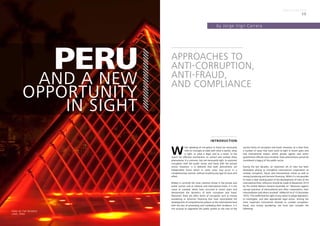
Park of the Reserve
lima, peru
by Jorge Vigil Carrera
2120
Issue Xi, june 2016
{{ the United Nations Convention against Corruption;
{{ the Inter-American Convention against Corruption;
{{ the European Union Convention against Corruption Involving
Officials;
{{ the Council of Europe Criminal Law Convention on
Corruption;
{{ the Council of Europe Civil Law Convention on Corruption;
{{ the United Nations Convention against Transnational
Organized Crime;
{{ the Convention on Combating Bribery of Foreign Public
Officials in International Business Transactions (OECD);
{{ the 20th APEC Economic Leaders’ Declaration Fighting
Corruption and Ensuring Transparency;
{{ the US Patriot Act;
{{ the Foreign Corrupt Practices Act (FCPA);
{{ the UK Bribery Act;
{{ EU Directive 2015/849 on preventing the use of the financial
system for money laundering or terrorist financing (4th Anti-
Money Laundering Directive);
{{ the Sarbanes-Oxley Act;
{{ the COSO Enterprise Risk Management (ERM) Framework;
{{ the Basel Committee on Banking Supervision Accords; and
{{ the Financial Action Task Force on Money Laundering
Recommendations (FATF/GAFI).
Under the pressure created by corporate scandals in recent years
and beyond the aforementioned compendium of legal
instruments, new schemes to counter corruption and fraud at
government as well as enterprise level have been developed.
These schemes go well beyond the aforementioned compendium
of legal instruments and are applicable to management of public
and private organizations. They comprise the promotion of
transparency, ethics, integrity, corporate governance, internal
controls, and prevention models in the compliance environment.
The Peruvian case
In Peru, for more than a decade a number of mechanisms and
initiatives aimed at fundamentally combating corruption
statewide standards have been developed and the need for
collective action is part of the solution to address these scourges.
Within Peru’s domestic law, the Peruvian Penal Code includes
chapters related to fraud in the administration of legal entities as
well as a section devoted to crimes against public administration.
The latter also includes offences related to corrupt practices,
such as identified concussions, collusion, and embezzlement.
Furthermore, one section is specifically dedicated to corruption
of officials, in which the active transnational bribery is also
comprised.
Economic growth in Peru and the signing of multiple free trade
agreements with North America, Europe, and Asia has increased
the need for Peruvian companies to become more competitive
and comply with the good business practices and integrity
standards required by the agreements.
In Peru compliance with the prevention of money laundering and
terrorist financing was initially based on the standards set by the
financial regulator. This concept was expanded and took effect
through domestic policies applicable to transnational
corporations with a presence in Peru, whose parent companies
were required to comply with ethics and compliance standards.
Among the most recently adopted standards, one should
mention the new risk management regulation on money
laundering and terrorist financing, which was approved in July
2015. More recently, on 21 April 2016, Law No. 30424 governing
the administrative liability of legal persons for the offence of
active transnational bribery was published. This will come into
effect on 1 July 2017.
This law still maintains distance from the scheme of criminal
liability of legal persons applied in many countries in the region
and internationally. But it is a first and important step which in
the future should be consolidated as an effective system to
prevent corruption in the interaction between private companies
and the state, with the extension to other offences related to
corruption of officials. But it is important to highlight the
momentum that the High Level Anti-Corruption Commission of
Peru gave to this piece of legislation. This was despite resistance
and scepticism from the business community, which was based
on mistrust of the actions of some functionaries in the judiciary
against whom there are allegations of corruption.
Law No. 30424 has become the first instrument in Peru’s legal
system in which the attribution of liability for legal persons,
regardless of the criminal liability of the natural person acting as
an agent of the unlawful conduct, is considered. Although
recognized as being oriented towards administrative
responsibility, the rule provides that the procedure is performed
in the context of criminal proceedings. The law considers the
application of administrative sanctions including fines,
disqualification, cancellation of licenses, concessions, and
administrative authorizations, until the dissolution of the legal
person. This law also considers an organization’s implementation
of prevention models involving surveillance measures and good
control to avoid the materialization of the crime. The effective
implementation and operation of these models will be verified by
the judge or prosecutor as appropriate as a mitigating or
exculpatory factor of administrative responsibility.
Based on the experience gained in both the public and private
sectors in prevention efforts and research, risk management,
internal control, and compliance, this is a timely opportunity for
Peruvian companies. They have a chance to develop prevention
models that not only serve for regulatory compliance, but also to
develop and internalize best business practices, corporate
governance protocols, implementation of ethical guidelines,
codes of conduct, and integrity, resulting in better positioning
and competitiveness. Corruption and fraud are now globalized
phenomena that jeopardize not only the public and private
sector as agents but also national and transnational efforts of
governments. A joint, responsible, and multidimensional action
to reduce corruption and fraud is therefore needed.
Jorge Vigil Carrera (Peru) is a lawyer and researcher
with over 15 years of experience in the public and
private sectors, with expertise in legal, risk
management, investigations, fraud prevention,
compliance, and internal control.
He has been a member of the Office of Internal
Affairs in the Ministry of the Interior and later
Director of the Special Action Unit, Inspector General
and Advisor to the General Inspectorate of the
Ministry of Interior. In the private sector he provides
legal advice to companies in fields including
electronics, telecommunications, and foreign trade.
He has obtained a certification in Risk Management
and Compliance, majoring in ethics, transparency,
anti-corruption, governance, and political
management.
He participated in the IACA Regional Summer
Academy - Latin America in Buenos Aires in
November 2015.
JORGE VIGIL CARRERA

IACA ALUMNUS June 2016

  • 1.
    1 Issue Xi, june2016 IACAlumnus t h e m a g a z i n e Issue XI, June 2016 winning the hearts and minds battle Empowering Professionals Powerful ideas in the fight against corruption: The Inspections from Public Lotteries Programme in Brazil By Ana Luiza Aranha Are Anti-Corruption agencies headed in the right direction? By Ashok Kumar Poddar Interview with Ady Macauley
  • 2.
    32 Issue Xi, june2016 IACAlumnus - the magazine is the alumni magazine of the International Anti-Corruption Academy (IACA), addressing alumni around the world who have participated, or are currently taking part in trainings designed and implemented by IACA. IACAlumnus - the magazine welcomes contributions by alumni. As a forum to exchange ideas and latest developments, and feature the career paths of our alumni, we seek to provide you with a medium to stay connected. For contributions please contact alumni@iaca.int. IACA reserves the right to select and edit any contribution to suit the publication. We will not consider contributions that have already been published, in any form, in print or online. Editorial Abhishek Bharti, Elisabeth Neckel, Mariana A. Rissetto Design Adrian Ciupagea Photographs IACA, iStock.com front cover; back cover “Minds and Hearts“; Laxenburg - aerial view Publisher International Anti-Corruption Academy (IACA) Muenchendorfer Strasse 2 2361 Laxenburg, Vienna AUSTRIA +43 (0)2236 710 718 100 www.iaca.int alumni@iaca.int Print Federal Ministry of Defence and Sports/Armed Forces Printing Centre, Vienna, Austria. Waiver IACA promotes academic freedom. The contents of this magazine reflect the opinions of the contributors and do not necessarily represent the views or official position of IACA. Neither IACA nor its staff members or partners shall be liable for any inaccuracy, incompleteness, unavailability or error of the information provided. Credits June 2016 CONTENTS Powerful ideas in the fight against corruption: The Inspections from Public Lotteries Programme in Brazil by Ana Luiza Aranha What‘s new at IACA ? Conferences APPROACHES TO ANTI-CORRUPTION, ANTI-FRAUD, AND COMPLIANCE PERU AND A NEW OPPORTUNITY IN SIGHT By Jorge Vigil Carrera Maps INTERVIEW UPCOMING Latin America Latin America IACA Alumni Mapping p4 p6 p18 p10 p27 p24 alumni working group bios crossword p23 p26 3rd IACA alumni reunion CORRUPTION AND SECURITY Interview with Ady Macauley Welcome Word Dear alumni, On 8 March 2016 IACA celebrated the fifth anniversary of its establishment as an international organization. In this first issue of IACAlumnus after the celebrations, we would like to thank you all for your dedication and enthusiasm in the fight against corruption and for your contribution to IACA. As a group of more than 800 alumni from all parts of the globe, you are all ambassadors of the Academy and part of a truly unique network of anti-corruption professionals. We are proud to have you on board! The Alumni Association of IACA was set up about three years ago supported by the Alumni Team, which aims to serve you to the best possible extent. In this issue you will find short introductions of those who are part of the Alumni Team. Furthermore, this issue brings you exciting articles from Brazil, where Maria Luisa Rodrigues de Lima Carvalho shares her experience as prosecutor in a long-standing corruption case, and from India, where Ashok Kumar Poddar shares his insights about the organizational capabilities to handle the aftermath of an investigation. We would also like to share with you the recent promotion of Ady Macauley at the Anti-Corruption Commission of Sierra Leone and the ambitions he has for the tasks ahead of him. As the third Alumni Reunion in Laxenburg on 7 and 8 July 2016 draws ever closer, we have also included some pictures and memories from the past five years of IACA activities. We will be delighted to welcome you to Laxenburg again and are certain that you will enjoy catching up with your fellow alumni during the event. As always, we encourage you to contribute to the IACAlumnus magazine and will be pleased to hear how we can serve you even better. Sincerely, Martin Kreutner Are Anti-Corruption agencies headed in the right direction? By Ashok Kumar Poddar india p14 Corruption in the construction sector Building the São Paulo Labour Court By Maria Luisa Lima Carvalho construction sector p22
  • 3.
    1918 Issue Xi, june2016 W hen speaking of corruption or fraud we necessarily refer to concepts at odds with what is lawful, what is right, or what is legal, and as a result, to the search for effective mechanisms to control and combat these phenomena. It is common, but not necessarily right, to associate corruption with the public sector and fraud with the private sector. However, it is believed that both phenomena are independent forms which in some cases may occur in a complementary manner, without involving any type of cause and effect. Bribery is currently the most common threat in the private and public sectors and at national and international levels. It is the cause of scandals which have occurred in recent years and demonstrate the dynamics of both corruption and fraud. Moreover, there are other forms of corruption such as money laundering or terrorism financing that have necessitated the development of comprehensive policies at the international level with the aim of preventing and combating their incidence. It is not unusual to stigmatize the public system as the core of the various forms of corruption and fraud. However, as is clear from a number of cases that have come to light in recent years and had international impact where private agents and senior government officials were involved, these phenomena cannot be considered a legacy of the public sector. During the last decades, an important set of rules has been developed aiming to strengthen international cooperation to combat corruption, fraud, and transnational crimes as well as money laundering and terrorist financing. While it is not possible to mark a clear starting point of the development of rules at the international level, reference should be made to Resolution 3514 by the United Nations General Assembly on “Measures against corrupt practices of transnational and other corporations, their intermediaries and others involved” (A/Res/3514 of 15 December 1975). This reaffirmed the right of any nation to adopt legislation, to investigate, and take appropriate legal action. Among the most important instruments enacted to combat corruption, fraud, and money laundering, we must also consider the following: and A NEW OPPORTUNITY IN SIGHT peru APPROACHES TO ANTI-CORRUPTION, ANTI-FRAUD, AND compliance Introduction Park of the Reserve lima, peru by Jorge Vigil Carrera
  • 4.
    2120 Issue Xi, june2016 {{ the United Nations Convention against Corruption; {{ the Inter-American Convention against Corruption; {{ the European Union Convention against Corruption Involving Officials; {{ the Council of Europe Criminal Law Convention on Corruption; {{ the Council of Europe Civil Law Convention on Corruption; {{ the United Nations Convention against Transnational Organized Crime; {{ the Convention on Combating Bribery of Foreign Public Officials in International Business Transactions (OECD); {{ the 20th APEC Economic Leaders’ Declaration Fighting Corruption and Ensuring Transparency; {{ the US Patriot Act; {{ the Foreign Corrupt Practices Act (FCPA); {{ the UK Bribery Act; {{ EU Directive 2015/849 on preventing the use of the financial system for money laundering or terrorist financing (4th Anti- Money Laundering Directive); {{ the Sarbanes-Oxley Act; {{ the COSO Enterprise Risk Management (ERM) Framework; {{ the Basel Committee on Banking Supervision Accords; and {{ the Financial Action Task Force on Money Laundering Recommendations (FATF/GAFI). Under the pressure created by corporate scandals in recent years and beyond the aforementioned compendium of legal instruments, new schemes to counter corruption and fraud at government as well as enterprise level have been developed. These schemes go well beyond the aforementioned compendium of legal instruments and are applicable to management of public and private organizations. They comprise the promotion of transparency, ethics, integrity, corporate governance, internal controls, and prevention models in the compliance environment. The Peruvian case In Peru, for more than a decade a number of mechanisms and initiatives aimed at fundamentally combating corruption statewide standards have been developed and the need for collective action is part of the solution to address these scourges. Within Peru’s domestic law, the Peruvian Penal Code includes chapters related to fraud in the administration of legal entities as well as a section devoted to crimes against public administration. The latter also includes offences related to corrupt practices, such as identified concussions, collusion, and embezzlement. Furthermore, one section is specifically dedicated to corruption of officials, in which the active transnational bribery is also comprised. Economic growth in Peru and the signing of multiple free trade agreements with North America, Europe, and Asia has increased the need for Peruvian companies to become more competitive and comply with the good business practices and integrity standards required by the agreements. In Peru compliance with the prevention of money laundering and terrorist financing was initially based on the standards set by the financial regulator. This concept was expanded and took effect through domestic policies applicable to transnational corporations with a presence in Peru, whose parent companies were required to comply with ethics and compliance standards. Among the most recently adopted standards, one should mention the new risk management regulation on money laundering and terrorist financing, which was approved in July 2015. More recently, on 21 April 2016, Law No. 30424 governing the administrative liability of legal persons for the offence of active transnational bribery was published. This will come into effect on 1 July 2017. This law still maintains distance from the scheme of criminal liability of legal persons applied in many countries in the region and internationally. But it is a first and important step which in the future should be consolidated as an effective system to prevent corruption in the interaction between private companies and the state, with the extension to other offences related to corruption of officials. But it is important to highlight the momentum that the High Level Anti-Corruption Commission of Peru gave to this piece of legislation. This was despite resistance and scepticism from the business community, which was based on mistrust of the actions of some functionaries in the judiciary against whom there are allegations of corruption. Law No. 30424 has become the first instrument in Peru’s legal system in which the attribution of liability for legal persons, regardless of the criminal liability of the natural person acting as an agent of the unlawful conduct, is considered. Although recognized as being oriented towards administrative responsibility, the rule provides that the procedure is performed in the context of criminal proceedings. The law considers the application of administrative sanctions including fines, disqualification, cancellation of licenses, concessions, and administrative authorizations, until the dissolution of the legal person. This law also considers an organization’s implementation of prevention models involving surveillance measures and good control to avoid the materialization of the crime. The effective implementation and operation of these models will be verified by the judge or prosecutor as appropriate as a mitigating or exculpatory factor of administrative responsibility. Based on the experience gained in both the public and private sectors in prevention efforts and research, risk management, internal control, and compliance, this is a timely opportunity for Peruvian companies. They have a chance to develop prevention models that not only serve for regulatory compliance, but also to develop and internalize best business practices, corporate governance protocols, implementation of ethical guidelines, codes of conduct, and integrity, resulting in better positioning and competitiveness. Corruption and fraud are now globalized phenomena that jeopardize not only the public and private sector as agents but also national and transnational efforts of governments. A joint, responsible, and multidimensional action to reduce corruption and fraud is therefore needed. Jorge Vigil Carrera (Peru) is a lawyer and researcher with over 15 years of experience in the public and private sectors, with expertise in legal, risk management, investigations, fraud prevention, compliance, and internal control. He has been a member of the Office of Internal Affairs in the Ministry of the Interior and later Director of the Special Action Unit, Inspector General and Advisor to the General Inspectorate of the Ministry of Interior. In the private sector he provides legal advice to companies in fields including electronics, telecommunications, and foreign trade. He has obtained a certification in Risk Management and Compliance, majoring in ethics, transparency, anti-corruption, governance, and political management. He participated in the IACA Regional Summer Academy - Latin America in Buenos Aires in November 2015. JORGE VIGIL CARRERA