Water Cycle		How does the water cycle affect our weather?
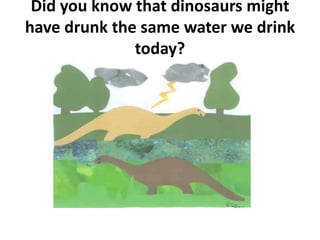
Did you know that dinosaurs might have drunk the same water we drink today?
The water that we have never goes away and new water is never created. You might say the water we use is recycled!
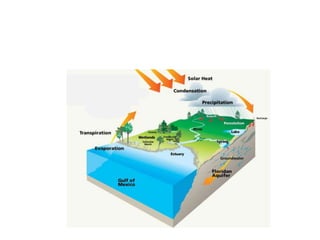
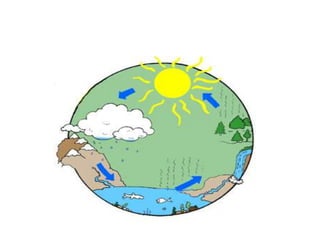
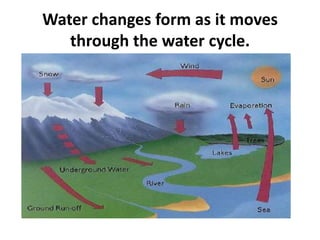
Water changes form as it moves through the water cycle.
TEKs  2nd  Grade Science 112.4. Science, Grade 2.  (4)  A system is a collection of cycles, structures, and processes that interact. Students should understand a whole in terms of its components and how these components relate to each other and to the whole. All systems have basic properties that can be described in terms of space, time, energy, and matter. Change and constancy occur in systems and can be observed and measured as patterns. These patterns help to predict what will happen next and can change over time.  (1)  Scientific processes. The student conducts classroom and field investigations following home and school safety procedures. The student is expected to:    (A)  demonstrate safe practices during classroom and field investigations; and    (B)  learn how to use and conserve resources and dispose of materials.  (2)  Scientific processes. The student develops abilities necessary to do scientific inquiry in the field and the classroom. The student is expected to:      (B)  plan and conduct simple descriptive investigations;    (C)  compare results of investigations with what students and scientists know about the world;  (7)  Science concepts. The student knows that many types of change occur. The student is expected to:      (A)  observe, measure, record, analyze, predict, and illustrate changes in size, mass, temperature, color, position, quantity, sound, and movement;    (B)  identify, predict, and test uses of heat to cause change such as melting and evaporation;  (10)  Science concepts. The student knows that the natural world includes rocks, soil, water, and gases of the atmosphere. The student is expected to:    (A)  describe and illustrate the water cycle;     (B)  identify uses of natural resources.  
Cited resourcesThe water cycle from USGS water science for schoolshttp://ga.water.usgs.gov/edu/watercycle.htmlWater cycle is truly a "cycle," there is no beginning or end. Water Cyclehttp://www.epa.gov/region07/kids/wtrcycle.htmWhere does the water come from to become part of the water cycle Water cycle diagramhttp://earthguide.ucsd.edu/earthguide/diagrams/watercycle/index.htmlAnimated water cycle diagram  Water: A never –Ending Storyhttp://www-k12.atmos.washington.edu/k12/pilot/water_cycle/teacherpage.html#backgroundA song to teach students vocabulary about the water cycle.  Water Cyclehttp://www.sweetwater.org/education/watercycle.htmlA video about the water cycle and a quiz that can be used to test the students after the end of the lesson Water Cyclehttp://www.bing.com/videos/search?q=water+cycle+videos&docid=650725621761&FORM=VIRE5I found a video that explains the cycle

Water Cycle

  • 1.
    Water Cycle How doesthe water cycle affect our weather?
  • 4.
    Did you knowthat dinosaurs might have drunk the same water we drink today?
  • 5.
    The water thatwe have never goes away and new water is never created. You might say the water we use is recycled!
  • 6.
    Water changes formas it moves through the water cycle.
  • 7.
    TEKs 2nd Grade Science 112.4. Science, Grade 2.  (4)  A system is a collection of cycles, structures, and processes that interact. Students should understand a whole in terms of its components and how these components relate to each other and to the whole. All systems have basic properties that can be described in terms of space, time, energy, and matter. Change and constancy occur in systems and can be observed and measured as patterns. These patterns help to predict what will happen next and can change over time.  (1)  Scientific processes. The student conducts classroom and field investigations following home and school safety procedures. The student is expected to:    (A)  demonstrate safe practices during classroom and field investigations; and    (B)  learn how to use and conserve resources and dispose of materials.  (2)  Scientific processes. The student develops abilities necessary to do scientific inquiry in the field and the classroom. The student is expected to:      (B)  plan and conduct simple descriptive investigations;    (C)  compare results of investigations with what students and scientists know about the world;  (7)  Science concepts. The student knows that many types of change occur. The student is expected to:      (A)  observe, measure, record, analyze, predict, and illustrate changes in size, mass, temperature, color, position, quantity, sound, and movement;    (B)  identify, predict, and test uses of heat to cause change such as melting and evaporation;  (10)  Science concepts. The student knows that the natural world includes rocks, soil, water, and gases of the atmosphere. The student is expected to:    (A)  describe and illustrate the water cycle;     (B)  identify uses of natural resources.  
  • 8.
    Cited resourcesThe watercycle from USGS water science for schoolshttp://ga.water.usgs.gov/edu/watercycle.htmlWater cycle is truly a "cycle," there is no beginning or end. Water Cyclehttp://www.epa.gov/region07/kids/wtrcycle.htmWhere does the water come from to become part of the water cycle Water cycle diagramhttp://earthguide.ucsd.edu/earthguide/diagrams/watercycle/index.htmlAnimated water cycle diagram  Water: A never –Ending Storyhttp://www-k12.atmos.washington.edu/k12/pilot/water_cycle/teacherpage.html#backgroundA song to teach students vocabulary about the water cycle.  Water Cyclehttp://www.sweetwater.org/education/watercycle.htmlA video about the water cycle and a quiz that can be used to test the students after the end of the lesson Water Cyclehttp://www.bing.com/videos/search?q=water+cycle+videos&docid=650725621761&FORM=VIRE5I found a video that explains the cycle