WATCH OUT, SMA
When a company like Chinese-based
Huawei Technologies Co. Ltd. decides
to start a new venture, one can be sure
it doesn’t aim to just sell a few thousand
devices. With revenue of $35.4 billion in
2012, a profit of about $2.48 billion, and
more than 150,000 employees, Huawei is
a new player in the inverter market that
has the potential to give market leader
SMA Solar Technology AG a run for
its money, if not outright scare it. Not
surprisingly, the PHOTON engineers
were very eager to get their hands on one
of the first devices from Huawei’s new
inverter series, which was tested under the
usual agreement.
And they were not disappointed. Not
only the high efficiency – achieved
without using silicon carbide (SiC)
transistors, no less – caught the engineer’s
attention, but also the overall impression
of the inverter. Many inverters coming
out of China show poor workmanship
and use a large amount of glue to attach
electrical components. Getting these
devices to work is usually complicated
and often success is only achieved on a
second try. There is no way to objectively
factor these things into a rating, so the
PHOTON grade does not reflect them.
When an inverter doesn’t show any of
these flaws, like the one from Huawei, its
»A+« grade is all the more valuable.
OPERATION
The Sun2000-20KTL is delivered well
packaged and includes a wall-mounting
bracket. At 48 kg, the inverter is lightwei-
ght given its nominal power. Once the
solar generator is properly configured and
the internal DC disconnect is activated,
the device begins to operate. At the lab,
the candidate took 63 seconds to run a se-
ries of tests before connecting to the grid.
SUMMARY
Overall the Sun2000-20KTL presented
itself as an outstanding inverter. Even
though it is designed with two levels of
circuit boards, it remains well sorted.
Since it does not need active cooling,
the inverter can be mounted indoors as
well as outdoors. Only if the temperature
rises above about 60 °C does the inverter
start to reduce its output, which does not
pose a problem in real life. The overload
capacity, 8.8 percent, turns out to be on
the smaller side.
There are no limitations when designing
PV systems with crystalline silicon mo-
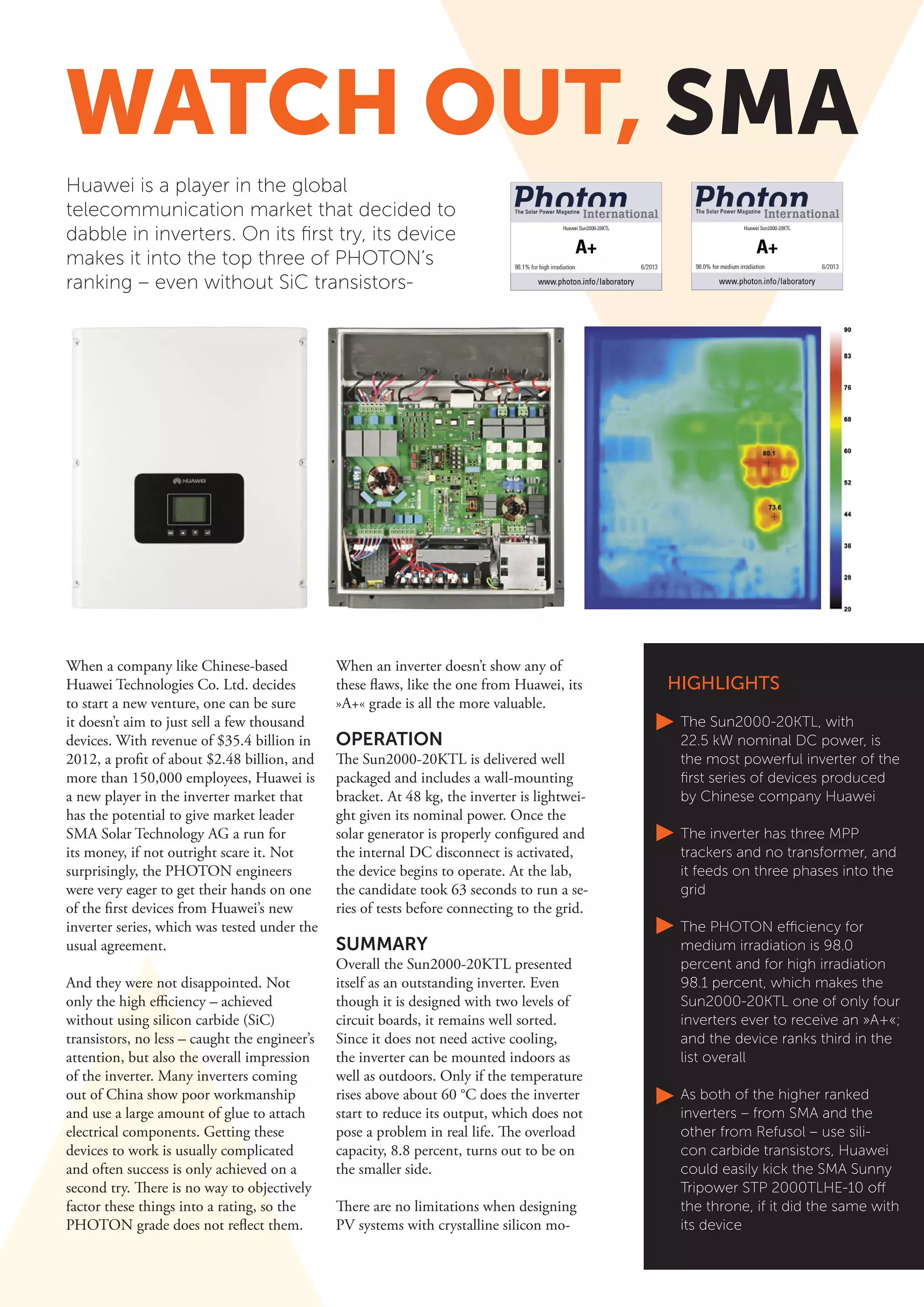
Huawei is a player in the global
telecommunication market that decided to
dabble in inverters. On its first try, its device
makes it into the top three of PHOTON’s
ranking – even without SiC transistors-
HIGHLIGHTS
The Sun2000-20KTL, with
22.5 kW nominal DC power, is
the most powerful inverter of the
first series of devices produced
by Chinese company Huawei
The inverter has three MPP
trackers and no transformer, and
it feeds on three phases into the
grid
The PHOTON efficiency for
medium irradiation is 98.0
percent and for high irradiation
98.1 percent, which makes the
Sun2000-20KTL one of only four
inverters ever to receive an »A+«;
and the device ranks third in the
list overall
As both of the higher ranked
inverters – from SMA and the
other from Refusol – use sili-
con carbide transistors, Huawei
could easily kick the SMA Sunny
Tripower STP 2000TLHE-10 off
the throne, if it did the same with
its device
dules: the maximum MPP voltage of 800
V keeps a healthy distance from the maxi-
mum DC input voltage of 1,000 V. Only
for thin-film modules does the difference
turn out to be a little too small. But
according to the manufacturer, thin-film
modules can only be used if the module
outs do not have any connection to the
ground or if there is to be an electrical
isolation installed on the inverter output
side.
The inverter display only shows a small
margin of error and can be used to track
the yield without hesitation. When it
comes to the efficiencies, it turns out that
they are almost identical in all three dif-
ferent modes (symmetrical, asymmetrical
and parallel) with the asymmetrical mode
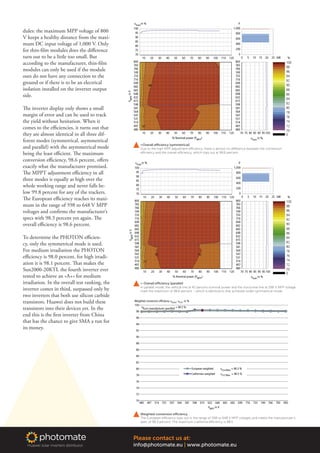
being the least efficient. The maximum
conversion efficiency, 98.6 percent, offers
exactly what the manufacturer promised.
The MPPT adjustment efficiency in all
three modes is equally as high over the
whole working range and never falls be-
low 99.8 percent for any of the trackers.
The European efficiency reaches its maxi-
mum in the range of 598 to 648 V MPP
voltages and confirms the manufacturer’s
specs with 98.3 percent yet again. The
overall efficiency is 98.6 percent.
To determine the PHOTON efficien-
cy, only the symmetrical mode is used.
For medium irradiation the PHOTON
efficiency is 98.0 percent, for high irradi-
ation it is 98.1 percent. That makes the
Sun2000-20KTL the fourth inverter ever
tested to achieve an »A+« for medium
irradiation. In the overall test ranking, the
inverter comes in third, surpassed only by
two inverters that both use silicon carbide
transistors. Huawei does not build these
transistors into their devices yet. In the
end this is the first inverter from China
that has the chance to give SMA a run for
its money.
Please contact us at:
info@photomate.eu | www.photomate.euHuawei solar inverters distributor.
=Overall efficiency (symmetrical)
Due to the high MPP adjustment efficiency, there is almost no difference between the conversion
efficiency and the overall efficiency, which tops out at 98.6 percent.
= Overall efficiency (parallel)
In parallel mode, the vertical line at 45 percent nominal power and the horizontal line at 598 V MPP voltage
mark the maximum of 98.6 percent – which is identical to that achieved under symmetrical mode.
Weighted conversion efficiency
The European efficiency tops out in the range of 598 to 648 V MPP voltages and meets the manufacturer’s
spec of 98.3 percent. The maximum California efficiency is 98.5.

Watch_out_SMA_A4

  • 1.
    WATCH OUT, SMA Whena company like Chinese-based Huawei Technologies Co. Ltd. decides to start a new venture, one can be sure it doesn’t aim to just sell a few thousand devices. With revenue of $35.4 billion in 2012, a profit of about $2.48 billion, and more than 150,000 employees, Huawei is a new player in the inverter market that has the potential to give market leader SMA Solar Technology AG a run for its money, if not outright scare it. Not surprisingly, the PHOTON engineers were very eager to get their hands on one of the first devices from Huawei’s new inverter series, which was tested under the usual agreement. And they were not disappointed. Not only the high efficiency – achieved without using silicon carbide (SiC) transistors, no less – caught the engineer’s attention, but also the overall impression of the inverter. Many inverters coming out of China show poor workmanship and use a large amount of glue to attach electrical components. Getting these devices to work is usually complicated and often success is only achieved on a second try. There is no way to objectively factor these things into a rating, so the PHOTON grade does not reflect them. When an inverter doesn’t show any of these flaws, like the one from Huawei, its »A+« grade is all the more valuable. OPERATION The Sun2000-20KTL is delivered well packaged and includes a wall-mounting bracket. At 48 kg, the inverter is lightwei- ght given its nominal power. Once the solar generator is properly configured and the internal DC disconnect is activated, the device begins to operate. At the lab, the candidate took 63 seconds to run a se- ries of tests before connecting to the grid. SUMMARY Overall the Sun2000-20KTL presented itself as an outstanding inverter. Even though it is designed with two levels of circuit boards, it remains well sorted. Since it does not need active cooling, the inverter can be mounted indoors as well as outdoors. Only if the temperature rises above about 60 °C does the inverter start to reduce its output, which does not pose a problem in real life. The overload capacity, 8.8 percent, turns out to be on the smaller side. There are no limitations when designing PV systems with crystalline silicon mo- Huawei is a player in the global telecommunication market that decided to dabble in inverters. On its first try, its device makes it into the top three of PHOTON’s ranking – even without SiC transistors- HIGHLIGHTS The Sun2000-20KTL, with 22.5 kW nominal DC power, is the most powerful inverter of the first series of devices produced by Chinese company Huawei The inverter has three MPP trackers and no transformer, and it feeds on three phases into the grid The PHOTON efficiency for medium irradiation is 98.0 percent and for high irradiation 98.1 percent, which makes the Sun2000-20KTL one of only four inverters ever to receive an »A+«; and the device ranks third in the list overall As both of the higher ranked inverters – from SMA and the other from Refusol – use sili- con carbide transistors, Huawei could easily kick the SMA Sunny Tripower STP 2000TLHE-10 off the throne, if it did the same with its device
  • 2.
    dules: the maximumMPP voltage of 800 V keeps a healthy distance from the maxi- mum DC input voltage of 1,000 V. Only for thin-film modules does the difference turn out to be a little too small. But according to the manufacturer, thin-film modules can only be used if the module outs do not have any connection to the ground or if there is to be an electrical isolation installed on the inverter output side. The inverter display only shows a small margin of error and can be used to track the yield without hesitation. When it comes to the efficiencies, it turns out that they are almost identical in all three dif- ferent modes (symmetrical, asymmetrical and parallel) with the asymmetrical mode being the least efficient. The maximum conversion efficiency, 98.6 percent, offers exactly what the manufacturer promised. The MPPT adjustment efficiency in all three modes is equally as high over the whole working range and never falls be- low 99.8 percent for any of the trackers. The European efficiency reaches its maxi- mum in the range of 598 to 648 V MPP voltages and confirms the manufacturer’s specs with 98.3 percent yet again. The overall efficiency is 98.6 percent. To determine the PHOTON efficien- cy, only the symmetrical mode is used. For medium irradiation the PHOTON efficiency is 98.0 percent, for high irradi- ation it is 98.1 percent. That makes the Sun2000-20KTL the fourth inverter ever tested to achieve an »A+« for medium irradiation. In the overall test ranking, the inverter comes in third, surpassed only by two inverters that both use silicon carbide transistors. Huawei does not build these transistors into their devices yet. In the end this is the first inverter from China that has the chance to give SMA a run for its money. Please contact us at: info@photomate.eu | www.photomate.euHuawei solar inverters distributor. =Overall efficiency (symmetrical) Due to the high MPP adjustment efficiency, there is almost no difference between the conversion efficiency and the overall efficiency, which tops out at 98.6 percent. = Overall efficiency (parallel) In parallel mode, the vertical line at 45 percent nominal power and the horizontal line at 598 V MPP voltage mark the maximum of 98.6 percent – which is identical to that achieved under symmetrical mode. Weighted conversion efficiency The European efficiency tops out in the range of 598 to 648 V MPP voltages and meets the manufacturer’s spec of 98.3 percent. The maximum California efficiency is 98.5.