International Research Journal of Engineering and Technology (IRJET) e-ISSN: 2395-0056
Volume: 09 Issue: 05 | May 2022 www.irjet.net p-ISSN: 2395-0072
© 2022, IRJET | Impact Factor value: 7.529 | ISO 9001:2008 Certified Journal | Page 742
WASTE MATERIALS USED IN CONCRETE TECHNOLOGY
GIRISH MAKHIJA1, Ms. MAUNI MODI2
1PG Student, M.E. (Civil) infrastructure engineering, L.D.R.P Institute of Technology & Research
2Asst. Professor, Dept. of civil engineering, L.D.R.P institute of technology & Research
---------------------------------------------------------------------***---------------------------------------------------------------------
Abstract - Infrastructure Development across the world
has created the demand for construction materials.
Concrete is the premier in civil engineering construction
material. Concrete manufacturing includes the
consumption of ingredients Such as cement, Sand,
aggregates, water and admixtures. Among all these
ingredients aggregates form the major part. In the other
hand, we use alternative waste materials in place of
natural aggregates in concrete production which can
make concrete as environment friendly material.
Examples of such materials are Coconut shells, Scrap
tires, plastic waste, Recycled aggregates etc. If these
materials are used in construction industry, thepollution
and disposal problems may be partly reduced.
1. INTRODUCTION
Concrete is basically made of aggregates, cementitious
materials paste, which includes cementitious materials and
water. Major problems to the local authority to identify the
potential and recycling of waste products like Waste rubber
tires which are expensive and decreases the number of
landfills. The disposals of waste tires to landfill are legally
banned in all the countries. The main purpose of study on
waste rubber tyre in concrete for eco-friendly environment.
Decomposition of waste rubber tire which contains
composed materials and it causes serious contaminationfor
environment condition. Another process of decomposing is
burning that can cause pollution in environment and the
gases exhausted are harmful.
2.Methodology
In this method, our present study aims the use of waste
rubber tire as a partial replacement of coarse aggregate to
produce concrete in M20 grade of mix. Different partial
replacement of rubber chips (0, 10, 20, & 30%) by the
volume of coarse aggregate casted and tested for
compressive strength in water on 14 and 28 days.
Materials and Methods
Materials
Cement
Portland cement with OPC grade 53 cement is used.
Aggregate
The fine aggregate which is round in shape is used in the
experiment with siliceous sand.
Rubber tyre chips
A rubber tyre chips of size 20mm are used with specific
gravity of 1.16
Water
A portable water of Ph 7 to 8 is used
Experimental Setup
In this experiment consist of 4 types of mix proportions
replaced by coarse aggregate in 0, 10, 20, 30% of waste
rubber tyre in M20 grade of concrete.
Total number of 48 cubes (150×150×150mm) were casted
for durability test and compressive strength. Compressive
test was performed at the age of 14 and 28 days and the
durability test at the age of 28 days of curing.
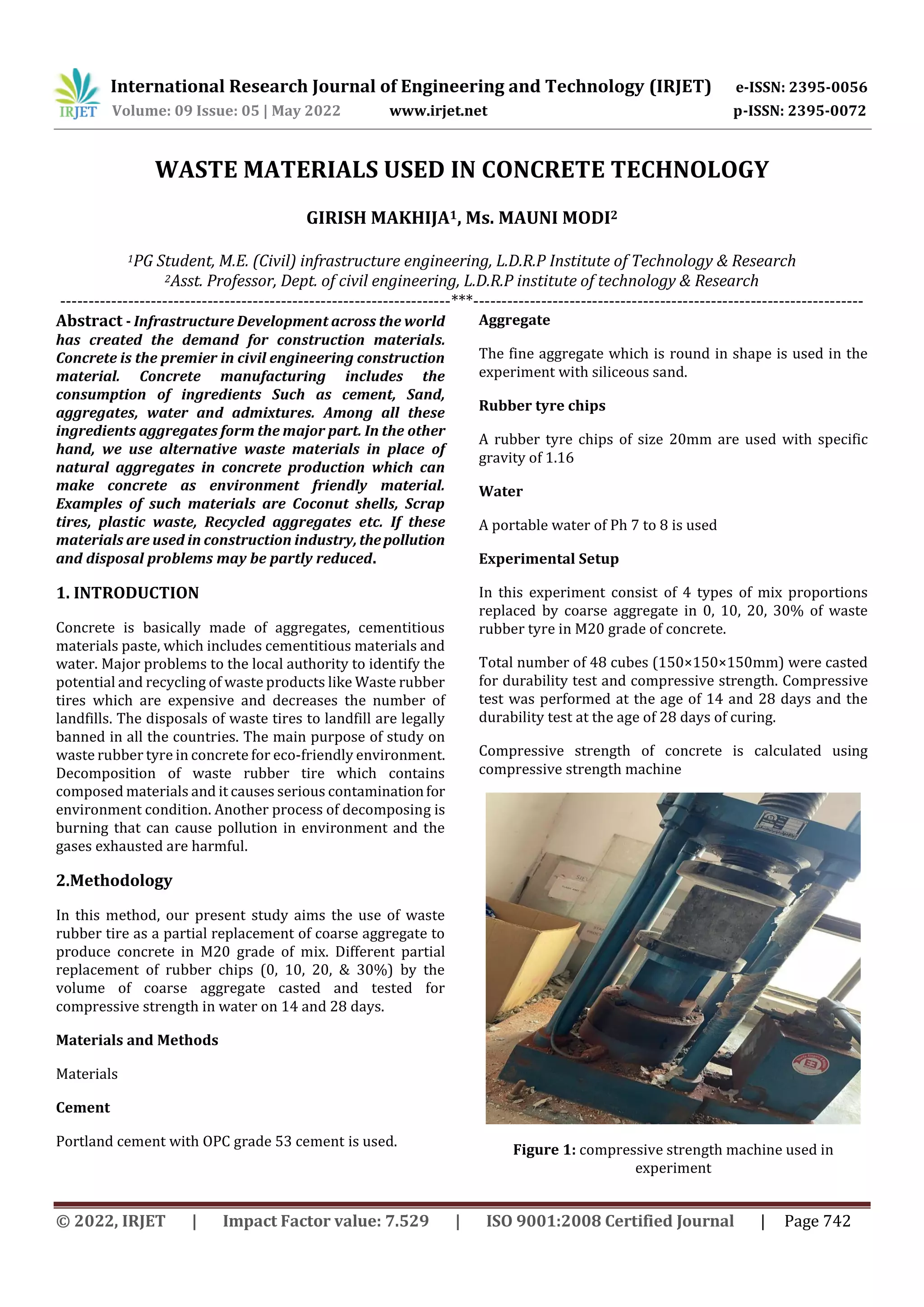
Compressive strength of concrete is calculated using
compressive strength machine
Figure 1: compressive strength machine used in
experiment
International Research Journal of Engineering and Technology (IRJET) e-ISSN: 2395-0056
Volume: 09 Issue: 05 | May 2022 www.irjet.net p-ISSN: 2395-0072
© 2022, IRJET | Impact Factor value: 7.529 | ISO 9001:2008 Certified Journal | Page 743
I. RESULTS AND DISCUSSION
Workability Of Concrete
TABLE 1 Workability of Concrete
% Replacement of waste
rubber tire
Slump value (mm)
Conventional concrete 81
10% 74
20% 67
30% 44
TABLE 2 Compressive strength of concrete
% Replacement of
waste rubber tyre
Average compressive strength
(N/mm²)
14 days 28 days
Conventional
concrete
17.58 20.41
10% 20.20 23.11
20% 18.15 20.85
30% 9.53 13.28
17.58
20.2
18.15
9.53
20.41
23.11
20.85
13.28
8
10
12
14
16
18
20
22
24
CC 10% 20% 30%
14 Days
Fig 1. Graph Of results
3. CONCLUSIONS
The various strength tests were conducted for the concrete
mix which contains different replacement proportions for
waste rubber tyre. Adding the waste rubber tyre into the
normal concrete mix leads to decrease in workability forthe
various mix samples.
All the main points of the research work are written in this
section. Ensure that abstract and conclusion should not
same. Graph and tables should not use in conclusion.
1.When 10% coarse aggregate wasreplacedbythewaste
rubber tire the compressive strength of the concrete
increases nearly about 14%
2.Density of the concrete decreases nearly about 11%
3.Strength decrease with increasingthewastetiredueto
the poor bonding strength between cement and waste
tire chips at 14- and 28-days strength
REFERENCES
[1] Mohammad Reza Shorbi and Mohammad karbalaie,ʺAn
Experimental Study on Compressive Strength of
Concrete Containing Crumb Rubber”. International
Journal of Civil and Environmental (IJCEE) Vol.11, NO.3,
pp 24-28, 2011.
[2] Sara S Gobba, Giuseppe Carlo Marano, Massimo Borsa
and Marcello Molfetta, ʺ Use of Rubber Particles from
Recycled Tires as a Concrete Aggregate for Engineering
Applications”, Second international Conference on
Sustainable construction materials and Technologies,
The University of Wisconsin Milwaukee Centre of By-
products Utilization June 2010.
[3] Pacheco Torgal. F, Shasavandi. A and Jalali. S, “Tyre
Rubber Wastes Based Concrete: A Review”. WASTES:
Solutions, Treatments and Opportunities, First
International Conference, September 2011.
[4] Neela Deshpande. S, Kulkarni. S, Tejaswinee Pawar and
Vijay Gunde, “Experimental investigation on Strength
characteristics of concrete using tyre rubber as
aggregates in concrete”. International Journal ofApplied
Engineering Research and Development, Vol. 4, Issue 2,
pp 97-108, April 2014.
BIOGRAPHY
Makhija Girish Prakash Kumar
PG student, (M.E Civil)
infrastructure engineering

WASTE MATERIALS USED IN CONCRETE TECHNOLOGY

  • 1.
    International Research Journalof Engineering and Technology (IRJET) e-ISSN: 2395-0056 Volume: 09 Issue: 05 | May 2022 www.irjet.net p-ISSN: 2395-0072 © 2022, IRJET | Impact Factor value: 7.529 | ISO 9001:2008 Certified Journal | Page 742 WASTE MATERIALS USED IN CONCRETE TECHNOLOGY GIRISH MAKHIJA1, Ms. MAUNI MODI2 1PG Student, M.E. (Civil) infrastructure engineering, L.D.R.P Institute of Technology & Research 2Asst. Professor, Dept. of civil engineering, L.D.R.P institute of technology & Research ---------------------------------------------------------------------***--------------------------------------------------------------------- Abstract - Infrastructure Development across the world has created the demand for construction materials. Concrete is the premier in civil engineering construction material. Concrete manufacturing includes the consumption of ingredients Such as cement, Sand, aggregates, water and admixtures. Among all these ingredients aggregates form the major part. In the other hand, we use alternative waste materials in place of natural aggregates in concrete production which can make concrete as environment friendly material. Examples of such materials are Coconut shells, Scrap tires, plastic waste, Recycled aggregates etc. If these materials are used in construction industry, thepollution and disposal problems may be partly reduced. 1. INTRODUCTION Concrete is basically made of aggregates, cementitious materials paste, which includes cementitious materials and water. Major problems to the local authority to identify the potential and recycling of waste products like Waste rubber tires which are expensive and decreases the number of landfills. The disposals of waste tires to landfill are legally banned in all the countries. The main purpose of study on waste rubber tyre in concrete for eco-friendly environment. Decomposition of waste rubber tire which contains composed materials and it causes serious contaminationfor environment condition. Another process of decomposing is burning that can cause pollution in environment and the gases exhausted are harmful. 2.Methodology In this method, our present study aims the use of waste rubber tire as a partial replacement of coarse aggregate to produce concrete in M20 grade of mix. Different partial replacement of rubber chips (0, 10, 20, & 30%) by the volume of coarse aggregate casted and tested for compressive strength in water on 14 and 28 days. Materials and Methods Materials Cement Portland cement with OPC grade 53 cement is used. Aggregate The fine aggregate which is round in shape is used in the experiment with siliceous sand. Rubber tyre chips A rubber tyre chips of size 20mm are used with specific gravity of 1.16 Water A portable water of Ph 7 to 8 is used Experimental Setup In this experiment consist of 4 types of mix proportions replaced by coarse aggregate in 0, 10, 20, 30% of waste rubber tyre in M20 grade of concrete. Total number of 48 cubes (150×150×150mm) were casted for durability test and compressive strength. Compressive test was performed at the age of 14 and 28 days and the durability test at the age of 28 days of curing. Compressive strength of concrete is calculated using compressive strength machine Figure 1: compressive strength machine used in experiment
  • 2.
    International Research Journalof Engineering and Technology (IRJET) e-ISSN: 2395-0056 Volume: 09 Issue: 05 | May 2022 www.irjet.net p-ISSN: 2395-0072 © 2022, IRJET | Impact Factor value: 7.529 | ISO 9001:2008 Certified Journal | Page 743 I. RESULTS AND DISCUSSION Workability Of Concrete TABLE 1 Workability of Concrete % Replacement of waste rubber tire Slump value (mm) Conventional concrete 81 10% 74 20% 67 30% 44 TABLE 2 Compressive strength of concrete % Replacement of waste rubber tyre Average compressive strength (N/mm²) 14 days 28 days Conventional concrete 17.58 20.41 10% 20.20 23.11 20% 18.15 20.85 30% 9.53 13.28 17.58 20.2 18.15 9.53 20.41 23.11 20.85 13.28 8 10 12 14 16 18 20 22 24 CC 10% 20% 30% 14 Days Fig 1. Graph Of results 3. CONCLUSIONS The various strength tests were conducted for the concrete mix which contains different replacement proportions for waste rubber tyre. Adding the waste rubber tyre into the normal concrete mix leads to decrease in workability forthe various mix samples. All the main points of the research work are written in this section. Ensure that abstract and conclusion should not same. Graph and tables should not use in conclusion. 1.When 10% coarse aggregate wasreplacedbythewaste rubber tire the compressive strength of the concrete increases nearly about 14% 2.Density of the concrete decreases nearly about 11% 3.Strength decrease with increasingthewastetiredueto the poor bonding strength between cement and waste tire chips at 14- and 28-days strength REFERENCES [1] Mohammad Reza Shorbi and Mohammad karbalaie,ʺAn Experimental Study on Compressive Strength of Concrete Containing Crumb Rubber”. International Journal of Civil and Environmental (IJCEE) Vol.11, NO.3, pp 24-28, 2011. [2] Sara S Gobba, Giuseppe Carlo Marano, Massimo Borsa and Marcello Molfetta, ʺ Use of Rubber Particles from Recycled Tires as a Concrete Aggregate for Engineering Applications”, Second international Conference on Sustainable construction materials and Technologies, The University of Wisconsin Milwaukee Centre of By- products Utilization June 2010. [3] Pacheco Torgal. F, Shasavandi. A and Jalali. S, “Tyre Rubber Wastes Based Concrete: A Review”. WASTES: Solutions, Treatments and Opportunities, First International Conference, September 2011. [4] Neela Deshpande. S, Kulkarni. S, Tejaswinee Pawar and Vijay Gunde, “Experimental investigation on Strength characteristics of concrete using tyre rubber as aggregates in concrete”. International Journal ofApplied Engineering Research and Development, Vol. 4, Issue 2, pp 97-108, April 2014. BIOGRAPHY Makhija Girish Prakash Kumar PG student, (M.E Civil) infrastructure engineering