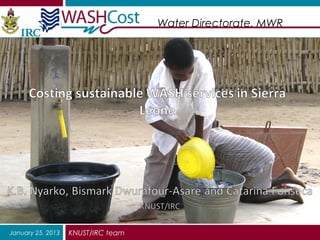
Water Directorate, MWR


January 25, 2013   KNUST/IRC team
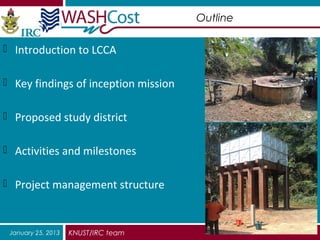
Outline

 Introduction to LCCA


 Key findings of inception mission


 Proposed study district


 Activities and milestones


 Project management structure


 January 25, 2013   KNUST/IRC team
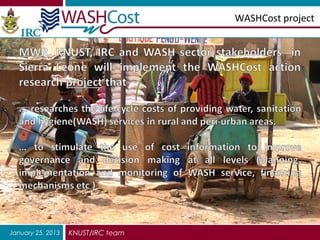
WASHCost project


January 25, 2013   KNUST/IRC team
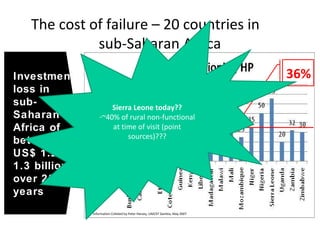
The cost of failure – 20 countries in
             sub-Saharan Africa
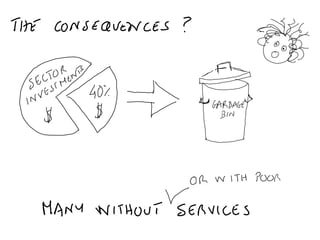
Investment                                                                    36%
loss in
sub-                  Sierra Leone today??
Saharan           -~40% of rural non-functional
Africa of             at time of visit (point
                           sources)???
between
US$ 1.2 to
1.3 billion
over 20
years
              Information Collated by Peter Harvey, UNICEF Zambia, May 2007
Life-cycle costs approach

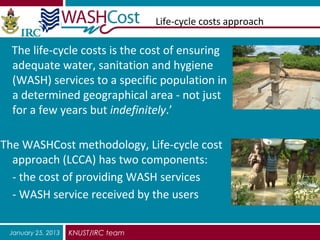
  The life-cycle costs is the cost of ensuring
  adequate water, sanitation and hygiene
  (WASH) services to a specific population in
  a determined geographical area - not just
  for a few years but indefinitely.’

The WASHCost methodology, Life-cycle cost
  approach (LCCA) has two components:
  - the cost of providing WASH services
  - WASH service received by the users

 January 25, 2013   KNUST/IRC team
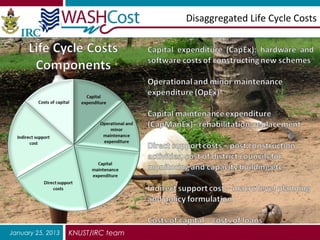
Disaggregated Life Cycle Costs


January 25, 2013   KNUST/IRC team
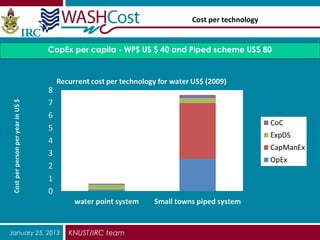
Cost per technology


            CapEx per capita - WPS US $ 40 and Piped scheme US$ 80


January 25, 2013   KNUST/IRC team
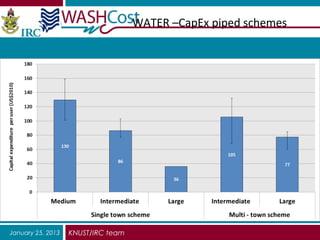
WATER –CapEx piped schemes


January 25, 2013   KNUST/IRC team
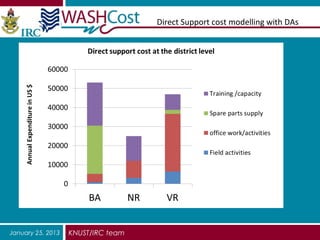
Direct Support cost modelling with DAs


January 25, 2013   KNUST/IRC team
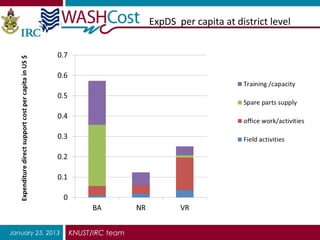
ExpDS per capita at district level


January 25, 2013   KNUST/IRC team
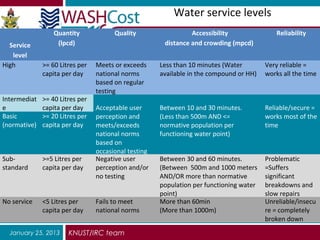
Water service levels
                  Quantity             Quality                  Accessibility                Reliability
  Service          (lpcd)                              distance and crowding (mpcd)
   level
High          >= 60 Litres per   Meets or exceeds     Less than 10 minutes (Water        Very reliable =
              capita per day     national norms       available in the compound or HH)   works all the time
                                 based on regular
                                 testing
Intermediat   >= 40 Litres per
e             capita per day     Acceptable user      Between 10 and 30 minutes.         Reliable/secure =
Basic         >= 20 Litres per   perception and       (Less than 500m AND <=             works most of the
(normative)   capita per day     meets/exceeds        normative population per           time
                                 national norms       functioning water point)
                                 based on
                                 occasional testing
Sub-          >=5 Litres per     Negative user        Between 30 and 60 minutes.         Problematic
standard      capita per day     perception and/or    (Between 500m and 1000 meters      =Suffers
                                 no testing           AND/OR more than normative         significant
                                                      population per functioning water   breakdowns and
                                                      point)                             slow repairs
No service    <5 Litres per      Fails to meet        More than 60min                    Unreliable/insecu
              capita per day     national norms       (More than 1000m)                  re = completely
    Source: Moriarty et al., 2010                                                        broken down
  January 25, 2013     KNUST/IRC team
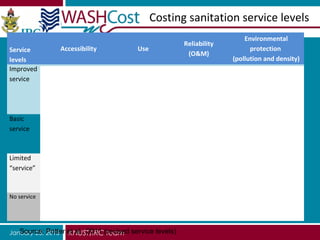
Costing sanitation service levels
                                                                                Environmental
                                                           Reliability
Service           Accessibility               Use                                  protection
                                                            (O&M)
levels                                                                      (pollution and density)
Improved Each family dwelling has Facilities used      Regular or routine Non problematic
service    one or more toilets in     by all members O&M (inc. pit         environmental impact
           the compound               of HH            emptying)           disposal and re-use of
                                                       requiring minimal safe-by products
                                                       user effort
Basic      Latrine with               Facilities used  Unreliable O&M      Non problematic
service    impermeable slab (hh or by some             (inc. pit emptying) environmental impact
           shared) at national norm members of HH and requiring high and safe disposal
           distance from hh                            user effort
Limited    Platform without
“service” (impermeable) slab          No or            No O&M (pit         Significant
           separated faeces from      insufficient use emptying) taking environmental
           users                                       place and any       pollution, increasing
No service No separation between user                  extremely dirty     with increased
           and faeces, e.g. open                       toilet              population density
           defecation


January 25, 2013 et al., 2011 (revised service levels)
   Source: Potter KNUST/IRC team
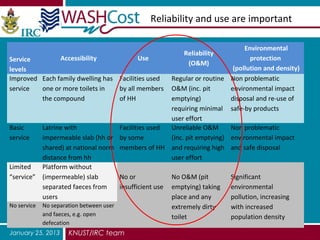
Reliability and use are important

                                                                                Environmental
                                                           Reliability
Service           Accessibility               Use                                  protection
                                                            (O&M)
levels                                                                      (pollution and density)
Improved Each family dwelling has Facilities used      Regular or routine Non problematic
service    one or more toilets in     by all members O&M (inc. pit         environmental impact
           the compound               of HH            emptying)           disposal and re-use of
                                                       requiring minimal safe-by products
                                                       user effort
Basic      Latrine with               Facilities used  Unreliable O&M      Non problematic
service    impermeable slab (hh or by some             (inc. pit emptying) environmental impact
           shared) at national norm members of HH and requiring high and safe disposal
           distance from hh                            user effort
Limited    Platform without
“service” (impermeable) slab          No or            No O&M (pit         Significant
           separated faeces from      insufficient use emptying) taking environmental
           users                                       place and any       pollution, increasing
No service No separation between user                  extremely dirty     with increased
           and faeces, e.g. open                       toilet              population density
           defecation
January 25, 2013    KNUST/IRC team
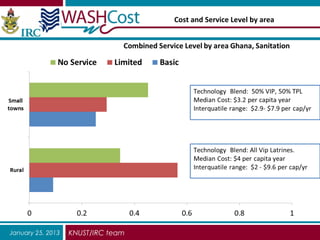
Cost and Service Level by area


January 25, 2013   KNUST/IRC team
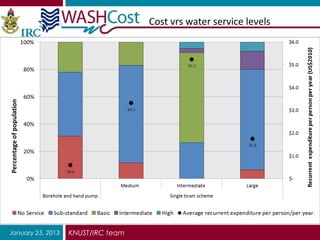
Cost vrs water service levels


January 25, 2013   KNUST/IRC team
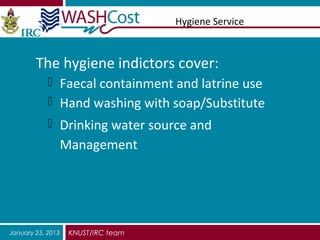
Hygiene Service


        The hygiene indictors cover:
             Faecal containment and latrine use
             Hand washing with soap/Substitute
             Drinking water source and
                   Management


January 25, 2013    KNUST/IRC team
KEY FINDINGS


January 25, 2013   KNUST/IRC team
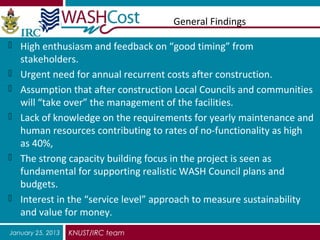
General Findings

 High enthusiasm and feedback on “good timing” from
    stakeholders.
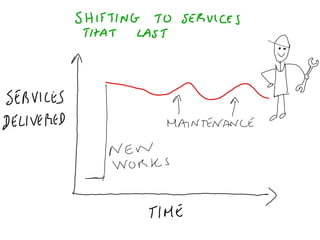
   Urgent need for annual recurrent costs after construction.
   Assumption that after construction Local Councils and communities
    will “take over” the management of the facilities.
   Lack of knowledge on the requirements for yearly maintenance and
    human resources contributing to rates of no-functionality as high
    as 40%,
   The strong capacity building focus in the project is seen as
    fundamental for supporting realistic WASH Council plans and
    budgets.
   Interest in the “service level” approach to measure sustainability
    and value for money.
January 25, 2013   KNUST/IRC team
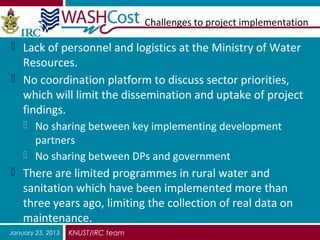
Challenges to project implementation

 Lack of personnel and logistics at the Ministry of Water
  Resources.
 No coordination platform to discuss sector priorities,
  which will limit the dissemination and uptake of project
  findings.
     No sharing between key implementing development
      partners
     No sharing between DPs and government
 There are limited programmes in rural water and
    sanitation which have been implemented more than
    three years ago, limiting the collection of real data on
    maintenance.
January 25, 2013   KNUST/IRC team
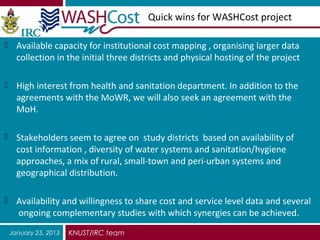
Quick wins for WASHCost project

 Available capacity for institutional cost mapping , organising larger data
   collection in the initial three districts and physical hosting of the project

 High interest from health and sanitation department. In addition to the
   agreements with the MoWR, we will also seek an agreement with the
   MoH.

 Stakeholders seem to agree on study districts based on availability of
   cost information , diversity of water systems and sanitation/hygiene
   approaches, a mix of rural, small-town and peri-urban systems and
   geographical distribution.

 Availability and willingness to share cost and service level data and several
   ongoing complementary studies with which synergies can be achieved.
 January 25, 2013   KNUST/IRC team
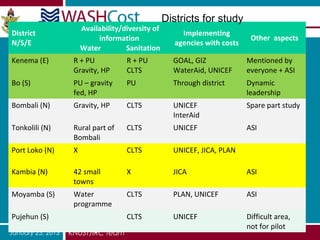
Districts for study
                        Availability/diversity of
District                                                 Implementing
                             information                                      Other aspects
N/S/E                                                  agencies with costs
                        Water         Sanitation
Kenema (E)          R + PU            R + PU          GOAL, GIZ              Mentioned by
                    Gravity, HP       CLTS            WaterAid, UNICEF       everyone + ASI
Bo (S)              PU – gravity      PU              Through district       Dynamic
                    fed, HP                                                  leadership
Bombali (N)         Gravity, HP       CLTS            UNICEF                 Spare part study
                                                      InterAid
Tonkolili (N)       Rural part of     CLTS            UNICEF                 ASI
                    Bombali
Port Loko (N)       X                 CLTS            UNICEF, JICA, PLAN

Kambia (N)          42 small          X               JICA                   ASI
                    towns
Moyamba (S)         Water             CLTS            PLAN, UNICEF           ASI
                    programme
Pujehun (S)                           CLTS            UNICEF                 Difficult area,
                                                                             not for pilot
January 25, 2013   KNUST/IRC team
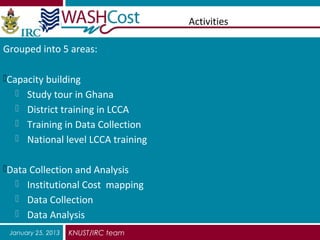
Activities

Grouped into 5 areas:

Capacity building
   Study tour in Ghana
   District training in LCCA
   Training in Data Collection
   National level LCCA training


Data Collection and Analysis
   Institutional Cost mapping
   Data Collection
   Data Analysis
 January 25, 2013   KNUST/IRC team
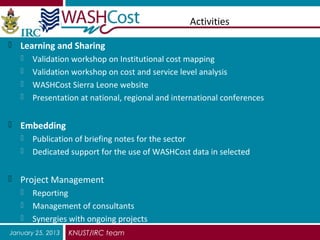
Activities

 Learning and Sharing
   Validation workshop on Institutional cost mapping
   Validation workshop on cost and service level analysis
   WASHCost Sierra Leone website
   Presentation at national, regional and international conferences


 Embedding
   Publication of briefing notes for the sector
   Dedicated support for the use of WASHCost data in selected


 Project Management
   Reporting
   Management of consultants
   Synergies with ongoing projects
January 25, 2013   KNUST/IRC team
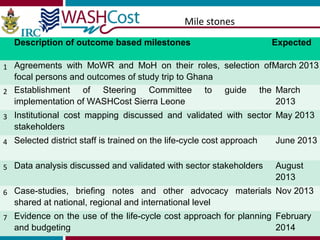
Mile stones
  Description of outcome based milestones                                Expected

1 Agreements with MoWR and MoH on their roles, selection ofMarch 2013
  focal persons and outcomes of study trip to Ghana
2 Establishment    of Steering Committee to                guide       the March
  implementation of WASHCost Sierra Leone                                  2013
3 Institutional cost mapping discussed and validated with sector May 2013
  stakeholders
4 Selected district staff is trained on the life-cycle cost approach      June 2013

5 Data analysis discussed and validated with sector stakeholders          August
                                                                          2013
6 Case-studies, briefing notes and other advocacy materials Nov 2013
  shared at national, regional and international level
7 Evidence on the use of the life-cycle cost approach for planning February
  and budgeting                                                           2014
 January 25, 2013   KNUST/IRC team
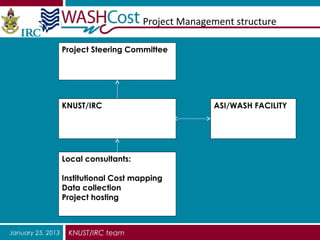
Project Management structure

                   Project Steering Committee


                   KNUST/IRC                          ASI/WASH FACILITY


                   Local consultants:

                   Institutional Cost mapping
                   Data collection
                   Project hosting


January 25, 2013    KNUST/IRC team
What WASHCost can offer
 Compare the normative service indicators stated in the Sierra Leone
     policy with the real level of services delivered.
    Provide life-cycle cost benchmarks for rural and peri-urban services.
    Measure the costs of decentralisation (direct support expenditure).
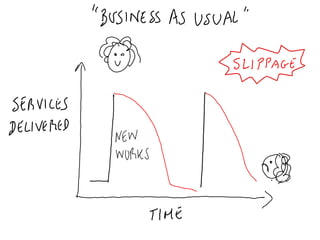
    Quantify wasteful investments by measuring “slippage levels”.
    Define the levels of maintenance required and compare with existing
     funds to the sector.
    Quantify amount of capital expenditure budget that could be
     reserved for the maintenance, which users cannot pay for to ensure
     sustainability.
    Capacity building and training on budgeting, planning and monitoring
     costs and service levels and the cost implications for different
     implementation models.
    January 25, 2013   KNUST/IRC team
January 25, 2013   KNUST/IRC team

WASHCost Sierra Leone

  • 1.
    Water Directorate, MWR January25, 2013 KNUST/IRC team
  • 2.
    Outline  Introduction toLCCA  Key findings of inception mission  Proposed study district  Activities and milestones  Project management structure January 25, 2013 KNUST/IRC team
  • 3.
    WASHCost project January 25,2013 KNUST/IRC team
  • 5.
    The cost offailure – 20 countries in sub-Saharan Africa Investment 36% loss in sub- Sierra Leone today?? Saharan -~40% of rural non-functional Africa of at time of visit (point sources)??? between US$ 1.2 to 1.3 billion over 20 years Information Collated by Peter Harvey, UNICEF Zambia, May 2007
  • 8.
    Life-cycle costs approach The life-cycle costs is the cost of ensuring adequate water, sanitation and hygiene (WASH) services to a specific population in a determined geographical area - not just for a few years but indefinitely.’ The WASHCost methodology, Life-cycle cost approach (LCCA) has two components: - the cost of providing WASH services - WASH service received by the users January 25, 2013 KNUST/IRC team
  • 9.
    Disaggregated Life CycleCosts January 25, 2013 KNUST/IRC team
  • 10.
    Cost per technology CapEx per capita - WPS US $ 40 and Piped scheme US$ 80 January 25, 2013 KNUST/IRC team
  • 11.
    WATER –CapEx pipedschemes January 25, 2013 KNUST/IRC team
  • 12.
    Direct Support costmodelling with DAs January 25, 2013 KNUST/IRC team
  • 13.
    ExpDS per capitaat district level January 25, 2013 KNUST/IRC team
  • 14.
    Water service levels Quantity Quality Accessibility Reliability Service (lpcd) distance and crowding (mpcd) level High >= 60 Litres per Meets or exceeds Less than 10 minutes (Water Very reliable = capita per day national norms available in the compound or HH) works all the time based on regular testing Intermediat >= 40 Litres per e capita per day Acceptable user Between 10 and 30 minutes. Reliable/secure = Basic >= 20 Litres per perception and (Less than 500m AND <= works most of the (normative) capita per day meets/exceeds normative population per time national norms functioning water point) based on occasional testing Sub- >=5 Litres per Negative user Between 30 and 60 minutes. Problematic standard capita per day perception and/or (Between 500m and 1000 meters =Suffers no testing AND/OR more than normative significant population per functioning water breakdowns and point) slow repairs No service <5 Litres per Fails to meet More than 60min Unreliable/insecu capita per day national norms (More than 1000m) re = completely Source: Moriarty et al., 2010 broken down January 25, 2013 KNUST/IRC team
  • 15.
    Costing sanitation servicelevels Environmental Reliability Service Accessibility Use protection (O&M) levels (pollution and density) Improved Each family dwelling has Facilities used Regular or routine Non problematic service one or more toilets in by all members O&M (inc. pit environmental impact the compound of HH emptying) disposal and re-use of requiring minimal safe-by products user effort Basic Latrine with Facilities used Unreliable O&M Non problematic service impermeable slab (hh or by some (inc. pit emptying) environmental impact shared) at national norm members of HH and requiring high and safe disposal distance from hh user effort Limited Platform without “service” (impermeable) slab No or No O&M (pit Significant separated faeces from insufficient use emptying) taking environmental users place and any pollution, increasing No service No separation between user extremely dirty with increased and faeces, e.g. open toilet population density defecation January 25, 2013 et al., 2011 (revised service levels) Source: Potter KNUST/IRC team
  • 16.
    Reliability and useare important Environmental Reliability Service Accessibility Use protection (O&M) levels (pollution and density) Improved Each family dwelling has Facilities used Regular or routine Non problematic service one or more toilets in by all members O&M (inc. pit environmental impact the compound of HH emptying) disposal and re-use of requiring minimal safe-by products user effort Basic Latrine with Facilities used Unreliable O&M Non problematic service impermeable slab (hh or by some (inc. pit emptying) environmental impact shared) at national norm members of HH and requiring high and safe disposal distance from hh user effort Limited Platform without “service” (impermeable) slab No or No O&M (pit Significant separated faeces from insufficient use emptying) taking environmental users place and any pollution, increasing No service No separation between user extremely dirty with increased and faeces, e.g. open toilet population density defecation January 25, 2013 KNUST/IRC team
  • 17.
    Cost and ServiceLevel by area January 25, 2013 KNUST/IRC team
  • 18.
    Cost vrs waterservice levels January 25, 2013 KNUST/IRC team
  • 19.
    Hygiene Service The hygiene indictors cover:  Faecal containment and latrine use  Hand washing with soap/Substitute  Drinking water source and Management January 25, 2013 KNUST/IRC team
  • 20.
    KEY FINDINGS January 25,2013 KNUST/IRC team
  • 21.
    General Findings  Highenthusiasm and feedback on “good timing” from stakeholders.  Urgent need for annual recurrent costs after construction.  Assumption that after construction Local Councils and communities will “take over” the management of the facilities.  Lack of knowledge on the requirements for yearly maintenance and human resources contributing to rates of no-functionality as high as 40%,  The strong capacity building focus in the project is seen as fundamental for supporting realistic WASH Council plans and budgets.  Interest in the “service level” approach to measure sustainability and value for money. January 25, 2013 KNUST/IRC team
  • 22.
    Challenges to projectimplementation  Lack of personnel and logistics at the Ministry of Water Resources.  No coordination platform to discuss sector priorities, which will limit the dissemination and uptake of project findings.  No sharing between key implementing development partners  No sharing between DPs and government  There are limited programmes in rural water and sanitation which have been implemented more than three years ago, limiting the collection of real data on maintenance. January 25, 2013 KNUST/IRC team
  • 23.
    Quick wins forWASHCost project  Available capacity for institutional cost mapping , organising larger data collection in the initial three districts and physical hosting of the project  High interest from health and sanitation department. In addition to the agreements with the MoWR, we will also seek an agreement with the MoH.  Stakeholders seem to agree on study districts based on availability of cost information , diversity of water systems and sanitation/hygiene approaches, a mix of rural, small-town and peri-urban systems and geographical distribution.  Availability and willingness to share cost and service level data and several ongoing complementary studies with which synergies can be achieved. January 25, 2013 KNUST/IRC team
  • 24.
    Districts for study Availability/diversity of District Implementing information Other aspects N/S/E agencies with costs Water Sanitation Kenema (E) R + PU R + PU GOAL, GIZ Mentioned by Gravity, HP CLTS WaterAid, UNICEF everyone + ASI Bo (S) PU – gravity PU Through district Dynamic fed, HP leadership Bombali (N) Gravity, HP CLTS UNICEF Spare part study InterAid Tonkolili (N) Rural part of CLTS UNICEF ASI Bombali Port Loko (N) X CLTS UNICEF, JICA, PLAN Kambia (N) 42 small X JICA ASI towns Moyamba (S) Water CLTS PLAN, UNICEF ASI programme Pujehun (S) CLTS UNICEF Difficult area, not for pilot January 25, 2013 KNUST/IRC team
  • 25.
    Activities Grouped into 5areas: Capacity building  Study tour in Ghana  District training in LCCA  Training in Data Collection  National level LCCA training Data Collection and Analysis  Institutional Cost mapping  Data Collection  Data Analysis January 25, 2013 KNUST/IRC team
  • 26.
    Activities  Learning andSharing  Validation workshop on Institutional cost mapping  Validation workshop on cost and service level analysis  WASHCost Sierra Leone website  Presentation at national, regional and international conferences  Embedding  Publication of briefing notes for the sector  Dedicated support for the use of WASHCost data in selected  Project Management  Reporting  Management of consultants  Synergies with ongoing projects January 25, 2013 KNUST/IRC team
  • 27.
    Mile stones Description of outcome based milestones Expected 1 Agreements with MoWR and MoH on their roles, selection ofMarch 2013 focal persons and outcomes of study trip to Ghana 2 Establishment of Steering Committee to guide the March implementation of WASHCost Sierra Leone 2013 3 Institutional cost mapping discussed and validated with sector May 2013 stakeholders 4 Selected district staff is trained on the life-cycle cost approach June 2013 5 Data analysis discussed and validated with sector stakeholders August 2013 6 Case-studies, briefing notes and other advocacy materials Nov 2013 shared at national, regional and international level 7 Evidence on the use of the life-cycle cost approach for planning February and budgeting 2014 January 25, 2013 KNUST/IRC team
  • 28.
    Project Management structure Project Steering Committee KNUST/IRC ASI/WASH FACILITY Local consultants: Institutional Cost mapping Data collection Project hosting January 25, 2013 KNUST/IRC team
  • 29.
    What WASHCost canoffer  Compare the normative service indicators stated in the Sierra Leone policy with the real level of services delivered.  Provide life-cycle cost benchmarks for rural and peri-urban services.  Measure the costs of decentralisation (direct support expenditure).  Quantify wasteful investments by measuring “slippage levels”.  Define the levels of maintenance required and compare with existing funds to the sector.  Quantify amount of capital expenditure budget that could be reserved for the maintenance, which users cannot pay for to ensure sustainability.  Capacity building and training on budgeting, planning and monitoring costs and service levels and the cost implications for different implementation models. January 25, 2013 KNUST/IRC team
  • 30.
    January 25, 2013 KNUST/IRC team