The Place and the
                                            People:
                                         An Exploration
                                       into Warm Springs

                                       7th Grade Humanities, Art
                                            and Technology

This is presentation was created by the REALMS 7th grade Humanities class to
share with you all the cool knowledge we now have about Warm Springs
Reservation. As a part of our learning we will be introducing you to the history
and culture of the Warm Springs people.
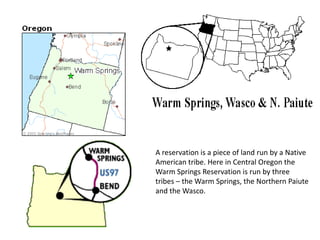
A reservation is a piece of land run by a Native
American tribe. Here in Central Oregon the
Warm Springs Reservation is run by three
tribes – the Warm Springs, the Northern Paiute
and the Wasco.
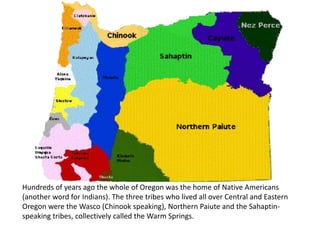
Hundreds of years ago the whole of Oregon was the home of Native Americans
(another word for Indians). The three tribes who lived all over Central and Eastern
Oregon were the Wasco (Chinook speaking), Northern Paiute and the Sahaptin-
speaking tribes, collectively called the Warm Springs.
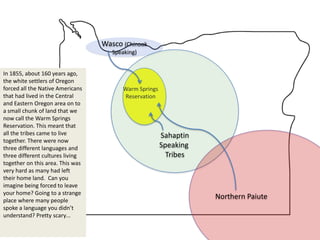
Wasco (Chinook
                                     Speaking)


In 1855, about 160 years ago,
the white settlers of Oregon
forced all the Native Americans         Warm Springs
that had lived in the Central           Reservation
and Eastern Oregon area on to
a small chunk of land that we
now call the Warm Springs
Reservation. This meant that
all the tribes came to live                            Sahaptin
together. There were now
three different languages and                          Speaking
three different cultures living                          Tribes
together on this area. This was
very hard as many had left
their home land. Can you
imagine being forced to leave
your home? Going to a strange
place where many people
                                                                  Northern Paiute
spoke a language you didn’t
understand? Pretty scary…
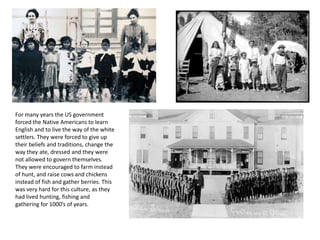
For many years the US government
forced the Native Americans to learn
English and to live the way of the white
settlers. They were forced to give up
their beliefs and traditions, change the
way they ate, dressed and they were
not allowed to govern themselves.
They were encouraged to farm instead
of hunt, and raise cows and chickens
instead of fish and gather berries. This
was very hard for this culture, as they
had lived hunting, fishing and
gathering for 1000’s of years.
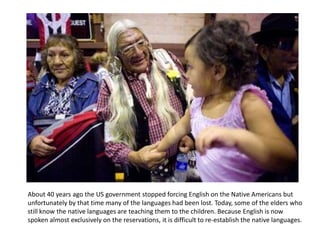
About 40 years ago the US government stopped forcing English on the Native Americans but
unfortunately by that time many of the languages had been lost. Today, some of the elders who
still know the native languages are teaching them to the children. Because English is now
spoken almost exclusively on the reservations, it is difficult to re-establish the native languages.
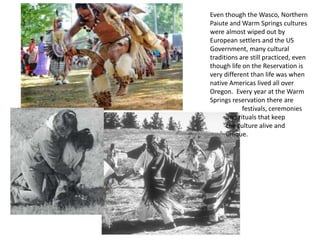
Even though the Wasco, Northern
Paiute and Warm Springs cultures
were almost wiped out by
European settlers and the US
Government, many cultural
traditions are still practiced, even
though life on the Reservation is
very different than life was when
native Americas lived all over
Oregon. Every year at the Warm
Springs reservation there are
            festivals, ceremonies
      and rituals that keep
      the culture alive and
      unique.
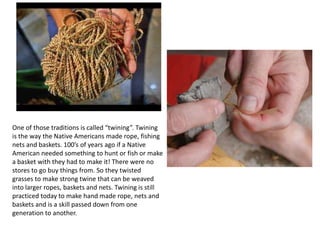
One of those traditions is called “twining”. Twining
is the way the Native Americans made rope, fishing
nets and baskets. 100’s of years ago if a Native
American needed something to hunt or fish or make
a basket with they had to make it! There were no
stores to go buy things from. So they twisted
grasses to make strong twine that can be weaved
into larger ropes, baskets and nets. Twining is still
practiced today to make hand made rope, nets and
baskets and is a skill passed down from one
generation to another.

Warm Springs Immersion Website

  • 1.
    The Place andthe People: An Exploration into Warm Springs 7th Grade Humanities, Art and Technology This is presentation was created by the REALMS 7th grade Humanities class to share with you all the cool knowledge we now have about Warm Springs Reservation. As a part of our learning we will be introducing you to the history and culture of the Warm Springs people.
  • 2.
    A reservation isa piece of land run by a Native American tribe. Here in Central Oregon the Warm Springs Reservation is run by three tribes – the Warm Springs, the Northern Paiute and the Wasco.
  • 3.
    Hundreds of yearsago the whole of Oregon was the home of Native Americans (another word for Indians). The three tribes who lived all over Central and Eastern Oregon were the Wasco (Chinook speaking), Northern Paiute and the Sahaptin- speaking tribes, collectively called the Warm Springs.
  • 4.
    Wasco (Chinook Speaking) In 1855, about 160 years ago, the white settlers of Oregon forced all the Native Americans Warm Springs that had lived in the Central Reservation and Eastern Oregon area on to a small chunk of land that we now call the Warm Springs Reservation. This meant that all the tribes came to live Sahaptin together. There were now three different languages and Speaking three different cultures living Tribes together on this area. This was very hard as many had left their home land. Can you imagine being forced to leave your home? Going to a strange place where many people Northern Paiute spoke a language you didn’t understand? Pretty scary…
  • 5.
    For many yearsthe US government forced the Native Americans to learn English and to live the way of the white settlers. They were forced to give up their beliefs and traditions, change the way they ate, dressed and they were not allowed to govern themselves. They were encouraged to farm instead of hunt, and raise cows and chickens instead of fish and gather berries. This was very hard for this culture, as they had lived hunting, fishing and gathering for 1000’s of years.
  • 6.
    About 40 yearsago the US government stopped forcing English on the Native Americans but unfortunately by that time many of the languages had been lost. Today, some of the elders who still know the native languages are teaching them to the children. Because English is now spoken almost exclusively on the reservations, it is difficult to re-establish the native languages.
  • 7.
    Even though theWasco, Northern Paiute and Warm Springs cultures were almost wiped out by European settlers and the US Government, many cultural traditions are still practiced, even though life on the Reservation is very different than life was when native Americas lived all over Oregon. Every year at the Warm Springs reservation there are festivals, ceremonies and rituals that keep the culture alive and unique.
  • 8.
    One of thosetraditions is called “twining”. Twining is the way the Native Americans made rope, fishing nets and baskets. 100’s of years ago if a Native American needed something to hunt or fish or make a basket with they had to make it! There were no stores to go buy things from. So they twisted grasses to make strong twine that can be weaved into larger ropes, baskets and nets. Twining is still practiced today to make hand made rope, nets and baskets and is a skill passed down from one generation to another.