Waring School
Rosetta Eun Ryong Lee
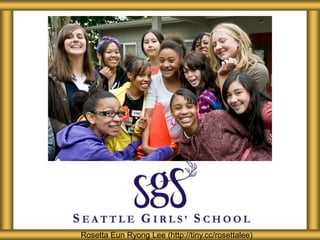
Seattle Girls’ School
21st Century Cultural Competency:
an Educational Imperative
Rosetta Eun Ryong Lee (http://tiny.cc/rosettalee)
About Seattle Girls’ School
Rosetta Eun Ryong Lee (http://tiny.cc/rosettalee)
Culture [consists] primarily of the
symbolic, ideational, and intangible
aspects of human societies… It is the
values, symbols, interpretations, and
perspectives that distinguish one
people from another.
James A. Banks
What is Culture?
Rosetta Eun Ryong Lee (http://tiny.cc/rosettalee)
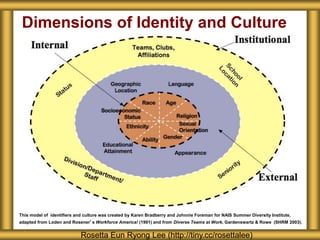
Dimensions of Identity and Culture
This model of identifiers and culture was created by Karen Bradberry and Johnnie Foreman for NAIS Summer Diversity Institute,
adapted from Loden and Rosener’s Workforce America! (1991) and from Diverse Teams at Work, Gardenswartz & Rowe (SHRM 2003).
Rosetta Eun Ryong Lee (http://tiny.cc/rosettalee)
Cultural Competency:
Many Models
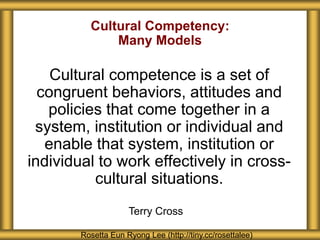
Cultural competence is a set of
congruent behaviors, attitudes and
policies that come together in a
system, institution or individual and
enable that system, institution or
individual to work effectively in cross-
cultural situations.
Rosetta Eun Ryong Lee (http://tiny.cc/rosettalee)
Terry Cross
Rosetta Eun Ryong Lee (http://tiny.cc/rosettalee)
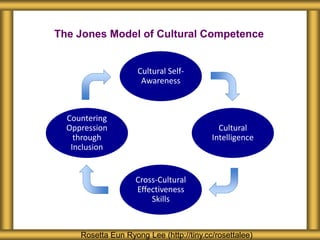
The Jones Model of Cultural Competence
Cultural Self-
Awareness
Cultural
Intelligence
Cross-Cultural
Effectiveness
Skills
Countering
Oppression
through
Inclusion
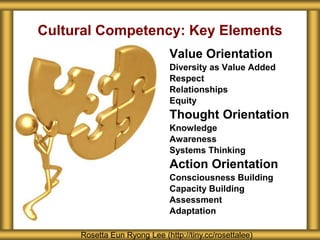
Cultural Competency: Key Elements
Value Orientation
Diversity as Value Added
Respect
Relationships
Equity
Thought Orientation
Knowledge
Awareness
Systems Thinking
Action Orientation
Consciousness Building
Capacity Building
Assessment
Adaptation
Rosetta Eun Ryong Lee (http://tiny.cc/rosettalee)
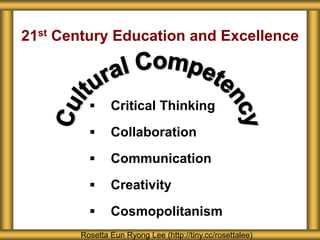
21st Century Education and Excellence
 Critical Thinking
 Collaboration
 Communication
 Creativity
 Cosmopolitanism
Rosetta Eun Ryong Lee (http://tiny.cc/rosettalee)
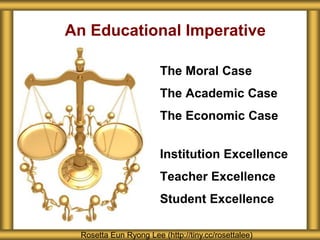
An Educational Imperative
The Moral Case
The Academic Case
The Economic Case
Institution Excellence
Teacher Excellence
Student Excellence
Rosetta Eun Ryong Lee (http://tiny.cc/rosettalee)
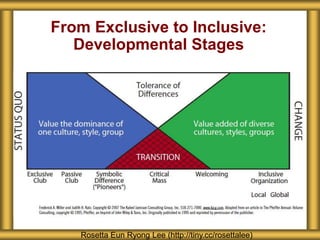
From Exclusive to Inclusive:
Developmental Stages
Rosetta Eun Ryong Lee (http://tiny.cc/rosettalee)
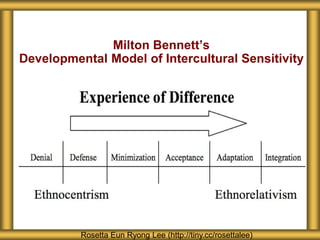
Milton Bennett’s
Developmental Model of Intercultural Sensitivity
Rosetta Eun Ryong Lee (http://tiny.cc/rosettalee)
Hallmarks of Earlier Phases
 People feel pressure to fit in
 People fear speaking up
 “Who you know” is more important than “what you
know” (relationship-based culture)
 You only trust those closest to you (cliques)
 Denial of differences is considered a virtue (“we
don’t see differences here”)
 It’s hard for outsiders to learn the rules (sink or
swim to prove yourself)
Rosetta Eun Ryong Lee (http://tiny.cc/rosettalee)
Hallmarks of Later Phases
 People can bring their full selves to school
 The school encourages and welcomes people to
contribute different opinions and points of view
 There is a performance driven culture
 People form dynamic and diverse groups (trust)
 Differences are seen as additive and productive
 Success is explicitly defined, and the school supports
people in achieving it
 The school has an interactive culture
 People have the competencies to adapt to different
cultural contexts.
Rosetta Eun Ryong Lee (http://tiny.cc/rosettalee)
The 5Ps of Institutional Cultural
Competency
• Policy – Enumeration of the school’s cultural
competency commitment through mission, strategic
plan, handbooks, websites, etc.
• Programming – Cultural competency training and
programming for all constituencies (board, admin,
faculty, staff, students, families, etc.). Diversity and
inclusivity curriculum.
• Practice – Consistent and meaningful revisit of policy
and programs. Climate assessments, proactive
changes, and meaningful responses to incidents.
• People – Critical mass of people who are supportive
AND active on all levels.
• Pecuniary – Funding, people, and time allocated in the
strategic plan and daily life for supporting cultural
competency efforts.
Rosetta Eun Ryong Lee (http://tiny.cc/rosettalee)
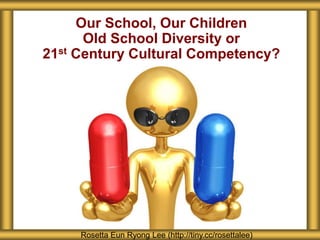
Our School, Our Children
Old School Diversity or
21st Century Cultural Competency?
Rosetta Eun Ryong Lee (http://tiny.cc/rosettalee)
Final Questions or Comments?
Rosetta Eun Ryong Lee (http://tiny.cc/rosettalee)
Presenter Information
Rosetta Eun Ryong Lee
6th Faculty and
Professional Outreach
Seattle Girls’ School
2706 S Jackson Street
Seattle WA 98144
(206) 805-6562
rlee@seattlegirlsschool.org
http://tiny.cc/rosettalee
Rosetta Eun Ryong Lee (http://tiny.cc/rosettalee)
Cultural Competence and Educational
Excellence
 "How Diversity Affects Teaching and Learning Climate of Inclusion has a
Positive Effect on Learning Outcomes," by Sylvia Hurtado. 2, 3, 5
http://www.diversityweb.org/research_and_trends/research_evaluation_impac
t/benefits_of_diversity/ sylvia_hurtado.cfm
 University of Michigan . Gratz v. Bollinger, et al., No. 97-75321 (E.D.
Michigan), Grutter v. Bollinger et al., No. 97-75928 (E.D. Michigan). 1 "The
Educational Value of Diversity." Center for Institutional Diversity.
 "Who Benefits from Racial Diversity in Higher Education?" by Mitchell J.
Chang, Associate Dean of the College of Liberal Arts, Loyola Marymount
University, and Alexander W. Astin, Director, Higher Education Research
Institute, University of California- Los Angeles. 2, 3
http://www.diversityweb.org/Digest/W97/research.html
 "Fostering Intercultural Harmony in Schools Research Findings." Report,
prepared by Kathleen Cotton, Northwest Regional Educational Laboratory,
Portland, Oregon, 1993. "Cooperative Learning, Multicultural Functioning and
Student Achievement. San Bernadino, CA: San Bernadino School District,
1990. 2, 4 http://www.nwrel.org/scpd/sirs/ 8/topsyn7.h
Rosetta Eun Ryong Lee (http://tiny.cc/rosettalee)

Waring School Cultural Competency

  • 1.
    Waring School Rosetta EunRyong Lee Seattle Girls’ School 21st Century Cultural Competency: an Educational Imperative Rosetta Eun Ryong Lee (http://tiny.cc/rosettalee)
  • 2.
    About Seattle Girls’School Rosetta Eun Ryong Lee (http://tiny.cc/rosettalee)
  • 3.
    Culture [consists] primarilyof the symbolic, ideational, and intangible aspects of human societies… It is the values, symbols, interpretations, and perspectives that distinguish one people from another. James A. Banks What is Culture? Rosetta Eun Ryong Lee (http://tiny.cc/rosettalee)
  • 4.
    Dimensions of Identityand Culture This model of identifiers and culture was created by Karen Bradberry and Johnnie Foreman for NAIS Summer Diversity Institute, adapted from Loden and Rosener’s Workforce America! (1991) and from Diverse Teams at Work, Gardenswartz & Rowe (SHRM 2003). Rosetta Eun Ryong Lee (http://tiny.cc/rosettalee)
  • 5.
    Cultural Competency: Many Models Culturalcompetence is a set of congruent behaviors, attitudes and policies that come together in a system, institution or individual and enable that system, institution or individual to work effectively in cross- cultural situations. Rosetta Eun Ryong Lee (http://tiny.cc/rosettalee) Terry Cross
  • 6.
    Rosetta Eun RyongLee (http://tiny.cc/rosettalee) The Jones Model of Cultural Competence Cultural Self- Awareness Cultural Intelligence Cross-Cultural Effectiveness Skills Countering Oppression through Inclusion
  • 7.
    Cultural Competency: KeyElements Value Orientation Diversity as Value Added Respect Relationships Equity Thought Orientation Knowledge Awareness Systems Thinking Action Orientation Consciousness Building Capacity Building Assessment Adaptation Rosetta Eun Ryong Lee (http://tiny.cc/rosettalee)
  • 8.
    21st Century Educationand Excellence  Critical Thinking  Collaboration  Communication  Creativity  Cosmopolitanism Rosetta Eun Ryong Lee (http://tiny.cc/rosettalee)
  • 9.
    An Educational Imperative TheMoral Case The Academic Case The Economic Case Institution Excellence Teacher Excellence Student Excellence Rosetta Eun Ryong Lee (http://tiny.cc/rosettalee)
  • 10.
    From Exclusive toInclusive: Developmental Stages Rosetta Eun Ryong Lee (http://tiny.cc/rosettalee)
  • 11.
    Milton Bennett’s Developmental Modelof Intercultural Sensitivity Rosetta Eun Ryong Lee (http://tiny.cc/rosettalee)
  • 12.
    Hallmarks of EarlierPhases  People feel pressure to fit in  People fear speaking up  “Who you know” is more important than “what you know” (relationship-based culture)  You only trust those closest to you (cliques)  Denial of differences is considered a virtue (“we don’t see differences here”)  It’s hard for outsiders to learn the rules (sink or swim to prove yourself) Rosetta Eun Ryong Lee (http://tiny.cc/rosettalee)
  • 13.
    Hallmarks of LaterPhases  People can bring their full selves to school  The school encourages and welcomes people to contribute different opinions and points of view  There is a performance driven culture  People form dynamic and diverse groups (trust)  Differences are seen as additive and productive  Success is explicitly defined, and the school supports people in achieving it  The school has an interactive culture  People have the competencies to adapt to different cultural contexts. Rosetta Eun Ryong Lee (http://tiny.cc/rosettalee)
  • 14.
    The 5Ps ofInstitutional Cultural Competency • Policy – Enumeration of the school’s cultural competency commitment through mission, strategic plan, handbooks, websites, etc. • Programming – Cultural competency training and programming for all constituencies (board, admin, faculty, staff, students, families, etc.). Diversity and inclusivity curriculum. • Practice – Consistent and meaningful revisit of policy and programs. Climate assessments, proactive changes, and meaningful responses to incidents. • People – Critical mass of people who are supportive AND active on all levels. • Pecuniary – Funding, people, and time allocated in the strategic plan and daily life for supporting cultural competency efforts. Rosetta Eun Ryong Lee (http://tiny.cc/rosettalee)
  • 15.
    Our School, OurChildren Old School Diversity or 21st Century Cultural Competency? Rosetta Eun Ryong Lee (http://tiny.cc/rosettalee)
  • 16.
    Final Questions orComments? Rosetta Eun Ryong Lee (http://tiny.cc/rosettalee)
  • 17.
    Presenter Information Rosetta EunRyong Lee 6th Faculty and Professional Outreach Seattle Girls’ School 2706 S Jackson Street Seattle WA 98144 (206) 805-6562 rlee@seattlegirlsschool.org http://tiny.cc/rosettalee Rosetta Eun Ryong Lee (http://tiny.cc/rosettalee)
  • 18.
    Cultural Competence andEducational Excellence  "How Diversity Affects Teaching and Learning Climate of Inclusion has a Positive Effect on Learning Outcomes," by Sylvia Hurtado. 2, 3, 5 http://www.diversityweb.org/research_and_trends/research_evaluation_impac t/benefits_of_diversity/ sylvia_hurtado.cfm  University of Michigan . Gratz v. Bollinger, et al., No. 97-75321 (E.D. Michigan), Grutter v. Bollinger et al., No. 97-75928 (E.D. Michigan). 1 "The Educational Value of Diversity." Center for Institutional Diversity.  "Who Benefits from Racial Diversity in Higher Education?" by Mitchell J. Chang, Associate Dean of the College of Liberal Arts, Loyola Marymount University, and Alexander W. Astin, Director, Higher Education Research Institute, University of California- Los Angeles. 2, 3 http://www.diversityweb.org/Digest/W97/research.html  "Fostering Intercultural Harmony in Schools Research Findings." Report, prepared by Kathleen Cotton, Northwest Regional Educational Laboratory, Portland, Oregon, 1993. "Cooperative Learning, Multicultural Functioning and Student Achievement. San Bernadino, CA: San Bernadino School District, 1990. 2, 4 http://www.nwrel.org/scpd/sirs/ 8/topsyn7.h Rosetta Eun Ryong Lee (http://tiny.cc/rosettalee)