
Identity, Authority, and Learning to Write in New Workplaces Elizabeth Wardle
Write: Genres and Identity Wardle writes that “workers’ identities are bound up in myriad ways with the genres they are asked to appropriate” (634).  Think about genres you have been required to write (5 paragraph essay, lab report, ethnography). How did these genres shape your identity? Have you ever resisted the identity assigned to you by these genres? What happened?
According to you, what is the main point of the article?
The inside scoop on Alan
Genres and Identity: Alan What kind of identity was Alan supposed to adopt in the community? How did he resist? What happened?
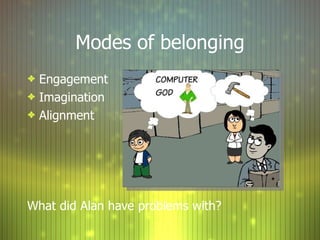
Modes of belonging Engagement Imagination Alignment What did Alan have problems with?
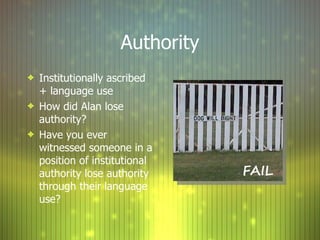
Authority Institutionally ascribed + language use How did Alan lose authority? Have you ever witnessed someone in a position of institutional authority lose authority through their language use?
Help Alan enculturate Alan had trouble enculturating into the humanities department, but maybe you can help him join your discourse community. Act out a scenario telling him what he needs to know to fit in. Modes of belonging: engagement, imagination, alignment Goals, participation, intercommunication, lexis, genres, expertise
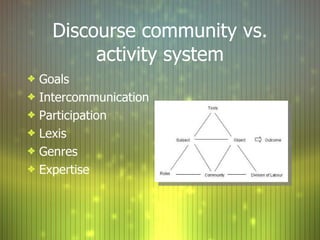
Discourse community vs. activity system Goals Intercommunication Participation Lexis  Genres Expertise
Alan’s a tool? Wardle seems to suggest that Alan was never supposed to become a full member of the department, because the faculty members saw him as a tool. What do you think?
Are the waiters at Lou’s diner tools? Wardle claims that the faculty members “expected a type of servitude” from Alan (636); do you think Mirabelli would say the same thing about the waiters at Lou’s diner?
Are you a tool?  Have you ever been part of a group in which you’re expected to be a “tool”? How did you respond? (Did you experience “alignment,” or not?)
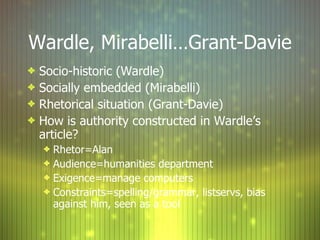
Wardle, Mirabelli…Grant-Davie Socio-historic (Wardle) Socially embedded (Mirabelli) Rhetorical situation (Grant-Davie) How is authority constructed in Wardle’s article? Rhetor=Alan Audience=humanities department Exigence=manage computers Constraints=spelling/grammar, listservs, bias against him, seen as a tool
Authority in Academics How much authority do you think you have as a writer in your college classes? What are some ways that you can gain authority? What are some ways you can (or have) lost authority?

Wardle

  • 1.
    Identity, Authority, andLearning to Write in New Workplaces Elizabeth Wardle
  • 2.
    Write: Genres andIdentity Wardle writes that “workers’ identities are bound up in myriad ways with the genres they are asked to appropriate” (634). Think about genres you have been required to write (5 paragraph essay, lab report, ethnography). How did these genres shape your identity? Have you ever resisted the identity assigned to you by these genres? What happened?
  • 3.
    According to you,what is the main point of the article?
  • 4.
  • 5.
    Genres and Identity:Alan What kind of identity was Alan supposed to adopt in the community? How did he resist? What happened?
  • 6.
    Modes of belongingEngagement Imagination Alignment What did Alan have problems with?
  • 7.
    Authority Institutionally ascribed+ language use How did Alan lose authority? Have you ever witnessed someone in a position of institutional authority lose authority through their language use?
  • 8.
    Help Alan enculturateAlan had trouble enculturating into the humanities department, but maybe you can help him join your discourse community. Act out a scenario telling him what he needs to know to fit in. Modes of belonging: engagement, imagination, alignment Goals, participation, intercommunication, lexis, genres, expertise
  • 9.
    Discourse community vs.activity system Goals Intercommunication Participation Lexis Genres Expertise
  • 10.
    Alan’s a tool?Wardle seems to suggest that Alan was never supposed to become a full member of the department, because the faculty members saw him as a tool. What do you think?
  • 11.
    Are the waitersat Lou’s diner tools? Wardle claims that the faculty members “expected a type of servitude” from Alan (636); do you think Mirabelli would say the same thing about the waiters at Lou’s diner?
  • 12.
    Are you atool? Have you ever been part of a group in which you’re expected to be a “tool”? How did you respond? (Did you experience “alignment,” or not?)
  • 13.
    Wardle, Mirabelli…Grant-Davie Socio-historic(Wardle) Socially embedded (Mirabelli) Rhetorical situation (Grant-Davie) How is authority constructed in Wardle’s article? Rhetor=Alan Audience=humanities department Exigence=manage computers Constraints=spelling/grammar, listservs, bias against him, seen as a tool
  • 14.
    Authority in AcademicsHow much authority do you think you have as a writer in your college classes? What are some ways that you can gain authority? What are some ways you can (or have) lost authority?