How to best satisfy your consumers’ needs? Lessons from Australian service exporters
This paper is to be presented  @  The 18th Annual Frontiers in Service Conference Co-authors: Professor Pascale Quester, Dr Carolin Plewa University of Hawaii at Manoa American Marketing Association IBM University of Maryland INFORMS Slide
Service exports Research steps Key findings Overview Slide
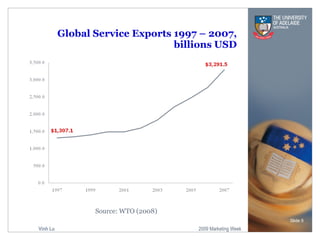
The Service Economy ~ 70% of global GDP > 70% in developed economies  50% in developing economies 70% of employment in OECD Global service exports US$3.29 trillion in 2007 (18% growth) 50% of world trade by 2020 Slide
Global Service Exports 1997 – 2007, billions USD Slide  Source: WTO (2008)
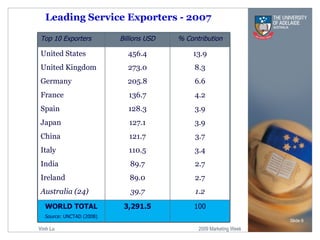
Leading Service Exporters - 2007 Slide  Top 10 Exporters Billions USD % Contribution United States United Kingdom Germany France Spain Japan China Italy India Ireland Australia (24) 456.4 273.0 205.8 136.7 128.3 127.1 121.7 110.5 89.7 89.0 39.7 13.9 8.3 6.6 4.2 3.9 3.9 3.7 3.4 2.7 2.7 1.2 WORLD TOTAL Source: UNCTAD (2008) 3,291.5 100
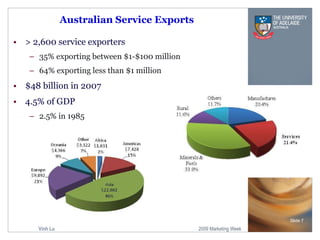
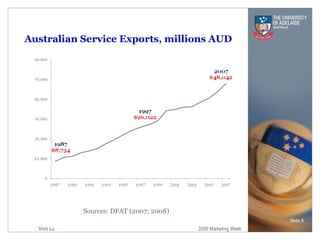
Australian Service Exports > 2,600 service exporters  35% exporting between $1-$100 million 64% exporting less than $1 million $48 billion in 2007 4.5% of GDP 2.5% in 1985 Slide
Australian Service Exports, millions AUD Slide  Sources: DFAT (2007; 2008)
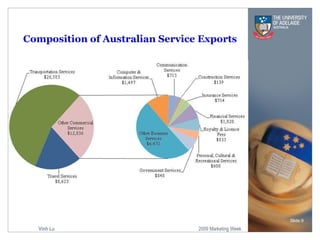
Composition of Australian Service Exports Slide
BUT… “ Under-serviced” service sector Fragmentary , exploratory and lacking a strong theoretical base  Fail to keep pace with globalisation of services Very limited attention to success drivers of service exporters Current international business climate High competitive intensity Volatile market demand What internal capabilities help better satisfy international customer needs? Service exporter defined. Slide
Research Phase 1: Qualitative 10 in-depth interviews  Service exporters in South Australia Computer, communication & information services Consulting services Financial services Transportation services Legal services Training services Slide
Research Phase 2: Quantitative Self-administered survey  Online Mail Sample of 770 service exporters Australia-wide 254 responses 33% response rate Export-venture focus: 1 services sold in 1 overseas market Slide
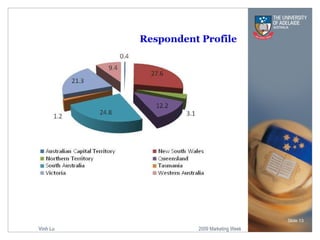
Respondent Profile Slide
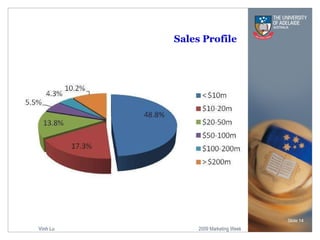
Sales Profile Slide
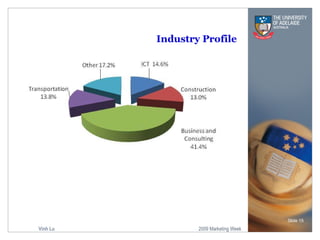
Industry Profile Slide
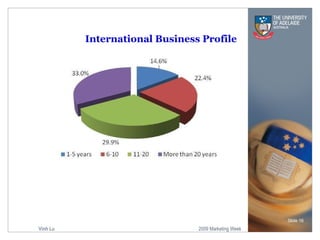
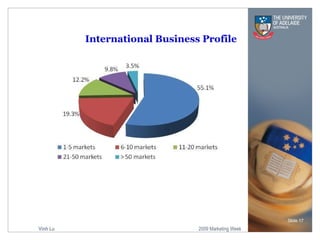
International Business Profile Slide
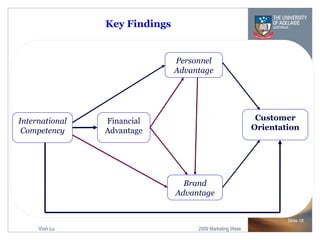
Key Findings Slide  International Competency Personnel Advantage Brand Advantage Financial Advantage Customer Orientation
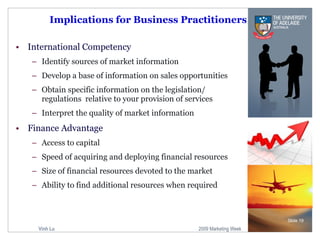
Implications for Business Practitioners International Competency Identify sources of market information Develop a base of information on sales opportunities Obtain specific information on the legislation/ regulations  relative to your provision of services Interpret the quality of market information Finance Advantage Access to capital Speed of acquiring and deploying financial resources Size of financial resources devoted to the market Ability to find additional resources when required Slide
Implications for Business Practitioners Personnel Advantage Knowledge Quality Experience Skills Brand Advantage Brand name awareness Distinctiveness of brand image Appeal of brand image Strength of brand image Slide
Implications for Business Practitioners Customer Orientation Objectives driven by the creation of customer satisfaction Regular contact with customer to learn how to serve them better Competitive strategies based on understanding customer needs Integrated internal functions to serve customers Desire to increase value for customers Managers understand how employees value customers Slide
Implications for Policy Makers Export assistance/promotion/incentives Benefits? “ for emerging exporters in service industries, we need to be aware of all relevant government agencies, what grants there are out there, what sort of information can be obtained for free…” ( Executive in South Australia ) “ We have and will continue to work with Austrade. We’ve sought assistance from the South Australian government and their representatives in the overseas market. Those agencies have been very helpful to us and they have definitely made a difference.” ( Executive in South Australia ) Source: Vinh Lu (2009),  Unpublished PhD Dissertation Slide
EMDG: $190 million for 2009-2010 SMEs with annual income < $50 million Spent at least $10,000 on eligible export promotion activities Get 50% of export promotion expenditure to a maximum of $200,000 Overseas representatives/ Marketing consultants Marketing visits/ Communications Free samples/ Trade fairs, seminars and in-store promotion Overseas buyers/ Promotional literature & advertising Registration/insurance of IP rights Slide
Follow Up Research Sub-group analyses Firm size High vs. low international experience Other drivers  Competition Home/host government actions Market turbulence Relationships Slide
Thank you! [email_address] Slide

War Room

  • 1.
    How to bestsatisfy your consumers’ needs? Lessons from Australian service exporters
  • 2.
    This paper isto be presented @ The 18th Annual Frontiers in Service Conference Co-authors: Professor Pascale Quester, Dr Carolin Plewa University of Hawaii at Manoa American Marketing Association IBM University of Maryland INFORMS Slide
  • 3.
    Service exports Researchsteps Key findings Overview Slide
  • 4.
    The Service Economy~ 70% of global GDP > 70% in developed economies 50% in developing economies 70% of employment in OECD Global service exports US$3.29 trillion in 2007 (18% growth) 50% of world trade by 2020 Slide
  • 5.
    Global Service Exports1997 – 2007, billions USD Slide Source: WTO (2008)
  • 6.
    Leading Service Exporters- 2007 Slide Top 10 Exporters Billions USD % Contribution United States United Kingdom Germany France Spain Japan China Italy India Ireland Australia (24) 456.4 273.0 205.8 136.7 128.3 127.1 121.7 110.5 89.7 89.0 39.7 13.9 8.3 6.6 4.2 3.9 3.9 3.7 3.4 2.7 2.7 1.2 WORLD TOTAL Source: UNCTAD (2008) 3,291.5 100
  • 7.
    Australian Service Exports> 2,600 service exporters 35% exporting between $1-$100 million 64% exporting less than $1 million $48 billion in 2007 4.5% of GDP 2.5% in 1985 Slide
  • 8.
    Australian Service Exports,millions AUD Slide Sources: DFAT (2007; 2008)
  • 9.
    Composition of AustralianService Exports Slide
  • 10.
    BUT… “ Under-serviced”service sector Fragmentary , exploratory and lacking a strong theoretical base Fail to keep pace with globalisation of services Very limited attention to success drivers of service exporters Current international business climate High competitive intensity Volatile market demand What internal capabilities help better satisfy international customer needs? Service exporter defined. Slide
  • 11.
    Research Phase 1:Qualitative 10 in-depth interviews Service exporters in South Australia Computer, communication & information services Consulting services Financial services Transportation services Legal services Training services Slide
  • 12.
    Research Phase 2:Quantitative Self-administered survey Online Mail Sample of 770 service exporters Australia-wide 254 responses 33% response rate Export-venture focus: 1 services sold in 1 overseas market Slide
  • 13.
  • 14.
  • 15.
  • 16.
  • 17.
  • 18.
    Key Findings Slide International Competency Personnel Advantage Brand Advantage Financial Advantage Customer Orientation
  • 19.
    Implications for BusinessPractitioners International Competency Identify sources of market information Develop a base of information on sales opportunities Obtain specific information on the legislation/ regulations relative to your provision of services Interpret the quality of market information Finance Advantage Access to capital Speed of acquiring and deploying financial resources Size of financial resources devoted to the market Ability to find additional resources when required Slide
  • 20.
    Implications for BusinessPractitioners Personnel Advantage Knowledge Quality Experience Skills Brand Advantage Brand name awareness Distinctiveness of brand image Appeal of brand image Strength of brand image Slide
  • 21.
    Implications for BusinessPractitioners Customer Orientation Objectives driven by the creation of customer satisfaction Regular contact with customer to learn how to serve them better Competitive strategies based on understanding customer needs Integrated internal functions to serve customers Desire to increase value for customers Managers understand how employees value customers Slide
  • 22.
    Implications for PolicyMakers Export assistance/promotion/incentives Benefits? “ for emerging exporters in service industries, we need to be aware of all relevant government agencies, what grants there are out there, what sort of information can be obtained for free…” ( Executive in South Australia ) “ We have and will continue to work with Austrade. We’ve sought assistance from the South Australian government and their representatives in the overseas market. Those agencies have been very helpful to us and they have definitely made a difference.” ( Executive in South Australia ) Source: Vinh Lu (2009), Unpublished PhD Dissertation Slide
  • 23.
    EMDG: $190 millionfor 2009-2010 SMEs with annual income < $50 million Spent at least $10,000 on eligible export promotion activities Get 50% of export promotion expenditure to a maximum of $200,000 Overseas representatives/ Marketing consultants Marketing visits/ Communications Free samples/ Trade fairs, seminars and in-store promotion Overseas buyers/ Promotional literature & advertising Registration/insurance of IP rights Slide
  • 24.
    Follow Up ResearchSub-group analyses Firm size High vs. low international experience Other drivers Competition Home/host government actions Market turbulence Relationships Slide
  • 25.

Editor's Notes

  • #5 accounted for 67% of world GDP in 2006 (United Nations Publication 2008).Also of note, services made up 50.8% of GDP in developing countries in 2006. 3. Exported services accounted for 72.9% of GDP in developed countries in 2006
  • #6 &gt; 2.5 times growth
  • #8 The United States, the United Kingdom, and China were Australia’s largest export markets for services, accounting for approximately AU$14.4 billion in 2007, a third of Australia’s total service exports (DFAT 2008). In terms of economic groupings, member economies of APEC and OECD accounted for the majority of Australian service exports in 2007. Australia exported $28.056 billion to APEC economies (58.4 per cent of total service exports), and $23.881 billion to OECD members (49.7 per cent)
  • #9 Consistent with the global trend, service exports remain an important component of Australia’s international trade. The total value of service exports was AU$48 billion in 2007, an increase of 9.4 per cent over the previous year (DFAT 2008). Australia’s service exports have, in fact, almost doubled in the past 10 years and have grown more rapidly than agriculture, mining and manufacturing exports since the mid-1980s (DFAT 2006, 2007a, 2008). However, the average growth rate of Australian service exports during 2002-2007 was 6 per cent per annum, slower than that of global service exports Australia’s exports of services have benefited from a wide range of contributing factors, ranging from rising incomes and changing preferences, to technological advances, deregulations and improved market access. First, the global market for services has experienced exceptionally strong growth . Second, a lot of trade barriers to exporting have been lowered and/or removed after the Uruguay Round of GATT negotiations and the opening of previously closed markets. Third, there is an existing high recognition of Australian expertise in many overseas markets, especially in terms of the quality of services. Fourth, distance has become less critical for international marketers, as advances in technology make national borders less significant. Fifth, many services are embedded in physical products and are consequently exported with those products, making it a lot easier for the service exporter to enter that market. Finally, all Australian exporters have access to a vast range of resources provided by Austrade.
  • #10 Transportation services and travel services, which included business-related travel, education-related travel, and other personal travel, accounted for more than 70 per cent of total services exports in 2007 (Figure 2.7). Exportations of other commercial services were valued at AU$12,836 million (DFAT 2008).
  • #12 This study undertakes an integrated theoretical approach, which has been utilized in several international business studies by incorporating two theories in the literature, including transaction cost economics and relational contracting theory. The chosen research method was in-depth face-to-face interviews with 10 service firms represented a range of industries , utilising a key informant approach. The interviewees were chief executive officer, managing directors, general managers, or other senior staff within the company that were very familiar with the firm’s international operations. Each interview lasted around 1-1.5 hour. The interviews were also semi-structured, enabling the researchers to cover a specific list of topics. Industries
  • #23 Host: jobs, nation’s competitiveness index, country image Service exporters, especially those in the early stage of internationalisation, should also take advantage of their home government’s export assistance programs as a form of resource to undertake market research, attend trade shows, and identifying market potential. In addition, service firms are also encouraged to invest a concerted effort in strengthening the industry-based associations to which they are associated, in order to better promote their common interests and build business networks for future success.