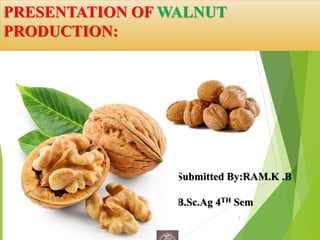
PRESENTATION OF WALNUT
PRODUCTION:
1
Submitted By:RAM.K .B
B.Sc.Ag 4TH Sem
Introduction:
 The walnut (juglans regia )it also known as name of okhar
 Belong to the family juglandaceae .
 It is a very important temperate tree nut in the world
including Nepal.
 Commercially cultivated are not found in Nepal. But being
commercially cultivated in many countries like China ,USA,
India etc.
 Walnut are mostly found in northern part of our country in
temperate region
 .
 .
2
BOTANY:
 The somatic chromatic number is (2 n) of juglans is 32
 Walnut is a deciduous tree and very large .
 Leaves are alternate, large aromatic and flower are
monoecious .i.e. male and female flowers in separate
structures on the same plant.
 The family juglandaceae have 60 species and 7 genera
among them some are monoecious and deciodous
 Flowers appear before and after the leaves .
 Its fruits is drupe, in which nut is enclosed inside the
husk, which vary in color from green to yellow
 Shapes of the walnut fruit vary from subglobose to
globose, having diameter of 3.5-8cm, fruit may be
glandular hairs.
3
4
Origin ,Area and Production:
 Walnut is believed to have originated in the
region from persia to kashmir.
 Further walnut is also originated in north
western Himalayan or Iran.
 The major walnut growing countries are China
,U.S.A, France, Italy,Turkey,Mexico,France,
India,Romania,Irane,and Chile.
 The major importing country of walnut from
India are United kingdome,Egypet,Netherland,
Gemany,Australia and Taiwan etc.
5
6
Importance and uses:
Walnut :
 High value nature crop.
 Mostly consumed as dry food being eaten for table purposes.
 Kernels are widely used in bakery industries in the preparation
like cake,chocolate,candy and ice-cream etc.
 Dry nut are used for many ceremonial and religious function.
 Wild walnut trees are used as timber and used in different kinds of
items such as musical instruments to furniture and even gun
stocks.
 Walnut have nutritional and medicinal value .
 The oil cake being rich in protein is fed to cattles.
 The main important of walnut is oil which is extracted from
kernels.
 Walnuts contain important phytochemicals as well as high
amounts of polyunsaturated fats which do offer potential benefits
for both brain health and brain function. Omega-3 plays a part by
helping to reduce oxidative stress in the brain.
7
Status of Walnut in Nepal:
 The worldwide production of walnuts has been
increasing rapidly in recent years, with the largest
increase coming from Asia.
In case in Nepal:
 Jumla is the center of walnut production including
the Kalikot, Mugu, Humla, Jajarkot etc.
 Where as in Baitadi nursery station of walnut has
been established for enhancing the walnut
production .
 Further many research, activities has been done in
walnut production.
8
Walnut Production – 2016
Country
Production
(thousands of tonnes)
China 1,786
United States 608
Iran 405
Turkey 195
Mexico 142
Ukraine 108
Chile 74
World 3,700
9
Scope and constraints:
 Walnut:
 Being high value nature of crop and agriculture
prospective plant, although there are constraints in
walnut production. i.e.
 Geophysical situation
 Climatic changes
 Lack of Systematic Marketing System
 Plant protection
 Physical facilities
 production input
 Low land holding
10
Climate:
Walnut:
 Mostly growing in the himalayan region between the elevation of
1200 to 2100m above sea level.
 Requires a climate which is free from frost in spring and from
extreme heat in summer.
 Grow well in areas with rainfall of about 76cm or more.
 High temperature during maturity caused the sun burn and black
nut of walnut.
 Cool summer ,on the other hand ,result in low oil content.
 Warm summer with temperature about 27-30 °c near the harvest
time appear to be optimal for good kernel development.
11
Soil
 Required silt loam soil with well drained, deep ,aerated
soil for their deep root system(about 2m in depth)and
containing high organic matter.
 Ph range of 6-7 is most suitable.
 Soil depth must be 2-3m depth for the best result of
walnut production.
 Alkaline and sandy sub-soil should avoided for better
walnut growing.
12
Varieties
 Payne: tree is small to medium and its female flowers rate
is very high ,resulting in high yield .
 Hartley :Tree are medium to tall with large fruits
 Ashley :small and good for filler trees
 Metcalf
 Broadview
 Thin-shelled
 Hansen
 Black walnut
13
14
Propagation of walnut:
Walnut
 Can be propagated either by seed or by vegetative methods.
 The commercial walnut can be grown by Patch budding or
Veneer grafting. .
 J. regia and J. hindsii are the popular rootstock which are
resistance to crown rot disease.
 Top working also done in walnut.
15
Fig: veneer grafting
16
Fig: patch budding 17
Fig> top working:
18
Planting distance and fertilizers
 Planting in case of seed: 10×10 m²and in case of
vegetative planting 7x7m².
 Usually no fertilization is done in walnut in Nepal
but it is good to apply NPK fertilizer.
 Apply 25 to 50 kg FYM for non-bearing trees and 50
to 100 kg FYM for bearing trees.
 NPK/ g 400-200-200 per bearing trees .
 Apply all FYM, where P and K and half of N is
applied in new growth start and the remaining dose
of in Sep-Oct after harvest the fruits.
19
Some pictures of planting system
20
Planting distance Sowing the seed
Emergence the seedling Young plant Grafting technique
Ready soil for planting
TRAINING AND PRUNING:
 Training is done to a central leader or modified leader.
 Young walnut trees are weak and must be given be
given adequate support using bamboo or others
materials for 4 to 5 years after planting.
 Very little annual pruning is done except removing
crossing or weak branches.
 Some thinning-out pruning is usually done in the heavy
bearing cultivars.
21
IRRIGATION:
 Basically walnut trees are grown under rainfed conditions.
However the rain is not sufficient and well distributed,
irrigation is essential for walnut cultivation.
 Low water supply to the trees result in slow growth, reduced
yield and low nut quality and fruit dope.
 More irrigation is needed at during fruit setting and
development stages.
 But excessive supply of water cause root and crown disease.
22
 MULCHING :
 Mulching is essential in walnut orchards when the plants
are younger .
 It also important in after fertilizer is applied to older trees.
 Mulching materials around the plant or trees to help
conserve soil moisture ,regulated soil temperature, reduce
weeds growth etc.
 INTRCROPPING:
 Since there are wider spaces in between trees and
trees row ,different crops such as
buckwheat,peas,legumes grasses,strawberry,cabbage
cauliflower,lentil etc. can be taken as intercrops
depending upon and market needs.
23
Harvest and yield
 Walnut are mature 1-4 weeks before hull dehiscence.
 The hulls split at the time of maturity in sep to oct.
 Mature nut do not fall all at a time so the mechanical shaking can
be done .
 Dropped food are collected in Sept to Oct.
 Hulls should be removed immediately to avoid discoloration in
quality.
 Nut must be immediately dried to a moisture level of 3 to 5% after
harvest at the temp of 38 to 43°c then kept at cold and dry
temperatures .
 Drying the nuts increases in fatty acid and bring favorable
change.
 . 24
25
Walnut physiological disorders:
 Rosette and bunch:
26
Yield:
 A trees may bear for about 100 years or more from age
of 8 to 10 years after planting .
 Grafted and budding plants gives fruiting about 4 to 5
years.
 A growing up trees yield an average of 50 to 80 kg per
trees and mature trees yield is 80-100 kg per tree
27
Insects -Pest:
 San Jose scale: This are the small insect damage both shoot and
fruits.
 Management:
 which can be control by diesel oil in winter or spray
0.03%Diazinon in winter
28
San Jose scale adult male
DAMAGE OF SAN JOSE SCALR
IN SHOOT of WALNUT:
29
 Walnut aphid:
 the young and adult stages of this aphid suck sap
reducing tree vigor, fruit quality and yield.
 Fruit may be drop before reach to maturity.
 Management :
 Collect dropped fruits and bury them in soil.
 Pheromone trap can be used when the tree starts
fruiting.
 Spray Rogor .
 .
30
 Husk fly :
 This is the most important and serious pest in walnut.
 The fly lays eggs on developing fruits and the maggots
destroy them
 Management :
 Use the pheromone traps or spray dipterex
31
 walnut weevil:
 The female lays eggs on the fruits. on hatching it feed
by boring hole on kernels causing premature fruits drop.
 Management:
 The pest can be checked by spraying twice carbaryl
(0.2%) at 7 days interval.
 Collect the dropped ,infected fruits and burn them.
32
 Diseases:
 Foot and root rot:
 This is a fungal disease that attacks the stem where it
touches the ground and also attacks on root.
 Small infected are seen on leaves.
 Management :
 Avoid planting walnut trees in moisture and cool soil.
 Provide proper drainage system.
 Treat soil with formaldehyde, or bavistin before
planting.
 Use only resistance rootstock.
33
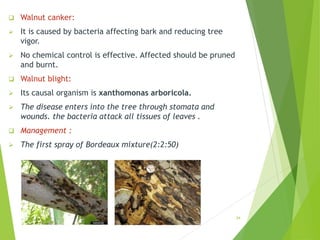
 Walnut canker:
 It is caused by bacteria affecting bark and reducing tree
vigor.
 No chemical control is effective. Affected should be pruned
and burnt.
 Walnut blight:
 Its causal organism is xanthomonas arboricola.
 The disease enters into the tree through stomata and
wounds. the bacteria attack all tissues of leaves .
 Management :
 The first spray of Bordeaux mixture(2:2:50)
34
35
 Powdery mildew :
 It is a causal organism of this disease is phyllactinia roboris
 Greyish to white powdery spore mass appears on upper and
lower surface of leaves.
 It can be control by spray the trees wetable sulphur (300
g/100 l of water) or carbendazim fungicide.(50g/100 L of
water )
36
 References :
 Fruit growing by DR.J.S BAL. kalyani publishers
 Fruit and plantation crops by DR .GYAN KUMAR
SHRESTHA. Heritage publisher and distributors pvt . ltd
in 2016
 A lecture notes on fruit and plantation crops
production.
 Wikipedia
 Slide share
 vikaspedia
37
38
39
Internal breakdown of almost mature
nuts in
late summer occurs each year. The inside
part
of the nut becomes soft and wa...
40

walnutpresentation-190223161059.pdf

  • 1.
  • 2.
    Introduction:  The walnut(juglans regia )it also known as name of okhar  Belong to the family juglandaceae .  It is a very important temperate tree nut in the world including Nepal.  Commercially cultivated are not found in Nepal. But being commercially cultivated in many countries like China ,USA, India etc.  Walnut are mostly found in northern part of our country in temperate region  .  . 2
  • 3.
    BOTANY:  The somaticchromatic number is (2 n) of juglans is 32  Walnut is a deciduous tree and very large .  Leaves are alternate, large aromatic and flower are monoecious .i.e. male and female flowers in separate structures on the same plant.  The family juglandaceae have 60 species and 7 genera among them some are monoecious and deciodous  Flowers appear before and after the leaves .  Its fruits is drupe, in which nut is enclosed inside the husk, which vary in color from green to yellow  Shapes of the walnut fruit vary from subglobose to globose, having diameter of 3.5-8cm, fruit may be glandular hairs. 3
  • 4.
  • 5.
    Origin ,Area andProduction:  Walnut is believed to have originated in the region from persia to kashmir.  Further walnut is also originated in north western Himalayan or Iran.  The major walnut growing countries are China ,U.S.A, France, Italy,Turkey,Mexico,France, India,Romania,Irane,and Chile.  The major importing country of walnut from India are United kingdome,Egypet,Netherland, Gemany,Australia and Taiwan etc. 5
  • 6.
  • 7.
    Importance and uses: Walnut:  High value nature crop.  Mostly consumed as dry food being eaten for table purposes.  Kernels are widely used in bakery industries in the preparation like cake,chocolate,candy and ice-cream etc.  Dry nut are used for many ceremonial and religious function.  Wild walnut trees are used as timber and used in different kinds of items such as musical instruments to furniture and even gun stocks.  Walnut have nutritional and medicinal value .  The oil cake being rich in protein is fed to cattles.  The main important of walnut is oil which is extracted from kernels.  Walnuts contain important phytochemicals as well as high amounts of polyunsaturated fats which do offer potential benefits for both brain health and brain function. Omega-3 plays a part by helping to reduce oxidative stress in the brain. 7
  • 8.
    Status of Walnutin Nepal:  The worldwide production of walnuts has been increasing rapidly in recent years, with the largest increase coming from Asia. In case in Nepal:  Jumla is the center of walnut production including the Kalikot, Mugu, Humla, Jajarkot etc.  Where as in Baitadi nursery station of walnut has been established for enhancing the walnut production .  Further many research, activities has been done in walnut production. 8
  • 9.
    Walnut Production –2016 Country Production (thousands of tonnes) China 1,786 United States 608 Iran 405 Turkey 195 Mexico 142 Ukraine 108 Chile 74 World 3,700 9
  • 10.
    Scope and constraints: Walnut:  Being high value nature of crop and agriculture prospective plant, although there are constraints in walnut production. i.e.  Geophysical situation  Climatic changes  Lack of Systematic Marketing System  Plant protection  Physical facilities  production input  Low land holding 10
  • 11.
    Climate: Walnut:  Mostly growingin the himalayan region between the elevation of 1200 to 2100m above sea level.  Requires a climate which is free from frost in spring and from extreme heat in summer.  Grow well in areas with rainfall of about 76cm or more.  High temperature during maturity caused the sun burn and black nut of walnut.  Cool summer ,on the other hand ,result in low oil content.  Warm summer with temperature about 27-30 °c near the harvest time appear to be optimal for good kernel development. 11
  • 12.
    Soil  Required siltloam soil with well drained, deep ,aerated soil for their deep root system(about 2m in depth)and containing high organic matter.  Ph range of 6-7 is most suitable.  Soil depth must be 2-3m depth for the best result of walnut production.  Alkaline and sandy sub-soil should avoided for better walnut growing. 12
  • 13.
    Varieties  Payne: treeis small to medium and its female flowers rate is very high ,resulting in high yield .  Hartley :Tree are medium to tall with large fruits  Ashley :small and good for filler trees  Metcalf  Broadview  Thin-shelled  Hansen  Black walnut 13
  • 14.
  • 15.
    Propagation of walnut: Walnut Can be propagated either by seed or by vegetative methods.  The commercial walnut can be grown by Patch budding or Veneer grafting. .  J. regia and J. hindsii are the popular rootstock which are resistance to crown rot disease.  Top working also done in walnut. 15
  • 16.
  • 17.
  • 18.
  • 19.
    Planting distance andfertilizers  Planting in case of seed: 10×10 m²and in case of vegetative planting 7x7m².  Usually no fertilization is done in walnut in Nepal but it is good to apply NPK fertilizer.  Apply 25 to 50 kg FYM for non-bearing trees and 50 to 100 kg FYM for bearing trees.  NPK/ g 400-200-200 per bearing trees .  Apply all FYM, where P and K and half of N is applied in new growth start and the remaining dose of in Sep-Oct after harvest the fruits. 19
  • 20.
    Some pictures ofplanting system 20 Planting distance Sowing the seed Emergence the seedling Young plant Grafting technique Ready soil for planting
  • 21.
    TRAINING AND PRUNING: Training is done to a central leader or modified leader.  Young walnut trees are weak and must be given be given adequate support using bamboo or others materials for 4 to 5 years after planting.  Very little annual pruning is done except removing crossing or weak branches.  Some thinning-out pruning is usually done in the heavy bearing cultivars. 21
  • 22.
    IRRIGATION:  Basically walnuttrees are grown under rainfed conditions. However the rain is not sufficient and well distributed, irrigation is essential for walnut cultivation.  Low water supply to the trees result in slow growth, reduced yield and low nut quality and fruit dope.  More irrigation is needed at during fruit setting and development stages.  But excessive supply of water cause root and crown disease. 22
  • 23.
     MULCHING : Mulching is essential in walnut orchards when the plants are younger .  It also important in after fertilizer is applied to older trees.  Mulching materials around the plant or trees to help conserve soil moisture ,regulated soil temperature, reduce weeds growth etc.  INTRCROPPING:  Since there are wider spaces in between trees and trees row ,different crops such as buckwheat,peas,legumes grasses,strawberry,cabbage cauliflower,lentil etc. can be taken as intercrops depending upon and market needs. 23
  • 24.
    Harvest and yield Walnut are mature 1-4 weeks before hull dehiscence.  The hulls split at the time of maturity in sep to oct.  Mature nut do not fall all at a time so the mechanical shaking can be done .  Dropped food are collected in Sept to Oct.  Hulls should be removed immediately to avoid discoloration in quality.  Nut must be immediately dried to a moisture level of 3 to 5% after harvest at the temp of 38 to 43°c then kept at cold and dry temperatures .  Drying the nuts increases in fatty acid and bring favorable change.  . 24
  • 25.
  • 26.
  • 27.
    Yield:  A treesmay bear for about 100 years or more from age of 8 to 10 years after planting .  Grafted and budding plants gives fruiting about 4 to 5 years.  A growing up trees yield an average of 50 to 80 kg per trees and mature trees yield is 80-100 kg per tree 27
  • 28.
    Insects -Pest:  SanJose scale: This are the small insect damage both shoot and fruits.  Management:  which can be control by diesel oil in winter or spray 0.03%Diazinon in winter 28 San Jose scale adult male
  • 29.
    DAMAGE OF SANJOSE SCALR IN SHOOT of WALNUT: 29
  • 30.
     Walnut aphid: the young and adult stages of this aphid suck sap reducing tree vigor, fruit quality and yield.  Fruit may be drop before reach to maturity.  Management :  Collect dropped fruits and bury them in soil.  Pheromone trap can be used when the tree starts fruiting.  Spray Rogor .  . 30
  • 31.
     Husk fly:  This is the most important and serious pest in walnut.  The fly lays eggs on developing fruits and the maggots destroy them  Management :  Use the pheromone traps or spray dipterex 31
  • 32.
     walnut weevil: The female lays eggs on the fruits. on hatching it feed by boring hole on kernels causing premature fruits drop.  Management:  The pest can be checked by spraying twice carbaryl (0.2%) at 7 days interval.  Collect the dropped ,infected fruits and burn them. 32
  • 33.
     Diseases:  Footand root rot:  This is a fungal disease that attacks the stem where it touches the ground and also attacks on root.  Small infected are seen on leaves.  Management :  Avoid planting walnut trees in moisture and cool soil.  Provide proper drainage system.  Treat soil with formaldehyde, or bavistin before planting.  Use only resistance rootstock. 33
  • 34.
     Walnut canker: It is caused by bacteria affecting bark and reducing tree vigor.  No chemical control is effective. Affected should be pruned and burnt.  Walnut blight:  Its causal organism is xanthomonas arboricola.  The disease enters into the tree through stomata and wounds. the bacteria attack all tissues of leaves .  Management :  The first spray of Bordeaux mixture(2:2:50) 34
  • 35.
  • 36.
     Powdery mildew:  It is a causal organism of this disease is phyllactinia roboris  Greyish to white powdery spore mass appears on upper and lower surface of leaves.  It can be control by spray the trees wetable sulphur (300 g/100 l of water) or carbendazim fungicide.(50g/100 L of water ) 36
  • 37.
     References : Fruit growing by DR.J.S BAL. kalyani publishers  Fruit and plantation crops by DR .GYAN KUMAR SHRESTHA. Heritage publisher and distributors pvt . ltd in 2016  A lecture notes on fruit and plantation crops production.  Wikipedia  Slide share  vikaspedia 37
  • 38.
  • 39.
    39 Internal breakdown ofalmost mature nuts in late summer occurs each year. The inside part of the nut becomes soft and wa...
  • 40.