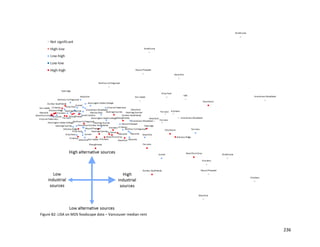
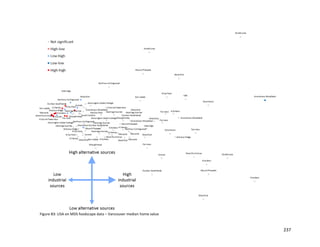
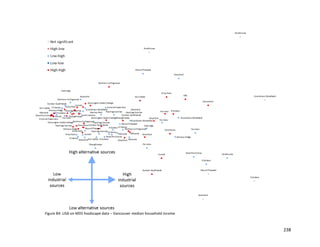
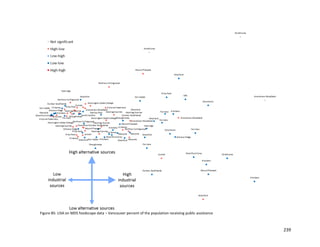
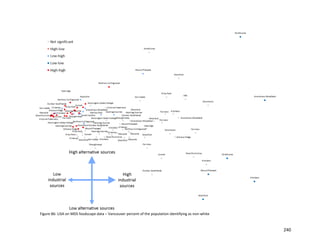
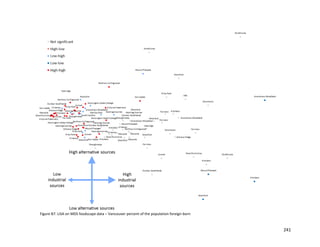
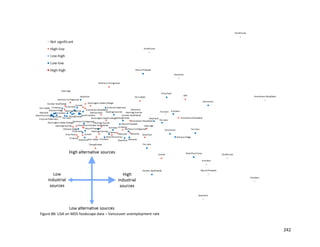
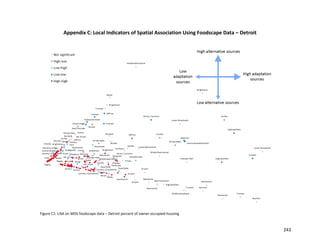
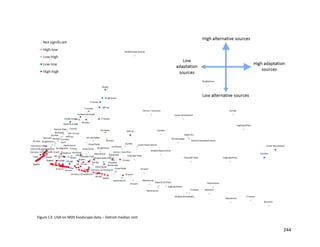
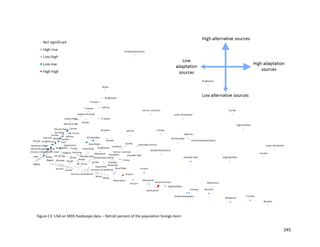
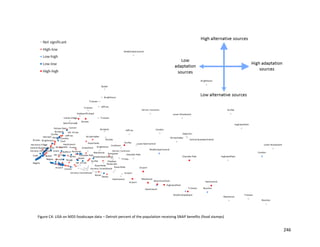
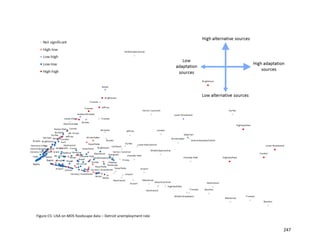
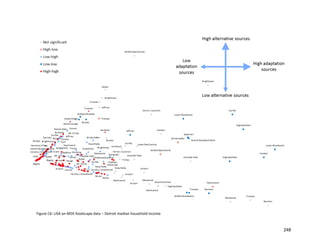
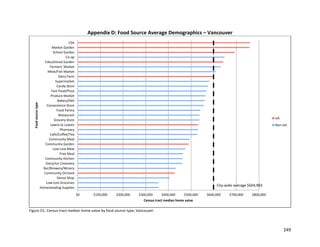
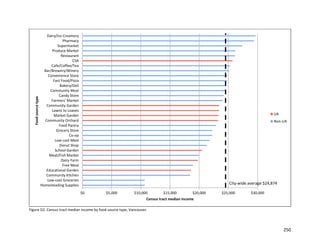
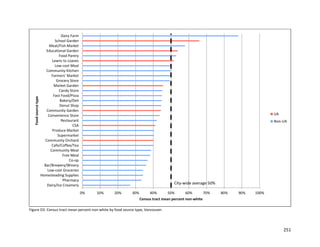
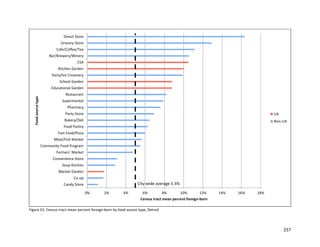
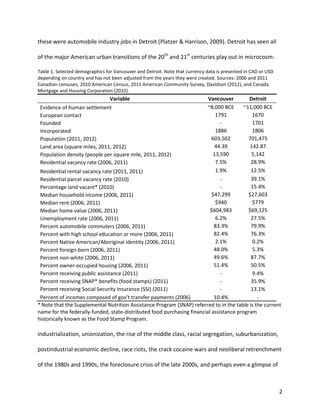
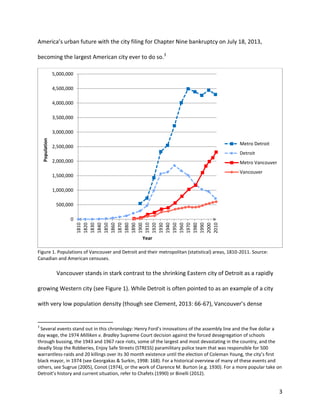
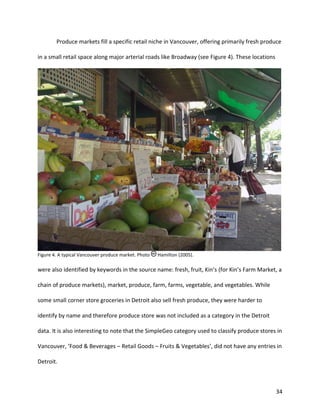
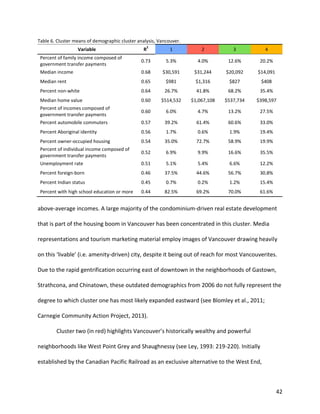
This thesis examines urban agriculture in Vancouver, BC and Detroit, MI through quantitative and qualitative methods. Chapter 1 details the author's approach to quantifying the urban foodscape through cluster analysis, multidimensional scaling, and local indicators of spatial association using census and food source data. Chapter 2 presents results of these analyses for Vancouver and Detroit individually and together. Chapter 3 is an interlude. Chapter 4 situates urban agriculture within political ecology and sustainability frameworks and provides histories of agriculture in each city. Chapter 5 presents vignettes of individual urban farms/gardens in both cities and relates them to theories of political change. The conclusion summarizes key findings and limitations and discusses future research avenues.

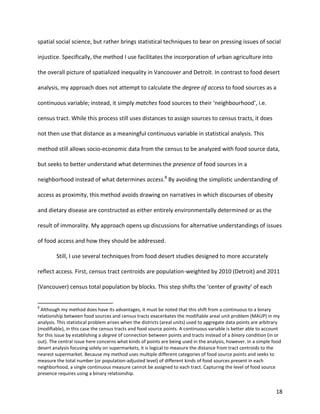
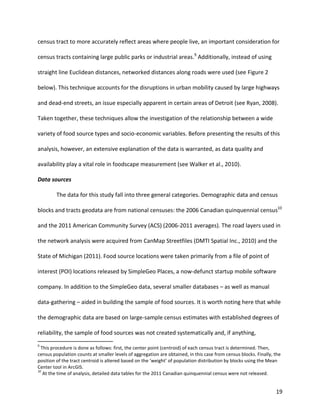
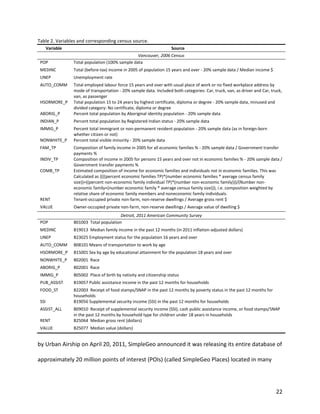
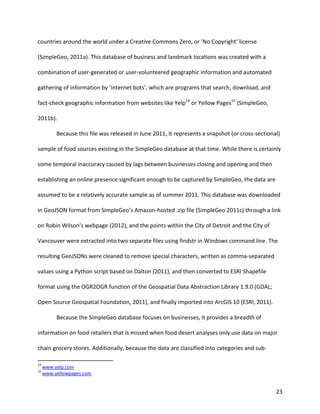
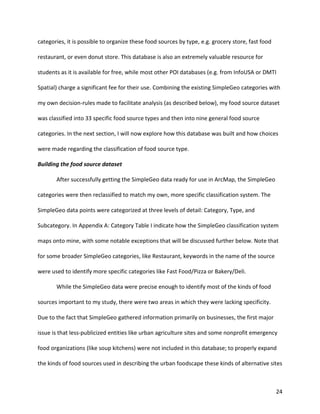
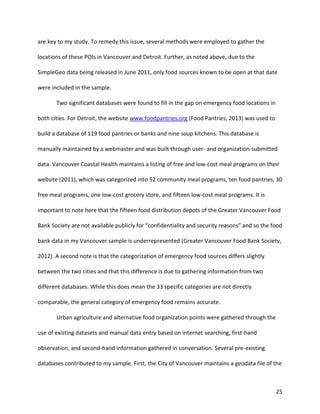
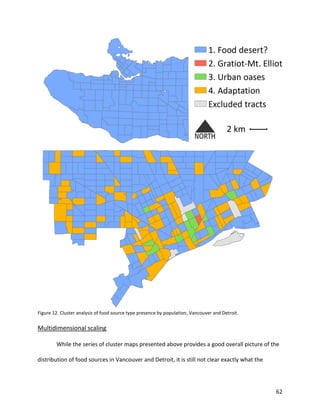
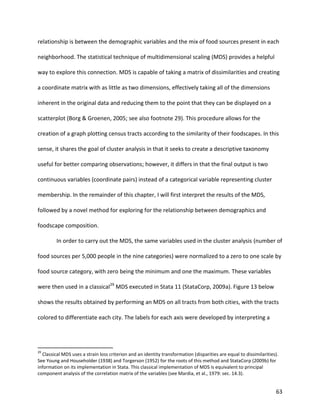
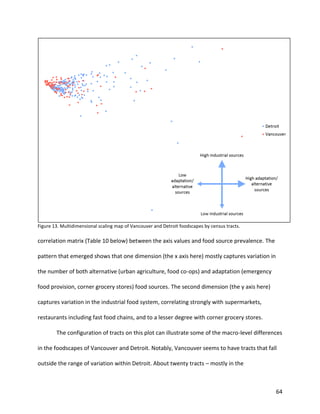
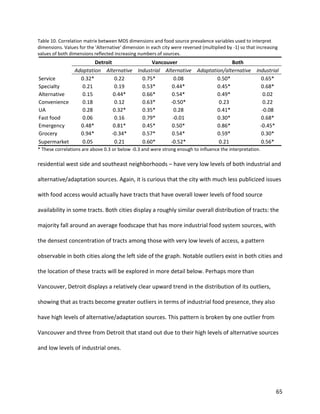
![81
industry giants like Walmart, which in 2011 announced that it would be opening 300 stores in
USDA-identified food deserts (Walmart, 2011).
In fact, the publishers of one of the first widely-publicized food desert studies in the
United States (Gallagher, 2006), the Mari Gallagher Research and Consulting Group, has since
been hired by Walmart to conduct an ‘apolitical’ assessment of the effects on local businesses
after one of their stores opened in the West Side of Chicago, resulting in three separate reports
(see Gallagher, n.d.). Unsurprisingly, they challenged the findings of researchers from the
Center for Urban Research and Learning at Loyola University Chicago, whose study (Merriman
et al., 2012) finds that the opening of the Walmart had a statistically significant relationship on
local small businesses closing. In all of the documents pertaining to this report, Gallagher and
company are sure to state the following: “We emphasize that we are neither ‘pro’ nor ‘anti’
Wal-Mart but, rather, a neutral third-party research firm. We do not conduct advocacy or any
type of political work” (Gallagher, n.d.). This claim begs the obvious question: is a neutral stance
possible when your research is funded by Walmart? Additionally, what does it mean if food
desert research can be co-opted so easily by actors from the industrialized food system?
As Shannon and Guthman have claimed, it suggests that the transformative political
power of the method is limited: “Therein lies the problem [with food desert research]: an
approach that appeals to all parts of the political spectrum cannot challenge the political-
economic forces that are producing cheap, toxic, and junky food – and making some people
dependent on it” (Guthman, 2011: 186). They advocate alternative quantitative and qualitative
methods that seek to avoid the problematic assumptions of food desert research and instead
take an approach that focuses on structural inequality. In the first two chapters of this thesis, I](https://image.slidesharecdn.com/f692e96e-0509-4d86-9945-2fafa478ea16-160307154644/85/Walker-2013-Growing-ideology-96-320.jpg)
![85
Chapter 4: Urban Agriculture and the Local Sustainability Fix
If one were to skim over recent articles on Vancouver and Detroit in the pages of a
major North American newspaper like The New York Times, a picture of two vastly dissimilar
cities would emerge. Many articles on Vancouver focus on its appeal as an international travel
destination. Consider the opening sentences of Denny Lee’s short travel guide for cruise
passengers:
No wonder Vancouver is often heralded as one of the world’s most livable cities. It is
blessed with a snowcapped mountain backdrop and crystal blue harbors. It is also a
gateway to the Inside Passage — the marvelous maze of glacier-carved fjords and
forested islands that are a cruise lover’s delight. But what really sets Vancouver apart is
its urban density. With sprawl kept in check by geography, the city thinks vertically.
Neighborhoods overlap, apartments rise. That seems to heighten the city’s international
mix. (2010: 1)
Contrast this picture of consumption-oriented ecotopia with a common portrayal of the Motor
City provided by Harvard economist Edward Glaeser:
Can Detroit shrink to greatness? After decades of betting that white elephant projects,
like the city’s monorail, would reverse decline, Detroit’s remarkable mayor, Dave Bing, a
former N.B.A. All-Star and successful steel entrepreneur, has focused on right-sizing his
city and its government. At the extreme, urban right-sizing could mean bulldozing large
swaths of the city. [. . .] Given that Detroit was on the wrong side of history with
competition, education, climate and industrial diversity, it is not surprising that the city’s
population fell from over 1.85 million in 1950 to 912,000 in 2008. Economic and social
headwinds ensured that Detroit would shrink, but public policies did little to halt the
city’s decline. (2010: 1)
Little mention of natural amenities here – except as part of the explanation for why Rust Belt
industrial jobs moved south to the Sun Belt. The picture presented is bleak.
On the other hand, consider some of the headlines from local papers in each city from
May and June, 2013, alone: in Vancouver, a free daily reports “Rooftop beehives, front yards
fertile ground for Vancouver’s urban farmers” (Harbottle, 2013) and a Vancouver Sun editorial](https://image.slidesharecdn.com/f692e96e-0509-4d86-9945-2fafa478ea16-160307154644/85/Walker-2013-Growing-ideology-100-320.jpg)
![95
The radical/neoliberal Janus face
The paradoxical nature of urban sustainability is especially apparent in analysis of the
factors leading to the emergence of urban agriculture in the built environment. To this effect,
Nathan McClintock’s work theorizing urban agriculture is worth quoting at length:
I contend that it’s not one or the other, radical or neoliberal, but, rather, a Janus face,
simultaneously a radical counter-movement and an actually-existing form of roll-out
neoliberalization existing in dialectical tension. Indeed, contradictory processes of
capital both create opportunities for urban agriculture (on land left vacant either via the
retreat of capital or via speculation/monopoly rent) and impose obstacles to its
expansion (such as increased competition for funding, environmental contamination
externalized from production, and rising land values once sites are improved and
gentrifiers move in). To debate whether urban agriculture is good or bad, neoliberal or
radical, bourgeois and gentrifying or grassroots and radical, is not particularly
constructive. Indeed, this approach forces us to answer a question that is too simple;
not only is urban agriculture both radical and neoliberal, gentrifying and unifying, it has
to be both. Indeed [. . .] it wouldn’t arise as a viable social movement without elements
of both. (2011: 6; see also McClintock, 2013)
This conception is valuable for a number of reasons. First, it can be used to explain the
emergence of urban agriculture in very different cities of the Global North, a utility that will be
demonstrated later in this chapter. Second, it touches on a number of aspects of urban
agricultural movements that have close connections to the three dynamics presented in
Chapter 2. These include the centrality of the rent gap and deindustrialization in the uneven
development of urban built environments – especially housing markets (see Smith, 1987); racial
disparities in housing, income, and environmental health; and what is often called the
‘nonprofit industrial complex’, wherein the normalization of emergency food (and to some
degree the CFS paradigm, see Morales, 2011), coupled with the roll-back of the welfare state’s
social safety net, has generated a permanent crisis within nonprofits reliant on a precarious](https://image.slidesharecdn.com/f692e96e-0509-4d86-9945-2fafa478ea16-160307154644/85/Walker-2013-Growing-ideology-110-320.jpg)
![97
movements in each city. In doing so, I will trace how urban agriculture has functioned within
socionatural metabolic relations and, crucially, how it has served as a protective counter-
movement to the social dislocation of market society.
A brief history of agriculture in the Lower Mainland
Any historical account of agriculture in British Columbia must begin by acknowledging
the fact that the land currently inhabited and farmed in the Pacific Northwest is the historical
and current home of a diverse array of indigenous peoples. Cole Harris, a historical geographer,
estimates that the pre-contact population of British Columbia was probably well over 200,000,
with around 50,000 living around the Lower Mainland (1996: 30). This large population was
supported primarily by the natural (and human-engineered) bounty of the Pacific Ocean and its
temperate rainforests, with the lower Fraser River having perhaps the highest non-agricultural
food production of anywhere in North America – or even the Western Hemisphere (Harris,
1996: xii, 20). Although the Coast Salish people living in this area did practice what Harris (1996:
219) calls ‘proto-agricultural’ cultivation of wild plants such as camas bulbs (Camassia
quamash) and Indian potato (Sagittaria latifolia) and undertook ecological modification of the
landscape (e.g. the cultivation of clam gardens, see Groesbeck, 2013), it is vital to recognize
that in British Columbia – like most of North America – European-style agriculture and its
attendant ideology of property rights were “social and economic introduction[s] with complex
ecological and cultural subtexts tied to colonialism and to the creation of an immigrant society”
(Harris, 1996: 220); indeed, they were “a strategy of successful colonialism” (Harris, 1996: 249).
Early efforts at the forceful ‘civilization’ of indigenous people by European settlers revolved
around introducing agriculture as a way of life, thereby severely damaging indigenous](https://image.slidesharecdn.com/f692e96e-0509-4d86-9945-2fafa478ea16-160307154644/85/Walker-2013-Growing-ideology-112-320.jpg)
![99
growth of timber provided raw material for construction and export and the industrialization of
agriculture led to increased inputs, monocropping, and export-driven specialization.
Today, British Columbia continues to have a relatively small but productive agricultural
sector (Barbolet et al., 2005; Serecon Management Consulting & Zbeetnoff Agro-Environmental
Consulting [SMC & ZAEC], 2009; Gibb, 2011). Due in part to a national supply management
quota system, British Columbia is nearly self-reliant in its production of milk, eggs, and poultry
(SMC & ZAEC, 2009). Additionally, the province produces nearly enough fish and vegetables to
meet its own consumption needs. However, due to production being seasonal and highly
specialized, a large percent (23% provincially in 2009, see Gibb, 2011: 18) of these commodities
are exported (SMC & ZAEC, 2009). Therefore, the Lower Mainland’s food supply is characterized
by “short seasonal abundance, significant off-season imported product flows, and exports in
periods of seasonal excess” (SMC & ZAEC, 2009: viii). The resulting ‘food gap’ between local
supply and demand is illustrated in Figure 16 below.
Although the establishment of the Agricultural Land Reserve (ALR) in 1973 has helped
preserve the province’s scarce arable land (Garrish, 2002), Vancouver faces significant
challenges in developing local agriculture due primarily to its expanding population, limited
growing season (despite being the longest in Canada, see Whiting & Lai, 2008), and
urbanization-led pressures on farmland. While many of the local truck farms and market
gardens pioneered by Chinese-Canadians continue to produce food within the ALR, over time
the majority of agricultural activity in the Lower Mainland has become increasingly
‘conventional’, employing migrant labor, synthetic inputs, and specialized commodity crop
production (Otero & Preibisch, 2010; Gibb, 2011). As shown in Figure 17 below, the amount](https://image.slidesharecdn.com/f692e96e-0509-4d86-9945-2fafa478ea16-160307154644/85/Walker-2013-Growing-ideology-114-320.jpg)

![105
Strathcona Community Gardens was established in 1985 after a long process in which many
different community groups vied for control of a vacant plot of land, which is located in a tidal
flats area and was seasonally inundated until the False Creek Flats were drained to make way
for the Canadian Pacific Railway in the early 20th
century (Strathcona Community Gardens,
n.d.). The area currently inhabited by the garden is still City-owned and at various points in
history served as garbage dump, ‘hobo jungle’ shantytown, military training ground, and a city
works yard (Environmental Youth Alliance [EYA], 1996).
The City of Vancouver did grant the garden the land over other community groups vying
for access, but it is important to recognize that tension between gardeners and the city
government has been an issue for decades. In the remainder of this section I will explore the
creation of the Cottonwood Community Garden as a way of illustrating that when it comes to
urban agriculture, the relationship between the local state and citizens is not strictly about the
use versus exchange value of public space, but also about the configuration of socionatural
metabolic relationships. In 1988, gardeners in the northwest quarter of the four acre lot were
evicted by City Council decree to allow for the building of senior nonmarket housing for the
Chinese Freemasons (EYA, 1996). In addition to moving plots and rebuilding parts of the garden
in response to the loss of land, the Strathcona gardeners also chose to expand to meet the high
demand of the community for growing space. Under the direction of land artist Oliver
Kellhammer, a group of guerilla gardeners began to claim plots in a three acre vacant right-of-
way at the southern edge of Strathcona Park along Malkin Avenue, just southeast of the
Community Gardens. This land was jointly managed by the Parks Board and Engineering
Department and had been used as an informal dumping ground before it was reclaimed as the](https://image.slidesharecdn.com/f692e96e-0509-4d86-9945-2fafa478ea16-160307154644/85/Walker-2013-Growing-ideology-120-320.jpg)


![110
Table 11. Vancouver food policy chronology. Adapted from City of Vancouver (2013c).
City Council motion in support of a ‘just and sustainable food system’ 2003
Vancouver Food Policy Council 2004
Guidelines for urban beekeeping 2005
Vancouver Food Charter 2007
2010 Garden Plots by 2010 Initiative (part of Greenest City) 2007 – 2010
Urban agriculture design guidelines for the private realm 2009
Greenest City Grants in support of urban agriculture 2009 – 2011
Guidelines for keeping backyard hens 2010
Food scraps collection program 2010
Interim Farmers Market policy 2010
Street food program expansion 2010 – 2012
Grants to support neighborhood food networks 2009 – 2012
Greenest City Action Plan Local Food Area 2011
Grant to support Urban Farming Forum 2011
Vancouver Food Strategy 2013
inter-urban league tables such as Siemens’ Green City Index.40
Since then, a Greenest City 2020
Action Plan has been created for the program and contains ten smaller plans, each with long-
term, quantitative targets that the City aims to reach by 2020. The goals range in focus from
creating green jobs, to reducing greenhouse gas emissions, to improving access to nature, clean
water, and clean air (City of Vancouver, 2011b). It also includes local food targets: goal ten of
the Plan reads, “increase city-wide and neighborhood food assets by a minimum of 50% over
2010 levels” (City of Vancouver, 2011b: 65), with a ‘food asset’ being defined quite broadly as
“resources, facilities, services or spaces that strengthen the city’s food system“(City of
Vancouver, 2011b: 69).41
One of the three short-term priority actions established under this
40
http://www.siemens.com/entry/cc/en/greencityindex.htm
41
Interestingly, in the early version of the Action Plan (called Vancouver 2020: A Bright Green Future; City of
Vancouver, 2009), the local food target was not based on food assets, but rather on the reduction of the city’s
carbon footprint, seeking to “[r]educe the carbon footprint of our food by 33% per capita” (City of Vancouver,
2009: 60). This initial focus meshes with the ‘bright green’ (see Steffen, 2009; Steffen et al., 2011) approach taken
by Robertson’s Greenest City Action team, which places technological and social innovation at the center of
ecological modernization. However, public input and consultation with the Food Policy Council and associated
organizations during the outreach phase of the plan likely influenced this change.](https://image.slidesharecdn.com/f692e96e-0509-4d86-9945-2fafa478ea16-160307154644/85/Walker-2013-Growing-ideology-125-320.jpg)
![111
rubric was the creation of a municipal food strategy, accomplished in January, 2013 with the
publishing of What Feeds Us: Vancouver Food Strategy (City of Vancouver, 2013c). This
document seeks to align existing alternative food movement capacity with government
programs, and specifically seeks to use a food systems planning approach to coordinate food
planning efforts among City departments in the name of sustainability.
Another short-term goal is to “[s]upport urban agriculture by creating 5-6 new
community gardens, enabling three new urban farms, encouraging new farmers markets,
adding public fruit trees, and supporting the development of a Vancouver food hub” (City of
Vancouver, 2012b). As of the summer of 2013, this goal has almost been met. In addition to the
progress made under these priority goals, the Greenest City 2020 Action Plan builds on a
number of urban agriculture initiatives that have already been accomplished under the
Greenest City rubric, including an initiative to create 2010 new community garden plots by
2010, Greenest City Grants in support of urban agriculture, and the Greenest City Action Plan
Local Food Area (see Table 11 above). Along similar lines as Detroit, Vancouver’s urban
agriculture movement finds its origins in citizen activism, but more recently has been actively
supported and managed by the City. I will argue in the next section that this shift is largely due
to the urban and regional adoption of sustainability initiatives as part of a strategy designed to
improve economic competiveness.
The Greenest City? Vancouverism’s sustainability fix
Numerous authors addressing academic (Kear, 2007; Quastel, 2009; Quastel et al., 2012;
Rostol, 2013) and popular (e.g. Longhurst, 2012) audiences have identified Vancouver’s
sustainability policy as a fix designed to preserve economic growth while selectively pursuing](https://image.slidesharecdn.com/f692e96e-0509-4d86-9945-2fafa478ea16-160307154644/85/Walker-2013-Growing-ideology-126-320.jpg)
![115
combines ‘natural amenities’ such as the mountains, the ocean, and the temperate rainforest,
with the cultural and entertainment amenities of a cosmopolitan consumption-oriented city,
the pursuit of planning designed to increase local food production and provide recreational
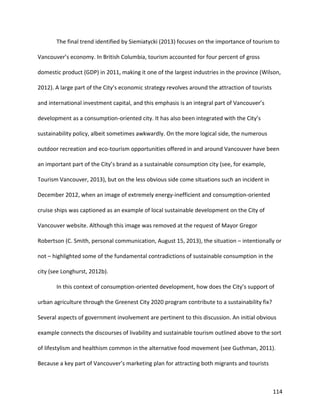
gardening opportunities is a perfect fit. The language used to support making Vancouver’s food
system ‘just and sustainable’ fits comfortably alongside messages advertising a green urban
lifestyle. In a recent article advertising summer events in the city, for example, the heading
asks, “A small farm with your condo?” (Bula, 2013b). Indeed, much of the success of the urban
agriculture movement in Vancouver stems from the strong support it receives from foodies
(and their civil society representatives) who value local, fresh, organic produce (see Fodor,
2012: 23; Mendes, 2006).
The second major factor pointing to urban agriculture as a sustainability fix in Vancouver
is the connection between local food production and the green economy. Although presumably
presented in no particular order, the goals of the Greenest City Action Plan (City of Vancouver,
2011b) do seem to prioritize the economic. The first goal is to “[s]ecure Vancouver’s
international reputation as a mecca of green enterprise” (10). This goal sums up Vision
Vancouver’s ‘bright green’ (see page 110) approach to environmentalism quite succinctly,
making the “strong business case for going green” (11). Their mission is supported by
organizations like the Vancouver Economic Development Commission (see Vancouver Economic
Development Commission, 2010).43
This section of the plan is central to Vision Vancouver’s
political and economic goals for the city. Mayor Robertson himself is a former ‘environmental
43
However, this approach to economic development has come under fire from some of city’s ‘common sense’
conservatives, such as when 2011 mayoral candidate Susan Anton’s campaign ran the following radio attack
advertisement: “Vancouverites know there’s something missing at City Hall. It’s called common sense, and it’s
costing you money. Backyard chickens, front yard wheat fields [. . .] In November, vote NPA… Because it’s time to
stop playing chicken with Vancouver’s future” (Non-Partisan Association, 2011).](https://image.slidesharecdn.com/f692e96e-0509-4d86-9945-2fafa478ea16-160307154644/85/Walker-2013-Growing-ideology-130-320.jpg)
![119
(Cleland, 1992: 287), the establishment of formal and visible native communities with powers
of self-determination is still a fraught process, especially in more heavily urbanized southern
Michigan (Cleland, 1992).
As in British Columbia, the introduction of European agriculture was a key feature of the
colonization of southeastern Michigan. When French and Dutch settlers first ventured into the
area in the 1600s, they planted orchards to stake a claim to the land (Detroit Food Policy
Council [DFPC], 2013). In a letter from 1735, a French missionary reports, “This stretch of
country is the finest in Canada; there is scarcely any winter, and all kinds of fruit grow there as
well as they do in France” (Nau). To this day several large pear trees grow in Detroit and across
the river in Windsor, Ontario, most of which have ancestors in the traditional ‘Jesuit pear’
groves of twelve trees, each representing one of the twelve apostles (Bénéteau, 2007). When
Fort Ponchartrain du Détroit was founded by the French officer Antoine de La Mothe Cadillac in
1701, France offered free land along the Detroit River to attract settlement to the area (Conot,
1974). While the fur trade was the major economic activity at the time, the construction of the
Fort and surrounding settlement led to the establishment of permanent agriculture. ‘Ribbon
farms’ followed the French seigneurial land tenure system, with long, narrow plots stretched
out from the river, which allowed a large number of farmers to access the water for
transportation and irrigation (Conot, 1974). Although Detroit’s early agricultural history has
been largely erased by the modernist planning and industrialization undertaken in the 19th
and
20th
century, the influence of these early ribbon farms is still evident in the city, with many
streets such as Chene, Dequindre, and Beaubien running parallel to the farm boundaries and
inheriting the names of their historical French landowners (DFPC, 2013).](https://image.slidesharecdn.com/f692e96e-0509-4d86-9945-2fafa478ea16-160307154644/85/Walker-2013-Growing-ideology-134-320.jpg)
![120
During the period from the late 1800s to the 1960s, Detroit’s rapid urbanization and
industrialization followed – some (e.g. Glaeser & Kahn, 2003) would claim epitomized – the
common mode of auto-centric, sprawling American urban and suburban development in the
20th
century. By definition, the rapid horizontal expansion of urban areas in southeast Michigan
required the conversion of farmland to residential and industrial land uses. This loss of
farmland was part of a process of specialization, commercialization, and – to a slightly lesser
degree – agglomeration that took place in Michigan’s agricultural sector as Detroit became one
of America’s major cities (Schaetzl, n.d.). Although the total acreage of agricultural land in the
state has decreased significantly from mid-century (see Figure 17 above), large parts of
Michigan remain rural and agricultural; in fact, the state was approximately 88% rural and
federal land in 2007 (U.S. Department of Agriculture, 2009). This slow conversion of land use is
contrasted by a much greater shift in population: in 1860, 85% of the population depended
upon agriculture for its livelihood (Schaetzl, n.d.); in 2011, the state population was 28% rural
and only 0.36% of the employed population worked primarily as farmers (American Community
Survey).
Despite these changes, the agriculture and food industry remain an important part of
Michigan’s economy, contributing $73.1 billion, or about four percent of state GDP, in 2011;
about 2.3% of that value came from exported products, with Canada, Mexico, and Japan being
the main destinations (United States Department of Agriculture National Agricultural Statistics
Service [USDA NASS], 2012). While few people are employed directly as farmers, over one
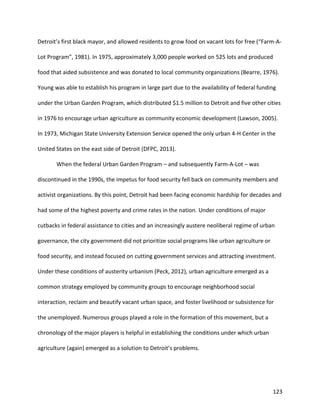
million residents are employed in the food sector (USDA NASS, 2012). Focus on high-value crops](https://image.slidesharecdn.com/f692e96e-0509-4d86-9945-2fafa478ea16-160307154644/85/Walker-2013-Growing-ideology-135-320.jpg)

![125
and food justice, intergenerational sharing and learning, reclaiming of public space through art,
and multi-scalar organizing and international solidarity (Boggs, 2009). In this sense, the Boggs
Center involvement in gardening is quite explicitly political and social justice-oriented, drawing
inspiration from both Martin Luther King, Jr.’s ‘beloved community’ and Malcolm X’s black
nationalism (see Boggs, 1998). Grace Lee Boggs has expressed her outlook as a six-decade
Detroit resident:
[W]e’re [Detroit] creating a whole new society which is postindustrial. And that turning
point, the evolution of humanity, is a great privilege. [. . . W]e were once the symbol,
nationally and internationally, of the miracles of production and we thought that
producing more, faster, even at the expense of the human beings on the line, was
progress [. . . T]hose dreams of the 20th century are dead and we are shaking the world
with a new dream. (Smiley & Boggs, 2013)
A parallel but differently-focused stream of organizing in the Detroit urban agriculture
movement since the 1990s comes from anti-hunger and beautification projects. Detroit
Agriculture Network (DAN) was started in 2003 by David Hacker, who at that time was director
of the Hunger Action Coalition. Another important anti-hunger organization in the city is the
Capuchin Soup Kitchen, which is run by the friars of the Capuchin Province of St Joseph of the
Saint Bonaventure Monastery located in Detroit’s east side neighborhood of Mount Elliott. The
soup kitchen was started in 1929 and has more recently expanded its programming to more
explicitly tackle food injustice and the root causes of poverty instead of being strictly anti-
hunger. Their Earthworks Urban Farm is one of the most successful in Detroit and is the only
operation in the city to be USDA-certified organic. Beautification organizations have also played
an important role in the movement. The major example is the Greening of Detroit, which began
in 1989 as an urban reforestation nonprofit and since that time has become heavily involved in](https://image.slidesharecdn.com/f692e96e-0509-4d86-9945-2fafa478ea16-160307154644/85/Walker-2013-Growing-ideology-140-320.jpg)



![134
After MDARD suspended the RTFA for Detroit, the Urban Agricultural Working Group
continued its work with an expanded list of partners (now fifteen in addition to five City
departments). In the process of developing an ordinance, public concern about regulating
pesticide use, genetically modified crops, and soil tests was taken into consideration, but
ultimately the City determined it could not be held responsible for enforcing such risks. Instead,
state and federal regulation was deferred to and soil test results were a component of a
required site plan submission for all agriculture land uses under the new ordinance. The
Working Group also decided that zoning for animals and honeybees would be accomplished at
a later date and that existing farms need only apply for site approval if their scale or type
changes. Additionally, they stated that “[t]he proposed ordinance provides a balance between
appropriate regulation and enforceability” by fulfilling two goals of zoning: protecting of health
and welfare and solving the issue that the City cannot sell its land to operations that cannot be
zoned (8). This second point is especially important, as several of the large existing and planned
urban agriculture projects in the city had been looking to purchase city-owned land – which
accounts for at least 35% of the vacant land in Detroit (see Colasanti & Hamm, 2010) – for their
farms.
By the end of 2012, the ordinance had been presented at three public meetings and
amended following consultation with the DCPC and was therefore nearly in its final form. While
most urban agriculture activists spurred on this development in support of their movement,
many simultaneously fought the City on another front: the sale of public land to Hantz
Woodlands. In fact, the events leading up to the sale illustrate the use of urban agriculture as
part of a municipal sustainability fix in Detroit. John Hantz is a Detroit resident and businessman](https://image.slidesharecdn.com/f692e96e-0509-4d86-9945-2fafa478ea16-160307154644/85/Walker-2013-Growing-ideology-149-320.jpg)
![136
for $520,000 ($300 per lot) on December 11, 2012. This sale adds to about 300 parcels already
privately purchased by Hantz.50
The development agreement requires that Hantz clear the lots
of garbage, demolish abandoned structures, and mow the grass, a requirement that will cost an
estimated $3.2 million over several years. It also contains language allowing Hantz to purchase
neighboring property if the company meets the city requirements for maintenance for four
years. The cost of $300 per lot is about $200 less than the price offered through the Wayne
County Foreclosure Auction, although some argue that even this is an inflated price as much of
the land is worthless due to abandoned structures, industrial contamination, or clouded title
(see Akers, 2012).
The lots are contained within an area where several thousand residents currently live;
according to Hantz and Score, the majority of residents support the sale on the grounds that it
will remove blight, clean up the aesthetics of the neighborhood, and increase their property
values (Gallagher et al., 2012). However, other residents – especially those involved in urban
agriculture in the city – have been critical of the sale from the start. The DBCFSN has joined
with several other organizations and individual farmers, including Earthworks and the Boggs
Center, to publicly oppose the sale, which they contest on several grounds. First, they see the
kind of urban agriculture championed by Hantz as counter to small-scale, grassroots efforts.
Although most advocates support scaling up production in the city, many are fundamentally
against the profit motive that has driven Hantz to buy the land: as Yakini says, “they [Hantz
Woodlands] don’t have any sense of using urban agriculture to empower communities. They
50
Though note that the sale cannot be finalized until Emergency Financial Manager Kevyn Orr approves it; after his
state appointment in 2013 he has been granted veto power to any decision made by City Council if he feels they
are fiscally irresponsible (see page 134).](https://image.slidesharecdn.com/f692e96e-0509-4d86-9945-2fafa478ea16-160307154644/85/Walker-2013-Growing-ideology-151-320.jpg)
![137
are driven by the profit motive. The current urban ag[riculture] movement is clearly steeped
within the social justice movement and clearly is trying to empower people, communities, and
community organizations. And none of that is on the radar of the Hantz project. So that is very
troubling” (Wallace, 2012).
The location of the land Hantz has proposed to buy is also vital to this critique, with
many activists decrying the sale as a land grab. Because the land is located close to downtown
and the waterfront – areas that in recent years have seen significant in-migration and rising
property values – critics contend that Hantz simply plans to speculate on the land until it
becomes valuable again. Indeed, what better way to speculate than plant trees that take
decades to mature? This point also draws on a political strategy common among food justice
activists (see McClintock, 2011) by connecting issues across space: some have compared this
land grab in the Global North to similar purchases of farmland occurring in the Global South
(see Holt-Giménez, 2012).
Related to this first point, critics of the plan like Yakini are concerned that Hantz has not
specifically committed to practicing organic agriculture, but instead talks extensively about
using innovative technology such as aqua-, aero-, and hydro-ponic growing techniques (see
Smith, 2010). The use of pesticides and artificial fertilizer instead of pest management and
organic composting represents a significant difference between most conventional (i.e. rural)
and urban agriculture; indeed, many Detroit growers began to produce their own food due to
the lack of availability of organic produce within the city limits (see Wallace, 2012). Concerns
over the negative health effects of conventional techniques possibly being used by Hantz are
amplified by another critique made by the DBCFSN: Hantz and Score, the leaders of the Hantz](https://image.slidesharecdn.com/f692e96e-0509-4d86-9945-2fafa478ea16-160307154644/85/Walker-2013-Growing-ideology-152-320.jpg)
![143
significant target for subprime lending during the years of reverse redlining (see Squires et al.,
2009). Additionally, the 2008 resignation of Mayor Kwame Kilpatrick following a corruption
scandal left the city in a vulnerable and open position.
During this time, the venture philanthropic organizations like the W.K. Kellogg, Kresge,
and Skillman Foundations that have fueled the nonprofit industrial complex in the city for
decades51
became even more influential and began to play a greater role in Detroit’s
governance (Gallagher, 2010; Clement, 2013). In 2008, ten of these philanthropic organizations
came together to start the New Economy Initiative with $100 million to work towards regional
economic development. A central goal of this project is ‘place-based philanthropy’, which
targets investment into specific areas of the city attractive to capital, a classic spatial fix
employed by entrepreneurial cities (Clement, 2013: 59). The New Economy Initiative has also
made an effort to tie this philanthro-capitalist approach to policies designed to attract the
creative class, as discussed in Peck (2011).52
The Kresge Foundation played a central role in this
51
Total foundation grant spending in Detroit totaled $136.3 million from 1989-1992 and $312.7 from 1996-1999
(Detroit Report Task Force of City Connect Detroit, 2001).
52
The creative city policies pursued by Detroit in recent years could make for very interesting future research
along the lines of work done in the recent volume Creative Economies in Post-Industrial Cities: Manufacturing a
(Different) Scene (Breitbart, 2013). As other commentators such as Jamie Peck (2011) have pointed out, Richard
Florida’s transition from seeing Detroit as the primary example of how not to attract the creative class to seeing
the city as a new haven for the knowledge economy is telling of how powerful creativity discourse has become in
urban policy-making circles. Continuing with Michigan’s recent history of transitioning its economy to knowledge
industries, many organizations and events designed for creative professionals have been sponsored by the major
corporations who have relocated to downtown Detroit in the last decade. The framework presented in DFC also
shows heavy support for creativity, which when mixed with public austerity is bound to have troubling
ramifications. The relationship between this new class of transient knowledge workers and native Detroiters is
strained and requires investigation: as one local activist claims, “I see two Detroit’s [sic]: one with resources and
one without. [. . .] If you’re a developer, capitalist, or a person with higher income, gentrification is a good thing for
cheap land, access; you get to be fast-tracked, considered an amenity, worthwhile, and encouraged and supported
in a place. You get to place-make. If you’re poor, you don’t get to place-make” (emphasis added; Williams, 2013:
41). Especially interesting for future study are technology-based initiatives run by non-native Detroiters that seek
to address social issues, such as Data Driven Detroit, Loveland Technologies, or the ‘think-then-do tank’ Dandelion
Detroit.](https://image.slidesharecdn.com/f692e96e-0509-4d86-9945-2fafa478ea16-160307154644/85/Walker-2013-Growing-ideology-158-320.jpg)

![151
Chapter 5: Metabolic Rifts, Theories of Change, and Urban Agriculture
“[A]long with growing food, we're growing culture, we're growing
community because we're growing structure, we're growing
ideology, we're growing a lot of things to make sure that our
existence is no longer threatened because of us being
marginalized in a system that's killing us.”
-Wayne Curtis of Feedom Freedom
Growers, Detroit (quoted in Tippett, 2012)
A common point made by boosters of urban agriculture is that its benefits are multiple
and varied. The simple act of planting a seed can allow gardeners to reconnect to nature,
support themselves or their community economically, reduce their reliance on fossil fuel-
dependent food supply chains, increase their physical activity, eat healthier, and form personal
connections with their neighbors (see, for example, Hodgson et al., 2011). As discussed in
Chapter 4 (pages 89-92), Nathan McClintock (2011) has interpreted these advantages as
addressing the socionatural metabolic rifts that are foundational to capitalist agriculture and
mode of production more broadly. The rifts are threefold: the ecological rift whereby the city is
spatially separated from the country and nature is therefore discursively and ideologically
separated from society; the social rift whereby labor and land are commodified, resulting in
urban agriculture occurring both as a Polanyian (1944) counter-movement to the social
dislocations of market society and as a support for inequality under capitalism by providing the
subsistence required for social reproduction; and the individual rift whereby the laborer is
dually alienated from the products of her labor and from nature.](https://image.slidesharecdn.com/f692e96e-0509-4d86-9945-2fafa478ea16-160307154644/85/Walker-2013-Growing-ideology-166-320.jpg)
![152
As McClintock (2011: 21) claims, his conceptualization is useful as a pedagogical tool and
as a framework for linking environmental degradation and sociological exploitation.
Furthermore, he does point out that urban agriculture projects that focus too much on the
ecological rift can be ignorant of the social implications of their practice (see also Crouch, 2012).
However, the connection between the two aspects of McClintock’s theory of urban agriculture
used in this thesis (metabolic rifts and the radical/neoliberal Janus face, see pages 89-92 and
95-96) requires further refinement. If it is the case that a balanced focus on the three rifts is
required for successful food justice praxis, how do urban agriculture practitioners negotiate the
difficult balance between these foci in a context of neoliberal urbanism? To explore this
question, in this chapter I will present several vignettes of urban agriculture operations in
Vancouver and Detroit, paying attention to their relationship with the threefold metabolic rift
and their selective enrollment in municipal sustainability fixes.53
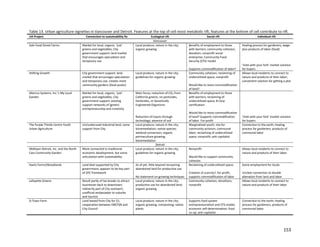
A summary of the results is
displayed in Table 13 below. By drawing out the connections between the socionatural and
political projects of urban agriculture, I hope to stress the importance of food justice as part of
a broader movement for social justice.
Although the sample of organizations used in this chapter is small, it demonstrates
several important points. First, that there exists a diversity of political and economic projects
53
The qualitative data in this chapter was gathered through multiple sources. The primary source is formal semi-
structured interviews with seven farmers, gardeners, and urban agriculture organization members in Vancouver
and six in Detroit. Interviewees were chosen purposely to get perspectives from a wide range of participants –
those who work in the field and those who do not – and to minimize the re-interviewing of more well-known
practitioners who have been interviewed elsewhere. Additional information – including operation details,
chronologies, and further interviews – was gathered through periodicals and the internet. Note that in transcribed
interviews, brackets [ ] are used to indicate an edit I made. Therefore, a bracketed ellipsis [. . .] denotes text I have
omitted for clarity and brevity while trying not to alter overall meaning, while an unbracketed ellipsis … denotes a
pause in the interviewee’s speech.](https://image.slidesharecdn.com/f692e96e-0509-4d86-9945-2fafa478ea16-160307154644/85/Walker-2013-Growing-ideology-167-320.jpg)
![156
emerged as an acronym in the alternative food movement (AFM) to stand for ‘Sustainable
Organic Local Ethical’. This influence also comes from Ableman’s background as a pioneering
organic farmer:
[W]e see a farm not as a factory but as a living organism, and we work with it that way.
We see our fields and orchards not as battlegrounds where farmers are pitted against a
host of alien forces, but as part of a system that can be symbiotic and cooperative. If we
can meld into the diverse natural life and traffic of the farm, we can satisfy the needs of
the land as well as those of the marketplace. (Cooper, 2003)
Here Sole Food’s founder distinguishes his style of agriculture from the cooperative models that
target the social rift’s commodification, instead portraying his fellow alternative food
movement farmers as “artisans” (Cooper, 2003), skilled craftspeople producing food for
distinguishing customers. Dory places emphasis upon the ecological in a similar manner with his
green economy social enterprise model, which has resulted in Sole Food targeting the demand
for local, organic produce among Vancouverites who can afford to pay premium prices at
farmers’ markets, restaurants, and upscale retail, the primary destinations of Sole Food’s
harvest.54
Here, the focus on the ecological could be seen as pragmatic: concerns over global
climate change, health, and generating local employment combined with a determination to
work within the existing socio-economic system require using marginal or precarious labor
(however needed or charitable) to sell high-value local produce.
Such an approach has been characterized as belonging to a community food security
(CFS, see Morales, 2011) paradigm by Dory, who expresses discontent with the charity-based
food system so prevalent in the DTES:
54
They also donate about ten percent of their produce and are working towards expanding the amount of their
production that goes to DTES residents (Kimmett, 2012).](https://image.slidesharecdn.com/f692e96e-0509-4d86-9945-2fafa478ea16-160307154644/85/Walker-2013-Growing-ideology-171-320.jpg)
![157
I think the food bank and churches and those people are doing a wonderful job feeding
hundreds of thousands of people in the Downtown Eastside. I have a… little bit of an
issue if that’s the only solution. [. . .] I think in the long term, we need to provide people
the means to feed themselves or have access in some sort of more meaningful way than
just standing in line and waiting for a handout. And I think this can be part of that
solution. Our belief here is that if you create an employment opportunity, you create
access. We’re not trying to feed the neighborhood, but through what we’re doing we’re
trying to educate and employ the neighborhood. So if you put the means of production
in the neighborhood that is considered, you know, by definition poor, then you’ve
empowered at least some of the people that are in it to have access to that healthy food
and to employment opportunities. (Fire and Light Media, 2013)
While Dory is right to question the long term impacts of the charitable food system, it is also
worth questioning if this social enterprise model fits within the framework of CFS.
Sole Food is heavily imbricated in a web of for-profit and nonprofit actors with interests
in the DTES. As a young business, it has received grants from various organizations, though its
ultimate goal is self-sufficiency. Between 2009 and 2012, Sole Food raised $700,000 in grant
money from City Council, City of Vancouver Greenest Neighbourhood Grants, Vancity Credit
Union, Nature's Path Organic Foods, and the Radcliffe Foundation,55
among others. As one of
the ‘poster child’ urban farms in the city, Sole Food has been a central part of municipal efforts
to promote urban agriculture. Ableman says of their organization:
This project is world-class not only in scale, but also in its innovative production
methods married to its social goals [. . .] This is a significant step towards making
Vancouver a showpiece for this movement [. . .] We hope to demonstrate that it is
possible to generate production quantities of fresh food in the city and for the city,
55
The Radcliffe Foundation is one of the major philanthropic organizations in the Lower Mainland. It was
established in 1997 by Frank Giustra, a billionaire who made his fortune in the international mining industry. The
Radcliffe Foundation is widely acknowledged to be a shell corporation used by Giustra in his mining deals (see
Allan, 2012) due to its tax-exempt status as a charity. Numerous journalists (e.g. Hoffman, 2008; Becker & Van
Natta, 2008) have also accused Giustra of unethical business dealings with former President William J. Clinton
through their cooperative philanthropic activities, where Giustra’s charitable donations are traded for Clinton’s
powerful contacts in developing countries that can help Giustra start mining operations. Giustra’s funding of Sole
Food is part of his recent switch in investing from mining to sustainable agriculture. As a businessman known for
his timely shifts in focus, his recent founding of Modern Farmer magazine, an olive oil company, and an organic
chocolate producer represent an interesting new direction (Gierasimczuk, 2013).](https://image.slidesharecdn.com/f692e96e-0509-4d86-9945-2fafa478ea16-160307154644/85/Walker-2013-Growing-ideology-172-320.jpg)
![162
development, or remediation. A growing number of gardens in Vancouver are using raised beds
to grow on brownfields, especially the sites of former gas stations. Today the city has 84 service
stations, 244 fewer than in 1970, largely driven out of business due to a failure to compete with
other uses as land values rose precipitously in the inner city (Godsall, 2012). With remediation
costs prohibitively expensive for many owners, most lots remain empty – except for those
converted to gardening. As David Godsall points out, “Paradoxically, it’s the high cost of land in
downtown Vancouver that turns marginally profitable gas stations into nonprofit community
gardens, at least temporarily” (2012).
Reclassification of vacant lots for urban agriculture use has been embroiled in significant
debate over the past several years. Following Quastel’s (2009) academic take on the process as
ecological gentrification, several periodical articles have also tackled the issue, with many
articles providing information on the reclassification process and viewing it either as an
inventive way to promote urban agriculture (e.g. Williams, 2010) or as “tax evasion” by
developers (e.g. Vulliamy, 2012). Chris Reid, co-founder and Executive Director of Shifting
Growth, disputed the latter accounts both factually and ideologically:
I know the system better than anybody else, to be honest, about reclassifying properties
for community gardens [. . . T]here’s a lot of properties out there that have a reduction
of property taxes because of their construction, and that’s a big list. [. . .] To pick on this
specific use, and to frame it in the usually negative light [. . .] of big condo developers,
tax breaks, scheming, seeking all the money, green-washing, is a big one [. . .] From my
understanding, part of it is misinformation, ‘cause everything I’ve ever read isn’t really
right. I read all the property tax literature, it’s quite complicated – I’ll sit her for an hour
explaining the entire system to you, because it’s a provincial and municipal thing, and it
is quite a bit more complex than you think maybe, to sum up in one paragraph. When
you get to accusing specific organizations, specifically the corporations and the people
who let this land use happen... I have clients who don’t even want these tax breaks.
There’s a reason why Concord is giving away the money. It’s not about the money, it’s
about… [F]ocusing on that element of why these clients are doing this is, in my opinion,
short-sighted. The money makes it happen; it’s a huge cost to do these projects, at all](https://image.slidesharecdn.com/f692e96e-0509-4d86-9945-2fafa478ea16-160307154644/85/Walker-2013-Growing-ideology-177-320.jpg)
![163
levels. So, there has to be money to do the projects. So, let’s just be realistic here, and
there’s a lot of benefits to actually getting that project in place. [. . .] Again, I have
landowners who say, ‘We do not want the property taxes’ [. . .T]hat’s why branding it
somewhat personally, like, it’s not about the facts, it’s about their opinion about a
specific organization, that’s where I have a bit of an issue.
Observers critical of Concord’s motivations or the justice of giving slumlords tax incentives to
continue to speculate on land are right to point out the injustices perpetrated by the
reclassification process. However, urban agriculture practitioners like Shifting Growth’s Reid
and Sole Food’s Dory are highly pragmatic when it comes to discussing land availability. They
have to be in a city with such high land values, where obtaining – and keeping – a plot to grow
food can be extremely difficult. Even organizations that borrow lawn space from willing
homeowners to grow their crops face challenges, as in a recent case in which the organization
Yummy Yards was forced into an early harvest after a neighbor complained about the height of
their Jerusalem artichokes (Hager & Lee, 2013).
The situation presented here is common, in which activists and business owners have to
make decisions about the short term benefits of establishing visible and productive sites of
urban agriculture, however temporary, versus the long term goals of making urban spaces more
amenable to the production and consumption of food in a just and sustainable manner. Beyond
differences in the theories of social change in these two approaches lies the ultimately
dialectical nature of urban agriculture itself. The radical/neoliberal tendencies that both give
rise to and ultimately limit urban agriculture are plain to see in these Vancouver organizations.
Ultimately, it is important to view the urban production of food as a complicated process and
one which cannot be a panacea for food injustice. As McClintock notes:
Food justice requires increased entitlements. It requires jobs and living wages, not just a
garden or grocery store in every neighbourhood. In other words, we are simply asking](https://image.slidesharecdn.com/f692e96e-0509-4d86-9945-2fafa478ea16-160307154644/85/Walker-2013-Growing-ideology-178-320.jpg)

![165
Drawing on Woollard’s background, Alterrus’ primary target is the ecological rift. During
a tour of the new facility by other urban agriculturalists, Woollard and company worried that
their high technology approach would draw the ire of those who used different techniques like
permaculture and small plot intensive (SPIN) gardening. However, he says:
[T]he key message that we make to everybody, including to, you know, the other urban
farmers on that tour [. . .] was that we’re not competing with them. We’re competing
with pack and sell in California. My primary motivation as an environmentalist for
wanting to do this is that while, you know, the answer to everything is not
fundamentally local, local, local, when it comes to something like salad, it’s crazy,
because it’s highly perishable air and water. And so, you know, you can’t fit much of it
into a container, relative to tuna cans, you have to, like, chill that container and you
have to move that container as fast as you possibly can. The carbon footprint of
transportation from California alone – just from transportation – is twice our total
lifecycle, you know. Plus the fact that, you know, our nutrients and [other inputs] are
much, much lower [. . . P]eople came in with some reservations and some concerns, and
left with a sense that, you know, we were complementary and a part of it, and people
liking what we were doing, which is great.
The approach employed by Alterrus is very much one of ecological modernization, with detailed
considerations of environmental impact and economic viability forming the basis for action. The
social rift is also accounted for in Alterrus’ project in a similar manner to Sole Food: they are a B
Corporation, which is a certification granted to sustainable businesses by a nonprofit agency,
and they make efforts to hire those with barriers to employment. The individual rift here is
largely absent, relying mostly on a ‘vote with your fork’ market solution for buyers that does
little to resist alienation.57
57
Though the project does bring up an interesting tension within McClintock’s (2011) framework regarding the
social construction of nature. Many urban agriculture practitioners report feeling closer to nature and gain some
form of spiritual connection or relaxation from gardening (Hodgson et al., 2011). McClintock’s understanding of
nature comes primarily from a Marxist humanist point of view, whereby humans are seen as being dialectically
within nature and yet outside of it due to the transformative power of labor. However, with an understanding that
ideas of what counts as natural, i.e. a blooming garden but not a vacant lot, are socially constructed and often
based on a particular Western ideology of nature (see Smith, 1980), how should this individual rift be properly
understood? Is it possible for urban agriculture practitioners to gain spiritual or physical benefits from spending](https://image.slidesharecdn.com/f692e96e-0509-4d86-9945-2fafa478ea16-160307154644/85/Walker-2013-Growing-ideology-180-320.jpg)
![166
Again, the focus on urban agriculture as part of a green economy sustainability fix by
Vision Vancouver has led to Alterrus receiving generous support by the municipal government.
Despite the management for the project being located in Vancouver, it was never a given that
the initial installation would be located in the city. Woollard says:
Certainly the City’s, you know, the leadership at the political level of the City is
absolutely conducive to this. [A]s we were talking with, you know, private and public
sector people in Surrey, Vancouver all these kinds of things, the reception we got from
the City of Vancouver was you know, much warmer possibly than in other places. Part of
that being the specific mandate of the governing party on Council, as well as just, you
know, a lot of the key staff. And you know there’s a strong food policy group that – but
it was really the City Manager’s office.
The City Manager’s office is responsible for transferring Council mandates to departmental
action within the city, and is responsible for leading implementation of the Greenest City 2020
Action Plan.
Woollard is quite frank about his personal relationship to Alterrus and the theory of
change it relies on. After 20 years in the nonprofit sector, he felt the need to become involved
in projects that could more clearly measure their success.
For me personally, I find it [entrepreneurship] much easier, maybe it’s just sort of like,
my emotional frailty. I like the wins of building something even if only five percent of the
population gives a shit about it, just working on building that five percent, you know,
good little organization building. If you’re trying to get a tipping point, like, 51% to vote
one way or the other, or approve some policy, lobbying for change, all of those things
are just much, much, more cumbersome.
For him, the social enterprise model is not the only or best way to reduce the environmental
impact of the food system. Unlike the examples from Detroit where small-scale, grassroots
time in a heavily mechanized hydroponic greenhouse? Does the idea of fingers-in-the-dirt activism as the best
solution to the dual alienation of capitalism (from the products of one’s labor and from the land through the
nature/society dualism) rely on a romanticized, even anti-technology notion of how to best unite the head and the
hand? These questions could be productive for future research.](https://image.slidesharecdn.com/f692e96e-0509-4d86-9945-2fafa478ea16-160307154644/85/Walker-2013-Growing-ideology-181-320.jpg)
![167
urban agriculture is dismissed as misguided (e.g. John Hantz in Whitford, 2009; or Jesse Jackson
in Oosting, 2010), Woollard sees Alterrus as one solution among many, albeit a technologically
advanced one that may end up being most effective in the long run:
[I]n addition to [our project . . .] is getting more food yield from the Agricultural Land
Reserve, in addition to getting, you know, community gardens, and school yards and all
that kinda stuff, in addition to that we still need to kinda fundamentally change the way
that we produce food. [. . . S]o I definitely would [take an] ‘and strategy’: this and that
and that. [. . . W]here you [. . .] actually start, you know, your local revolution is when,
you know, local is not moving from like eight to ten percent, but is actually moving to
25-30% or 50% and I think that all of these things are going to be used, in order to do
that.
The case of Alterrus provides further evidence of the green economy sustainability fix pursued
by the City of Vancouver through urban agriculture. By focusing primarily on the ecological
metabolic rift while never fully addressing the social rifts of commodification and the individual
rifts of alienation, such projects have limited transformative power as political projects.
The Purple Thistle Centre youth urban agriculture
The Purple Thistle Centre is a youth-run collective located in an industrial park on the
East side of Vancouver. Formed to provide an alternative to traditional schooling, the Centre
specializes in facilitating creative projects like film-making, animation, photography, etc. Since
its inception in 2001, one of the many projects run out of the Centre is permaculture urban
gardening. Since 2010, the collective has created “two intensively managed gardens on
marginal roadside land, one baby food forest and wetland remediation project on industrial
rail-side land, three beehives, and a worm bin” (Huggins, 2012).
The Purple Thistle’s permaculture approach and relationship to the land differentiates
them significantly from the other projects mentioned in this section. Permaculture is a system
of thought that practices ecological design to build structures and agricultural systems that](https://image.slidesharecdn.com/f692e96e-0509-4d86-9945-2fafa478ea16-160307154644/85/Walker-2013-Growing-ideology-182-320.jpg)

![172
downtown and are fostering a rapidly growing knowledge economy.59
Although the relative
impact of this change is still low, it has had a notable effect on the demographics and cultural
makeup of Detroit’s downtown and Midtown neighborhoods. Due to its wealth of cultural,
medical, and educational institutions, the neighborhood of Midtown is an attractive option for
the wave of young professionals that have decided to make Detroit their home in recent years.
In fact, a 2009 study found that new homebuyers in the area boasted average household
incomes of $113,788, well over the city-wide median of $26,098 (Social Compact, 2010).
This influx of wealth into the Midtown area has had an appreciable effect on the
streetscape, demographics, and culture of the neighborhood, leading some to identify the
neighborhood change as gentrification (see Williams, 2013). “Midtown is Detroit’s
neighborhood with fixies and really small dogs, so it’s only natural that, like Williamsburg, Silver
Lake, San Francisco's Mission district, and their ilk, [that] despite Midtown’s relative affluence,
the poor are just a few blocks away” (Pearl, 2013). Although the pressures in rents occurring in
Midtown and other Detroit neighborhoods like Corktown and Woodbridge are not quite as
severe as in other gentrifying neighborhoods like those identified above – or many
neighborhoods of Vancouver, for that matter – the cultural aspect of neighborhood change still
suggests a gentrification process is occurring. The 2013 opening of a new Whole Foods in the
area is but one sign of this change. Deborah Cowen (2006: 22) has identified a similar process in
Toronto’s ‘hipster urbanism’ or ‘hipsturbanism’:
59
Not to mention a changing relationship between public and private space in the downtown core: Dan Gilbert is
undertaking a project he calls ‘Opportunity Detroit’, through which he is seeking to redesign the downtown core to
be retail, pedestrian, and business-friendly. His philanthropic mission to booster downtown goes hand-in-hand
with the investments of his real estate company, Rock Ventures, which has spent $1 billion acquiring 3 million
square feet of office, retail, and residential space, much of it in formerly empty skyscrapers (see Segal, 2013).](https://image.slidesharecdn.com/f692e96e-0509-4d86-9945-2fafa478ea16-160307154644/85/Walker-2013-Growing-ideology-187-320.jpg)
![173
Once the ‘storm troopers’ of gentrification, who were readily displaced the moment
people with financial capital (as opposed to hipsters’ ‘symbolic’ and ‘social’ capital)
bought up the cool spaces, today’s hipsters are actively working to institutional-ize
themselves in the city. They have recently found allies in government and business who
see possibilities of accumulation by good design. [. . .] Hipsturbanism elects young white
professionals to ‘reclaim’ the down-town in denial of their own [colonial] occupation. It
ushers in a future where difference has firm class limits.
The institutional arm of this economic redevelopment in Midtown belongs in part to
Midtown Detroit Inc. (MD), a nonprofit planning and development organization funded
primarily by the corporate philanthropic organizations mentioned in Chapter 4: the Kresge,
Hudson Webber, Skillman, and Ford Foundations, among others. Annmarie Borucki,
their Special Projects and Community Garden Manager, says that MD’s mission is to “curate
development in the neighborhood by partnering with the right kind of developers to create
mixed-use developments that really service the neighborhood.” With this goal in mind, MD has
created two community gardens in the neighborhood: the North Cass Community Garden and
the Art Center Community Garden. In this section I will discuss the North Cass Community
Garden (NCCG), which stands out among Detroit gardens due to its significant funding, its
allotment structure, and its presence in a gentrifying neighborhood.
The NCCG was formed in 2009 by combining three vacant lots at the corner of Willis
Street and 2nd
Avenue. Two of the lots were owned by the Midtown Development Corporation,
the development nonprofit that provides assistance – tax credits, renovation consulting,
financing assistance, etc. – for homeowners, homebuyers, and real estate developers in
Midtown. The final lot is owned by the city and has been permitted to allow gardening in
cooperation with MD. Borucki is clear about MD’s motivations for their community garden
projects:](https://image.slidesharecdn.com/f692e96e-0509-4d86-9945-2fafa478ea16-160307154644/85/Walker-2013-Growing-ideology-188-320.jpg)
![174
For us, the property was heavily blighted, it was an area where a lot of homeless people
had camped out, we had a strong resident neighborhood around there from low-income
to middle- to high-income residents, and since we owned the property we were trying
to figure out the best use for it [. . .] So for us, it wasn’t necessarily about gardening, per
se, it really was about creating an amenity, to: one, clean up the area; two, to maintain
residents in the neighborhood and provide a service to have them want to live in the
neighborhood, and at the same time build community. So that’s kinda how we got
involved in the first garden. And so for us it’s really [more] about the community/social
aspect really, than the gardening.
As an organization with the mission to strengthen homeownership in Midtown, MD’s goals are
met by a community garden that serves as a temporary land while strengthening homeowners’
bonds to the neighborhood. However, what reconfiguration of metabolic socionatural
relationships is targeted in this process? Borucki says that the ecological and individual benefits
that accrue to the gardeners are welcome, but are not the primary goal of the NCCG. This fits
with the location of the garden; unlike most Detroit urban agriculture projects, the NCCG is
located in a neighborhood with above-city-average income, home value, and employment rate
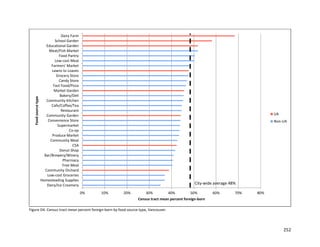
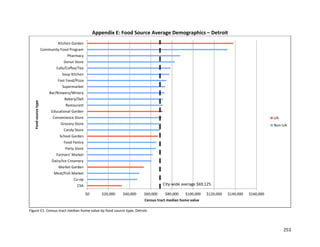
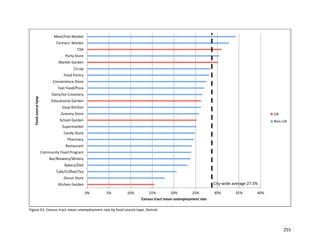
(see Figures E1, E2, and E3). Additionally, the social benefits of the garden to the neighborhood
are limited: due to their focus on targeting homeowners, the garden is set up with an allotment
system. This means that although there is social interaction in the garden, the social rifts usually
targeted through communal labor and ownership are not a focus at the NCCG:
The problem is, with our garden, it is an allotment-style garden and we do keep it
locked. Because the first year we tried to keep it open, and there are a lot of gardens in
the city where they just let whoever come in and pick whatever they want, whereas our
residents, when we first started designing the garden, everyone knew that they wanted
their own space, be able to grow whatever they wanted. So we basically rent out space
to the residents of the neighborhood. [. . .] So we knew we were going to be different.
And then with the money that we raised to build the garden, it was [seen] as being an
elitist garden. Because at the same time – even though doing the right thing for that
space, [. . .] design is also very important to us. We have to lead by example in this
neighborhood, because if you don’t, then you get a lot of these developers who come in
and build developments that are not appropriate for an urban environment, they might
be more of a suburban kind of feeling. And you try and encourage people more to](https://image.slidesharecdn.com/f692e96e-0509-4d86-9945-2fafa478ea16-160307154644/85/Walker-2013-Growing-ideology-189-320.jpg)
![175
embrace the historic architecture here, good quality, you know, quality developments. [.
. .] So we get a lot of crap, from a number of people.
Here the ideal of creating an urban commons as present in some community gardens is
dropped in favor of creating a space where neighbors can interact while maintaining their own
garden plot. Although this style of gardening was requested by the residents, it is worth
questioning the role the NCCG plays in the cultural displacement (see Elliott, 2012) occurring in
Midtown. One event in particular is worth touching on to explore this issue.
The East Michigan Environmental Action Council (EMEAC) is a nonprofit environmental
and food justice organization that has been active in southeast Michigan for over 50 years.
Currently, their activism focuses largely on providing a critical counter discourse the recent
boosterism associated with Detroit by pointing out the history of environmental racism and
social injustice in the city and presenting alternatives to the neoliberal redevelopment favored
by the city’s elites. In this way, EMEAC members – most of who identify as African American or
black – have played an important part in recent organizing around grassroots urban agriculture
in the city. In the summer of 2011, EMEAC felt the pressures of gentrification directly, as they
were priced out of their headquarters building in the Medical Center area of Midtown
(Williams, 2013: 28). They have since relocated to the Cass Corridor Commons, located in the
First Unitarian-Universalist Church of Detroit. In July 2012, I attended a conference hosted by
the James and Grace Lee Boggs Center to Nurture Community Leadership (Boggs Center, see
page 124) called ‘Reimagining Detroit 2012’. Several events were held at the Cass Corridor
Commons, including a panel on gentrification in Detroit led by EMEAC’s youth program, the
Young Educators Alliance (YEA); the evidence in this section comes in part from that experience.](https://image.slidesharecdn.com/f692e96e-0509-4d86-9945-2fafa478ea16-160307154644/85/Walker-2013-Growing-ideology-190-320.jpg)
![177
The one that I know of, there were a bunch of young activist kids who didn’t live in the
neighborhood but they hung out here, had a couple of bad experiences. You know one
was at our garden, where one of our gardeners didn’t want to allow them to come and
tour through the garden and accused them of being thieves, and it’s not reflective at all
of what our opinion is about allowing people to come in, except maybe that this person
is not a nice person, it’s just a bad experience. And um, but at the same time, I feel like
it’s just so easy for people to blame, blame, blame, instead of looking off towards their
own actions and how they might be perceived by people.
However, the group of YEA members did not see this as an isolated experience. By
connecting the NCCG to historical processes by which the black majority has been politically
and economically oppressed in the city, they understand the incident at the garden as part of
institutional racism. This identification has led them to broaden their definition of gentrification
beyond increasing rents and the associated physical displacement:
But [what] I try to keep in front of YEA, in the context of Detroit, is gentrification being
not merely a thing about demographics but also really of power and the attempt to
disrupt Detroit’s identity as a place of where there is a concentration of Black political
and community power. (YEA supervisor quoted in Williams, 2013: 37)
In the case of the NCCG, the radical/neoliberal Janus face of urban agriculture is obviously at
play: vacant land in an economically depressed city suffering from “demarcated devaluation”
(see McClintock, 2011: Chapter 2), economic conditions that prevent outright development but
encourage temporary land uses, nonprofits with the modest means to make urban agriculture
projects happen, and urban residents ready and willing to grow some of their own food in a
reconfiguration of socionatural metabolisms. However, as this chapter argues, the specific rifts
targeted by the NCCG are not enough to tap into the radical potential of urban agriculture: by
setting up an allotment garden that targets homeowners, including residents identified as
gentrifiers by the YEA, it plays into the process of cultural displacement occurring in Midtown.](https://image.slidesharecdn.com/f692e96e-0509-4d86-9945-2fafa478ea16-160307154644/85/Walker-2013-Growing-ideology-192-320.jpg)
![180
designed to address an issue raised by some employees of the company, who critiqued the self-
contained nature of the Compuware headquarters. Because employees could work, eat, shop,
and exercise all within the confines of the building, it fostered a very isolated social sphere and
“insular working environment,” as Heeres put it.
Lafayette Greens, then, represents an effort by Compuware to be a “good corporate
citizen” by reconfiguring urban metabolism. The primary target of the project is social: “the
impetus definitely wasn’t sustainability. It helps, you know, and they [Compuware] are trying to
figure out how to roll it into that, but it’s definitely more of a community-minded, civic-minded
endeavor.” The well-designed space is capable of producing nearly 2,000 pounds of produce a
year; the majority is donated to Gleaners Community Food Bank and the rest is distributed to
the volunteers who help tend the plots and used in public events. Using a mix of allotment and
communal beds, the garden has been very successful in bringing a diverse group of people
together to get their hands dirty or just relax, as Meyer tells it:
I feel like part of my job is to just [work with] different kinds of people that are maybe
uncomfortable with each other, to recognize that ok, we have one volunteer who is very
loud, she’s a former alcoholic, who kind of barks at you, and I was really uncomfortable
at first, but you know, creating those touching relationships [. . .] We hold stakeholder
meetings [. . . and] people can give feedback.
In fact, both Heeres and Meyer expressed surprise that they found such a positive environment
in a corporate-owned garden. Meyer had experience working at the nonprofit Earthworks
Urban Farm (see page 125) and expressed initial doubts about working for Compuware:
After working at Earthworks, which is an amazing place, I felt though, I was really aware
of the serious issue between the people who have and the people who have not.
Earthworks was really trying to bridge that gap, but it was still really tangible. My idea of
coming in, which was interesting because I never thought I would work for a
corporation, but coming in, and working for a corporation, and finding myself in this
public space that could be a really amazing, engaging spot for different – people from](https://image.slidesharecdn.com/f692e96e-0509-4d86-9945-2fafa478ea16-160307154644/85/Walker-2013-Growing-ideology-195-320.jpg)
![181
different walks of life to come and meet, and work together, and I really think that we
all eat food, we all have ancestors and grandparents [. . .] that grew food, that we are
actually much more comfortable.
Heeres suggested that the garden was a powerful tool for breaking down preconceptions many
(formerly suburban or non-native) employees of Compuware had about the city and its
residents:
You know it’s funny, because I had mixed feelings about working for a corporation,
but I really, you know, do believe that Compuware has good intentions in terms of
wanting the city to do well, and in caring about this place and sort of, ‘What are
some different ways that we can outreach and be good corporate citizens?’ But then
also, at an individual level, I think that the, from, you know, helping to enrich
employees in different ways and getting them out of the building and just trying to
change the perceptions that way.
So the garden was designed with several social goals: to get Compuware employees out of the
office and into the community; to serve downtown residents as a relaxing green space; to
create produce for donation; to educate the public about gardening and urban agriculture; and
to serve as an example of the possibilities of privately-owned public urban spaces. Gidley was in
fact hired in part to create a public information board that would tell the story of Detroit urban
agriculture and discuss other projects in the city. With its central location downtown, Lafayette
Greens is the only urban garden many suburbanites and visitors to Detroit might see, and so
the Compuware employees want to use their visibility to advocate for other, less well-funded
gardens.
Meyer, Heeres, and Gidley were all very aware of this privileged position occupied by
Lafayette Greens. Firstly, they acknowledged that although convincing the City to permit the lot
for a garden use was difficult, the heavy-hitting support provided by Compuware was integral in](https://image.slidesharecdn.com/f692e96e-0509-4d86-9945-2fafa478ea16-160307154644/85/Walker-2013-Growing-ideology-196-320.jpg)
![182
getting the project started. Secondly, Heeres stressed their concerns about community
involvement during the planning phase of the project:
The setup of it, I think a lot of the work trying to convince the city was also coupled with
going in and around this neighborhood and sort of introducing the project and, I know
like, from the get go just sort of starting with an employee survey and always engaging
employees and letting them know what stage of process the garden was at and just
really trying to get people on board from the get go. I mean I think I was very conscious,
and I also know Gwen is very conscious as well when she came on board, in terms of just
plopping something down. And being like ‘Bam! This is our garden,’ you know, and
people would be like, ‘Wait what?’ And I think that, cause it, at the same time when we
were sort of coming up with this Hantz issue [. . .] that whole thing was going on, and I
feel fortunate knowing people at Earthworks and I know other people at [the] Greening
[of Detroit] and knowing about the sensitivities of the urban agricultural community and
[knowing that] we didn’t want to be a Hantz project. You know and to just sorta say,
‘This is what the city needs.’
The case of Lafayette Greens does well to encapsulate the Janus face of urban
agriculture in Detroit. Behind its lavender-lined pathways and irrigation system hooked up to
the City water supply through the bar next door, lays the greater economic context of Rust Belt
neoliberal urbanism. This garden would not exist without Detroit’s economic development plan
designed to lure large corporations – and their employees – back downtown after decades of
(relative) absence.60
The city-suburb tension is palpable in this garden: not only was it in part
designed to provide a space where Compuware employees could feel comfortable interacting
with their urban neighbors, but its caretakers now function as Detroit urban agriculture
spokespeople, spreading the message about other projects to suburbanites who do not venture
too far from the downtown sports stadiums. Finally, despite its successes, the project unearths
the ultimate utility of growing food in the city for neoliberal municipal governments and their
60
The racial dynamic present in this absence is obvious. One can add in a single word to this sentence by former
Compuware co-founder and former chairman and CEO, Peter Karmanos Jr., to illustrate this: “A couple generations
of [white] people in the Detroit area were denied an urban experience [. . .] I think now they are getting to
experience it again, and they are thrilled with it” (Karmanos quoted in Ramsey, 2006).](https://image.slidesharecdn.com/f692e96e-0509-4d86-9945-2fafa478ea16-160307154644/85/Walker-2013-Growing-ideology-197-320.jpg)
![183
corporate allies: fostering community without making anyone too uncomfortable. However, as
the next section illustrates, sometimes food justice requires difficult conversations.
D-Town Farm
Malik Yakini and several other Detroit residents founded the Detroit Black Community
Food Security Network (DBCFSN) in 2006 to support CFS and counter the racial bifurcation of
the Detroit alternative food system. Following the national pattern (Slocum, 2007, 2011;
Guthman, 2008a, 2008b, 2011, 2012) even in majority-black Detroit, at that time all of the
leadership in the city’s major alternative food organizations was white. This is especially
troubling given the data gathered earlier in this study, which show that alternative food
movement and urban agriculture sources are – on average – located in more racially and
ethnically diverse census tracts (see Figures E4 and E5). The DBCFSN was created to work
towards fixing this racial and cultural mismatch of participants and leadership; Yakini says of the
white leadership, “They had very good intentions, they’re not bad people, [. . .] they’re good
people who are caught in a bad paradigm” (Yakini, 2011).
The reception of the DBCFSN by existing white urban agriculturalists varied, with some
too ‘colorblind’ to recognize the degree to which Detroit’s alternative food spaces were
(implicitly or explicitly) coded as white:
Several white people said, ‘Why do they have to call it the Detroit Black Community
Food Security Network? Why can't we just all work together and have a Food Security
Network?’ And so they started paying attention to us as we were speaking and as they
listened they said, ‘Hmm maybe there's something to do this,’ and they started thinking
more deeply themselves about race and about the work they were doing and how they
could be more intentional in their work. (Yakini, 2011)
Inspired by the dRworks ‘Dismantling Racism’ training he attended at the 2006 Bridging Borders
Toward Food Security conference in Vancouver (see page 128), Yakini and the DBCFSN began](https://image.slidesharecdn.com/f692e96e-0509-4d86-9945-2fafa478ea16-160307154644/85/Walker-2013-Growing-ideology-198-320.jpg)

![195
gardeners’ selective rearrangement of socionatural metabolisms and the political possibility of
radical urban agriculture.
This final point is perhaps the most vital and still least understood. Although urban
agriculture is experiencing a moment of significant visibility right now, there are no guarantees
that it will scale up to change the industrialized food system in any way. This is especially true in
a neoliberal political economy in which market logic reigns supreme. However, it is by posing a
very visible and deliberate alternative to this particular and often unjust economic calculus that
the radical potential of urban agriculture can be found. Many of the urban farmers I
interviewed had a habit of sprinkling their dialogue with remarkably apt biological metaphors.
Patrick Crouch, Program Manager at Earthworks Urban Farm in Detroit, was particularly
eloquent when expressing his theory of political change that resists neoliberal common sense.
As a major part of Earthworks’ programmatic shift from its historical role as a soup kitchen to
an organization working to build community food security and self-determination, Crouch
compares the radical61
nature of such work to cultivating mushrooms during our interview:
There’s this tendency to think that social movements work in a really like… [snaps
fingers] like that. And I compare it to a mushroom, that the mycelium of the mushroom
that has been growing forever, or for a long, long time, it’s not until the spring rains
come along where we see the fruit, and the fruit is not really what it’s about. The real
action is underground, where we never even realize what is happening. [. . .] You’ve got
to develop deep roots, you know. If you don’t have deep roots, when the winds start
coming you’re going to get knocked down.
As Crouch and the other grassroots urban agriculture participants of Vancouver and Detroit
exemplify, building these deep roots requires not only a foundational critique of the injustices
caused by a market-based value system, but also a praxis that actively works to present an
61
Literally, radical as in “Late Latin radicalis ‘of or having roots,’ from Latin radix (genitive radicis) ‘root’” (Harper,
2013).](https://image.slidesharecdn.com/f692e96e-0509-4d86-9945-2fafa478ea16-160307154644/85/Walker-2013-Growing-ideology-210-320.jpg)




![216
McCutcheon. P. (2011). Community Food Security “For Us, By Us”: The Nation of Islam and the
Pan African Orthodox Christian Church. In Agyeman, J. & Alkon, A., (Eds.), Cultivating
Food Justice (177-196). Boston: MIT Press.
McDonald, R. A., & Barman, J. (1986). Vancouver past: Essays in social history. Vancouver, BC:
University of British Columbia Press.
McEntee, J., & Agyeman, J. (2010). Towards the development of a GIS method for identifying
rural food deserts: Geographic access in Vermont, USA. Applied Geography, 30(1), 165-
176.
McFarlane, C. & Robinson, J. (Eds.). (2012). Experiments in Comparative Urbanism [Special
issue]. Urban Geography, 33(6).
McKnight, Z. (2013, July 7). City orchard brings new life to vacant Vancouver lot. The Vancouver
Sun. Retrieved
http://www.vancouversun.com/City+orchard+brings+life+vacant+Vancouver/8627476/s
tory.html
Melanson, T. (2012, August 14). Vancouver still third in new Economist ranking of most livable
cities. Canadian Business. Retrieved from http://www.canadianbusiness.com/blogs-and-
comment/vancouver-still-third-in-new-economist-ranking-of-most-livable-cities/
Mendes, W. (2006). Creating a 'just and sustainable' food system in the City of Vancouver: The
role of governance, partnerships and policy-making (Doctoral dissertation, Simon Fraser
University).
Merriman, D., Persky, J., Davis, J., & Baiman, R. (2012). The Impact of an Urban WalMart Store
on Area Businesses: The Chicago Case. Economic Development Quarterly, 26(4), 321-
333.
Michigan Farmers Market Association. (2011). SNAP Flyer 2011 Region 7. Retrieved from
http://www.mifma.org/wp-content/uploads/2010/05/SNAP-Flyer-2011-Region-7.pdf
Miewald, C. (2009). Food security and housing in Vancouver’s Downtown Eastside. Vancouver:
Simon Fraser University.
Mikkelsen, B. E. (2011). Images of foodscapes: Introduction to foodscape studies and their
application in the study of healthy eating out-of-home environments. Perspectives in
Public Health, 131(5), 209-216.
Millington, N. (2010). Post-Industrial Imaginaries: Nature, Representation, and Ruin In Detroit,
Michigan (M.Sc. thesis, University of Wisconsin-Madison). Retrieved from
http://minds.wisconsin.edu/handle/1793/47035](https://image.slidesharecdn.com/f692e96e-0509-4d86-9945-2fafa478ea16-160307154644/85/Walker-2013-Growing-ideology-231-320.jpg)
![218
Food. Panel session conducted at the meeting of the Association of American
Geographers, Los Angeles, CA.
Neuman, M. (2005). The compact city fallacy. Journal of planning education and research, 25(1),
11-26.
Neumann, R. P. (2009). Political ecology I: theorizing scale. Progress in Human Geography,
33(3), 398-406.
Neumann, R. P. (2010). Political ecology II: theorizing region. Progress in Human Geography,
34(3), 368-374.
Neumann, R. P. (2011). Political ecology III: theorizing landscape. Progress in Human
Geography, 35(6), 843-850.
Non-Partisan Association. (2011). Suzanne Anton for mayor radio spot. Vancouver, BC.
Retrieved from https://soundcloud.com/sunciviclee
Norris, P. E. & Taylor G. D. (2007). Questions About Intent and Application of Michigan's Right
to Farm Act. Planning and Zoning News, March: 5-11.
Norris, P., Taylor, G., & Wyckoff, M. (2011). When Urban Agriculture Meets Michigan's Right to
Farm Act: The Pig's in the Parlor. Michigan State Law Review, 365, 365-404.
O’Connor, M. (2011, November 15). Lululemon Run by Ayn Rand-Obsessed Ideologue. Gawker.
Retrieved from http://gawker.com/5859867/lululemon-run-by-ayn-rand+obsessed-
ideologue
Occupy Detroit. (2013). Occupy Detroit – About. Google+. Retrieved from
https://plus.google.com/112749422317242363210/about
Olds, K. (1996). Developing the Trans-Pacific Property Market: Tales from Vancouver via Hong
Kong. RIIM Working Paper Series, 96-02.
Oosting, J. (2010, September 8). Jesse Jackson on urban farming: Detroit needs investment and
industry -- 'not bean patches'. M Live.
http://www.mlive.com/news/detroit/index.ssf/2010/09/jesse_jackson_on_urban_farmi
ng.html
Open Source Geospatial Foundation. (2011). Geospatial Data Abstraction Library OGR Library
1.9.0 [computer software]. Delaware.
Otero, G. & Preibisch, K. (2010). Farmworker health and safety: Challenges for British Columbia.
Final report for WorkSafe BC (the Workers Compensation Board of British Columbia).](https://image.slidesharecdn.com/f692e96e-0509-4d86-9945-2fafa478ea16-160307154644/85/Walker-2013-Growing-ideology-233-320.jpg)


![229
Williams, M. (2013). Listening to Detroit: Perspectives on Gentrification in the Motor City. (B.A.
thesis, University of Michigan). Retrieved from
http://www.lsa.umich.edu/UMICH/daas/Home/Undergraduate/Degree%20Requiremen
ts/Honors%20Program/Williams,%20Micheal_%20Listening%20to%20Detroi.pdf
Wilson, M. (2012). Tourism Indicators: Tourism Sector Sees Modest Growth in 2011. BC Stats
Report. Retrieved from http://www.bcstats.gov.bc.ca/Files/0db66c12-b05f-4c6e-8dbd-
6e9bdebf957f/TourismIndicatorsTourismSectorSeesModestGrowthin2011.pdf
Wilson, R. (2013). Free GIS Datasets – Categorized List. Retrieved from
http://freegisdata.rtwilson.com/
Woods, A. (2013, April 12). White Entrepreneurial Guy Detroit Meme, Or, A Viral Tale Of Two
Cities . Huffpost Detroit. http://www.huffingtonpost.com/2013/04/12/white-
entrepreneurial-guy-detroit-jason-lorimer-meme_n_3071712.html
Wrigley, N. (2002). Transforming the Corporate Landscape of US Food Retailing: Market Power,
Financial Re‐engineering and Regulation. Tijdschrift voor economische en sociale
geografie, 93(1), 62-82.
Wylie, J. (1990). Poletown: Community Betrayed. Chicago: University of Illinois Press.
Wyly, E. (2009). Strategic Positivism. The Professional Geographer, 61(3), 310-322.
Wyly, E. (2011). Positively radical. International Journal of Urban and Regional Research, 35(5),
889-912.
Wyly, E. K., & Hammel, D. J. (1999). Islands of decay in seas of renewal: housing policy and the
resurgence of gentrification. Housing Policy Debate, 10(4), 711-771.
Yakini, M. (2011, November 1). Malik Yakini “Undoing Racism in the Food System” 10-24-11
[Video file]. Retrieved from http://y2u.be/0cCekNUSP3w
Yakini, M. (2012, December 2012). Ill-conceived Hantz Farms land deal should be dropped. The
Michigan Citizen. Retrieved from http://michigancitizen.com/ill-conceived-hantz-farms-
land-deal-should-be-dropped/
Yakini, M. (2013, June 27). Support DBCFSN Co-op Grocery Store. The Michigan Citizen.
Retrieved from http://michigancitizen.com/support-dbcfsn-co-op-grocery-store/
Yan, A. (2009). Ownership, Occupancy, and Rentals: An Indicative Sample Study of
Condominiums in Downtown Vancouver. Retrieved from http://www.btaworks.com/wp-
content/uploads/2009/12/btaworks_condo_study_report_final2.pdf](https://image.slidesharecdn.com/f692e96e-0509-4d86-9945-2fafa478ea16-160307154644/85/Walker-2013-Growing-ideology-244-320.jpg)