Introduction
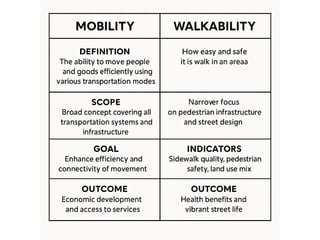
• What isWalkability? Ease of walking safely
and comfortably.
• What is Mobility? Efficient movement of
people and goods.
• Importance: Sustainable cities, health
benefits, economic growth.
3.
Importance of Walkability
•Reduces congestion & pollution
• Promotes public health & active lifestyles
• Enhances community interaction
• Supports local businesses
4.
Importance of Mobility
•Improves access to jobs, education & services
• Enhances economic competitiveness
• Ensures inclusive development
• Reduces travel time and cost
7.
Attributes of Walkability
•Sidewalk availability & quality
• Street connectivity
• Safety (traffic & crime)
• Comfort (shade, seating, street trees)
• Accessibility for disabled users
• Mixed land use (shops, services near
residences)
8.
Attributes of Mobility
•Availability of multiple transport modes
• Infrastructure quality (roads, bike lanes, bus
stops)
• Travel time efficiency
• Affordability & accessibility
• Integration of transport systems
• User satisfaction and safety
9.
Survey Design
• Objective:Measure walkability and mobility
perceptions
• Target Group: Residents, commuters, business
owners
• Sample Size: e.g., 100–200 respondents
• Method: Online survey + field observations
10.
Survey Questionnaire (Example)
•Frequency of walking for daily needs
• Rating of sidewalk quality (1–5)
• Safety while walking (day/night)
• Main mode of transport used
• Public transport availability (1–5)
• Accessibility for elderly and disabled
• Suggestions for improvements
11.
Key Findings (Example)
•65% satisfied with sidewalk quality
• 30% want better street lighting
• High dependence on two-wheelers/cars
• Preference for mixed-use areas for short trips
12.
Recommendations
• Improve pedestrianinfrastructure
• Develop last-mile connectivity
• Introduce traffic calming measures
• Encourage mixed-use development and green
corridors
13.
Conclusion
• Walkability andmobility are critical for
sustainable urban growth.
• Survey insights help identify gaps and guide
urban improvements.
14.
References
• Project forPublic Spaces (PPS)
• WHO Urban Mobility Reports
• Local Transport Surveys / Census Data