Walden University
Dissertation
Prospectus
Guide
Dissertation Prospectus Guide Page i
What’s New in 2018
The 2018 edition of the Dissertation Prospectus Guide contains
additional material to support
prospectus development. What has not changed are the basic
expectations for the content of the
prospectus and how it will be evaluated and approved. Specific
new items in this guide include
• discussion about research design alignment;
• added clarity in the outline annotations;
• enhanced formatting for better presentation, including a
separate Purpose section;
• updated sample prospectuses to include both a quantitative and
a qualitative example; and
• the sample prospectus documents captured in the historic
alignment tool (HAT), which is
introduced in Residency 3.
For internal use only
Walden University
100 Washington Avenue South
Suite 900
Minneapolis, MN 55401
1-800-WALDENU (1-800-925-3368)
Walden University is accredited by The Higher Learning
Commission, www.hlcommission.org;
1-312-263-0456.
© 2018 Walden University, LLC
https://www.hlcommission.org/
Dissertation Prospectus Guide Page ii
Contents
What’s New in 2018
...............................................................................................
......................... i
The Prospectus
...............................................................................................
................................. 1
Completing the Prospectus
...............................................................................................
........... 1
My Doctoral Research (MyDR)
...............................................................................................
.... 3
An Annotated Outline
...............................................................................................
...................... 4
Sample Quantitative Prospectus
................................................................................ ...............
...... 8
Sample Qualitative Prospectus
...............................................................................................
...... 18
Quality
Indicators........................................................................... .....
.......................................... 28
Dissertation Prospectus Rubric
...............................................................................................
.. 28
Ten Tips for Writing a Quality Prospectus
................................................................................... 30
Sample Quantitative Prospectus in the Historic Alignment Tool
(HAT) ..................................... 32
Sample Qualitative Prospectus in the Historic Alignment Tool
(HAT) ....................................... 33
Dissertation Prospectus Guide Page 1
The Prospectus
The Dissertation Prospectus is a brief document that provides
preliminary information about
your dissertation research and is used in two ways:
• It serves as an agreed-upon plan for developing the proposal
and is evaluated to ensure
doctoral-level work.
• It serves as a step to finalize the structure of your dissertation
supervisory committee,
who will work with you on completing the dissertation.
Completing the Prospectus
The Dissertation Prospectus consists of several short sections,
which are detailed in the
annotated outline. Your goal for the prospectus is to create a
plan for developing your
dissertation proposal. Therefore, you need to have more
information for the prospectus than for
your earlier documents, such as the Dissertation Premise, but
you do not need to know all the
specific details of the study that you will ultimately conduct.
For example, you may identify
intelligence as a covariate in a quantitative study, but at this
point, you do not yet need to identify
the instrument that you plan to use to measure the covariate.
Also, because every research project is unique, and because this
outline is general, you may be
asked to include additional information in your prospectus to
help assure your supervisory
committee that you are headed in the right direction. For
example, feasibility will be one
criterion for evaluating your prospectus, and if you are
considering a very unique sample group,
your committee may ask that you explore that aspect in more
detail before moving forward.
The Dissertation Prospectus should follow the guidelines in the
sixth edition of the Publication
Manual of the American Psychological Association and be
saved as either a .doc, .docx, or .rtf
file. As you work on the document, you may also want to review
the Litmus Test for a Doctoral-
Level Research Problem, which is available on the Research
Resources page of the Center for
Research Quality site, your historic alignment tool (HAT) from
your academic residency
experience, as well as the nine quality indicators included in
this guide.
One prospectus quality indicator that is not included as a
separate section in the prospectus
document, but rather is holistically assessed throughout the
prospectus, is research design
alignment. The rubric item reads: “Aligned? Do the various
components of the research plan
align overall?" Alignment is critically important to research
quality. Research design alignment
means that all pieces of the study design match and/or
complement one another. For example,
the identified doctoral-level problem must drive the purpose of
the study and the research
questions. The framework must support the research approach
overall. There should be common
language throughout, with concepts and theories corresponding
with the problem and purpose—
meaning that language should be repeated from earlier sections
into later sections. As you write,
be sure to connect the dots among each section of the
prospectus, ensuring alignment throughout.
The visual below represents this idea.
http://academicguides.waldenu.edu/researchcenter/resources/pla
nning
http://academicguides.waldenu.edu/researchcenter/resources/pla
nning
Dissertation Prospectus Guide Page 2
Conceptualizing the research plan and the various components
of the research design is
sometimes challenging. One way to assist with this and to
ensure research design alignment is to
use a visual to help you see how the various parts of a research
design should fit together and
therefore must align with one another. For example, as
presented in the graphic below, the
Problem Statement, Purpose, and Framework in the prospectus
must align with all other pieces
of the research design. This example has three research
questions. If one research question does
not appear to fit with the study purpose, it does not belong in
the study design. The method and
design make up the section in the prospectus called “Nature of
the Study.” Each section must
coordinate with the others.
As a self-check, you should ask yourself these questions about
your research design:
1. Is there a logical progression from the research problem to
the purpose of the study?
2. Does the identified framework ground the investigation in the
stated problem?
Dissertation Prospectus Guide Page 3
3. Do the problem, purpose, and framework align with the
RQ(s) and nature of the study?
4. Does each RQ address the problem and align with the purpose
of the study?
5. Will the instrument, data source, and analysis address the
RQ?
Depending on your academic program, you will be in a course
of some type that supports
prospectus development and will work with your committee
chair and second member to
complete the document. See your specific program of study for
more information on the type of
course and the timing of it. Keep in mind that prospectus
development is an iterative process and
that you will receive feedback on working drafts, as will happen
with the proposal and
dissertation.
When your supervisory committee members agree that your
prospectus meets all the quality
indicators discussed herein, they will endorse it for review by
your academic program director or
designee. After the program director or designee gives final
approval of the prospectus and your
supervisory committee, you will start working on your proposal.
This entire approval process
will occur in My Doctoral Research (MyDR).
My Doctoral Research (MyDR)
If you have not done so already, you should familiarize yourself
with the MyDR system and
other resources on the Center for Research Quality website. The
MyDR system was designed to
assist you and your committee in navigating your doctoral
research journey, from the very
beginning through the final approval. The various landing pages
in MyDR will track your
progress and will serve as a central location for resources to
support that progress. The
Taskstream element of the MyDR system is used to establish a
process flow tool in which you
exchange and store faculty evaluations of and feedback on your
work as you progress along that
journey.
You will be entered into the MyDR system when both your
committee chair and second member
nominees are approved by the academic program. At that point,
you will be able to access MyDR
from the homepage of your dissertation completion course in
Blackboard. The first document
that you will submit for approval in MyDR will be your
prospectus.
https://academicguides.waldenu.edu/researchcenter/mydr
https://academicguides.waldenu.edu/researchcenter
Dissertation Prospectus Guide Page 4
An Annotated Outline
The Prospectus document includes a title page (page 1)
followed by pages containing the
required elements in the prospectus. Please use the Prospectus
template that is available on the
Writing Center website.
Title Page
The recommended title length is 12 words or fewer to include
the topic, the variables and
relationship between them, and the critical keywords. Double-
space the title if over one line of
type and center it under the word “Prospectus.” Please note that
your dissertation title will likely
change as the project evolves.
Include your name, your program of study (and specialization,
if applicable), and Student
ID number—double-spaced and centered under the title.
Title
Start with “Prospectus” and a colon, and then include the title
as it appears on the title
page. Double-space if over one line of type and center it at the
top of the page.
Problem Statement
Provide a one- to two-paragraph statement that is the result of a
review of research
findings and current practice and that contains the following
information:
1. A logical argument for the need to address an identified gap
in the research literature
that has current relevance to the discipline and area of practice.
Keep in mind that a gap
in the research is not, in and of itself, a reason to conduct
research. Make sure to clarify
the problem that led you to the gap. The situation being
experienced in a societal
population or discipline is described within the problem
statement.
2. Preliminary evidence that provides justification that this
problem is meaningful to the
discipline or professional field. Provide three to five key
citations that support the
relevance and currency of the problem. These references need
not all be from peer-
reviewed journals but should be from reputable sources, such as
national agency
Note:
A social problem involves an issue that affects a specific
population/discipline. It is the issue
that students see “on the ground” so to speak. The social
problem is often what prompts students
to think about a topic of interest drives their dissertation topic.
Usually such a topic is one that
students identify with, sometimes having personally
experienced some aspect of the problem as
it exists in the world. All too often, students want to solve a
specific social, organizational,
clinical, or practical problem rather than explore a research
problem.
A research problem is a focused topic of concern, a condition to
be improved upon, or troubling
question that is supported in scholarly literature or theory that
you study to understand in more
detail, and that can lead to recommendations for resolutions. It
is the research problem that
drives the rest of the dissertation: the purpose, the research
questions, and the methodology. It is
the research problem that is identified in the Problem Statement
of the prospectus.
http://writingcenter.waldenu.edu/549.htm
Dissertation Prospectus Guide Page 5
databases or scholarly books, and should ideally be from the
past 5 years.
3. Assure that the problem is framed within and primarily
focused on the discipline
(program of study).
Purpose
Present a concise, one-paragraph statement on the overall
purpose or intention of the
study, which serves as the connection between the problem
being addressed and the focus of the
study.
• In quantitative studies, state what needs be studied by
describing two or more factors
(variables) and a conjectured relationship among them related to
the identified gap or
problem.
• In qualitative studies, describe the need for increased
understanding about the issue
to be studied, based on the identified gap or problem.
• In mixed-methods studies, with both quantitative and
qualitative aspects, clarify how
the two approaches will be used together to inform the study.
Significance
Provide one or two paragraphs, informed by the topic in the
problem statement, that
describe the following:
1. How this study will contribute to filling the gap identified in
the problem statement: What
original contribution will this study make?
2. How this research will support professional practice or allow
practical
application: Answer the So what? question.
3. How the claim aligns with the problem statement to reflect
the potential
relevance of this study to society: How might the potential
findings lead
to positive social change?
Background
Provide (a) the keywords or phrases that you searched and the
databases used; and (b) a
representative list of scholarship and findings, or an annotated
bibliography, that support and
clarify the main assertions in the problem statement,
highlighting their relationship to the topic,
for example, “this variable was studied with a similar sample by
Smith (2013) and Johnson
(2014)” or “Jones’s (2012) examination of industry leaders
showed similar trends in the same
key segments.” Some of these resources may have already been
mentioned in the first sections of
the prospectus and can be included here, also. Provide 5 to 10
peer-reviewed articles most of
which should have been published within the last 5 years and/or
represent current information on
the topic.
Framework (Conceptual or Theoretical)
In one paragraph, describe the framework that demonstrates an
understanding of the
theories and concepts relevant to your topic. Align the
framework with the problem, purpose,
research questions, and background of your study. This
theoretical or conceptual framework is
Dissertation Prospectus Guide Page 6
the basis for understanding, designing, and analyzing ways to
investigate your research problem
(data collection and analysis). Provide the original scholarly
literature on the theory or concepts
even if it is more than 5 years old. Please do not cite secondary
sources.
Research Question(s) and Hypotheses (if applicable)
List the question or a series of related questions that are
informed by the study purpose,
which will lead to the development of what needs to be done in
this study and how it will be
accomplished. A research question informs the research design
by providing a foundation for
• generation of hypotheses in quantitative studies,
• questions necessary to build the design structure for
qualitative studies, and
• a process by which different methods will work together in
mixed-methods studies.
Nature of the Study
Provide a concise paragraph that (a) presents the approach that
will be used to address the
research question(s) and (b) discusses how this approach aligns
with the problem statement. The
examples of study design are as follows:
• Quantitative—for experimental, quasiexperimental, or
nonexperimental designs;
treatment-control; repeated measures; causal-comparative;
single-subject; predictive
studies; or other quantitative approaches
• Qualitative—for ethnography, case study, grounded theory,
narrative inquiry,
phenomenological research, policy analysis, or other qualitative
traditions
• Mixed methods, primarily quantitative—for sequential,
concurrent, or
transformative studies, with the main focus on quantitative
methods
• Mixed methods, primarily qualitative—for sequential,
concurrent, or
transformative studies, with the main focus on qualitative
methods
• Other—for another design, to be specified with a justification
provided for its use
Possible Types and Sources of Data
Secondary data include public or existing data that are collected
by others. Primary data
are collected by the researcher. Provide a list of possible types
and sources of data that could be
used to address the proposed research question(s), such as test
scores from college students,
employee surveys, observations of a phenomenon, interviews
with practitioners, historical
documents from state records, de-identified medical records, or
information from a federal
database. For secondary, or preexisting data, identify the data
source, how the data will be
accessed, and the data points that will be used to address the
research questions. For primary
data, explain the data points, how the data will be obtained, and
potential participants who will
be accessed to address the research questions. Possible
secondary data sources, by program, are
available on the Center for Research Quality website. Sources
of information that support and
clarify the problem belong in the Background section.
If you are thinking about collecting data on a sensitive topic or
from a vulnerable
population, an early consultation with the Institutional Review
Board (IRB; [email protected])
during your prospectus writing process is recommended to gain
ethics guidance that you can
https://academicguides.waldenu.edu/researchcenter/dataresource
s
Dissertation Prospectus Guide Page 7
incorporate into your subsequent proposal drafts and research
planning. Find more information
on the IRB Guides and FAQs page.
Limitations, Challenges, and/or Barriers
Provide information on limitations, challenges, and/or barriers
that may need to be
addressed when conducting this study. These may include
access to participants, access to data,
separation of roles (researcher versus employee),
instrumentation fees, etc.
References
On a new page, list your references formatted in the correct
style (sixth edition of the
Publication Manual of the American Psychological Association,
modeled at the end of this
guide) for all citations within the Dissertation Prospectus.
https://academicguides.waldenu.edu/researchcenter/orec/docume
nts#s-lg-box-19529598
Dissertation Prospectus Guide Page 8
Sample Quantitative Prospectus
Dissertation Prospectus Guide Page 9
1
Prospectus
Differences in the Quality of Problem Statements Written
Throughout the Capstone Process
Alpha B. Gamma
General Studies program – General specialization
A00000000
[Per Publication Manual of the American Psychological
Association
formatting, include page numbers at the top right corner of each
page.]
Dissertation Prospectus Guide Page 10
2
Prospectus: Differences in the Quality of Problem Statements
Written Throughout the Capstone
Process
Problem Statement
Conducting a supervised independent research project is a
unique feature of completing a
doctoral degree (Lovitts, 2008; Luse, Mennecke, & Townsend,
2012). Contrary to the commonly
held belief of a 50% all-but-dissertation (ABD) rate, only
approximately 20% of doctoral
students are unable to complete the dissertation after finishing
their coursework (Lovitts, 2008;
Wendler et al., 2010). The challenge of the dissertation is not a
new phenomenon in higher
education, but what is new is the growing number of students
who complete their academic
programs online (Allen & Seaman, 2007; Kumar, Johnson, &
Hardemon, 2013). Although many
students are ultimately successful in defining the central
argument for a doctoral capstone, how
this process occurs in a distributed environment has not been
well researched.
In their book on doctoral education, Walker, Golde, Jones,
Conklin- Bueschel, and
Hutchings (2009) highlight the need to develop more
“pedagogies of research” (p. 151) for
teaching graduate students to be scholars. Although a modest
body of scholarship exists on
research training in traditional programs, emerging research
suggests that the online environment
offers some unique challenges and opportunities for doctoral
students (Baltes, Hoffman-Kipp,
Lynn, & Weltzer-Ward, 2010; Kumar et al., 2013; Lim,
Dannels, & Watkins, 2008). Of the
many aspects of a research project, development of the problem
statement is arguably a key step
because it provides the rationale for the entire dissertation
(Alvesson & Sandberg, 2013; Luse et
al., 2012). Hence, this study will fill a gap in the research by
focusing specifically on the
development of problem statements by students in online
doctoral programs.
Dissertation Prospectus Guide Page 11
3
Purpose
The purpose of this study is to examine differences in the
quality of problem statements
written by doctoral students in online programs during the
various stages of their doctoral
studies. Secondary data that include objective ratings of
problem statements by doctoral faculty
over the course of the capstone process will be examined for
differences. This project is unique
because it addresses an underresearched area of higher
education (Gardner & Barnes, 2014) with
a group of learners that has expanded over the past decade
(Bell, 2011).
Significance
The results of this study will provide much-needed insights into
the processes by which
increasing numbers of new scholars work through the beginning
phase of their research. Insights
from this study should aid doctoral committees in helping
students to succeed in their final
projects, thus supporting eventual degree attainment. Education
has long been a force for social
change by addressing inequities in society. Because a broad
range of students attend online
institutions, supporting their successful attainment of a terminal
degree allows for increased
diversity among individuals in key academic and scholarly
leadership positions.
Background
Selected articles relating to doctoral education and the process
of learning to be a
researcher are described here. The keywords searched were
ABD, online doctoral program
completion, doctoral capstone completion, online research
training, and online learning in the
databases Education Source, ERIC, and SAGE Journals, as well
as in a Thoreau multidatabase
search.
Dissertation Prospectus Guide Page 12
4
1. Baltes et al. (2010) and Bieschke (2006) provided
information on research self-efficacy,
which has been shown as a key predictor of the future research
of doctoral students.
2. Gelso (2006), Holmes (2009), Hilliard (2013), and Kim and
Karau (2009) provided
different views of strategies to support the development of
scholar practitioners during
the capstone experience.
3. Ivankova and Stick (2007) and Kumar et al. (2013) offered
models that align well with
the possible methodologies used in this study and that involved
online students.
4. Lim et al. (2008) addressed the role of research courses in an
online program.
5. Lovitts (2008), Gardner and Barnes (2014), and Werner and
Rogers (2013) gave different
views of the transition from student to researcher.
6. Ismail, Majid, and Ismail (2013); Spaulding and Rockinson-
Szapkiw (2012); and Stubb,
Pyhältö, and Lonka (2014) focused on the student experience of
learning to conduct
research.
Framework
The theoretical base for this study will be Perry’s (1970) theory
of epistemological
development. Because this theory addresses ways of knowing in
adults, Perry’s theoretical work
has been used extensively in all aspects of higher education,
albeit more frequently with
undergraduates than with doctoral students. The approach
provides details on cognitive-
structural changes that emerge as a result of development and
learning. Further, subsequent
research and application of Perry’s theory offer guidance on
ways to facilitate academic
development, thus allowing for insight into the pedagogical
challenge of the dissertation
(Gardner, 2009).
Dissertation Prospectus Guide Page 13
5
Research Question(s) and Hypotheses
RQ–Quantitative: Based on objective ratings by doctoral
faculty, what are the differences
in the overall quality of problem statements as students progress
through the doctoral study
process?
H01—Based on objective ratings by doctoral faculty, there are
no statistically significant
differences in the overall quality of problem statements as
students progress through the doctoral
study process.
H1—Based on objective ratings by doctoral faculty, there are
statistically significant
differences in the overall quality of problem statements as
students progress through the doctoral
study process.
Nature of the Study
The nature of this study will be quantitative research with a
repeated-measure design
consistent with understanding how students approach the work
of creating a successful doctoral
study problem statement, which is the primary focus of this
doctoral study. To elucidate how a
viable research problem emerges, objective ratings of student
work products will be examined
across time. This quantitative analysis should help pinpoint the
amount of growth from the
beginning to the end of the project.
Possible Types and Sources of Data
Data will be accessed from an online doctoral program. The
program collects and rates
doctoral problem statements written at four key points in a
doctoral student’s career: the premise,
the prospectus, the proposal, and the doctoral study writing
stage. The data will be deidentified
and contain the scores by stage of program for 300 online
doctoral students. Other data may be
Dissertation Prospectus Guide Page 14
6
collected from surveys of instructors.
Limitations, Challenges, and/or Barriers
A potential barrier, if using secondary data, is that data access
may include a partner-site
agreement and possible fees for data access. A potential barrier
for collecting primary data
(surveys) includes recruitment of participants.
Dissertation Prospectus Guide Page 15
7
References
Allen, I. E., & Seaman, J. (2007). Online nation: Five years of
growth in online learning.
Needham, MA: Sloan-C.
Alvesson, M., & Sandberg, J. (2013). Constructing research
questions: Doing interesting
research. Los Angeles, CA: Sage Publications.
Baltes, B., Hoffman-Kipp, P., Lynn, L., & Weltzer-Ward, L.
(2010). Students’ research self-
efficacy during online doctoral research courses. Contemporary
Issues in Education
Research, 3, 51–58.
Bell, N. (2011). Graduate enrollment and degrees: 2000 to 2010.
Washington, DC: Council of
Graduate Schools.
Bieschke, K. J. (2006). Research self-efficacy beliefs and
research outcome expectations:
Implications for developing scientifically minded psychologists.
Journal of Career
Assessment, 14, 77–91.
http://dx.doi.org/10.1177/1069072705281366
Gardner, S. K. (2009). The development of doctoral students:
Phases of challenge and support.
ASHE Higher Education Report, 34, 1–127.
Gardner, S. K., & Barnes, B. J. (2014). Advising and mentoring
doctoral students: A handbook.
San Bernardino, CA: CreateSpace Independent Publishing.
Gelso, C. J. (2006). On the making of a scientist-practitioner: A
theory of research training in
professional psychology. Training and Education in
Professional Psychology, S, 3–16.
http://dx.doi.org/10.1037/1931-3918.S.1.3
Hilliard, A. T. (2013). Advising doctorate candidates and
candidates’ views during the
dissertation process. Journal of College Teaching & Learning,
10, 7–13.
http://dx.doi.org/10.1177/1069072705281366
http://dx.doi.org/10.1037/1931-3918.S.1.3
Dissertation Prospectus Guide Page 16
8
Holmes, B. D. (2009). Re-envisioning the dissertation stage of
doctoral study: Traditional
mistakes with non-traditional learners. Journal of College
Teaching and Learning, 6(8),
9–13.
Ismail, H. M., Majid, F. A., & Ismail, I. S. (2013). “It’s
complicated” relationship: Research
students’ perspective on doctoral supervision. Procedia - Social
and Behavioral Sciences,
90, 165–170. http://dx.doi.org/10.1016/j.sbspro.2013.07.078
Ivankova, N. V., & Stick, S. L. (2007). Students’ persistence in
a distributed doctoral program in
educational leadership in higher education: A mixed methods
study. Research in Higher
Education, 48, 93–135. http://dx.doi.org/10.1007/s11162-006-
9025-4
Kim, K., & Karau, S. (2009). Working environment and the
research productivity of doctoral
students in management. Journal of Education for Business, 85,
101–106.
http://dx.doi.org/10.1080/08832320903258535
Kumar, S., Johnson, M., & Hardemon, T. (2013). Dissertations
at a distance: Students’ perceptions
of online mentoring in a doctoral program. The Journal of
Distance Education, 27(1), 1–
12.
Lim, J. H., Dannels, S. A., & Watkins, R. (2008). Qualitative
investigation of doctoral students’
learning experiences in online research methods courses.
Quarterly Review of Distance
Education, 9, 223–236.
Lovitts, B. (2008). The transition to independent research: Who
makes it, who doesn’t, and why.
Journal of Higher Education, 79, 296–325.
http://dx.doi.org/10.1353/jhe.0.0006
Luse, A., Mennecke, B., & Townsend, A. (2012). Selecting a
research topic: A framework for
doctoral students. International Journal of Doctoral Studies, 7,
143–152.
http://dx.doi.org/10.1016/j.sbspro.2013.07.078
http://dx.doi.org/10.1007/s11162-006-9025-4
http://dx.doi.org/10.1080/08832320903258535
http://dx.doi.org/10.1353/jhe.0.0006
Dissertation Prospectus Guide Page 17
9
Perry, W. G., Jr. (1970). Forms of intellectual and ethical
development in the college years: A
scheme. New York, NY: Holt, Rinehart, & Winston.
Spaulding, L. S., & Rockinson-Szapkiw, A. J. (2012). Hearing
their voices: Factors doctoral
candidates attribute to their persistence. International Journal of
Doctoral Studies, 7,
199–219.
Stubb, J., Pyhältö, K., & Lonka, K. (2014). Conceptions of
research: The doctoral student
experience in three domains. Studies in Higher Education, 39,
251–264.
http://dx.doi.org/10.1080/03075079.2011.651449
Walker, G. E., Golde, C. M., Jones, L., Conklin-Bueschel, A., &
Hutchings, P. (2009). The
formation of scholars: Rethinking doctoral education for the
twenty-first century. San
Francisco, CA: Jossey-Bass.
Wendler, C., Bridgeman, B., Cline, F., Millett, C., Rock, J.,
Bell, N., & McAllister, P. (2010).
The path forward: The future of graduate education in the
United States. Princeton, NJ:
Educational Testing Service.
Werner, T., & Rogers, K. (2013). Scholar-craftsmanship
question-type, epistemology, culture of
inquiry, and personality-type in dissertation research design.
Adult Learning, 24, 159–
166. http://dx.doi.org/10.1177/1045159513499549
http://dx.doi.org/10.1080/03075079.2011.651449
http://dx.doi.org/10.1177/1045159513499549
Dissertation Prospectus Guide Page 18
Sample Qualitative Prospectus
Dissertation Prospectus Guide Page 19
1
Prospectus
How Online Doctoral Students Develop a Dissertation Problem
Statement
Alpha B. Gamma
General Studies program – General specialization
A00000000
[Per Publication Manual of the American Psychological
Association
formatting, include page numbers at the top right corner of each
page.]
Dissertation Prospectus Guide Page 20
2
Prospectus: How Online Doctoral Students Develop a
Dissertation Problem Statement
Problem Statement
Conducting a supervised independent research project is a
unique feature of completing a
doctoral degree (Lovitts, 2008; Luse, Mennecke, & Townsend,
2012). Contrary to the commonly
held belief of a 50% all-but-dissertation (ABD) rate, only
approximately 20% of doctoral
students are unable to complete the dissertation after finishing
their coursework (Lovitts, 2008;
Wendler et al., 2010). The challenge of the dissertation is not a
new phenomenon in higher
education, but what is new is the growing number of students
who complete their academic
programs online (Allen & Seaman, 2007; Kumar, Johnson, &
Hardemon, 2013). Although many
students are ultimately successful in defining the central
argument for a doctoral capstone, how
this process occurs in a distributed environment has not been
well researched.
In their book on doctoral education, Walker, Golde, Jones,
Conklin- Bueschel, and
Hutchings (2009) highlight the need to develop more
“pedagogies of research” (p. 152) for
teaching graduate students to be scholars. Although a modest
body of scholarship exists on
research training in traditional programs, emerging research
suggests that the online environment
offers some unique challenges and opportunities for doctoral
students (Baltes, Hoffman-Kipp,
Lynn, & Weltzer-Ward, 2010; Kumar et al., 2013; Lim,
Dannels, & Watkins, 2008). Of the
many aspects of a research project, development of the problem
statement is arguably a key step
because it provides the rationale for the entire dissertation
(Alvesson & Sandberg, 2013; Luse et
al., 2012). Hence, this study will fill a gap in the research by
focusing specifically on the
development of problem statements by students in online
doctoral programs.
Dissertation Prospectus Guide Page 21
3
Purpose
The purpose of this study is to improve the understanding of the
process by which
doctoral students in online programs arrive at a viable problem
statement for their dissertations.
To address this gap, the study approach will use the qualitative
paradigm. Interviews will be used
to develop an understanding of students’ strategies for
formulating problem statements.
Significance
This research will fill a gap in understanding by focusing
specifically on development of
problem statements by students in online doctoral programs.
This project is unique because it
addresses an underresearched area of higher education (Gardner
& Barnes, 2014) among a group
of learners that has expanded over the past decade (Bell, 2011).
The results of this study will
provide much-needed insights into the processes by which
increasing numbers of new scholars
work through the beginning phase of their research. Insights
from this study should aid doctoral
committees and academic programs in helping students to
succeed in their final projects, thus
supporting eventual degree attainment. Education has long been
a force for social change by
addressing inequities in society. Because a broad range of
students attends online institutions,
supporting their successful attainment of a terminal degree
allows for increased diversity among
individuals in key academic and scholarly leadership positions.
Background
Selected articles relating to doctoral education and the process
of learning to be a
researcher are described here. The keywords searched were
ABD, online doctoral program
completion, doctoral capstone completion, online research
training, and online learning in the
Dissertation Prospectus Guide Page 22
4
databases Education Source, ERIC, and SAGE Journals, as well
as in a Thoreau multidatabase
search.
1. Baltes et al. (2010) and Bieschke (2006) provided
information on research self-
efficacy, which has been shown as a key predictor of the future
research of doctoral
students.
2. Gelso (2006), Holmes (2009), Hilliard (2013), and Kim and
Karau (2009) provided
different views of strategies to support the development of
scholar practitioners
during the capstone experience.
3. Ivankova and Stick (2007) and Kumar et al. (2013) offered
models that align well
with the possible methodologies used in this study and that
involved online students.
4. Lim et al. (2008) addressed the role of research courses in an
online program.
5. Lovitts (2008), Gardner and Barnes (2014), and Werner and
Rogers (2013) gave
different views of the transition from student to researcher.
6. Ismail, Majid, and Ismail (2013); Spaulding and Rockinson-
Szapkiw (2012); and
Stubb, Pyhältö, and Lonka (2014) focused on the student
experience of learning to
conduct research.
Framework
The framework for this study will be based on Perry’s (1970)
theory of epistemological
development. Because this theory addresses ways of knowing in
adults, Perry’s theoretical work
has been used extensively in all aspects of higher education,
albeit more frequently with
undergraduates than with doctoral students. Concepts explored
will include what online learning
is and the pedagogical challenges associated with online
learning and dissertation writing. The
Dissertation Prospectus Guide Page 23
5
approach provides details on cognitive-structural changes that
emerge as a result of development
and learning. Further, subsequent research and application of
Perry’s theory offers guidance on
ways to facilitate academic development, thus allowing for
insight into the pedagogical
challenge of the dissertation (Gardner, 2009).
Research Question(s)
RQ–Qualitative: For students with a high-quality problem
statement at
the dissertation stage, what themes emerge in their reports of
the process that they used to
develop it?
Nature of the Study
The nature of this study will be qualitative with a generic
qualitative approach (Merriam
& Tisdell, 2015). Qualitative research is consistent with
understanding how students approach
the work of creating a successful dissertation problem
statement, which is the focus of this
dissertation. Keeping the focus on how students make sense of
their dissertation research should
be consistent with Perry’s (1970) epistemological expectations
at this point in their development
(Gardner, 2009).
Possible Types and Sources of Data
Data for the study will include interviews with a representative
group of doctoral
graduates who have successfully defended their dissertations
and whose work was highly ranked
by faculty. In addition, the design may include, as a possible
source for triangulation, interviews
with doctoral faculty who have helped students to succeed.
Dissertation Prospectus Guide Page 24
6
Limitations, Challenges, and/or Barriers
Potential barriers include the partner site agreement and
possible difficulty recruiting
participants for interviews. Ensuring clear separation of my role
at the institution from my role as
researcher may also be a challenge.
Dissertation Prospectus Guide Page 25
7
References
Allen, I. E., & Seaman, J. (2007). Online nation: Five years of
growth in online learning.
Needham, MA: Sloan-C.
Alvesson, M., & Sandberg, J. (2013). Constructing research
questions: Doing interesting
research. Los Angeles, CA: Sage Publications.
Baltes, B., Hoffman-Kipp, P., Lynn, L., & Weltzer-Ward, L.
(2010). Students’ research self-
efficacy during online doctoral research courses. Contemporary
Issues in Education
Research, 3, 51–58.
Bell, N. (2011). Graduate enrollment and degrees: 2000 to 2010.
Washington, DC: Council of
Graduate Schools.
Bieschke, K. J. (2006). Research self-efficacy beliefs and
research outcome expectations:
Implications for developing scientifically minded psychologists.
Journal of Career
Assessment, 14, 77–91.
http://dx.doi.org/10.1177/1069072705281366
Gardner, S. K. (2009). The development of doctoral students:
Phases of challenge and support.
ASHE Higher Education Report, 34, 1–127.
Gardner, S. K., & Barnes, B. J. (2014). Advising and mentoring
doctoral students: A handbook.
San Bernardino, CA: CreateSpace Independent Publishing.
Gelso, C. J. (2006). On the making of a scientist-practitioner: A
theory of research training in
professional psychology. Training and Education in
Professional Psychology, S, 3–16.
http://dx.doi.org/10.1037/1931-3918.S.1.3
Hilliard, A. T. (2013). Advising doctorate candidates and
candidates’ views during the
dissertation process. Journal of College Teaching & Learning,
10, 7–13.
http://dx.doi.org/10.1177/1069072705281366
http://dx.doi.org/10.1037/1931-3918.S.1.3
Dissertation Prospectus Guide Page 26
8
Holmes, B. D. (2009). Re-envisioning the dissertation stage of
doctoral study: Traditional
mistakes with non-traditional learners. Journal of College
Teaching and Learning, 6(8),
9–13.
Ismail, H. M., Majid, F. A., & Ismail, I. S. (2013). “It’s
complicated” relationship: Research
students’ perspective on doctoral supervision. Procedia - Social
and Behavioral Sciences,
90, 165–170. http://dx.doi.org/10.1016/j.sbspro.2013.07.078
Ivankova, N. V., & Stick, S. L. (2007). Students’ persistence in
a distributed doctoral program in
educational leadership in higher education: A mixed methods
study. Research in Higher
Education, 48, 93–135. http://dx.doi.org/10.1007/s11162-006-
9025-4
Kim, K., & Karau, S. (2009). Working environment and the
research productivity of doctoral
students in management. Journal of Education for Business, 85,
101–106.
http://dx.doi.org/10.1080/08832320903258535
Kumar, S., Johnson, M., & Hardemon, T. (2013). Dissertations
at a distance: Students’ perceptions
of online mentoring in a doctoral program. The Journal of
Distance Education, 27(1), 1–
12.
Lim, J. H., Dannels, S. A., & Watkins, R. (2008). Qualitative
investigation of doctoral students’
learning experiences in online research methods courses.
Quarterly Review of Distance
Education, 9, 223–236.
Lovitts, B. (2008). The transition to independent research: Who
makes it, who doesn’t, and why.
Journal of Higher Education, 79, 296–325.
http://dx.doi.org/10.1353/jhe.0.0006
Luse, A., Mennecke, B., & Townsend, A. (2012). Selecting a
research topic: A framework for
doctoral students. International Journal of Doctoral Studies, 7,
143–152.
http://dx.doi.org/10.1016/j.sbspro.2013.07.078
http://dx.doi.org/10.1007/s11162-006-9025-4
http://dx.doi.org/10.1080/08832320903258535
http://dx.doi.org/10.1353/jhe.0.0006
Dissertation Prospectus Guide Page 27
9
Merriam, S. B., & Tisdell, E. J. (2015). Qualitative research: A
guide to design and
implementation (4th ed.). San Francisco, CA: John Wiley &
Sons.
Perry, W. G., Jr. (1970). Forms of intellectual and ethical
development in the college years: A
scheme. New York, NY: Holt, Rinehart, & Winston.
Spaulding, L. S., & Rockinson-Szapkiw, A. J. (2012). Hearing
their voices: Factors doctoral
candidates attribute to their persistence. International Journal of
Doctoral Studies, 7,
199–219.
Stubb, J., Pyhältö, K., & Lonka, K. (2014). Conceptions of
research: The doctoral student
experience in three domains. Studies in Higher Education, 39,
251–264.
http://dx.doi.org/10.1080/03075079.2011.651449
Walker, G. E., Golde, C. M., Jones, L., Conklin-Bueschel, A., &
Hutchings, P. (2009). The
formation of scholars: Rethinking doctoral education for the
twenty-first century. San
Francisco, CA: Jossey-Bass.
Wendler, C., Bridgeman, B., Cline, F., Millett, C., Rock, J.,
Bell, N., & McAllister, P. (2010).
The path forward: The future of graduate education in the
United States. Princeton, NJ:
Educational Testing Service.
Werner, T., & Rogers, K. (2013). Scholar-craftsmanship
question-type, epistemology, culture of
inquiry, and personality-type in dissertation research design.
Adult Learning, 24, 159–
166. http://dx.doi.org/10.1177/1045159513499549
http://dx.doi.org/10.1080/03075079.2011.651449
http://dx.doi.org/10.1177/1045159513499549
Dissertation Prospectus Guide Page 28
Quality Indicators
Nine key indicators have been identified to assure the overall
quality of the dissertation project at
this point in its development. Supervisory committee members
will use these indicators to give
ongoing feedback and to document their final evaluation of the
Dissertation Prospectus in
MyDR. Students should use these indicators to guide
development of their prospectus.
Dissertation Prospectus Rubric
A Dissertation Prospectus shows the potential of leading to a
doctoral-quality dissertation only if
the answer to all of the following standards is “Met” on the
rubric.
1. Complete?
Does the prospectus contain all the required elements? Refer to
the annotated outline to see
the required parts of the Dissertation Prospectus document.
2. Meaningful?
Has a meaningful problem or gap in the research literature been
identified? In other words,
is addressing this problem the logical next step, given the
previous exploratory and
confirmatory research (or lack thereof) on this topic? It is not
acceptable to simply replicate
previous research for a PhD degree.
3. Justified?
Is evidence presented that this problem is significant to the
discipline and/or professional
field? The prospectus should provide relevant statistics and
evidence, documentable
discrepancies, and other scholarly facts that point to the
significance and urgency of the
problem.
4. Grounded?
Is the problem framed to enable the researcher to either build
upon or counter the previously
published findings on the topic? For most fields, grounding
involves articulating the problem
within the context of a theoretical base or conceptual
framework. Although many approaches
can ground a study in the scientific literature, the essential
requirement is that the problem is
framed such that the new findings will have implications for the
previous findings.
5. Original?
Does this project have potential to make an original
contribution? The problem must be an
authentic “puzzle” that needs solving, not merely a topic that
the researcher finds interesting.
Addressing the problem should result in an original contribution
to the field or discipline.
6. Impact?
Does this project have potential to affect positive social
change? As described in the
Significance section (see annotated outline), the anticipated
findings have potential to support
the mission of Walden University to promote positive social
change.
Dissertation Prospectus Guide Page 29
7. Feasible?
Can a systematic method of inquiry be used to address the
problem; and does the approach
have the potential to address the problem while considering
potential risks and burdens
placed on research participants? The tentative methodology
demonstrates that the researcher
has considered the options for inquiry, selected an approach that
has potential to address the
problem, and considered potential risks and burdens placed on
research participants.
8. Aligned?
Do the various aspects of the prospectus align overall? The
nature of the study should align
with the problem, research questions, and tentative approaches
to inquiry.
9. Objective?
Is the topic approached in an objective manner? The framing of
the problem should not
reveal bias or present a foregone conclusion. Even if the
researcher has a strong opinion on
the expected findings, the researcher must maximize scholarly
objectivity by framing the
problem in the context of a systematic inquiry that permits
multiple possible conclusions.
Self-Check Item on Partner Site Masking
Walden capstones typically mask the identity of the partner
organization. The methodological
and ethical reasons for this practice as well as criteria for
exceptions are outlined in Guidance on
Masking Partner Organizations in Walden Capstones.
If you perceive that your partner organization’s identity would
be impossible to mask or if there
is a strong rationale for naming the organization in your
capstone, the program director must
review your request for an exception. If granted, that exception
will need to be confirmed by the
IRB during the ethics review process. The IRB will also ensure
that your consent form(s) and/or
site agreement(s) permit naming the organization.
https://academicguides.waldenu.edu/researchcenter/orec/docume
nts#s-lg-box-19529598
https://academicguides.waldenu.edu/researchcenter/orec/docume
nts#s-lg-box-19529598
Dissertation Prospectus Guide Page 30
Ten Tips for Writing a Quality
Prospectus
Prospectuses tend to be as unique as the students writing them,
so specific strategies are hard to
offer. Based on a recent institutional analysis, the following
general tips are provided to support
successful approval. Students should ensure they can answer
“Yes” to the following questions.
1. Is it complete?
One of the most common reasons that a prospectus is sent back
is one of the simplest to
fix: Some pieces are missing. You should ask yourself, “Did I
effectively respond to every
item on the annotated outline?”
2. Is it well written?
Your prospectus is the first time that your scholarly writing
style is on full display for
your committee. The prospectus needs to be a preview of what
they can expect when they
agree to work with you. Certainly, if your writing is unclear,
your supervisory committee
will have a difficult time ascertaining whether you have met the
quality indicators. If you
need added support with your writing, now is the time to find it.
The Walden Writing
Center offers webinars and multimedia resources to assist
students with improving their
academic writing, and the Academic Skills Center offers
courses to help students
improve their writing skills. If you need refreshers and support
with key research
concepts, the Center for Research Quality site has additional
resources.
3. Are the parts and sections aligned?
Of all the quality indicators, alignment tends to be one of the
more challenging because it
transcends the content in the prospectus. Some examples of
misalignment are as follows:
research on children has been reviewed when the study is
concerned with adults, the
intended sample group does not seem appropriate to provide
information to answer the
research question, and the study is labeled as qualitative even
though the intention is to
draw inferences from a statistical test of group differences.
Importantly, all the parts—not
just some—need to align.
4. Is the topic relevant to my discipline and program of study?
Doctoral students are encouraged to explore scholarship from a
variety of disciplines as
they formulate their questions. When choosing their actual
research topic, however, they
need to be especially careful to not go beyond their own
disciplinary program of study
area.
5. Did I answer the “So what?” question?
Too often, what is obvious to the student is not always captured
in what is written in the
prospectus. Ironically, one area that seems to get neglected is
the social change statement,
because the writer assumes that the reader understands the full
impact of the situation and
how this research will have potential for a positive impact.
Make sure you are clear on
https://academicguides.waldenu.edu/writingcenter
https://academicguides.waldenu.edu/academicskillscenterhome
https://academicguides.waldenu.edu/researchcenter
Dissertation Prospectus Guide Page 31
why so many people, including your committee and your
participants, will need to invest
their time in this project.
6. Is the prospectus presented in an objective manner?
Students are encouraged to develop a deep understanding of the
problem and the people
affected by it. When coupled with experiences gained through
one’s work as a
practitioner, however, it is tempting to lose sight of researcher
objectivity. It is certainly
acceptable to have a hypothesis based on your understanding of
the research literature,
but you should not suggest an answer before you have started
the study (“I want to prove
this point”) or offer solutions before the study has been
completed (“I know what needs
to happen here”).
7. Did I do my “homework”?
Although the prospectus sets the stage for a more in-depth
examination of a research
topic, students are still expected to conduct a preliminary
literature review. Be careful not
to equate “Here’s a gap in the research” with “I haven’t looked
at the research.” Students
are sometimes shocked at how much research has already been
done on a topic after they
start digging into it, even if more research is eventually needed.
8. Have I identified a research question?
A common mistake that new researchers make is to confuse the
broader social problem
with the research question that will be the focus of the
dissertation, because the two are
related. Although much is often known about the scope and
nature of the social problem
(e.g., incident rates, outcomes), less information may be
available on how to address the
social problem, or it would not be a problem. What is often
lacking in the situation is
some piece of information or understanding that can be used to
address the social
problem. That question or gap is what your research will
address.
9. Is my topic too broad?
Most doctoral students have overly ambitious research goals at
the beginning, and we
rarely have to ask someone to “do more.” Usually, the struggle
is to identify a focused,
doable question that fits within in the expectations of a
dissertation. Exploring the
existing research literature for similar studies is one way to see
how other researchers
have shaped their questions. Keep in mind that a tightly
conceived, well-executed study
of one robust research question is better than a dissertation that
tries to answer a bunch of
tangentially related questions with a variety of methods.
10. Have you considered the feasibility of the study?
The prospectus is a plan to develop the proposal, and the
proposal is where many key
research decisions are finalized. Still, it is never too early to
start thinking about the
feasibility of conducting the study, which is why it is one of the
quality indicators. Like
all the indicators, feasibility is a quality that you will revisit as
the project evolves. At the
prospectus stage, you need to show your supervisory committee
that you are considering
your choices in light of previous scholarship and what you have
learned about the
research process in your courses.
Dissertation Prospectus Guide Page 32
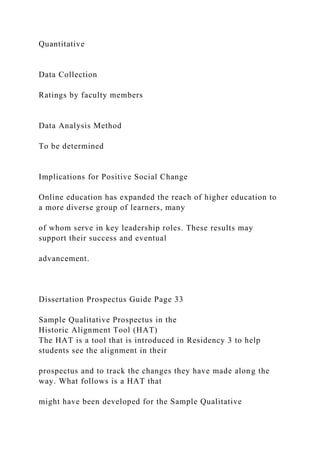
Sample Quantitative Prospectus in the
Historic Alignment Tool (HAT)
The HAT is a tool that is introduced in Residency 3 to help
students see the alignment in their
prospectus and to track the changes they have made along the
way. What follows is a HAT that might
have been developed for the Sample Quantitative Prospectus
that appears in this guide.
Problem Statement
There is a lack of information on how online doctoral students
develop their research problem and
whether the quality of the problem statement varies over time.
Purpose
The purpose of this study is to examine differences in the
quality of problem statements written by
doctoral students in online programs during the various stages
of their doctoral studies.
Potential Significance
Results may help promote the success of online doctoral
students.
Research Questions and Hypotheses
RQ–Quantitative: Based on objective ratings by doctoral
faculty, what are the differences in the overall
quality of problem statements as students progress through the
doctoral study process?
H01—Based on objective ratings by doctoral faculty, there are
no statistically significant differences
in the overall quality of problem statements as students progress
through the doctoral study process.
H1—Based on objective ratings by doctoral faculty, there are
statistically significant differences in
the overall quality of problem statements as students progress
through the doctoral study process.
Theories or Conceptual Frameworks
Perry’s theory of epistemological development
Method of Inquiry
Quantitative
Data Collection
Ratings by faculty members
Data Analysis Method
To be determined
Implications for Positive Social Change
Online education has expanded the reach of higher education to
a more diverse group of learners, many
of whom serve in key leadership roles. These results may
support their success and eventual
advancement.
Dissertation Prospectus Guide Page 33
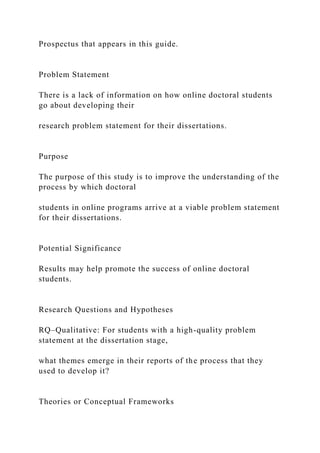
Sample Qualitative Prospectus in the
Historic Alignment Tool (HAT)
The HAT is a tool that is introduced in Residency 3 to help
students see the alignment in their
prospectus and to track the changes they have made along the
way. What follows is a HAT that
might have been developed for the Sample Qualitative
Prospectus that appears in this guide.
Problem Statement
There is a lack of information on how online doctoral students
go about developing their
research problem statement for their dissertations.
Purpose
The purpose of this study is to improve the understanding of the
process by which doctoral
students in online programs arrive at a viable problem statement
for their dissertations.
Potential Significance
Results may help promote the success of online doctoral
students.
Research Questions and Hypotheses
RQ–Qualitative: For students with a high-quality problem
statement at the dissertation stage,
what themes emerge in their reports of the process that they
used to develop it?
Theories or Conceptual Frameworks
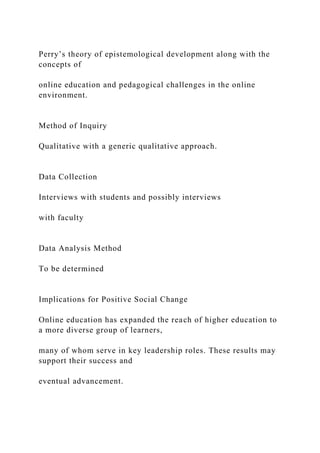
Perry’s theory of epistemological development along with the
concepts of
online education and pedagogical challenges in the online
environment.
Method of Inquiry
Qualitative with a generic qualitative approach.
Data Collection
Interviews with students and possibly interviews
with faculty
Data Analysis Method
To be determined
Implications for Positive Social Change
Online education has expanded the reach of higher education to
a more diverse group of learners,
many of whom serve in key leadership roles. These results may
support their success and
eventual advancement.
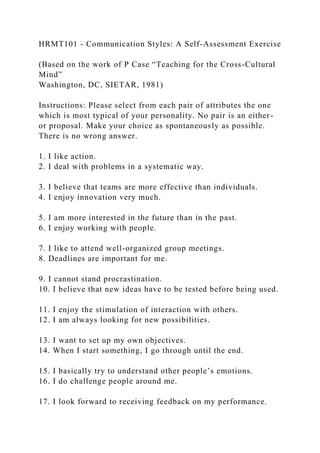
HRMT101 - Communication Styles: A Self-Assessment Exercise
(Based on the work of P Case “Teaching for the Cross-Cultural
Mind”
Washington, DC, SIETAR, 1981)
Instructions: Please select from each pair of attributes the one
which is most typical of your personality. No pair is an either-
or proposal. Make your choice as spontaneously as possible.
There is no wrong answer.
1. I like action.
2. I deal with problems in a systematic way.
3. I believe that teams are more effective than individuals.
4. I enjoy innovation very much.
5. I am more interested in the future than in the past.
6. I enjoy working with people.
7. I like to attend well-organized group meetings.
8. Deadlines are important for me.
9. I cannot stand procrastination.
10. I believe that new ideas have to be tested before being used.
11. I enjoy the stimulation of interaction with others.
12. I am always looking for new possibilities.
13. I want to set up my own objectives.
14. When I start something, I go through until the end.
15. I basically try to understand other people’s emotions.
16. I do challenge people around me.
17. I look forward to receiving feedback on my performance.
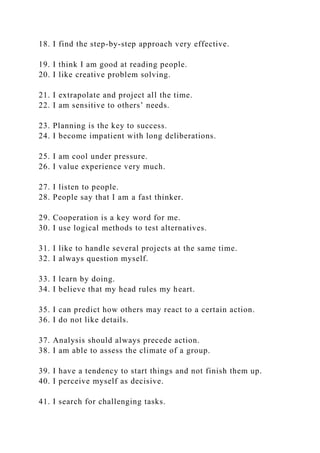
18. I find the step-by-step approach very effective.
19. I think I am good at reading people.
20. I like creative problem solving.
21. I extrapolate and project all the time.
22. I am sensitive to others’ needs.
23. Planning is the key to success.
24. I become impatient with long deliberations.
25. I am cool under pressure.
26. I value experience very much.
27. I listen to people.
28. People say that I am a fast thinker.
29. Cooperation is a key word for me.
30. I use logical methods to test alternatives.
31. I like to handle several projects at the same time.
32. I always question myself.
33. I learn by doing.
34. I believe that my head rules my heart.
35. I can predict how others may react to a certain action.
36. I do not like details.
37. Analysis should always precede action.
38. I am able to assess the climate of a group.
39. I have a tendency to start things and not finish them up.
40. I perceive myself as decisive.
41. I search for challenging tasks.
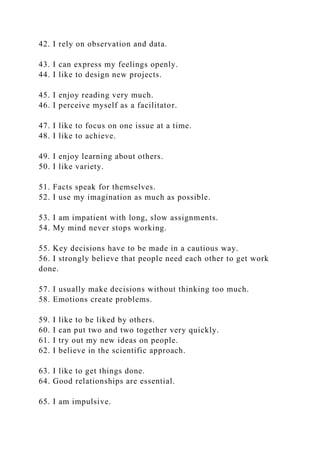
42. I rely on observation and data.
43. I can express my feelings openly.
44. I like to design new projects.
45. I enjoy reading very much.
46. I perceive myself as a facilitator.
47. I like to focus on one issue at a time.
48. I like to achieve.
49. I enjoy learning about others.
50. I like variety.
51. Facts speak for themselves.
52. I use my imagination as much as possible.
53. I am impatient with long, slow assignments.
54. My mind never stops working.
55. Key decisions have to be made in a cautious way.
56. I strongly believe that people need each other to get work
done.
57. I usually make decisions without thinking too much.
58. Emotions create problems.
59. I like to be liked by others.
60. I can put two and two together very quickly.
61. I try out my new ideas on people.
62. I believe in the scientific approach.
63. I like to get things done.
64. Good relationships are essential.
65. I am impulsive.
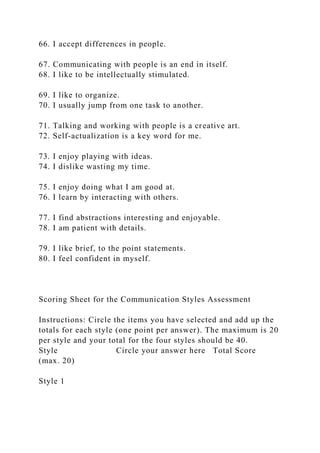
66. I accept differences in people.
67. Communicating with people is an end in itself.
68. I like to be intellectually stimulated.
69. I like to organize.
70. I usually jump from one task to another.
71. Talking and working with people is a creative art.
72. Self-actualization is a key word for me.
73. I enjoy playing with ideas.
74. I dislike wasting my time.
75. I enjoy doing what I am good at.
76. I learn by interacting with others.
77. I find abstractions interesting and enjoyable.
78. I am patient with details.
79. I like brief, to the point statements.
80. I feel confident in myself.
Scoring Sheet for the Communication Styles Assessment
Instructions: Circle the items you have selected and add up the
totals for each style (one point per answer). The maximum is 20
per style and your total for the four styles should be 40.
Style Circle your answer here Total Score
(max. 20)
Style 1
1 - 8 - 9 - 13 - 17 - 24 - 26 - 31 - 33 - 40 - 41 -
48 - 50 - 53 - 57 - 63 - 65 - 70 - 74 - 79
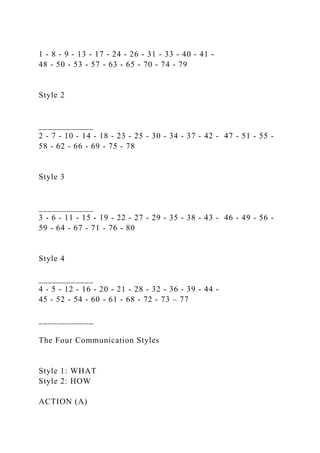
Style 2
____________
2 - 7 - 10 - 14 - 18 - 23 - 25 - 30 - 34 - 37 - 42 - 47 - 51 - 55 -
58 - 62 - 66 - 69 - 75 - 78
Style 3
____________
3 - 6 - 11 - 15 - 19 - 22 - 27 - 29 - 35 - 38 - 43 - 46 - 49 - 56 -
59 - 64 - 67 - 71 - 76 - 80
Style 4
____________
4 - 5 - 12 - 16 - 20 - 21 - 28 - 32 - 36 - 39 - 44 -
45 - 52 - 54 - 60 - 61 - 68 - 72 - 73 – 77
____________
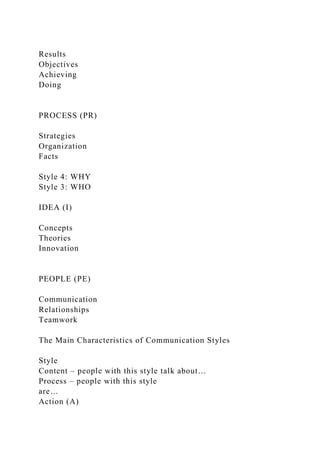
The Four Communication Styles
Style 1: WHAT
Style 2: HOW
ACTION (A)
Results
Objectives
Achieving
Doing
PROCESS (PR)
Strategies
Organization
Facts
Style 4: WHY
Style 3: WHO
IDEA (I)
Concepts
Theories
Innovation
PEOPLE (PE)
Communication
Relationships
Teamwork
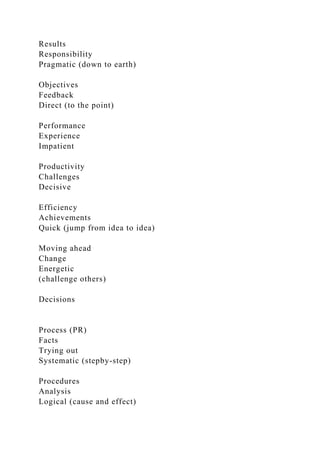
The Main Characteristics of Communication Styles
Style
Content – people with this style talk about…
Process – people with this style
are…
Action (A)
Results
Responsibility
Pragmatic (down to earth)
Objectives
Feedback
Direct (to the point)
Performance
Experience
Impatient
Productivity
Challenges
Decisive
Efficiency
Achievements
Quick (jump from idea to idea)
Moving ahead
Change
Energetic
(challenge others)
Decisions
Process (PR)
Facts
Trying out
Systematic (stepby-step)
Procedures
Analysis
Logical (cause and effect)
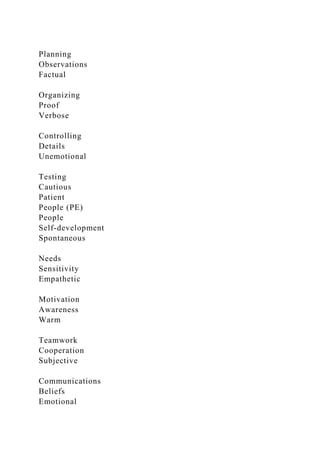
Planning
Observations
Factual
Organizing
Proof
Verbose
Controlling
Details
Unemotional
Testing
Cautious
Patient
People (PE)
People
Self-development
Spontaneous
Needs
Sensitivity
Empathetic
Motivation
Awareness
Warm
Teamwork
Cooperation
Subjective
Communications
Beliefs
Emotional
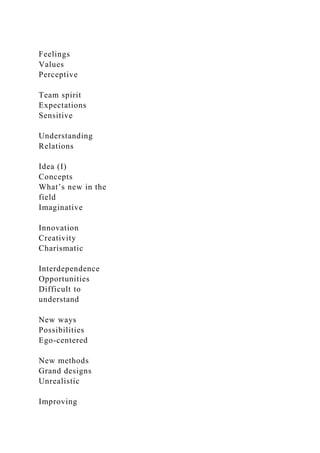
Feelings
Values
Perceptive
Team spirit
Expectations
Sensitive
Understanding
Relations
Idea (I)
Concepts
What’s new in the
field
Imaginative
Innovation
Creativity
Charismatic
Interdependence
Opportunities
Difficult to
understand
New ways
Possibilities
Ego-centered
New methods
Grand designs
Unrealistic
Improving
Issues
Creative
Problems
Potential
Full of ideas
Alternatives
Provocative
Adjusting to Other Communication Styles
Communicating with an Action (A) oriented person:
· Focus on the result first; state the conclusion at the outset.
· State your best recommendation; do not offer many
alternatives.
· Be as brief as possible.
· Emphasize the practicality of your ideas.
· Use visual aids to illustrate your case
Communicating with a Process (PR) oriented person:
· Be precise; state the facts.
· Organize your discussion in a logical order:
i)background
ii) present situation
iii) outcome
· Break down your recommendations.
· Include options and alternatives with pros and cons.
· Do not rush a process-oriented person.
· Outline your proposal.
Communicating with a People (PE) oriented person:
· Allow for small talk; do not start the discussion right away.
· Stress the relationship between your proposal and the people
concerned.
· Show how the idea worked well in the past.
· Indicate support from well-respected people.
· Use an informal writing style.
Communicating with an Idea (I) oriented person:
· Allow enough time for discussion.
Stress the uniqueness of the idea or topic at hand.
· Emphasize future value or relate the impact of the idea to the
future.
· If writing, try to stress the key concepts that underlie your
recommendation at the outset. Start with an overall statement
and work toward the particulars.
How to use this new understanding:
None of us are 100% of only one style, we are a blend of each
of the four styles. Furthermore, in some situations (such as high
pressure at work) we may tend to prefer one style, while in
another situation (like relaxing with friends) we prefer a
different approach.
However, when you consider the person you identified at the
start – the person you have difficulty connecting with – I would
like you to ask yourself if you can answer some simple
questions.
One: Does that person fit reasonably strongly into one of these
four styles? (If you had to pick one of the four, which best
represents that person?)
Two: Is that a different style to your own preferred style?
Three: So why are you surprised that you find it hard to
communicate with them?
If we want to gain that person’s full attention, we need to adapt
the way we are trying to get through to them!
No, we do not need to change our message. We need to change
the way we are expressing it.
Let’s move on to think about some tips on how to do this. As a
little test, check out the suggestions for communicating with
somebody like yourself, with your preferred communication
style – would these seem like good strategies to you?
If so, you can bet the others will work too.
1
Prospectus
Title
Student Name
Name of program – Name of specialization
A00000000
Prospectus: Title
Problem Statement
Insert the text of your problem statement here. Follow the
guidance in the Annotated Outline and the sample prospectus in
the Dissertation Prospectus Guide for more on writing this
section.
Purpose
Insert the text of your purpose statement here. Follow the
guidance in the Annotated Outline and the sample prospectus in
the Dissertation Prospectus Guide for more on writing this
section.
Significance
Insert the text of the purpose and significance of your study
here. Follow the guidance in the Annotated Outline and the
sample prospectus in the Dissertation Prospectus Guide for
more on writing this section.
Background
Insert the text of the background of your study here. Follow the
guidance in the Annotated Outline and the sample prospectus in
the Dissertation Prospectus Guide for more on writing this
section.
Framework (Conceptual or Theoretical)
Insert the text of the framework of your study here. Follow the
guidance in the Annotated Outline and the sample prospectus in
the Dissertation Prospectus Guide for more on writing this
section.
Research Question(s) and Hypotheses (if applicable)
Insert your research questions and hypotheses (if applicable)
here. Follow the guidance in the Annotated Outline and the
sample prospectus in the Dissertation Prospectus Guide for
more on writing this section.
Nature of the Study
Insert the text of the nature of your study here. Follow the
guidance in the Annotated Outline and the sample prospectus in
the Dissertation Prospectus Guide for more on writing this
section.
Possible Types and Sources of Data
Insert the text of possible types and sources of data here.
Follow the guidance in the Annotated Outline and the sample
prospectus in the Dissertation Prospectus Guide for more on
writing this section.
Limitations, Challenges, and/or Barriers
Insert the text of information on limitations, challenges, and/or
barriers that may need to be addressed when conducting this
study. Follow the guidance in the Annotated Outline and the
sample prospectus in the Dissertation Prospectus Guide for
more on writing this section.
References
Insert your reference list here. Refer to the sample in the
Dissertation Prospectus guide for an example of this section.
Walden University    Dissertation Prospectus .docx

Walden University Dissertation Prospectus .docx

  • 1.
    Walden University Dissertation Prospectus Guide Dissertation ProspectusGuide Page i What’s New in 2018 The 2018 edition of the Dissertation Prospectus Guide contains additional material to support prospectus development. What has not changed are the basic expectations for the content of the prospectus and how it will be evaluated and approved. Specific new items in this guide include • discussion about research design alignment;
  • 2.
    • added clarityin the outline annotations; • enhanced formatting for better presentation, including a separate Purpose section; • updated sample prospectuses to include both a quantitative and a qualitative example; and • the sample prospectus documents captured in the historic alignment tool (HAT), which is introduced in Residency 3. For internal use only Walden University 100 Washington Avenue South Suite 900
  • 3.
    Minneapolis, MN 55401 1-800-WALDENU(1-800-925-3368) Walden University is accredited by The Higher Learning Commission, www.hlcommission.org; 1-312-263-0456. © 2018 Walden University, LLC https://www.hlcommission.org/ Dissertation Prospectus Guide Page ii Contents What’s New in 2018 ............................................................................................... ......................... i The Prospectus ............................................................................................... ................................. 1 Completing the Prospectus ............................................................................................... ........... 1 My Doctoral Research (MyDR) ............................................................................................... .... 3
  • 4.
    An Annotated Outline ............................................................................................... ......................4 Sample Quantitative Prospectus ................................................................................ ............... ...... 8 Sample Qualitative Prospectus ............................................................................................... ...... 18 Quality Indicators........................................................................... ..... .......................................... 28 Dissertation Prospectus Rubric ............................................................................................... .. 28 Ten Tips for Writing a Quality Prospectus ................................................................................... 30 Sample Quantitative Prospectus in the Historic Alignment Tool (HAT) ..................................... 32 Sample Qualitative Prospectus in the Historic Alignment Tool (HAT) ....................................... 33 Dissertation Prospectus Guide Page 1
  • 5.
    The Prospectus The DissertationProspectus is a brief document that provides preliminary information about your dissertation research and is used in two ways: • It serves as an agreed-upon plan for developing the proposal and is evaluated to ensure doctoral-level work. • It serves as a step to finalize the structure of your dissertation supervisory committee, who will work with you on completing the dissertation. Completing the Prospectus The Dissertation Prospectus consists of several short sections, which are detailed in the annotated outline. Your goal for the prospectus is to create a plan for developing your dissertation proposal. Therefore, you need to have more information for the prospectus than for your earlier documents, such as the Dissertation Premise, but you do not need to know all the specific details of the study that you will ultimately conduct. For example, you may identify intelligence as a covariate in a quantitative study, but at this point, you do not yet need to identify the instrument that you plan to use to measure the covariate.
  • 6.
    Also, because everyresearch project is unique, and because this outline is general, you may be asked to include additional information in your prospectus to help assure your supervisory committee that you are headed in the right direction. For example, feasibility will be one criterion for evaluating your prospectus, and if you are considering a very unique sample group, your committee may ask that you explore that aspect in more detail before moving forward. The Dissertation Prospectus should follow the guidelines in the sixth edition of the Publication Manual of the American Psychological Association and be saved as either a .doc, .docx, or .rtf file. As you work on the document, you may also want to review the Litmus Test for a Doctoral- Level Research Problem, which is available on the Research Resources page of the Center for Research Quality site, your historic alignment tool (HAT) from your academic residency experience, as well as the nine quality indicators included in this guide.
  • 7.
    One prospectus qualityindicator that is not included as a separate section in the prospectus document, but rather is holistically assessed throughout the prospectus, is research design alignment. The rubric item reads: “Aligned? Do the various components of the research plan align overall?" Alignment is critically important to research quality. Research design alignment means that all pieces of the study design match and/or complement one another. For example, the identified doctoral-level problem must drive the purpose of the study and the research questions. The framework must support the research approach overall. There should be common language throughout, with concepts and theories corresponding with the problem and purpose— meaning that language should be repeated from earlier sections into later sections. As you write, be sure to connect the dots among each section of the prospectus, ensuring alignment throughout. The visual below represents this idea. http://academicguides.waldenu.edu/researchcenter/resources/pla
  • 8.
    nning http://academicguides.waldenu.edu/researchcenter/resources/pla nning Dissertation Prospectus GuidePage 2 Conceptualizing the research plan and the various components of the research design is sometimes challenging. One way to assist with this and to ensure research design alignment is to use a visual to help you see how the various parts of a research design should fit together and therefore must align with one another. For example, as presented in the graphic below, the Problem Statement, Purpose, and Framework in the prospectus must align with all other pieces of the research design. This example has three research questions. If one research question does not appear to fit with the study purpose, it does not belong in the study design. The method and design make up the section in the prospectus called “Nature of the Study.” Each section must coordinate with the others.
  • 9.
    As a self-check,you should ask yourself these questions about your research design: 1. Is there a logical progression from the research problem to the purpose of the study? 2. Does the identified framework ground the investigation in the stated problem? Dissertation Prospectus Guide Page 3 3. Do the problem, purpose, and framework align with the RQ(s) and nature of the study? 4. Does each RQ address the problem and align with the purpose of the study? 5. Will the instrument, data source, and analysis address the RQ? Depending on your academic program, you will be in a course of some type that supports prospectus development and will work with your committee chair and second member to complete the document. See your specific program of study for more information on the type of course and the timing of it. Keep in mind that prospectus development is an iterative process and
  • 10.
    that you willreceive feedback on working drafts, as will happen with the proposal and dissertation. When your supervisory committee members agree that your prospectus meets all the quality indicators discussed herein, they will endorse it for review by your academic program director or designee. After the program director or designee gives final approval of the prospectus and your supervisory committee, you will start working on your proposal. This entire approval process will occur in My Doctoral Research (MyDR). My Doctoral Research (MyDR) If you have not done so already, you should familiarize yourself with the MyDR system and other resources on the Center for Research Quality website. The MyDR system was designed to assist you and your committee in navigating your doctoral research journey, from the very beginning through the final approval. The various landing pages in MyDR will track your progress and will serve as a central location for resources to support that progress. The
  • 11.
    Taskstream element ofthe MyDR system is used to establish a process flow tool in which you exchange and store faculty evaluations of and feedback on your work as you progress along that journey. You will be entered into the MyDR system when both your committee chair and second member nominees are approved by the academic program. At that point, you will be able to access MyDR from the homepage of your dissertation completion course in Blackboard. The first document that you will submit for approval in MyDR will be your prospectus. https://academicguides.waldenu.edu/researchcenter/mydr https://academicguides.waldenu.edu/researchcenter Dissertation Prospectus Guide Page 4 An Annotated Outline The Prospectus document includes a title page (page 1) followed by pages containing the required elements in the prospectus. Please use the Prospectus template that is available on the Writing Center website.
  • 12.
    Title Page The recommendedtitle length is 12 words or fewer to include the topic, the variables and relationship between them, and the critical keywords. Double- space the title if over one line of type and center it under the word “Prospectus.” Please note that your dissertation title will likely change as the project evolves. Include your name, your program of study (and specialization, if applicable), and Student ID number—double-spaced and centered under the title. Title Start with “Prospectus” and a colon, and then include the title as it appears on the title page. Double-space if over one line of type and center it at the top of the page. Problem Statement Provide a one- to two-paragraph statement that is the result of a review of research
  • 13.
    findings and currentpractice and that contains the following information: 1. A logical argument for the need to address an identified gap in the research literature that has current relevance to the discipline and area of practice. Keep in mind that a gap in the research is not, in and of itself, a reason to conduct research. Make sure to clarify the problem that led you to the gap. The situation being experienced in a societal population or discipline is described within the problem statement. 2. Preliminary evidence that provides justification that this problem is meaningful to the discipline or professional field. Provide three to five key citations that support the relevance and currency of the problem. These references need not all be from peer- reviewed journals but should be from reputable sources, such as national agency Note: A social problem involves an issue that affects a specific population/discipline. It is the issue that students see “on the ground” so to speak. The social problem is often what prompts students
  • 14.
    to think abouta topic of interest drives their dissertation topic. Usually such a topic is one that students identify with, sometimes having personally experienced some aspect of the problem as it exists in the world. All too often, students want to solve a specific social, organizational, clinical, or practical problem rather than explore a research problem. A research problem is a focused topic of concern, a condition to be improved upon, or troubling question that is supported in scholarly literature or theory that you study to understand in more detail, and that can lead to recommendations for resolutions. It is the research problem that drives the rest of the dissertation: the purpose, the research questions, and the methodology. It is the research problem that is identified in the Problem Statement of the prospectus. http://writingcenter.waldenu.edu/549.htm Dissertation Prospectus Guide Page 5 databases or scholarly books, and should ideally be from the past 5 years.
  • 15.
    3. Assure thatthe problem is framed within and primarily focused on the discipline (program of study). Purpose Present a concise, one-paragraph statement on the overall purpose or intention of the study, which serves as the connection between the problem being addressed and the focus of the study. • In quantitative studies, state what needs be studied by describing two or more factors (variables) and a conjectured relationship among them related to the identified gap or problem. • In qualitative studies, describe the need for increased understanding about the issue to be studied, based on the identified gap or problem. • In mixed-methods studies, with both quantitative and qualitative aspects, clarify how the two approaches will be used together to inform the study. Significance Provide one or two paragraphs, informed by the topic in the problem statement, that
  • 16.
    describe the following: 1.How this study will contribute to filling the gap identified in the problem statement: What original contribution will this study make? 2. How this research will support professional practice or allow practical application: Answer the So what? question. 3. How the claim aligns with the problem statement to reflect the potential relevance of this study to society: How might the potential findings lead to positive social change? Background Provide (a) the keywords or phrases that you searched and the databases used; and (b) a representative list of scholarship and findings, or an annotated bibliography, that support and clarify the main assertions in the problem statement, highlighting their relationship to the topic, for example, “this variable was studied with a similar sample by Smith (2013) and Johnson (2014)” or “Jones’s (2012) examination of industry leaders showed similar trends in the same key segments.” Some of these resources may have already been
  • 17.
    mentioned in thefirst sections of the prospectus and can be included here, also. Provide 5 to 10 peer-reviewed articles most of which should have been published within the last 5 years and/or represent current information on the topic. Framework (Conceptual or Theoretical) In one paragraph, describe the framework that demonstrates an understanding of the theories and concepts relevant to your topic. Align the framework with the problem, purpose, research questions, and background of your study. This theoretical or conceptual framework is Dissertation Prospectus Guide Page 6 the basis for understanding, designing, and analyzing ways to investigate your research problem (data collection and analysis). Provide the original scholarly literature on the theory or concepts even if it is more than 5 years old. Please do not cite secondary sources.
  • 18.
    Research Question(s) andHypotheses (if applicable) List the question or a series of related questions that are informed by the study purpose, which will lead to the development of what needs to be done in this study and how it will be accomplished. A research question informs the research design by providing a foundation for • generation of hypotheses in quantitative studies, • questions necessary to build the design structure for qualitative studies, and • a process by which different methods will work together in mixed-methods studies. Nature of the Study Provide a concise paragraph that (a) presents the approach that will be used to address the research question(s) and (b) discusses how this approach aligns with the problem statement. The examples of study design are as follows: • Quantitative—for experimental, quasiexperimental, or nonexperimental designs; treatment-control; repeated measures; causal-comparative; single-subject; predictive studies; or other quantitative approaches
  • 19.
    • Qualitative—for ethnography,case study, grounded theory, narrative inquiry, phenomenological research, policy analysis, or other qualitative traditions • Mixed methods, primarily quantitative—for sequential, concurrent, or transformative studies, with the main focus on quantitative methods • Mixed methods, primarily qualitative—for sequential, concurrent, or transformative studies, with the main focus on qualitative methods • Other—for another design, to be specified with a justification provided for its use Possible Types and Sources of Data Secondary data include public or existing data that are collected by others. Primary data are collected by the researcher. Provide a list of possible types and sources of data that could be used to address the proposed research question(s), such as test scores from college students, employee surveys, observations of a phenomenon, interviews with practitioners, historical documents from state records, de-identified medical records, or information from a federal
  • 20.
    database. For secondary,or preexisting data, identify the data source, how the data will be accessed, and the data points that will be used to address the research questions. For primary data, explain the data points, how the data will be obtained, and potential participants who will be accessed to address the research questions. Possible secondary data sources, by program, are available on the Center for Research Quality website. Sources of information that support and clarify the problem belong in the Background section. If you are thinking about collecting data on a sensitive topic or from a vulnerable population, an early consultation with the Institutional Review Board (IRB; [email protected]) during your prospectus writing process is recommended to gain ethics guidance that you can https://academicguides.waldenu.edu/researchcenter/dataresource s Dissertation Prospectus Guide Page 7 incorporate into your subsequent proposal drafts and research planning. Find more information
  • 21.
    on the IRBGuides and FAQs page. Limitations, Challenges, and/or Barriers Provide information on limitations, challenges, and/or barriers that may need to be addressed when conducting this study. These may include access to participants, access to data, separation of roles (researcher versus employee), instrumentation fees, etc. References On a new page, list your references formatted in the correct style (sixth edition of the Publication Manual of the American Psychological Association, modeled at the end of this guide) for all citations within the Dissertation Prospectus. https://academicguides.waldenu.edu/researchcenter/orec/docume nts#s-lg-box-19529598 Dissertation Prospectus Guide Page 8 Sample Quantitative Prospectus
  • 22.
    Dissertation Prospectus GuidePage 9 1 Prospectus Differences in the Quality of Problem Statements Written Throughout the Capstone Process Alpha B. Gamma General Studies program – General specialization A00000000 [Per Publication Manual of the American Psychological Association formatting, include page numbers at the top right corner of each page.] Dissertation Prospectus Guide Page 10 2 Prospectus: Differences in the Quality of Problem Statements Written Throughout the Capstone Process
  • 23.
    Problem Statement Conducting asupervised independent research project is a unique feature of completing a doctoral degree (Lovitts, 2008; Luse, Mennecke, & Townsend, 2012). Contrary to the commonly held belief of a 50% all-but-dissertation (ABD) rate, only approximately 20% of doctoral students are unable to complete the dissertation after finishing their coursework (Lovitts, 2008; Wendler et al., 2010). The challenge of the dissertation is not a new phenomenon in higher education, but what is new is the growing number of students who complete their academic programs online (Allen & Seaman, 2007; Kumar, Johnson, & Hardemon, 2013). Although many students are ultimately successful in defining the central argument for a doctoral capstone, how this process occurs in a distributed environment has not been well researched. In their book on doctoral education, Walker, Golde, Jones, Conklin- Bueschel, and Hutchings (2009) highlight the need to develop more “pedagogies of research” (p. 151) for
  • 24.
    teaching graduate studentsto be scholars. Although a modest body of scholarship exists on research training in traditional programs, emerging research suggests that the online environment offers some unique challenges and opportunities for doctoral students (Baltes, Hoffman-Kipp, Lynn, & Weltzer-Ward, 2010; Kumar et al., 2013; Lim, Dannels, & Watkins, 2008). Of the many aspects of a research project, development of the problem statement is arguably a key step because it provides the rationale for the entire dissertation (Alvesson & Sandberg, 2013; Luse et al., 2012). Hence, this study will fill a gap in the research by focusing specifically on the development of problem statements by students in online doctoral programs. Dissertation Prospectus Guide Page 11 3 Purpose The purpose of this study is to examine differences in the quality of problem statements
  • 25.
    written by doctoralstudents in online programs during the various stages of their doctoral studies. Secondary data that include objective ratings of problem statements by doctoral faculty over the course of the capstone process will be examined for differences. This project is unique because it addresses an underresearched area of higher education (Gardner & Barnes, 2014) with a group of learners that has expanded over the past decade (Bell, 2011). Significance The results of this study will provide much-needed insights into the processes by which increasing numbers of new scholars work through the beginning phase of their research. Insights from this study should aid doctoral committees in helping students to succeed in their final projects, thus supporting eventual degree attainment. Education has long been a force for social change by addressing inequities in society. Because a broad range of students attend online institutions, supporting their successful attainment of a terminal degree allows for increased diversity among individuals in key academic and scholarly
  • 26.
    leadership positions. Background Selected articlesrelating to doctoral education and the process of learning to be a researcher are described here. The keywords searched were ABD, online doctoral program completion, doctoral capstone completion, online research training, and online learning in the databases Education Source, ERIC, and SAGE Journals, as well as in a Thoreau multidatabase search. Dissertation Prospectus Guide Page 12 4 1. Baltes et al. (2010) and Bieschke (2006) provided information on research self-efficacy, which has been shown as a key predictor of the future research of doctoral students. 2. Gelso (2006), Holmes (2009), Hilliard (2013), and Kim and Karau (2009) provided different views of strategies to support the development of scholar practitioners during
  • 27.
    the capstone experience. 3.Ivankova and Stick (2007) and Kumar et al. (2013) offered models that align well with the possible methodologies used in this study and that involved online students. 4. Lim et al. (2008) addressed the role of research courses in an online program. 5. Lovitts (2008), Gardner and Barnes (2014), and Werner and Rogers (2013) gave different views of the transition from student to researcher. 6. Ismail, Majid, and Ismail (2013); Spaulding and Rockinson- Szapkiw (2012); and Stubb, Pyhältö, and Lonka (2014) focused on the student experience of learning to conduct research. Framework The theoretical base for this study will be Perry’s (1970) theory of epistemological development. Because this theory addresses ways of knowing in adults, Perry’s theoretical work has been used extensively in all aspects of higher education, albeit more frequently with
  • 28.
    undergraduates than withdoctoral students. The approach provides details on cognitive- structural changes that emerge as a result of development and learning. Further, subsequent research and application of Perry’s theory offer guidance on ways to facilitate academic development, thus allowing for insight into the pedagogical challenge of the dissertation (Gardner, 2009). Dissertation Prospectus Guide Page 13 5 Research Question(s) and Hypotheses RQ–Quantitative: Based on objective ratings by doctoral faculty, what are the differences in the overall quality of problem statements as students progress through the doctoral study process? H01—Based on objective ratings by doctoral faculty, there are no statistically significant differences in the overall quality of problem statements as students progress through the doctoral
  • 29.
    study process. H1—Based onobjective ratings by doctoral faculty, there are statistically significant differences in the overall quality of problem statements as students progress through the doctoral study process. Nature of the Study The nature of this study will be quantitative research with a repeated-measure design consistent with understanding how students approach the work of creating a successful doctoral study problem statement, which is the primary focus of this doctoral study. To elucidate how a viable research problem emerges, objective ratings of student work products will be examined across time. This quantitative analysis should help pinpoint the amount of growth from the beginning to the end of the project. Possible Types and Sources of Data Data will be accessed from an online doctoral program. The program collects and rates doctoral problem statements written at four key points in a
  • 30.
    doctoral student’s career:the premise, the prospectus, the proposal, and the doctoral study writing stage. The data will be deidentified and contain the scores by stage of program for 300 online doctoral students. Other data may be Dissertation Prospectus Guide Page 14 6 collected from surveys of instructors. Limitations, Challenges, and/or Barriers A potential barrier, if using secondary data, is that data access may include a partner-site agreement and possible fees for data access. A potential barrier for collecting primary data (surveys) includes recruitment of participants. Dissertation Prospectus Guide Page 15 7 References
  • 31.
    Allen, I. E.,& Seaman, J. (2007). Online nation: Five years of growth in online learning. Needham, MA: Sloan-C. Alvesson, M., & Sandberg, J. (2013). Constructing research questions: Doing interesting research. Los Angeles, CA: Sage Publications. Baltes, B., Hoffman-Kipp, P., Lynn, L., & Weltzer-Ward, L. (2010). Students’ research self- efficacy during online doctoral research courses. Contemporary Issues in Education Research, 3, 51–58. Bell, N. (2011). Graduate enrollment and degrees: 2000 to 2010. Washington, DC: Council of Graduate Schools. Bieschke, K. J. (2006). Research self-efficacy beliefs and research outcome expectations: Implications for developing scientifically minded psychologists. Journal of Career Assessment, 14, 77–91. http://dx.doi.org/10.1177/1069072705281366 Gardner, S. K. (2009). The development of doctoral students: Phases of challenge and support. ASHE Higher Education Report, 34, 1–127.
  • 32.
    Gardner, S. K.,& Barnes, B. J. (2014). Advising and mentoring doctoral students: A handbook. San Bernardino, CA: CreateSpace Independent Publishing. Gelso, C. J. (2006). On the making of a scientist-practitioner: A theory of research training in professional psychology. Training and Education in Professional Psychology, S, 3–16. http://dx.doi.org/10.1037/1931-3918.S.1.3 Hilliard, A. T. (2013). Advising doctorate candidates and candidates’ views during the dissertation process. Journal of College Teaching & Learning, 10, 7–13. http://dx.doi.org/10.1177/1069072705281366 http://dx.doi.org/10.1037/1931-3918.S.1.3 Dissertation Prospectus Guide Page 16 8 Holmes, B. D. (2009). Re-envisioning the dissertation stage of doctoral study: Traditional mistakes with non-traditional learners. Journal of College Teaching and Learning, 6(8), 9–13.
  • 33.
    Ismail, H. M.,Majid, F. A., & Ismail, I. S. (2013). “It’s complicated” relationship: Research students’ perspective on doctoral supervision. Procedia - Social and Behavioral Sciences, 90, 165–170. http://dx.doi.org/10.1016/j.sbspro.2013.07.078 Ivankova, N. V., & Stick, S. L. (2007). Students’ persistence in a distributed doctoral program in educational leadership in higher education: A mixed methods study. Research in Higher Education, 48, 93–135. http://dx.doi.org/10.1007/s11162-006- 9025-4 Kim, K., & Karau, S. (2009). Working environment and the research productivity of doctoral students in management. Journal of Education for Business, 85, 101–106. http://dx.doi.org/10.1080/08832320903258535 Kumar, S., Johnson, M., & Hardemon, T. (2013). Dissertations at a distance: Students’ perceptions of online mentoring in a doctoral program. The Journal of Distance Education, 27(1), 1– 12. Lim, J. H., Dannels, S. A., & Watkins, R. (2008). Qualitative investigation of doctoral students’
  • 34.
    learning experiences inonline research methods courses. Quarterly Review of Distance Education, 9, 223–236. Lovitts, B. (2008). The transition to independent research: Who makes it, who doesn’t, and why. Journal of Higher Education, 79, 296–325. http://dx.doi.org/10.1353/jhe.0.0006 Luse, A., Mennecke, B., & Townsend, A. (2012). Selecting a research topic: A framework for doctoral students. International Journal of Doctoral Studies, 7, 143–152. http://dx.doi.org/10.1016/j.sbspro.2013.07.078 http://dx.doi.org/10.1007/s11162-006-9025-4 http://dx.doi.org/10.1007/s11162-006-9025-4 http://dx.doi.org/10.1080/08832320903258535 http://dx.doi.org/10.1353/jhe.0.0006 Dissertation Prospectus Guide Page 17 9 Perry, W. G., Jr. (1970). Forms of intellectual and ethical development in the college years: A scheme. New York, NY: Holt, Rinehart, & Winston. Spaulding, L. S., & Rockinson-Szapkiw, A. J. (2012). Hearing
  • 35.
    their voices: Factorsdoctoral candidates attribute to their persistence. International Journal of Doctoral Studies, 7, 199–219. Stubb, J., Pyhältö, K., & Lonka, K. (2014). Conceptions of research: The doctoral student experience in three domains. Studies in Higher Education, 39, 251–264. http://dx.doi.org/10.1080/03075079.2011.651449 Walker, G. E., Golde, C. M., Jones, L., Conklin-Bueschel, A., & Hutchings, P. (2009). The formation of scholars: Rethinking doctoral education for the twenty-first century. San Francisco, CA: Jossey-Bass. Wendler, C., Bridgeman, B., Cline, F., Millett, C., Rock, J., Bell, N., & McAllister, P. (2010). The path forward: The future of graduate education in the United States. Princeton, NJ: Educational Testing Service. Werner, T., & Rogers, K. (2013). Scholar-craftsmanship question-type, epistemology, culture of inquiry, and personality-type in dissertation research design. Adult Learning, 24, 159–
  • 36.
    166. http://dx.doi.org/10.1177/1045159513499549 http://dx.doi.org/10.1080/03075079.2011.651449 http://dx.doi.org/10.1177/1045159513499549 Dissertation ProspectusGuide Page 18 Sample Qualitative Prospectus Dissertation Prospectus Guide Page 19 1 Prospectus How Online Doctoral Students Develop a Dissertation Problem Statement Alpha B. Gamma General Studies program – General specialization A00000000 [Per Publication Manual of the American Psychological Association
  • 37.
    formatting, include pagenumbers at the top right corner of each page.] Dissertation Prospectus Guide Page 20 2 Prospectus: How Online Doctoral Students Develop a Dissertation Problem Statement Problem Statement Conducting a supervised independent research project is a unique feature of completing a doctoral degree (Lovitts, 2008; Luse, Mennecke, & Townsend, 2012). Contrary to the commonly held belief of a 50% all-but-dissertation (ABD) rate, only approximately 20% of doctoral students are unable to complete the dissertation after finishing their coursework (Lovitts, 2008; Wendler et al., 2010). The challenge of the dissertation is not a new phenomenon in higher education, but what is new is the growing number of students who complete their academic programs online (Allen & Seaman, 2007; Kumar, Johnson, & Hardemon, 2013). Although many
  • 38.
    students are ultimatelysuccessful in defining the central argument for a doctoral capstone, how this process occurs in a distributed environment has not been well researched. In their book on doctoral education, Walker, Golde, Jones, Conklin- Bueschel, and Hutchings (2009) highlight the need to develop more “pedagogies of research” (p. 152) for teaching graduate students to be scholars. Although a modest body of scholarship exists on research training in traditional programs, emerging research suggests that the online environment offers some unique challenges and opportunities for doctoral students (Baltes, Hoffman-Kipp, Lynn, & Weltzer-Ward, 2010; Kumar et al., 2013; Lim, Dannels, & Watkins, 2008). Of the many aspects of a research project, development of the problem statement is arguably a key step because it provides the rationale for the entire dissertation (Alvesson & Sandberg, 2013; Luse et al., 2012). Hence, this study will fill a gap in the research by focusing specifically on the development of problem statements by students in online doctoral programs.
  • 39.
    Dissertation Prospectus GuidePage 21 3 Purpose The purpose of this study is to improve the understanding of the process by which doctoral students in online programs arrive at a viable problem statement for their dissertations. To address this gap, the study approach will use the qualitative paradigm. Interviews will be used to develop an understanding of students’ strategies for formulating problem statements. Significance This research will fill a gap in understanding by focusing specifically on development of problem statements by students in online doctoral programs. This project is unique because it addresses an underresearched area of higher education (Gardner & Barnes, 2014) among a group of learners that has expanded over the past decade (Bell, 2011). The results of this study will provide much-needed insights into the processes by which
  • 40.
    increasing numbers ofnew scholars work through the beginning phase of their research. Insights from this study should aid doctoral committees and academic programs in helping students to succeed in their final projects, thus supporting eventual degree attainment. Education has long been a force for social change by addressing inequities in society. Because a broad range of students attends online institutions, supporting their successful attainment of a terminal degree allows for increased diversity among individuals in key academic and scholarly leadership positions. Background Selected articles relating to doctoral education and the process of learning to be a researcher are described here. The keywords searched were ABD, online doctoral program completion, doctoral capstone completion, online research training, and online learning in the Dissertation Prospectus Guide Page 22
  • 41.
    4 databases Education Source,ERIC, and SAGE Journals, as well as in a Thoreau multidatabase search. 1. Baltes et al. (2010) and Bieschke (2006) provided information on research self- efficacy, which has been shown as a key predictor of the future research of doctoral students. 2. Gelso (2006), Holmes (2009), Hilliard (2013), and Kim and Karau (2009) provided different views of strategies to support the development of scholar practitioners during the capstone experience. 3. Ivankova and Stick (2007) and Kumar et al. (2013) offered models that align well with the possible methodologies used in this study and that involved online students. 4. Lim et al. (2008) addressed the role of research courses in an online program. 5. Lovitts (2008), Gardner and Barnes (2014), and Werner and Rogers (2013) gave
  • 42.
    different views ofthe transition from student to researcher. 6. Ismail, Majid, and Ismail (2013); Spaulding and Rockinson- Szapkiw (2012); and Stubb, Pyhältö, and Lonka (2014) focused on the student experience of learning to conduct research. Framework The framework for this study will be based on Perry’s (1970) theory of epistemological development. Because this theory addresses ways of knowing in adults, Perry’s theoretical work has been used extensively in all aspects of higher education, albeit more frequently with undergraduates than with doctoral students. Concepts explored will include what online learning is and the pedagogical challenges associated with online learning and dissertation writing. The Dissertation Prospectus Guide Page 23 5 approach provides details on cognitive-structural changes that emerge as a result of development
  • 43.
    and learning. Further,subsequent research and application of Perry’s theory offers guidance on ways to facilitate academic development, thus allowing for insight into the pedagogical challenge of the dissertation (Gardner, 2009). Research Question(s) RQ–Qualitative: For students with a high-quality problem statement at the dissertation stage, what themes emerge in their reports of the process that they used to develop it? Nature of the Study The nature of this study will be qualitative with a generic qualitative approach (Merriam & Tisdell, 2015). Qualitative research is consistent with understanding how students approach the work of creating a successful dissertation problem statement, which is the focus of this dissertation. Keeping the focus on how students make sense of their dissertation research should be consistent with Perry’s (1970) epistemological expectations at this point in their development
  • 44.
    (Gardner, 2009). Possible Typesand Sources of Data Data for the study will include interviews with a representative group of doctoral graduates who have successfully defended their dissertations and whose work was highly ranked by faculty. In addition, the design may include, as a possible source for triangulation, interviews with doctoral faculty who have helped students to succeed. Dissertation Prospectus Guide Page 24 6 Limitations, Challenges, and/or Barriers Potential barriers include the partner site agreement and possible difficulty recruiting participants for interviews. Ensuring clear separation of my role at the institution from my role as researcher may also be a challenge. Dissertation Prospectus Guide Page 25
  • 45.
    7 References Allen, I. E.,& Seaman, J. (2007). Online nation: Five years of growth in online learning. Needham, MA: Sloan-C. Alvesson, M., & Sandberg, J. (2013). Constructing research questions: Doing interesting research. Los Angeles, CA: Sage Publications. Baltes, B., Hoffman-Kipp, P., Lynn, L., & Weltzer-Ward, L. (2010). Students’ research self- efficacy during online doctoral research courses. Contemporary Issues in Education Research, 3, 51–58. Bell, N. (2011). Graduate enrollment and degrees: 2000 to 2010. Washington, DC: Council of Graduate Schools. Bieschke, K. J. (2006). Research self-efficacy beliefs and research outcome expectations: Implications for developing scientifically minded psychologists. Journal of Career Assessment, 14, 77–91. http://dx.doi.org/10.1177/1069072705281366
  • 46.
    Gardner, S. K.(2009). The development of doctoral students: Phases of challenge and support. ASHE Higher Education Report, 34, 1–127. Gardner, S. K., & Barnes, B. J. (2014). Advising and mentoring doctoral students: A handbook. San Bernardino, CA: CreateSpace Independent Publishing. Gelso, C. J. (2006). On the making of a scientist-practitioner: A theory of research training in professional psychology. Training and Education in Professional Psychology, S, 3–16. http://dx.doi.org/10.1037/1931-3918.S.1.3 Hilliard, A. T. (2013). Advising doctorate candidates and candidates’ views during the dissertation process. Journal of College Teaching & Learning, 10, 7–13. http://dx.doi.org/10.1177/1069072705281366 http://dx.doi.org/10.1037/1931-3918.S.1.3 Dissertation Prospectus Guide Page 26 8 Holmes, B. D. (2009). Re-envisioning the dissertation stage of doctoral study: Traditional
  • 47.
    mistakes with non-traditionallearners. Journal of College Teaching and Learning, 6(8), 9–13. Ismail, H. M., Majid, F. A., & Ismail, I. S. (2013). “It’s complicated” relationship: Research students’ perspective on doctoral supervision. Procedia - Social and Behavioral Sciences, 90, 165–170. http://dx.doi.org/10.1016/j.sbspro.2013.07.078 Ivankova, N. V., & Stick, S. L. (2007). Students’ persistence in a distributed doctoral program in educational leadership in higher education: A mixed methods study. Research in Higher Education, 48, 93–135. http://dx.doi.org/10.1007/s11162-006- 9025-4 Kim, K., & Karau, S. (2009). Working environment and the research productivity of doctoral students in management. Journal of Education for Business, 85, 101–106. http://dx.doi.org/10.1080/08832320903258535 Kumar, S., Johnson, M., & Hardemon, T. (2013). Dissertations at a distance: Students’ perceptions of online mentoring in a doctoral program. The Journal of Distance Education, 27(1), 1–
  • 48.
    12. Lim, J. H.,Dannels, S. A., & Watkins, R. (2008). Qualitative investigation of doctoral students’ learning experiences in online research methods courses. Quarterly Review of Distance Education, 9, 223–236. Lovitts, B. (2008). The transition to independent research: Who makes it, who doesn’t, and why. Journal of Higher Education, 79, 296–325. http://dx.doi.org/10.1353/jhe.0.0006 Luse, A., Mennecke, B., & Townsend, A. (2012). Selecting a research topic: A framework for doctoral students. International Journal of Doctoral Studies, 7, 143–152. http://dx.doi.org/10.1016/j.sbspro.2013.07.078 http://dx.doi.org/10.1007/s11162-006-9025-4 http://dx.doi.org/10.1007/s11162-006-9025-4 http://dx.doi.org/10.1080/08832320903258535 http://dx.doi.org/10.1353/jhe.0.0006 Dissertation Prospectus Guide Page 27 9 Merriam, S. B., & Tisdell, E. J. (2015). Qualitative research: A guide to design and
  • 49.
    implementation (4th ed.).San Francisco, CA: John Wiley & Sons. Perry, W. G., Jr. (1970). Forms of intellectual and ethical development in the college years: A scheme. New York, NY: Holt, Rinehart, & Winston. Spaulding, L. S., & Rockinson-Szapkiw, A. J. (2012). Hearing their voices: Factors doctoral candidates attribute to their persistence. International Journal of Doctoral Studies, 7, 199–219. Stubb, J., Pyhältö, K., & Lonka, K. (2014). Conceptions of research: The doctoral student experience in three domains. Studies in Higher Education, 39, 251–264. http://dx.doi.org/10.1080/03075079.2011.651449 Walker, G. E., Golde, C. M., Jones, L., Conklin-Bueschel, A., & Hutchings, P. (2009). The formation of scholars: Rethinking doctoral education for the twenty-first century. San Francisco, CA: Jossey-Bass. Wendler, C., Bridgeman, B., Cline, F., Millett, C., Rock, J., Bell, N., & McAllister, P. (2010). The path forward: The future of graduate education in the
  • 50.
    United States. Princeton,NJ: Educational Testing Service. Werner, T., & Rogers, K. (2013). Scholar-craftsmanship question-type, epistemology, culture of inquiry, and personality-type in dissertation research design. Adult Learning, 24, 159– 166. http://dx.doi.org/10.1177/1045159513499549 http://dx.doi.org/10.1080/03075079.2011.651449 http://dx.doi.org/10.1177/1045159513499549 Dissertation Prospectus Guide Page 28 Quality Indicators Nine key indicators have been identified to assure the overall quality of the dissertation project at this point in its development. Supervisory committee members will use these indicators to give ongoing feedback and to document their final evaluation of the Dissertation Prospectus in MyDR. Students should use these indicators to guide development of their prospectus. Dissertation Prospectus Rubric
  • 51.
    A Dissertation Prospectusshows the potential of leading to a doctoral-quality dissertation only if the answer to all of the following standards is “Met” on the rubric. 1. Complete? Does the prospectus contain all the required elements? Refer to the annotated outline to see the required parts of the Dissertation Prospectus document. 2. Meaningful? Has a meaningful problem or gap in the research literature been identified? In other words, is addressing this problem the logical next step, given the previous exploratory and confirmatory research (or lack thereof) on this topic? It is not acceptable to simply replicate previous research for a PhD degree. 3. Justified? Is evidence presented that this problem is significant to the discipline and/or professional field? The prospectus should provide relevant statistics and evidence, documentable discrepancies, and other scholarly facts that point to the significance and urgency of the problem.
  • 52.
    4. Grounded? Is theproblem framed to enable the researcher to either build upon or counter the previously published findings on the topic? For most fields, grounding involves articulating the problem within the context of a theoretical base or conceptual framework. Although many approaches can ground a study in the scientific literature, the essential requirement is that the problem is framed such that the new findings will have implications for the previous findings. 5. Original? Does this project have potential to make an original contribution? The problem must be an authentic “puzzle” that needs solving, not merely a topic that the researcher finds interesting. Addressing the problem should result in an original contribution to the field or discipline. 6. Impact? Does this project have potential to affect positive social change? As described in the Significance section (see annotated outline), the anticipated findings have potential to support the mission of Walden University to promote positive social change.
  • 53.
    Dissertation Prospectus GuidePage 29 7. Feasible? Can a systematic method of inquiry be used to address the problem; and does the approach have the potential to address the problem while considering potential risks and burdens placed on research participants? The tentative methodology demonstrates that the researcher has considered the options for inquiry, selected an approach that has potential to address the problem, and considered potential risks and burdens placed on research participants. 8. Aligned? Do the various aspects of the prospectus align overall? The nature of the study should align with the problem, research questions, and tentative approaches to inquiry. 9. Objective? Is the topic approached in an objective manner? The framing of the problem should not reveal bias or present a foregone conclusion. Even if the researcher has a strong opinion on the expected findings, the researcher must maximize scholarly
  • 54.
    objectivity by framingthe problem in the context of a systematic inquiry that permits multiple possible conclusions. Self-Check Item on Partner Site Masking Walden capstones typically mask the identity of the partner organization. The methodological and ethical reasons for this practice as well as criteria for exceptions are outlined in Guidance on Masking Partner Organizations in Walden Capstones. If you perceive that your partner organization’s identity would be impossible to mask or if there is a strong rationale for naming the organization in your capstone, the program director must review your request for an exception. If granted, that exception will need to be confirmed by the IRB during the ethics review process. The IRB will also ensure that your consent form(s) and/or site agreement(s) permit naming the organization. https://academicguides.waldenu.edu/researchcenter/orec/docume nts#s-lg-box-19529598 https://academicguides.waldenu.edu/researchcenter/orec/docume nts#s-lg-box-19529598
  • 55.
    Dissertation Prospectus GuidePage 30 Ten Tips for Writing a Quality Prospectus Prospectuses tend to be as unique as the students writing them, so specific strategies are hard to offer. Based on a recent institutional analysis, the following general tips are provided to support successful approval. Students should ensure they can answer “Yes” to the following questions. 1. Is it complete? One of the most common reasons that a prospectus is sent back is one of the simplest to fix: Some pieces are missing. You should ask yourself, “Did I effectively respond to every item on the annotated outline?” 2. Is it well written? Your prospectus is the first time that your scholarly writing style is on full display for your committee. The prospectus needs to be a preview of what they can expect when they agree to work with you. Certainly, if your writing is unclear, your supervisory committee
  • 56.
    will have adifficult time ascertaining whether you have met the quality indicators. If you need added support with your writing, now is the time to find it. The Walden Writing Center offers webinars and multimedia resources to assist students with improving their academic writing, and the Academic Skills Center offers courses to help students improve their writing skills. If you need refreshers and support with key research concepts, the Center for Research Quality site has additional resources. 3. Are the parts and sections aligned? Of all the quality indicators, alignment tends to be one of the more challenging because it transcends the content in the prospectus. Some examples of misalignment are as follows: research on children has been reviewed when the study is concerned with adults, the intended sample group does not seem appropriate to provide information to answer the research question, and the study is labeled as qualitative even though the intention is to draw inferences from a statistical test of group differences.
  • 57.
    Importantly, all theparts—not just some—need to align. 4. Is the topic relevant to my discipline and program of study? Doctoral students are encouraged to explore scholarship from a variety of disciplines as they formulate their questions. When choosing their actual research topic, however, they need to be especially careful to not go beyond their own disciplinary program of study area. 5. Did I answer the “So what?” question? Too often, what is obvious to the student is not always captured in what is written in the prospectus. Ironically, one area that seems to get neglected is the social change statement, because the writer assumes that the reader understands the full impact of the situation and how this research will have potential for a positive impact. Make sure you are clear on https://academicguides.waldenu.edu/writingcenter https://academicguides.waldenu.edu/writingcenter https://academicguides.waldenu.edu/academicskillscenterhome https://academicguides.waldenu.edu/researchcenter
  • 58.
    Dissertation Prospectus GuidePage 31 why so many people, including your committee and your participants, will need to invest their time in this project. 6. Is the prospectus presented in an objective manner? Students are encouraged to develop a deep understanding of the problem and the people affected by it. When coupled with experiences gained through one’s work as a practitioner, however, it is tempting to lose sight of researcher objectivity. It is certainly acceptable to have a hypothesis based on your understanding of the research literature, but you should not suggest an answer before you have started the study (“I want to prove this point”) or offer solutions before the study has been completed (“I know what needs to happen here”). 7. Did I do my “homework”? Although the prospectus sets the stage for a more in-depth examination of a research topic, students are still expected to conduct a preliminary
  • 59.
    literature review. Becareful not to equate “Here’s a gap in the research” with “I haven’t looked at the research.” Students are sometimes shocked at how much research has already been done on a topic after they start digging into it, even if more research is eventually needed. 8. Have I identified a research question? A common mistake that new researchers make is to confuse the broader social problem with the research question that will be the focus of the dissertation, because the two are related. Although much is often known about the scope and nature of the social problem (e.g., incident rates, outcomes), less information may be available on how to address the social problem, or it would not be a problem. What is often lacking in the situation is some piece of information or understanding that can be used to address the social problem. That question or gap is what your research will address. 9. Is my topic too broad? Most doctoral students have overly ambitious research goals at
  • 60.
    the beginning, andwe rarely have to ask someone to “do more.” Usually, the struggle is to identify a focused, doable question that fits within in the expectations of a dissertation. Exploring the existing research literature for similar studies is one way to see how other researchers have shaped their questions. Keep in mind that a tightly conceived, well-executed study of one robust research question is better than a dissertation that tries to answer a bunch of tangentially related questions with a variety of methods. 10. Have you considered the feasibility of the study? The prospectus is a plan to develop the proposal, and the proposal is where many key research decisions are finalized. Still, it is never too early to start thinking about the feasibility of conducting the study, which is why it is one of the quality indicators. Like all the indicators, feasibility is a quality that you will revisit as the project evolves. At the prospectus stage, you need to show your supervisory committee that you are considering
  • 61.
    your choices inlight of previous scholarship and what you have learned about the research process in your courses. Dissertation Prospectus Guide Page 32 Sample Quantitative Prospectus in the Historic Alignment Tool (HAT) The HAT is a tool that is introduced in Residency 3 to help students see the alignment in their prospectus and to track the changes they have made along the way. What follows is a HAT that might have been developed for the Sample Quantitative Prospectus that appears in this guide. Problem Statement There is a lack of information on how online doctoral students develop their research problem and whether the quality of the problem statement varies over time. Purpose The purpose of this study is to examine differences in the quality of problem statements written by doctoral students in online programs during the various stages of their doctoral studies.
  • 62.
    Potential Significance Results mayhelp promote the success of online doctoral students. Research Questions and Hypotheses RQ–Quantitative: Based on objective ratings by doctoral faculty, what are the differences in the overall quality of problem statements as students progress through the doctoral study process? H01—Based on objective ratings by doctoral faculty, there are no statistically significant differences in the overall quality of problem statements as students progress through the doctoral study process. H1—Based on objective ratings by doctoral faculty, there are statistically significant differences in the overall quality of problem statements as students progress through the doctoral study process. Theories or Conceptual Frameworks Perry’s theory of epistemological development Method of Inquiry
  • 63.
    Quantitative Data Collection Ratings byfaculty members Data Analysis Method To be determined Implications for Positive Social Change Online education has expanded the reach of higher education to a more diverse group of learners, many of whom serve in key leadership roles. These results may support their success and eventual advancement. Dissertation Prospectus Guide Page 33 Sample Qualitative Prospectus in the Historic Alignment Tool (HAT) The HAT is a tool that is introduced in Residency 3 to help students see the alignment in their prospectus and to track the changes they have made along the way. What follows is a HAT that might have been developed for the Sample Qualitative
  • 64.
    Prospectus that appearsin this guide. Problem Statement There is a lack of information on how online doctoral students go about developing their research problem statement for their dissertations. Purpose The purpose of this study is to improve the understanding of the process by which doctoral students in online programs arrive at a viable problem statement for their dissertations. Potential Significance Results may help promote the success of online doctoral students. Research Questions and Hypotheses RQ–Qualitative: For students with a high-quality problem statement at the dissertation stage, what themes emerge in their reports of the process that they used to develop it? Theories or Conceptual Frameworks
  • 65.
    Perry’s theory ofepistemological development along with the concepts of online education and pedagogical challenges in the online environment. Method of Inquiry Qualitative with a generic qualitative approach. Data Collection Interviews with students and possibly interviews with faculty Data Analysis Method To be determined Implications for Positive Social Change Online education has expanded the reach of higher education to a more diverse group of learners, many of whom serve in key leadership roles. These results may support their success and eventual advancement.
  • 66.
    HRMT101 - CommunicationStyles: A Self-Assessment Exercise (Based on the work of P Case “Teaching for the Cross-Cultural Mind” Washington, DC, SIETAR, 1981) Instructions: Please select from each pair of attributes the one which is most typical of your personality. No pair is an either- or proposal. Make your choice as spontaneously as possible. There is no wrong answer. 1. I like action. 2. I deal with problems in a systematic way. 3. I believe that teams are more effective than individuals. 4. I enjoy innovation very much. 5. I am more interested in the future than in the past. 6. I enjoy working with people. 7. I like to attend well-organized group meetings. 8. Deadlines are important for me. 9. I cannot stand procrastination. 10. I believe that new ideas have to be tested before being used. 11. I enjoy the stimulation of interaction with others. 12. I am always looking for new possibilities. 13. I want to set up my own objectives. 14. When I start something, I go through until the end. 15. I basically try to understand other people’s emotions. 16. I do challenge people around me. 17. I look forward to receiving feedback on my performance.
  • 67.
    18. I findthe step-by-step approach very effective. 19. I think I am good at reading people. 20. I like creative problem solving. 21. I extrapolate and project all the time. 22. I am sensitive to others’ needs. 23. Planning is the key to success. 24. I become impatient with long deliberations. 25. I am cool under pressure. 26. I value experience very much. 27. I listen to people. 28. People say that I am a fast thinker. 29. Cooperation is a key word for me. 30. I use logical methods to test alternatives. 31. I like to handle several projects at the same time. 32. I always question myself. 33. I learn by doing. 34. I believe that my head rules my heart. 35. I can predict how others may react to a certain action. 36. I do not like details. 37. Analysis should always precede action. 38. I am able to assess the climate of a group. 39. I have a tendency to start things and not finish them up. 40. I perceive myself as decisive. 41. I search for challenging tasks.
  • 68.
    42. I relyon observation and data. 43. I can express my feelings openly. 44. I like to design new projects. 45. I enjoy reading very much. 46. I perceive myself as a facilitator. 47. I like to focus on one issue at a time. 48. I like to achieve. 49. I enjoy learning about others. 50. I like variety. 51. Facts speak for themselves. 52. I use my imagination as much as possible. 53. I am impatient with long, slow assignments. 54. My mind never stops working. 55. Key decisions have to be made in a cautious way. 56. I strongly believe that people need each other to get work done. 57. I usually make decisions without thinking too much. 58. Emotions create problems. 59. I like to be liked by others. 60. I can put two and two together very quickly. 61. I try out my new ideas on people. 62. I believe in the scientific approach. 63. I like to get things done. 64. Good relationships are essential. 65. I am impulsive.
  • 69.
    66. I acceptdifferences in people. 67. Communicating with people is an end in itself. 68. I like to be intellectually stimulated. 69. I like to organize. 70. I usually jump from one task to another. 71. Talking and working with people is a creative art. 72. Self-actualization is a key word for me. 73. I enjoy playing with ideas. 74. I dislike wasting my time. 75. I enjoy doing what I am good at. 76. I learn by interacting with others. 77. I find abstractions interesting and enjoyable. 78. I am patient with details. 79. I like brief, to the point statements. 80. I feel confident in myself. Scoring Sheet for the Communication Styles Assessment Instructions: Circle the items you have selected and add up the totals for each style (one point per answer). The maximum is 20 per style and your total for the four styles should be 40. Style Circle your answer here Total Score (max. 20) Style 1
  • 70.
    1 - 8- 9 - 13 - 17 - 24 - 26 - 31 - 33 - 40 - 41 - 48 - 50 - 53 - 57 - 63 - 65 - 70 - 74 - 79 Style 2 ____________ 2 - 7 - 10 - 14 - 18 - 23 - 25 - 30 - 34 - 37 - 42 - 47 - 51 - 55 - 58 - 62 - 66 - 69 - 75 - 78 Style 3 ____________ 3 - 6 - 11 - 15 - 19 - 22 - 27 - 29 - 35 - 38 - 43 - 46 - 49 - 56 - 59 - 64 - 67 - 71 - 76 - 80 Style 4 ____________ 4 - 5 - 12 - 16 - 20 - 21 - 28 - 32 - 36 - 39 - 44 - 45 - 52 - 54 - 60 - 61 - 68 - 72 - 73 – 77 ____________ The Four Communication Styles Style 1: WHAT Style 2: HOW ACTION (A)
  • 71.
    Results Objectives Achieving Doing PROCESS (PR) Strategies Organization Facts Style 4:WHY Style 3: WHO IDEA (I) Concepts Theories Innovation PEOPLE (PE) Communication Relationships Teamwork The Main Characteristics of Communication Styles Style Content – people with this style talk about… Process – people with this style are… Action (A)
  • 72.
    Results Responsibility Pragmatic (down toearth) Objectives Feedback Direct (to the point) Performance Experience Impatient Productivity Challenges Decisive Efficiency Achievements Quick (jump from idea to idea) Moving ahead Change Energetic (challenge others) Decisions Process (PR) Facts Trying out Systematic (stepby-step) Procedures Analysis Logical (cause and effect)
  • 73.
  • 74.
    Feelings Values Perceptive Team spirit Expectations Sensitive Understanding Relations Idea (I) Concepts What’snew in the field Imaginative Innovation Creativity Charismatic Interdependence Opportunities Difficult to understand New ways Possibilities Ego-centered New methods Grand designs Unrealistic Improving
  • 75.
    Issues Creative Problems Potential Full of ideas Alternatives Provocative Adjustingto Other Communication Styles Communicating with an Action (A) oriented person: · Focus on the result first; state the conclusion at the outset. · State your best recommendation; do not offer many alternatives. · Be as brief as possible. · Emphasize the practicality of your ideas. · Use visual aids to illustrate your case Communicating with a Process (PR) oriented person: · Be precise; state the facts. · Organize your discussion in a logical order: i)background ii) present situation iii) outcome · Break down your recommendations. · Include options and alternatives with pros and cons. · Do not rush a process-oriented person. · Outline your proposal. Communicating with a People (PE) oriented person: · Allow for small talk; do not start the discussion right away.
  • 76.
    · Stress therelationship between your proposal and the people concerned. · Show how the idea worked well in the past. · Indicate support from well-respected people. · Use an informal writing style. Communicating with an Idea (I) oriented person: · Allow enough time for discussion. Stress the uniqueness of the idea or topic at hand. · Emphasize future value or relate the impact of the idea to the future. · If writing, try to stress the key concepts that underlie your recommendation at the outset. Start with an overall statement and work toward the particulars. How to use this new understanding: None of us are 100% of only one style, we are a blend of each of the four styles. Furthermore, in some situations (such as high pressure at work) we may tend to prefer one style, while in another situation (like relaxing with friends) we prefer a different approach. However, when you consider the person you identified at the start – the person you have difficulty connecting with – I would like you to ask yourself if you can answer some simple questions. One: Does that person fit reasonably strongly into one of these
  • 77.
    four styles? (Ifyou had to pick one of the four, which best represents that person?) Two: Is that a different style to your own preferred style? Three: So why are you surprised that you find it hard to communicate with them? If we want to gain that person’s full attention, we need to adapt the way we are trying to get through to them! No, we do not need to change our message. We need to change the way we are expressing it. Let’s move on to think about some tips on how to do this. As a little test, check out the suggestions for communicating with somebody like yourself, with your preferred communication style – would these seem like good strategies to you? If so, you can bet the others will work too.
  • 78.
    1 Prospectus Title Student Name Name ofprogram – Name of specialization A00000000 Prospectus: Title Problem Statement Insert the text of your problem statement here. Follow the guidance in the Annotated Outline and the sample prospectus in the Dissertation Prospectus Guide for more on writing this section. Purpose Insert the text of your purpose statement here. Follow the guidance in the Annotated Outline and the sample prospectus in the Dissertation Prospectus Guide for more on writing this section. Significance Insert the text of the purpose and significance of your study here. Follow the guidance in the Annotated Outline and the sample prospectus in the Dissertation Prospectus Guide for more on writing this section. Background Insert the text of the background of your study here. Follow the guidance in the Annotated Outline and the sample prospectus in the Dissertation Prospectus Guide for more on writing this section. Framework (Conceptual or Theoretical) Insert the text of the framework of your study here. Follow the
  • 79.
    guidance in theAnnotated Outline and the sample prospectus in the Dissertation Prospectus Guide for more on writing this section. Research Question(s) and Hypotheses (if applicable) Insert your research questions and hypotheses (if applicable) here. Follow the guidance in the Annotated Outline and the sample prospectus in the Dissertation Prospectus Guide for more on writing this section. Nature of the Study Insert the text of the nature of your study here. Follow the guidance in the Annotated Outline and the sample prospectus in the Dissertation Prospectus Guide for more on writing this section. Possible Types and Sources of Data Insert the text of possible types and sources of data here. Follow the guidance in the Annotated Outline and the sample prospectus in the Dissertation Prospectus Guide for more on writing this section. Limitations, Challenges, and/or Barriers Insert the text of information on limitations, challenges, and/or barriers that may need to be addressed when conducting this study. Follow the guidance in the Annotated Outline and the sample prospectus in the Dissertation Prospectus Guide for more on writing this section. References Insert your reference list here. Refer to the sample in the Dissertation Prospectus guide for an example of this section.